

EN 16378:2013
(Main)Cereals - Determination of impurities content in maize (Zea mays, L.) and sorghum (Sorghum bicolor, L.)
- Abstract
This European Standard specifies the term Besatz (impurities) and the method for the determination of its components. The term Besatz is used as a parameter for certain quality aspects in maize (Zea mays L.) and sorghum (Sorghum bicolor L.).
This method has been validated in an interlaboratory study via the analysis of samples containing natural amount of impurities, ranging from:
- 0,0 % to 2,7 % for broken grains;
- 0,2 % to 3,5 % for grains impurities;
- 0,5 % to 3,3 % for miscellaneous impurities;
- 1,8 % to 8,7 % for total impurities.
For further information on the validation, see Annex D.
- Status
- Published
- Publication Date
- 27-Aug-2013
- Withdrawal Date
- 27-Feb-2014
- Technical Committee
- CEN/TC 338 - Cereal and cereal products
- Drafting Committee
- CEN/TC 338/WG 6 - Besatz
- Current Stage
- 9092 - Decision on results of review/2YR ENQ - revise - Review Enquiry
- Start Date
- 07-Jul-2026
- Completion Date
- 07-Oct-2026

Overview
EN 16378:2013 (CEN) - "Cereals - Determination of impurities content in maize (Zea mays L.) and sorghum (Sorghum bicolor L.)" defines the term Besatz (impurities) and specifies a validated laboratory method for quantifying its components. The standard describes separation by sieving and manual selection, identification criteria, calculation rules and precision estimates (repeatability, reproducibility, uncertainty). Validation results from an interlaboratory study are reported in Annex D.
Keywords: EN 16378:2013, Besatz, impurities, maize, sorghum, cereals, determination, sieving, interlaboratory validation
Key topics
- Scope and definitions: Besatz includes broken grains, grain impurities (other cereals, grains damaged by pests, grains overheated during drying), sprouted grains and miscellaneous impurities (extraneous seeds, unsound grains, extraneous matter). Live pests are reported separately.
- Apparatus & reference materials: sample divider, precision balance (0.001 g readability), sieves per ISO 5223 (circular holes 4.5 mm for maize and 1.8 mm for sorghum; slot width 1.0 mm × 20.0 mm), sieving machine, magnifying glass, forceps and the NCS colour standard S 3030‑Y30R for assessing overheated grains.
- Sampling and sample size: recommended laboratory subsamples - typically ~500 g for maize and ~250 g for sorghum; representative sampling guidance referenced to EN ISO 24333.
- Procedure: sieve through 1.0 mm slotted sieve (1/2 minute), weigh extraneous matter, produce a subsample (100–200 g maize; 25–50 g sorghum), manually pick impurity fractions, cut and compare germ colour against the NCS standard for overheated grains, then sieve the subsample on the 4.5 mm (maize) or 1.8 mm (sorghum) sieve to determine broken grains.
- Expression of results: mass fractions calculated per the formulas in the standard; report subcomponents to 0.01% and summary categories to 0.1%. Impurities of animal origin are reported as counts per kilogram.
- Precision & validation: interlaboratory validation ranges and statistical limits for repeatability (r), reproducibility (R) and uncertainty are provided for typical impurity ranges (see Annex D).
Applications
EN 16378:2013 is used by:
- grain testing laboratories and quality control departments in milling and feed industries
- seed companies and grain traders for contract compliance and quality grading
- regulatory authorities and certification bodies monitoring cereal quality and safety
- research and interlaboratory studies on maize and sorghum quality
Practical uses include incoming goods inspection, quality certification, dispute resolution and monitoring post-harvest handling or drying damage.
Related standards
- ISO 5223 - test sieves for cereals (normative reference used in EN 16378)
- EN ISO 24333 - sampling of cereals (sampling guidance referenced)
For implementation, refer to the full EN 16378:2013 text (including Annex D validation data) to ensure correct application and reporting.
Relations
- Effective Date
- 09-Feb-2026
- Effective Date
- 28-Jan-2026
Get Certified
Connect with accredited certification bodies for this standard

BSI Group
BSI (British Standards Institution) is the business standards company that helps organizations make excellence a habit.

Bureau Veritas
Bureau Veritas is a world leader in laboratory testing, inspection and certification services.

DNV
DNV is an independent assurance and risk management provider.
Sponsored listings
Frequently Asked Questions
EN 16378:2013 is a standard published by the European Committee for Standardization (CEN). Its full title is "Cereals - Determination of impurities content in maize (Zea mays, L.) and sorghum (Sorghum bicolor, L.)". This standard covers: This European Standard specifies the term Besatz (impurities) and the method for the determination of its components. The term Besatz is used as a parameter for certain quality aspects in maize (Zea mays L.) and sorghum (Sorghum bicolor L.). This method has been validated in an interlaboratory study via the analysis of samples containing natural amount of impurities, ranging from: - 0,0 % to 2,7 % for broken grains; - 0,2 % to 3,5 % for grains impurities; - 0,5 % to 3,3 % for miscellaneous impurities; - 1,8 % to 8,7 % for total impurities. For further information on the validation, see Annex D.
This European Standard specifies the term Besatz (impurities) and the method for the determination of its components. The term Besatz is used as a parameter for certain quality aspects in maize (Zea mays L.) and sorghum (Sorghum bicolor L.). This method has been validated in an interlaboratory study via the analysis of samples containing natural amount of impurities, ranging from: - 0,0 % to 2,7 % for broken grains; - 0,2 % to 3,5 % for grains impurities; - 0,5 % to 3,3 % for miscellaneous impurities; - 1,8 % to 8,7 % for total impurities. For further information on the validation, see Annex D.
EN 16378:2013 is classified under the following ICS (International Classification for Standards) categories: 67.060 - Cereals, pulses and derived products. The ICS classification helps identify the subject area and facilitates finding related standards.
EN 16378:2013 has the following relationships with other standards: It is inter standard links to ISO 5223:1995, CEN/TR 16875:2015. Understanding these relationships helps ensure you are using the most current and applicable version of the standard.
EN 16378:2013 is available in PDF format for immediate download after purchase. The document can be added to your cart and obtained through the secure checkout process. Digital delivery ensures instant access to the complete standard document.
Standards Content (Sample)
2003-01.Slovenski inštitut za standardizacijo. Razmnoževanje celote ali delov tega standarda ni dovoljeno.Getreide - Bestimmung von Besatz in Mais (Zea mays, L.) und Hirse (Sorghum bicolor, L.)Céréales - Détermination de la teneur en impuretés dans le maïs (Zea mays, L.) et le sorgho (Sorghum bicolor, L.)Cereals - Determination of impurities content in maize (Zea mays, L.) and sorghum (Sorghum bicolor, L.)67.060QMLKCereals, pulses and derived productsICS:Ta slovenski standard je istoveten z:EN 16378:2013SIST EN 16378:2013en,fr,de01-december-2013SIST EN 16378:2013SLOVENSKI
STANDARD
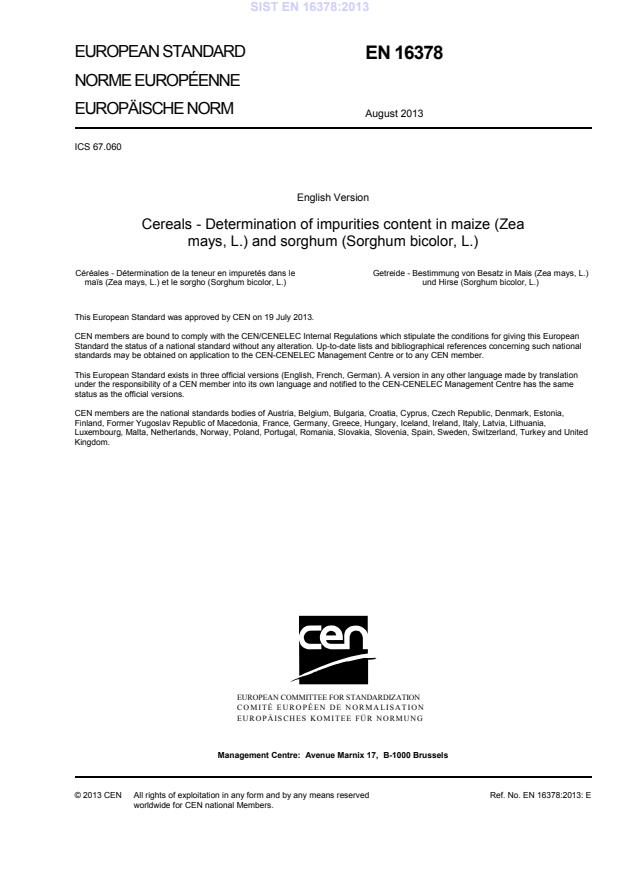
EUROPEAN STANDARD NORME EUROPÉENNE EUROPÄISCHE NORM
EN 16378
August 2013 ICS 67.060 English Version
Cereals - Determination of impurities content in maize (Zea mays, L.) and sorghum (Sorghum bicolor, L.)
Céréales - Détermination de la teneur en impuretés dans le maïs (Zea mays, L.) et le sorgho (Sorghum bicolor, L.)
Getreide - Bestimmung von Besatz in Mais (Zea mays, L.) und Hirse (Sorghum bicolor, L.) This European Standard was approved by CEN on 19 July 2013.
CEN members are bound to comply with the CEN/CENELEC Internal Regulations which stipulate the conditions for giving this European Standard the status of a national standard without any alteration. Up-to-date lists and bibliographical references concerning such national standards may be obtained on application to the CEN-CENELEC Management Centre or to any CEN member.
This European Standard exists in three official versions (English, French, German). A version in any other language made by translation under the responsibility of a CEN member into its own language and notified to the CEN-CENELEC Management Centre has the same status as the official versions.
CEN members are the national standards bodies of Austria, Belgium, Bulgaria, Croatia, Cyprus, Czech Republic, Denmark, Estonia, Finland, Former Yugoslav Republic of Macedonia, France, Germany, Greece, Hungary, Iceland, Ireland, Italy, Latvia, Lithuania, Luxembourg, Malta, Netherlands, Norway, Poland, Portugal, Romania, Slovakia, Slovenia, Spain, Sweden, Switzerland, Turkey and United Kingdom.
EUROPEAN COMMITTEE FOR STANDARDIZATION
COMITÉ EUROPÉEN DE NORMALISATION EUROPÄISCHES KOMITEE FÜR NORMUNG
Management Centre:
Avenue Marnix 17,
B-1000 Brussels © 2013 CEN All rights of exploitation in any form and by any means reserved worldwide for CEN national Members. Ref. No. EN 16378:2013: ESIST EN 16378:2013
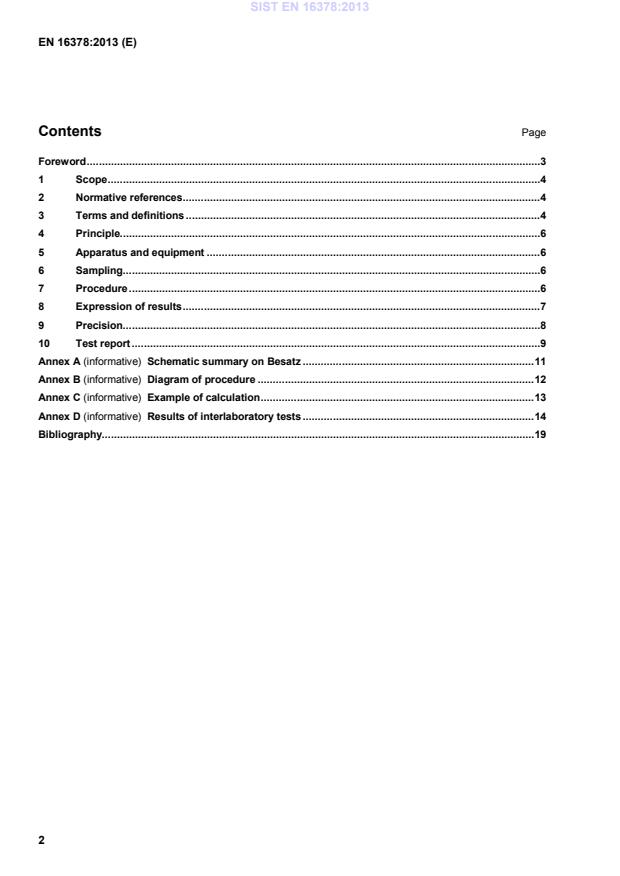
Schematic summary on Besatz . 11 Annex B (informative)
Diagram of procedure . 12 Annex C (informative)
Example of calculation . 13 Annex D (informative)
Results of interlaboratory tests . 14 Bibliography. 19
1) The Natural Colour System is defined by the Scandinavian Colour Institute AB, Stockholm (SE). For further explanation see www.ncscolour.com. SIST EN 16378:2013
...