


EN 15948:2020
(Main)Cereals - Determination of moisture and protein - Method using Near-Infrared Spectroscopy in whole kernels
Cereals - Determination of moisture and protein - Method using Near-Infrared Spectroscopy in whole kernels
This document defines a routine method for the determination of moisture and protein contents in whole kernels of wheat and barley using near infrared spectroscopy in the constituent ranges:
- for wheat:
- moisture content minimum range from 8 % to 22 %;
- protein content minimum range from 7 %DM to 20 %DM.
- for barley:
- moisture content minimum range from 8 % to 22 %;
- protein content minimum range from 7 %DM to 16 %DM.
This document describes the modalities to be implemented by the supplier (5.3 and 5.4) and the user of the method.
Getreide - Bestimmung der Feuchte und des Proteins - Verfahren der Nahinfrarot-Spektroskopie bei ganzen Körnern
Dieses Dokument legt ein routinemäßiges Verfahren für die Bestimmung des Feuchte- und Proteingehalts in ganzen Weizen- und Gerstenkörnern unter Anwendung der Nahinfrarot-Spektroskopie in den folgenden Bestandteilbereichen fest:
- für Weizen:
- Feuchtegehalt von mindestens 8 % bis 22 %;
- Proteingehalt von mindestens 7 % i. TS bis 20 % i. TS.
- für Gerste:
- Feuchtegehalt von mindestens 8 % bis 22 %;
- Proteingehalt von mindestens 7 % i. TS bis 16 % i. TS.
In diesem Dokument sind die Modalitäten beschrieben, die vom Lieferanten (5.3 und 5.4) und vom Anwender des Verfahrens umzusetzen sind.
Céréales - Détermination de la teneur en eau et en protéines - Méthode utilisant la spectroscopie proche infrarouge sur des grains entiers
Le présent document définit une méthode de routine pour la détermination de la teneur en eau et en protéines dans des grains entiers de blé et d’orge, par spectroscopie proche infrarouge, dans les plages suivantes :
- pour le blé :
-- teneur en eau comprise dans une plage minimale de 8 % à 22 % ;
-- teneur en protéines comprise dans une plage minimale de 7 % MS à 20 % MS.
- pour l’orge :
-- teneur en eau comprise dans une plage minimale de 8 % à 22 % ;
-- teneur en protéines comprise dans une plage minimale de 7 % MS à 16 % MS.
Le présent document décrit les modalités à mettre en oeuvre par le fournisseur (5.3 et 5.4) et par l’utilisateur de la méthode.
Žito - Določevanje vlage in beljakovin - Metoda z uporabo bližnje infrardeče spektroskopije v celih zrnih
General Information
- Status
- Published
- Publication Date
- 27-Oct-2020
- Withdrawal Date
- 29-Apr-2021
- Technical Committee
- CEN/TC 338 - Cereal and cereal products
- Drafting Committee
- CEN/TC 338 - Cereal and cereal products
- Current Stage
- 9060 - Closure of 2 Year Review Enquiry - Review Enquiry
- Start Date
- 04-Jun-2026
- Completion Date
- 04-Jun-2026


Relations
- Effective Date
- 12-Apr-2017
- Effective Date
- 28-Jan-2026
- Effective Date
- 28-Jan-2026
Overview
EN 15948:2020 - "Cereals: Determination of moisture and protein - Method using Near‑Infrared Spectroscopy in whole kernels" (CEN) defines a routine, correlative method using near‑infrared (NIR) spectroscopy to predict moisture and protein in whole kernels of wheat and barley. The standard covers instruments, prediction models, validation and ongoing performance checks for NIR analysis in the constituent ranges specified for each crop.
Key topics and technical requirements
- Scope and ranges
- Wheat: moisture 8%–22%, protein 7% DM–20% DM.
- Barley: moisture 8%–22%, protein 7% DM–16% DM.
- Instrument requirements
- NIR instruments based on diffuse reflectance or transmittance covering wavelengths 700–2500 nm (or selected segments).
- Prediction models (calibrations) - supplier responsibilities (Clauses 5.3–5.4):
- Document number of calibration samples, geographic/seasonal coverage, stability across harvests, calibration file integrity (e.g., checksum), temperature range, and reference laboratory performance.
- Protein expressed as % DM or "as is"; conversion factors from total nitrogen: 5.7 for wheat, 6.25 for barley.
- Initial validation
- Done per EN ISO 12099 using independent test sets.
- At least 200 representative samples per species (minimum 20 per country), covering seasonal, geographic and varietal variation; gaps ≤ 0.3% in the constituent range.
- Minimum performance targets (SEP): Moisture SEP = 0.24%, Protein SEP (wheat) = 0.25% DM, Protein SEP (barley) = 0.27% DM.
- Local validation and maintenance
- Users must perform local validation (minimum 20 samples) to assess bias, SEP and slope before routine use.
- Periodic instrument standardization, annual performance checks against reference methods, and model updates integrating new samples are required. Model updates must include at least 20 new samples and follow EN ISO 12099 guidance.
- Sampling
- Sampling is not specified in full here; EN ISO 24333 is recommended for representative sampling.
Practical applications
- Rapid routine screening of moisture and protein in whole-kernel wheat and barley for:
- Grain elevators, seed companies, millers and cereal processors
- Commodity traders and quality control laboratories
- Breeding programs monitoring grain composition across harvests
- Benefits: non-destructive, high-throughput testing, cost-effective batch control when calibrations and validations are compliant with EN 15948:2020.
Who should use this standard
- NIR instrument manufacturers and calibration suppliers (to document and validate prediction models)
- Quality managers in grain handling, milling and food processing operations
- Analytical laboratories implementing NIR-based routine methods
- Regulators and standardization professionals comparing analytical performance and compliance
Related standards
- EN ISO 12099 - Guidelines for application of NIR spectrometry (validation/statistics)
- EN ISO 24333 - Recommended sampling procedures for cereals
EN 15948:2020 provides the technical framework for reliable, validated NIR determination of moisture and protein in whole wheat and barley - critical for quality control and commercial decision‑making in the cereal supply chain.
Get Certified
Connect with accredited certification bodies for this standard

BSI Group
BSI (British Standards Institution) is the business standards company that helps organizations make excellence a habit.

Bureau Veritas
Bureau Veritas is a world leader in laboratory testing, inspection and certification services.

DNV
DNV is an independent assurance and risk management provider.
Sponsored listings
Frequently Asked Questions
EN 15948:2020 is a standard published by the European Committee for Standardization (CEN). Its full title is "Cereals - Determination of moisture and protein - Method using Near-Infrared Spectroscopy in whole kernels". This standard covers: This document defines a routine method for the determination of moisture and protein contents in whole kernels of wheat and barley using near infrared spectroscopy in the constituent ranges: - for wheat: - moisture content minimum range from 8 % to 22 %; - protein content minimum range from 7 %DM to 20 %DM. - for barley: - moisture content minimum range from 8 % to 22 %; - protein content minimum range from 7 %DM to 16 %DM. This document describes the modalities to be implemented by the supplier (5.3 and 5.4) and the user of the method.
This document defines a routine method for the determination of moisture and protein contents in whole kernels of wheat and barley using near infrared spectroscopy in the constituent ranges: - for wheat: - moisture content minimum range from 8 % to 22 %; - protein content minimum range from 7 %DM to 20 %DM. - for barley: - moisture content minimum range from 8 % to 22 %; - protein content minimum range from 7 %DM to 16 %DM. This document describes the modalities to be implemented by the supplier (5.3 and 5.4) and the user of the method.
EN 15948:2020 is classified under the following ICS (International Classification for Standards) categories: 67.060 - Cereals, pulses and derived products. The ICS classification helps identify the subject area and facilitates finding related standards.
EN 15948:2020 has the following relationships with other standards: It is inter standard links to EN 15948:2015, EN ISO 12099:2017, CEN/TR 17474:2020. Understanding these relationships helps ensure you are using the most current and applicable version of the standard.
EN 15948:2020 is available in PDF format for immediate download after purchase. The document can be added to your cart and obtained through the secure checkout process. Digital delivery ensures instant access to the complete standard document.
Standards Content (Sample)
SLOVENSKI STANDARD
01-december-2020
Nadomešča:
SIST EN 15948:2015
Žito - Določevanje vlage in beljakovin - Metoda z uporabo bližnje infrardeče
spektroskopije v celih zrnih
Cereals - Determination of moisture and protein - Method using Near-Infrared-
Spectroscopy in whole kernels
Getreide - Bestimmung der Feuchte und des Proteins - Verfahren der Nahinfrarot-
Spektroskopie bei ganzen Körnern
Céréales - Détermination de la teneur en eau et en protéines - Méthode utilisant la
spectroscopie dans le proche infrarouge sur des grains entiers
Ta slovenski standard je istoveten z: EN 15948:2020
ICS:
67.060 Žita, stročnice in proizvodi iz Cereals, pulses and derived
njih products
2003-01.Slovenski inštitut za standardizacijo. Razmnoževanje celote ali delov tega standarda ni dovoljeno.
EN 15948
EUROPEAN STANDARD
NORME EUROPÉENNE
October 2020
EUROPÄISCHE NORM
ICS 67.060 Supersedes EN 15948:2015
English Version
Cereals - Determination of moisture and protein - Method
using Near-Infrared Spectroscopy in whole kernels
Céréales - Détermination de la teneur en eau et en Getreide - Bestimmung der Feuchte und des Proteins -
protéines - Méthode utilisant la spectroscopie dans le Verfahren der Nahinfrarot-Spektroskopie bei ganzen
proche infrarouge sur des grains entiers Körnern
This European Standard was approved by CEN on 21 September 2020.
CEN members are bound to comply with the CEN/CENELEC Internal Regulations which stipulate the conditions for giving this
European Standard the status of a national standard without any alteration. Up-to-date lists and bibliographical references
concerning such national standards may be obtained on application to the CEN-CENELEC Management Centre or to any CEN
member.
This European Standard exists in three official versions (English, French, German). A version in any other language made by
translation under the responsibility of a CEN member into its own language and notified to the CEN-CENELEC Management
Centre has the same status as the official versions.
CEN members are the national standards bodies of Austria, Belgium, Bulgaria, Croatia, Cyprus, Czech Republic, Denmark, Estonia,
Finland, France, Germany, Greece, Hungary, Iceland, Ireland, Italy, Latvia, Lithuania, Luxembourg, Malta, Netherlands, Norway,
Poland, Portugal, Republic of North Macedonia, Romania, Serbia, Slovakia, Slovenia, Spain, Sweden, Switzerland, Turkey and
United Kingdom.
EUROPEAN COMMITTEE FOR STANDARDIZATION
COMITÉ EUROPÉEN DE NORMALISATION
EUROPÄISCHES KOMITEE FÜR NORMUNG
CEN-CENELEC Management Centre: Rue de la Science 23, B-1040 Brussels
© 2020 CEN All rights of exploitation in any form and by any means reserved Ref. No. EN 15948:2020 E
worldwide for CEN national Members.
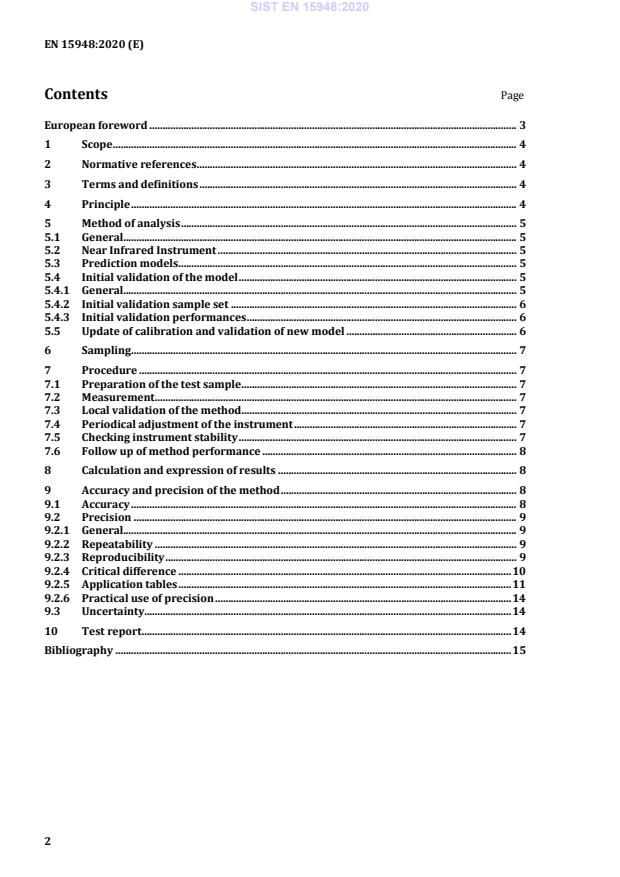
Contents Page
European foreword . 3
1 Scope . 4
2 Normative references . 4
3 Terms and definitions . 4
4 Principle . 4
5 Method of analysis . 5
5.1 General. 5
5.2 Near Infrared Instrument . 5
5.3 Prediction models . 5
5.4 Initial validation of the model . 5
5.4.1 General. 5
5.4.2 Initial validation sample set . 6
5.4.3 Initial validation performances . 6
5.5 Update of calibration and validation of new model . 6
6 Sampling . 7
7 Procedure . 7
7.1 Preparation of the test sample . 7
7.2 Measurement . 7
7.3 Local validation of the method . 7
7.4 Periodical adjustment of the instrument . 7
7.5 Checking instrument stability . 7
7.6 Follow up of method performance . 8
8 Calculation and expression of results . 8
9 Accuracy and precision of the method . 8
9.1 Accuracy . 8
9.2 Precision . 9
9.2.1 General. 9
9.2.2 Repeatability . 9
9.2.3 Reproducibility . 9
9.2.4 Critical difference . 10
9.2.5 Application tables . 11
9.2.6 Practical use of precision . 14
9.3 Uncertainty. 14
10 Test report . 14
Bibliography . 15
European foreword
This document (EN 15948:2020) has been prepared by Technical Committee CEN/TC 338 “Cereal and
cereal products”, the secretariat of which is held by AFNOR.
This European Standard shall be given the status of a national standard, either by publication of an
identical text or by endorsement, at the latest by April 2021, and conflicting national standards shall be
withdrawn at the latest by April 2021.
Attention is drawn to the possibility that some of the elements of this document may be the subject of
patent rights. CEN shall not be held responsible for identifying any or all such patent rights.
This document supersedes EN 15948:2015.
In comparison with the previous edition, the following technical modifications have been made:
— updating normative references,
— change in the number of validation samples according to the new version of EN ISO 12099:2017,
— precision of the expression of the protein content,
— repeatability and reproducibility determined from 3 interlaboratory tests and addition of
uncertainty according to EN ISO 12099,
— precision about practical use of precision,
— removal of informative annexes concerning 3 interlaboratory tests. All these data being included in
technical report CEN/TR 17474 (Cereals (wheat and barley) - Technical Report of the
interlaboratory studies for the determination of moisture and protein in whole kernels by near
infrared spectroscopy) [1].
According to the CEN-CENELEC Internal Regulations, the national standards organisations of the
following countries are bound to implement this European Standard: Austria, Belgium, Bulgaria, Croatia,
Cyprus, Czech Republic, Denmark, Estonia, Finland, France, Germany, Greece, Hungary, Iceland, Ireland,
Italy, Latvia, Lithuania, Luxembourg, Malta, Netherlands, Norway, Poland, Portugal, Republic of North
Macedonia, Romania, Serbia, Slovakia, Slovenia, Spain, Sweden, Switzerland, Turkey and the United
Kingdom.
Under preparation. Stage at the time of publication: FprCEN/TR 17474.
1 Scope
This document defines a routine method for the determination of moisture and protein contents in whole
kernels of wheat and barley using near infrared spectroscopy in the constituent ranges:
— for wheat:
— moisture content minimum range from 8 % to 22 %;
— protein content minimum range from 7 %DM to 20 %DM.
— for barley:
— moisture content minimum range from 8 % to 22 %;
— protein content minimum range from 7 %DM to 16 %DM.
This document describes the modalities to be implemented by the supplier (5.3 and 5.4) and the user of
the method.
2 Normative references
The following documents are referred to in the text in such a way that some or all of their content
constitutes requirements of this document. For dated references, only the edition cited applies. For
undated references, the latest edition of the referenced document (including any amendments) applies.
EN ISO 12099, Animal feeding stuffs, cereals and milled cereal products - Guidelines for the application of
near infrared spectrometry (ISO 12099)
3 Terms and definitions
For the purposes of this document, the terms and definitions given in EN ISO 12099 apply.
ISO and IEC maintain terminological databases for use in standardization at the following addresses:
— ISO Online browsing platform: available at https://www.iso.org/obp
— IEC Electropedia: available at http://www.electropedia.org/
4 Principle
The method is based on Near Infrared (NIR) spectroscopy, an indirect, correlative technique to predict
the concentration of various constituents in organic samples. Linear or nonlinear regression modelling is
used to relate NIR spectra to moisture or protein concentrations determined by officially approved
standard methods (e.g. Artificial Neural Network (ANN) regression, Partial Least Squares (PLS)
regression).
5 Method of analysis
5.1 General
According to this document, the method of analysis is defined as the association between a NIR
instrument and a model of prediction or calibration.
5.2 Near Infrared Instrument
Instrument based on diffuse reflectance or transmittance measurement covering the wavelength region
of 700 nm to 2500 nm or segments of this or at selected wavelengths.
5.3 Prediction models
Each model for the prediction of protein and moisture contents in whole grain of wheat and barley is
amongst others characterized by:
— the number of samples used for the calibration (prediction model) development;
— the constituent ranges covered in the model for moisture and protein;
— the factor for calculation of the crude protein content from the total nitrogen content: 5,7 for wheat
or 6,25 for barley taken into account in reference values;
— the expression of the protein result (%DM or as is);
— the temperature range of the samples;
— the number and performance of involved reference laboratories;
— the stability of the model i.e. by number of harvests covered;
— the calibration file defined by its name and its IT name (for example CHECKSUM) insuring its
integrity;
— the seasonal, geographic and genetic variations covered.
5.4 Initial validation of the model
5.4.1 General
Since NIR analysis is an indirect, correlative technique, the results shall be validated against chemical
analysis reference methods. It is important that the reference methods used are officially approved such
as the methods described in the EN ISO standards [2], [3], [4] and [5]. The purpose of validation is to
determine the standard error of prediction (SEP or SEP(C)) which expresses the accuracy of routine NIR
results corrected for the mean difference (bias) between routine NIR and reference method.
The standard error of prediction between chemical analysis methods and predictions shall be compared
to calibration performances specifications and/or historical performances.
5.4.2 Initial validation sample set
The initial validation of a calibration shall be done in accordance with EN ISO 12099 using independent
test sets of wheat and barley samples, originating from different countries and analysed by the reference
methods as [2], [3], [4] or [5].
Requirements for the validation sample set are:
— For each crop species, at least 200 representative samples coming from countries where the model
will be used (20 representative samples min/country) distributed homogeneously over the entire
constituent range;
— the part of the range without any reference sample shall not exceed 0,3 % or %DM;
— the same sample analysed on several instruments or several times on a same device counts for one
sample;
— seasonal effects over at least a three year period, t
...