

EN 13209-1:2021
(Main)Child care articles - Child carriers - Safety requirements and test methods - Part 1: Framed back carrier
- Abstract
This document specifies the safety requirements and test methods for child back carriers with framed support to carry a child in a seated position. Framed back carriers are intended for children from 6 months of age up to a maximum weight of 18 kg and are designed to carry the child on the carer’s back and be attached to a carer’s torso allowing a hands-free operation e.g. standing, walking.
Note The rationales for the inclusion of some of the requirements given in this document are given in Annex B.
This document does not cover framed back carriers designed for children with special needs.
If the framed back carrier has other functions not covered in this document, reference should be made to the relevant European Standard.
- Status
- Withdrawn
- Publication Date
- 20-Jul-2021
- Withdrawal Date
- 06-Oct-2026
- Technical Committee
- CEN/TC 252 - Child use and care articles
- Drafting Committee
- CEN/TC 252/WG 4 - Early learning and protection
- Current Stage
- 9960 - Withdrawal effective - Withdrawal
- Start Date
- 04-May-2022
- Completion Date
- 07-Oct-2026
- Directive
- 2001/95/EC - General product safety

Relations
- Effective Date
- 08-Jun-2022
- Effective Date
- 09-Mar-2022
- Effective Date
- 28-Jan-2026
- Effective Date
- 28-Jan-2026
- Effective Date
- 28-Jan-2026
Frequently Asked Questions
EN 13209-1:2021 is a standard published by the European Committee for Standardization (CEN). Its full title is "Child care articles - Child carriers - Safety requirements and test methods - Part 1: Framed back carrier". This standard covers: This document specifies the safety requirements and test methods for child back carriers with framed support to carry a child in a seated position. Framed back carriers are intended for children from 6 months of age up to a maximum weight of 18 kg and are designed to carry the child on the carer’s back and be attached to a carer’s torso allowing a hands-free operation e.g. standing, walking. Note The rationales for the inclusion of some of the requirements given in this document are given in Annex B. This document does not cover framed back carriers designed for children with special needs. If the framed back carrier has other functions not covered in this document, reference should be made to the relevant European Standard.
This document specifies the safety requirements and test methods for child back carriers with framed support to carry a child in a seated position. Framed back carriers are intended for children from 6 months of age up to a maximum weight of 18 kg and are designed to carry the child on the carer’s back and be attached to a carer’s torso allowing a hands-free operation e.g. standing, walking. Note The rationales for the inclusion of some of the requirements given in this document are given in Annex B. This document does not cover framed back carriers designed for children with special needs. If the framed back carrier has other functions not covered in this document, reference should be made to the relevant European Standard.
EN 13209-1:2021 is classified under the following ICS (International Classification for Standards) categories: 97.190 - Equipment for children. The ICS classification helps identify the subject area and facilitates finding related standards.
EN 13209-1:2021 has the following relationships with other standards: It is inter standard links to EN 13209-1:2004, EN 13209-1:2022, EN ISO 14184-1:2011, EN 71-3:2019+A2:2024, EN 71-2:2020. Understanding these relationships helps ensure you are using the most current and applicable version of the standard.
EN 13209-1:2021 is associated with the following European legislation: EU Directives/Regulations: 2001/95/EC; Standardization Mandates: M/264. When a standard is cited in the Official Journal of the European Union, products manufactured in conformity with it benefit from a presumption of conformity with the essential requirements of the corresponding EU directive or regulation.
EN 13209-1:2021 is available in PDF format for immediate download after purchase. The document can be added to your cart and obtained through the secure checkout process. Digital delivery ensures instant access to the complete standard document.
Standards Content (Sample)
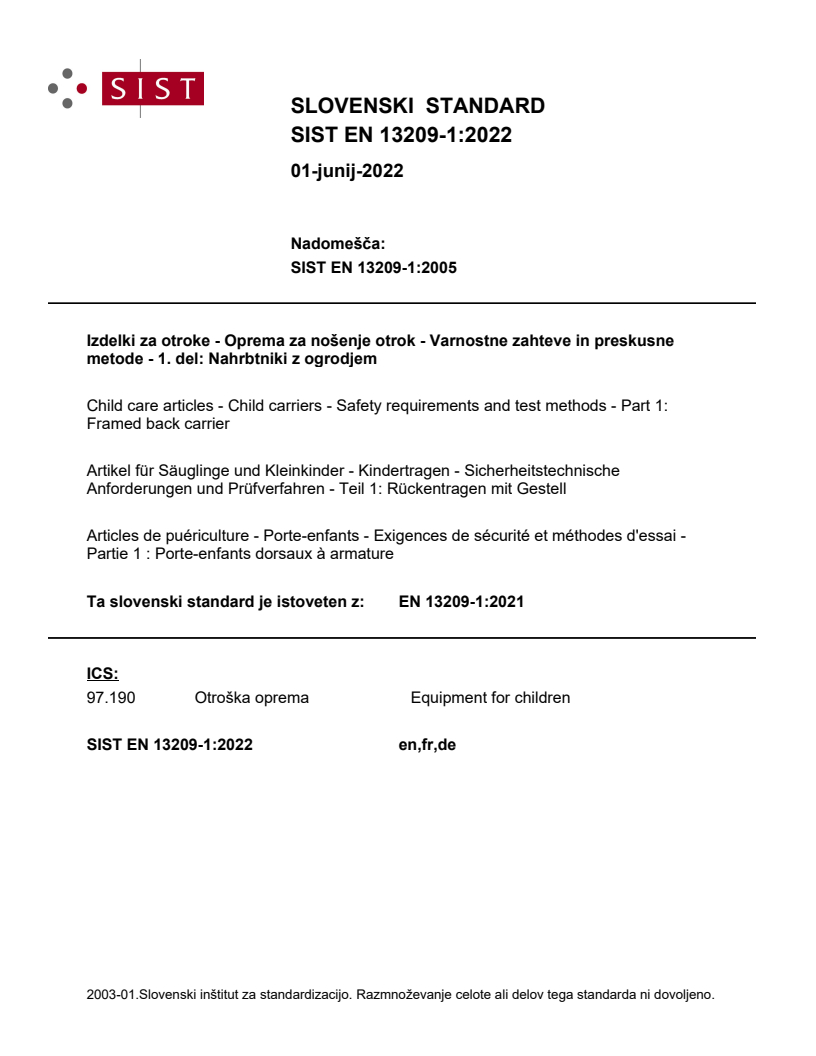
SLOVENSKI STANDARD
01-junij-2022
Nadomešča:
SIST EN 13209-1:2005
Izdelki za otroke - Oprema za nošenje otrok - Varnostne zahteve in preskusne
metode - 1. del: Nahrbtniki z ogrodjem
Child care articles - Child carriers - Safety requirements and test methods - Part 1:
Framed back carrier
Artikel für Säuglinge und Kleinkinder - Kindertragen - Sicherheitstechnische
Anforderungen und Prüfverfahren - Teil 1: Rückentragen mit Gestell
Articles de puériculture - Porte-enfants - Exigences de sécurité et méthodes d'essai -
Partie 1 : Porte-enfants dorsaux à armature
Ta slovenski standard je istoveten z: EN 13209-1:2021
ICS:
97.190 Otroška oprema Equipment for children
2003-01.Slovenski inštitut za standardizacijo. Razmnoževanje celote ali delov tega standarda ni dovoljeno.
EN 13209-1
EUROPEAN STANDARD
NORME EUROPÉENNE
July 2021
EUROPÄISCHE NORM
ICS 97.190 Supersedes EN 13209-1:2004
English Version
Child care articles - Child carriers - Safety requirements
and test methods - Part 1: Framed back carrier
Articles de puériculture - Porte-enfants - Exigences de Artikel für Säuglinge und Kleinkinder - Kindertragen -
sécurité et méthodes d'essai - Partie 1 : Porte-enfants Sicherheitstechnische Anforderungen und
dorsaux à armature Prüfverfahren - Teil 1: Rückentragen mit Gestell
This European Standard was approved by CEN on 25 January 2021.
This European Standard was corrected and reissued by the CEN-CENELEC Management Centre on 23 December 2021.
CEN members are bound to comply with the CEN/CENELEC Internal Regulations which stipulate the conditions for giving this
European Standard the status of a national standard without any alteration. Up-to-date lists and bibliographical references
concerning such national standards may be obtained on application to the CEN-CENELEC Management Centre or to any CEN
member.
This European Standard exists in three official versions (English, French, German). A version in any other language made by
translation under the responsibility of a CEN member into its own language and notified to the CEN-CENELEC Management
Centre has the same status as the official versions.
CEN members are the national standards bodies of Austria, Belgium, Bulgaria, Croatia, Cyprus, Czech Republic, Denmark, Estonia,
Finland, France, Germany, Greece, Hungary, Iceland, Ireland, Italy, Latvia, Lithuania, Luxembourg, Malta, Netherlands, Norway,
Poland, Portugal, Republic of North Macedonia, Romania, Serbia, Slovakia, Slovenia, Spain, Sweden, Switzerland, Turkey and
United Kingdom.
EUROPEAN COMMITTEE FOR STANDARDIZATION
COMITÉ EUROPÉEN DE NORMALISATIO N
EUROPÄISCHES KOMITEE FÜR NORMUN G
CEN-CENELEC Management Centre: Rue de la Science 23, B-1040 Brussels
© 2021 CEN All rights of exploitation in any form and by any means reserved Ref. No. EN 13209-1:2021 E
worldwide for CEN national Members.
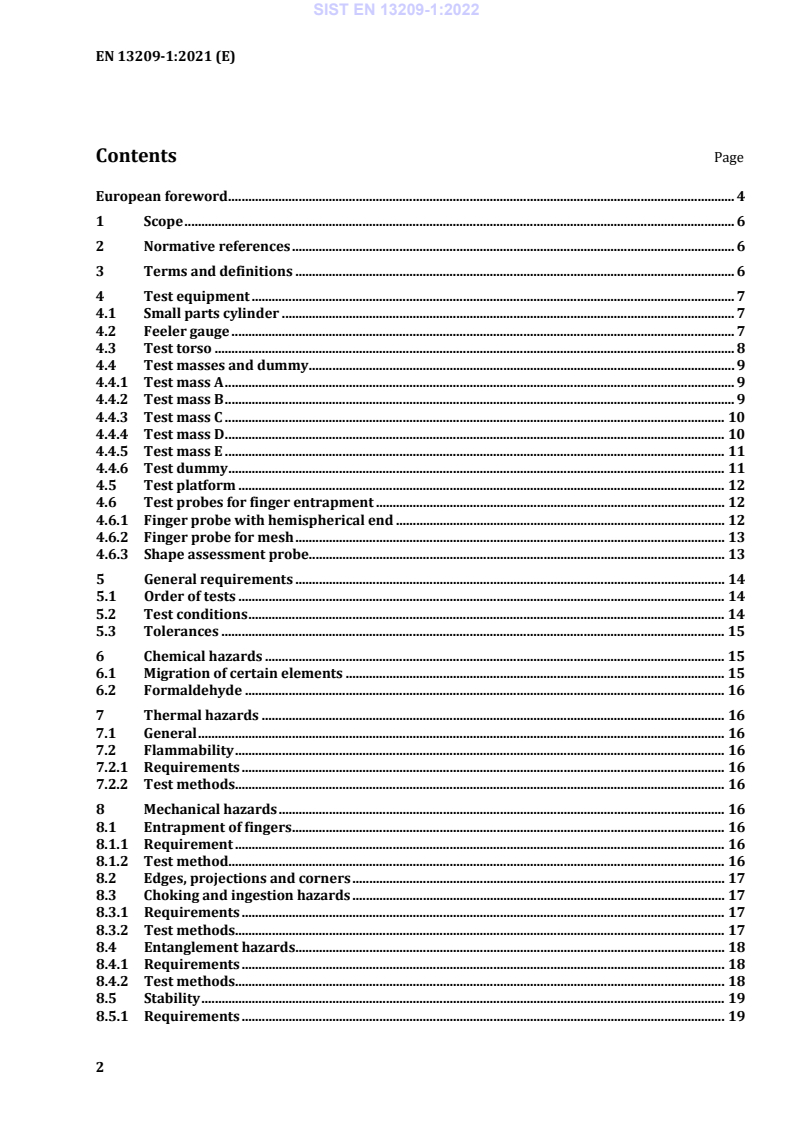
Contents Page
European foreword . 4
1 Scope . 6
2 Normative references . 6
3 Terms and definitions . 6
4 Test equipment . 7
4.1 Small parts cylinder . 7
4.2 Feeler gauge . 7
4.3 Test torso . 8
4.4 Test masses and dummy . 9
4.4.1 Test mass A . 9
4.4.2 Test mass B . 9
4.4.3 Test mass C . 10
4.4.4 Test mass D . 10
4.4.5 Test mass E . 11
4.4.6 Test dummy . 11
4.5 Test platform . 12
4.6 Test probes for finger entrapment . 12
4.6.1 Finger probe with hemispherical end . 12
4.6.2 Finger probe for mesh . 13
4.6.3 Shape assessment probe. 13
5 General requirements . 14
5.1 Order of tests . 14
5.2 Test conditions . 14
5.3 Tolerances . 15
6 Chemical hazards . 15
6.1 Migration of certain elements . 15
6.2 Formaldehyde . 16
7 Thermal hazards . 16
7.1 General . 16
7.2 Flammability . 16
7.2.1 Requirements . 16
7.2.2 Test methods. 16
8 Mechanical hazards . 16
8.1 Entrapment of fingers . 16
8.1.1 Requirement . 16
8.1.2 Test method. 16
8.2 Edges, projections and corners . 17
8.3 Choking and ingestion hazards . 17
8.3.1 Requirements . 17
8.3.2 Test methods. 17
8.4 Entanglement hazards . 18
8.4.1 Requirements . 18
8.4.2 Test methods. 18
8.5 Stability . 19
8.5.1 Requirements . 19
8.5.2 Test method. 19
8.6 Protective function . 20
8.6.1 Child restraint system . 20
8.6.2 Carer’s attachment system . 20
8.6.3 Structural integrity . 21
9 Suffocation hazards from packaging materials . 21
10 Product information . 22
10.1 General . 22
10.2 Purchase information . 22
10.3 Marking . 22
10.4 Instructions for use . 22
10.4.1 General . 22
10.4.2 Warnings . 23
10.4.3 Additional information . 23
Annex A (normative) Warnings. 24
Annex B (informative) Rationales . 29
Bibliography . 31
European foreword
This document (EN 13209-1:2021) has been prepared by Technical Committee CEN/TC 252
"Child use and care articles", the secretariat of which is held by AFNOR.
This European Standard shall be given the status of a national standard, either by publication of
an identical text or by endorsement, at the latest by January 2022, and conflicting national
standards shall be withdrawn at the latest by July 2022.
Attention is drawn to the possibility that some of the elements of this document may be the
subject of patent rights. CEN shall not be held responsible for identifying any or all such patent
rights.
This document supersedes EN 13209-1:2004.
In comparison with EN 13209-1:2004, the following changes were made:
— Clarified the scope, which includes a maximum weight for which the product is intended;
— Improvement of definitions including the addition of the definition of framed back carrier;
— Conversion to a hazard based format;
— Introduction of additional test masses;
— Reduction in tolerances;
— Update of chemical requirements;
— Update of flammability requirements and test methods;
— Increase in size of bounded openings in recognition of the age of the child for which the
product is intended;
— Improvement of entanglement hazard requirements and addition of test methods;
— Improvement of the test methods for the carer’s attachment system;
— Introduction of warning for packaging materials;
— Introduction of purchase information;
— Addition of warning translations;
— Addition of rationales.
This document has been prepared under a Standardization Request given to CEN by the
European Commission and the European Free Trade Association, and supports essential
requirements of EU Directive(s) / Regulation(s).
Any feedback and questions on this document should be directed to the users’ national
standards body. A complete listing of these bodies can be found on the CEN website.
According to the CEN-CENELEC Internal Regulations, the national standards organisations of
the following countries are bound to implement this European Standard: Austria, Belgium,
Bulgaria, Croatia, Cyprus, Czech Republic, Denmark, Estonia, Finland, France, Germany, Greece,
Hungary, Iceland, Ireland, Italy, Latvia, Lithuania, Luxembourg, Malta, Netherlands, Norway,
Poland, Portugal, Republic of North Macedonia, Romania, Serbia, Slovakia, Slovenia, Spain,
Sweden, Switzerland, Turkey and the United Kingdom.
1 Scope
This document specifies the safety requirements and test methods for child back carriers with
framed support to carry a child in a seated position. Framed back carriers are intended for
children from 6 months of age up to a maximum weight of 18 kg and are designed to carry the
child on the carer’s back and be attached to a carer’s torso allowing a hands-free operation e.g.
standing, walking.
Note The rationales for the inclusion of some of the requirements given in this document are given
in Annex B.
This document does not cover framed back carriers designed for children with special needs.
If the framed back carrier has other functions not covered in this document, reference should be
made to the relevant European Standard.
2 Normative references
The following documents are referred to in the text in such a way that some or all of their
content constitutes requirements of this document. For dated references, only the edition cited
applies. For undated references, the latest edition of the referenced document (including any
amendments) applies.
EN 71-2:2020, Safety of toys — Part 2: Flammability
EN 71-3, Safety of toys — Part 3: Migration of certain elements
EN ISO 14184-1:2011, Textiles — Determination of formaldehyde — Part 1: Free and hydrolysed
formaldehyde (water extraction method) (ISO 14184-1:2011)
3 Terms and definitions
For the purposes of this document, the following terms and definitions apply.
ISO and IEC maintain terminological databases for use in standardization at the following
addresses:
— IEC Electropedia. available at http://www.electropedia.org/
— ISO Online browsing platform: available at https://www.iso.org/obp
3.1
framed back carrier
product with a framed support designed to carry the child on the carer’s back and to be attached
to the carer’s torso
3.2
freestanding framed back carrier
framed back carrier designed to stand unsupported
3.3
carer’s attachment system
fastenings, straps and/or belts or similar parts which are fitted to the framed back carrier for
the purpose of securing the product to the carer’s torso
3.4
child restraint system
system incorporated into the framed back carrier in order to retain the child in the product
4 Test equipment
4.1 Small parts cylinder
Small parts cylinder with the dimensions specified in Figure 1.
Dimensions in millimetres
Figure 1 — Small parts cylinder
4.2 Feeler gauge
Gauge with thickness of (0,4 ± 0,02) mm, with the end to be inserted having a radius of
approximately (3 mm ± 0,5), see Figure 2.
Dimensions in millimetres
Figure 2 — Feeler gauge dimensions
4.3 Test torso
Rigid torso made from a hard smooth material with the dimensions specified in Figure 3 which
is fitted on a rigid plate.
Dimensions in millimetres
Figure 3 — Test torso
4.4 Test masses and dummy
4.4.1 Test mass A
Bag filled with sand to a total mass of 15 kg, the shape and size of which is adjustable so that it
can be firmly restrained by the carrier.
4.4.2 Test mass B
Bag filled with sand to a total mass of 22 kg, the shape and size of which is adjustable so that it
can be firmly restrained by the carrier.
4.4.3 Test mass C
Rigid cylinder (200 ± 5) mm in diameter and (300 ± 5) mm in height having a mass of
(15 + 0,01/0) kg with its centre of gravity in the centre of the cylinder. All edges shall have a
radius of (5 ± 1) mm. Two anchorage points shall be provided, positioned (150 ± 2,5) mm from
the base and at 180 ° to each other around the circumference. See Figure 4.
Key
1 radius (5 ± 1) mm
2 two anchorage points
Figure 4 — Test mass C
4.4.4 Test mass D
Rigid cylinder (220 ± 5) mm in diameter and (320 ± 5) mm in height having a mass of
(22 + 0,01/0) kg with its centre of gravity in the centre of the cylinder. All edges shall have a
radius of (5 ± 1) mm. Two anchorage points shall be provided, positioned (160 ± 2,5) mm from
the base and at 180 ° to each other around the circumference (see Figure 5).
Dimensions in millimetres
Key
1 radius (5 ± 1) mm
2 two anchorage points
Figure 5 — Test mass D
4.4.5 Test mass E
Rigid cylinder (160 ± 5) mm in diameter and (300 ± 5) mm in height, having a mass of
(9 + 0,01/0) kg and with its centre of gravity in the centre of the cylinder. All edges shall have a
radius of (5 ± 1) mm. Two anchorage points shall be provided, positioned (150 ± 2,5) mm from
the base and at 180 ° to each other around the circumference as shown in Figure 6.
Dimensions in millimetres
Key
1 radius (5 ± 1) mm
2 two anchorage points
Figure 6 — Test mass E
4.4.6 Test dummy
Made of a rigid material with a smooth finish with a total mass of (9 ± 0,1) kg (see Figure 7).
Dimensions in millimetres
Figure 7 — Test dummy
4.5 Test platform
Platform inclined to an angle of (12 ± 0,5) ° to the horizontal and covered with aluminium oxide
paper of grade 80.
Rectangular stops of 25 mm in height shall be fitted at the base of the platform if required.
4.6 Test probes for finger entrapment
4.6.1 Finger probe with hemispherical end
Probe made from plastic or other hard smooth material of diameter 7 mm and 12 mm with a full
hemispherical end that can be mounted on a force measuring device. See Figure 8.
Dimensions in millimetres
Key
1 hemispherical end
2 scibed line around circumference
3 ø 7mm and 12 mm
Figure 8 — 7 mm and 12 mm probe for openings
4.6.2 Finger probe for mesh
Probe made from plastic or other hard smooth material. See Figure 9.
Dimensions in millimetres
Figure 9 — Finger probe for mesh
4.6.3 Shape assessment probe
Probe made from plastics or other hard, smooth material with the dimensions shown in
Figure 10.
Dimensions in milimeters
Figure 10 — Shape assessment probe
5 General requirements
5.1 Order of tests
Unless otherwise stated, the specified tests shall be carried out on one sample in the order of the
clause numbers in this document.
5.2 Test conditions
The tests are designed to be applied to framed back carriers that are fully assembled and ready
for use in accordance with the manufacturer’s instructions.
5.3 Tolerances
Unless otherwise stated the following tolerances shall apply for testing and test equipment:
— force: ± 5 %;
— mass: ± 0,5 %;
— dimension: ± 0,5 mm;
— time: ± 1 s.
6 Chemical hazards
6.1 Migration of certain elements
The migration of elements from materials on exterior surfaces shall not exceed the limits listed
below:
Element mg/kg
Aluminium 70 000
Antimony 560
Arsenic 47
Barium 18 750
Boron 15 000
Cadmium 17
Chromium (III) 460
Chromium (VI) 0,2
Cobalt 130
Copper 7 700
Lead 23
Manganese 15 000
Mercury 94
Nickel 930
Selenium 460
Strontium 56 000
Tin 180 000
Organic tin 12
Zinc 46 000
When testing is performed, the method described in EN 71-3 shall be used.
A separate sample may be used for these tests.
6.2 Formaldehyde
Textile components shall not contain free and hydrolysed formaldehyde in excess of 30 mg/kg
when tested in accordance with EN ISO 14184-1.
7 Thermal hazards
7.1 General
Any metal components of the top rim of the carrier shall not be accessible to the child in the
position of use.
7.2 Flammability
7.2.1 Requirements
When tested in accordance with 7.2.2 there shall be no surface flash.
When tested in accordance with 7.2.2 the rate of spread of flame shall not exceed 50 mm/s.
7.2.2 Test methods
7.2.2.1 To verify the surface flash effect apply the test flame specified in EN 71-2:2020, 5.5
for (3 ± 0,5) s to the framed back carrier in different places likely to cause surface flash.
7.2.2.2 To verify rate of spread of flame apply the test flame specified in EN 71-2:2020, 5.4.
8 Mechanical hazards
8.1 Entrapment of fingers
8.1.1 Requirement
There shall be no accessible completely bounded openings in rigid materials between 7 mm and
12 mm unless the depth is less than 10 mm or unless the shape assessment probe, see 4.6.3,
enters, when tested in accordance with 8.1.2.
There shall be no accessible openings in mesh that allow the finger probe for mesh, see 4.6.2, to
penetrate up to the 7 mm diameter section, when tested in accordance with 8.1.2.
The test shall be carried out with the product in any intended position of use without any test
mass and with test mass A, see 4.4.1.
8.1.2 Test method
Check whether the 7 mm probe, 4.6.1, with an applied force of up to 30 N, enters 10 mm or
more into any accessible completely bounded opening in any possible orientation.
If the 7 mm probe enters 10 mm or more, then the 12 mm probe, 4.6.1, shall also enter 10 mm
or more with an applied force of up to 5 N. If the 7 mm probe enters with an applied force of up
to 30 N but the 12 mm probe does not enter 10 mm or more with an applied force of up to 5 N,
check whether the 12 mm shape assessment probe, see 4.6.3, enters 10 mm or more with an
applied force of up to 5 N.
Check whethe
...