

EN 16162:2012
(Main)Animal feeding stuffs - Determination of decoquinate by HPLC with fluorescence detection
- Abstract
This European Standard specifies a method for the determination of decoquinate. This high-performance liquid chromatographic (HPLC) method with a fluorescence detection is applicable to the quantification of decoquinate content in complete and complementary compound feeds, medicated feeds, semi-liquid feeds, premixtures and feed additives.
The method was fully validated from LOQ to 60 000 mg/kg on different matrices during an international collaborative study [11], especially on complete compound feeds for poultry, at trace contamination level of 3 mg/kg and at European authorized level of 20 mg/kg to 40 mg/kg [12].
The limit of detection is between 0,1 mg/kg and 0,3 mg/kg and the limit of quantification is around 0,5 mg/kg. These limits were validated during the collaborative study [11], from results on the blank feed. Lower limits of detection or quantification could be reached but a single laboratory validation is then requested.
- Status
- Published
- Publication Date
- 20-Mar-2012
- Technical Committee
- CEN/TC 327 - Animal feeding stuffs - Methods of sampling and analysis
- Drafting Committee
- CEN/TC 327/WG 3 - Feed additives and drugs
- Current Stage
- 9093 - Decision to confirm - Review Enquiry
- Start Date
- 01-Jan-2024
- Completion Date
- 07-Oct-2026

Overview
EN 16162:2012 (CEN) defines a validated analytical method for the determination of decoquinate in animal feeding stuffs using HPLC with fluorescence detection. Published March 2012, this European Standard covers complete and complementary compound feeds, medicated and semi‑liquid feeds, premixtures and feed additives. The method was validated across multiple matrices from the limit of quantification (LOQ) up to 60 000 mg/kg, with demonstrated trace-level performance and suitability for regulatory control and quality assurance.
Key topics and technical requirements
- Analytical principle: Reversed‑phase HPLC with fluorescence detection; positive trace samples confirmed using an alternate excitation wavelength.
- Sample extraction: Decoquinate is extracted using a solution of 1% calcium chloride in methanol with mechanical shaking (≈60 min), followed by centrifugation or filtration.
- Chromatography & detection: Typical configuration uses a C18 column (5 µm, 4.6 × 250 mm) and fluorescence detector (excitation wavelengths ~330 nm and 260 nm; emission 390 nm). Mobile phase: methanol/water (825/175 v/v) containing calcium chloride.
- Calibration & standards: Stock and calibration solutions prepared from certified decoquinate reference standard; calibration range supports quantification down to target extract concentrations (≈0.3–0.6 µg/ml).
- Performance characteristics:
- Limit of detection (LOD): between 0.1 mg/kg and 0.3 mg/kg
- Limit of quantification (LOQ): around 0.5 mg/kg (validated in collaborative study)
- Validated at trace contamination level (3 mg/kg) and at common European authorized levels 20–40 mg/kg.
- Quality control: Use of blank and spiked feeds, duplicated analyses recommended, and procedural requirements for premixtures and high‑concentration samples.
Practical applications
- Regulatory monitoring of decoquinate residues in animal feed to ensure compliance with authorized levels.
- Feed mill quality control to detect cross‑contamination from medicated feeds.
- Routine laboratory testing of feed additives, premixtures and finished feeds (including poultry feeds, where validation focused).
- Confirmation of suspect trace positives using alternate excitation parameters for robust identification.
Who should use this standard
- Accredited feed testing laboratories and analytical chemists.
- National and regional regulatory authorities performing surveillance of animal feeding stuffs.
- Feed manufacturers, QA/QC teams and formulators handling medicated feeds and feed additives.
- Proficiency testing providers and method validators.
Related standards
- prEN ISO 6498 - Guidelines for sample preparation (normative reference in EN 16162).
- EN ISO 6497 - Recommended sampling procedures (referenced for representative sampling).
Keywords: EN 16162:2012, decoquinate, HPLC, fluorescence detection, animal feed analysis, limit of detection, limit of quantification, feed additives, premixtures, CEN.
Relations
- Effective Date
- 28-Jan-2026
Get Certified
Connect with accredited certification bodies for this standard

Control Union Certifications
Global certification for agriculture and sustainability.

ECOCERT
Organic and sustainability certification.

FSC International
Forest Stewardship Council certification.
Sponsored listings
Frequently Asked Questions
EN 16162:2012 is a standard published by the European Committee for Standardization (CEN). Its full title is "Animal feeding stuffs - Determination of decoquinate by HPLC with fluorescence detection". This standard covers: This European Standard specifies a method for the determination of decoquinate. This high-performance liquid chromatographic (HPLC) method with a fluorescence detection is applicable to the quantification of decoquinate content in complete and complementary compound feeds, medicated feeds, semi-liquid feeds, premixtures and feed additives. The method was fully validated from LOQ to 60 000 mg/kg on different matrices during an international collaborative study [11], especially on complete compound feeds for poultry, at trace contamination level of 3 mg/kg and at European authorized level of 20 mg/kg to 40 mg/kg [12]. The limit of detection is between 0,1 mg/kg and 0,3 mg/kg and the limit of quantification is around 0,5 mg/kg. These limits were validated during the collaborative study [11], from results on the blank feed. Lower limits of detection or quantification could be reached but a single laboratory validation is then requested.
This European Standard specifies a method for the determination of decoquinate. This high-performance liquid chromatographic (HPLC) method with a fluorescence detection is applicable to the quantification of decoquinate content in complete and complementary compound feeds, medicated feeds, semi-liquid feeds, premixtures and feed additives. The method was fully validated from LOQ to 60 000 mg/kg on different matrices during an international collaborative study [11], especially on complete compound feeds for poultry, at trace contamination level of 3 mg/kg and at European authorized level of 20 mg/kg to 40 mg/kg [12]. The limit of detection is between 0,1 mg/kg and 0,3 mg/kg and the limit of quantification is around 0,5 mg/kg. These limits were validated during the collaborative study [11], from results on the blank feed. Lower limits of detection or quantification could be reached but a single laboratory validation is then requested.
EN 16162:2012 is classified under the following ICS (International Classification for Standards) categories: 65.120 - Animal feeding stuffs. The ICS classification helps identify the subject area and facilitates finding related standards.
EN 16162:2012 has the following relationships with other standards: It is inter standard links to EN ISO 6498:2012. Understanding these relationships helps ensure you are using the most current and applicable version of the standard.
EN 16162:2012 is associated with the following European legislation: EU Directives/Regulations: 70/373/EC; Standardization Mandates: M/382. When a standard is cited in the Official Journal of the European Union, products manufactured in conformity with it benefit from a presumption of conformity with the essential requirements of the corresponding EU directive or regulation.
EN 16162:2012 is available in PDF format for immediate download after purchase. The document can be added to your cart and obtained through the secure checkout process. Digital delivery ensures instant access to the complete standard document.
Standards Content (Sample)
2003-01.Slovenski inštitut za standardizacijo. Razmnoževanje celote ali delov tega standarda ni dovoljeno.Futtermittel - Bestimmung von Decoquinat mit Hochleistungs-Flüssigchromatographie (HPLC) und FluoreszenzdetektionAliments des animaux - Dosage du décoquinate par CLHP avec détection par fluorescenceAnimal feeding stuffs - Determination of Decoquinate by HPLC with fluorescence detection65.120KrmilaAnimal feeding stuffsICS:Ta slovenski standard je istoveten z:EN 16162:2012SIST EN 16162:2012en,fr,de01-september-2012SIST EN 16162:2012SLOVENSKI
STANDARD
EUROPEAN STANDARD NORME EUROPÉENNE EUROPÄISCHE NORM
EN 16162
March 2012 ICS 65.120 English Version
Animal feeding stuffs - Determination of decoquinate by HPLC with fluorescence detection
Aliments des animaux - Détermination du décoquinate par Chromatographie Liquide Haute Performance avec détection fluorimétrique
Futtermittel - Bestimmung von Decoquinat mit Hochleistungs-Flüssigchromatographie (HPLC) und Fluoreszenzdetektion This European Standard was approved by CEN on 4 February 2012.
CEN members are bound to comply with the CEN/CENELEC Internal Regulations which stipulate the conditions for giving this European Standard the status of a national standard without any alteration. Up-to-date lists and bibliographical references concerning such national standards may be obtained on application to the CEN-CENELEC Management Centre or to any CEN member.
This European Standard exists in three official versions (English, French, German). A version in any other language made by translation under the responsibility of a CEN member into its own language and notified to the CEN-CENELEC Management Centre has the same status as the official versions.
CEN members are the national standards bodies of Austria, Belgium, Bulgaria, Croatia, Cyprus, Czech Republic, Denmark, Estonia, Finland, France, Germany, Greece, Hungary, Iceland, Ireland, Italy, Latvia, Lithuania, Luxembourg, Malta, Netherlands, Norway, Poland, Portugal, Romania, Slovakia, Slovenia, Spain, Sweden, Switzerland, Turkey and United Kingdom.
EUROPEAN COMMITTEE FOR STANDARDIZATION
COMITÉ EUROPÉEN DE NORMALISATION EUROPÄISCHES KOMITEE FÜR NORMUNG
Management Centre:
Avenue Marnix 17,
B-1000 Brussels © 2012 CEN All rights of exploitation in any form and by any means reserved worldwide for CEN national Members. Ref. No. EN 16162:2012: ESIST EN 16162:2012
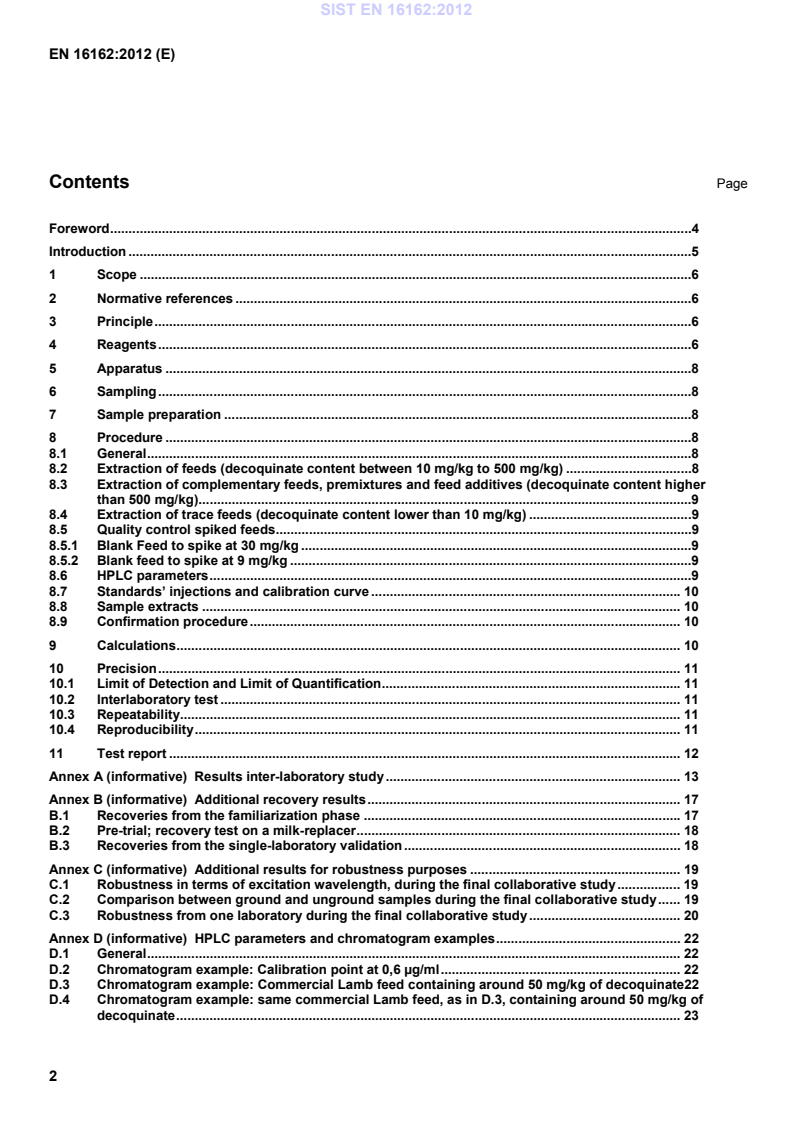
Results inter-laboratory study . 13Annex B (informative)
Additional recovery results . 17B.1Recoveries from the familiarization phase . 17B.2Pre-trial; recovery test on a milk-replacer . 18B.3Recoveries from the single-laboratory validation . 18Annex C (informative)
Additional results for robustness purposes . 19C.1Robustness in terms of excitation wavelength, during the final collaborative study . 19C.2Comparison between ground and unground samples during the final collaborative study . 19C.3Robustness from one laboratory during the final collaborative study . 20Annex D (informative)
HPLC parameters and chromatogram examples . 22D.1General . 22D.2Chromatogram example: Calibration point at 0,6 µg/ml . 22D.3Chromatogram example: Commercial Lamb feed containing around 50 mg/kg of decoquinate22D.4Chromatogram example: same commercial Lamb feed, as in D.3, containing around 50 mg/kg of decoquinate . 23SIST EN 16162:2012
The following documents, in whole or in part, are normatively referenced in this document and are indispensable for its application. For dated references, only the edition cited applies. For undated references, the latest edition of the referenced document (including any amendments) applies. prEN ISO 6498, Animal feeding stuffs — Guidelines for sample preparation (ISO/DIS 6498) 3 Principle Decoquinate is extracted from samples with a solution of 1 % calcium chloride in methanol using mechanical shaking or stirring for 60 min. After centrifugation or filtration, an aliquot is, if necessary, diluted with the extraction solvent and analysed by reversed phase HPLC with fluorescence detection. Positive trace level samples should be confirmed by HPLC analysis using an alternate excitation wavelength. 4 Reagents Use only reagents of recognized analytical grade, unless otherwise specified, and distilled or demineralised water or water of equivalent purity. WARNING — This method requires the handling of hazardous substances. It is recommended to use various regulations for potentially hazardous chemicals. Organisational, technical and personal safety has to be observed. 4.1 Methanol, HPLC grade. 4.2 Methanol, technical grade. 4.3 Calcium chloride anhydrous or Calcium chloride dihydrate, each > 99 % purity. 4.4 HPLC dilution solution. Dissolve a mass of calcium salt (4.3) equivalent to 10 g of calcium chloride anhydrous in methanol (4.1). Mix well and make up to 1 000 ml. 4.5 Extraction solvent. SIST EN 16162:2012
Evaluate precisely each exact concentration by using the exact concentration of the stock solution (4.6.2). All solutions described here (standards A/B/C/D) are prepared fresh daily. 4.7 HPLC Mobile Phase. Dissolve a mass of calcium salt (4.3) equivalent to 10 g calcium chloride anhydrous into 1 l of a solvent mixture of methanol (4.1) / water in proportion by volume of 825/175. Filter under vacuum (5.2) before use. NOTE HPLC shutdown solution. Prepare a methanol (4.1) / water solution in proportion by volume of 85/15 without calcium salt to flush the HPLC column and equipment at the end of each day of analysis. SIST EN 16162:2012
Blank feed to spike at 9 mg/kg Accurately weigh, to the nearest 0,1 g, 10,0 g of quality control blank feed in a 250 ml amber conical flask. Add 15 ml of intermediate solution (4.6.3.1). Wait for 15 min. Then add 85 ml of the extraction solution (4.5). Proceed as described in 8.4. The recovery shall be from 80 % to 120 %. 8.6 HPLC parameters These HPLC parameters are given for guidance. Other parameters should be applicable (column, flow rate adapted to HPLC columns and optimum response of the fluorescence detector…). Analytical column: C18 column; 5 µm; 4.6 mm x 250 mm as described in 5.4.3; Column Temperature: ambient or 30 °C; Mobile phase (4.7): MeOH/water in proportion by volume of 825/
...