

ASTM D7301-21
(Specification)Standard Specification for Nuclear Graphite Suitable for Components Subjected to Low Neutron Irradiation Dose
General Information
- Abstract
SCOPE
1.1 This specification covers the classification, processing, and properties of nuclear grade graphite billets with dimensions sufficient to meet the designer’s requirements for reflector blocks and core support structures, in a high temperature gas cooled reactor. The graphite classes specified here would be suitable for reactor core applications where neutron irradiation induced dimensional changes are not a significant design consideration.
1.2 The purpose of this specification is to document the minimum acceptable properties and levels of quality assurance and traceability for nuclear grade graphite suitable for components subjected to low irradiation dose. Nuclear graphites meeting the requirements of Specification D7219 are also suitable for components subjected to low neutron irradiation dose.
1.3 The values stated in SI units are to be regarded as standard. No other units of measurement are included in this standard.
1.4 This international standard was developed in accordance with internationally recognized principles on standardization established in the Decision on Principles for the Development of International Standards, Guides and Recommendations issued by the World Trade Organization Technical Barriers to Trade (TBT) Committee.
- Status
- Published
- Publication Date
- 31-Oct-2021
- Technical Committee
- D02 - Petroleum Products, Liquid Fuels, and Lubricants
- Drafting Committee
- D02.F0 - Manufactured Carbon and Graphite Products
Buy Documents
ASTM D7301-21 - Standard Specification for Nuclear Graphite Suitable for Components Subjected to Low Neutron Irradiation Dose
REDLINE ASTM D7301-21 - Standard Specification for Nuclear Graphite Suitable for Components Subjected to Low Neutron Irradiation Dose
Overview
ASTM D7301-21 is the Standard Specification for Nuclear Graphite Suitable for Components Subjected to Low Neutron Irradiation Dose, developed by ASTM International. This standard defines the classification, processing, and minimum acceptable properties of nuclear grade graphite billets, primarily intended for use in high temperature gas-cooled reactor core components such as reflector blocks and core support structures. The specification is essential for applications where neutron irradiation-induced dimensional changes are not a major design concern. By establishing strict requirements for quality assurance and traceability, ASTM D7301-21 supports the safe and reliable use of nuclear graphite in low irradiation environments.
Key Topics
- Classification and Properties: Outlines various classes of nuclear graphite based on forming method, isotropy, purity, and density. These include isomolded, extruded, and molded classes with specific criteria for ash content and equivalent boron content.
- Material Requirements: Details specifications for raw materials, fillers, binders, and impregnants used in manufacturing graphite billets. All components must be from traceable and identified sources.
- Physical and Mechanical Properties: Specifies key performance metrics such as bulk density, thermal conductivity, strength, and coefficient of thermal expansion, ensuring billets meet stringent operational requirements.
- Quality Assurance and Traceability: Stipulates thorough traceability for each billet, including production history from raw materials to additives and processing steps. Compliance with recognized quality management standards, such as ASME NQA-1, is required.
- Sampling and Testing: Requires statistical sampling and robust testing plans for both chemical and physical properties within each production lot. Details on sampling methods, specimen preparation, and property measurements are included.
- Dimensional and Visual Inspection: Provides guidance on standard billet dimensions and mandates visual and non-destructive inspection for internal and external flaws.
Applications
- High Temperature Gas-Cooled Reactors (HTGRs): ASTM D7301-21 is particularly crucial for nuclear graphite used as core support structures and reflector blocks in HTGRs, where components must operate reliably under high temperatures and low neutron flux.
- Design of Low-Irradiation Nuclear Components: This specification assists designers and engineers in selecting graphite materials that maintain stability and physical properties, even where irradiation doses are low and dimensional changes are secondary considerations.
- Quality-Driven Manufacturing: Manufacturers benefit from detailed requirements for traceability, impurity control, and mechanical property verification-critical for ensuring consistent performance in nuclear-grade applications.
- Procurement and Supply Chain: By standardizing specifications and batch acceptance protocols, ASTM D7301-21 eases procurement processes, allowing both buyers and suppliers to communicate clear requirements and expectations for supplied nuclear graphite.
Related Standards
- ASTM D7219: Specification for isotropic and near-isotropic nuclear graphites, often referenced for graphite intended for low neutron irradiation dose applications.
- ASTM C781: Practice for testing graphite materials for gas-cooled nuclear reactor components.
- ASTM C1233: Practice for determining equivalent boron content in nuclear materials.
- ASME NQA-1: Quality assurance program requirements for nuclear facilities, referenced for quality management in the supply of nuclear graphite.
- ASTM C838: Test method for measuring bulk density of as-manufactured graphite shapes.
Adherence to ASTM D7301-21 provides assurance that nuclear graphite components will exhibit the necessary performance, quality, and traceability in demanding nuclear reactor environments, reducing risk and enhancing reactor safety and longevity.
Keywords: nuclear graphite, ASTM D7301-21, low neutron irradiation dose, high temperature gas-cooled reactor, graphite billets, quality assurance, physical properties, chemical properties, traceability, ASME NQA-1.
Relations
- Refers
ASTM D4175-23a - Standard Terminology Relating to Petroleum Products, Liquid Fuels, and Lubricants - Effective Date
- 15-Dec-2023
- Effective Date
- 01-Dec-2023
- Refers
ASTM D4175-23e1 - Standard Terminology Relating to Petroleum Products, Liquid Fuels, and Lubricants - Effective Date
- 01-Jul-2023
- Effective Date
- 01-Jun-2020
- Effective Date
- 01-Nov-2019
- Effective Date
- 01-Nov-2019
- Effective Date
- 01-Oct-2018
- Effective Date
- 01-Oct-2018
- Refers
ASTM C838-16 - Standard Test Method for Bulk Density of As-Manufactured Carbon and Graphite Shapes - Effective Date
- 01-Jan-2016
- Effective Date
- 01-May-2014
- Refers
ASTM D7219-08(2014) - Standard Specification for Isotropic and Near-isotropic Nuclear Graphites - Effective Date
- 01-May-2014
- Effective Date
- 01-May-2010
- Effective Date
- 01-May-2010
- Effective Date
- 01-May-2010
- Effective Date
- 01-May-2010
Buy Documents
ASTM D7301-21 - Standard Specification for Nuclear Graphite Suitable for Components Subjected to Low Neutron Irradiation Dose
REDLINE ASTM D7301-21 - Standard Specification for Nuclear Graphite Suitable for Components Subjected to Low Neutron Irradiation Dose
Get Certified
Connect with accredited certification bodies for this standard

DNV
DNV is an independent assurance and risk management provider.

Lloyd's Register
Lloyd's Register is a global professional services organisation specialising in engineering and technology.
DNV Energy Systems
Energy and renewable energy certification.
Sponsored listings
Frequently Asked Questions
ASTM D7301-21 is a technical specification published by ASTM International. Its full title is "Standard Specification for Nuclear Graphite Suitable for Components Subjected to Low Neutron Irradiation Dose". This standard covers: SCOPE 1.1 This specification covers the classification, processing, and properties of nuclear grade graphite billets with dimensions sufficient to meet the designer’s requirements for reflector blocks and core support structures, in a high temperature gas cooled reactor. The graphite classes specified here would be suitable for reactor core applications where neutron irradiation induced dimensional changes are not a significant design consideration. 1.2 The purpose of this specification is to document the minimum acceptable properties and levels of quality assurance and traceability for nuclear grade graphite suitable for components subjected to low irradiation dose. Nuclear graphites meeting the requirements of Specification D7219 are also suitable for components subjected to low neutron irradiation dose. 1.3 The values stated in SI units are to be regarded as standard. No other units of measurement are included in this standard. 1.4 This international standard was developed in accordance with internationally recognized principles on standardization established in the Decision on Principles for the Development of International Standards, Guides and Recommendations issued by the World Trade Organization Technical Barriers to Trade (TBT) Committee.
SCOPE 1.1 This specification covers the classification, processing, and properties of nuclear grade graphite billets with dimensions sufficient to meet the designer’s requirements for reflector blocks and core support structures, in a high temperature gas cooled reactor. The graphite classes specified here would be suitable for reactor core applications where neutron irradiation induced dimensional changes are not a significant design consideration. 1.2 The purpose of this specification is to document the minimum acceptable properties and levels of quality assurance and traceability for nuclear grade graphite suitable for components subjected to low irradiation dose. Nuclear graphites meeting the requirements of Specification D7219 are also suitable for components subjected to low neutron irradiation dose. 1.3 The values stated in SI units are to be regarded as standard. No other units of measurement are included in this standard. 1.4 This international standard was developed in accordance with internationally recognized principles on standardization established in the Decision on Principles for the Development of International Standards, Guides and Recommendations issued by the World Trade Organization Technical Barriers to Trade (TBT) Committee.
ASTM D7301-21 is classified under the following ICS (International Classification for Standards) categories: 27.120.20 - Nuclear power plants. Safety. The ICS classification helps identify the subject area and facilitates finding related standards.
ASTM D7301-21 has the following relationships with other standards: It is inter standard links to ASTM D4175-23a, ASTM C838-16(2023), ASTM D4175-23e1, ASTM C781-20, ASTM D7219-19, ASTM C781-19, ASTM C781-18, ASTM D8186-18, ASTM C838-16, ASTM C781-08(2014), ASTM D7219-08(2014), ASTM C838-96(2010)e1, ASTM D2638-10, ASTM C561-91(2010)e1, ASTM D346-04(2010). Understanding these relationships helps ensure you are using the most current and applicable version of the standard.
ASTM D7301-21 is available in PDF format for immediate download after purchase. The document can be added to your cart and obtained through the secure checkout process. Digital delivery ensures instant access to the complete standard document.
Standards Content (Sample)
This international standard was developed in accordance with internationally recognized principles on standardization established in the Decision on Principles for the
Development of International Standards, Guides and Recommendations issued by the World Trade Organization Technical Barriers to Trade (TBT) Committee.
Designation:D7301 −21
Standard Specification for
Nuclear Graphite Suitable for Components Subjected to
Low Neutron Irradiation Dose
This standard is issued under the fixed designation D7301; the number immediately following the designation indicates the year of
original adoption or, in the case of revision, the year of last revision.Anumber in parentheses indicates the year of last reapproval.A
superscript epsilon (´) indicates an editorial change since the last revision or reapproval.
1. Scope* C838Test Method for Bulk Density of As-Manufactured
Carbon and Graphite Shapes
1.1 This specification covers the classification, processing,
C1233Practice for Determining Equivalent Boron Contents
and properties of nuclear grade graphite billets with dimen-
of Nuclear Materials
sions sufficient to meet the designer’s requirements for reflec-
D346 Practice for Collection and Preparation of Coke
tor blocks and core support structures, in a high temperature
Samples for Laboratory Analysis
gas cooled reactor. The graphite classes specified here would
D2638Test Method for Real Density of Calcined Petroleum
be suitable for reactor core applications where neutron irradia-
Coke by Helium Pycnometer
tion induced dimensional changes are not a significant design
D4175Terminology Relating to Petroleum Products, Liquid
consideration.
Fuels, and Lubricants
1.2 The purpose of this specification is to document the
D7219 Specification for Isotropic and Near-isotropic
minimum acceptable properties and levels of quality assurance
Nuclear Graphites
and traceability for nuclear grade graphite suitable for compo-
D8186Test Method for Measurement of Impurities in
nents subjected to low irradiation dose. Nuclear graphites
Graphite by Electrothermal Vaporization Inductively
meeting the requirements of Specification D7219 are also
Coupled Plasma Optical Emission Spectrometry (ETV-
suitable for components subjected to low neutron irradiation
ICP OES)
dose.
IEEE/ASTM SI 10 American National Standard for Use of
theInternationalSystemofUnits(SI):TheModernMetric
1.3 The values stated in SI units are to be regarded as
standard. No other units of measurement are included in this System
standard.
2.2 ASME Standards:
1.4 This international standard was developed in accor- NQA-1 Quality Assurance Program Requirements for
dance with internationally recognized principles on standard-
Nuclear Facilities
ization established in the Decision on Principles for the
Development of International Standards, Guides and Recom-
3. Terminology
mendations issued by the World Trade Organization Technical
3.1 Definitions—Definitionsrelatingtothisspecificationare
Barriers to Trade (TBT) Committee.
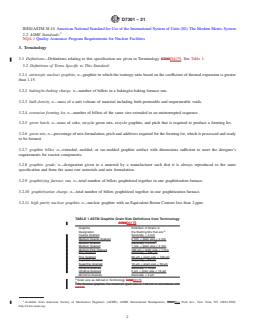
given in Terminology D4175. See Table 1.
3.2 Definitions of Terms Specific to This Standard:
2. Referenced Documents
3.2.1 anistropic nuclear graphite, n—graphite in which the
2.1 ASTM Standards:
isotropy ratio based on the coefficient of thermal expansion is
C561Test Method for Ash in a Graphite Sample
greater than 1.15.
C781PracticeforTestingGraphiteMaterialsforGas-Cooled
3.2.2 baking/re-baking charge, n—number of billets in a
Nuclear Reactor Components
baking/re-baking furnace run.
3.2.3 bulk density, n—mass of a unit volume of material
1 including both permeable and impermeable voids.
This specification is under the jurisdiction of ASTM Committee D02 on
Petroleum Products, Liquid Fuels, and Lubricants and is the direct responsibility of
3.2.4 extrusion forming lot, n—number of billets of the
Subcommittee D02.F0 on Manufactured Carbon and Graphite Products.
same size extruded in an uninterrupted sequence.
Current edition approved Nov. 1, 2021. Published November 2021. Originally
approved in 2008. Last previous edition approved in 2015 as D7301–11 (2015).
DOI: 10.1520/D7301-21.
For referenced ASTM standards, visit the ASTM website, www.astm.org, or
contact ASTM Customer Service at service@astm.org. For Annual Book of ASTM Available from American Society of Mechanical Engineers (ASME), ASME
Standards volume information, refer to the standard’s Document Summary page on International Headquarters, Two Park Ave., New York, NY 10016-5990, http://
the ASTM website. www.asme.org.
*A Summary of Changes section appears at the end of this standard
Copyright © ASTM International, 100 Barr Harbor Drive, PO Box C700, West Conshohocken, PA 19428-2959. United States
D7301−21
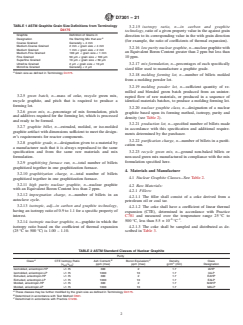
TABLE 1 ASTM Graphite Grain Size Definitions from Terminology
3.2.15 isotropy ratio, n—in carbon and graphite
D4175
technology, ratio of a given property value in the against grain
Graphite Definition of Grains in
direction to its corresponding value in the with grain direction
A
Designation the Starting Mix that are:
(for example, the ratio of coefficients of thermal expansion).
Coarse Grained Generally>4mm
Medium-Coarse Grained 2 mm < grain size<4mm
3.2.16 low purity nuclear graphite, n—nucleargraphitewith
Medium Grained 1 mm < grain size<2mm
an Equivalent Boron Content greater than 2ppm but less than
Medium-Fine Grained 100 µm < grain size<1mm
Fine Grained 50 µm < grain size < 100 µm
10ppm.
Superfine Grained 10 µm < grain size < 50 µm
Ultrafine Grained 2 µm < grain size < 10 µm 3.2.17 mix formulation, n—percentages of each specifically
Microfine Grained Generally<2µm
sized filler used to manufacture a graphite grade.
A
Grain size as defined in Terminology D4175.
3.2.18 molding forming lot, n—number of billets molded
from a molding powder lot.
3.2.19 molding powder lot, n—sufficient quantity of re-
milled and blended green batch produced from an uninter-
3.2.5 green batch, n—mass of coke, recycle green mix,
rupted flow of raw materials, or produced in a sequence of
recycle graphite, and pitch that is required to produce a
identical materials batches, to produce a molding forming lot.
forming lot.
3.2.20 nuclear graphite class, n—designation of a nuclear
3.2.6 green mix, n—percentage of mix formulation, pitch
graphite based upon its forming method, isotropy, purity and
and additives required for the forming lot, which is processed
density (see Table 2).
and ready to be formed.
3.2.21 production lot, n—specified number of billets made
3.2.7 graphite billet, n—extruded, molded, or iso-molded
in accordance with this specification and additional require-
graphite artifact with dimensions sufficient to meet the design-
ments determined by the purchaser.
er’s requirements for reactor components.
3.2.22 purification charge, n—number of billets in a purifi-
3.2.8 graphite grade, n—designation given to a material by
cation run.
a manufacturer such that it is always reproduced to the same
specification and from the same raw materials and mix 3.2.23 recycle green mix, n—ground non-baked billets or
non-used green mix manufactured in compliance with the mix
formulation.
formulation specified here.
3.2.9 graphitizing furnace run, n—total number of billets
graphitized together in one graphitization furnace.
4. Materials and Manufacture
3.2.10 graphitization charge, n—total number of billets
4.1 Nuclear Graphite Classes—See Table 2.
graphitized together in one graphitization furnace.
3.2.11 high purity nuclear graphite, n—nuclear graphite
4.2 Raw Materials:
with an Equivalent Boron Content less than 2ppm.
4.2.1 Fillers:
3.2.12 impregnation charge, n—number of billets in an
4.2.1.1 The filler shall consist of a coke derived from a
autoclave cycle.
petroleum oil or coal tar.
3.2.13 isotropic, adj—in carbon and graphite technology,
4.2.1.2 The coke shall have a coefficient of linear thermal
having an isotropy ratio of 0.9 to 1.1 for a specific property of
expansion (CTE), determined in accordance with Practice
interest.
C781 and measured over the temperature range 25°C to
-6 -1
500°C, less than 5.5 × 10 °C .
3.2.14 isotropic nuclear graphite, n—graphite in which the
isotropy ratio based on the coefficient of thermal expansion 4.2.1.3 The coke shall be sampled and distributed as de-
(25°C to 500°C) is 1.00 – 1.10. scribed in Table 3.
TABLE 2 ASTM Standard Classes of Nuclear Graphite
Purity
A B C
Class CTE Isotropy Ratio Ash Content, Boron Equivalent, Density, Class
ppm (max) ppm (max)
(α /α ) g/cm (min) Designation
AG AG
Isomolded, anisotropic-HP >1.15 300 2 1.7 IAHP
Isomolded, anisotropic-LP >1.15 1000 10 1.7 IALP
Extruded, anisotropic-HP >1.15 300 2 1.7 EAHP
Extruded, anisotropic-LP >1.15 1000 10 1.7 EALP
Molded, anisotropic-HP >1.15 300 2 1.7 MAHP
Molded, anisotropic-LP >1.15 1000 10 1.7 MALP
A
These classes may be further modified by the grain size as defined in Terminology D4175.
B
Determined in accordance with Test Method C561.
C
Determined in accordance with Practice C1233.
D7301−21
TABLE 3 Inspection Sampling and Testing of Filler Cokes
Inspection Plan Sampling Procedure Tests and Test Methods
A representative sample of the coke Sample in accordance with Practice D346 The procedure in Practice C781 shall be used
shall be taken prior to the mixing step to prepare test specimens for the measurement of coke CTE
of manufacture 1. A sufficient sample for preparation of CTE test specimens
2. A sufficient sample will be taken for additional testing. Measure the coke real density in accordance with
This sample shall be retained for a period specified by Test Method D2638
the graphite purchaser
4.2.1.4 Graphite manufactured in compliance with this with Practice C781 shall have a Specific Electrical Resistivity
specification but failing to meet the property requirements of (SER)correspondingtoagraphitizationtemperatureofatleast
Sections5–7 may be used as recycle material in the mix 2700°C.
formulation.
5. Chemical Properties
4.2.1.5 Recyclegreenmixmanufacturedfromrawmaterials
5.1 Each graphite production lot shall be sampled in accor-
in compliance with this specification may be used in the mix
dancewithSection10.Thechemicalimpuritiestobemeasured
formulation.
shall be agreed upon between the supplier and the purchaser.
4.3 Binder—The binder shall consist of coal tar pitch of the
The minimum list of elements to be measured and used for the
samegradefromthesamemanufacturer.Thespecificbinder(s)
EBC calculation shall be B, Cd, Dy, Eu, Gd, and Sm.
used shall be identified to the purchaser and be traceable
5.2 The boron equivalent shall be calculated in accordance
through the forming lot.
with Practice C1233. The acceptance limits for the boron
4.4 Impregnant—The impregnant shall consist of a petro-
equivalent as well as for ash content are given in Table 2.
leum or coal tar pitch of the same grade from the same
5.3 TableX1.1containsalistofchemicalimpuritiesthatare
manufacturer. The spec
...
This document is not an ASTM standard and is intended only to provide the user of an ASTM standard an indication of what changes have been made to the previous version. Because
it may not be technically possible to adequately depict all changes accurately, ASTM recommends that users consult prior editions as appropriate. In all cases only the current version
of the standard as published by ASTM is to be considered the official document.
Designation: D7301 − 11 (Reapproved 2015) D7301 − 21
Standard Specification for
Nuclear Graphite Suitable for Components Subjected to
Low Neutron Irradiation Dose
This standard is issued under the fixed designation D7301; the number immediately following the designation indicates the year of
original adoption or, in the case of revision, the year of last revision. A number in parentheses indicates the year of last reapproval. A
superscript epsilon (´) indicates an editorial change since the last revision or reapproval.
1. Scope Scope*
1.1 This specification covers the classification, processing, and properties of nuclear grade graphite billets with dimensions
sufficient to meet the designer’s requirements for reflector blocks and core support structures, in a high temperature gas cooled
reactor. The graphite classes specified here would be suitable for reactor core applications where neutron irradiation induced
dimensional changes are not a significant design consideration.
1.2 The purpose of this specification is to document the minimum acceptable properties and levels of quality assurance and
traceability for nuclear grade graphite suitable for components subjected to low irradiation dose. Nuclear graphites meeting the
requirements of Specification D7219 are also suitable for components subjected to low neutron irradiation dose.
1.3 The values stated in SI units are to be regarded as standard. No other units of measurement are included in this standard.
1.4 This international standard was developed in accordance with internationally recognized principles on standardization
established in the Decision on Principles for the Development of International Standards, Guides and Recommendations issued
by the World Trade Organization Technical Barriers to Trade (TBT) Committee.
2. Referenced Documents
2.1 ASTM Standards:
C559C561 Test Method for Bulk Density by Physical Measurements of Manufactured Carbon and Graphite ArticlesAsh in a
Graphite Sample
C709 Terminology Relating to Manufactured Carbon and Graphite (Withdrawn 2017)
C781 Practice for Testing Graphite Materials for Gas-Cooled Nuclear Reactor Components
C838 Test Method for Bulk Density of As-Manufactured Carbon and Graphite Shapes
C1233 Practice for Determining Equivalent Boron Contents of Nuclear Materials
D346 Practice for Collection and Preparation of Coke Samples for Laboratory Analysis
D2638 Test Method for Real Density of Calcined Petroleum Coke by Helium Pycnometer
D4175 Terminology Relating to Petroleum Products, Liquid Fuels, and Lubricants
D7219 Specification for Isotropic and Near-isotropic Nuclear Graphites
D8186 Test Method for Measurement of Impurities in Graphite by Electrothermal Vaporization Inductively Coupled Plasma
Optical Emission Spectrometry (ETV-ICP OES)
This specification is under the jurisdiction of ASTM Committee D02 on Petroleum Products, Liquid Fuels, and Lubricants and is the direct responsibility of Subcommittee
D02.F0 on Manufactured Carbon and Graphite Products.
Current edition approved June 1, 2015Nov. 1, 2021. Published July 2015November 2021. Originally approved in 2008. Last previous edition approved in 20112015 as
D7301 – 11.D7301 – 11 (2015). DOI: 10.1520/D7301-11R15.10.1520/D7301-21.
For referenced ASTM standards, visit the ASTM website, www.astm.org, or contact ASTM Customer Service at service@astm.org. For Annual Book of ASTM Standards
volume information, refer to the standard’s Document Summary page on the ASTM website.
*A Summary of Changes section appears at the end of this standard
Copyright © ASTM International, 100 Barr Harbor Drive, PO Box C700, West Conshohocken, PA 19428-2959. United States
D7301 − 21
IEEE/ASTM SI 10 American National Standard for Use of the International System of Units (SI): The Modern Metric System
2.2 ASME Standards:
NQA-1 Quality Assurance Program Requirements for Nuclear Facilities
3. Terminology
3.1 Definitions—Definitions relating to this specification are given in Terminology C709D4175. See Table 1.
3.2 Definitions of Terms Specific to This Standard:
3.2.1 anistropic nuclear graphite, n—graphite in which the isotropy ratio based on the coefficient of thermal expansion is greater
than 1.15.
3.2.2 baking/re-baking charge, n—number of billets in a baking/re-baking furnace run.
3.2.3 bulk density, n—mass of a unit volume of material including both permeable and impermeable voids.
3.2.4 extrusion forming lot, n—number of billets of the same size extruded in an uninterrupted sequence.
3.2.5 green batch, n—mass of coke, recycle green mix, recycle graphite, and pitch that is required to produce a forming lot.
3.2.6 green mix, n—percentage of mix formulation, pitch and additives required for the forming lot, which is processed and ready
to be formed.
3.2.7 graphite billet, n—extruded, molded, or iso-molded graphite artifact with dimensions sufficient to meet the designer’s
requirements for reactor components.
3.2.8 graphite grade, n—designation given to a material by a manufacturer such that it is always reproduced to the same
specification and from the same raw materials and mix formulation.
3.2.9 graphitizing furnace run, n—total number of billets graphitized together in one graphitization furnace.
3.2.10 graphitization charge, n—total number of billets graphitized together in one graphitization furnace.
3.2.11 high purity nuclear graphite, n—nuclear graphite with an Equivalent Boron Content less than 2 ppm.
TABLE 1 ASTM Graphite Grain Size Definitions from Terminology
C709D4175
Graphite Definition of Grains in
A
Designation the Starting Mix that are:
Coarse Grained Generally > 4 mm
Medium-Coarse Grained 2 mm < grain size < 4 mm
B
Medium Grained Generally < 4 mm
Medium Grained 1 mm < grain size < 2 mm
Medium-Fine Grained 100 μm < grain size < 1 mm
Fine Grained Generally < 100 μm
Fine Grained 50 μm < grain size < 100 μm
Superfine Grained Generally < 50 μm
Superfine Grained 10 μm < grain size < 50 μm
Ultrafine Grained Generally < 10 μm
Ultrafine Grained 2 μm < grain size < 10 μm
Microfine Grained Generally < 2 μm
A
Grain size as defined in Terminology C709D4175.
B
For Nuclear graphite, the maximum grain size is 1.68 mm in accordance with
4.2.1.6.
Available from American Society of Mechanical Engineers (ASME), ASME International Headquarters, ThreeTwo Park Ave., New York, NY 10016-5990,
http://www.asme.org.
D7301 − 21
3.2.12 impregnation charge, n—number of billets in an autoclave cycle.
3.2.13 isotropic, adj—in carbon and graphite technology, having an isotropy ratio of 0.9 to 1.1 for a specific property of interest.
3.2.14 isotropic nuclear graphite, n—graphite in which the isotropy ratio based on the coefficient of thermal expansion (25 °C to
500 °C) is 1.00 – 1.10.
3.2.15 isotropy ratio, n—in carbon and graphite technology, ratio of a given property value in the against grain direction to its
corresponding value in the with grain direction (for example, the ratio of coefficients of thermal expansion).
3.2.16 low purity nuclear graphite, n—nuclear graphite with an Equivalent Boron Content greater than 2 ppm but less than
10 ppm.
3.2.17 mix formulation, n—percentages of each specifically sized filler used to manufacture a graphite grade.
3.2.18 molding forming lot, n—number of billets molded from a molding powder lot.
3.2.19 molding powder lot, n—sufficient quantity of re-milled and blended green batch produced from an uninterrupted flow of
raw materials, or produced in a sequence of identical materials batches, to produce a molding forming lot.
3.2.20 nuclear graphite class, n—designation of a nuclear graphite based upon its forming method, isotropy, purity and density
(see Table 2).
3.2.21 production lot, n—specified number of billets made in accordance with this specification and additional requirements
determined by the purchaser.
3.2.22 purification charge, n—number of billets in a purification run.
3.2.23 recycle green mix, n—ground non-baked billets or non-used green mix manufactured in compliance with the mix
formulation specified here.
4. Materials and Manufacture
4.1 Nuclear Graphite Classes—See Table 2.
4.2 Raw Materials:
4.2.1 Fillers:
4.2.1.1 The filler shall consist of a coke derived from a petroleum oil or coal tar.
TABLE 2 ASTM Standard Classes of Nuclear Graphite
Purity
A B CB DC
Class CTE Isotropy Ratio Ash Content, Boron Equivalent, Density, Class
(α /α ) ppm (max) ppm (max)
AG AG g/cm (min) Designation
Isomolded, anisotropic-HP >1.15 300 2 1.7 IAHP
Isomolded, anisotropic-LP >1.15 1000 10 1.7 IALP
Extruded, anisotropic-HP >1.15 300 2 1.7 EAHP
Extruded, anisotropic-LP >1.15 1000 10 1.7 EALP
Molded, anisotropic-HP >1.15 300 2 1.7 MAHP
Molded, anisotropic-LP >1.15 1000 10 1.7 MALP
A
These classes may be further modified by the grain size as defined in Terminology C709D4175.
B
Determined in accordance with Practice Test Method C781C561.
C
Determined in accordance with Test Method C559.
C
Determined in accordance with Practice C1233.
D7301 − 21
4.2.1.2 The coke shall have a coefficient of linear thermal expansion (CTE), determined in accordance with Practice C781 and
-6 -1
measured over the temperature range 25 °C to 500 °C, less than 5.5 × 10 °C °C .
4.2.1.3 The coke shall be sampled and distributed as described in Table 3.
4.2.1.4 Graphite manufactured in compliance with this specification but failing to meet the property requirements of Sections 5
– 7 may be used as recycle material in the mix formulation.
4.2.1.5 Recycle green mix manufactured from raw materials in compliance with this specification may be used in the mix
formulation.
4.2.1.6 The maximum filler particle size used in the mix formulation shall be 1.68 mm.
4.3 Binder—The binder shall consist of coal tar pitch of the same grade from the same manufacturer. The specific binder(s) used
shall be identified to the purchaser and be traceable through the forming lot.
4.4 Impregnant—The impregnant shall consist of a petroleum or coal tar pitch of the same grade from the same manufacturer. The
specific impregnant(s) used shall be identified to the purchaser and be traceable through the impregnation steps.
4.5 Manufacturing or Processing Additives—Additives (for example, extrusion aids) may be used to improve the processing,
quality and properties of the product, but only with the consent and approval of the purchaser, and they must be traceable through
the forming lot.
4.6 Manufacture:
4.6.1 Formulation—The mix formulation (as defined in 3.2.143.2.17) and recycle green mix fraction (as defined in 3.2.203.2.23)
in the filler shall be recorded. This information shall be reported to the purchaser if requested.
4.6.2 Forming—The green mix may be formed by extrusion, molding (including vibrationally molding), or iso-molding.
4.6.3 Graphitization Temperature—The graphitization temperature shall be determined on each billet using the procedure
described in Practice C781. Each billet tested in accordance with Practice C781 shall have a Specific Electrical Resistivity (SER)
corresponding to a graphiti
...