

ASTM C876-22b
(Test Method)Standard Test Method for Corrosion Potentials of Uncoated Reinforcing Steel in Concrete
General Information
- Abstract
SIGNIFICANCE AND USE
4.1 This test method is suitable for in-service evaluation and for use in research and development work.
4.2 This test method is applicable to members regardless of their size or the depth of concrete cover over the reinforcing steel. Concrete cover in excess of 75 mm (3 in.) can result in an averaging of adjacent reinforcement corrosion potentials that can result in a loss of the ability to discriminate variation in relative corrosion activity.
4.3 This test method is not applicable to reinforced concrete structures with epoxy-coated reinforcement.
4.4 This test method is not applicable to reinforced concrete structures in which waterproofing membranes are located between the reinforcement cage and the concrete surface as they can prevent the conduction of electricity and result in erroneous readings.
4.5 This test method may be used at any time during the life of a concrete member after the concrete has set, although it is generally most useful for evaluating mature reinforced concrete that is suspected to be susceptible to corrosion.
4.6 The results obtained by the use of this test method shall not be considered as a means for estimating the structural properties of the steel or of the reinforced concrete member.
4.7 Temperature and humidity can impact potential readings. This is particularly important for periodic testing of the same test location. An increase in the temperature leads to increasing ionic mobility, which in turn affects the reference electrode’s potential. The temperature influence can be neglected if the measurements are taken within the range of 22.2 °C ± 5.5 °C (72 °F ± 10 °F). Otherwise, the temperature-dependency of the measurements must be taken into account.
4.8 The potential measurements should be interpreted by engineers or technical specialists experienced in the fields of concrete materials and corrosion testing. It is often necessary to use other complementary data such as chloride contents, depth of carbonation, ...
SCOPE
1.1 This test method covers the estimation of the electrical corrosion potential of uncoated reinforcing steel in field and laboratory concrete, for the purpose of determining the corrosion activity of the reinforcing steel.
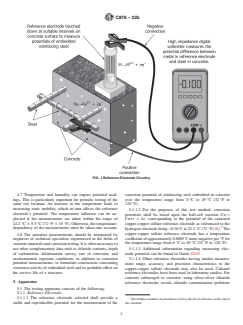
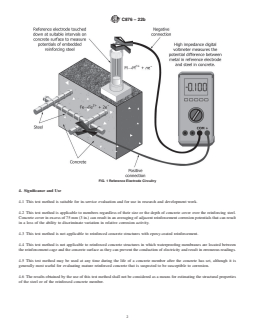
1.2 This test method is limited by electrical circuitry. Concrete surface in building interiors and desert environments lose sufficient moisture so that the concrete resistivity becomes so high that special testing techniques not covered in this test method may be required (see 5.1.4.1). Concrete surfaces that are coated or treated with sealers may not provide an acceptable electrical circuit. The basic configuration of the electrical circuit is shown in Fig. 1.
FIG. 1 Reference Electrode Circuitry
1.3 The values stated in SI units are to be regarded as standard. The values given in parentheses after SI units are provided for information only and are not considered standard.
1.4 This standard does not purport to address all of the safety concerns, if any, associated with its use. It is the responsibility of the user of this standard to establish appropriate safety, health, and environmental practices and determine the applicability of regulatory limitations prior to use.
1.5 This international standard was developed in accordance with internationally recognized principles on standardization established in the Decision on Principles for the Development of International Standards, Guides and Recommendations issued by the World Trade Organization Technical Barriers to Trade (TBT) Committee.
- Status
- Published
- Publication Date
- 30-Sep-2022
- Technical Committee
- G01 - Corrosion of Metals
- Drafting Committee
- G01.14 - Corrosion of Metals in Construction Materials
Buy Documents
ASTM C876-22b - Standard Test Method for Corrosion Potentials of Uncoated Reinforcing Steel in Concrete
REDLINE ASTM C876-22b - Standard Test Method for Corrosion Potentials of Uncoated Reinforcing Steel in Concrete
Overview
ASTM C876-22b: Standard Test Method for Corrosion Potentials of Uncoated Reinforcing Steel in Concrete is a widely recognized standard developed by ASTM International. This test method provides procedures for estimating the electrical corrosion potential of uncoated steel reinforcement embedded in concrete structures, which is essential for assessing the likelihood of corrosion activity. Applicable in both field and laboratory settings, ASTM C876-22b supports in-service evaluations and research and development investigations focused on the durability of reinforced concrete.
The standard outlines requirements for apparatus, calibration, test procedures, data interpretation, and reporting, serving as a critical tool for engineers and specialists in concrete materials and corrosion testing.
Key Topics
Scope of Application
- Suitable for evaluating in-service and mature reinforced concrete structures for corrosion potential.
- Applicable regardless of member size or depth of concrete cover, though covers exceeding 75 mm may affect sensitivity.
- Not valid for structures with epoxy-coated reinforcement or where waterproof membranes separate reinforcement from the surface, as these conditions impede valid electrical circuit formation.
Significance of Corrosion Potential Measurement
- Determines the probability of active corrosion in steel reinforcement.
- Does not measure corrosion rate or the structural properties of the steel or concrete member.
- Periodic testing sensitivity can be influenced by environmental factors such as temperature and humidity.
Test Method Highlights
- Utilizes a reference electrode system (commonly copper-copper sulfate, or silver-silver chloride where appropriate) with a voltmeter to measure half-cell corrosion potentials.
- Electrical connection to reinforcing steel and pre-wetting concrete surface may be required for accurate readings.
- Data interpretation often involves mapping potential measurements to identify corrosion-prone areas (equipotential contour maps).
Data Recording and Reporting
- Test data should include details about reference electrode type, calibration, environmental conditions, and method of connection to steel.
- Analysis may involve statistical methods to assess repeatability and reproducibility of measurements.
Applications
ASTM C876-22b is indispensable in the following contexts:
Condition Assessment of Reinforced Concrete
- Used by engineers for periodic maintenance inspections of bridges, parking structures, water tanks, tunnels, and other infrastructure.
- Helps identify zones with a high probability of steel corrosion, guiding targeted repairs and rehabilitation.
Infrastructure Asset Management
- Supports long-term durability planning by providing quantitative data for risk assessment and prioritization of maintenance schedules.
Research and Development
- Facilitates the study of corrosion mechanisms, material performance, and the effectiveness of protective measures or rehabilitation methods in concrete.
Related Standards
Professionals often use ASTM C876-22b in conjunction with other ASTM and industry standards, including:
- ASTM E691 - Practice for Conducting an Interlaboratory Study to Determine the Precision of a Test Method
- ASTM G3 - Practice for Conventions Applicable to Electrochemical Measurements in Corrosion Testing
- ASTM G16 - Guide for Applying Statistics to Analysis of Corrosion Data
- ASTM G193 - Terminology and Acronyms Relating to Corrosion
- ASTM G215 - Guide for Electrode Potential Measurement
Collaboration with guidelines from organizations such as the American Concrete Institute (ACI) and the Association for Materials Protection and Performance (AMPP) further enhances corrosion assessment reliability.
Utilizing ASTM C876-22b helps ensure more durable, safer reinforced concrete infrastructure by enabling consistent and reliable assessment of corrosion risks, contributing to informed decision-making in maintenance, design, and research. For full technical details and authoritative guidance, professionals should reference the current official ASTM standard.
Relations
- Effective Date
- 01-May-2019
- Effective Date
- 15-Feb-2019
- Effective Date
- 01-Jan-2017
- Effective Date
- 01-May-2016
- Effective Date
- 15-Dec-2014
- Effective Date
- 01-Dec-2013
- Effective Date
- 01-Dec-2013
- Effective Date
- 01-May-2013
- Effective Date
- 01-Nov-2011
- Effective Date
- 01-May-2010
- Effective Date
- 01-Feb-2010
- Effective Date
- 01-Oct-2008
- Effective Date
- 01-Nov-2005
- Effective Date
- 01-Nov-2004
- Effective Date
- 01-May-2004
Buy Documents
ASTM C876-22b - Standard Test Method for Corrosion Potentials of Uncoated Reinforcing Steel in Concrete
REDLINE ASTM C876-22b - Standard Test Method for Corrosion Potentials of Uncoated Reinforcing Steel in Concrete
Get Certified
Connect with accredited certification bodies for this standard

Element Materials Technology
Materials testing and product certification.

Inštitut za kovinske materiale in tehnologije
Institute of Metals and Technology. Materials testing, metallurgical analysis, NDT.
Sponsored listings
Frequently Asked Questions
ASTM C876-22b is a standard published by ASTM International. Its full title is "Standard Test Method for Corrosion Potentials of Uncoated Reinforcing Steel in Concrete". This standard covers: SIGNIFICANCE AND USE 4.1 This test method is suitable for in-service evaluation and for use in research and development work. 4.2 This test method is applicable to members regardless of their size or the depth of concrete cover over the reinforcing steel. Concrete cover in excess of 75 mm (3 in.) can result in an averaging of adjacent reinforcement corrosion potentials that can result in a loss of the ability to discriminate variation in relative corrosion activity. 4.3 This test method is not applicable to reinforced concrete structures with epoxy-coated reinforcement. 4.4 This test method is not applicable to reinforced concrete structures in which waterproofing membranes are located between the reinforcement cage and the concrete surface as they can prevent the conduction of electricity and result in erroneous readings. 4.5 This test method may be used at any time during the life of a concrete member after the concrete has set, although it is generally most useful for evaluating mature reinforced concrete that is suspected to be susceptible to corrosion. 4.6 The results obtained by the use of this test method shall not be considered as a means for estimating the structural properties of the steel or of the reinforced concrete member. 4.7 Temperature and humidity can impact potential readings. This is particularly important for periodic testing of the same test location. An increase in the temperature leads to increasing ionic mobility, which in turn affects the reference electrode’s potential. The temperature influence can be neglected if the measurements are taken within the range of 22.2 °C ± 5.5 °C (72 °F ± 10 °F). Otherwise, the temperature-dependency of the measurements must be taken into account. 4.8 The potential measurements should be interpreted by engineers or technical specialists experienced in the fields of concrete materials and corrosion testing. It is often necessary to use other complementary data such as chloride contents, depth of carbonation, ... SCOPE 1.1 This test method covers the estimation of the electrical corrosion potential of uncoated reinforcing steel in field and laboratory concrete, for the purpose of determining the corrosion activity of the reinforcing steel. 1.2 This test method is limited by electrical circuitry. Concrete surface in building interiors and desert environments lose sufficient moisture so that the concrete resistivity becomes so high that special testing techniques not covered in this test method may be required (see 5.1.4.1). Concrete surfaces that are coated or treated with sealers may not provide an acceptable electrical circuit. The basic configuration of the electrical circuit is shown in Fig. 1. FIG. 1 Reference Electrode Circuitry 1.3 The values stated in SI units are to be regarded as standard. The values given in parentheses after SI units are provided for information only and are not considered standard. 1.4 This standard does not purport to address all of the safety concerns, if any, associated with its use. It is the responsibility of the user of this standard to establish appropriate safety, health, and environmental practices and determine the applicability of regulatory limitations prior to use. 1.5 This international standard was developed in accordance with internationally recognized principles on standardization established in the Decision on Principles for the Development of International Standards, Guides and Recommendations issued by the World Trade Organization Technical Barriers to Trade (TBT) Committee.
SIGNIFICANCE AND USE 4.1 This test method is suitable for in-service evaluation and for use in research and development work. 4.2 This test method is applicable to members regardless of their size or the depth of concrete cover over the reinforcing steel. Concrete cover in excess of 75 mm (3 in.) can result in an averaging of adjacent reinforcement corrosion potentials that can result in a loss of the ability to discriminate variation in relative corrosion activity. 4.3 This test method is not applicable to reinforced concrete structures with epoxy-coated reinforcement. 4.4 This test method is not applicable to reinforced concrete structures in which waterproofing membranes are located between the reinforcement cage and the concrete surface as they can prevent the conduction of electricity and result in erroneous readings. 4.5 This test method may be used at any time during the life of a concrete member after the concrete has set, although it is generally most useful for evaluating mature reinforced concrete that is suspected to be susceptible to corrosion. 4.6 The results obtained by the use of this test method shall not be considered as a means for estimating the structural properties of the steel or of the reinforced concrete member. 4.7 Temperature and humidity can impact potential readings. This is particularly important for periodic testing of the same test location. An increase in the temperature leads to increasing ionic mobility, which in turn affects the reference electrode’s potential. The temperature influence can be neglected if the measurements are taken within the range of 22.2 °C ± 5.5 °C (72 °F ± 10 °F). Otherwise, the temperature-dependency of the measurements must be taken into account. 4.8 The potential measurements should be interpreted by engineers or technical specialists experienced in the fields of concrete materials and corrosion testing. It is often necessary to use other complementary data such as chloride contents, depth of carbonation, ... SCOPE 1.1 This test method covers the estimation of the electrical corrosion potential of uncoated reinforcing steel in field and laboratory concrete, for the purpose of determining the corrosion activity of the reinforcing steel. 1.2 This test method is limited by electrical circuitry. Concrete surface in building interiors and desert environments lose sufficient moisture so that the concrete resistivity becomes so high that special testing techniques not covered in this test method may be required (see 5.1.4.1). Concrete surfaces that are coated or treated with sealers may not provide an acceptable electrical circuit. The basic configuration of the electrical circuit is shown in Fig. 1. FIG. 1 Reference Electrode Circuitry 1.3 The values stated in SI units are to be regarded as standard. The values given in parentheses after SI units are provided for information only and are not considered standard. 1.4 This standard does not purport to address all of the safety concerns, if any, associated with its use. It is the responsibility of the user of this standard to establish appropriate safety, health, and environmental practices and determine the applicability of regulatory limitations prior to use. 1.5 This international standard was developed in accordance with internationally recognized principles on standardization established in the Decision on Principles for the Development of International Standards, Guides and Recommendations issued by the World Trade Organization Technical Barriers to Trade (TBT) Committee.
ASTM C876-22b is classified under the following ICS (International Classification for Standards) categories: 77.140.15 - Steels for reinforcement of concrete. The ICS classification helps identify the subject area and facilitates finding related standards.
ASTM C876-22b has the following relationships with other standards: It is inter standard links to ASTM G3-14(2019), ASTM G16-13(2019), ASTM G215-17, ASTM G215-16, ASTM G3-14, ASTM G16-13, ASTM G3-13, ASTM E691-13, ASTM E691-11, ASTM G3-89(2010), ASTM G16-95(2010), ASTM E691-08, ASTM E691-05, ASTM G3-89(2004), ASTM G16-95(2004). Understanding these relationships helps ensure you are using the most current and applicable version of the standard.
ASTM C876-22b is available in PDF format for immediate download after purchase. The document can be added to your cart and obtained through the secure checkout process. Digital delivery ensures instant access to the complete standard document.
Standards Content (Sample)
This international standard was developed in accordance with internationally recognized principles on standardization established in the Decision on Principles for the
Development of International Standards, Guides and Recommendations issued by the World Trade Organization Technical Barriers to Trade (TBT) Committee.
Designation: C876 − 22b
Standard Test Method for
Corrosion Potentials of Uncoated Reinforcing Steel in
Concrete
This standard is issued under the fixed designation C876; the number immediately following the designation indicates the year of
original adoption or, in the case of revision, the year of last revision.Anumber in parentheses indicates the year of last reapproval.A
superscript epsilon (´) indicates an editorial change since the last revision or reapproval.
1. Scope E691Practice for Conducting an Interlaboratory Study to
Determine the Precision of a Test Method
1.1 This test method covers the estimation of the electrical
G3Practice for Conventions Applicable to Electrochemical
corrosion potential of uncoated reinforcing steel in field and
Measurements in Corrosion Testing
laboratory concrete, for the purpose of determining the corro-
G16Guide for Applying Statistics to Analysis of Corrosion
sion activity of the reinforcing steel.
Data
1.2 This test method is limited by electrical circuitry.
G193Terminology and Acronyms Relating to Corrosion
Concrete surface in building interiors and desert environments
G215Guide for Electrode Potential Measurement
losesufficientmoisturesothattheconcreteresistivitybecomes
so high that special testing techniques not covered in this test
3. Terminology
method may be required (see 5.1.4.1). Concrete surfaces that
are coated or treated with sealers may not provide an accept-
3.1 Fordefinitionsoftermsusedinthistestmethod,referto
able electrical circuit. The basic configuration of the electrical
Terminology G193.
circuit is shown in Fig. 1.
4. Significance and Use
1.3 The values stated in SI units are to be regarded as
standard. The values given in parentheses after SI units are
4.1 Thistestmethodissuitableforin-serviceevaluationand
providedforinformationonlyandarenotconsideredstandard.
for use in research and development work.
1.4 This standard does not purport to address all of the
4.2 This test method is applicable to members regardless of
safety concerns, if any, associated with its use. It is the
their size or the depth of concrete cover over the reinforcing
responsibility of the user of this standard to establish appro-
steel. Concrete cover in excess of 75 mm (3 in.) can result in
priate safety, health, and environmental practices and deter-
mine the applicability of regulatory limitations prior to use. an averaging of adjacent reinforcement corrosion potentials
that can result in a loss of the ability to discriminate variation
1.5 This international standard was developed in accor-
dance with internationally recognized principles on standard- in relative corrosion activity.
ization established in the Decision on Principles for the
4.3 Thistestmethodisnotapplicabletoreinforcedconcrete
Development of International Standards, Guides and Recom-
structures with epoxy-coated reinforcement.
mendations issued by the World Trade Organization Technical
Barriers to Trade (TBT) Committee.
4.4 Thistestmethodisnotapplicabletoreinforcedconcrete
structures in which waterproofing membranes are located
2. Referenced Documents
between the reinforcement cage and the concrete surface as
2.1 ASTM Standards:
they can prevent the conduction of electricity and result in
erroneous readings.
This test method is under the jurisdiction of ASTM Committee G01 on
4.5 Thistestmethodmaybeusedatanytimeduringthelife
Corrosion of Metals and is the direct responsibility of Subcommittee G01.14 on
of a concrete member after the concrete has set, although it is
Corrosion of Metals in Construction Materials.
Current edition approved Oct. 1, 2022. Published October 2022. Originally
generally most useful for evaluating mature reinforced con-
approved in 1977. Last previous edition approved in 2022 as C876–22a. DOI:
crete that is suspected to be susceptible to corrosion.
10.1520/C0876-22B.
For referenced ASTM standards, visit the ASTM website, www.astm.org, or
4.6 The results obtained by the use of this test method shall
contact ASTM Customer Service at service@astm.org. For Annual Book of ASTM
not be considered as a means for estimating the structural
Standards volume information, refer to the standard’s Document Summary page on
the ASTM website. properties of the steel or of the reinforced concrete member.
Copyright © ASTM International, 100 Barr Harbor Drive, PO Box C700, West Conshohocken, PA 19428-2959. United States
C876 − 22b
FIG. 1 Reference Electrode Circuitry
4.7 Temperature and humidity can impact potential read- corrosion potential of reinforcing steel embedded in concrete
ings. This is particularly important for periodic testing of the over the temperature range from 0°C to 49°C (32°F to
same test location. An increase in the temperature leads to 120°F).
increasing ionic mobility, which in turn affects the reference
5.1.1.2 For the purposes of this test method, corrosion
electrode’s potential. The temperature influence can be ne-
potentials shall be based upon the half-cell reaction Cu→
glected if the measurements are taken within the range of
Cu++ + 2e- corresponding to the potential of the saturated
22.2°C 65.5°C(72°F 610°F).Otherwise,thetemperature-
copper-copper sulfate reference electrode as referenced to the
dependency of the measurements must be taken into account.
hydrogen electrode being −0.30 V at 22.2°C (72°F) (1). The
copper-copper sulfate reference electrode has a temperature
4.8 The potential measurements should be interpreted by
coefficientofapproximately0.0005Vmorenegativeper°Ffor
engineers or technical specialists experienced in the fields of
the temperature range from 0°C to 49°C (32°F to 120°F).
concretematerialsandcorrosiontesting.Itisoftennecessaryto
5.1.1.3 Additional information regarding measuring elec-
use other complementary data such as chloride contents, depth
of carbonation, delamination survey, rate of corrosion, and trode potential can be found in Guide G215.
environmental exposure conditions, in addition to corrosion
5.1.1.4 Other reference electrodes having similar measure-
potential measurements, to formulate conclusions concerning
ment range, accuracy, and precision characteristics to the
corrosion activity of embedded steel and its probable effect on
copper-copper sulfate electrode may also be used. Calomel
the service life of a structure.
reference electrodes have been used in laboratory studies. For
concrete submerged in seawater, using silver-silver chloride
5. Apparatus
reference electrodes avoids chloride contamination problems
5.1 The testing apparatus consists of the following:
5.1.1 Reference Electrode:
5.1.1.1 The reference electrode selected shall provide a
Theboldfacenumbersinparenthesesrefertothelistofreferencesattheendof
stable and reproducible potential for the measurement of the this standard.
C876 − 22b
liquid junction potentials. On large horizontal reinforced con-
crete structures, such as bridge decks, preliminary cleaning of
the concrete surface with “street sweepers” has proven suc-
cessful.
5.1.4 Voltmeter—The voltmeter shall allow DC voltage
readings, have the capacity to be battery operated, and provide
adequate input impedance and AC rejection capability for the
environment where this test method is applied.
5.1.4.1 Prior to commencing testing, a digital voltmeter
with a variable input impedance ranging from 10MΩ to
200MΩ may be used to determine the input impedance
required to obtain precision readings. The use of a meter with
variable input impedance avoids meter loading errors from
high concrete resistivity. An initial reading is taken in the
10MΩ position, and then switching to successively higher
impedances while watching the meter display until the reading
remains constant through two successive increases. Then
decrease the impedance on setting to reduce noise and provide
the most precise readings. If the voltmeter does not display a
constantreadingthrough200MΩ,thentheuseofagalvanom-
eter with an input impedance of 1GΩor2GΩ should be
considered. Logging voltmeters may also be used.
5.1.4.2 Electromagnetic interference or induction resulting
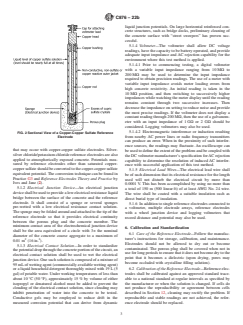
FIG. 2 Sectional View of a Copper-Copper Sulfate Reference
from nearby AC power lines or radio frequency transmitters
Electrode
can produce an error. When in the proximity of such interfer-
ence sources, the readings may fluctuate. An oscilloscope can
that may occur with copper-copper sulfate electrodes. Silver-
beusedtodefinetheextentoftheproblemandbecoupledwith
silverchloride/potassiumchloridereferenceelectrodesarealso
theDCvoltmetermanufacturer’sspecificationforACrejection
applied to atmospherically exposed concrete. Potentials mea-
capability to determine the resolution of induced AC interfer-
sured by reference electrodes other than saturated copper-
ence with successful application of this test method.
coppersulfateshouldbeconvertedtothecopper-coppersulfate
5.1.5 Electrical Lead Wires—The electrical lead wire shall
equivalentpotential.Theconversiontechniquecanbefoundin
beofsuchdimensionthatitselectricalresistanceforthelength
Practice G3 and Reference Electrodes Theory and Practice by
used will not disturb the electrical circuit by more than
Ives and Janz (2).
0.0001V. This has been accomplished by using no more than
5.1.2 Electrical Junction Device—An electrical junction
a total of 150 m (500 linearft) of at least AWG No. 24 wire.
deviceshallbeusedtoprovidealowelectricalresistanceliquid
The wire shall be coated with a suitable insulation such as
bridge between the surface of the concrete and the reference
direct burial type of insulation.
electrode. It shall consist of a sponge or several sponges
5.1.6 In addition to single reference electrodes connected to
pre-wetted with a low electrical resistance contact solution.
a voltmeter, multiple electrode arrays, reference electrodes
Thespongemaybefoldedaroundandattachedtothetipofthe
with a wheel junction device and logging voltmeters that
reference electrode so that it provides electrical continuity
record distance and potential may also be used.
between the porous plug and the concrete member. The
minimum contact area of the electrochemical junction device
6. Calibration and Standardization
shall be the area equivalent of a circle with 3× the nominal
6.1 Care of the Reference Electrode—Follow the manufac-
diameter of the concrete coarse aggregate to a maximum of
2 2 turer’s instructions for storage, calibration, and maintenance.
0.01 m (16in. ).
Electrodes should not be allowed to dry out or become
5.1.3 Electrical Contact Solution—In order to standardize
contaminated. The porous plug shall be covered when not in
thepotentialdropthroughtheconcreteportionofthecircuit,an
useforlongperiodstoensurethatitdoesnotbecomedrytothe
electrical contact solution shall be used to wet the electrical
point that it becomes a dielectric (upon drying, pores may
junctiondevice.Onesuchsolutioniscomposedofamixtureof
become occluded with crystalline filling solution).
95mLofwettingagent(commerciallyavailablewettingagent)
or a liquid household detergent thoroughly mixed with 19 L(5 6.2 CalibrationoftheReferenceElectrode—Referenceelec-
gal) of potable water. Under working temperatures of less than trodes shall be calibrated against an approved standard trace-
about 10°C (50°F), approximately 15% by volume of either able to a national standard at regular intervals as specified by
isopropyl or denatured alcohol must be added to prevent the the manufacturer or when the solution is changed. If cells do
clouding of the electrical contact solution, since clouding may not produce the reproducibility or agreement between cells
inhibit penetration of water into the concrete to be tested. described in Section 12, cleaning may rectify the problem. If
Conductive gels may be employed to reduce drift in the reproducible and stable readings are not achieved, the refer-
measured corrosion potential that can derive from dynamic ence electrode should be replaced.
C876 − 22b
6.3 Calibration of the Voltmeter—The voltmeter shall be measurements are continued over a long period of time,
calibrated against an approved standard traceable to a national identical connection points should be used each time for a
standard at regular intervals specified by the manufacturer. given measurement.
7.2.3 Care should be taken that the whole area of the
7. Procedure
reinforcing mat being measured is electrically continuous by
7.1 Spacing Between Measurements—While there is no
checking electrical continuity between diagonally opposite
pre-defined minimum spacing between measurements on the ends of the area surveyed.
surface of the concrete member, it is of little value to take two
7.3 Electrical Connection to the Reference Electrode—
measurements from virtually the same point. Conversely,
Electrically connect one end of the lead wire to the reference
measurementstakenwithverywidespacingmayneitherdetect
electrode and the other end of this same lead wire to the
corrosion activity that is present nor result in the appropriate
negative (ground) terminal of the voltmeter.
accumulation of data for evaluation. The spacing shall there-
7.4 Pre-Wetting of the Concrete Surface:
fore be consistent with the member being investigated and the
intended end use of the measurements (Note 1). 7.4.1 Under most conditions, the concrete surface or an
overlaying material, or both, must be pre-wetted by either of
NOTE1—Aspacingof1.2m(4ft)hasbeenfoundsatisfactoryforrapid
the two methods described in 7.4.3 or 7.4.4 with the solution
evaluation of structures with large horizontal surfaces like bridge decks.
described in 5.1.3 to decrease the electrical resistance of the
Generally,largerspacingsincreasetheprobabilitythatlocalizedcorrosion
areas will not be detected. Measurements may be taken in either a grid or circuit.
a random pattern. Spacing between measurements should generally be
7.4.2 A test to determine the need for pre-wetting shall be
reduced where adjacent readings exhibit reading differences exceeding 50
made as follows:
mV (areas of high corrosion activity). Cracks, cold joints, and areas with
7.4.2.1 Placethereferenceelectrodeontheconcretesurface
dynamic structural activity can produce areas of localized corrosion
activity where the corrosion potential can change several hundred milli-
and do not move.
volts in less than 300 mm (1 ft). Therefore, care must be given that
7.4.2.2 Observe the voltmeter for one of the following
relatively large spacing between readings does not miss areas of localized
conditions:
corrosion activity. For small, lightly reinforced members, it may be
(1)The measured value of the corrosion potential does not
advantageous to map the reinforcement locations with a cover meter and
place the reference electrode over the bars on a suitable grid. change or fluctuate with time.
(2)The measured value of the corrosion potential changes
7.2 Electrical Connection to the Steel:
or fluctuates with time.
7.2.1 Thetypeofconnectionusedwilldependonwhethera
7.4.2.3 Ifcondition(1)isobserved,pre-wettingtheconcrete
temporary or permanent connection is required. Make a direct
surfaceisnotnecessary.However,ifcondition (2)isobserved,
electrical connection to the reinforcing steel by means of a
pre-wetting is required for an amount of time such that the
compression-type ground clamp, by brazing or welding a
voltage reading is stable (60.02V) when observed for at least
protruding rod, or by using a self-tapping screw in a hole
5 min. If pre-wetting cannot obtain condition (1), either the
drilled in the bar. To ensure a low electrical resistance
electrical resistance of the circuit is too great to obtain valid
connection, scrape the bar or brush the wire before connecting
corrosion potential measurements of the steel, or stray current
to the reinforcing steel to ensure a bright metal to bright metal
fromanearbydirectcurrenttractionsystemorotherfluctuating
contact. In certain cases, this technique may require the
direct current, such as arc welding, is affecting the readings. In
removal of some concrete to expose the reinforcing steel.
either case, the reference electrode method should not be used.
Electrically connect the reinforcing steel to the positive termi-
7.4.3 Method A for Pre-Wetting Concrete Surfaces—Use
nal of the voltmeter. Special care should be exercised with
Method A for those conditions where a minimal amount of
prestressingsteelstoavoidseriousinjury,andonlymechanical
pre-wetting is required to obtain condition (1) as described in
connections should be made. Where welding is employed to
7.4.2.2. Accomplish this by spraying or otherwise wetting
makeconnectionstoconventionalreinforcingsteel,preheating
either the entire concrete surface or only the points of mea-
will be necessary to avoid forming a brittle area in the rebar
surement as described in 7.1 with the solution described in
adjacent to the weld. Such welding should be per
...
This document is not an ASTM standard and is intended only to provide the user of an ASTM standard an indication of what changes have been made to the previous version. Because
it may not be technically possible to adequately depict all changes accurately, ASTM recommends that users consult prior editions as appropriate. In all cases only the current version
of the standard as published by ASTM is to be considered the official document.
Designation: C876 − 22a C876 − 22b
Standard Test Method for
Corrosion Potentials of Uncoated Reinforcing Steel in
Concrete
This standard is issued under the fixed designation C876; the number immediately following the designation indicates the year of
original adoption or, in the case of revision, the year of last revision. A number in parentheses indicates the year of last reapproval. A
superscript epsilon (´) indicates an editorial change since the last revision or reapproval.
1. Scope
1.1 This test method covers the estimation of the electrical corrosion potential of uncoated reinforcing steel in field and laboratory
concrete, for the purpose of determining the corrosion activity of the reinforcing steel.
1.2 This test method is limited by electrical circuitry. Concrete surface in building interiors and desert environments lose sufficient
moisture so that the concrete resistivity becomes so high that special testing techniques not covered in this test method may be
required (see 5.1.4.1). Concrete surfaces that are coated or treated with sealers may not provide an acceptable electrical circuit.
The basic configuration of the electrical circuit is shown in Fig. 1.
1.3 The values stated in SI units are to be regarded as standard. The values given in parentheses after SI units are provided for
information only and are not considered standard.
1.4 This standard does not purport to address all of the safety concerns, if any, associated with its use. It is the responsibility
of the user of this standard to establish appropriate safety, health, and environmental practices and determine the applicability of
regulatory limitations prior to use.
1.5 This international standard was developed in accordance with internationally recognized principles on standardization
established in the Decision on Principles for the Development of International Standards, Guides and Recommendations issued
by the World Trade Organization Technical Barriers to Trade (TBT) Committee.
2. Referenced Documents
2.1 ASTM Standards:
E691 Practice for Conducting an Interlaboratory Study to Determine the Precision of a Test Method
G3 Practice for Conventions Applicable to Electrochemical Measurements in Corrosion Testing
G16 Guide for Applying Statistics to Analysis of Corrosion Data
G193 Terminology and Acronyms Relating to Corrosion
G16G215 Guide for Applying Statistics to Analysis of Corrosion DataElectrode Potential Measurement
3. Terminology
3.1 For definitions of terms used in this test method, refer to Terminology G193.
This test method is under the jurisdiction of ASTM Committee G01 on Corrosion of Metals and is the direct responsibility of Subcommittee G01.14 on Corrosion of
Metals in Construction Materials.
Current edition approved Sept. 1, 2022Oct. 1, 2022. Published September 2022October 2022. Originally approved in 1977. Last previous edition approved in 2022 as
C876–22.–22a. DOI: 10.1520/C0876-22A.10.1520/C0876-22B.
For referenced ASTM standards, visit the ASTM website, www.astm.org, or contact ASTM Customer Service at service@astm.org. For Annual Book of ASTM Standards
volume information, refer to the standard’s Document Summary page on the ASTM website.
Copyright © ASTM International, 100 Barr Harbor Drive, PO Box C700, West Conshohocken, PA 19428-2959. United States
C876 − 22b
FIG. 1 Reference Electrode Circuitry
4. Significance and Use
4.1 This test method is suitable for in-service evaluation and for use in research and development work.
4.2 This test method is applicable to members regardless of their size or the depth of concrete cover over the reinforcing steel.
Concrete cover in excess of 75 mm (3 in.) can result in an averaging of adjacent reinforcement corrosion potentials that can result
in a loss of the ability to discriminate variation in relative corrosion activity.
4.3 This test method is not applicable to reinforced concrete structures with epoxy-coated reinforcement.
4.4 This test method is not applicable to reinforced concrete structures in which waterproofing membranes are located between
the reinforcement cage and the concrete surface as they can prevent the conduction of electricity and result in erroneous readings.
4.5 This test method may be used at any time during the life of a concrete member after the concrete has set, although it is
generally most useful for evaluating mature reinforced concrete that is suspected to be susceptible to corrosion.
4.6 The results obtained by the use of this test method shall not be considered as a means for estimating the structural properties
of the steel or of the reinforced concrete member.
C876 − 22b
4.7 Temperature and humidity can impact potential readings. This is particularly important for periodic testing of the same test
location. An increase in the temperature leads to increasing ionic mobility, which in turn affects the reference electrode’s potential.
The temperature influence can be neglected if the measurements are taken within the range of 22.2 °C 6 5.5 °C (72 °F 6 10 °F).
Otherwise, the temperature-dependency of the measurements must be taken into account.
4.8 The potential measurements should be interpreted by engineers or technical specialists experienced in the fields of concrete
materials and corrosion testing. It is often necessary to use other complementary data such as chloride contents, depth of
carbonation, delamination survey, rate of corrosion, and environmental exposure conditions, in addition to corrosion potential
measurements, to formulate conclusions concerning corrosion activity of embedded steel and its probable effect on the service life
of a structure.
5. Apparatus
5.1 The testing apparatus consists of the following:
5.1.1 Reference Electrode:
5.1.1.1 The reference electrode selected shall provide a stable and reproducible potential for the measurement of the corrosion
potential of reinforcing steel embedded in concrete over the temperature range from 0 °C to 49 °C (32 °F to 120 °F).
5.1.1.2 For the purposes of this test method, corrosion potentials shall be based upon the half-cell reaction Cu→ Cu++ + 2e-
corresponding to the potential of the saturated copper-copper sulfate reference electrode as referenced to the hydrogen electrode
being −0.30 V at 22.2 °C (72 °F) (1). The copper-copper sulfate reference electrode has a temperature coefficient of approximately
0.0005 V more negative per °F for the temperature range from 0 °C to 49 °C (32 °F to 120 °F).
5.1.1.3 Additional information regarding measuring electrode potential can be found in Guide G215.
5.1.1.4 Other reference electrodes having similar measurement range, accuracy, and precision characteristics to the copper-copper
sulfate electrode may also be used. Calomel reference electrodes have been used in laboratory studies. For concrete submerged in
seawater, using silver-silver chloride reference electrodes avoids chloride contamination problems that may occur with
FIG. 2 Sectional View of a Copper-Copper Sulfate Reference Electrode
The boldface numbers in parentheses refer to the list of references at the end of this standard.
C876 − 22b
copper-copper sulfate electrodes. Silver-silver chloride/potassium chloride reference electrodes are also applied to atmospherically
exposed concrete. Potentials measured by reference electrodes other than saturated copper-copper sulfate should be converted to
the copper-copper sulfate equivalent potential. The conversion technique can be found in Practice G3 and Reference Electrodes
Theory and Practice by Ives and Janz (2).
5.1.2 Electrical Junction Device—An electrical junction device shall be used to provide a low electrical resistance liquid bridge
between the surface of the concrete and the reference electrode. It shall consist of a sponge or several sponges pre-wetted with a
low electrical resistance contact solution. The sponge may be folded around and attached to the tip of the reference electrode so
that it provides electrical continuity between the porous plug and the concrete member. The minimum contact area of the
electrochemical junction device shall be the area equivalent of a circle with 3× the nominal diameter of the concrete coarse
2 2
aggregate to a maximum of 0.01 m (16 in. ).
5.1.3 Electrical Contact Solution—In order to standardize the potential drop through the concrete portion of the circuit, an
electrical contact solution shall be used to wet the electrical junction device. One such solution is composed of a mixture of 95 mL
of wetting agent (commercially available wetting agent) or a liquid household detergent thoroughly mixed with 19 L (5 gal) of
potable water. Under working temperatures of less than about 10 °C (50 °F), approximately 15 % by volume of either isopropyl
or denatured alcohol must be added to prevent the clouding of the electrical contact solution, since clouding may inhibit penetration
of water into the concrete to be tested. Conductive gels may be employed to reduce drift in the measured corrosion potential that
can derive from dynamic liquid junction potentials. On large horizontal reinforced concrete structures, such as bridge decks,
preliminary cleaning of the concrete surface with “street sweepers” has proven successful.
5.1.4 Voltmeter—The voltmeter shall allow DC voltage readings, have the capacity to be battery operated, and provide adequate
input impedance and AC rejection capability for the environment where this test method is applied.
5.1.4.1 Prior to commencing testing, a digital voltmeter with a variable input impedance ranging from 10 MΩ to 200 MΩ may
be used to determine the input impedance required to obtain precision readings. The use of a meter with variable input impedance
avoids meter loading errors from high concrete resistivity. An initial reading is taken in the 10 MΩ position, and then switching
to successively higher impedances while watching the meter display until the reading remains constant through two successive
increases. Then decrease the impedance on setting to reduce noise and provide the most precise readings. If the voltmeter does not
display a constant reading through 200 MΩ, then the use of a galvanometer with an input impedance of 1 GΩ or 2 GΩ should be
considered. Logging voltmeters may also be used.
5.1.4.2 Electromagnetic interference or induction resulting from nearby AC power lines or radio frequency transmitters can
produce an error. When in the proximity of such interference sources, the readings may fluctuate. An oscilloscope can be used to
define the extent of the problem and be coupled with the DC voltmeter manufacturer’s specification for AC rejection capability
to determine the resolution of induced AC interference with successful application of this test method.
5.1.5 Electrical Lead Wires—The electrical lead wire shall be of such dimension that its electrical resistance for the length used
will not disturb the electrical circuit by more than 0.0001 V. This has been accomplished by using no more than a total of 150 m
(500 linear ft) of at least AWG No. 24 wire. The wire shall be coated with a suitable insulation such as direct burial type of
insulation.
5.1.6 In addition to single reference electrodes connected to a voltmeter, multiple electrode arrays, reference electrodes with a
wheel junction device and logging voltmeters that record distance and potential may also be used.
6. Calibration and Standardization
6.1 Care of the Reference Electrode—Follow the manufacturer’s instructions for storage, calibration, and maintenance. Electrodes
should not be allowed to dry out or become contaminated. The porous plug shall be covered when not in use for long periods to
ensure that it does not become dry to the point that it becomes a dielectric (upon drying, pores may become occluded with
crystalline filling solution).
6.2 Calibration of the Reference Electrode—Reference electrodes shall be calibrated against an approved standard traceable to a
national standard at regular intervals as specified by the manufacturer or when the solution is changed. If cells do not produce the
reproducibility or agreement between cells described in Section 12, cleaning may rectify the problem. If reproducible and stable
readings are not achieved, the reference electrode should be replaced.
C876 − 22b
6.3 Calibration of the Voltmeter—The voltmeter shall be calibrated against an approved standard traceable to a national standard
at regular intervals specified by the manufacturer.
7. Procedure
7.1 Spacing Between Measurements—While there is no pre-defined minimum spacing between measurements on the surface of
the concrete member, it is of little value to take two measurements from virtually the same point. Conversely, measurements taken
with very wide spacing may neither detect corrosion activity that is present nor result in the appropriate accumulation of data for
evaluation. The spacing shall therefore be consistent with the member being investigated and the intended end use of the
measurements (Note 1).
NOTE 1—A spacing of 1.2 m (4 ft) has been found satisfactory for rapid evaluation of structures with large horizontal surfaces like bridge decks. Generally,
larger spacings increase the probability that localized corrosion areas will not be detected. Measurements may be taken in either a grid or a random pattern.
Spacing between measurements should generally be reduced where adjacent readings exhibit reading differences exceeding 50 mV (areas of high
corrosion activity). Cracks, cold joints, and areas with dynamic structural activity can produce areas of localized corrosion activity where the corrosion
potential can change several hundred millivolts in less than 300 mm (1 ft). Therefore, care must be given that relatively large spacing between readings
does not miss areas of localized corrosion activity. For small, lightly reinforced members, it may be advantageous to map the reinforcement locations
with a cover meter and place the reference electrode over the bars on a suitable grid.
7.2 Electrical Connection to the Steel:
7.2.1 The type of connection used will depend on whether a temporary or permanent connection is required. Make a direct
electrical connection to the reinforcing steel by means of a compression-type ground clamp, by brazing or welding a protruding
rod, or by using a self-tapping screw in a hole drilled in the bar. To ensure a low electrical resistance connection, scrape the bar
or brush the wire before connecting to the reinforcing steel to ensure a bright metal to bright metal contact. In certain cases, this
technique may require the removal of some concrete to expose the reinforcing steel. Electrically connect the reinforcing steel to
the positive terminal of the voltmeter. Special care should be exercised with prestressing steels to avoid serious injury, and only
mechanical connections should be made. Where welding is employed to make connections to conventional reinforcing steel,
preheating will be necessary to avoid forming a brittle area in the rebar adjacent to the weld. Such welding should be performed
by certified welders.
7.2.2 Attachment must be made directly to the reinforcing steel except in cases where it can be documented that an exposed steel
member is directly attached to the reinforcing steel. Certain members, such as expansion dams, date plates, lift works, scuppers,
drains, and parapet rails, may not be attached directly to the reinforcing steel and, therefore, may yield invalid readings. Electrical
continuity of steel components with the reinforcing steel can be established by measuring the resistance between widely separated
steel components on the test section. The resistance values should be in the range below 1 Ω to ensure electrical continuity. Where
duplicate test measurements are continued over a long period of time, identical connection points should be used each time for a
given measurement.
7.2.3 Care should be taken that the whole area of the reinforcing mat being measured is electrically continuous by checking
electrical continuity between diagonally opposite ends of the area surveyed.
7.3 Electrical Connection to the Reference Electrode—Electrically connect one end of the lead wire to the reference electrode and
the other end of this same lead wire to the negative (ground) terminal of the voltmeter.
7.4 Pre-Wetting of the Concrete Surface:
7.4.1 Under most conditions, the concrete surface or an overlaying material, or both, must be pre-wetted by either of the two
methods described in 7.4.3 or 7.4.4 with the solution described in 5.1.3 to decrease the electrical resistance of the circuit.
7.4.2 A test to determine the need for pre-wetting shall be made as follows:
7.4.2.1 Place the reference electrode on the concrete surface and do not move.
7.4.2.2 Observe the voltmeter for one of the following conditions:
(1) The measured value of the corrosion potential does not change or fluctuate with time.
(2) The measured value of the corrosion potential changes or fluctuates with time.
C876 − 22b
7.4.2.3 If condition (1) is observed, pre-wetting the concrete surface is not necessary. H
...