

ASTM F543-23
(Specification)Standard Specification and Test Methods for Metallic Medical Bone Screws
General Information
- Abstract
ABSTRACT
This specification provides requirements for materials, finish and marking, care and handling, and the acceptable dimensions and tolerances for metallic bone screws that are implanted into bone. There are a large variety of medical bone screws currently in use, the following type of screws are used: type HA - spherical undersurface of head, shallow, asymmetrical buttress thread, and deep screw head, type HB - spherical undersurface of head, deep, asymmetrical buttress thread, and shallow screw head, type HC - conical undersurface of head, symmetrical thread, and type HD - conical undersurface of head, symmetrical thread. The torsional strength, breaking angle, axial pullout strength, insertion torque, self-tapping force, and removal torque shall be tested to meet the requirements prescribed.
SIGNIFICANCE AND USE
A1.1 Significance and Use
A1.1.1 This test method is used to measure the torsional yield strength, maximum torque, and breaking angle of the bone screw under standard conditions. The results obtained in this test method are not intended to predict the torque encountered while inserting or removing a bone screw in human or animal bone. This test method is intended only to measure the uniformity of the product tested or to compare the mechanical properties of different, yet similarly sized, products.
SCOPE
1.1 This specification provides requirements for materials, finish and marking, care and handling, and the acceptable dimensions and tolerances for metallic bone screws that are implanted into bone. The dimensions and tolerances in this specification are applicable only to metallic bone screws described in this specification.
1.2 This specification provides performance considerations and standard test methods for measuring mechanical properties in torsion of metallic bone screws that are implanted into bone. These test methods may also be applicable to other screws besides those whose dimensions and tolerances are specified here. The following annexes are included:
1.2.1 Annex A1—Test Method for Determining the Torsional Properties of Metallic Bone Screws.
1.2.2 Annex A2—Test Method for Driving Torque of Medical Bone Screws.
1.2.3 Annex A3—Test Method for Determining the Axial Pullout Load of Medical Bone Screws.
1.2.4 Annex A4—Test Method for Determining the Self-Tapping Performance of Self-Tapping Medical Bone Screws.
1.2.5 Annex A5—Specifications for Type HA and Type HB Metallic Bone Screws.
1.2.6 Annex A6—Specifications for Type HC and Type HD Metallic Bone Screws.
1.2.7 Annex A7—Specifications for Metallic Bone Screw Drive Connections.
1.3 This specification is based, in part, upon ISO 5835, ISO 6475, and ISO 9268.
1.4 The values stated in SI units are to be regarded as standard. No other units of measurement are included in this standard.
1.5 Multiple test methods are included in this standard. However, the user is not necessarily obligated to test using all of the described methods. Instead, the user should only select, with justification, test methods that are appropriate for a particular device design. This may only be a subset of the herein described test methods.
1.6 This standard may involve the use of hazardous materials, operations, and equipment. This standard does not purport to address all of the safety concerns, if any, associated with its use. It is the responsibility of the user of this standard to establish appropriate safety, health, and environmental practices and determine the applicability of regulatory limitations prior to use.
1.7 This international standard was developed in accordance with internationally recognized principles on standardization established in the Decision on Principles for the Development of International Standards, Guides and Recommendations issued by the World Trade Organization Technical Barriers to Trade (TBT) Committee.
- Status
- Published
- Publication Date
- 31-May-2023
- Technical Committee
- F04 - Medical and Surgical Materials and Devices
- Drafting Committee
- F04.21 - Osteosynthesis
Buy Documents
ASTM F543-23 - Standard Specification and Test Methods for Metallic Medical Bone Screws
REDLINE ASTM F543-23 - Standard Specification and Test Methods for Metallic Medical Bone Screws
Overview
ASTM F543-23: Standard Specification and Test Methods for Metallic Medical Bone Screws provides requirements and standard test methods for metallic bone screws used in medical implants. Issued by ASTM International and overseen by Committee F04, this standard covers materials, dimensions, tolerances, finish and marking, as well as care and handling practices essential for bone screws intended for surgical implantation.
The standard details specifications for four main types of bone screws (HA, HB, HC, HD) and outlines mechanical testing protocols, enabling manufacturers and regulatory bodies to assess product uniformity and safety. These requirements ensure that bone screws used in orthopaedic procedures meet stringent quality and performance benchmarks, protecting patient safety and supporting consistent medical outcomes.
Key Topics
Material Requirements: Specifies that all screws must be made from biocompatible metallic materials suitable for surgical implantation and conforming to relevant ASTM material specifications.
Design and Classification: Covers several screw types including:
- Type HA: Spherical undersurface, shallow, asymmetrical buttress thread, deep head
- Type HB: Spherical undersurface, deep, asymmetrical buttress thread, shallow head
- Type HC: Conical undersurface, symmetrical thread
- Type HD: Conical undersurface, symmetrical thread
Mechanical Properties and Testing: Standardizes the measurement of critical properties, including:
- Torsional yield strength and maximum torque
- Breaking angle
- Axial pullout strength
- Insertion and removal torque
- Self-tapping force for self-tapping screws
Dimensions and Tolerances: Establishes dimensional requirements and allowable tolerances for the covered screw types, ensuring interchangeability and predictable performance.
Finish, Marking, and Traceability: Outlines requirements to ensure each screw is free from defects, and mandates clear marking for identification, material, lot traceability, and compliance.
Care and Handling: Recommends established practices for proper handling, cleaning, and maintaining screws to preserve their integrity prior to surgical use.
Testing Method Selection: Provides flexibility by allowing users to select only the test methods appropriate for a given device design, optimizing compliance and resource use.
Safety Guidance: Advises that ultimate safety, health, and environmental practices are the user’s responsibility, in line with international standards development principles.
Applications
Manufacturers and regulatory authorities utilize ASTM F543-23 to ensure:
- Quality Assurance: Consistent design, material selection, and manufacturing processes lead to safer, more reliable bone screws.
- Regulatory Compliance: Product development that meets the requirements of ASTM F543-23 aligns with global regulatory expectations for orthopaedic implants.
- Performance Validation: Standardized testing for mechanical properties such as torsional strength, pullout load, and insertion/removal torque allows for benchmarking and comparison of bone screw products.
- Clinical Safety: Surgeons and hospitals rely on screws produced under this standard to minimize risk during orthopaedic procedures, improve fixation, and enhance patient outcomes.
The standard also supports research and development by offering a framework for comparing new screw designs and materials, facilitating innovation while maintaining safety and efficacy.
Related Standards
ASTM F543-23 references various other standards for materials, testing, and device marking, including:
- ASTM E4: Force Calibration and Verification of Testing Machines
- ASTM F67: Unalloyed Titanium for Surgical Implants
- ASTM F86: Surface Preparation and Marking of Metallic Surgical Implants
- ASTM F116, F138, F1472, F799, F1537: Specifications for medical implant materials and driver tools
- ASTM F983: Permanent Marking of Orthopaedic Implant Components
- ASTM F2503: Marking for MR safety
International references include:
- ISO 5835, ISO 6475, ISO 9268: Implants for Surgery - Metal Bone Screws: dimensions and mechanical requirements
- ISO 8319-1, ISO 10664: Orthopaedic instrument drive connections
By adhering to ASTM F543-23 and its referenced standards, stakeholders in the medical device industry can ensure their bone screws are safe, effective, and globally compatible, optimizing orthopaedic care and supporting regulatory approval processes.
Relations
- Effective Date
- 15-Mar-2024
- Effective Date
- 01-Jan-2024
- Effective Date
- 01-Apr-2023
- Effective Date
- 01-Mar-2020
- Effective Date
- 01-Feb-2020
- Effective Date
- 01-Dec-2019
- Effective Date
- 15-May-2019
- Refers
ASTM F983-86(2018) - Standard Practice for Permanent Marking of Orthopaedic Implant Components - Effective Date
- 01-Feb-2018
- Effective Date
- 01-Feb-2018
- Effective Date
- 01-Mar-2017
- Effective Date
- 15-Jul-2016
- Effective Date
- 01-Dec-2015
- Effective Date
- 01-Feb-2015
- Effective Date
- 01-Jun-2014
- Effective Date
- 01-Oct-2013
Buy Documents
ASTM F543-23 - Standard Specification and Test Methods for Metallic Medical Bone Screws
REDLINE ASTM F543-23 - Standard Specification and Test Methods for Metallic Medical Bone Screws
Get Certified
Connect with accredited certification bodies for this standard

BSI Group
BSI (British Standards Institution) is the business standards company that helps organizations make excellence a habit.

TÜV Rheinland
TÜV Rheinland is a leading international provider of technical services.

TÜV SÜD
TÜV SÜD is a trusted partner of choice for safety, security and sustainability solutions.
Sponsored listings
Frequently Asked Questions
ASTM F543-23 is a technical specification published by ASTM International. Its full title is "Standard Specification and Test Methods for Metallic Medical Bone Screws". This standard covers: ABSTRACT This specification provides requirements for materials, finish and marking, care and handling, and the acceptable dimensions and tolerances for metallic bone screws that are implanted into bone. There are a large variety of medical bone screws currently in use, the following type of screws are used: type HA - spherical undersurface of head, shallow, asymmetrical buttress thread, and deep screw head, type HB - spherical undersurface of head, deep, asymmetrical buttress thread, and shallow screw head, type HC - conical undersurface of head, symmetrical thread, and type HD - conical undersurface of head, symmetrical thread. The torsional strength, breaking angle, axial pullout strength, insertion torque, self-tapping force, and removal torque shall be tested to meet the requirements prescribed. SIGNIFICANCE AND USE A1.1 Significance and Use A1.1.1 This test method is used to measure the torsional yield strength, maximum torque, and breaking angle of the bone screw under standard conditions. The results obtained in this test method are not intended to predict the torque encountered while inserting or removing a bone screw in human or animal bone. This test method is intended only to measure the uniformity of the product tested or to compare the mechanical properties of different, yet similarly sized, products. SCOPE 1.1 This specification provides requirements for materials, finish and marking, care and handling, and the acceptable dimensions and tolerances for metallic bone screws that are implanted into bone. The dimensions and tolerances in this specification are applicable only to metallic bone screws described in this specification. 1.2 This specification provides performance considerations and standard test methods for measuring mechanical properties in torsion of metallic bone screws that are implanted into bone. These test methods may also be applicable to other screws besides those whose dimensions and tolerances are specified here. The following annexes are included: 1.2.1 Annex A1—Test Method for Determining the Torsional Properties of Metallic Bone Screws. 1.2.2 Annex A2—Test Method for Driving Torque of Medical Bone Screws. 1.2.3 Annex A3—Test Method for Determining the Axial Pullout Load of Medical Bone Screws. 1.2.4 Annex A4—Test Method for Determining the Self-Tapping Performance of Self-Tapping Medical Bone Screws. 1.2.5 Annex A5—Specifications for Type HA and Type HB Metallic Bone Screws. 1.2.6 Annex A6—Specifications for Type HC and Type HD Metallic Bone Screws. 1.2.7 Annex A7—Specifications for Metallic Bone Screw Drive Connections. 1.3 This specification is based, in part, upon ISO 5835, ISO 6475, and ISO 9268. 1.4 The values stated in SI units are to be regarded as standard. No other units of measurement are included in this standard. 1.5 Multiple test methods are included in this standard. However, the user is not necessarily obligated to test using all of the described methods. Instead, the user should only select, with justification, test methods that are appropriate for a particular device design. This may only be a subset of the herein described test methods. 1.6 This standard may involve the use of hazardous materials, operations, and equipment. This standard does not purport to address all of the safety concerns, if any, associated with its use. It is the responsibility of the user of this standard to establish appropriate safety, health, and environmental practices and determine the applicability of regulatory limitations prior to use. 1.7 This international standard was developed in accordance with internationally recognized principles on standardization established in the Decision on Principles for the Development of International Standards, Guides and Recommendations issued by the World Trade Organization Technical Barriers to Trade (TBT) Committee.
ABSTRACT This specification provides requirements for materials, finish and marking, care and handling, and the acceptable dimensions and tolerances for metallic bone screws that are implanted into bone. There are a large variety of medical bone screws currently in use, the following type of screws are used: type HA - spherical undersurface of head, shallow, asymmetrical buttress thread, and deep screw head, type HB - spherical undersurface of head, deep, asymmetrical buttress thread, and shallow screw head, type HC - conical undersurface of head, symmetrical thread, and type HD - conical undersurface of head, symmetrical thread. The torsional strength, breaking angle, axial pullout strength, insertion torque, self-tapping force, and removal torque shall be tested to meet the requirements prescribed. SIGNIFICANCE AND USE A1.1 Significance and Use A1.1.1 This test method is used to measure the torsional yield strength, maximum torque, and breaking angle of the bone screw under standard conditions. The results obtained in this test method are not intended to predict the torque encountered while inserting or removing a bone screw in human or animal bone. This test method is intended only to measure the uniformity of the product tested or to compare the mechanical properties of different, yet similarly sized, products. SCOPE 1.1 This specification provides requirements for materials, finish and marking, care and handling, and the acceptable dimensions and tolerances for metallic bone screws that are implanted into bone. The dimensions and tolerances in this specification are applicable only to metallic bone screws described in this specification. 1.2 This specification provides performance considerations and standard test methods for measuring mechanical properties in torsion of metallic bone screws that are implanted into bone. These test methods may also be applicable to other screws besides those whose dimensions and tolerances are specified here. The following annexes are included: 1.2.1 Annex A1—Test Method for Determining the Torsional Properties of Metallic Bone Screws. 1.2.2 Annex A2—Test Method for Driving Torque of Medical Bone Screws. 1.2.3 Annex A3—Test Method for Determining the Axial Pullout Load of Medical Bone Screws. 1.2.4 Annex A4—Test Method for Determining the Self-Tapping Performance of Self-Tapping Medical Bone Screws. 1.2.5 Annex A5—Specifications for Type HA and Type HB Metallic Bone Screws. 1.2.6 Annex A6—Specifications for Type HC and Type HD Metallic Bone Screws. 1.2.7 Annex A7—Specifications for Metallic Bone Screw Drive Connections. 1.3 This specification is based, in part, upon ISO 5835, ISO 6475, and ISO 9268. 1.4 The values stated in SI units are to be regarded as standard. No other units of measurement are included in this standard. 1.5 Multiple test methods are included in this standard. However, the user is not necessarily obligated to test using all of the described methods. Instead, the user should only select, with justification, test methods that are appropriate for a particular device design. This may only be a subset of the herein described test methods. 1.6 This standard may involve the use of hazardous materials, operations, and equipment. This standard does not purport to address all of the safety concerns, if any, associated with its use. It is the responsibility of the user of this standard to establish appropriate safety, health, and environmental practices and determine the applicability of regulatory limitations prior to use. 1.7 This international standard was developed in accordance with internationally recognized principles on standardization established in the Decision on Principles for the Development of International Standards, Guides and Recommendations issued by the World Trade Organization Technical Barriers to Trade (TBT) Committee.
ASTM F543-23 is classified under the following ICS (International Classification for Standards) categories: 11.040.40 - Implants for surgery, prosthetics and orthotics. The ICS classification helps identify the subject area and facilitates finding related standards.
ASTM F543-23 has the following relationships with other standards: It is inter standard links to ASTM F1295-24, ASTM E8/E8M-24, ASTM F2503-23e1, ASTM F1537-20, ASTM F620-20, ASTM F138-19, ASTM F799-19, ASTM F983-86(2018), ASTM F1314-18, ASTM F67-13(2017), ASTM E8/E8M-16, ASTM F620-11(2015), ASTM E8/E8M-15, ASTM E4-14, ASTM F1314-13ae1. Understanding these relationships helps ensure you are using the most current and applicable version of the standard.
ASTM F543-23 is available in PDF format for immediate download after purchase. The document can be added to your cart and obtained through the secure checkout process. Digital delivery ensures instant access to the complete standard document.
Standards Content (Sample)
This international standard was developed in accordance with internationally recognized principles on standardization established in the Decision on Principles for the
Development of International Standards, Guides and Recommendations issued by the World Trade Organization Technical Barriers to Trade (TBT) Committee.
Designation: F543 − 23
Standard Specification and Test Methods for
Metallic Medical Bone Screws
This standard is issued under the fixed designation F543; the number immediately following the designation indicates the year of original
adoption or, in the case of revision, the year of last revision. A number in parentheses indicates the year of last reapproval. A superscript
epsilon (´) indicates an editorial change since the last revision or reapproval.
1. Scope particular device design. This may only be a subset of the
herein described test methods.
1.1 This specification provides requirements for materials,
1.6 This standard may involve the use of hazardous
finish and marking, care and handling, and the acceptable
materials, operations, and equipment. This standard does not
dimensions and tolerances for metallic bone screws that are
purport to address all of the safety concerns, if any, associated
implanted into bone. The dimensions and tolerances in this
with its use. It is the responsibility of the user of this standard
specification are applicable only to metallic bone screws
to establish appropriate safety, health, and environmental
described in this specification.
practices and determine the applicability of regulatory limita-
1.2 This specification provides performance considerations
tions prior to use.
and standard test methods for measuring mechanical properties
1.7 This international standard was developed in accor-
in torsion of metallic bone screws that are implanted into bone.
dance with internationally recognized principles on standard-
These test methods may also be applicable to other screws
ization established in the Decision on Principles for the
besides those whose dimensions and tolerances are specified
Development of International Standards, Guides and Recom-
here. The following annexes are included:
mendations issued by the World Trade Organization Technical
1.2.1 Annex A1—Test Method for Determining the Tor-
Barriers to Trade (TBT) Committee.
sional Properties of Metallic Bone Screws.
1.2.2 Annex A2—Test Method for Driving Torque of Medi-
2. Referenced Documents
cal Bone Screws.
2.1 ASTM Standards:
1.2.3 Annex A3—Test Method for Determining the Axial
E4 Practices for Force Calibration and Verification of Test-
Pullout Load of Medical Bone Screws.
ing Machines
1.2.4 Annex A4—Test Method for Determining the Self-
E6 Terminology Relating to Methods of Mechanical Testing
Tapping Performance of Self-Tapping Medical Bone Screws.
E8/E8M Test Methods for Tension Testing of Metallic Ma-
1.2.5 Annex A5—Specifications for Type HA and Type HB
Metallic Bone Screws. terials
E122 Practice for Calculating Sample Size to Estimate, With
1.2.6 Annex A6—Specifications for Type HC and Type HD
Metallic Bone Screws. Specified Precision, the Average for a Characteristic of a
Lot or Process
1.2.7 Annex A7—Specifications for Metallic Bone Screw
Drive Connections. F67 Specification for Unalloyed Titanium, for Surgical Im-
plant Applications (UNS R50250, UNS R50400, UNS
1.3 This specification is based, in part, upon ISO 5835, ISO
R50550, UNS R50700)
6475, and ISO 9268.
F86 Practice for Surface Preparation and Marking of Metal-
1.4 The values stated in SI units are to be regarded as
lic Surgical Implants
standard. No other units of measurement are included in this
F116 Specification for Medical Screwdriver Bits
standard.
F136 Specification for Wrought Titanium-6Aluminum-
4Vanadium ELI (Extra Low Interstitial) Alloy for Surgical
1.5 Multiple test methods are included in this standard.
Implant Applications (UNS R56401)
However, the user is not necessarily obligated to test using all
F138 Specification for Wrought 18Chromium-14Nickel-
of the described methods. Instead, the user should only select,
2.5Molybdenum Stainless Steel Bar and Wire for Surgical
with justification, test methods that are appropriate for a
Implants (UNS S31673)
This specification is under the jurisdiction of ASTM Committee F04 on
Medical and Surgical Materials and Devices and is the direct responsibility of
Subcommittee F04.21 on Osteosynthesis. For referenced ASTM standards, visit the ASTM website, www.astm.org, or
Current edition approved June 1, 2023. Published July 2023. Originally approved contact ASTM Customer Service at service@astm.org. For Annual Book of ASTM
in 1977. Last previous edition approved in 2017 as F543 – 17. DOI: 10.1520/F0543- Standards volume information, refer to the standard’s Document Summary page on
23. the ASTM website.
Copyright © ASTM International, 100 Barr Harbor Drive, PO Box C700, West Conshohocken, PA 19428-2959. United States
F543 − 23
F565 Practice for Care and Handling of Orthopedic Implants 10664 Hexalobular Internal Driving Feature for Bolts and
and Instruments Screws
F620 Specification for Titanium Alloy Forgings for Surgical
3. Terminology
Implants in the Alpha Plus Beta Condition
F799 Specification for Cobalt-28 Chromium-6 Molybdenum
3.1 Definitions—Some of the terms defined in this section
Alloy Forgings for Surgical Implants (UNS R31537,
are shown in Fig. 1.
R31538, R31539)
F983 Practice for Permanent Marking of Orthopaedic Im-
plant Components
F1295 Specification for Wrought Titanium-6Aluminum-
7Niobium Alloy for Surgical Implant Applications (UNS
R56700)
F1314 Specification for Wrought Nitrogen Strengthened 22
Chromium–13 Nickel–5 Manganese–2.5 Molybdenum
Stainless Steel Alloy Bar and Wire for Surgical Implants
(UNS S20910)
F1472 Specification for Wrought Titanium-6Aluminum-
4Vanadium Alloy for Surgical Implant Applications (UNS
R56400)
F1537 Specification for Wrought Cobalt-28Chromium-
6Molybdenum Alloys for Surgical Implants (UNS
FIG. 1 Schematic of Screw Terms
R31537, UNS R31538, and UNS R31539)
F1586 Specification for Wrought Nitrogen Strengthened
21Chromium—10Nickel—3Manganese—
3.1.1 axial pullout load—the tensile force required to fail or
2.5Molybdenum Stainless Steel Alloy Bar for Surgical
remove a bone screw from a material into which the screw has
Implants (UNS S31675)
been inserted.
F1713 Specification for Wrought Titanium-13Niobium-
3.1.2 breaking angle—angle of rotation when the screw fails
13Zirconium Alloy for Surgical Implant Applications
in torsion as demonstrated by a rapid decrease in the indicated
(UNS R58130) (Withdrawn 0)
torque.
F1813 Specification for Wrought Titanium-12Molybdenum-
3.1.3 buttress thread—an asymmetrical thread profile char-
6Zirconium-2Iron Alloy for Surgical Implant (UNS
acterized by a pressure flank which is nearly perpendicular to
R58120)
the screw axis.
F1839 Specification for Rigid Polyurethane Foam for Use as
a Standard Material for Testing Orthopaedic Devices and 3.1.4 cancellous screw—a screw designed primarily to gain
Instruments
purchase into cancellous bone. Cancellous screws typically
F2066 Specification for Wrought Titanium-15 Molybdenum have an HB (see 4.1.2) thread and may or may not be fully
Alloy for Surgical Implant Applications (UNS R58150)
threaded.
F2503 Practice for Marking Medical Devices and Other
3.1.5 cortical screw—a screw designed primarily to gain
Items for Safety in the Magnetic Resonance Environment
biocortical purchase into cortical bone. Cortical screws typi-
2.2 ISO Standards: cally have a HA (see 4.1.1) thread and are fully threaded.
5835 Implants for Surgery—Metal Bone Screws with Hex-
3.1.6 core diameter—the smallest diameter of the threaded
agonal Driver Connection, Spherical Under Surface of
portion of the screw measured at the thread root. This is also
Head, Asymmetrical Thread—Dimensions
known as the minor diameter or root diameter.
6475 Implants for Surgery—Metal Bone Screws with Asym-
3.1.7 gage length—the distance between the holding device
metrical Thread and Spherical Under-Surface—
(for example, a split collet) and the underside of the screw
Mechanical Requirements and Test Methods
head.
8319-1 Orthopaedic Instruments—Drive connections—Part
3.1.8 grip length—the length of threads held fast in the split
1: Keys for use with hexagon socket heads
collet or other holding mechanism.
8319-2 Orthopaedic Instruments—Drive connections—Part
2: Screwdrivers for single slot head screws, screws with 3.1.9 insertion depth—the threaded length as inserted into
cruciate and cross-ecessed head screws
the test block.
9268 Implants for Surgery—Metal Bone Screws with Coni-
3.1.10 insertion torque—the amount of torque required to
cal Under-Surface of Head—Dimensions
overcome the frictional force between the screw and the
material used for testing while driving the screw into the
material.
The last approved version of this historical standard is referenced on
3.1.11 maximum torque (N-m)—the largest value of torque
www.astm.org.
recorded during the period of rotation before screw failure in
Available from American National Standards Institute, 25 W. 43rd St., 4th
Floor, New York, NY 10036. torsional shear when tested in accordance with Annex A1.
F543 − 23
3.1.12 nontapping screw—a screw that has a tip that does 4.1.1 Type HA—Spherical undersurface of head, shallow,
not contain a flute. Nontapping screws usually require a tap to asymmetrical buttress thread, and deep screw head.
be inserted into the pilot hole before the insertion of the screw, 4.1.2 Type HB—Spherical undersurface of head, deep,
when used in moderate or hard bone. asymmetrical buttress thread, and shallow screw head.
4.1.3 Type HC—Conical undersurface of head, symmetrical
3.1.13 partially threaded screw—a screw whose threaded
thread.
portion does not extend fully from the screw point to the screw
4.1.4 Type HD—Conical undersurface of head, asymmetri-
head but instead has a smooth shaft running between the head
cal thread.
and threads.
3.1.14 pilot hole—the hole drilled into the bone into which
5. Material
the screw tip is inserted. The pilot hole is normally slightly
5.1 Screws shall be fabricated from a metallic material
larger than the screw’s core diameter. However, if the screw is
intended for surgical implant applications, and meeting the
to be used to provide compression across a fracture, a portion
requirements for an ASTM medical material. In addition, the
of the pilot hole may be larger to allow for a clearance fit.
materials shall be biocompatible for the intended application.
3.1.15 pitch—the length between the thread crests.
3.1.16 removal torque—the amount of torque required to
6. Dimensions and Tolerances
overcome the frictional force between the screw and the
6.1 There are many types of metallic bone screw designs
material used for testing while removing the screw from the
available, so a complete list of dimensions and tolerances for
material (for example, counterclockwise rotation for right-hand
all screws covered by this specification is unfeasible. However,
thread).
this specification does provide required dimensions and toler-
3.1.17 screw head—the end of the screw which is opposite
ances for four types of screws as classified in 4.1. Screws
of the tip and to which the means of inserting the screw is
conforming to this specification, and designated HA, HB, HC,
coupled.
or HD screws, shall be fabricated in accordance with the
3.1.18 screw length—the overall length of the screw mea-
dimensions and tolerances described in Annex A5 and Annex
sured from the screw head to the screw tip.
A6.
3.1.19 screw thread—a helical groove on a cylindrical or
7. Finish and Marking
conical surface. The projecting helical ridge thus formed is
called a screw thread, consisting of peaks (crests) and valleys
7.1 The screw shall be free from nicks, dents, burrs, and
(roots).
scratches when examined in accordance with Practice F86.
3.1.20 self-tapping force (N)—the amount of axial force
7.2 When size permits, the following information should be
required to engage the self-tapping features of self-tapping
legibly marked on the head of the screw (in order of prefer-
style screws when tested in accordance with Annex A4.
ence):
3.1.21 self-tapping screw—a screw that has any number of
7.2.1 Manufacturer’s name or logo,
flutes at its tip which are intended to cut the screw’s thread
7.2.2 Screw Size—If a screw is manufactured in accordance
form into the bone upon insertion.
with ASTM or ISO specifications, the ASTM or ISO designa-
tion should be provided,
3.1.22 size—an identification of a screw based on its nomi-
7.2.3 Material,
nal thread diameter, as defined in Section 6.
7.2.4 Catalog number, and
3.1.23 solid core—a screw that does not contain a cannula-
7.2.5 Manufacturing lot number.
tion along its longitudinal axis.
7.3 Screws shall be marked in accordance with Practice
3.1.24 thread diameter—the largest diameter of the threaded
F983, unless otherwise specified in 7.2, in a manner such that
portion of the screw measured over the thread crests. This is
the mechanical integrity of the screw is not compromised.
also known as the major diameter.
3.1.25 thread length—the length of the threaded portion of
8. Care and Handling
the screw, measured from the thread runout to the screw tip.
8.1 Screws should be cared for and handled in accordance
3.1.26 thread runout—the intersection of the screw thread
with Practice F565, as appropriate.
with either the screw shaft or screw head.
8.2 Consider Practice F2503 to identify potential hazards
3.1.27 torsional yield strength (N-m)—the point at which
produced by interactions between the device and the MR
the screw reaches its proportional limit when tested in accor-
environment and for terms that may be used to label the device
dance with Annex A1. This will be determined by the offset
for safety in the MR environment.
method. A 2° offset value shall be used.
4. Classification 9. Driving Instruments
4.1 There are a large variety of medical bone screws 9.1 A variety of screwdrivers for the insertion and removal
currently in use. They may be classified by the definitions of bone screws exist. The classification and dimensions for
provided in Section 3. This specification currently includes various screw-drive recesses currently used in the medical
information that defines the following types of screws: industry are documented in Annex A7. Specification F116
F543 − 23
provides related dimensional information for several types of bone. The pullout load may be determined using the test
medical screwdrivers. methods described in Annex A3.
10.1.4 Insertion Torque—This test method may be an im-
9.2 Screws conforming to this specification, and designated
portant parameter to avoid failure of the screw during insertion
HA, HB, HC, or HD screws, shall be manufactured with drive
and to ensure that the screw may be easily inserted by the
recesses that conform to the requirements specified in Annex
surgeon. The insertion torque should be much less than
A5 and Annex A6.
torsional yield strength of the screw and of the appropriate
screwdriver bit. The insertion torque may be determined using
10. Performance Considerations and Test Methods
the test methods described in Annex A2.
10.1.5 Removal Torque—This test method may be an im-
10.1 The following properties may be important when
portant parameter to avoid failure of the screw during removal
determining the suitability of a screw for a particular applica-
and to ensure that the screw may be easily removed by the
tion. However, the test methods referenced as follows may not
surgeon. The removal torque should be much less than tor-
be appropriate for all types of implant applications. The user is
sional yield strength of the screw and of the appropriate
cautioned to consider the appropriateness of the test methods in
screwdriver bit. The removal torque may be determined using
view of the devices being tested and their potential application.
the test methods described in Annex A2.
10.1.1 Torsional Strength—This test method is an important
10.1.6 Self-Tapping Force—This test method may be an
parameter to prevent screw breakage during insertion or
important parameter to ensure that the screw may be easily
removal. The torsional strength shall be determined using the
inserted by the surgeon, particularly if the screw is fixed in
test methods described in Annex A1.
poor quality or osteoporotic bone. The self-tapping force may
10.1.2 Breaking Angle—This test method provides a mea-
be determined using the test method described in Annex A4.
sure of the ductility of the screw when undergoing a torsional
moment. A screw with a greater breaking angle may provide an 11. Performance Requirements
earlier tactile warning to the surgeon that the screw is reaching
11.1 Screws shall meet the mechanical performance require-
its maximum torsional strength. The breaking angle shall be
ments specified in its associated specification annex.
determined using the test methods described in Annex A1.
12. Keywords
10.1.3 Axial Pullout Load—This test method may be an
important parameter if the screw is subjected to axial tensile 12.1 bone screw; dimensions; insertion; performance re-
forces, or if the screw is fixed into poor quality or osteoporotic quirements; pullout; static; test methods; torsion
ANNEXES
(Mandatory Information)
A1. TEST METHOD FOR DETERMINING THE TORSIONAL PROPERTIES OF METALLIC BONE SCREWS
A1.1 Significance and Use
A1.1.1 This test method is used to measure the torsional fixture for the torsional yield strength maximum torque-
yield strength, maximum torque, and breaking angle of the breaking angle test is illustrated in Fig. A1.1.
bone screw under standard conditions. The results obtained in
A1.2.1.1 Test Speed—The torsional force shall be applied at
this test method are not intended to predict the torque encoun- a constant rate of 1 to 5 r/min.
tered while inserting or removing a bone screw in human or
A1.2.1.2 Torque Transducer—A transducer to translate the
animal bone. This test method is intended only to measure the applied torque into an electrical signal amenable to continuous
uniformity of the product tested or to compare the mechanical
recording, calibrated over the range of torques, both in the
properties of different, yet similarly sized, products. clockwise and counterclockwise rotation, to be encountered in
the test method, shall be provided.
A1.2 Apparatus
A1.2.1.3 Torsional Displacement Transducer—A transducer
to translate the angle of twist into an electrical signal amenable
A1.2.1 Testing Fixture—The torsion testing apparatus that is
to continuous recording, calibrated over the range of angles to
to be used for applying the required torque to the specimen
be encountered in the test and an accuracy of 60.3°, both in the
shall be calibrated for the range of torques and rotational
clockwise and counterclockwise rotation, shall be provided.
displacements used in the determination. A suitable testing
A1.2.1.4 Specimen Holder—A mechanical device to clamp
onto the bone screw to prevent its rotation while being stressed
without significantly damaging its mechanical integrity shall be
At the time that this specification was approved, no standard test method for the
provided. One such method is to insert a threaded stopper into
verification of torsion machines or transducers has been accepted. The user is urged
to review Terminology E6 and Test Methods E8/E8M for general guidance. the opposite side of a test block. The test block for this holding
F543 − 23
appropriate. Place the split collet in the collet holder. Clamp the
split collet and holder in the vise. The clamping force of the
vise should be sufficient to prevent rotation of the screw or the
split collet. Drive the specimen in the direction of insertion,
using an appropriate size and configured screwdriver bit, by
applying a torsional force. If an axial load is required to
maintain the screwdriver bit in the screw head, its value should
be noted. The torque wrench shall be driven at a rate of 1 to 5
revolutions/min (r/min).
NOTE A1.1—The simultaneous use of two chart recorders may simplify
the ability to measure torsional yield strength accurately by the offset
method. One chart recorder with an angular displacement scale or
sensitivity of 50°/cm is convenient for measuring maximum torque and
breaking angle. A second chart recorder with an angular displacement
scale or sensitivity of 10°/cm or less is suggested to provide accurate offset
measurement capability for measuring a 2° angular displacement.
Alternatively, one chart recorder and a digital storage oscilloscope may be
used.
FIG. A1.1 Test Apparatus for Determination of Torsional Breaking
Force and Breaking Angle
A1.3.3 The torsional yield strength will be determined by
the offset method (Fig. A1.2), using the torque versus angle of
rotation curve produced in A1.3.1 and A1.3.2.
mechanism will accommodate the insertion of a threaded
A1.3.3.1 On the torque versus angle of rotation curve, locate
stopper on the other side of the test block. The threaded stopper
Point m equal to a rotation of 2°. Draw mn parallel to OA, and
will prevent the screw from being completely inserted into the
locate b, the intersection of mn with the torque versus angle of
test block and will allow the torsional strength of the screw to
rotation curve. Torque B is defined as the torsional yield
be measured. This holder will be modified according to the size
strength.
of the testing specimen so that the gage length of the specimen
A1.3.3.2 The maximum torque is determined by the largest
will be as outlined in A1.3.1.
value of torque on the torque versus angle of rotation curve.
A1.2.1.5 Recorder—The data recorder shall be suitable to
A1.3.3.3 The breaking angle is determined from the torque
continuously record torque versus angle of rotation, calibrated
versus angle plot shown in Fig. A1.3. The breaking angle is
in units of newton-meters for torque and degrees for angle of
defined as the point at which the torque portion of the curve
rotation. The value of torque shall have a resolution of 5 % of
demonstrates its most rapid descent (negative slope) to total
torsional yield strength. The angular displacement scale shall
failure. The breaking angle (B.A.) is determined as the inter-
have a minimum sensitivity so as to enable an accurate offset
section of the two tangents (D and E) shown in Fig. A1.3. Line
measurement capability for a 2° angular displacement (see
E is a tangent to the horizontal portion of the curve which
A1.3.3).
represents maximum torque. Line D is drawn at the curve’s
most rapid descent. The intersection of these two lines is the
A1.2.2 Test Specimen—The test specimen shall be a com-
breaking angle (B.A.) and is recorded to the nearest 10°.
pletely fabricated and finished bone screw.
A1.3 Procedure
A1.3.1 Torsional Yield Strength, Maximum Torque, and
Breaking Angle—Place the specimen in the holding device so
that five threads below the head of the screw are exposed
outside the holding device (for example, split collet, and so
forth). If the test specimen cannot accommodate this setup
because the screw is too small or is partially threaded, alternate
procedures may be used. For fully threaded screws that are too
small, the gage length of the specimen should represent 20 %
of the threaded portion of the test specimen. For partially
threaded screws, a large enough portion of the screw thread
should be gripped to firmly secure the screw so that it does not
rotate when under torsional load. There are no specific require-
ments on the gage length or the grip length in this case;
however, at least one full thread shall be exposed, if possible.
Since the gage length and grip length can vary for these screws,
the only requirement is that both be reported.
A1.3.2 The gage length or grip length should be kept the
same length for test screws of similar design. If a split collet
and collet holder are used, the following test method is FIG. A1.2 Typical Torque versus Angle of Rotation Curve
F543 − 23
head and shank (unthreaded portion of the screw excluding the
head) length, and type of screw point.
A1.4.1.2 Screw chemical composition.
A1.4.1.3 Surface finish.
A1.4.1.4 Gage length.
A1.4.1.5 Torsional yield strength.
A1.4.1.6 Maximum torque.
A1.4.1.7 Breaking angle.
A1.4.1.8 Torque versus angle of rotation plot.
A1.4.1.9 The size of the exposed portion of the screwdriver
(that is, the length and diameter relative to the tested screw) or
the angular deformation of the screwdriver assembly at maxi-
mum torque.
A1.4.1.10 Grip Length—Does not have to be reported for a
fully threaded screw of ASTM or ISO specification whose
FIG. A1.3 Typical Plot of Torque versus Torsion Angle
overall length is given.
A1.4.1.11 Fracture Location—The location can be specified
A1.4 Report
by listing the number of threads below the head at which the
screw fails or by measuring the distance below the head to the
A1.4.1 Report the following information for each specimen
approximate fracture point.
tested:
A1.4.1.1 Screw Identification—Reference any applicable
A1.5 Precision and Bias
ASTM or ISO specification that may apply to the specimen. If
specifications do not exist, provide head form, thread form, A1.5.1 Data establishing the precision and bias to be ex-
pected from this test method have not yet been obtained.
major and minor diameter, thread pitch, overall screw length,
A2. TEST METHOD FOR DRIVING TORQUE OF MEDICAL BONE SCREWS
A2.1 Significance and Use
A2.1.1 This test method is used to measure the torque Practices E4 over the range of angles to be encountered in the
required to drive a bone screw into a standard material. The test to an accuracy of 60.3°, in both the clockwise and
results obtained in this test method bear no direct correlation to counterclockwise rotation, shall be provided.
the insertion torque required to insert the subject bone screw in A2.2.1.3 Data Recorder—The data recorder shall be suit-
human or animal bone. This test method should be used only able to record torque versus angle of rotation continuously,
for the purpose of maintaining the uniformity of the product calibrated in units of newton-meters for torque and degrees for
tested. angle of rotation. The value of torque shall have a resolution of
10 % of the maximum measured torque. The angular displace-
A2.2 Apparatus
ment scale shall have sensitivity such that at least four
revolutions can be recorded and displayed.
A2.2.1 Testing Fixture—A suitable test fixture as shown in
Fig. A2.1 may be used for the insertion-removal torque tests. A2.2.1.4 Test Block Clamp—A clamp or holding device
shall be incorporated into the testing fixture. This clamp shall
This fixture shall incorporate the test block material that
conforms to Specification F1839, test block clamp, drill maintain the drilled pilot hole in the test block in line with the
bushing (if necessary to maintain alignment), and bushing test specimen.
support (if drill bushing is used). A2.2.1.5 Test Specimen—The test specimen shall be a
A2.2.1.1 Torque Transducer—A transducer to convert the completely fabricated, finished bone screw of sufficient length
applied torque into an electrical signal amenable to continuous to traverse the test block.
recording, calibrated over the range of torques, in both the A2.2.1.6 Test Block—The test block shall be fabricated from
clockwise and counterclockwise rotation, to be encountered in a uniform material that conforms to Specification F1839. The
the test shall be provided. choice of appropriate foam density for this test is at the
A2.2.1.2 Torsional Displacement Transducer—A transducer discretion of the user. See Section 8.6.2 of Specification F1839
to translate the angle of twist into an electrical signal amenable for additional information. To accommodate the requirements
to continuous recording, calibrated in a manner similar to of the pilot hole as described in A2.2.1.7, the smallest
F543 − 23
FIG. A2.1 Schematic of Test Apparatus for Driving Force
dimension of the test block’s surface shall be greater than 5× using the appropriate screwdriver bit, by applying a torsional
the diameter of the screw under test. The top and bottom force at a rate of 1 to 5 r/min (3 rpm is recommended) to the
surfaces shall be flat, smooth, and parallel as required to ensure
head of the specimen with the machine actuator. Values should
that the test block will be supported in the fixture with the top be reported in newton-meters. The exposed length of the
surface at an angle of 90° to the centerline of the test specimen.
screwdriver bit shall be equal to 20 mm, or less if justified (see
The test block thickness shall be not less than 1.25× the
X1.10). For fully threaded screws, 20 mm of the thread length
intended insertion depth.
shall be inserted into the test block. For fully threaded screws
A2.2.1.7 Pilot Holes in Test Block—Pilot holes shall be
with threaded lengths equal or less than 20 mm, 100 % of the
drilled in the test block for insertion of the test specimen for
threaded length of the screw shall be inserted, except by one
test specimens that require pilot holes. The drill size used shall
thread below the screw’s head, which may be left exposed. For
be that specified by the screw manufacturer for the size screw
partially threaded screws, 20 mm or 100 % of the threaded
being tested. If specified by the screw manufacturer, the
length of the screw shall be inserted into the test block. For
specified sized tap could be used to tap the pilot hole before
comparison between partially threaded screws with different
testing. The holes shall be drilled perpendicular to the top
thread lengths, they should all be inserted to the same depth.
surface of the test block. The holes shall be drilled straight and
The insertion torque shall be the maximum reading recorded
true, free of taper, bell mouth, or barrel shape. If there are
during the insertion of the specimen.
multiple holes in one test block, the pilot holes shall be spaced
A2.4.2 Removal Torque—The removal torque measurement
sufficiently far away from test block edges so that testing does
is optional. If it is conducted, it shall be measured by reversing
not deform the test block edges. Spacing should have a
minimum distance of 5× the diameter of the screw. When the the direction of rotation and recording the torque during the
test block is inserted into the test fixture (Fig. A2.1), the pilot removal of the screw from the test block. The removal torque
hole, screw, and screwdriver shall be on the same axis. shall be the maximum reading recorded during the removal of
A2.2.1.8 Screwdriver Bit—A screwdriver bit shall be used the specimen.
to insert or remove bone screws on test blocks. An off-the-shelf
A2.4.3 Axial Load for Insertion and Removal Torque
screwdriver bit may be used in lieu of a screwdriver bit that is
Measurements—An axial load of 11.5 N or less should be used
representative of the instruments indicated to be used with the
to maintain the screwdriver bit in the screw head during both
screw, only if the screwdriver bit is not a source or cause of
the insertion and removal procedures. If a larger axial load is
failure during insertion or removal of the bone screw.
applied, this load shall be recorded on the report form. This
load may be measured by any appropriate method. Torque
A2.3 Sampling
values should be reported in newton-meters.
A2.3.1 Representative random samples may be taken from
each lot or processing quantity in accordance with Practice
A2.5 Report
E122. Minimum sample size is n = 5.
A2.5.1 The report shall include the following for each
A2.4 Procedure
specimen tested. (All standards units for reporting shall be in
SI units.)
A2.4.1 Insertion Torque—Place the specimen in the test
A2.5.1.1 Screw Identification—Reference any applicable
fixture as illustrated in Fig. A2.1. Zero the load where the tip of
the screw is not in contact with the test block. Zero the ASTM or ISO standard specification that may apply to the
specimen. If specifications do not exist, provide head form,
displacement where the tip of the screw is flush with the test
surface of the block. Drive the specimen into the test block, thread form, major and minor diameter, thread pitch, overall
F543 − 23
screw length, head and shank (unthreaded portion of the screw A2.5.1.6.1 Trade name.
excluding the head) length, and type of screw point.
A2.5.1.6.2 Composition.
A2.5.1.2 Screw material.
A2.5.1.6.3 Density.
A2.5.1.3 Screw surface finish.
A2.5.1.6.4 Tensile strength.
A2.5.1.4 Insertion torque.
A2.5.1.6.5 Compression strength.
A2.5.1.4.1 Axial load applied during insertion.
A2.5.1.6.6 Shear strength.
A2.5.1.4.2 Insertion depth (may be calculated or measured).
A2.5.1.4.3 Specification of whether the pilot holes were or
A2.5.1.7 Test Machine—List relevant information about the
were not pretapped, if pretapped, specifications of the tap size,
test machine and provide the calibrated range of the load cell
tap diameter, and tap depth shall be reported.
and torque wrench used.
A2.5.1.4.4 Insertion test speed if different from specified in
A2.5.1.8 Test Environment—For example, air, room
A2.4.1.
temperature, and other relevant environment information.
A2.5.1.5 Removal torque, if applicable.
A2.5.1.9 Deviations from this test method, including de-
A2.5.1.5.1 Axial load applied during removal.
scription and rationale/justification.
A2.5.1.5.2 Removal test speed if different from specified for
insertion torque in A2.4.1.
A2.6 Precision and Bias
A2.5.1.6 Test Block Material Description—Specification
F1839 grade. For test block material that does not conform to A2.6.1 Data establishing the precision and accuracy to be
Specification F1839, provide the following information: expected from this test method have not yet been obtained.
A3. TEST METHOD FOR DETERMINING THE AXIAL PULLOUT LOAD OF MEDICAL BONE SCREWS
A3.1 Significance and Use
A3.1.1 This test method is used to measure the axial tensile
force required to fail or remove a bone screw from a defined
material. The results obtained in this test method are not
intended to predict the force required to remove the subject
bone screw from human or animal bone. This test method is
intended only to measure the uniformity of the products tested
or to compare the pullout load of different products.
A3.1.2 This test method may not be appropriate for all types
of implant applications. The user is cautioned to consider the
appropriateness of the method in view of the materials being
tested and their potential application.
A3.2 Apparatus
A3.2.1 Test Fixture—Machines used for testing the axial
pullout load of screws shall conform to the requirements of
Practices E4. A suitable test fixture as shown in Fig. A3.1 may
be used. This fixture shall incorporate the test block material
which conforms to Specification F1839. Drill bushing and
bushing support are optional. The test block clamp should have
a minimum grip span of 20 mm or five times the major FIG. A3.1 Schematic of Test Apparatus for Pullout Load
(when drill bushing is used)
diameter of the bone screw with the screw centered between
the grips, whichever length is higher.
A3.2.2 Test Block—The test block shall be fabricated from a
uniform material that conforms to Specification F1839. The
diameter of the screw from adjacent screws or the edges of the
choice of appropriate foam density for this test is at the
foam. The depth of the test block shall not be less than 1.25×
discretion of the user. See Section 8.6.2 of Specification F1839
the intended insertion depth.
for additional information. The top and bottom surfaces shall
A3.2.3 Data Recorder—The data recorder shall be suitable
be flat, smooth, and parallel as required to ensure that the test
to continuously record load versus displacement.
block will be supported in the fixture with the top surface
perpendicular to the centerline of the test specimen. Screws A3.2.4 Load Frame—Machines used for testing shall con-
inserted during testing shall be at minimum distance of 5× the form to the requirements of Practices E4. The loads used for
F543 − 23
the test method shall be within the loading range of the test A3.5 Calculation or Interpretation of Results
machine as defined in Practices E4.
A3.5.1 Axial Pullout Load—Determine the axial pullout
load (in newtons) of the test specimen from the load-
A3.2.5 Load Fixture—A suitable fixture shall be used to
displacement curve. The axial pullout load shall be the maxi-
place a tensile load on the bone screw. The load shall maintain
mum load reading recorded during the pullout of the specimen.
hold of the screw head and pull the screw perpendicular to the
block surface throughout the test, allowing the screw to
A3.6 Report
“self-align” during testing. An example of how this can be
A3.6.1 Report the following information:
achieved is to design a slot either by mimicking the plate hole
A3.6.1.1 Screw Identification—Reference any applicable
design or with a spherical recess into which the screw head can
ASTM or ISO standard specification that may apply to the
be seated directly under the applied load.
specimen. If a specification does not exist, provide head form,
thread form, helix angle, major and minor diameter, thread
A3.3 Sampling, Test Specimens, and Test Units
pitch, overall screw length, head and shank length, length of
the threaded portion of the shank for partially threaded screws,
A3.3.1 All test components shall be representative of im-
and type of screw point.
plant quality products. Minimum sample size is n = 5.
A3.6.1.2 Screw material.
A3.6.1.3 Screw surface finish.
A3.4 Procedure
A3.6.1.4 Axial pullout load (as defined in 3.1.1).
A3.4.1 Insertion of the Test Specimen—Drive the specimen
A3.6.1.5 Minimum grip span applied in the test.
into the test block, using the appropriate screwdriver bit, by
A3.6.1.6 Insertion depth.
applying a torsional force at a rate of 3 r/min to the head of the
A3.6.1.7 Minimum test block thickness applied in the test.
specimen with the machine actuator. For fully threaded screws,
A3.6.1.8 Mode of failure.
20 mm of the thread length shall be inserted into the test block.
A3.6.1.9 Test Block Material Description—Specification
For fully threaded screws with threaded lengths equal to or less
F1839 grade or density. For materials that do not conform to
than 20 mm, insert full thread length, but one thread below the Specification F1839, provide the following information and the
screw’s head may be exposed in order to allow clearance for
appropriate test methods used to determine the properties of the
the test fixture. Partially threaded bone screws shall have all test block material:
threads inserted into the standard material. The test specimen A3.6.1.9.1 Trade name,
used for insertion torque measurement (Annex A2) can also be A3.6.1.9.2 Composition,
used for pullout load measurement (Annex A3). A3.6.1.9.3 Density,
A3.6.1.9.4 Tensile strength,
A3.4.2 Axial Pullout Load of the Test Specimen—The test
A3.6.1.9.5 Compression strength, and
block and test block clamp depicted in Annex A2 shall be fixed
A3.6.1.9.6 Shear strength.
to the base of the load frame so that the longitudinal axis of the
A3.6.1.10 Test Machine—List relevant information about
screw is aligned with the direction of the applied load. The
the test machine and provide the calibrated range of the load
screw’s head shall be placed in the slot of the load fixture and
cell used.
seated in the spherical recess. The load fixture shall then be
A3.6.1.11 Test Environment—For example, air, room
attached to the load frame. A tensile load shall be applied to the
temperature, and other relevant environment information.
test specimen at a rate of 5 mm/min until the screw fails or
A3.6.1.12 Deviations from this test method, including de-
releases from the test block. Load (newtons) versus load fixture
scription and rationale/justification.
displacement (millimeters) shall be recorded on a data
A3.7 Precision and Bias
recorder, noting the maximum load applied and the mode of
failure (screw shaft, screw threads, or test block material A3.7.1 Data establishing the precision and accuracy to be
failure). expected from this test method have not yet been obtained.
F543 − 23
A4. TEST METHOD FOR DETERMINING THE SELF-TAPPING PERFORMANCE OF SELF-TAPPING MEDICAL BONE
SCREWS
A4.1 Significance and Use
A4.1.1 This test method is used to determine the axial cell should have an accuracy of 0.5 % of full-scale output and
compression load (force) required to engage the self-tapping
allow measurement resolution of 61.0 N.
feature of self-tapping medical bone screws into a standard
A4.2.3 Torque Transducer—A transducer to translate the
material. The results obtained in this test method bear no direct
applied torque into an electrical signal suitable for continuous
correlation to the axial force required to insert the subject bone
recording and calibrated over the range of torques, both in
screw into human or animal bone. This test method is used only
clockwise and counterclockwise rotation, to be encountered in
to measure the uniformity of the product tested or to compare
the test method, shall be provided. The torque transducer
the performance of different, yet similarly sized, products. This
should have an accuracy of 0.5 % of full-scale output and allow
test method is not applicable to “self-drilling” or “self-drilling/
measurement resolution of 60.10 N-m.
self-tapping” styles of medical bone screws.
NOTE A4.1—A combination compressive load and torque transducer is
A4.2 Apparatus
suitable for this application provided the transducer meets the specifica-
tions detailed in A4.2.2 and A4.2.3.
A4.2.1 Testing Apparatus—A schematic for the axial self-
tapping force test apparatus is illustrated in Fig. A4.1. The
A4.2.4 Linear Displacement Transducer—A transducer to
apparatus shall provide a variable speed motor capable of
translate the axial displacement of the test apparatus’s spindle
continuously driving a spindle. The spindle shall be capable of
into an electrical signal suitable for continuous recording and
a continuous rotation as well as axial translation to allow
calibrated over the range of displacements to be encountered in
variable force on the test specimen. The apparatus and spindle
the test method, shall be provided. The displacement trans-
shall be sufficiently rigid to neither deflect nor deform under
ducer should have an accuracy of 1 % of full scale and allow
the conditions of loading encountered during the test. The
a measurement resolution of 60.5 mm.
apparatus shall incorporate a test block clamp for the purpose
A4.2.5 Test Block Clamp—A clamp or holding device shall
of rigidly fixing a test block. The apparatus shall be capable of
be incorporated into the testing fixture. This holding device
continuously monitoring and recording the force, torque, and
shall maintain the drilled pilot hole in the test block in line with
axial displacement of the specimen. The apparatus shall be
the test specimen. The holding device shall be sufficiently rigid
calibrated for the range of forces, torques, and linear displace-
to neither deflect nor deform under the conditions of loading
ments used in the determination.
encountered during the test and yet not deform the test block
A4.2.2 Compression Load Cell—A transducer to translate
during clamping of the test block or performance of the test.
the applied axial force into an electrical signal suitable for
continuous recording and calibrated over the range of forces to A4.2.6 Test Block—The test block shall be fabricated from a
be encountered in the test method, shall be provided. The load uniform material that conforms to Specification F1839. The top
and bottom surfaces shall be flat, smooth, and parallel (within
0.4 mm) as required to ensure that the test block will be
supported in the fixture with the top surface at an angle of 90°
to the centerline of the test specimen. The edges of the test
block shall be of such contour or squareness as required to
ensure that the test block clamp shall hold the test block free of
relative motion without deformation of the test block during
clamping or testing. The test block thickness shall be not less
than 25 mm.
A4.2.7 Pilot Holes in Test Block—Pilot holes shall be drilled
in the test block for insertion and removal of the test specimen.
The drill size used shall be that specified by the screw
manufacturer for the size screw being tested. The holes shall be
drilled at 90° to the top surface of the test block. The holes
shall be
...
This document is not an ASTM standard and is intended only to provide the user of an ASTM standard an indication of what changes have been made to the previous version. Because
it may not be technically possible to adequately depict all changes accurately, ASTM recommends that users consult prior editions as appropriate. In all cases only the current version
of the standard as published by ASTM is to be considered the official document.
Designation: F543 − 17 F543 − 23
Standard Specification and Test Methods for
Metallic Medical Bone Screws
This standard is issued under the fixed designation F543; the number immediately following the designation indicates the year of original
adoption or, in the case of revision, the year of last revision. A number in parentheses indicates the year of last reapproval. A superscript
epsilon (´) indicates an editorial change since the last revision or reapproval.
1. Scope
1.1 This specification provides requirements for materials, finish and marking, care and handling, and the acceptable dimensions
and tolerances for metallic bone screws that are implanted into bone. The dimensions and tolerances in this specification are
applicable only to metallic bone screws described in this specification.
1.2 This specification provides performance considerations and standard test methods for measuring mechanical properties in
torsion of metallic bone screws that are implanted into bone. These test methods may also be applicable to other screws besides
those whose dimensions and tolerances are specified here. The following annexes are included:
1.2.1 Annex A1—Test Method for Determining the Torsional Properties of Metallic Bone Screws.
1.2.2 Annex A2—Test Method for Driving Torque of Medical Bone Screws.
1.2.3 Annex A3—Test Method for Determining the Axial Pullout StrengthLoad of Medical Bone Screws.
1.2.4 Annex A4—Test Method for Determining the Self-Tapping Performance of Self-Tapping Medical Bone Screws.
1.2.5 Annex A5—Specifications for Type HA and Type HB Metallic Bone Screws.
1.2.6 Annex A6—Specifications for Type HC and Type HD Metallic Bone Screws.
1.2.7 Annex A7—Specifications for Metallic Bone Screw Drive Connections.
1.3 This specification is based, in part, upon ISO 5835, ISO 6475, and ISO 9268.
1.4 The values stated in SI units are to be regarded as standard. No other units of measurement are included in this standard.
1.5 Multiple test methods are included in this standard. However, the user is not necessarily obligated to test using all of the
described methods. Instead, the user should only select, with justification, test methods that are appropriate for a particular device
design. This may only be a subset of the herein described test methods.
This specification is under the jurisdiction of ASTM Committee F04 on Medical and Surgical Materials and Devices and is the direct responsibility of Subcommittee
F04.21 on Osteosynthesis.
Current edition approved March 1, 2017June 1, 2023. Published April 2017July 2023. Originally approved in 1977. Last previous edition approved in 20132017 as
ε1
F543 – 13F543 – 17. . DOI: 10.1520/F0543-17.10.1520/F0543-23.
Copyright © ASTM International, 100 Barr Harbor Drive, PO Box C700, West Conshohocken, PA 19428-2959. United States
F543 − 23
1.6 This standard may involve the use of hazardous materials, operations, and equipment. This standard does not purport to
address all of the safety concerns, if any, associated with its use. It is the responsibility of the user of this standard to establish
appropriate safety and healthsafety, health, and environmental practices and determine the applicability of regulatory limitations
prior to use.
1.7 This international standard was developed in accordance with internationally recognized principles on standardization
established in the Decision on Principles for the Development of International Standards, Guides and Recommendations issued
by the World Trade Organization Technical Barriers to Trade (TBT) Committee.
2. Referenced Documents
2.1 ASTM Standards:
E4 Practices for Force Calibration and Verification of Testing Machines
E6 Terminology Relating to Methods of Mechanical Testing
E8E8/E8M Test Methods for Tension Testing of Metallic Materials [Metric] E0008_E0008M
E122 Practice for Calculating Sample Size to Estimate, With Specified Precision, the Average for a Characteristic of a Lot or
Process
F67 Specification for Unalloyed Titanium, for Surgical Implant Applications (UNS R50250, UNS R50400, UNS R50550, UNS
R50700)
F86 Practice for Surface Preparation and Marking of Metallic Surgical Implants
F116 Specification for Medical Screwdriver Bits
F136 Specification for Wrought Titanium-6Aluminum-4Vanadium ELI (Extra Low Interstitial) Alloy for Surgical Implant
Applications (UNS R56401)
F138 Specification for Wrought 18Chromium-14Nickel-2.5Molybdenum Stainless Steel Bar and Wire for Surgical Implants
(UNS S31673)
F565 Practice for Care and Handling of Orthopedic Implants and Instruments
F620 Specification for Titanium Alloy Forgings for Surgical Implants in the Alpha Plus Beta Condition
F799 Specification for Cobalt-28 Chromium-6 Molybdenum Alloy Forgings for Surgical Implants (UNS R31537, R31538,
R31539)
F983 Practice for Permanent Marking of Orthopaedic Implant Components
F1295 Specification for Wrought Titanium-6Aluminum-7Niobium Alloy for Surgical Implant Applications (UNS R56700)
F1314 Specification for Wrought Nitrogen Strengthened 22 Chromium–13 Nickel–5 Manganese–2.5 Molybdenum Stainless
Steel Alloy Bar and Wire for Surgical Implants (UNS S20910)
F1472 Specification for Wrought Titanium-6Aluminum-4Vanadium Alloy for Surgical Implant Applications (UNS R56400)
F1537 Specification for Wrought Cobalt-28Chromium-6Molybdenum Alloys for Surgical Implants (UNS R31537, UNS
R31538, and UNS R31539)
F1586 Specification for Wrought Nitrogen Strengthened 21Chromium—10Nickel—3Manganese—2.5Molybdenum Stainless
Steel Alloy Bar for Surgical Implants (UNS S31675)
F1713 Specification for Wrought Titanium-13Niobium-13Zirconium Alloy for Surgical Implant Applications (UNS R58130)
(Withdrawn 0)
F1813 Specification for Wrought Titanium-12Molybdenum-6Zirconium-2Iron Alloy for Surgical Implant (UNS R58120)
F1839 Specification for Rigid Polyurethane Foam for Use as a Standard Material for Testing Orthopaedic Devices and
Instruments
F2066 Specification for Wrought Titanium-15 Molybdenum Alloy for Surgical Implant Applications (UNS R58150)
F2503 Practice for Marking Medical Devices and Other Items for Safety in the Magnetic Resonance Environment
2.2 ISO Standards:
5835 Implants for Surgery—Metal Bone Screws with Hexagonal Driver Connection, Spherical Under Surface of Head,
Asymmetrical Thread—Dimensions
6475 Implants for Surgery—Metal Bone Screws with Asymmetrical Thread and Spherical Under-Surface—Mechanical
Requirements and Test Methods
8319-1 Orthopaedic Instruments—Drive connections—Part 1: Keys for use with hexagon socket heads
8319-2 Orthopaedic Instruments—Drive connections—Part 2: Screwdrivers for single slot head screws, screws with cruciate
and cross-ecessed head screws
9268 Implants for Surgery—Metal Bone Screws with Conical Under-Surface of Head—Dimensions
10664 Hexalobular Internal Driving Feature for Bolts and Screws
For referenced ASTM standards, visit the ASTM website, www.astm.org, or contact ASTM Customer Service at service@astm.org. For Annual Book of ASTM Standards
volume information, refer to the standard’s Document Summary page on the ASTM website.
The last approved version of this historical standard is referenced on www.astm.org.
Available from American National Standards Institute, 25 W. 43rd St., 4th Floor, New York, NY 10036.
F543 − 23
3. Terminology
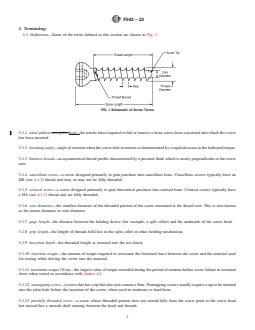
3.1 Definitions—Some of the terms defined in this section are shown in Fig. 1.
FIG. 1 Schematic of Screw Terms
3.1.1 axial pullout strength—load—the tensile force required to fail or remove a bone screw from a material into which the screw
has been inserted.
3.1.2 breaking angle—angle of rotation when the screw fails in torsion as demonstrated by a rapid decrease in the indicated torque.
3.1.3 buttress thread—an asymmetrical thread profile characterized by a pressure flank which is nearly perpendicular to the screw
axis.
3.1.4 cancellous screw—a screw designed primarily to gain purchase into cancellous bone. Cancellous screws typically have an
HB (see 4.1.2) thread and may or may not be fully threaded.
3.1.5 cortical screw—a screw designed primarily to gain biocortical purchase into cortical bone. Cortical screws typically have
a HA (see 4.1.1) thread and are fully threaded.
3.1.6 core diameter—the smallest diameter of the threaded portion of the screw measured at the thread root. This is also known
as the minor diameter or root diameter.
3.1.7 gage length—the distance between the holding device (for example, a split collet) and the underside of the screw head.
3.1.8 grip length—the length of threads held fast in the split collet or other holding mechanism.
3.1.9 insertion depth—the threaded length as inserted into the test block.
3.1.10 insertion torque—the amount of torque required to overcome the frictional force between the screw and the material used
for testing while driving the screw into the material.
3.1.11 maximum torque (N-m)—the largest value of torque recorded during the period of rotation before screw failure in torsional
shear when tested in accordance with Annex A1.
3.1.12 nontapping screw—a screw that has a tip that does not contain a flute. Nontapping screws usually require a tap to be inserted
into the pilot hole before the insertion of the screw, when used in moderate or hard bone.
3.1.13 partially threaded screw—a screw whose threaded portion does not extend fully from the screw point to the screw head
but instead has a smooth shaft running between the head and threads.
F543 − 23
3.1.14 pilot hole—the hole drilled into the bone into which the screw tip is inserted. The pilot hole is normally slightly larger than
the screw’s core diameter. However, if the screw is to be used to provide compression across a fracture, a portion of the pilot hole
may be larger to allow for a clearance fit.
3.1.15 pitch—the length between the thread crests.
3.1.16 removal torque—the amount of torque required to overcome the frictional force between the screw and the material used
for testing while removing the screw from the material (for example, counterclockwise rotation for right-hand thread).
3.1.17 screw head—the end of the screw which is opposite of the tip and to which the means of inserting the screw is coupled.
3.1.18 screw length—the overall length of the screw measured from the screw head to the screw tip.
3.1.19 screw thread—a helical groove on a cylindrical or conical surface. The projecting helical ridge thus formed is called a screw
thread, consisting of peaks (crests) and valleys (roots).
3.1.20 self-tapping force (N)—the amount of axial force required to engage the self-tapping features of self-tapping style screws
when tested in accordance with Annex A4.
3.1.21 self-tapping screw—a screw that has any number of flutes at its tip which are intended to cut the screw’s thread form into
the bone upon insertion.
3.1.22 size—an identification of a screw based on its nominal thread diameter, as defined in Section 6.
3.1.23 solid core—a screw that does not contain a cannulation along its longitudinal axis.
3.1.24 thread diameter—the largest diameter of the threaded portion of the screw measured over the thread crests. This is also
known as the major diameter.
3.1.25 thread length—the length of the threaded portion of the screw, measured from the thread runout to the screw tip.
3.1.26 thread runout—the intersection of the screw thread with either the screw shaft or screw head.
3.1.27 torsional yield strength (N-m)—the point at which the screw reaches its proportional limit when tested in accordance with
Annex A1. This will be determined by the offset method. A 2° offset value shall be used.
4. Classification
4.1 There are a large variety of medical bone screws currently in use. They may be classified by the definitions provided in Section
3. This specification currently includes information that defines the following types of screws:
4.1.1 Type HA—Spherical undersurface of head, shallow, asymmetrical buttress thread, and deep screw head.
4.1.2 Type HB—Spherical undersurface of head, deep, asymmetrical buttress thread, and shallow screw head.
4.1.3 Type HC—Conical undersurface of head, symmetrical thread.
4.1.4 Type HD—Conical undersurface of head, asymmetrical thread.
5. Material
5.1 Screws shall be fabricated from a metallic material intended for surgical implant applications, and meeting the requirements
for an ASTM medical material. In addition, the materials shall be biocompatible for the intended application.
F543 − 23
6. Dimensions and Tolerances
6.1 There are many types of metallic bone screw designs available, so a complete list of dimensions and tolerances for all screws
covered by this specification is unfeasible. However, this specification does provide required dimensions and tolerances for four
types of screws as classified in 4.1. Screws conforming to this specification, and designated HA, HB, HC, or HD screws, shall be
fabricated in accordance with the dimensions and tolerances described in Annex A5 and Annex A6Annex A5 and Annex A6.
7. Finish and Marking
7.1 The screw shall be free from nicks, dents, burrs, and scratches when examined in accordance with Practice F86.
7.2 When size permits, the following information should be legibly marked on the head of the screw (in order of preference):
7.2.1 Manufacturer’s name or logo,
7.2.2 Screw Size—If a screw is manufactured in accordance with ASTM or ISO specifications, the ASTM or ISO designation
should be provided,
7.2.3 Material,
7.2.4 Catalog number, and
7.2.5 Manufacturing lot number.
7.3 Screws shall be marked in accordance with Practice F983, unless otherwise specified in 7.2, in a manner such that the
mechanical integrity of the screw is not compromised.
8. Care and Handling
8.1 Screws should be cared for and handled in accordance with Practice F565, as appropriate.
8.2 Consider Practice F2503 to identify potential hazards produced by interactions between the device and the MR environment
and for terms that may be used to label the device for safety in the MR environment.
9. Driving Instruments
9.1 A variety of screwdrivers for the insertion and removal of bone screws exist. The classification and dimensions for various
screw-drive recesses currently used in the medical industry are documented in Annex A7. Specification F116 provides related
dimensional information for several types of medical screwdrivers.
9.2 Screws conforming to this specification, and designated HA, HB, HC, or HD screws, shall be manufactured with drive recesses
that conform to the requirements specified in Annex A5 and Annex A6Annex A5 and Annex A6.
10. Performance Considerations and Test Methods
10.1 The following properties may be important when determining the suitability of a screw for a particular application. However,
the test methods referenced as follows may not be appropriate for all types of implant applications. The user is cautioned to
consider the appropriateness of the test methods in view of the devices being tested and their potential application.
10.1.1 Torsional Strength—This test method is an important parameter to prevent screw breakage during insertion or removal. The
torsional strength shall be determined using the test methods described in Annex A1.
10.1.2 Breaking Angle—This test method provides a measure of the ductility of the screw when undergoing a torsional moment.
A screw with a greater breaking angle may provide an earlier tactile warning to the surgeon that the screw is reaching its maximum
torsional strength. The breaking angle shall be determined using the test methods described in Annex A1.
F543 − 23
10.1.3 Axial Pullout Strength—Load—This test method may be an important parameter if the screw is subjected to axial tensile
forces, or if the screw is fixed into poor quality or osteoporotic bone. The pullout strengthload may be determined using the test
methods described in Annex A3.
10.1.4 Insertion Torque—This test method may be an important parameter to avoid failure of the screw during insertion and to
ensure that the screw may be easily inserted by the surgeon. The insertion torque should be much less than torsional yield strength
of the screw and of the appropriate screwdriver bit. The insertion torque may be determined using the test methods described in
Annex A2.
10.1.5 Removal Torque—This test method may be an important parameter to avoid failure of the screw during removal and to
ensure that the screw may be easily removed by the surgeon. The removal torque should be much less than torsional yield strength
of the screw and of the appropriate screwdriver bit. The removal torque may be determined using the test methods described in
Annex A2.
10.1.6 Self-Tapping Force—This test method may be an important parameter to ensure that the screw may be easily inserted by
the surgeon, particularly if the screw is fixed in poor quality or osteoporotic bone. The self-tapping force may be determined using
the test method described in Annex A4.
11. Performance Requirements
11.1 Screws shall meet the mechanical performance requirements specified in its associated specification annex.
12. Keywords
12.1 bone screw; dimensions; insertion; performance requirements; pullout; static; test methods; torsion
ANNEXES
(Mandatory Information)
A1. TEST METHOD FOR DETERMINING THE TORSIONAL PROPERTIES OF METALLIC BONE SCREWS
A1.1. Significance and Use
A1.1.1 This test method is used to measure the torsional yield strength, maximum torque, and breaking angle of the bone screw
under standard conditions. The results obtained in this test method are not intended to predict the torque encountered while
inserting or removing a bone screw in human or animal bone. This test method is intended only to measure the uniformity of the
product tested or to compare the mechanical properties of different, yet similarly sized, products.
A1.2. Apparatus
A1.2.1 Testing Fixture—The torsion testing apparatus that is to be used for applying the required torque to the specimen shall be
calibrated for the range of torques and rotational displacements used in the determination. A suitable testing fixture for the
torsional yield strength-maximum strength maximum torque-breaking angle test is illustrated in Fig. A1.1.
A1.2.1.1 Test Speed—The torsional force shall be applied at a constant rate of 1 to 5 r/min.
A1.2.1.2 Torque Transducer—A transducer to translate the applied torque into an electrical signal amenable to continuous
recording, calibrated over the range of torques, both in the clockwise and counterclockwise rotation, to be encountered in the test
method, shall be provided.
At the time that this specification was approved, no standard test method for the verification of torsion machines or transducers has been accepted. The user is urged
to review Terminology E6 and Test Methods E8E8/E8M for general guidance.
F543 − 23
FIG. A1.1 Test Apparatus for Determination of Torsional Breaking Force and Breaking Angle
A1.2.1.3 Torsional Displacement Transducer—A transducer to translate the angle of twist into an electrical signal amenable to
continuous recording, calibrated over the range of angles to be encountered in the test and an accuracy of 60.3°, both in the
clockwise and counterclockwise rotation, shall be provided.
A1.2.1.4 Specimen Holder—A mechanical device to clamp onto the bone screw to prevent its rotation while being stressed without
significantly damaging its mechanical integrity shall be provided. One such method is to insert a threaded stopper into the opposite
side of a test block. The test block for this holding mechanism will accommodate the insertion of a threaded stopper on the other
side of the test block. The threaded stopper will prevent the screw from being completely inserted into the test block and will allow
the torsional strength of the screw to be measured. This holder will be modified according to the size of the testing specimen so
that the gage length of the specimen will be as outlined in A1.3.1.
A1.2.1.5 Recorder—The data recorder shall be suitable to continuously record torque versus angle of rotation, calibrated in units
of Newton-metresnewton-meters for torque and degrees for angle of rotation. The value of torque shall have a resolution of 5 %
of torsional yield strength. The angular displacement scale shall have a minimum sensitivity so as to enable an accurate offset
measurement capability for a 2° angular displacement (see A1.3.3).
A1.2.2 Test Specimen—The test specimen shall be a completely fabricated and finished bone screw.
A1.3. Procedure
A1.3.1 Torsional Yield Strength, Maximum Torque, and Breaking Angle—Place the specimen in the holding device so that five
threads,threads below the head of the screw,screw are exposed outside the holding device (for example, split collet, and so forth).
If the test specimen cannot accommodate this setup because the screw is too small or is partially threaded, alternate procedures
may be used. For fully threaded screws that are too small, the gage length of the specimen should represent 20 % of the threaded
portion of the test specimen. For partially threaded screws, a large enough portion of the screw thread should be gripped to firmly
secure the screw so that it does not rotate when under torsional load. There are no specific requirements on the gage length or the
grip length in this case; however, at least one full thread shall be exposed, if possible. Since the gage length and grip length can
vary for these screws, the only requirement is that both be reported.
A1.3.2 The gage length or grip length should be kept the same length for test screws of similar design. If a split collet and collet
holder are used, the following test method is appropriate. Place the split collet in the collet holder. Clamp the split collet and holder
in the vise. The clamping force of the vise should be sufficient to prevent rotation of the screw or the split collet. Drive the specimen
F543 − 23
in the direction of insertion, using an appropriate size and configured screwdriver bit, by applying a torsional force. If an axial load
is required to maintain the screwdriver bit in the screw head, its value should be noted. The torque wrench shall be driven at a rate
of 1 to 5 revolutions/min (r/min).
NOTE A1.1—The simultaneous use of two chart recorders may simplify the ability to measure torsional yield strength accurately by the offset method.
One chart recorder with an angular displacement scale or sensitivity of 50°/cm is convenient for measuring maximum torque and breaking angle. A second
chart recorder with an angular displacement scale or sensitivity of 10°/cm or less is suggested to provide accurate offset measurement capability for
measuring a 2° angular displacement. Alternatively, one chart recorder and a digital storage oscilloscope may be used.
A1.3.3 The torsional yield strength will be determined by the offset method (Fig. A1.2), using the torque versus angle of rotation
curve produced in A1.3.1 and A1.3.2.
A1.3.3.1 On the torque versus angle of rotation curve, locate Point m equal to a rotation of 2°. Draw mn parallel to OA, and locate
b, the intersection of mn with the torque versus angle of rotation curve. Torque B is defined as the torsional yield strength.
A1.3.3.2 The maximum torque is determined by the largest value of torque on the torque versus angle of rotation curve.
A1.3.3.3 The breaking angle is determined from the torque versus angle plot shown in Fig. A1.3. The breaking angle is defined
as the point at which the torque portion of the curve demonstrates its most rapid descent (negative slope) to total failure. The
breaking angle (B.A.) is determined as the intersection of the two tangents (D and E) shown in Fig. A1.3. Line E is a tangent to
the horizontal portion of the curve which represents maximum torque. Line D is drawn at the curve’s most rapid descent. The
intersection of these two lines is the breaking angle (B.A.) and is recorded to the nearest 10°.
A1.4. Report
A1.4.1 Report the following information for each specimen tested:
A1.4.1.1 Screw Identification—Reference any applicable ASTM or ISO specification that may apply to the specimen. If
specifications do not exist, provide head form, thread form, major and minor diameter, thread pitch, overall screw length, head and
shank (unthreaded portion of the screw excluding the head) length, and type of screw point.
FIG. A1.2 Typical Torque Versusversus Angle of Rotation Curve
F543 − 23
FIG. A1.3 Typical Plot of Torque Versusversus Torsion Angle
A1.4.1.2 Screw chemical composition.
A1.4.1.3 Surface finish.
A1.4.1.4 Gage length.
A1.4.1.5 Torsional yield strength.
A1.4.1.6 Maximum torque.
A1.4.1.7 Breaking angle.
A1.4.1.8 Torque versus angle of rotation plot.
A1.4.1.9 The size of the exposed portion of the screwdriver (that is, the length and diameter relative to the tested screw) or the
angular deformation of the screwdriver assembly at maximum torque.
A1.4.1.10 Grip Length—Does not have to be reported for a fully threaded screw of ASTM or ISO specification whose overall
length is given.
A1.4.1.11 Fracture Location—The location can be specified by listing the number of threads below the head at which the screw
fails or by measuring the distance below the head to the approximate fracture point.
A1.5. Precision and Bias
A1.5.1 Data establishing the precision and bias to be expected from this test method have not yet been obtained.
F543 − 23
A2. TEST METHOD FOR DRIVING TORQUE OF MEDICAL BONE SCREWS
A2.1. Significance and Use
A2.1.1 This test method is used to measure the torque required to drive a bone screw into a standard material. The results obtained
in this test method bear no direct correlation to the insertion torque required to insert the subject bone screw in human or animal
bone. This test method should be used only for the purpose of maintaining the uniformity of the product tested.
A2.2. Apparatus
A2.2.1 Testing Fixture—A suitable test fixture as shown in Fig. A2.1 may be used for the insertion-removal torque tests. This
fixture shall incorporate the test block material that conforms to Specification F1839, test block clamp, drill bushing, bushing (if
necessary to maintain alignment), and bushing support depicted. It shall be sufficiently rigid to not deflect or deform under the
conditions of loading encountered during the test.(if drill bushing is used).
A2.2.1.1 Torque Transducer—A transducer to convert the applied torque into an electrical signal amenable to continuous
recording, calibrated over the range of torques, both in both the clockwise and counterclockwise rotation, to be encountered in the
test shall be provided.
A2.2.1.2 Torsional Displacement Transducer—A transducer to translate the angle of twist into an electrical signal amenable to
continuous recording, calibrated in a manner similar to Practices E4 over the range of angles to be encountered in the test to an
accuracy of 60.3°, both in both the clockwise and counterclockwise rotation, shall be provided.
A2.2.1.3 Data Recorder—The data recorder shall be suitable to record torque versus angle of rotation continuously, calibrated in
units of newton-metresnewton-meters for torque and degrees for angle of rotation. The value of torque shall have a resolution of
10 % of the maximum measured torque. The angular displacement scale shall have sensitivity such that at least four revolutions
can be recorded and displayed.
A2.2.1.4 Bushing—A suitable replaceable bushing, fabricated from material that conforms to Specification F1839, shall be
incorporated into the testing fixture. This bushing shall be of sufficient length and rigidity to ensure that specimens are driven into
the test block normal to the top surface of the test block. The bore of the bushing shall be of such dimension as to ensure guidance
of the test specimen with minimum frictional resistance between the major diameter of the test specimen and the bore of the
bushing. Worn bushings shall be discarded and replaced with new bushings before conducting the test.
FIG. A2.1 Schematic of Test Apparatus for Driving Force
F543 − 23
A2.2.1.4 Test Block Clamp—A clamp or holding device shall be incorporated into the testing fixture. This holding device clamp
shall maintain the drilled pilot hole in the test block in line with the test specimen. The holding device shall not deform the test
block during clamping of the test block or performance of the test.
A2.2.1.5 Test Specimen—The test specimen shall be a completely fabricated, finished, and sterilized finished bone screw of
sufficient length to transverse the bushing and traverse the test block.
A2.2.1.6 Test Block—The test block shall be fabricated from a uniform material that conforms to Specification F1839. The choice
of appropriate foam density for this test is at the discretion of the user. See Section 8.6.2 of Specification F1839 for additional
information. To accommodate the requirements of the pilot hole as described in A2.2.1.8A2.2.1.7, the smallest dimension of the
test block’s surface shall be greater than 10×5× the diameter of the screw under test. The top and bottom surfaces shall be flat,
smooth, and parallel (within 60.4 mm) as required to ensure that the test block will be supported in the fixture with the top surface
at an angle of 90° to the centerline of the test specimen. The edges of the test block shall be of such contour or squareness as
required to ensure that the test block clamp shall hold the test block free of relative motion without deformation of the test block
during clamping or testing. The test block test block thickness shall be not less than 4.8 mm.1.25× the intended insertion depth.
A2.2.1.7 Pilot Holes in Test Block—Pilot holes shall be drilled in the test block for insertion and removal of the test specimen.
specimen for test specimens that require pilot holes. The drill size used shall be that specified by the screw manufacturer,
manufacturer for the size screw being tested. If specified by the screw manufacturer, the specified sized tap shallcould be used to
tap the pilot hole before testing. The holes shall be drilled at 90° perpendicular to the top surface of the test block. The holes shall
be drilled straight and true, free of taper, bell mouth, or barrel shape. If there are multiple holes in one test block, the pilot holes
shall be spaced sufficiently far away from test block edges so that testing does not deform the test block edges. Spacing should
have a minimum distance of 5× the diameter of the screw. When the test block is inserted into the test fixture (Fig. A2.1), the pilot
hole, screw, and screwdriver shall be on the same axis.
A2.2.1.8 Screwdriver Bit—A screwdriver bit shall be used to insert or remove bone screws on test blocks. An off-the-shelf
screwdriver bit may be used in lieu of a screwdriver bit that is representative of the instruments indicated to be used with the screw,
only if the screwdriver bit is not a source or cause of failure during insertion or removal of the bone screw.
A2.3. Sampling
A2.3.1 Representative random samples may be taken from each lot or processing quantity in accordance with Practice E122.
Minimum sample size is n = 5.
A2.4. Procedure
A2.4.1 Insertion and Removal Torque—Place the specimen in the test fixture as illustrated in Fig. A2.1. Zero the load where the
tip of the screw is not in contact with the test block. Zero the displacement where the tip of the screw is flush with the test surface
of the block. Drive the specimen into the test block, using the appropriate size and configured screwdriver bit, by applying a
torsional force at a rate of 1 to 5 r/min, r/min (3 rpm is recommended) to the head of the specimen with the motor-driven torque
wrench. The insertion torque shall be the maximum reading recorded during the initial four revolutions of the specimen. The
removal torque shall be measured by reversing the direction of rotation and recording the maximum torque recorded during the
four revolutions required to remove the screw from the test block. machine actuator. Values should be reported in Newton-metres.
A 1.14-kgf or less axial load should be used to maintain newton-meters. The exposed length of the screwdriver bit in shall be equal
to 20 mm, or less if justified (see X1.10the screw head during both the insertion and removal procedures. If a larger axial load is
applied, this load shall be recorded on the report form. This load may be measured by any appropriate method.). For fully threaded
screws, 20 mm of the thread length shall be inserted into the test block. For fully threaded screws with threaded lengths equal or
less than 20 mm, 100 % of the threaded length of the screw shall be inserted, except by one thread below the screw’s head, which
may be left exposed. For partially threaded screws, 20 mm or 100 % of the threaded length of the screw shall be inserted into the
test block. For comparison between partially threaded screws with different thread lengths, they should all be inserted to the same
depth. The insertion torque shall be the maximum reading recorded during the insertion of the specimen.
F543 − 23
A2.4.2 Removal Torque—The removal torque measurement is optional. If it is conducted, it shall be measured by reversing the
direction of rotation and recording the torque during the removal of the screw from the test block. The removal torque shall be
the maximum reading recorded during the removal of the specimen.
A2.4.3 Axial Load for Insertion and Removal Torque Measurements—An axial load of 11.5 N or less should be used to maintain
the screwdriver bit in the screw head during both the insertion and removal procedures. If a larger axial load is applied, this load
shall be recorded on the report form. This load may be measured by any appropriate method. Torque values should be reported
in newton-meters.
A2.5. Report
A2.5.1 The report shall include the following for each specimen tested. (All standards units for reporting shall be in SI units.)
A2.5.1.1 Screw Identification—Reference any applicable ASTM or ISO standard specification that may apply to the specimen. If
specifications do not exist, provide head form, thread form, major and minor diameter, thread pitch, overall screw length, head and
shank (unthreaded portion of the screw excluding the head) length, and type of screw point.
A2.5.1.2 Screw chemical composition.material.
A2.5.1.3 Surface Screw surface finish.
A2.5.1.4 Insertion torque.
A2.5.1.4.1 Axial load required.applied during insertion.
A2.5.1.4.2 Insertion depth (may be calculated or measured).
A2.5.1.4.3 Specification of whether the pilot holes were or were not pretapped, if pretapped, specifications of the tap size, tap
diameter, and tap depth shall be reported.
A2.5.1.4.4 Insertion test speed if outside the range different from specified in A2.4.1.
A2.5.1.5 Removal torque.torque, if applicable.
A2.5.1.5.1 Axial load required.applied during removal.
A2.5.1.5.2 Removal test speed if outside the range specified different from specified for insertion torque in A2.4.1.
A2.5.1.6 Test Block Material Description—Specification F1839 grade. For bushing test block material that does not conform to
Specification F1839, provide the following information:
F543 − 23
A2.5.1.6.1 Trade name.
A2.5.1.6.2 Composition.
A2.5.1.6.3 Density.
A2.5.1.6.4 Tensile strength.
A2.5.1.6.5 Compression strength.
A2.5.1.6.6 Shear strength.
A2.5.1.7 Test Machine—List relevant information about the test machine and provide the calibrated range of the load cell and
torque wrench used.
A2.5.1.8 Test Environment—For example, air, room temperature, and other relevant environment information.
A2.5.1.9 Deviations from this test method, including description and rationale/justification.
A2.6. Precision and Bias
A2.6.1 Data establishing the precision and accuracy to be expected from this test method have not yet been obtained.
A3. TEST METHOD FOR DETERMINING THE AXIAL PULLOUT STRENGTHLOAD OF MEDICAL BONE SCREWS
A3.1. Significance and Use
A3.1.1 This test method is used to measure the axial tensile force required to fail or remove a bone screw from a defined material.
The results obtained in this test method are not intended to predict the force required to remove the subject bone screw from human
or animal bone. This test method is intended only to measure the uniformity of the products tested or to compare the strength
pullout load of different products.
A3.1.2 This test method may not be appropriate for all types of implant applications. The user is cautioned to consider the
appropriateness of the method in view of the materials being tested and their potential application.
A3.2. Apparatus
A3.2.1 Test Fixture—Machines used for testing the axial pullout strengthload of screws shall conform to the requirements of
Practices E4. A suitable test fixture as shown in Fig. A3.1 may be used. This fixture shall incorporate the test block material which
conforms to Specification F1839, test block clamp, drill bushing, and bushing support depicted in the insertion torque test method,
Annex A2. In addition to these requirements, the test block clamp Drill bushing and bushing support should be sufficiently rigid
such that deflection under the required loading conditions is negligible. are optional. The test block clamp should have a minimum
F543 − 23
FIG. A3.1 Schematic of Test Apparatus for Pullout StrengthLoad
(when drill bushing is used)
grip span of 20 mm or five times the major diameter of the bone screw with the screw centered between the grips. The grip span
should be consistent throughout testing.grips, whichever length is higher.
A3.2.2 Test Block—The test block shall be fabricated from a uniform material that conforms to Specification F1839. The choice
of appropriate foam density for this test is at the discretion of the user. See Section 8.6.2 of Specification F1839 for additional
information. The top and bottom surfaces shall be flat, smooth, and parallel (within 60.4 mm) as required to ensure that the test
block will be supported in the fixture with the top surface at an angle of 90° perpendicular to the centerline of the test specimen.
The edges of the test block shall be of such contour or squareness as required to ensure that Screws inserted during testing shall
be at minimum distance of 5× the diameter of the screw from adjacent screws or the edges of the foam. The depth of the test block
clamp shall hold the test block free of relative motion without deformation of the test block during clamping or testing. The test
block thickness shall be not less than 20 mm.shall not be less than 1.25× the intended insertion depth.
A3.2.3 Data Acquisition Device—Recorder—The data recorder shall be suitable to continuously record load versus load fixture
displacement.
A3.2.4 Load Frame—Machines used for testing shall conform to the requirements of Practices E4. The loads used for the test
method shall be within the loading range of the test machine as defined in Practices E4.
A3.2.5 Load Fixture—A suitable fixture shall be used to place a tensile load on the bone screw. The load shall be transferred
through the head maintain hold of the screw and should be aligned with the screw’s longitudinal axis. The fixture shall have a slot
to capture the head of the screw without contact being made with the screw’s shaft. To ensure proper alignment, the slot shall have
head and pull the screw perpendicular to the block surface throughout the test, allowing the screw to “self-align” during testing.
An example of how this can be achieved is to design a slot either by mimicking the plate hole design or with a spherical recess
into which the screw head can be seated directly under the applied load.
A3.3. Sampling, Test Specimens, and Test Units
A3.3.1 All test components shall be representative of implant quality products. Minimum sample size is n = 5.
F543 − 23
A3.4. Procedure
A3.4.1 Insertion of the Test Specimen—The bone screws shall be inserted into the standard material in accordance with the
insertion torque test method,Drive the specimen into the test block, Annex A2. The screws shall be inserted using the appropriate
screwdriver bit, by applying a torsional force at a rate of 3 r/min to a depth of 20 mm. the head of the specimen with the machine
actuator. For fully threaded screws, 20 mm of the thread length shall be inserted into the test block. For fully threaded screws with
threaded lengths equal to or less than 20 mm, the insertion depth should be 60 % of the threaded length of the screw. insert full
thread length, but one thread below the screw’s head may be exposed in order to allow clearance for the test fixture. Partially
threaded bone screws shouldshall have all threads inserted into the standard material. The test specimen used for insertion torque
measurement (Annex A2) can also be used for pullout load measurement (Annex A3).
A3.4.2 Axial Pullout StrengthLoad of the Test Specimen—The test block and test block clamp depicted in Annex A2 shall be fixed
to the base of the load frame so that the longitudinal axis of the screw is aligned with the direction of the applied load. The screw’s
head shall be placed in the slot of the load fixture and seated in the spherical recess. The load fixture shall then be attached to the
load frame. A tensile load shall be applied to the test specimen at a rate of 5 mm/min until the screw fails or releases from the test
block. Load (newtons) versus load fixture displacement (millimetres)(millimeters) shall be recorded on a data acquisition device,
recorder, noting the maximum load applied and the mode of failure (screw shaft, screw threads, or test block material failure).
A3.5. Calculation or Interpretation of Results
A3.5.1 Axial Pullout Strength—Load—Determine the axial pullout strength (in Newtons)load (in newtons) of the test specimen
from the load-displacement curve. The maximum load is reached during the test method.axial pullout load shall be the maximum
load reading recorded during the pullout of the specimen.
A3.6. Report
A3.6.1 Report the following information:
A3.6.1.1 Screw Identification—Reference any applicable ASTM or ISO standard specification that may apply to the specimen. If
specifications do a specification does not exist, provide head form, thread form, helix angle, major and minor diameter, thread
pitch, overall screw length, head and shank length, length of the threaded portion of the shank for partially threaded screws, and
type of screw point.
A3.6.1.2 Screw chemical composition.material.
A3.6.1.3 Surface Screw surface finish.
A3.6.1.4 Axial pullout strengthload (as defined in 3.1.1).
A3.6.1.5 Grip span.Minimum grip span applied in the test.
A3.6.1.6 Insertion depth.
A3.6.1.7 Test block thickness.Minimum test block thickness applied in the test.
A3.6.1.8 Mode of failure.
F543 − 23
A3.6.1.9 Test Block Material Description—Specification F1839 grade or density. For materials that do not conform to
Specification F1839, provide the following information and the appropriate test methods used to determine the properties of the
test block material:
A3.6.1.9.1 Trade name,
A3.6.1.9.2 Composition,
A3.6.1.9.3 Density,
A3.6.1.9.4 Tensile strength,
A3.6.1.9.5 Compression strength, and
A3.6.1.9.6 Shear strength.
A3.6.1.10 Test Machine—List relevant information about the test machine and provide the calibrated range of the load cell used.
A3.6.1.11 Test Environment—For example, air, room temperature, and other relevant environment information.
A3.6.1.12 Deviations from this test method, including description and rationale/justification.
A3.7. Precision and Bias
A3.7.1 Data establishing the precision and accuracy to be expected from this test method have not yet been obtained.
A4. TEST METHOD FOR DETERMINING THE SELF-TAPPING PERFORMANCE OF SELF-TAPPING MEDICAL BONE
SCREWS
A4.1 Significance and Use
A4.1.1 This test method is used to dete
...