

ASTM E1065/E1065M-20
(Practice)Standard Practice for Evaluating Characteristics of Ultrasonic Search Units
General Information
- Abstract
SIGNIFICANCE AND USE
5.1 This practice is intended to provide standardized procedures for evaluating ultrasonic search units. It is not intended to define performance and acceptance criteria, but rather to provide data from which such criteria may be established.
5.2 These procedures are intended to evaluate the characteristics of single-element piezoelectric search units.
5.3 Implementation may require more detailed procedural instructions in a format of the using facility.
5.4 The measurement data obtained may be employed by users of this practice to specify, describe, or provide a performance criteria for procurement and quality assurance, or service evaluation of the operating characteristics of ultrasonic search units. All or portions of the practice may be used as determined by the user.
5.5 The measurements are made primarily under pulse-echo conditions. To determine the relative performance of a search unit as either a transmitter or a receiver may require additional tests.
5.6 While these procedures relate to many of the significant parameters, others that may be important in specific applications may not be treated. These might include power handling capability, breakdown voltage, wear properties of contact units, radio-frequency interference, and the like.
5.7 Care must be taken to ensure that comparable measurements are made and that users of the practice follow similar procedures. The conditions specified or selected (if optional) may affect the test results and lead to apparent differences.
5.8 Interpretation of some test results, such as the shape of the frequency response curve, may be subjective. Small irregularities may be significant. Interpretation of the test results is beyond the scope of this practice.
5.9 Certain results obtained using the procedures outlined may differ from measurements made with ultrasonic test instruments. These differences may be attributed to differences in the nature of the experiment or the electrical characteristic...
SCOPE
1.1 This practice covers measurement procedures for evaluating certain characteristics of ultrasonic search units (also known as “probes”) that are used with ultrasonic testing instrumentation. This practice describes means for obtaining performance data that may be used to define the acoustic and electric responses of ultrasonic search units.
1.2 The procedures are designed to measure search units as individual components (separate from the ultrasonic test instrument) using commercial search unit characterization systems or using laboratory instruments such as signal generators, pulsers, amplifiers, digitizers, oscilloscopes, and waveform analyzers.
1.3 The procedures are applicable to manufacturing acceptance and incoming inspection of new search units or to periodic performance evaluation of search units throughout their service life.
1.4 The procedures in Annex A1 – Annex A6 are generally applicable to ultrasonic search units operating within the 0.4 to 10 MHz range. Annex A7 is applicable to higher frequency immersion search unit evaluation. Annex A8 describes a practice for measuring sound beam profiles in metals from contact straight-beam search units. Additional Annexes, such as sound beam profiling for angle-beam search units in metal and alternate means for search unit characterization, will be added when developed.
1.5 Units—The values stated in either SI units or inch-pound units are to be regarded separately as standard. The values stated in each system are not necessarily exact equivalents; therefore, to ensure conformance with the standard, each system shall be used independently of the other, and values from the two systems shall not be combined.
1.6 This standard does not purport to address all of the safety concerns, if any, associated with its use. It is the responsibility of the user of this standard to establish appropriate safety, health, and environmental practices and determine the ...
- Status
- Published
- Publication Date
- 14-Jan-2020
- Technical Committee
- E07 - Nondestructive Testing
- Drafting Committee
- E07.06 - Ultrasonic Method
Buy Documents
ASTM E1065/E1065M-20 - Standard Practice for Evaluating Characteristics of Ultrasonic Search Units
REDLINE ASTM E1065/E1065M-20 - Standard Practice for Evaluating Characteristics of Ultrasonic Search Units
Overview
ASTM E1065/E1065M-20 is a standard practice published by ASTM International for evaluating the characteristics of ultrasonic search units, also known as probes, used in conjunction with ultrasonic testing instrumentation. This standard provides a set of measurement procedures to obtain performance data describing the acoustic and electrical behavior of ultrasonic search units as individual components, separate from the testing instrument itself. The intent is to enable users, manufacturers, and quality assurance professionals to obtain consistent and comparable data that can help establish their own acceptance criteria and detailed procedures within various facilities.
Key Topics
Scope and Purpose
- Defines standardized procedures for evaluating single-element piezoelectric ultrasonic search units.
- Does not impose performance criteria, but provides data to inform such criteria.
- Intended for both new unit acceptance and periodic in-service evaluation.
Evaluation Parameters
- Procedures focus on key characteristics, including:
- Frequency response
- Bandwidth and center frequency
- Relative pulse-echo sensitivity
- Time (waveform) response
- Electrical impedance (magnitude and phase)
- Sound field parameters (beam profiles)
- Most evaluation conducted under pulse-echo conditions.
- Procedures focus on key characteristics, including:
Applicable Frequency Ranges
- Procedures generally apply to search units operating from 0.4 to 10 MHz, with some annexes covering higher frequency immersion probes and specific beam profile measurements.
Testing Methods
- Methods can involve commercial search unit characterization systems or laboratory instruments such as signal generators, pulsers, oscilloscopes, digitizers, amplifiers, and waveform analyzers.
- Detailed protocols for measurement and data collection are summarized, with references to annexes for specific equipment and techniques.
Flexibility in Application
- The standard allows users to apply only relevant portions, depending on specific testing requirements.
- Allows for adaptation to facility-specific procedural details as required.
Applications
Quality Control and Procurement
- Supports manufacturing acceptance and incoming inspection of new ultrasonic search units.
- Facilitates the development of procurement specifications and performance criteria based on measured characteristics.
Periodic Evaluation
- Enables periodic or service-life checks of ultrasonic probe performance to ensure continued reliability and consistency.
Calibration and Documentation
- Provides consistent, repeatable baseline data for calibration records in nondestructive testing (NDT) programs.
- Aids in identifying drift, degradation, or failure in ultrasonic probes.
Establishing Performance Criteria
- Offers foundational measurement data that can be used to define facility- or application-specific acceptance criteria.
Training and Procedure Development
- Serves as an educational reference for NDT personnel in understanding and applying consistent evaluation methods.
Related Standards
- ASTM E1316 – Terminology for Nondestructive Examinations: Provides definitions crucial for interpreting and applying ASTM E1065/E1065M-20.
- ISO 10375:1997 – Non-destructive Testing-Ultrasonic Inspection-Characterization of Search Unit and Sound Field: Internationally recognized procedures aligning with the practice.
- AIUM Standard Methods for Testing Single Element Pulse-Echo Ultrasonic Transducers: Related methodologies for assessing transducer characteristics.
These related standards can be referenced for terminology, additional methodologies, and global harmonization of testing practices.
Keywords: ASTM E1065, ultrasonic search unit evaluation, probe characterization, ultrasonic testing, NDT probe calibration, frequency response, pulse-echo sensitivity, bandwidth measurement, electric impedance, sound field measurement, nondestructive testing standards.
Relations
- Effective Date
- 01-Feb-2024
- Effective Date
- 01-Dec-2019
- Effective Date
- 01-Mar-2019
- Effective Date
- 01-Jan-2018
- Effective Date
- 15-Jun-2017
- Effective Date
- 01-Feb-2017
- Effective Date
- 01-Aug-2016
- Effective Date
- 01-Feb-2016
- Effective Date
- 01-Dec-2015
- Effective Date
- 01-Sep-2015
- Effective Date
- 01-Jun-2014
- Effective Date
- 01-Jun-2014
- Effective Date
- 01-Dec-2013
- Effective Date
- 15-Jun-2013
- Effective Date
- 01-Jun-2013
Buy Documents
ASTM E1065/E1065M-20 - Standard Practice for Evaluating Characteristics of Ultrasonic Search Units
REDLINE ASTM E1065/E1065M-20 - Standard Practice for Evaluating Characteristics of Ultrasonic Search Units
Get Certified
Connect with accredited certification bodies for this standard

BSMI (Bureau of Standards, Metrology and Inspection)
Taiwan's standards and inspection authority.
Sponsored listings
Frequently Asked Questions
ASTM E1065/E1065M-20 is a standard published by ASTM International. Its full title is "Standard Practice for Evaluating Characteristics of Ultrasonic Search Units". This standard covers: SIGNIFICANCE AND USE 5.1 This practice is intended to provide standardized procedures for evaluating ultrasonic search units. It is not intended to define performance and acceptance criteria, but rather to provide data from which such criteria may be established. 5.2 These procedures are intended to evaluate the characteristics of single-element piezoelectric search units. 5.3 Implementation may require more detailed procedural instructions in a format of the using facility. 5.4 The measurement data obtained may be employed by users of this practice to specify, describe, or provide a performance criteria for procurement and quality assurance, or service evaluation of the operating characteristics of ultrasonic search units. All or portions of the practice may be used as determined by the user. 5.5 The measurements are made primarily under pulse-echo conditions. To determine the relative performance of a search unit as either a transmitter or a receiver may require additional tests. 5.6 While these procedures relate to many of the significant parameters, others that may be important in specific applications may not be treated. These might include power handling capability, breakdown voltage, wear properties of contact units, radio-frequency interference, and the like. 5.7 Care must be taken to ensure that comparable measurements are made and that users of the practice follow similar procedures. The conditions specified or selected (if optional) may affect the test results and lead to apparent differences. 5.8 Interpretation of some test results, such as the shape of the frequency response curve, may be subjective. Small irregularities may be significant. Interpretation of the test results is beyond the scope of this practice. 5.9 Certain results obtained using the procedures outlined may differ from measurements made with ultrasonic test instruments. These differences may be attributed to differences in the nature of the experiment or the electrical characteristic... SCOPE 1.1 This practice covers measurement procedures for evaluating certain characteristics of ultrasonic search units (also known as “probes”) that are used with ultrasonic testing instrumentation. This practice describes means for obtaining performance data that may be used to define the acoustic and electric responses of ultrasonic search units. 1.2 The procedures are designed to measure search units as individual components (separate from the ultrasonic test instrument) using commercial search unit characterization systems or using laboratory instruments such as signal generators, pulsers, amplifiers, digitizers, oscilloscopes, and waveform analyzers. 1.3 The procedures are applicable to manufacturing acceptance and incoming inspection of new search units or to periodic performance evaluation of search units throughout their service life. 1.4 The procedures in Annex A1 – Annex A6 are generally applicable to ultrasonic search units operating within the 0.4 to 10 MHz range. Annex A7 is applicable to higher frequency immersion search unit evaluation. Annex A8 describes a practice for measuring sound beam profiles in metals from contact straight-beam search units. Additional Annexes, such as sound beam profiling for angle-beam search units in metal and alternate means for search unit characterization, will be added when developed. 1.5 Units—The values stated in either SI units or inch-pound units are to be regarded separately as standard. The values stated in each system are not necessarily exact equivalents; therefore, to ensure conformance with the standard, each system shall be used independently of the other, and values from the two systems shall not be combined. 1.6 This standard does not purport to address all of the safety concerns, if any, associated with its use. It is the responsibility of the user of this standard to establish appropriate safety, health, and environmental practices and determine the ...
SIGNIFICANCE AND USE 5.1 This practice is intended to provide standardized procedures for evaluating ultrasonic search units. It is not intended to define performance and acceptance criteria, but rather to provide data from which such criteria may be established. 5.2 These procedures are intended to evaluate the characteristics of single-element piezoelectric search units. 5.3 Implementation may require more detailed procedural instructions in a format of the using facility. 5.4 The measurement data obtained may be employed by users of this practice to specify, describe, or provide a performance criteria for procurement and quality assurance, or service evaluation of the operating characteristics of ultrasonic search units. All or portions of the practice may be used as determined by the user. 5.5 The measurements are made primarily under pulse-echo conditions. To determine the relative performance of a search unit as either a transmitter or a receiver may require additional tests. 5.6 While these procedures relate to many of the significant parameters, others that may be important in specific applications may not be treated. These might include power handling capability, breakdown voltage, wear properties of contact units, radio-frequency interference, and the like. 5.7 Care must be taken to ensure that comparable measurements are made and that users of the practice follow similar procedures. The conditions specified or selected (if optional) may affect the test results and lead to apparent differences. 5.8 Interpretation of some test results, such as the shape of the frequency response curve, may be subjective. Small irregularities may be significant. Interpretation of the test results is beyond the scope of this practice. 5.9 Certain results obtained using the procedures outlined may differ from measurements made with ultrasonic test instruments. These differences may be attributed to differences in the nature of the experiment or the electrical characteristic... SCOPE 1.1 This practice covers measurement procedures for evaluating certain characteristics of ultrasonic search units (also known as “probes”) that are used with ultrasonic testing instrumentation. This practice describes means for obtaining performance data that may be used to define the acoustic and electric responses of ultrasonic search units. 1.2 The procedures are designed to measure search units as individual components (separate from the ultrasonic test instrument) using commercial search unit characterization systems or using laboratory instruments such as signal generators, pulsers, amplifiers, digitizers, oscilloscopes, and waveform analyzers. 1.3 The procedures are applicable to manufacturing acceptance and incoming inspection of new search units or to periodic performance evaluation of search units throughout their service life. 1.4 The procedures in Annex A1 – Annex A6 are generally applicable to ultrasonic search units operating within the 0.4 to 10 MHz range. Annex A7 is applicable to higher frequency immersion search unit evaluation. Annex A8 describes a practice for measuring sound beam profiles in metals from contact straight-beam search units. Additional Annexes, such as sound beam profiling for angle-beam search units in metal and alternate means for search unit characterization, will be added when developed. 1.5 Units—The values stated in either SI units or inch-pound units are to be regarded separately as standard. The values stated in each system are not necessarily exact equivalents; therefore, to ensure conformance with the standard, each system shall be used independently of the other, and values from the two systems shall not be combined. 1.6 This standard does not purport to address all of the safety concerns, if any, associated with its use. It is the responsibility of the user of this standard to establish appropriate safety, health, and environmental practices and determine the ...
ASTM E1065/E1065M-20 is classified under the following ICS (International Classification for Standards) categories: 17.140.01 - Acoustic measurements and noise abatement in general. The ICS classification helps identify the subject area and facilitates finding related standards.
ASTM E1065/E1065M-20 has the following relationships with other standards: It is inter standard links to ASTM E1316-24, ASTM E1316-19b, ASTM E1316-19, ASTM E1316-18, ASTM E1316-17a, ASTM E1316-17, ASTM E1316-16a, ASTM E1316-16, ASTM E1316-15a, ASTM E1316-15, ASTM E1316-14e1, ASTM E1316-14, ASTM E1316-13d, ASTM E1316-13c, ASTM E1316-13b. Understanding these relationships helps ensure you are using the most current and applicable version of the standard.
ASTM E1065/E1065M-20 is available in PDF format for immediate download after purchase. The document can be added to your cart and obtained through the secure checkout process. Digital delivery ensures instant access to the complete standard document.
Standards Content (Sample)
This international standard was developed in accordance with internationally recognized principles on standardization established in the Decision on Principles for the
Development of International Standards, Guides and Recommendations issued by the World Trade Organization Technical Barriers to Trade (TBT) Committee.
Designation: E1065/E1065M − 20
Standard Practice for
Evaluating Characteristics of Ultrasonic Search Units
ThisstandardisissuedunderthefixeddesignationE1065/E1065M;thenumberimmediatelyfollowingthedesignationindicatestheyear
of original adoption or, in the case of revision, the year of last revision.Anumber in parentheses indicates the year of last reapproval.
A superscript epsilon (´) indicates an editorial change since the last revision or reapproval.
1. Scope* priate safety, health, and environmental practices and deter-
mine the applicability of regulatory limitations prior to use.
1.1 This practice covers measurement procedures for evalu-
1.7 This international standard was developed in accor-
ating certain characteristics of ultrasonic search units (also
dance with internationally recognized principles on standard-
known as “probes”) that are used with ultrasonic testing
ization established in the Decision on Principles for the
instrumentation. This practice describes means for obtaining
Development of International Standards, Guides and Recom-
performance data that may be used to define the acoustic and
mendations issued by the World Trade Organization Technical
electric responses of ultrasonic search units.
Barriers to Trade (TBT) Committee.
1.2 The procedures are designed to measure search units as
individualcomponents(separatefromtheultrasonictestinstru-
2. Referenced Documents
ment) using commercial search unit characterization systems
2.1 ASTM Standards:
or using laboratory instruments such as signal generators,
E1316Terminology for Nondestructive Examinations
pulsers, amplifiers, digitizers, oscilloscopes, and waveform
2.2 ISO Standards:
analyzers.
ISO 10375:1997 Non-destructive Testing—Ultrasonic
1.3 The procedures are applicable to manufacturing accep-
Inspection—Characterization of Search Unit and Sound
tance and incoming inspection of new search units or to
Field
periodic performance evaluation of search units throughout
2.3 Other Document:
their service life.
Standard Methods for Testing Single Element Pulse-Echo
1.4 The procedures in AnnexA1 – AnnexA6 are generally
Ultrasonic Transducers
applicabletoultrasonicsearchunitsoperatingwithinthe0.4to
10 MHz range. Annex A7 is applicable to higher frequency
3. Terminology
immersion search unit evaluation. Annex A8 describes a
3.1 Definitions—For definitions of terms used in this
practice for measuring sound beam profiles in metals from
practice, see Terminology E1316.
contact straight-beam search units. Additional Annexes, such
3.2 Definitions of Terms Specific to This Standard:
as sound beam profiling for angle-beam search units in metal
3.2.1 aperture, n—the dimension(s) of the active area of the
and alternate means for search unit characterization, will be
piezoelectric element of the search unit as established by
added when developed.
experimentation.
1.5 Units—The values stated in either SI units or inch-
3.2.2 bandwidth (BW), n—that portion of the frequency
pound units are to be regarded separately as standard. The
response that falls within given limits.
values stated in each system are not necessarily exact equiva-
3.2.2.1 Discussion—In this text, the limits used are the
lents; therefore, to ensure conformance with the standard, each
-6dB level, as measured from the peak of the frequency
system shall be used independently of the other, and values
response. The equation used for BW is:
from the two systems shall not be combined.
BW 5 f 2 f /f 3100 (1)
~ !
1.6 This standard does not purport to address all of the u 1 c
safety concerns, if any, associated with its use. It is the
responsibility of the user of this standard to establish appro-
For referenced ASTM standards, visit the ASTM website, www.astm.org, or
contact ASTM Customer Service at service@astm.org. For Annual Book of ASTM
Standards volume information, refer to the standard’s Document Summary page on
This practice is under the jurisdiction of ASTM Committee E07 on Nonde- the ASTM website.
structive Testing and is the direct responsibility of Subcommittee E07.06 on Available from International Organization for Standardization (ISO), ISO
Ultrasonic Method. Central Secretariat, BIBC II, Chemin de Blandonnet 8, CP 401, 1214 Vernier,
Current edition approved Jan. 15, 2020. Published February 2020. Originally Geneva, Switzerland, http://www.iso.org.
approved in 1985. Last previous edition approved in 2014 as E1065/E1065M–14. Available from the American Institute of Ultrasonics in Medicine, 14750
DOI: 10.1520/E1065_E1065M-20. Sweitzer Lane, Suite 100, Laurel, MD 20707-5906.
*A Summary of Changes section appears at the end of this standard
Copyright © ASTM International, 100 Barr Harbor Drive, PO Box C700, West Conshohocken, PA 19428-2959. United States
E1065/E1065M − 20
where: contact search units. Annex A2 describes the procedure for
obtaining bandwidth characteristics.
f = upper frequency,
u
4.1.2 Relative Pulse-Echo Sensitivity (S )—The relative
f = lower frequency, and
rel
f = center frequency. pulse-echo sensitivity may be obtained from the frequency
c
response data obtained using the sinusoidal burst procedure
Bandwidth is expressed as a percentage.
described in Annex A1. The value is obtained from the
3.2.3 center frequency (f ), n—the frequency value calcu-
c
relationship of the amplitude of the voltage applied to the
lated to be at the center of the bandwidth limits.
searchunitandtheamplitudeofthepulse-echosignalreceived
3.2.4 depth of field (F ), n—as measured on the on-axis
from a specified target. AnnexA3 describes the procedure for
D
profileofafocusedsearchunit,thatportionofthesoundbeam
obtaining pulse-echo sensitivity.
that falls within given limits.
NOTE 1—Values for applied and received power, from which insertion
3.2.5 focal length (F ), n—for focused search units, the
L loss might be determined, are not covered with procedures described in
distance from the lens to the focal point. this practice.
3.2.6 focal point (F ), n—for focused search units, the point 4.1.3 Time Response—The time response provides a means
p
along the acoustic axis of the beam in water at which the peak for describing the radio frequency (rf) response of the wave-
form. A shock excitation, pulse-echo procedure is used to
(maximum) pulse-echo amplitude response is recorded from a
ball target reflector. obtain the response. The time or waveform responses are
recorded from specific targets that are chosen for the type of
3.2.6.1 Discussion—This is also referred to as Y
search unit under evaluation (for example, immersion, contact
3.2.7 frequency response, n—the pulse-echo response of the
straight beam, or contact angle beam). AnnexA4 describes the
search unit measured as a function of frequency. (This term is
procedures for measuring time response.
also referred to as frequency spectrum.)
4.1.4 Electrical Impedance:
3.2.8 nominal frequency (f ), n—the frequency stated on
nom
4.1.4.1 Complex Electrical Impedance—The complex elec-
the label supplied by the manufacturer.
trical impedance may be obtained with commercial impedance
3.2.9 on-axis profile, n—a sequence of measurements made
measuring instrumentation, and these measurements may be
along the acoustic axis of the beam of the search unit.
used to provide the magnitude and phase of the impedance of
3.2.10 peak frequency (f ), n—the frequency value at the the search unit over the operating frequency range of the unit.
p
These measurements are generally made under laboratory
maximum amplitude of the frequency response.
conditions with minimum cable lengths or external accessories
3.2.11 pulse duration, n—the length of the electrical im-
and in accordance with the instructions of the instrument
pulse or sinusoidal burst used to excite the search unit as
manufacturer. The value of the magnitude of the complex
expressed in time or number of cycles.
electrical impedance may also be obtained using values re-
3.2.12 pulse echo sensitivity, n—a measurement that com-
corded from the sinusoidal burst techniques as outlined in
pares the amplitude of the applied voltage with the amplitude
Annex A5.
of the pulse-echo voltage recorded from a specified target.
4.1.4.2 d-c Resistance—Thed-cresistanceofthesearchunit
3.2.13 shock excitation, n—a short electrical impulse that is
may provide information regarding the electrical tuning ele-
applied to the search unit.
ments.Measurementsaremadeacrosstheterminalsoftheunit.
3.2.13.1 Discussion—The impulse is typically a negative-
4.1.5 Sound Field Measurements—The objective of these
going voltage spike of fast rise time and short duration.
measurements is to establish parameters such as the on-axis
Typically generated by spike or square wave pulsers.
and transverse sound beam profiles for immersion flat and
focused search units.
3.2.14 transverse profile, n—sequence of measurements
4.1.5.1 Annex A6 and Annex A8 of this practice describe
made along a line perpendicular to the acoustic axis of the
waysformakingsoundfieldmeasurementsforbothimmersion
beam of the search unit.
flatandfocusedsearchunitsinwaterandcontactstraight-beam
3.2.15 sinusoidal burst, n—also known as tone burst.
search units in metal. The literature discusses several ways for
3.2.16 waveform duration, n—the time interval or duration
making these measurements, but the techniques described are
over which the unrectified signal or echo from a specified
relatively simple and easily performed.
target exceeds a selected amplitude level as related to the
4.1.5.2 Means are recommended for making measurements
maximum amplitude of the signal or echo (for example,−20
in an immersion tank, thereby allowing either pulse-echo (ball
or−40 dB).
target) or hydrophone receiver techniques to be followed. The
goal is to provide measurements to evaluate the characteristics
4. Summary of Practice
of search units or to identify changes that may occur as a
4.1 The acoustic and electrical characteristics which can be
function of time or use, or both.
describedfromthedataobtainedbyproceduresoutlinedinthis
4.1.5.3 None of the measurements of sound beam patterns
practice are described as follows:
areintendedtodefinelimitsofperformance.Theyaredesigned
4.1.1 Frequency Response—Thefrequencyresponsemaybe
to provide a common means for making measurements that
obtained from one of two procedures: (a) shock excitation and
may be used to define the initial and inservice performance.
(b) sinusoidal burst. Annex A1 describes procedures for
obtaining frequency response for immersion and zero-degree NOTE 2—No procedure is given for measuring sound beam profile
E1065/E1065M − 20
characteristics for angle-beam search units. Several potential approaches
5.6 While these procedures relate to many of the significant
are being considered, but have not yet gained subcommittee agreement
parameters, others that may be important in specific applica-
(1).
tions may not be treated. These might include power handling
NOTE 3—Frequency Response Displays. The frequency responses in
capability,breakdownvoltage,wearpropertiesofcontactunits,
Fig. 1 and Fig. 2 and throughout the text are displayed as a linear
amplitude (not logarithmic) response as a function of frequency (the use
radio-frequency interference, and the like.
oflogarithmicformatsisvalidandpermissible).Therecordingshowsonly
the positive component or envelope of the responses. While this is the 5.7 Care must be taken to ensure that comparable measure-
normal display for a spectrum analyzer, the sinusoidal burst response is
ments are made and that users of the practice follow similar
shown as only one-half of the actual sinusoidal wave.
procedures. The conditions specified or selected (if optional)
may affect the test results and lead to apparent differences.
5. Significance and Use
5.8 Interpretation of some test results, such as the shape of
5.1 This practice is intended to provide standardized proce-
thefrequencyresponsecurve,maybesubjective.Smallirregu-
duresforevaluatingultrasonicsearchunits.Itisnotintendedto
define performance and acceptance criteria, but rather to larities may be significant. Interpretation of the test results is
provide data from which such criteria may be established. beyond the scope of this practice.
5.2 These procedures are intended to evaluate the charac-
5.9 Certain results obtained using the procedures outlined
teristics of single-element piezoelectric search units.
may differ from measurements made with ultrasonic test
instruments.These differences may be attributed to differences
5.3 Implementation may require more detailed procedural
in the nature of the experiment or the electrical characteristics
instructions in a format of the using facility.
of the instrumentation.
5.4 The measurement data obtained may be employed by
users of this practice to specify, describe, or provide a
5.10 The pulse generator used to obtain the frequency
performance criteria for procurement and quality assurance, or
response and time response of the search unit must have a rise
service evaluation of the operating characteristics of ultrasonic
time, duration, and spectral content sufficient to excite the
search units. All or portions of the practice may be used as
search unit over its full bandwidth, otherwise time distortion
determined by the user.
and erroneous results may result.
5.5 Themeasurementsaremadeprimarilyunderpulse-echo
conditions. To determine the relative performance of a search 6. Typical Results Obtainable from Tests Described in
unit as either a transmitter or a receiver may require additional Annex A1 – Annex A5
tests.
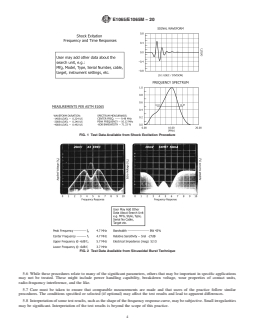
6.1 Fig. 1 illustrates some of the typical results that may be
obtained using shock excitation techniques. Values for fre-
quencyresponse,peakfrequency,bandwidth,bandwidthcenter
5 frequency, and time response may be obtained.
Theboldfacenumbersinparenthesesrefertothelistofreferencesattheendof
this test method.
FIG. 1 Test Data Available from Shock Excitation Procedure
E1065/E1065M − 20
FIG. 2 Test Data Available from Sinusoidal Burst Technique
6.2 Fig. 2 illustrates the typical results obtained using the 7. Keywords
sinusoidal burst technique. Values may be obtained for fre-
7.1 aperture; bandwidth; characterization; contact testing;
quencyresponse,peakfrequency,bandwidth,bandwidthcenter
depth of field; focal point; frequency response; immersion
frequency,relativepulse-echosensitivity,andmagnitudeofthe
testing; peak frequency; search unit; sound beam profile; time
electrical impedance from the data recorded with this tech-
response; ultrasound
nique.
ANNEXES
(Mandatory Information)
A1. MEASUREMENT OF FREQUENCY RESPONSE
A1.1 Introduction—The frequency response (also known as generator driving impedance, search unit impedance, pulse
as frequency spectrum) is a measure of the amplitude of the
shape, and measurement systems. The measurement system to
pulse-echo response from a given target as a function of
be used for search unit evaluation should be established by
frequency. This response is used as the basis for establishing
users of the practice.
other operating parameters of the search unit, including peak
A1.2 Shock Excitation Technique—The shock excitation
frequency, center frequency (see Annex A2), bandwidth (see
AnnexA2),andsensitivity(seeAnnexA3).Sketchesoftypical technique for obtaining frequency response is based on the
response curves are shown in Fig. A1.1. These sketches are principlethatashockpulseappliedtothesearchunitproduces
used to describe two conditions: (a) a response that is sym-
a broad spectrum of energies and that the echo from a given
metricalaboutacenterfrequency,and(b)aconditioninwhich
targetreflectsthefrequencydistributionthatischaracteristicof
the frequency response is asymmetrical.
that search unit. Measurements may be made using either the
analog or digitized rf waveform. Fig. A1.2 describes typical
A1.1.1 Two means are described for obtaining the fre-
components used to measure frequency response of an rf
quencyresponse:(a)shockexcitation,and(b)sinusoidalburst.
analog waveform. The system consists of a search unit, shock
The responses obtained using these procedures provide similar
results; however, reproducibility is dependent on factors such pulsegenerator(pulser),preamplifier(receiver),electronicgate
E1065/E1065M − 20
[a] Symmetrical-Response Curve
[b] Asymmetrical-Response Curve
FIG. A1.1 Frequency-Response Curves
that can be adjusted to capture the echo waveform, display digitized rf waveform. The system consists of a search unit,
oscilloscope, and spectrum analyzer. Fig. A1.3 describes typi- pulser, receiver, gate that can be adjusted to capture the echo
cal components used to measure the frequency response of a waveform, analog to digital converter (digitizer), Fourier
E1065/E1065M − 20
FIG. A1.2 Block Diagram of Shock Excitation System Used to Obtain Analog rf Waveform Information
FIG. A1.3 Block Diagram of Shock Excitation System Used to Obtain Digitized rf Waveform Information
transform calculator, and display. To make the measurement, formisinputtotheFouriertransformcalculatoranddisplayed,
an excitation pulse is applied to the search unit and an echo is (seeFig.A1.3).Theresultantspectrumdescribesthefrequency
obtainedfromaspecifictarget.Thegatedechoismonitoredon
response of the search unit.
an oscilloscope to ensure that only the desired rf waveform is
NOTE A1.1—Special Notice for Frequency Response Measurements.
analyzed. The gated analog rf waveform is input to the
With correct settings, the results from the shock excitation and sinusoidal
burst procedures will produce similar results. However, because of the
spectrum analyzer, (see Fig. A1.2). The gated digitized wave-
E1065/E1065M − 20
multiplevariablesassociatedwithelectroniccomponentsandadjustments,
A1.3.1 Fig. A1.4 is a block diagram for a system designed
some differences may result. Users of the practice must identify the
for displaying and recording the frequency response. The
parameters that will be used to make the measurements.
function generator is adjusted to produce sinusoidal bursts
NOTEA1.2—Pulsergeneratorsusedforshockexcitationofsearchunits
across the range of frequencies anticipated for the operating
aresometimesdesignedtohavelowdrivingor onimpedancesandhigh off
impedances. Generally, the duration of the pulse can be adjusted to frequency of the search unit (for example, 1 to 5MHz for
provideamaximumenergytransfertoasearchunit.Asthepulseduration
2.5MHz, 1 to 10MHz for 5MHz, etc.). The generator pulse
and the output impedance of the generator may influence the actual
width is adjusted to provide a minimum pulse duration of 15
spectrumdeliveredtothesearchunit,caremustbeexercisedtoensurethat
cycles at the lowest measurement frequency. The sinusoidal
the spectrum of energies applied is sufficient to accurately describe the
burst (see Fig. A1.4, Position A) is applied to the search unit,
frequency response of the search unit. Operating parameters of the pulser
shouldbeestablishedbyusersofthepractice.Theelectricalimpedanceof
andthepulse-echoresponsefromagiventargetisrecordedfor
the receiver used can have an influence on the frequency response. The
a specific frequency. The frequency of the bursts is stepped
input impedance of the receiver should be known to reduce the potential
through the frequency range, and the pulse-echo voltage
adverse influence.
response is recorded at each frequency. The returning echo is
NOTE A1.3—For measurement of frequency response, a digitizer
capable of providing a minimum of ten samples per cycle at the nominal gated (Position B) to the center one-half of the echo response
frequency of the search unit is recommended. A sufficient number of
to ensure that transients from the generator or electronics do
cycles should be sampled to reliably reproduce the spectrum of the echo
not influence the measurements. Both the amplitude of the
waveform. Averaging a number of waveforms increases the reliability of
applied voltage and the amplitude of the echo response are
measurements. Specific requirements may be established between the
plotted as a function of frequency (Position C).
supplier and user.
NOTEA1.4—When using the shock excitation technique, the returning
A1.3.2 Influence of Generator Output—Commercial sinu-
echo should be gated such that the gate is wider than the echo to ensure
soidal burst generators typically are designed to provide a
that the rising and decaying portions or the waveform are included in the
frequency response analysis. If a portion of the time response is excluded
constant-voltage output into a 50ohm resistance load. When
from the frequency response, this should be clearly documented by
these generators are loaded by an ultrasonic search unit, the
showing the gate position and width relative to the waveform.
output driving voltage may vary with frequency, depending on
the impedance of the search unit.
A1.3 Sinusoidal Burst Technique—Theprincipleistoapply
a sinusoidal burst of a known voltage and frequency to the A1.3.2.1 Recording Procedure—The initial step in the sinu-
search unit and determine its pulse-echo response. By varying soidal burst recording procedure is to terminate the generator
thefrequencyofthesinusoidalburstacrosstheoperatingrange with a 50ohm resistive load and establish that the output
of the search unit and recording the echo response at each voltage is constant over the frequency range of interest. Once
frequency, a plot of the acoustic frequency is obtained (2). this is established, the 50ohm resistor is removed and the
FIG. A1.4 Block Diagram of a Sinusoidal Burst System (Frequency Response)
E1065/E1065M − 20
of a digitizer with the capability of 10 samples per cycle. For the higher
search unit is connected. The frequency response is obtained
frequencies, this recommendation may be modified by the users, but the
without further adjustment of the generator drive voltage. The
digitize capability employed must be documented.
frequency response and the applied voltage are recorded,
The positioning of the gates is essential for accurately analyzing the
thereby showing the influence of the electrical impedance of
frequency response of the search unit. Fig. A1.6 describes examples for
the search unit:
positioning the gate settings for the digitizer. The gate start should be set
at the initiation of the waveform. The gate end should be set at a position
A1.4 Specific Procedures—The sinusoidal burst and shock that encompasses the entire waveform to the 20 dB level. Waveform A
would indicate an approximate 100% bandwidth, while Waveform D
excitation procedures are applicable to nearly all types of
would indicate a bandwidth of approximately 10%.
searchunits.Theproceduresforevaluatingthecharacterization
of various styles are outlined as follows: A1.4.1.2 Focused Search Units—Aball target may be used
to obtain the frequency response of spherically focused search
A1.4.1 Immersion—Fig. A1.5 shows the test setup for
units. The ball should have a diameter that is at least 10
obtaining frequency response for immersion units.
wavelengthsinwater(forexample,15mm[ ⁄8in.]at1MHzin
A1.4.1.1 Flat Search Units—Flatornonfocusedsearchunits
water). Users may specify frequency response be measured on
areadjustedsothatthedistancefromthefaceofthesearchunit
flat plates or rods for cylindrically focused search units. The
to the target (Z ) is a known value (typically 25mm [1in.] or
o
distance Z should be adjusted for maximum amplitude re-
o
50mm [2in.]).Aflat and smooth glass block with dimensions
sponse from the target. Care must be taken to ensure that no
not smaller than 50 by 50mm [2 by 2in.] by 25mm [1in.]
internal reflections from the reflector or creeping wave signals
thick is recommended as the target. A manipulator is used to
around the balls or rods are included in the recorded response,
adjust for a maximum amplitude response from the target.
as these can distort the response.
(a)Thinner blocks may be used for higher frequency
search units. Thicker blocks may be used for lower frequency
A1.4.2 Contact Straight Beam—Measurements for contact
or larger diameter search units, or both, as agreed upon by
straight-beam search units are made with the unit coupled to
users of this practice.
the test block. Couplant shall be machine oil or other specified
(b)Alltargetsortestblocksmusthaveamaterialthickness
fluid. Fig. A1.7 shows the test setup for contact straight-beam
that is greater than the sinusoidal burst pulse duration of the
search units.A38mm [1 ⁄2in.] flat (32µin.) aluminum block,
excitation voltage.
or a block of other suitable material and dimension, may be
used for the frequency response measurements. The back
NOTE A1.5—Guideline for Analyzing Frequency Response. Ultrasonic
surface of the block is used as the target and the echo response
search units used for nondestructive evaluation typically fall with a range
of100kHzto100MHz.Forshockexcitation,NoteA1.3recommendsuse from this surface is recorded.
FIG. A1.5 Test Setup for Immersion Search Units
E1065/E1065M − 20
FIG. A1.6 Digitizer Gate Positioning
FIG. A1.7 Test Setup for Contact Straight-Beam Search Units
NOTE A1.6—Caution: The immersion procedure is not valid for
A1.4.2.1 Thinner blocks may be used for higher frequency
evaluating contact straight-beam search units that incorporate a hard
search units. Thicker blocks may be used for lower frequency
wear-face plate.
or larger diameter search units, or both, as agreed upon by
users of this practice.
A1.4.2.2 All targets or test blocks must have a material
thicknessthatisgreaterthanthesinusoidalburstpulseduration
of the excitation voltage.
E1065/E1065M − 20
A2. BANDWIDTH AND CENTER FREQUENCY MEASUREMENTS
A2.1 The bandwidth (BW) (sometimes referred to as func- f 1f
l u
f 5 (A2.1)
c
tional or operational bandwidth) of a search unit is a selected 2
portion of the frequency response of the search unit.
A2.4 Bandwidth is then calculated as follows:
A2.2 The lower and upper frequency values (f and f
l u
BW 5 f 2 f /f 3100 ~percentage! (A2.2)
~ !
u l c
respectively) of the bandwidth are defined as the values at
whichtheamplitudeofthepulse-echoresponsehasfallen6dB A2.5 By way of example, the bandwidth for the frequency
below the peak of the frequency response curve (f ) (see Fig. responses shown in Fig. A1.1 (a) and (b) are as follows:
p
A1.1). The peak is chosen as the reference even though it may
A2.5.1 Symmetrical Curve (Fig. A1.1 (a)):
not be at the center frequency (f ). Bandwidth measurements
c
f 5 4.016.1 /2 55.05 MHz (A2.3)
~ !
c
are determined by locating the peak response and then select-
BW 5 ~6.1 24.0!/5.05 3100 542% (A2.4)
ing the f and f values.
l u
A2.5.2 Asymmetrical Curve (Fig. A1.1 (b)):
A2.3 Bandwidth calculations are based on determining the
f 5 3.418.2 /2 55.8 MHz (A2.5)
~ !
c
center frequency, f , in MHz, of the bandwidth as described as
c
follows: BW 5 ~8.2 23.4!/5.8 3100 583% (A2.6)
A3. RELATIVE PULSE-ECHO SENSITIVITY
A3.1 Relative pulse-echo sensitivity (S ) is defined as S 520log~0.2/2.0!5220db
rel rel
follows:
Example B:
S 520logV /V expressedindB (A3.1)
~ !
rel e a
f fif V 52.0 V (A3.3)
nom p a
where V is the peak-to-peak voltage response of the echo
e
from the specific reflector as defined in Annex A1, and V is
V 50.1 V
a
e
the peak-to-peak voltage applied to the search unit. Both V
a
S 520log~0.1/2.0!5226db
andV aremeasuredatthenominalfrequency(f ),asstated rel
e nom
NOTE A3.1—Relative pulse-echo sensitivity measurements may be
by the manufacturer’s label.
made with either analog or digitized rf echo waveforms.
NOTE A3.2—No procedure is given in this practice for determining
A3.1.1 Sinusoidal Burst Procedure—Fig.A3.1describesthe
sensitivity using shock excitation procedures.
data for establishing S from the test results obtained with the
rel
sinusoidal burst procedure. The value for S is established at
rel
A3.2 Search unit sensitivity comparisons made with ultra-
f . In the example shown:
nom
sonic instruments may vary from the values obtained with this
Example A:
procedure and they may vary between types of flaw detectors.
f 5 f V 52.0 V (A3.2) Search unit responses are influenced by the impedance of the
nom p a
pulser, impedance of the search unit and coaxial cable, and the
V 5200mV
e input impedance of the receiver.
E1065/E1065M − 20
FIG. A3.1 Measurement of Sensitivity from Sinusoidal Burst Frequency Response Curve
A4. MEASUREMENT OF TIME RESPONSE
A4.1 Time Response—Thetimeresponseofasearchunitis can be defined. Example is shown in Fig. 1. The terms and
established from the rf waveform of the echo received from a parameters selected in the quantitative description of wave-
given target using the pulse-echo procedure. This response is forms (for example, waveform duration, resolution, and damp-
used as the basis for evaluating other operating and recovery ing) should be defined and agreed upon by users of this
parameters of the search unit such as waveform duration and practice.Waveformdurationmaybemeasuredasaleveleither
damping (Standard Methods forTesting Single Element Pulse- 20 or 40 dB below the peak of the pulse-echo response.As the
Echo Ultrasonic Transducers). Typical examples of waveform time response can be influenced by the input electronics and
duration are shown in Fig. A4.1. impedanceofthereceiver,caremustbetakentoensurethatthe
receiver input is not saturated and that the impedance is high
A4.2 Procedure—The procedure for measuring the time
enough(forexample,500ohmsorgreater)toaccuratelyrecord
response employs the shock excitation techniques defined in
the echo signal.
A1.2 and the procedures outlined in A1.4. Fig. A1.2 and Fig.
NOTEA4.1—This practice does not describe a procedure for obtaining
A1.3 illustrate the setup for pulse-echo procedure. Fig. A1.5 “time response” using the sinusoidal burst excitation procedure.
NOTE A4.2—For accurate measurement of the time response of a
and Fig. A1.7 illustrate the test configuration for immersion
digitized rf waveform, an 8-bit digitizer is needed.Asufficient number of
and contact straight-beam search units.
samplespercycleshouldbetakenthatacurvethroughthesampledvalues
provides a smooth waveform that resembles the original analog wave-
A4.3 Time Response Terms and Parameters—A photo-
form. For reliable measurement of peak or low-level waveforms, a
graphorprintoutoftherfwaveformfromtheCRTcanbeused
minimum sampling of 36 samples per cycle is recommended. An 8-bit
to described the time response of the search unit. This record
digitizer is inherently limited to displaying 48 dB of dynamic range and
onlyhalfofthisrangeisusableforevaluatinganrfwaveform,toevaluate
shouldprovideascaledtimebasefromwhichthemeasurement
low level signals may require increasing the gain of the amplifier.
Averaging a number of waveforms increases the reliability. Specific
See AIUM Standard Methods (2.2).
requirements may be established between the supplier and user.
E1065/E1065M − 20
FIG. A4.1 Time Responses (Waveform Duration)
A5. ELECTRICAL IMPEDANCE MEASUREMENTS
A5.1 The magnitude and phase of the electrical impedance ment of the applied current as a function of frequency. The
of a search unit may be determined using an impedance meter. value for the magnitude of the electrical impedance is deter-
The magnitude of the electrical impedance of the search unit mined at the nominal frequency of the search unit (f ).
nom
may be determined using the sinusoidal burst technique and
Z?5 V /I (A5.1)
?
a a
measuring the voltage and current applied to the search unit.
where V is the applied voltage and I is the applied current
a a
A5.1.1 Electrical Impedance to be Measured with an Im-
at f . Fig.A5.1 shows a sketch of the responses from which
nom
pedance Meter—Refer to the instruction manual for the im-
the impedance measurements are measured. For using the
pedance meter being used for procedures to obtain the magni-
sinusoidalbursttechnique,measurementsshallbemadewitha
tude and phase angle of the complex impedance of the unit
coaxial cable attached to the search unit. For purposes of this
being measured.
practice, a 1.2 m [4 ft] long cable is recommended.
A5.1.2 Electrical Impedance to be Measured with Sinusoi-
dal Burst Technique—Fig. A1.4 describes the block diagram NOTE A5.1—All impedance measurements are to be made under
conditionsthatapplyappropriateloadingtothefaceofthesearchunit.As
used for measuring the frequency response of a search unit.
examples, immersion units should be measured in water; contact units
The same electrical setup may be used for measuring the
should be coupled to a metal block. No coupling load (impedance
magnitude of the electrical impedance of the search unit. The
measurements in air) may be advisable when uniform hard face coupling
voltageprobeprovidesameasurementoftheappliedvoltageas
is difficult to achieve. Precautions should be made to ensure that no
afunctionoffrequency.Thecurrentprobeprovidesameasure- standing wave interference occurs in the water tank or test block.
FIG. A5.1 Typical Voltage and Current Recordings for Determining Magnitude of Search Unit Impedance
E1065/E1065M − 20
A6. MEASUREMENT OF SOUND FIELD PARAMETERS
A6.1 Introduction—This section describes procedures for broad so that no adverse response is introduced by the
measuring sound field parameters of immersion flat and
hydrophone. A hydrophone may be a miniature search unit
focused search units. Either analog or digital equipment may
withasmallpiezoelectricelementormaybeconstructedusing
be used.
appropriate commercial immersion search units by attaching a
sound-absorbing mask (for example, cork) which has a small
A6.2 Test Setup—This procedure outlines a means for
centerpinholetothefaceofthesearchunit.Fig.A6.3describes
employing a pulse-echo technique using a ball target reflector.
the hydrophone with the sound-absorbing mask.
A second procedure using a hydrophone receiver is also
described. For purposes of this practice, the transmission
A6.3 Immersion Flat (Nonfocused) Search Units—Four
patternandthereceptionpatternsofsearchunitsareconsidered
parameters are identified as important for evaluating the
identical and reciprocal.The search unit may be excited with a
characteristicsofimmersionflatsearchunits:(a)aperturesize,
shock excitation pulse or with a sinusoidal burst at center
(b) traverse profile, (c) on-axis profile, and (d) sound beam
frequency, f .
c
spread.
A6.2.1 The test setup for pulse-echo measurements is
A6.3.1 Ball Target Measurements:
shown in Fig. A6.1. The test setup for hydrophone measure-
A6.3.1.1 The sketch in Fig. A6.1 shows a setup for obtain-
ments is shown in Fig. A6.2. The setup includes a pulse
ingsound-fieldparametersusingthepulse-echoreflectionfrom
generator, preamplifier, echo gate that can be adjusted to
capture the echo, search unit, target or hydrophone, a peak a ball target reflector.As the sound beam transmitted from the
detector, and a XY recorder. The peak detector output is the searchunitisassumedtobeidenticaltothesoundbeampattern
Y-axis input. The X-axis input is the analog output from the
ofthesearchunitinareceivingmode,thepulse-echoresponse
X-Y-Z manipulator of the bridge carriage and immersion tank
is the product of the two sound beams. Accordingly, various
scanning and indexing equipment.
parameters such as aperture size and sound beam spread are
measured to different levels on the response curve depending
A6.2.2 Ball Target—The ball target chosen for the pulse-
onthetechniqueemployed.Asanexample,whenusingtheball
echo procedure should be a small smooth sphere (for example,
target,pulse-echotechnique,measurementsaremadetoalevel
a diameter equal to 10 wavelengths (λ) in water).
that is-6 dB below the peak of the response. With use of the
A6.2.3 Hydrophone—Two types of hydrophones may be
hydrophone technique, the measurements are made to a level
employed. The most desirable is the hydrophone that has an
that is-3 dB below peak of the response. Commercial systems
active element with a diameter less than 2λ of the center
are available for making such measurements.
frequency, f , of the search unit as measured in water. If the
c
A6.3.1.2 An example of the procedure for obtaining sound
element is larger than this dimension, a correction factor must
be added to include the directivity function of the hydrophone. beam parameters using ball target measurements is as follows
Frequency response of the hydrophone must be sufficiently (see Fig. A6.1):
FIG. A6.1 Test Setup for Measuring Sound Field Patterns with Pulse-Echo Technique Using Ball Target Reflector
E1065/E1065M − 20
FIG. A6.2 Test Setup for Measuring Sound Field Patterns Using Hydrophone Procedure
FIG. A6.3 Cork Mask for Adapting Commercial Search Units to Small Hydrophone
(a)Place a flat target that is perpendicular to the bridge near-far-fieldtransition, Z ,orotherpointssuchas Z /2, Z /3,
n n n
carriage in the tank and adjust the θ and φ axis of the or 2Z , may be appropriate if a sinusoidal burst excitation is
n
manipulator holding the search unit to obtain maximum
employed. For shock excitation, it may be more appropriate to
pulse-echo response from the target.
use specific distances (for example, 25, 75, 125, etc. mm [1, 3,
(b)Place the ball target in the tank at a fixed location and
5, etc. in.]). For reference purposes, the near-far-field transi-
position the search unit so that it is located at a distance that is
tions for various aperture sizes may be calculated from the
inthefarfield(beyondpeakresponseforfocusedunits).Adjust
following:
the X-Y- Z manipulator to obtain maximum response from the
CircularPiston, Z 5 d /4λ (A6.1)
n
ball target. (Alternatively, the search unit may be fixed and the
ball target moved.)
where:
A6.3.1.3 Aperture Size—To obtain aperture size (see Fig.
Z = distance from search unit face to far field transition,
n
A6.4 (c) Position 1), move the search unit close to the ball
λ = wavelength, and
target (for example, 1.5 mm [ ⁄16 in.]) and scan the target. Care
d = aperture.
must be exercised to ensure that the echo in the gate contains
Squareelement ~A 3ADimension! (A6.2)
only the energy from the ball target. The aperture size is
definedasthedimensionofthepressurepatternasmeasuredto 2
Z 51.35 A /4λ
n
the-6 dB level below the average response across the center
(See Ref (3).)
portion of the search unit.
To establish beam patterns or beam symmetry, the beam
A6.3.1.4 Transverse Profiles—Transverse profiles are ob-
should be plotted in two orthogonal directions at the near-far
tained by scanning the ball target through the sound beam at
fieldtransitionorotherselecteddistances,orboth,asagreedby
selected distances away from the face of the search unit (see
Fig. A6.4). Selection of theoretical positions such as the the users.
E1065/E1065M − 20
[a] Transverse Profile
[b] On-Axis Profile Distribution [Shock Excitation]
[c] Transverse Profile Distribution
[d] Sound Beam Spread
FIG. A6.4 Sound Field Patterns for Establishing Search Unit Performance Parameters
A6.3.1.5 On-Axis Profiles—On-axisprofileisobtainedfrom target measurements, the responses are measured to a level
the transverse profile by recording the amplitude of the center -6dB below peak response. The beam spread (2ψ) is then
of the transverse plots as a function of distance, Z, from the calculated as follows:
face of the search unit (see Fig. A6.4). Alternatively, if the
2ψ 52 Arctan W/ Z 2 Z (A6.3)
~ !
c a
center of the beam can be established, the ball target may be
moved along the axis of the beam and record the on-axis (See Fig. A6.4.)
pressure response as a function of distance. This procedure is
where:
more difficult as it is hard to maintain the central axis of the
Z = distance beyond the near-far field transition,
a
beam as the ball target is moved away from the face of the
Z = selected distance beyond Z , and
c a
search unit.
W = measured increase in sound field width.
A6.3.1.6 Beam Spread—Beam spread is a measure of the
beam divergence as a function of distance beyond the near-far A6.3.2 Hydrophone Measurements—Fig. A6.4 shows
field transition (see Fig. A6.4). Beam spread may be deter- sketches of typical results for flat immersion search units. A
mined from the transverse plots or by measuring the sound procedure for obtaining these parameters with hydrophone
field pattern at two or more locations in the far field. The measurements is as follows (see Fig. A6.2):
procedure is to establish the width of the sound beam at a (a)Place a flat target that is perpendicular to the bridge
specificdBvaluebelowpeakresponseatthatposition.Forball carriage in the tank and adjust the φ and θ axis of the
E1065/E1065M − 20
manipulator holding the search unit to obtain maximum (F ), and depth of field (F ). Once the maximum amplitude
P D
pulse-echoresponsefromthetarget.Thisensuresthatscanning response is obtained from the target, the search unit is moved
and indexing will be normal and parallel to the axis of the
toward the target until the amplitude drops 6 dB (50%) below
sound field.
the peak. This distance is noted as the lower position of the
(b)Placethehydrophoneonthescanningbridgeandcenter
depth of field. The search unit is then moved through the peak
the hydrophone by placing it in the far field and adjust the
andbeyonduntiltheamplitudedrops6dBbelowthepeak.The
hydrophone to obtain maximum or peak response
distance between these two positions (F through F ) defines
1 2
(alternatively,thehydrophonemaybefixedandthesearchunit
the depth of field (F ) of focused search units. When making
D
moved).
these measurements, care must be taken to ensure that the
A6.3.2.1 Aperture Size—To obtain aperture size, move the
targetremainsdirectlyontheaxisofthesearchunit.Misalign-
hydrophone close to the face of the search unit (for example,
ment can result in erroneous measurements.
1.5 mm [ ⁄16 in.]) and scan the beam. The aperture size of the
A6.4.1.1 Thedepthoffieldisdefinedasthedistance F –F .
2 1
sound beam is defined as the dimension of the pressure pattern
The values for F and F may be obtained using a pulse-echo
1 2
as measured to the−3 dB level below the average response
response from a ball target reflector or in a transmission mode
across the center portion of the search unit minus the radius of
using the hydrophone technique. However, if the hydrophone
the hydrophone. See Fig. A6.4(c), Position 1.
technique is used, the depth of field, F , is measured to
A6.3.2.2 Transverse Profiles—Transverse profiles are ob-
D
tained by recording the response from the hydrophone as the−3dB below the amplitude at peak response instead of
measuredatselecteddistancesawayfromthefaceofthesearch
−6dB below the amplitude at peak response as used in
unit. The same conditions apply to hydrophone measurements
pulse-echo procedures.
as applied for the ball target measurements (see A6.3.1.4).
A6.4.2 Diameter at Focal Point—The diameter at the focal
A6.3.2.3 On-Axis Profiles—On-axis profiles are obtained in
point, d , of a search unit may be obtained using either the
FP
a manner similar to that followed for ball target measurements
pulse-echo response from a ball target or by using the hydro-
(see A6.3.1.5). As with other hydrophone measurements, care
phone technique. The initial step in this procedure is to locate
mustbetakentoensurethattheresponsefromthehydrophone
the focal peak. After the peak is located, a cross-axial plot
falls within the gate.
provides the diameter at the focal point. When using the
A6.3.2.4 Beam Spread—Beam spread is measured in the
samemannerasdescribedfortheballtargetmeasurements(see pulse-echo,balltargettechnique,thediameteratthefocalpoint
A6.3.1.6).Thebasicdifferenceisthatbeamspreadismeasured is defined as the width of the sound beam measured to
at a level of−3 dB below the peak response obtained at the
the−6dB level. When the hydrophone technique is used, the
position measured instead of the 6 dB level as followed for the
diameter at the focal p
...
This document is not an ASTM standard and is intended only to provide the user of an ASTM standard an indication of what changes have been made to the previous version. Because
it may not be technically possible to adequately depict all changes accurately, ASTM recommends that users consult prior editions as appropriate. In all cases only the current version
of the standard as published by ASTM is to be considered the official document.
Designation: E1065/E1065M − 14 E1065/E1065M − 20
Standard Practice for
Evaluating Characteristics of Ultrasonic Search Units
This standard is issued under the fixed designation E1065/E1065M; the number immediately following the designation indicates the year
of original adoption or, in the case of revision, the year of last revision. A number in parentheses indicates the year of last reapproval.
A superscript epsilon (´) indicates an editorial change since the last revision or reapproval.
1. Scope*
1.1 This practice covers measurement procedures for evaluating certain characteristics of ultrasonic search units (also known
as “probes”) that are used with ultrasonic testing instrumentation. This practice describes means for obtaining performance data
that may be used to define the acoustic and electric responses of ultrasonic search units.
1.2 The procedures are designed to measure search units as individual components (separate from the ultrasonic test instrument)
using commercial search unit characterization systems or using laboratory instruments such as signal generators, pulsers,
amplifiers, digitizers, oscilloscopes, and waveform analyzers.
1.3 The procedures are applicable to manufacturing acceptance and incoming inspection of new search units or to periodic
performance evaluation of search units throughout their service life.
1.4 The procedures in Annex A1 – Annex A6 are generally applicable to ultrasonic search units operating within the 0.4 to 10
MHz range. Annex A7 is applicable to higher frequency immersion search unit evaluation. Annex A8 describes a practice for
measuring sound beam profiles in metals from contact straight-beam search units. Additional Annexes, such as sound beam
profiling for angle-beam search units in metal and alternate means for search unit characterization, will be added when developed.
1.5 Units—The values stated in either SI units or inch-pound units are to be regarded separately as standard. The values stated
in each system are not necessarily exact equivalents; therefore, to ensure conformance with the standard, each system shall be used
independently of the other, and values from the two systems shall not be combined.
1.6 This standard does not purport to address all of the safety concerns, if any, associated with its use. It is the responsibility
of the user of this standard to establish appropriate safety safety, health, and healthenvironmental practices and determine the
applicability of regulatory limitations prior to use.
1.7 This international standard was developed in accordance with internationally recognized principles on standardization
established in the Decision on Principles for the Development of International Standards, Guides and Recommendations issued
by the World Trade Organization Technical Barriers to Trade (TBT) Committee.
2. Referenced Documents
2.1 ASTM Standards:
E1316 Terminology for Nondestructive Examinations
2.2 ISO Standards:
ISO 10375:1997 Non-destructive Testing—Ultrasonic Inspection—Characterization of Search Unit and Sound Field
2.3 Other Document:
Standard Methods for Testing Single Element Pulse-Echo Ultrasonic Transducers
3. Terminology
3.1 Definitions—For definitions of terms used in this practice, see Terminology E1316.
3.2 Definitions of Terms Specific to This Standard:
This practice is under the jurisdiction of ASTM Committee E07 on Nondestructive Testing and is the direct responsibility of Subcommittee E07.06 on Ultrasonic Method.
Current edition approved Jan. 1, 2014Jan. 15, 2020. Published February 2014February 2020. Originally approved in 1985. Last previous edition approved in 20082014
as E1065 – 08.E1065/E1065M – 14. DOI: 10.1520/E1065_E1065M-14.10.1520/E1065_E1065M-20.
For referenced ASTM standards, visit the ASTM website, www.astm.org, or contact ASTM Customer Service at service@astm.org. For Annual Book of ASTM Standards
volume information, refer to the standard’s Document Summary page on the ASTM website.
Available from International Organization for Standardization (ISO), ISO Central Secretariat, BIBC II, Chemin de Blandonnet 8, CP 401, 1214 Vernier, Geneva,
Switzerland, http://www.iso.org.
Available from the American Institute of Ultrasonics in Medicine, 14750 Sweitzer Lane, Suite 100, Laurel, MD 20707-5906.
*A Summary of Changes section appears at the end of this standard
Copyright © ASTM International, 100 Barr Harbor Drive, PO Box C700, West Conshohocken, PA 19428-2959. United States
E1065/E1065M − 20
3.2.1 aperture—aperture, n—the dimension(s) of the active area of the piezoelectric element of the search unit as established
by experimentation.
3.2.2 bandwidth (BW)—), n—that portion of the frequency response that falls within given limits. In this text, the limits used
are the -6 dB level, as measured from the peak of the frequency response. The equation used for BW is:
BW 5 f 2 f /f 3100 (1)
~ !
u 1 c
where:
f = upper frequency,
u
f = lower frequency, and
f = center frequency.
c
3.2.2.1 Discussion—
In this text, the limits used are the -6 dB level, as measured from the peak of the frequency response. The equation used for BW
is:
BW 5 f 2 f /f 3100 (1)
~ !
u 1 c
where:
f = upper frequency,
u
f = lower frequency, and
f = center frequency.
c
Bandwidth is expressed as a percentage.
Bandwidth is expressed as a percentage.
3.2.3 center frequency (f )—), n—the frequency value calculated to be at the center of the bandwidth limits.
c
3.2.4 depth of field (F )—), n—as measured on the on-axis profile of a focused search unit, that portion of the sound beam that
D
falls within given limits.
3.2.5 focal length (F )—), n—for focused search units, the distance from the lens to the focal point.
L
3.2.6 focal point (F )—), n—for focused search units, the point along the acoustic axis of the beam in water at which the peak
p
(maximum) pulse-echo amplitude response is recorded from a ball target reflector.
3.2.6.1 Discussion—
This is also referred to as Y
3.2.7 frequency response—response, n—the pulse-echo response of the search unit measured as a function of frequency. (This
term is also referred to as frequency spectrum.)
3.2.8 nominal frequency (f )—), n—the frequency stated on the label supplied by the manufacturer.
nom
3.2.9 on-axis profile—profile, n—a sequence of measurements made along the acoustic axis of the beam of the search unit.
3.2.10 peak frequency (f )—), n—the frequency value at the maximum amplitude of the frequency response.
p
3.2.11 pulse duration—duration, n—the length of the electrical impulse or sinusoidal burst used to excite the search unit as
expressed in time or number of cycles (sometimes referred to as tone-burst).cycles.
3.2.12 pulse echo sensitivity—sensitivity, n—a measurement that compares the amplitude of the applied voltage with the
amplitude of the pulse-echo voltage recorded from a specified target.
3.2.13 shock excitation—excitation, n—a short electrical impulse that is applied to the search unit. The impulse is typically a
negative-going voltage spike of fast rise time and short duration.
3.2.13.1 Discussion—
The impulse is typically a negative-going voltage spike of fast rise time and short duration. Typically generated by spike or square
wave pulsers.
3.2.14 transverse profile—profile, n—sequence of measurements made along a line perpendicular to the acoustic axis of the
beam of the search unit.
3.2.15 sinusoidal burst, n—also known as tone burst.
E1065/E1065M − 20
3.2.16 waveform duration—duration, n—the time interval or duration over which the unrectified signal or echo from a specified
target exceeds a selected amplitude level as related to the maximum amplitude of the signal or echo (for example, −20 or −40 dB).
4. Summary of Practice
4.1 The acoustic and electrical characteristics which can be described from the data obtained by procedures outlined in this
practice are described as follows:
4.1.1 Frequency Response—The frequency response may be obtained from one of two procedures: (a) shock excitation and (b)
sinusoidal burst. Annex A1 describes procedures for obtaining frequency response for immersion and zero-degree contact search
units. Annex A2 describes the procedure for obtaining bandwidth characteristics.
4.1.2 Relative Pulse-Echo Sensitivity (S )—The relative pulse-echo sensitivity may be obtained from the frequency response
rel
data obtained using the sinusoidal burst procedure described in Annex A1. The value is obtained from the relationship of the
amplitude of the voltage applied to the search unit and the amplitude of the pulse-echo signal received from a specified target.
Annex A3 describes the procedure for obtaining pulse-echo sensitivity.
NOTE 1—Values for applied and received power, from which insertion loss might be determined, are not covered with procedures described in this
practice.
4.1.3 Time Response—The time response provides a means for describing the radio frequency (rf) response of the waveform.
A shock excitation, pulse-echo procedure is used to obtain the response. The time or waveform responses are recorded from
specific targets that are chosen for the type of search unit under evaluation (for example, immersion, contact straight beam, or
contact angle beam). Annex A4 describes the procedures for measuring time response.
4.1.4 Electrical Impedance:
4.1.4.1 Complex Electrical Impedance—The complex electrical impedance may be obtained with commercial impedance
measuring instrumentation, and these measurements may be used to provide the magnitude and phase of the impedance of the
search unit over the operating frequency range of the unit. These measurements are generally made under laboratory conditions
with minimum cable lengths or external accessories and in accordance with the instructions of the instrument manufacturer. The
value of the magnitude of the complex electrical impedance may also be obtained using values recorded from the sinusoidal burst
techniques as outlined in Annex A5.
4.1.4.2 d-c Resistance—The d-c resistance of the search unit may provide information regarding the electrical tuning elements.
Measurements are made across the terminals of the unit.
4.1.5 Sound Field Measurements—The objective of these measurements is to establish parameters such as the on-axis and
transverse sound beam profiles for immersion flat and focused search units.
4.1.5.1 Annex A6 and Annex A8 of this practice describe ways for making sound field measurements for both immersion flat
and focused search units in water and contact straight-beam search units in metal. The literature discusses several ways for making
these measurements, but the techniques described are relatively simple and easily performed.
4.1.5.2 Means are recommended for making measurements in an immersion tank, thereby allowing either pulse-echo (ball
target) or hydrophone receiver techniques to be followed. The goal is to provide measurements to evaluate the characteristics of
search units or to identify changes that may occur as a function of time or use, or both.
4.1.5.3 None of the measurements of sound beam patterns are intended to define limits of performance. They are designed to
provide a common means for making measurements that may be used to define the initial and inservice performance.
NOTE 2—No procedure is given for measuring sound beam profile characteristics for angle-beam search units. Several potential approaches are being
considered, but have not yet gained subcommittee agreement (1).
NOTE 3—Frequency Response Displays. The frequency responses in Fig. 1 and Fig. 2 and throughout the text are displayed as a linear amplitude (not
logarithmic) response as a function of frequency. The recording or line drawing frequency (the use of logarithmic formats is valid and permissible). The
recording shows only the positive component or envelope of the responses. While this is the normal display for a spectrum analyzer, the sinusoidal burst
response is shown as only one-half of the actual sinusoidal wave.
5. Significance and Use
5.1 This practice is intended to provide standardized procedures for evaluating ultrasonic search units. It is not intended to
define performance and acceptance criteria, but rather to provide data from which such criteria may be established.
5.2 These procedures are intended to evaluate the characteristics of single-element piezoelectric search units.
5.3 Implementation may require more detailed procedural instructions in a format of the using facility.
5.4 The measurement data obtained may be employed by users of this practice to specify, describe, or provide a performance
criteria for procurement and quality assurance, or service evaluation of the operating characteristics of ultrasonic search units. All
or portions of the practice may be used as determined by the user.
5.5 The measurements are made primarily under pulse-echo conditions. To determine the relative performance of a search unit
as either a transmitter or a receiver may require additional tests.
The boldface numbers in parentheses refer to athe list of references at the end of this test method.
E1065/E1065M − 20
FIG. 1 Test Data Available from Shock Excitation Procedure
FIG. 2 Test Data Available from Sinusoidal Burst Technique
5.6 While these procedures relate to many of the significant parameters, others that may be important in specific applications
may not be treated. These might include power handling capability, breakdown voltage, wear properties of contact units,
radio-frequency interference, and the like.
5.7 Care must be taken to ensure that comparable measurements are made and that users of the practice follow similar
procedures. The conditions specified or selected (if optional) may affect the test results and lead to apparent differences.
5.8 Interpretation of some test results, such as the shape of the frequency response curve, may be subjective. Small irregularities
may be significant. Interpretation of the test results is beyond the scope of this practice.
E1065/E1065M − 20
5.9 Certain results obtained using the procedures outlined may differ from measurements made with ultrasonic test instruments.
These differences may be attributed to differences in the nature of the experiment or the electrical characteristics of the
instrumentation.
5.10 The pulse generator used to obtain the frequency response and time response of the search unit must have a rise time,
duration, and spectral content sufficient to excite the search unit over its full bandwidth, otherwise time distortion and erroneous
results may result.
6. Typical Results Obtainable from Tests Described in Annex A1 – Annex A5
6.1 Fig. 1 illustrates some of the typical results that may be obtained using shock excitation techniques. Values for frequency
response, peak frequency, bandwidth, bandwidth center frequency, and time response may be obtained.
6.2 Fig. 2 illustrates the typical results obtained using the sinusoidal burst technique. Values may be obtained for frequency
response, peak frequency, bandwidth, bandwidth center frequency, relative pulse-echo sensitivity, and magnitude of the electrical
impedance from the data recorded with this technique.
7. Keywords
7.1 aperture; bandwidth; characterization; contact testing; depth of field; focal point; frequency response; immersion testing;
peak frequency; search unit; sound beam profile; time response; ultrasound
ANNEXES
(Mandatory Information)
A1. MEASUREMENT OF FREQUENCY RESPONSE
A1.1 Introduction—The frequency response (also known as frequency spectrum) is a measure of the amplitude of the pulse-echo
response from a given target as a function of frequency. This response is used as the basis for establishing other operating
parameters of the search unit, including peak frequency, center frequency (see Annex A1A2), bandwidth (see Annex A2)), and
sensitivity (see Annex A3). Sketches of typical response curves are shown in Fig. A1.1. These sketches are used to describe two
conditions: (a) a response that is symmetrical about a center frequency, and (b) a condition in which the frequency response is
asymmetrical.
A1.1.1 Two means are described for obtaining the frequency response: (a) shock excitation, and (b) sinusoidal burst. The
responses obtained using these procedures provide similar results; however, reproducibility is dependent on factors such as
generator driving impedance, search unit impedance, pulse shape, and measurement systems. The measurement system to be used
for search unit evaluation should be established by users of the practice.
A1.2 Shock Excitation Technique—The shock excitation technique for obtaining frequency response is based on the principle that
a shock pulse applied to the search unit produces a broad spectrum of energies and that the echo from a given target reflects the
frequency distribution that is characteristic of that search unit. Measurements may be made using either the analog or digitized rf
waveform. Fig. A1.2 describes typical components used to measure frequency response of an rf analog waveform. The system
consists of a search unit, shock pulse generator (pulser), preamplifier (receiver), electronic gate that can be adjusted to capture the
echo waveform, display oscilloscope, and spectrum analyzer. Fig. A1.3 describes typical components used to measure the
frequency response of a digitized rf waveform. The system consists of a search unit, pulser, receiver, gate that can be adjusted to
capture the echo waveform, analog to digital converter (digitizer), Fourier transform calculator, and display. To make the
measurement, an excitation pulse is applied to the search unit and an echo is obtained from a specific target. The gated echo is
monitored on an oscilloscope to ensure that only the desired rf waveform is analyzed. The gated analog rf waveform is input to
the spectrum analyzer, (see Fig. A1.2). The gated digitized waveform is input to the Fourier transform calculator and displayed,
(see Fig. A1.3). The resultant spectrum describes the frequency response of the search unit.
NOTE A1.1—Special Notice for Frequency Response Measurements. With correct settings, the results from the shock excitation and sinusoidal burst
procedures will produce similar results. However, because of the multiple variables associated with electronic components and adjustments, some
differences may result. Users of the practice must identify the parameters that will be used to make the measurements.
NOTE A1.2—Pulser generators used for shock excitation of search units are sometimes designed to have low driving or on impedances and high off
impedances. Generally, the duration of the pulse can be adjusted to provide a maximum energy transfer to a search unit. As the pulse duration and the
output impedance of the generator may influence the actual spectrum delivered to the search unit, care must be exercised to ensure that the spectrum of
E1065/E1065M − 20
[a] Symmetrical-Response Curve
[b] Asymmetrical-Response Curve
FIG. A1.1 Frequency-Response Curves
energies applied is sufficient to accurately describe the frequency response of the search unit. Operating parameters of the pulser should be established
by users of the practice. The electrical impedance of the receiver used can have an influence on the frequency response. The input impedance of the
receiver should be high (500 ohms or higher) known to reduce the potential adverse influence.
E1065/E1065M − 20
FIG. A1.2 Block Diagram of Shock Excitation System Used to Obtain Analog rf Waveform Information
FIG. A1.3 Block Diagram of Shock Excitation System Used to Obtain Digitized rf Waveform Information
NOTE A1.3—For measurement of frequency response, a digitizer capable of providing a minimum of ten samples per cycle at the nominal frequency of
the search unit is recommended. A sufficient number of cycles should be sampled to reliably reproduce the spectrum of the echo waveform. Averaging
a number of waveforms increases the reliability of measurements. Specific requirements may be established between the supplier and user.
NOTE A1.4—When using the shock excitation technique, the returning echo should be gated such that the gate is wider than the echo to ensure that the
rising and decaying portions or the waveform are included in the frequency response analysis. If a portion of the time response is excluded from the
frequency response, this should be clearly documented by showing the gate position and width relative to the waveform.
E1065/E1065M − 20
A1.3 Sinusoidal Burst Technique—The principle is to apply a sinusoidal burst of a known voltage and frequency to the search
unit and determine its pulse-echo response. By varying the frequency of the sinusoidal burst across the operating range of the
search unit and recording the echo response at each frequency, a plot of the acoustic frequency is obtained (2).
A1.3.1 Fig. A1.4 is a block diagram for a system designed for displaying and recording the frequency response. The function
generator is adjusted to produce sinusoidal bursts across the range of frequencies anticipated for the operating frequency of the
search unit (for example, 1 to 5 MHz for 2.5 MHz, 5 MHz for 2.5 MHz, 1 to 10 MHz for 5 MHz, 10 MHz for 5 MHz, etc.). The
generator pulse width is adjusted to provide a minimum pulse duration of 15 cycles at the lowest measurement frequency. The
sinusoidal burst (see Fig. A1.4, Position A) is applied to the search unit, and the pulse-echo response from a given target is recorded
for a specific frequency. The frequency of the bursts is stepped through the frequency range, and the pulse-echo voltage response
is recorded at each frequency. The returning echo is gated (Position B) to the center one-half of the echo response to ensure that
transients from the generator or electronics do not influence the measurements. Both the amplitude of the applied voltage and the
amplitude of the echo response are plotted as a function of frequency (Position C).
A1.3.2 Influence of Generator Output—Commercial sinusoidal burst generators typically are designed to provide a constant-
voltage output into a 50-ohm50 ohm resistance load. When these generators are loaded by an ultrasonic search unit, the output
driving voltage may vary with frequency, depending on the impedance of the search unit.
A1.3.2.1 Recording Procedure—The initial step in the sinusoidal burst recording procedure is to terminate the generator with a
50-ohm50 ohm resistive load and establish that the output voltage is constant over the frequency range of interest. Once this is
established, the 50-ohm50 ohm resistor is removed and the search unit is connected. The frequency response is obtained without
further adjustment of the generator drive voltage. The frequency response and the applied voltage are recorded, thereby showing
the influence of the electrical impedance of the search unit:
A1.4 Specific Procedures—The sinusoidal burst and shock excitation procedures are applicable to nearly all types of search units.
The procedures for evaluating the characterization of various styles are outlined as follows:
A1.4.1 Immersion—Fig. A1.5 shows the test setup for obtaining frequency response for immersion units.
FIG. A1.4 Block Diagram of a Sinusoidal Burst System (Frequency Response)
E1065/E1065M − 20
FIG. A1.5 Test Setup for Immersion Search Units
A1.4.1.1 Flat Search Units—Flat or nonfocused search units are adjusted so that the distance from the face of the search unit to
the target (Z ) is 50 mm [2 in.]. a known value (typically 25 mm [1 in.] or 50 mm [2 in.]). A flat and smooth glass block with
o
dimensions not smaller than 50 by 50 mm 50 mm [2 by 2 in.] by 25 mm [1 in.] 2 in.] by 25 mm [1 in.] thick is recommended as
the target. A manipulator is used to adjust for a maximum amplitude response from the target.
(a) Thinner blocks may be used for higher frequency search units. Thicker blocks may be used for lower frequency or larger
diameter search units, or both, as agreed upon by users of this practice.
(b) All targets or test blocks must have a material thickness that is greater than the sinusoidal burst pulse duration of the
excitation voltage.
NOTE A1.5—Guideline for Analyzing Frequency Response. Ultrasonic search units used for nondestructive evaluation typically fall with a range of 100
kHz to 100 MHz. For shock excitation, Note A1.3 recommends use of a digitizer with the capability of 10 samples per cycle. For the higher frequencies,
this recommendation may be modified by the users, but the digitize capability employed must be documented.
The positioning of the gates is essential for accurately analyzing the frequency response of the search unit. Fig. A1.6 describes examples for positioning
the gate settings for the digitizer. The first gate start should be set at the initiation of the waveform. The second gate end should be set at a position that
encompasses the entire waveform to the 20 dB level. Waveform A would indicate an approximate 100 % bandwidth, while Waveform D would indicate
a bandwidth of approximately 10 %.
A1.4.1.2 Focused Search Units—A ball target shouldmay be used to obtain the frequency response of spherically focused search
units. The ball should have a diameter that is at least 10 wavelengths in water (for example, 15 mm [ ⁄8-inch] in.] at 1 MHz in
water). Users may specify frequency response be measured on flat plates or rods for cylindrically focused search units. The distance
Z should be adjusted for maximum amplitude response from the target. Care must be taken to ensure that no internal reflections
o
from the ballreflector or creeping wave signals around the ball balls or rods are included in the recorded response, as these can
distort the response.
A1.4.2 Contact Straight Beam—Measurements for contact straight-beam search units are made with the unit coupled to the test
block. Couplant shall be machine oil or other specified fluid. Fig. A1.7 shows the test setup for contact straight-beam search units.
A 38-mm38 mm [1 ⁄2-in.] in.] flat (32-μin.)(32 μin.) aluminum block, or a block of other suitable material and dimension, may be
used for the frequency response measurements. The back surface of the block is used as the target and the echo response from this
surface is recorded.
E1065/E1065M − 20
FIG. A1.6 Digitizer Gate Positioning
FIG. A1.7 Test Setup for Contact Straight-Beam Search Units
A1.4.2.1 Thinner blocks may be used for higher frequency search units. Thicker blocks may be used for lower frequency or larger
diameter search units, or both, as agreed upon by users of this practice.
A1.4.2.2 All targets or test blocks must have a material thickness that is greater than the sinusoidal burst pulse duration of the
excitation voltage.
NOTE A1.6—Caution: The immersion procedure is not valid for evaluating contact straight-beam search units that incorporate a hard wear-face plate.
E1065/E1065M − 20
A2. BANDWIDTH AND CENTER FREQUENCY MEASUREMENTS
A2.1 The bandwidth (BW) (sometimes referred to as functional or operational bandwidth) of a search unit is a selected portion
of the frequency response of the search unit.
A2.2 The lower and upper frequency values (f and f respectively) of the bandwidth are defined as the values at which the
l u
amplitude of the pulse-echo response has fallen 6 dB below the peak of the frequency response curve (f ) (see Fig. A1.1). The peak
p
is chosen as the reference even though it may not be at the center frequency (f ). Bandwidth measurements are determined by
c
locating the peak response and then selecting the f and f values.
l u
A2.3 Bandwidth calculations are based on determining the center frequency, f , in MHz, of the bandwidth as described as follows:
c
f 1f
l u
f 5 (A2.1)
c
A2.4 Bandwidth is then calculated as follows:
BW 5 f 2 f /f 3100 ~percentage! (A2.2)
~ !
u l c
A2.5 By way of example, the bandwidth for the frequency responses shown in Fig. A1.1 (a) and (b) are as follows:
A2.5.1 Symmetrical Curve (Fig. A1.1 (a)):
f 5 4.016.1 /25 5.05 MHz (A2.3)
~ !
c
BW 5 6.1 2 4.0 /5.05 3100 5 42 % (A2.4)
~ !
A2.5.2 Asymmetrical Curve (Fig. A1.1 (b)):
f 5 ~3.418.2!/25 5.8 MHz (A2.5)
c
BW 5 8.2 2 3.4 /5.8 3100 5 83 % (A2.6)
~ !
A3. RELATIVE PULSE-ECHO SENSITIVITY
A3.1 Relative pulse-echo sensitivity (S ) is defined as follows:
rel
S 5 20logV /V expressed in dB (A3.1)
~ !
rel e a
where V is the peak-to-peak voltage response of the echo
e
from the specific reflector as defined in Annex A1, and V is
a
the peak-to-peak voltage applied to the search unit. Both V
a
and V are measured at the nominal frequency (f ), as stated
e nom
by the manufacturer’s label.
A3.1.1 Sinusoidal Burst Procedure—Fig. A3.1 describes the data for establishing S from the test results obtained with the
rel
sinusoidal burst procedure. The value for S is established at f . In the example shown:
rel nom
Example A:
f 5 f V 5 2.0 V (A3.2)
nom p a
V 5 200 mV
e
S 5 20log 0.2/2.0 5220 db
~ !
rel
E1065/E1065M − 20
Example B:
f fif V 5 2.0 V (A3.3)
nom p a
V 5 0.1 V
e
S 5 20log 0.1/2.0 5226 db
~ !
rel
NOTE A3.1—Relative pulse-echo sensitivity measurements may be made with either analog or digitized rf echo waveforms.
NOTE A3.2—No procedure is given in this practice for determining sensitivity using shock excitation procedures.
A3.2 Search unit sensitivity comparisons made with ultrasonic instruments may vary from the values obtained with this procedure
and they may vary between types of flaw detectors. Search unit responses are influenced by the impedance of the pulser, impedance
of the search unit and coaxial cable, and the input impedance of the receiver.
FIG. A3.1 Measurement of Sensitivity from Sinusoidal Burst Frequency Response Curve
A4. MEASUREMENT OF TIME RESPONSE
A4.1 Time Response—The time response of a search unit is established from the rf waveform of the echo received from a given
target using the pulse-echo procedure. This response is used as the basis for evaluating other operating and recovery parameters
of the search unit such as waveform duration and damping (Standard Methods for Testing Single Element Pulse-Echo Ultrasonic
Transducers). Typical examples of waveform duration are shown in Fig. A4.1.
A4.2 Procedure—The procedure for measuring the time response employs the shock excitation techniques defined in A1.2 and
the procedures outlined in A1.4. Fig. A1.2 and Fig. A1.3 illustrate the setup for pulse-echo procedure. Fig. A1.5 and Fig. A1.7
illustrate the test configuration for immersion and contact straight-beam search units.
A4.3 Time Response Terms and Parameters—A photograph or printout of the rf waveform from the CRT can be used to described
the time response of the search unit. This record should provide a scaled time base from which the measurement can be defined.
Examples areExample is shown in Fig. 1 and Fig. 2. The terms and parameters selected in the quantitative description of
waveforms (for example, waveform duration, resolution, and damping) should be defined and agreed upon by users of this practice.
See AIUM Standard Methods (2.2).
E1065/E1065M − 20
Waveform duration may be measured as a level either 20 or 40 dB below the peak of the pulse-echo response. As the time response
can be influenced by the input electronics and impedance of the receiver, care must be taken to ensure that the receiver input is
not saturated and that the impedance is high enough (for example, 500 ohms or greater) to accurately record the echo signal.
NOTE A4.1—This practice does not describe a procedure for obtaining “time response” using the sinusoidal burst excitation procedure.
NOTE A4.2—For accurate measurement of the time response of a digitized rf waveform, an 8-bit digitizer is needed. A sufficient number of samples per
cycle should be taken that a curve through the sampled values provides a smooth waveform that resembles the original analog waveform. For reliable
measurement of peak or low-level waveforms, a minimum sampling of 36 samples per cycle is recommended. An 8-bit digitizer is inherently limited to
displaying 48 dB of dynamic range and only half of this range is usable for evaluating an rf waveform, to evaluate low level signals may require increasing
the gain of the amplifier. Averaging a number of waveforms increases the reliability. Specific requirements may be established between the supplier and
user.
FIG. A4.1 Time Responses (Waveform Duration)
A5. ELECTRICAL IMPEDANCE MEASUREMENTS
A5.1 The magnitude and phase of the electrical impedance of a search unit may be determined using an impedance meter. The
magnitude of the electrical impedance of the search unit may be determined using the sinusoidal burst technique and measuring
the voltage and current applied to the search unit.
A5.1.1 Electrical Impedance to be Measured with an Impedance Meter—Refer to the instruction manual for the impedance meter
being used for procedures to obtain the magnitude and phase angle of the complex impedance of the unit being measured.
A5.1.2 Electrical Impedance to be Measured with Sinusoidal Burst Technique—Fig. A1.4 describes the block diagram used for
measuring the frequency response of a search unit. The same electrical setup may be used for measuring the magnitude of the
electrical impedance of the search unit. The voltage probe provides a measurement of the applied voltage as a function of
frequency. The current probe provides a measurement of the applied current as a function of frequency. The value for the
magnitude of the electrical impedance is determined at the nominal frequency of the search unit (f ).
nom
Z?5 V /I (A5.1)
? a a
where V is the applied voltage and I is the applied current at f . Fig. A5.1 shows a sketch of the responses from which the
a a nom
impedance measurements are measured. For using the sinusoidal burst technique, measurements shall be made with a coaxial cable
attached to the search unit. For purposes of this practice, a 1.2 m [4 ft] long cable is recommended.
NOTE A5.1—All impedance measurements are to be made under conditions that apply appropriate loading to the face of the search unit. As examples,
immersion units should be measured in water; contact units should be coupled to a metal block. No coupling load (impedance measurements in air) may
be advisable when uniform hard face coupling is difficult to achieve. Precautions should be made to ensure that no standing wave interference occurs
in the water tank or test block.
E1065/E1065M − 20
FIG. A5.1 Typical Voltage and Current Recordings for Determining Magnitude of Search Unit Impedance
A6. MEASUREMENT OF SOUND FIELD PARAMETERS
A6.1 Introduction—This section describes procedures for measuring sound field parameters of immersion flat and focused search
units. Either analog or digital equipment may be used.
A6.2 Test Setup—This procedure outlines a means for employing a pulse-echo technique using a ball target reflector. A second
procedure using a hydrophone receiver is also described. For purposes of this practice, the transmission pattern and the reception
patterns of search units are considered identical and reciprocal. The search unit may be excited with a shock excitation pulse or
with a sinusoidal burst at center frequency, f .
c
A6.2.1 For users of the practice, the The test setup for pulse-echo measurements is shown in Fig. A6.1. The test setup for
hydrophone measurements is shown in Fig. A6.2. The setup includes a pulse generator, preamplifier, echo gate that can be adjusted
to capture the echo, search unit, target or hydrophone, a peak detector, and a XY recorder. The peak detector output is the Y-axis
input. The X-axis input is the analog output from the X-Y-Z manipulator of the bridge carriage and immersion tank scanning and
indexing equipment.
A6.2.2 Ball Target—The ball target chosen for the pulse-echo procedure should be a small smooth sphere (for example, a diameter
equal to 10 wavelengths (λ) in water).
FIG. A6.1 Test Setup for Measuring Sound Field Patterns with Pulse-Echo Technique Using Ball Target Reflector
E1065/E1065M − 20
FIG. A6.2 Test Setup for Measuring Sound Field Patterns Using Hydrophone Procedure
A6.2.3 Hydrophone—Two types of hydrophones may be employed. The most desirable is the hydrophone that has an active
element with a diameter less than 2λ of the center frequency, f , of the search unit as measured in water. If the element is larger
c
than this dimension, a correction factor must be added to include the directivity function of the hydrophone. Frequency response
of the hydrophone must be sufficiently broad so that no adverse response is introduced by the hydrophone. A hydrophone may be
a miniature search unit with a small piezoelectric element or may be constructed using appropriate commercial immersion search
units by attaching a sound-absorbing mask (for example, cork) which has a small center pinhole to the face of the search unit. Fig.
A6.3 describes the hydrophone with the sound-absorbing mask.
A6.3 Immersion Flat (Nonfocused) Search Units)Units—Four parameters are identified as important for evaluating the
characteristics of immersion flat search units: (a) aperture size, (b) traverse profile, (c) on-axis profile, and (d) sound beam spread.
A6.3.1 Ball Target Measurements:
A6.3.1.1 The sketch in Fig. A6.1 shows a setup for obtaining sound-field parameters using the pulse-echo reflection from a ball
target reflector. As the sound beam transmitted from the search unit is assumed to be identical to the sound beam pattern of the
search unit in a receiving mode, the pulse-echo response is the product of the two sound beams. Accordingly, various parameters
such as aperture size and sound beam spread are measured to different levels on the response curve depending on the technique
employed. As an example, when using the ball target, pulse-echo technique, measurements are made to a level that is -6 dB below
the peak of the response. With use of the hydrophone technique, the measurements are made to a level that is -3 dB below peak
of the response. Commercial systems are available for making such measurements.
FIG. A6.3 Cork Mask for Adapting Commercial Search Units to Small Hydrophone
E1065/E1065M − 20
A6.3.1.2 An example of the procedure for obtaining sound beam parameters using ball target measurements is as follows (see Fig.
A6.1):
(a) Place a flat target that is perpendicular to the bridge carriage in the tank and adjust the θ and φ axis of the manipulator
holding the search unit to obtain maximum pulse-echo response from the target.
(b) Place the ball target in the tank at a fixed location and position the search unit so that it is located at a distance that is in
the far field (beyond peak response for focused units). Adjust the X-Y- Z manipulator to obtain maximum response from the ball
target. (Alternatively, the search unit may be fixed and the ball target moved.)
A6.3.1.3 Aperture Size—To obtain aperture size (see Fig. A6.4 (c) Position 1), move the search unit close to the ball target (for
example, 1.5 mm [ ⁄16 in.]) and scan the target. Care must be exercised to ensure that the echo in the gate contains only the energy
from the ball target. The aperture size is defined as the dimension of the pressure pattern as measured to the -6 dB level below the
average response across the center portion of the search unit.
A6.3.1.4 Transverse Profiles—Transverse profiles are obtained by scanning the ball target through the sound beam at selected
distances away from the face of the search unit (see Fig. A6.4). Selection of theoretical positions such as the near-far-field
transition, Z , or other points such as Z /2, Z /3, or 2Z , may be appropriate if a sinusoidal burst excitation is employed. For shock
n n n n
[a] Transverse Profile
[b] On-Axis Profile Distribution [Shock Excitation]
[c] Transverse Profile Distribution
[d] Sound Beam Spread
FIG. A6.4 Sound Field Patterns for Establishing Search Unit Performance Parameters
E1065/E1065M − 20
excitation, it may be more appropriate to use specific distances (for example, 25, 75, 125, etc. mm [1, 3, 5, etc. in.]). For reference
purposes, the near-far-field transitions for various aperture sizes may be calculated from the following:
Circular P iston, Z 5 d /4λ (A6.1)
n
Circular Piston , Z 5 d /4λ (A6.1)
n
where:
Z = distance from search unit face to far field transition,
n
λ = wavelength, and
d = aperture.
Square element ~A 3A Dimension! (A6.2)
Z 5 1.35 A /4λ
n
(See Ref (3).)
To establish beam patterns or beam symmetry, the beam should be plotted in two orthogonal directions at the near-far field
transition or other selected distances, or both, as agreed by the users.
A6.3.1.5 On-Axis Profiles—On-axis profile is obtained from the transverse profile by recording the amplitude of the center of the
transverse plots as a function of distance, Z, from the face of the search unit (see Fig. A6.4). Alternatively, if the center of the beam
can be established, the ball target may be moved along the axis of the beam and record the on-axis pressure response as a function
of distance. This procedure is more difficult as it is hard to maintain the central axis of the beam as the ball target is moved away
from the face of the search unit.
A6.3.1.6 Beam Spread—Beam spread is a measure of the beam divergence as a function of distance beyond the near-far field
transition (see Fig. A6.4). Beam spread may be determined from the transverse plots or by measuring the sound field pattern at
two or more locations in the far field. The procedure is to establish the width of the sound beam at a specific dB value below peak
response at that position. For ball target measurements, the responses are measured to a level -6level
dB -6 dB below peak response. The beam spread (2ψ) is then calculated as follows:
2ψ5 2 Arctan W/ Z 2 Z (A6.3)
~ !
c a
(See Fig. A6.4.)
where:
Z = distance beyond the near-far field transition,
a
Z = selected distance beyond Z , and
c a
W = measured increase in sound field width.
A6.3.2 Hydrophone Measurements—Fig. A6.4 shows sketches of typical results for flat immersion search units. A procedure for
obtaining these parameters with hydrophone measurements is as follows (see Fig. A6.2):
(a) Place a flat target that is perpendicular to the bridge carriage in the tank and adjust the φ and θ axis of the manipulator
holding the search unit to obtain maximum pulse-echo response from the target. This ensures that scanning and indexing will be
normal and parallel to the axis of the sound field.
(b) Place the hydrophone on the scanning bridge and center the hydrophone by placing it in the far field and adjust the
hydrophone to obtain maximum or peak response (alternatively, the hydrophone may be fixed and the search unit moved).
A6.3.2.1 Aperture Size—To obtain aperture size, move the hydrophone close to the face of the search unit (for example, 1.5 mm
[ ⁄16 in.]) and scan the beam. The aperture size of the sound beam is defined as the dimension of the pressure pattern as measured
to the −3 dB level below the average response across the center portion of the search unit minus the radius of the hydrophone. See
Fig. A6.4(c), Position 1.
A6.3.2.2 Transverse Profiles—Transverse profiles are obtained by recording the response from the hydrophone as measured at
selected distances away from the face of the search unit. The same conditions apply to hydrophone measurements as applied for
the ball target measurements (see A6.3.1.4).
A6.3.2.3 On-Axis Profiles—On-axis profiles are obtained in a manner similar to that followed for ball target measurements (see
A6.3.1.5). As with other hydrophone measurements, care must be taken to ensure that the response from the hydrophone falls
within the gate. (Assuming a gated receiver is used.)
------------
...