

ASTM F75-23
(Specification)Standard Specification for Cobalt-28 Chromium-6 Molybdenum Alloy Castings and Casting Alloy for Surgical Implants (UNS R30075)
General Information
- Abstract
ABSTRACT
This specification covers the requirements for unfinished cobalt-28chromium-6molybdenum (UNS R30075) investment product alloy castings for surgical implant applications, and casting alloys of the same in the form of shot, bar, or ingots to be used in the manufacture of surgical implants. This specification does not apply to completed surgical implants made from castings. Both product castings and casting alloys shall conform to specified chemical composition and mechanical requirements including ultimate tensile strength, yield strength, elongation, and reduction of area. Product castings shall additional undergo liquid penetrant, radiographic, metallographic, and hardness examination.
SCOPE
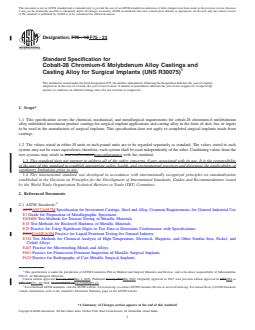
1.1 This specification covers the chemical, mechanical, and metallurgical requirements for cobalt-28 chromium-6 molybdenum alloy unfinished investment product castings for surgical implant applications and casting alloy in the form of shot, bar, or ingots to be used in the manufacture of surgical implants. This specification does not apply to completed surgical implants made from castings.
1.2 The values stated in either SI units or inch-pound units are to be regarded separately as standard. The values stated in each system may not be exact equivalents; therefore, each system shall be used independently of the other. Combining values from the two systems may result in nonconformance with the standard.
1.3 This standard does not purport to address all of the safety concerns, if any, associated with its use. It is the responsibility of the user of this standard to establish appropriate safety, health, and environmental practices and determine the applicability of regulatory limitations prior to use.
1.4 This international standard was developed in accordance with internationally recognized principles on standardization established in the Decision on Principles for the Development of International Standards, Guides and Recommendations issued by the World Trade Organization Technical Barriers to Trade (TBT) Committee.
- Status
- Published
- Publication Date
- 30-Apr-2023
- Technical Committee
- F04 - Medical and Surgical Materials and Devices
- Drafting Committee
- F04.12 - Metallurgical Materials
Buy Documents
ASTM F75-23 - Standard Specification for Cobalt-28 Chromium-6 Molybdenum Alloy Castings and Casting Alloy for Surgical Implants (UNS R30075)
REDLINE ASTM F75-23 - Standard Specification for Cobalt-28 Chromium-6 Molybdenum Alloy Castings and Casting Alloy for Surgical Implants (UNS R30075)
Overview
ASTM F75-23: Standard Specification for Cobalt-28 Chromium-6 Molybdenum Alloy Castings and Casting Alloy for Surgical Implants (UNS R30075) establishes critical requirements for unfinished investment castings and casting alloys used in the manufacture of surgical implants. Developed by ASTM International, this standard applies to the materials-specifically in forms like shot, bar, or ingots-prior to their fabrication into finished medical devices. It details chemical composition, mechanical, and metallurgical criteria, ensuring that alloys intended for surgical implant production achieve the consistent quality and performance required for medical applications.
This specification supports regulatory compliance and quality assurance in the medical device industry, serving as a benchmark for suppliers, manufacturers, and auditors involved in the surgical implants supply chain.
Key Topics
Scope of Coverage
- Applies to cobalt-28 chromium-6 molybdenum (Co-Cr-Mo) alloy castings and casting alloys for surgical implant manufacturing
- Does not address finished implants or fabricated end-use devices
Material and Manufacturing Requirements
- Strict conformance to specified chemical composition, including cobalt, chromium, and molybdenum balance
- Control of residual elements and prohibition of unspecified intentional additions
- Welding for repair is allowed under stringent procedures, performed before any final thermal processing and using matching alloy filler
Mechanical Properties
- Ultimate tensile strength, yield strength, elongation, and reduction of area must be verified for each master heat
- Testing follows ASTM E8/E8M for tension, with clear acceptance and retesting protocols to ensure uniform quality
Quality Control and Testing
- Product and casting alloy samples must undergo:
- Chemical analysis for conformity
- Liquid penetrant examination
- Radiographic (X-ray) testing
- Metallographic inspection
- Rockwell hardness testing (for informational purposes)
- Sampling and acceptance criteria for special tests to be agreed upon between supplier and purchaser
- Product and casting alloy samples must undergo:
Unit Selection and Certification
- Values reported in either SI or inch-pound units as chosen by the purchaser
- Certification required, providing documentation that material meets all specified criteria
Quality Management
- Suppliers must maintain a recognized quality management system such as ISO 9001 or ISO 13485
- Purchasers have the right to audit producers for compliance
Applications
This ASTM standard is essential in the manufacture of raw materials for surgical implants, providing foundational requirements for materials used in components such as:
- Orthopedic joint prostheses (e.g., hip and knee implants)
- Dental implants
- Spinal implants and hardware
- Trauma fixation devices
The cobalt-chromium-molybdenum alloy (UNS R30075) covered by ASTM F75-23 is valued for its biocompatibility, corrosion resistance, high strength, and proven track record in medical use. The specification ensures these qualities are realized consistently throughout the production process. While the standard does not address finished medical devices, it plays a crucial role in the upstream quality assurance of implantable materials, providing a recognized basis for traceability and regulatory acceptance.
Related Standards
ASTM F75-23 references and aligns with a range of other national and international standards, enhancing its relevance throughout the surgical implant supply chain:
- ASTM A957/A957M – General requirements for investment castings
- ASTM E8/E8M – Methods for tension testing of metallic materials
- ASTM E18 – Rockwell hardness testing procedures
- ASTM E165/E165M, F601, F629 – Test methods for penetrant and radiographic inspection of metallic implants
- ISO 5832-4 – Equivalent international standard for Co-Cr-Mo casting alloy
- ISO 9001 / ISO 13485 – Quality management system requirements for manufacturers in the medical device sector
By adhering to the ASTM F75-23 specification, manufacturers can demonstrate compliance with regulatory expectations, support quality documentation for audits, and reinforce market acceptance of their surgical implant materials worldwide.
Keywords: ASTM F75-23, cobalt-chromium-molybdenum alloy, UNS R30075, surgical implant materials, investment casting, medical device manufacturing, biocompatibility, quality management, orthopedic implants.
Relations
- Effective Date
- 01-Jan-2024
- Effective Date
- 01-Nov-2023
- Effective Date
- 01-Feb-2020
- Effective Date
- 01-Sep-2018
- Effective Date
- 01-Jul-2018
- Effective Date
- 15-May-2018
- Effective Date
- 01-Jul-2017
- Effective Date
- 15-Jul-2016
- Effective Date
- 01-Dec-2015
- Effective Date
- 01-Nov-2015
- Effective Date
- 01-Jun-2015
- Effective Date
- 01-Mar-2015
- Effective Date
- 01-Feb-2015
- Effective Date
- 01-Oct-2014
- Refers
ASTM F601-13 - Standard Practice for Fluorescent Penetrant Inspection of Metallic Surgical Implants - Effective Date
- 01-Dec-2013
Buy Documents
ASTM F75-23 - Standard Specification for Cobalt-28 Chromium-6 Molybdenum Alloy Castings and Casting Alloy for Surgical Implants (UNS R30075)
REDLINE ASTM F75-23 - Standard Specification for Cobalt-28 Chromium-6 Molybdenum Alloy Castings and Casting Alloy for Surgical Implants (UNS R30075)
Get Certified
Connect with accredited certification bodies for this standard

BSI Group
BSI (British Standards Institution) is the business standards company that helps organizations make excellence a habit.

TÜV Rheinland
TÜV Rheinland is a leading international provider of technical services.

TÜV SÜD
TÜV SÜD is a trusted partner of choice for safety, security and sustainability solutions.
Sponsored listings
Frequently Asked Questions
ASTM F75-23 is a technical specification published by ASTM International. Its full title is "Standard Specification for Cobalt-28 Chromium-6 Molybdenum Alloy Castings and Casting Alloy for Surgical Implants (UNS R30075)". This standard covers: ABSTRACT This specification covers the requirements for unfinished cobalt-28chromium-6molybdenum (UNS R30075) investment product alloy castings for surgical implant applications, and casting alloys of the same in the form of shot, bar, or ingots to be used in the manufacture of surgical implants. This specification does not apply to completed surgical implants made from castings. Both product castings and casting alloys shall conform to specified chemical composition and mechanical requirements including ultimate tensile strength, yield strength, elongation, and reduction of area. Product castings shall additional undergo liquid penetrant, radiographic, metallographic, and hardness examination. SCOPE 1.1 This specification covers the chemical, mechanical, and metallurgical requirements for cobalt-28 chromium-6 molybdenum alloy unfinished investment product castings for surgical implant applications and casting alloy in the form of shot, bar, or ingots to be used in the manufacture of surgical implants. This specification does not apply to completed surgical implants made from castings. 1.2 The values stated in either SI units or inch-pound units are to be regarded separately as standard. The values stated in each system may not be exact equivalents; therefore, each system shall be used independently of the other. Combining values from the two systems may result in nonconformance with the standard. 1.3 This standard does not purport to address all of the safety concerns, if any, associated with its use. It is the responsibility of the user of this standard to establish appropriate safety, health, and environmental practices and determine the applicability of regulatory limitations prior to use. 1.4 This international standard was developed in accordance with internationally recognized principles on standardization established in the Decision on Principles for the Development of International Standards, Guides and Recommendations issued by the World Trade Organization Technical Barriers to Trade (TBT) Committee.
ABSTRACT This specification covers the requirements for unfinished cobalt-28chromium-6molybdenum (UNS R30075) investment product alloy castings for surgical implant applications, and casting alloys of the same in the form of shot, bar, or ingots to be used in the manufacture of surgical implants. This specification does not apply to completed surgical implants made from castings. Both product castings and casting alloys shall conform to specified chemical composition and mechanical requirements including ultimate tensile strength, yield strength, elongation, and reduction of area. Product castings shall additional undergo liquid penetrant, radiographic, metallographic, and hardness examination. SCOPE 1.1 This specification covers the chemical, mechanical, and metallurgical requirements for cobalt-28 chromium-6 molybdenum alloy unfinished investment product castings for surgical implant applications and casting alloy in the form of shot, bar, or ingots to be used in the manufacture of surgical implants. This specification does not apply to completed surgical implants made from castings. 1.2 The values stated in either SI units or inch-pound units are to be regarded separately as standard. The values stated in each system may not be exact equivalents; therefore, each system shall be used independently of the other. Combining values from the two systems may result in nonconformance with the standard. 1.3 This standard does not purport to address all of the safety concerns, if any, associated with its use. It is the responsibility of the user of this standard to establish appropriate safety, health, and environmental practices and determine the applicability of regulatory limitations prior to use. 1.4 This international standard was developed in accordance with internationally recognized principles on standardization established in the Decision on Principles for the Development of International Standards, Guides and Recommendations issued by the World Trade Organization Technical Barriers to Trade (TBT) Committee.
ASTM F75-23 is classified under the following ICS (International Classification for Standards) categories: 11.040.40 - Implants for surgery, prosthetics and orthotics. The ICS classification helps identify the subject area and facilitates finding related standards.
ASTM F75-23 has the following relationships with other standards: It is inter standard links to ASTM E8/E8M-24, ASTM E407-23, ASTM F629-20, ASTM A957/A957M-18a, ASTM E18-18, ASTM A957/A957M-18, ASTM E18-17, ASTM E8/E8M-16, ASTM F629-15, ASTM A957/A957M-15a, ASTM E407-07(2015)e1, ASTM A957/A957M-15, ASTM E8/E8M-15, ASTM A957/A957M-14, ASTM F601-13. Understanding these relationships helps ensure you are using the most current and applicable version of the standard.
ASTM F75-23 is available in PDF format for immediate download after purchase. The document can be added to your cart and obtained through the secure checkout process. Digital delivery ensures instant access to the complete standard document.
Standards Content (Sample)
This international standard was developed in accordance with internationally recognized principles on standardization established in the Decision on Principles for the
Development of International Standards, Guides and Recommendations issued by the World Trade Organization Technical Barriers to Trade (TBT) Committee.
Designation: F75 − 23
Standard Specification for
Cobalt-28 Chromium-6 Molybdenum Alloy Castings and
Casting Alloy for Surgical Implants (UNS R30075)
This standard is issued under the fixed designation F75; the number immediately following the designation indicates the year of original
adoption or, in the case of revision, the year of last revision. A number in parentheses indicates the year of last reapproval. A superscript
epsilon (´) indicates an editorial change since the last revision or reapproval.
1. Scope* E8/E8M Test Methods for Tension Testing of Metallic Ma-
terials
1.1 This specification covers the chemical, mechanical, and
E18 Test Methods for Rockwell Hardness of Metallic Ma-
metallurgical requirements for cobalt-28 chromium-6 molyb-
terials
denum alloy unfinished investment product castings for surgi-
E29 Practice for Using Significant Digits in Test Data to
cal implant applications and casting alloy in the form of shot,
Determine Conformance with Specifications
bar, or ingots to be used in the manufacture of surgical
E165/E165M Practice for Liquid Penetrant Testing for Gen-
implants. This specification does not apply to completed
eral Industry
surgical implants made from castings.
E354 Test Methods for Chemical Analysis of High-
1.2 The values stated in either SI units or inch-pound units
Temperature, Electrical, Magnetic, and Other Similar Iron,
are to be regarded separately as standard. The values stated in
Nickel, and Cobalt Alloys
each system may not be exact equivalents; therefore, each
E407 Practice for Microetching Metals and Alloys
system shall be used independently of the other. Combining
F601 Practice for Fluorescent Penetrant Inspection of Me-
values from the two systems may result in nonconformance
tallic Surgical Implants
with the standard.
F629 Practice for Radiography of Cast Metallic Surgical
1.3 This standard does not purport to address all of the Implants
safety concerns, if any, associated with its use. It is the
F981 Practice for Assessment of Compatibility of Biomate-
responsibility of the user of this standard to establish appro- rials for Surgical Implants with Respect to Effect of
priate safety, health, and environmental practices and deter-
Materials on Muscle and Insertion into Bone
mine the applicability of regulatory limitations prior to use. IEEE/ASTM SI 10 American National Standard for Metric
1.4 This international standard was developed in accor-
Practice
dance with internationally recognized principles on standard-
2.2 Aerospace Material Specification:
ization established in the Decision on Principles for the
AMS 2248 Chemical Check Analysis Limits: Corrosion and
Development of International Standards, Guides and Recom-
Heat Resistant Steels and Alloys, Maraging and Other
mendations issued by the World Trade Organization Technical
Highly-Alloyed Steels, and Iron Alloys
Barriers to Trade (TBT) Committee.
AMS 2269 Chemical Check Analysis Limits: Nickel, Nickel
Alloys and Cobalt Alloys
2. Referenced Documents
2.3 ISO Standards:
ISO 5832-4 Implants for Surgery—Metallic Materials—Part
2.1 ASTM Standards:
4: Cobalt-Chromium-Molybdenum Casting Alloy
A957/A957M Specification for Investment Castings, Steel
ISO 6892 Metallic Materials—Tensile Testing at Ambient
and Alloy, Common Requirements, for General Industrial
Temperature
Use
ISO 9001 Quality Management Systems—Requirements
E3 Guide for Preparation of Metallographic Specimens
ISO 13485 Medical Devices—Quality Management
Systems—Requirements for Regulatory Purposes
This specification is under the jurisdiction of ASTM Committee F04 on
Medical and Surgical Materials and Devices and is the direct responsibility of
3. Terminology
Subcommittee F04.12 on Metallurgical Materials.
3.1 Definitions of Terms Specific to This Standard:
Current edition approved May 1, 2023. Published May 2023. Originally
approved in 1967. Last previous edition approved in 2018 as F75 – 18. DOI:
10.1520/F0075-23.
2 3
For referenced ASTM standards, visit the ASTM website, www.astm.org, or Available from Society of Automotive Engineers (SAE), 400 Commonwealth
contact ASTM Customer Service at service@astm.org. For Annual Book of ASTM Dr., Warrendale, PA 15096-0001, http://www.sae.org.
Standards volume information, refer to the standard’s Document Summary page on Available from American National Standards Institute (ANSI), 25 W. 43rd St.,
the ASTM website. 4th Floor, New York, NY 10036, http://www.ansi.org.
*A Summary of Changes section appears at the end of this standard
Copyright © ASTM International, 100 Barr Harbor Drive, PO Box C700, West Conshohocken, PA 19428-2959. United States
F75 − 23
TABLE 1 Chemical Composition
3.1.1 investment casting, n—a metal casting that is produced
in a mold obtained by investing (surrounding) an expendable Composition, % (Mass/Mass)
Element
pattern with a ceramic slurry that is allowed to solidify. The min max
expendable pattern may consist of wax, plastic, or other Chromium 27.00 30.00
Molybdenum 5.00 7.00
material and is removed prior to filling the mold with liquid
Nickel . 0.50
metal.
Iron . 0.75
Carbon . 0.35
3.1.2 master heat, n—a quantity of metal processed in a
Silicon . 1.00
single furnace or refining vessel at one time in such a manner
Manganese . 1.00
as to produce the desired composition and properties. Tungsten . 0.20
Phosphorous . 0.020
3.1.3 sub-heat, n—a portion of a master heat remelted
Sulfur . 0.010
without additional processing for pouring into castings. Syn- Nitrogen . 0.25
Aluminum . 0.10
onyms: melt, production heat.
Titanium . 0.10
Boron . 0.010
NOTE 1—Terminology section in accordance with Specification A957/
A
Cobalt balance balance
A957M.
A
Approximately equal to the difference of 100 % and the sum percentage of the
4. Ordering Information
other specified elements. The percentage of the cobalt difference is not required to
be reported.
4.1 Include with inquiries and orders for material under this
specification the following information:
4.1.1 Quantity (number of product castings or weight of
casting alloy);
6.1.2 Requirements for the major and minor elemental
4.1.2 ASTM designation and date of issue;
constituents are listed in Table 1. Also listed are important
4.1.3 Units to be certified—SI or inch-pound;
residual elements. Analysis for elements not listed in Table 1 is
4.1.4 Form (product casting, shot, bar, ingot);
not required to verify compliance with this specification.
4.1.5 Applicable dimensions or drawing number;
6.1.3 All commercial metals contain small amounts of
4.1.6 Condition (as-cast, hot isostatically pressed (HIP),
elements other than those which are specified. It is neither
solution annealed, and so forth);
practical nor necessary to specify limits for unspecified
4.1.7 Special tests, if any; and
elements, whether residual elements or trace elements that can
4.1.8 Other requirements.
be present. The producer is permitted to analyze for unspecified
5. Materials and Manufacturing Requirements for
elements and is permitted to report such analyses. The presence
Product Castings
of an unspecified element and the reporting of an analysis for
5.1 Final thermal processing for castings, if any, shall be
that element shall not be a basis for rejection.
specified by mutual agreement between the supplier and 6.1.4 Intentional elemental additions other than those speci-
purchaser.
fied in Table 1 are not permitted.
6.1.5 Analysis for elements not listed in Table 1 is not
5.2 Castings shall be free of visible investment shell mate-
required to verify compliance with this specification, unless
rial and scale when examined without magnification.
previously agreed to between purchaser and supplier.
5.3 Welding may be used to repair castings as agreed upon
6.2 Product (Check) Analysis—The product (check) analy-
between supplier and purchaser.
sis tolerances shall conform to the product tolerances in Table
5.3.1 Weld repair shall be performed in accordance with
2 per AMS 2269. Product analysis tolerances do not broaden
written procedures by individuals certified to perform those
the specified heat (ladle or ingot) analysis requirements but
procedures.
cover variations between laboratories in the measurement of
5.3.2 Weld filler metal conforming to the chemistry of Table
chemical content.
1 shall be used when it is needed.
6.2.1 Product (check) analysis limits are not for the
5.3.3 Weld repair, if any, shall be performed before final
supplier’s/producer’s use at acceptance testing. Product analy-
thermal processing.
sis limits are not permitted to be applied to ladle or ingot
NOTE 2—Under certain circumstances, a weld repair may act as a stress
analysis. The supplier/producer shall not ship material that is
riser. Therefore, care should be exercised in the location and extent of
outside the limits specified in Table 1.
weld repair as it relates to regions of the implant where significant stresses
6.2.2 The product (check) analysis is one performed by the
might occur.
purchaser or the supplier of metal after it has been worked into
6. Chemical Requirements
semi-finished or finished forms, or fabricated into parts, and is
6.1 Both product castings and casting alloy shall conform to either for the purpose of verifying the composition of a heat or
the chemical requirements prescribed in Table 1. The supplier manufacturing lot or to determine variations in the composition
shall not ship material that is outside the limits specified in within the heat.
Table 1. 6.2.3 Acceptance or rejection of a heat or manufacturing lot
6.1.1 Chemical analysis shall be performed on a represen- of material may be made by the purchaser on the basis of this
tative specimen of a sub-heat cast from each master heat using product (check) analysis. Product (check) analysis outside the
the same general foundry procedures used for casting implants. tolerance limits allowed in Table 2 are cause for rejection of the
F75 − 23
A,B
TABLE 2 Product Analysis Tolerances
7.1.5 Tensile tests results for which any specimen fractures
Tolerance Under the Minimum
outside the gage length shall be considered valid if both the
Element or Over the Maximum Limit,
elongation and reduction of area meet the minimum require-
C
% (Mass/Mass)
ments specified. If either the elongation or reduction of area is
Chromium 0.30
less than the minimum requirement, invalidate the specimen
Molybdenum 0.15
Nickel 0.05
and retest. Retest one specimen for each invalidated specimen.
Iron 0.03
7.1.6 If castings are supplied in a heat-treated condition,
Carbon 0.02
tensile property requirements shall be agreed upon between
Silicon 0.05
Manganese 0.03
supplier and purchaser.
Tungsten 0.04
Phosphorous 0.005
7.2 Tensile Properties for Casting Alloy:
Sulfur 0.003
7.2.1 As-cast material shall conform to the mechanical
D
Nitrogen 0.02
property requirements given in Table 3 when tested in accor-
Aluminum 0.02
Titanium 0.02 dance with Test Methods E8/E8M.
Boron 0.002
7.2.2 Tension test specimens shall be melted and cast from
A
See Test Methods E354.
a sub-heat of each master heat by the same general procedures
B
Refer to AMS Standard 2269 for chemical check analysis limits (except nitrogen).
used in casting of the surgical implants
C
For elements in which only a maximum perce
...
This document is not an ASTM standard and is intended only to provide the user of an ASTM standard an indication of what changes have been made to the previous version. Because
it may not be technically possible to adequately depict all changes accurately, ASTM recommends that users consult prior editions as appropriate. In all cases only the current version
of the standard as published by ASTM is to be considered the official document.
Designation: F75 − 18 F75 − 23
Standard Specification for
Cobalt-28 Chromium-6 Molybdenum Alloy Castings and
Casting Alloy for Surgical Implants (UNS R30075)
This standard is issued under the fixed designation F75; the number immediately following the designation indicates the year of original
adoption or, in the case of revision, the year of last revision. A number in parentheses indicates the year of last reapproval. A superscript
epsilon (´) indicates an editorial change since the last revision or reapproval.
1. Scope*
1.1 This specification covers the chemical, mechanical, and metallurgical requirements for cobalt-28 chromium-6 molybdenum
alloy unfinished investment product castings for surgical implant applications and casting alloy in the form of shot, bar, or ingots
to be used in the manufacture of surgical implants. This specification does not apply to completed surgical implants made from
castings.
1.2 The values stated in either SI units or inch-pound units are to be regarded separately as standard. The values stated in each
system may not be exact equivalents; therefore, each system shall be used independently of the other. Combining values from the
two systems may result in non-conformancenonconformance with the standard.
1.3 This standard does not purport to address all of the safety concerns, if any, associated with its use. It is the responsibility
of the user of this standard to establish appropriate safety, health, and environmental practices and determine the applicability of
regulatory limitations prior to use.
1.4 This international standard was developed in accordance with internationally recognized principles on standardization
established in the Decision on Principles for the Development of International Standards, Guides and Recommendations issued
by the World Trade Organization Technical Barriers to Trade (TBT) Committee.
2. Referenced Documents
2.1 ASTM Standards:
A957A957/A957M Specification for Investment Castings, Steel and Alloy, Common Requirements, for General Industrial Use
E3 Guide for Preparation of Metallographic Specimens
E8/E8M Test Methods for Tension Testing of Metallic Materials
E18 Test Methods for Rockwell Hardness of Metallic Materials
E29 Practice for Using Significant Digits in Test Data to Determine Conformance with Specifications
E165E165/E165M Practice for Liquid Penetrant Testing for General Industry
E354 Test Methods for Chemical Analysis of High-Temperature, Electrical, Magnetic, and Other Similar Iron, Nickel, and
Cobalt Alloys
E407 Practice for Microetching Metals and Alloys
F601 Practice for Fluorescent Penetrant Inspection of Metallic Surgical Implants
F629 Practice for Radiography of Cast Metallic Surgical Implants
This specification is under the jurisdiction of ASTM Committee F04 on Medical and Surgical Materials and Devices and is the direct responsibility of Subcommittee
F04.12 on Metallurgical Materials.
Current edition approved Nov. 15, 2018May 1, 2023. Published January 2019May 2023. Originally approved in 1967. Last previous edition approved in 20122018 as
F75 – 12.F75 – 18. DOI: 10.1520/F0075-18.10.1520/F0075-23.
For referenced ASTM standards, visit the ASTM website, www.astm.org, or contact ASTM Customer Service at service@astm.org. For Annual Book of ASTM Standards
volume information, refer to the standard’s Document Summary page on the ASTM website.
*A Summary of Changes section appears at the end of this standard
Copyright © ASTM International, 100 Barr Harbor Drive, PO Box C700, West Conshohocken, PA 19428-2959. United States
F75 − 23
F981 Practice for Assessment of Compatibility of Biomaterials for Surgical Implants with Respect to Effect of Materials on
Muscle and Insertion into Bone
IEEE/ASTM SI 10 American National Standard for Metric Practice
2.2 Aerospace Material Specification:
AMS 2248 Chemical Check Analysis Limits: Corrosion and Heat Resistant Steels and Alloys, Maraging and Other
Highly-Alloyed Steels, and Iron Alloys
AMS 2269 Chemical Check Analysis Limits: Nickel, Nickel Alloys and Cobalt Alloys
2.3 ISO Standards:
ISO 5832-4 Implants for Surgery—Metallic Materials—Part 4: Cobalt-Chromium-Molybdenum Casting Alloy
ISO 6892 Metallic Materials—Tensile Testing at Ambient Temperature
ISO 9001 Quality Management Systems—Requirements
ISO 13485 Medical Devices—Quality Management Systems—Requirements for Regulatory Purposes
3. Terminology
3.1 Definitions of Terms Specific to This Standard:
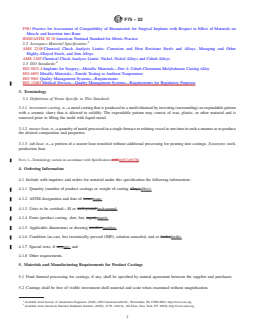
3.1.1 investment casting, n—a metal casting that is produced in a mold obtained by investing (surrounding) an expendable pattern
with a ceramic slurry that is allowed to solidify. The expendable pattern may consist of wax, plastic, or other material and is
removed prior to filling the mold with liquid metal.
3.1.2 master heat, n—a quantity of metal processed in a single furnace or refining vessel at one time in such a manner as to produce
the desired composition and properties.
3.1.3 sub-heat, n—a portion of a master heat remelted without additional processing for pouring into castings. Synonyms: melt,
production heat.
NOTE 1—Terminology section in accordance with Specification A957A957/A957M.
4. Ordering Information
4.1 Include with inquiries and orders for material under this specification the following information:
4.1.1 Quantity (number of product castings or weight of casting alloy),alloy);
4.1.2 ASTM designation and date of issue,issue;
4.1.3 Units to be certified—SI or inch-pound.inch-pound;
4.1.4 Form (product casting, shot, bar, ingot),ingot);
4.1.5 Applicable dimensions or drawing number,number;
4.1.6 Condition (as-cast, hot isostatically pressed (HIP), solution annealed, and so forth),forth);
4.1.7 Special tests, if any,any; and
4.1.8 Other requirements.
5. Materials and Manufacturing Requirements for Product Castings
5.1 Final thermal processing for castings, if any, shall be specified by mutual agreement between the supplier and purchaser.
5.2 Castings shall be free of visible investment shell material and scale when examined without magnification.
Available from Society of Automotive Engineers (SAE), 400 Commonwealth Dr., Warrendale, PA 15096-0001, http://www.sae.org.
Available from American National Standards Institute (ANSI), 25 W. 43rd St., 4th Floor, New York, NY 10036, http://www.ansi.org.
F75 − 23
5.3 Welding may be used to repair castings as agreed upon between supplier and purchaser.
5.3.1 Weld repair shall be performed in accordance with written procedures by individuals certified to perform those procedures.
5.3.2 Weld filler metal conforming to the chemistry of Table 1 shall be used when it is needed.
5.3.3 Weld repair, if any, shall be performed before final thermal processing.
NOTE 2—Under certain circumstances, a weld repair may act as a stress riser. Therefore, care should be exercised in the location and extent of weld repair
as it relates to regions of the implant where significant stresses might occur.
6. Chemical Requirements
6.1 Both product castings and casting alloy shall conform to the chemical requirements prescribed in Table 1. The supplier shall
not ship material that is outside the limits specified in Table 1.
6.1.1 Chemical analysis shall be performed on a representative specimen of a sub heat sub-heat cast from each master heat using
the same general foundry procedures used for casting implants.
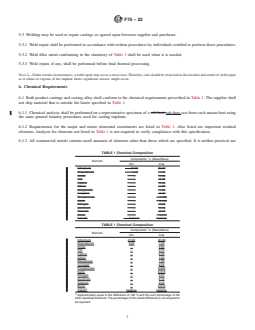
6.1.2 Requirements for the major and minor elemental constituents are listed in Table 1. Also listed are important residual
elements. Analysis for elements not listed in Table 1 is not required to verify compliance with this specification.
6.1.3 All commercial metals contain small amounts of elements other than those which are specified. It is neither practical nor
TABLE 1 Chemical Composition
Composition, % (Mass/Mass)
Element
min max
Chromium 27.00 30.00
Molybdenum 5.00 7.00
Nickel . 0.50
Iron . 0.75
Carbon . 0.35
Silicon . 1.00
Manganese . 1.00
Tungsten . 0.20
Phosphorous . 0.020
Sulfur . 0.010
Nitrogen . 0.25
Aluminum . 0.10
Titanium . 0.10
Boron . 0.010
A
Cobalt balance balance
TABLE 1 Chemical Composition
Composition, % (Mass/Mass)
Element
min max
Chromium 27.00 30.00
Molybdenum 5.00 7.00
Nickel . 0.50
Iron . 0.75
Carbon . 0.35
Silicon . 1.00
Manganese . 1.00
Tungsten . 0.20
Phosphorous . 0.020
Sulfur . 0.010
Nitrogen . 0.25
Aluminum . 0.10
Titanium . 0.10
Boron . 0.010
A
Cobalt balance balance
A
Approximately equal to the difference of 100 % and the sum percentage of the
other specified elements. The percentage of the cobalt difference is not required to
be reported.
F75 − 23
necessary to specify limits for unspecified elements, whether residual elements or trace elements that can be present. The producer
is permitted to analyze for unspecified elements and is permitted to report such analyses. The presence of an unspecified element
and the reporting of an analysis for that element shall not be a basis for rejection.
6.1.4 Intentional elemental additions other than those specified in Table 1 are not permitted.
6.1.5 Analysis for elements not listed in Table 1 is not required to verify compliance with this specification.specification, unless
previously agreed to between purchaser and supplier.
6.2 Product Analysis: (Check) Analysis—The product (check) analysis tolerances shall conform to the product tolerances in Table
2 per AMS 2269. Product analysis tolerances do not broaden the specified heat (ladle or ingot) analysis requirements but cover
variations between laboratories in the measurement of chemical content.
6.2.1 Product analysis tolerances do not broaden the specified heat analysis requirements but cover variations in the measurement
of chemical content between laboratories . The product analysis tolerances shall conform to the product tolerances(check) analysis
limits are not for the supplier’s/producer’s use at acceptance testing. Product analysis limits are not permitted to be applied to ladle
or ingot analysis. The supplier/producer shall not ship material that is outside the limits specified in Table 21.
6.2.2 The product analysis is (check) analysis is one performed by the purchaser or the supplier of metal after it has been worked
into semi-finished or finished forms, or fabricated into parts, and is either for the purpose of verifying the composition of a heat
or manufacturing lot or to determine variations in the composition within the heat.
6.2.3 Acceptance or rejection of a heat or manufacturing lot of material may be made by the purchaser on the basis of this product
analyses. Product (check) analysis. Product (check) analysis outside the tolerance limits allowed in Table 2 are cause for rejection
of the product. A referee analysis may be used if agreed upon by supplier and purchaser.
6.2.4 Methods and practices relating to chemical analysis required by this specification shall be in accordance with Test Methods
E354.
7. Mechanical Requirements
7.1 Tensile Properties for Product Castings:
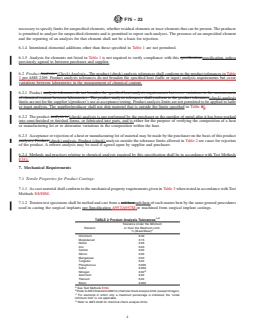
7.1.1 As-cast material shall conform to the mechanical property requirements given in Table 3 when tested in accordance with Test
Methods E8/E8M.
7.1.2 Tension test specimens shall be melted and cast from a sub heat sub-heat of each master heat by the same general procedures
used in casting the surgical implants per Specification A957/A957M or machined from surgical implant castings.
A,B
TABLE 2 Product Analysis Tolerances
Tolerance Under the Minimum
Element or Over the Maximum Limit,
C
% (Mass/Mass)
Chromium 0.30
Molybdenum 0.15
Nickel 0.05
Iron 0.03
Carbon 0.02
Silicon 0.05
Manganese 0.03
Tungsten 0.04
Phosphorous 0.005
Sulfur 0.003
D
Nitrogen 0.02
Aluminum 0.02
Titanium 0.02
Boron 0.002
A
See Test Methods E354.
B
Refer to AMS Standard 2269 for chemical check analysis limits (except nitrogen).
C
For elements in which only a maximum percentage is indicated, the “under
minimum limit” is not applicable.
D
Refer to AMS 2248
...