

ASTM F2182-19e2
(Test Method)Standard Test Method for Measurement of Radio Frequency Induced Heating On or Near Passive Implants During Magnetic Resonance Imaging
General Information
- Abstract
SIGNIFICANCE AND USE
5.1 This test method describes a test procedure for evaluating the ∆T associated with RF power deposition during an MR procedure, involving a specific frequency of RF irradiation of a passive implant. The method allows characterization of the heating propensity of an implant rather than the prediction of heating during a specific MR procedure in a patient. The results may be used as an input to a computational model for estimating ∆T due to the presence of that implant in a patient. The combination of the test results and the computational model results may then be used to help assess the safety of a patient with the implant during an MR examination.
SCOPE
1.1 This test method covers measurement of radio frequency (RF)-induced heating on or near a passive medical implant within a phantom during magnetic resonance imaging (MRI). The test method does not specify levels of heating considered to be safe to the patient and relies on users to define their own acceptance criteria.
1.2 This test method does not address other possible safety issues which include, but are not limited to: issues of magnetically-induced displacement, magnetically-induced torque, image artifact, acoustic noise, tissue heating, interaction among devices, and the functionality of the device and the MR system.
1.3 The amount of RF-induced temperature rise (∆T) for a given incident electric field will depend on the RF frequency, which is dependent on the static magnetic field strength of the MR system. While the focus in this test method is on 1.5 tesla (T) or 3 T MR systems, the ∆T for an implant in MR systems of other static magnetic field strengths or magnet designs can be evaluated by suitable modification of the method described herein.
1.4 This test method assumes that testing is done on devices that will be entirely inside the body. Testing for devices with other implantation conditions (e.g., external fixation devices, percutaneous needles, catheters or tethered devices such as ablation probes) is beyond the scope of this standard; for such devices, modifications of this test method may be necessary.
Note 1: RF-heating induced by any electrically conductive implanted device may be impacted by the presence of other metallic or otherwise electrically conductive devices present nearby.
1.5 This test method is written for several possible RF exposure systems, including Volume RF transmit coils. The exposure system needs to be properly characterized, within the stated uncertainties, in term of local background RF exposure for the implants which are tested.
1.6 The values stated in SI units are to be regarded as standard.
1.7 A device with deployed dimensions of less than 2 cm in all directions may not need to be tested with respect to RF-induced heating, as it is expected to generate ∆T of less than 2°C over 1 h of exposure at 1.5 T/64-MHz or 3 T/128-MHz frequencies (1, 2)2 and ANSI/AAMI/ISO 14708-3:2017). This condition is not valid when multiple replicas of the device (e.g., multiple anchors) are implanted within 3 cm of the device.
Note 2: The above values were derived from existing data and literature. The 3 cm distance is recommended to avoid any RF coupling with other neighboring devices.
1.8 This standard does not purport to address all of the safety concerns, if any, associated with its use. It is the responsibility of the user of this standard to establish appropriate safety, health, and environmental practices and determine the applicability of regulatory limitations prior to use.
1.9 This international standard was developed in accordance with internationally recognized principles on standardization established in the Decision on Principles for the Development of International Standards, Guides and Recommendations issued by the World Trade Organization Technical Barriers to Trade (TBT) Committee.
- Status
- Published
- Publication Date
- 14-Sep-2019
- Technical Committee
- F04 - Medical and Surgical Materials and Devices
- Drafting Committee
- F04.15 - Material Test Methods
Overview
ASTM F2182-19e2 is a key international standard developed by ASTM International for assessing the radio frequency (RF) induced heating on or near passive medical implants during magnetic resonance imaging (MRI). This standard provides a test method to measure the temperature rise (∆T) that occurs when passive implants are exposed to the RF fields used in MRI procedures. The method is designed to characterize the heating tendency of an implant, offering crucial data to help predict and manage potential safety risks for patients with implants undergoing MRI scans. While this standard does not specify what levels of heating are considered safe, it supports consistent, repeatable testing and informs subsequent computational modeling and risk assessment by manufacturers and healthcare facilities.
Key Topics
- Scope: Covers temperature measurement of RF-induced heating for fully internal passive implants within a standardized phantom model during MRI scans. Primarily applicable to 1.5 T (64 MHz) and 3 T (128 MHz) MR systems but can be adapted for other field strengths.
- Test Method: Describes placement of the passive implant and temperature sensors in a gelled-saline phantom, exposure to controlled RF energy, and monitoring temperature rise on or near the device.
- Parameters and Conditions: Determines local background RF exposure using temperature (∆T) or electric field (E-field) measurements. Recommends repeatability verification using reference rods and consistent probe positioning.
- Limitations: Does not set patient safety thresholds for heating or address other MRI safety concerns such as device displacement, torque, or image artifacts.
- Applicability: Intended for passive medical implants fully contained in the body, such as orthopedic pins, stents, or other non-active devices. Devices with external or percutaneous features require modified methods.
- Reporting Requirements: Specifies comprehensive documentation including temperature data, probe placement, device and phantom descriptions, and test conditions to ensure reproducibility and transparency.
Applications
ASTM F2182-19e2 is widely used in:
- Medical Device Development: Manufacturers use the standard to assess the MRI compatibility and safety of new passive implant designs, providing essential data for regulatory submissions.
- Regulatory Compliance: Testing according to this standard helps demonstrate adherence to regulatory requirements for device labeling and marketing, particularly in regions where MRI-device interactions are tightly regulated.
- Clinical Risk Assessment: Hospitals and MRI centers reference ASTM F2182 results to guide patient management decisions, minimizing the risk of hazardous heating during MRI procedures.
- Computational Modeling: The output data (∆T values) serve as essential inputs to computational models, which can be used to estimate temperature rise in specific clinical scenarios and patient anatomies.
- Phantom and Protocol Validation: Ensures that laboratory testing environments use materials and exposure setups that accurately reflect human tissue properties and clinical MRI conditions.
Related Standards
ASTM F2182-19e2 is part of a network of standards and guidelines related to MRI safety and medical implants:
- ASTM F2052: Measurement of magnetically induced displacement force on medical devices in the MRI environment.
- ASTM F2213: Measurement of magnetically induced torque on medical devices.
- ASTM F2119: Evaluation of MRI image artifacts from passive implants.
- ASTM F2503: Practice for marking medical devices for MRI safety.
- IEC 60601-2-33: Safety of medical electrical equipment - MRI systems.
- ISO TS 10974: Assessment of the safety of MRI for patients with active implantable medical devices.
- ANSI/AAMI/ISO 14708-3:2017: Implants for surgery - Implantable neurostimulators.
Using ASTM F2182-19e2 alongside these related standards enables a comprehensive, multi-faceted evaluation of medical device performance and safety in the MRI environment, supporting both innovation and patient protection in the healthcare sector.
Keywords: ASTM F2182-19e2, MRI safety, RF-induced heating, passive implants, medical device testing, magnetic resonance imaging, implant characterization, phantom testing, regulatory compliance, healthcare safety.
Relations
- Effective Date
- 15-Sep-2019
- Effective Date
- 01-Apr-2023
- Effective Date
- 01-Sep-2017
- Effective Date
- 15-May-2014
- Effective Date
- 01-Jul-2013
- Effective Date
- 01-Jun-2013
- Effective Date
- 01-Oct-2011
- Effective Date
- 01-Jul-2011
- Effective Date
- 01-Jun-2009
- Effective Date
- 01-Oct-2008
- Effective Date
- 01-Aug-2008
- Effective Date
- 15-May-2008
- Refers
ASTM F2119-07 - Standard Test Method for Evaluation of MR Image Artifacts from Passive Implants - Effective Date
- 01-Sep-2007
- Effective Date
- 01-Jun-2006
- Effective Date
- 01-May-2006
Get Certified
Connect with accredited certification bodies for this standard

BSI Group
BSI (British Standards Institution) is the business standards company that helps organizations make excellence a habit.

TÜV Rheinland
TÜV Rheinland is a leading international provider of technical services.

TÜV SÜD
TÜV SÜD is a trusted partner of choice for safety, security and sustainability solutions.
Sponsored listings
Frequently Asked Questions
ASTM F2182-19e2 is a standard published by ASTM International. Its full title is "Standard Test Method for Measurement of Radio Frequency Induced Heating On or Near Passive Implants During Magnetic Resonance Imaging". This standard covers: SIGNIFICANCE AND USE 5.1 This test method describes a test procedure for evaluating the ∆T associated with RF power deposition during an MR procedure, involving a specific frequency of RF irradiation of a passive implant. The method allows characterization of the heating propensity of an implant rather than the prediction of heating during a specific MR procedure in a patient. The results may be used as an input to a computational model for estimating ∆T due to the presence of that implant in a patient. The combination of the test results and the computational model results may then be used to help assess the safety of a patient with the implant during an MR examination. SCOPE 1.1 This test method covers measurement of radio frequency (RF)-induced heating on or near a passive medical implant within a phantom during magnetic resonance imaging (MRI). The test method does not specify levels of heating considered to be safe to the patient and relies on users to define their own acceptance criteria. 1.2 This test method does not address other possible safety issues which include, but are not limited to: issues of magnetically-induced displacement, magnetically-induced torque, image artifact, acoustic noise, tissue heating, interaction among devices, and the functionality of the device and the MR system. 1.3 The amount of RF-induced temperature rise (∆T) for a given incident electric field will depend on the RF frequency, which is dependent on the static magnetic field strength of the MR system. While the focus in this test method is on 1.5 tesla (T) or 3 T MR systems, the ∆T for an implant in MR systems of other static magnetic field strengths or magnet designs can be evaluated by suitable modification of the method described herein. 1.4 This test method assumes that testing is done on devices that will be entirely inside the body. Testing for devices with other implantation conditions (e.g., external fixation devices, percutaneous needles, catheters or tethered devices such as ablation probes) is beyond the scope of this standard; for such devices, modifications of this test method may be necessary. Note 1: RF-heating induced by any electrically conductive implanted device may be impacted by the presence of other metallic or otherwise electrically conductive devices present nearby. 1.5 This test method is written for several possible RF exposure systems, including Volume RF transmit coils. The exposure system needs to be properly characterized, within the stated uncertainties, in term of local background RF exposure for the implants which are tested. 1.6 The values stated in SI units are to be regarded as standard. 1.7 A device with deployed dimensions of less than 2 cm in all directions may not need to be tested with respect to RF-induced heating, as it is expected to generate ∆T of less than 2°C over 1 h of exposure at 1.5 T/64-MHz or 3 T/128-MHz frequencies (1, 2)2 and ANSI/AAMI/ISO 14708-3:2017). This condition is not valid when multiple replicas of the device (e.g., multiple anchors) are implanted within 3 cm of the device. Note 2: The above values were derived from existing data and literature. The 3 cm distance is recommended to avoid any RF coupling with other neighboring devices. 1.8 This standard does not purport to address all of the safety concerns, if any, associated with its use. It is the responsibility of the user of this standard to establish appropriate safety, health, and environmental practices and determine the applicability of regulatory limitations prior to use. 1.9 This international standard was developed in accordance with internationally recognized principles on standardization established in the Decision on Principles for the Development of International Standards, Guides and Recommendations issued by the World Trade Organization Technical Barriers to Trade (TBT) Committee.
SIGNIFICANCE AND USE 5.1 This test method describes a test procedure for evaluating the ∆T associated with RF power deposition during an MR procedure, involving a specific frequency of RF irradiation of a passive implant. The method allows characterization of the heating propensity of an implant rather than the prediction of heating during a specific MR procedure in a patient. The results may be used as an input to a computational model for estimating ∆T due to the presence of that implant in a patient. The combination of the test results and the computational model results may then be used to help assess the safety of a patient with the implant during an MR examination. SCOPE 1.1 This test method covers measurement of radio frequency (RF)-induced heating on or near a passive medical implant within a phantom during magnetic resonance imaging (MRI). The test method does not specify levels of heating considered to be safe to the patient and relies on users to define their own acceptance criteria. 1.2 This test method does not address other possible safety issues which include, but are not limited to: issues of magnetically-induced displacement, magnetically-induced torque, image artifact, acoustic noise, tissue heating, interaction among devices, and the functionality of the device and the MR system. 1.3 The amount of RF-induced temperature rise (∆T) for a given incident electric field will depend on the RF frequency, which is dependent on the static magnetic field strength of the MR system. While the focus in this test method is on 1.5 tesla (T) or 3 T MR systems, the ∆T for an implant in MR systems of other static magnetic field strengths or magnet designs can be evaluated by suitable modification of the method described herein. 1.4 This test method assumes that testing is done on devices that will be entirely inside the body. Testing for devices with other implantation conditions (e.g., external fixation devices, percutaneous needles, catheters or tethered devices such as ablation probes) is beyond the scope of this standard; for such devices, modifications of this test method may be necessary. Note 1: RF-heating induced by any electrically conductive implanted device may be impacted by the presence of other metallic or otherwise electrically conductive devices present nearby. 1.5 This test method is written for several possible RF exposure systems, including Volume RF transmit coils. The exposure system needs to be properly characterized, within the stated uncertainties, in term of local background RF exposure for the implants which are tested. 1.6 The values stated in SI units are to be regarded as standard. 1.7 A device with deployed dimensions of less than 2 cm in all directions may not need to be tested with respect to RF-induced heating, as it is expected to generate ∆T of less than 2°C over 1 h of exposure at 1.5 T/64-MHz or 3 T/128-MHz frequencies (1, 2)2 and ANSI/AAMI/ISO 14708-3:2017). This condition is not valid when multiple replicas of the device (e.g., multiple anchors) are implanted within 3 cm of the device. Note 2: The above values were derived from existing data and literature. The 3 cm distance is recommended to avoid any RF coupling with other neighboring devices. 1.8 This standard does not purport to address all of the safety concerns, if any, associated with its use. It is the responsibility of the user of this standard to establish appropriate safety, health, and environmental practices and determine the applicability of regulatory limitations prior to use. 1.9 This international standard was developed in accordance with internationally recognized principles on standardization established in the Decision on Principles for the Development of International Standards, Guides and Recommendations issued by the World Trade Organization Technical Barriers to Trade (TBT) Committee.
ASTM F2182-19e2 is classified under the following ICS (International Classification for Standards) categories: 11.040.40 - Implants for surgery, prosthetics and orthotics. The ICS classification helps identify the subject area and facilitates finding related standards.
ASTM F2182-19e2 has the following relationships with other standards: It is inter standard links to ASTM F2182-19e1, ASTM F2503-23e1, ASTM F2213-17, ASTM F2052-14, ASTM B348-13, ASTM F2503-13, ASTM F2213-06(2011), ASTM B348-11, ASTM B348-09, ASTM F2503-08, ASTM B348-08a, ASTM B348-08, ASTM F2119-07, ASTM B348-06a, ASTM F2213-06. Understanding these relationships helps ensure you are using the most current and applicable version of the standard.
ASTM F2182-19e2 is available in PDF format for immediate download after purchase. The document can be added to your cart and obtained through the secure checkout process. Digital delivery ensures instant access to the complete standard document.
Standards Content (Sample)
This international standard was developed in accordance with internationally recognized principles on standardization established in the Decision on Principles for the
Development of International Standards, Guides and Recommendations issued by the World Trade Organization Technical Barriers to Trade (TBT) Committee.
´2
Designation: F2182 − 19
Standard Test Method for
Measurement of Radio Frequency Induced Heating On or
Near Passive Implants During Magnetic Resonance
Imaging
This standard is issued under the fixed designation F2182; the number immediately following the designation indicates the year of
original adoption or, in the case of revision, the year of last revision.Anumber in parentheses indicates the year of last reapproval.A
superscript epsilon (´) indicates an editorial change since the last revision or reapproval.
ε NOTE—Editorially revised throughout in January 2020.
ε NOTE—Corrected editorially in April 2020.
1. Scope 1.5 This test method is written for several possible RF
exposure systems, including Volume RF transmit coils. The
1.1 This test method covers measurement of radio fre-
exposuresystemneedstobeproperlycharacterized,withinthe
quency (RF)-induced heating on or near a passive medical
stated uncertainties, in term of local background RF exposure
implant within a phantom during magnetic resonance imaging
for the implants which are tested.
(MRI). The test method does not specify levels of heating
consideredtobesafetothepatientandreliesonuserstodefine
1.6 The values stated in SI units are to be regarded as
their own acceptance criteria.
standard.
1.2 This test method does not address other possible safety
1.7 Adevice with deployed dimensions of less than 2 cm in
issues which include, but are not limited to: issues of
all directions may not need to be tested with respect to
magnetically-induced displacement, magnetically-induced
RF-induced heating, as it is expected to generate �T of less
torque, image artifact, acoustic noise, tissue heating, interac-
than 2°C over1hof exposure at 1.5 T/64-MHz or 3
tionamongdevices,andthefunctionalityofthedeviceandthe
T/128-MHz frequencies (1, 2) and ANSI/AAMI/ISO 14708-
MR system.
3:2017). This condition is not valid when multiple replicas of
1.3 The amount of RF-induced temperature rise (�T) for a
thedevice(e.g.,multipleanchors)areimplantedwithin3cmof
given incident electric field will depend on the RF frequency,
the device.
which is dependent on the static magnetic field strength of the
MR system. While the focus in this test method is on 1.5 tesla NOTE 2—The above values were derived from existing data and
literature. The 3 cm distance is recommended to avoid any RF coupling
(T) or 3 T MR systems, the �T for an implant in MR systems
with other neighboring devices.
of other static magnetic field strengths or magnet designs can
be evaluated by suitable modification of the method described
1.8 This standard does not purport to address all of the
herein.
safety concerns, if any, associated with its use. It is the
responsibility of the user of this standard to establish appro-
1.4 Thistestmethodassumesthattestingisdoneondevices
priate safety, health, and environmental practices and deter-
that will be entirely inside the body. Testing for devices with
mine the applicability of regulatory limitations prior to use.
other implantation conditions (e.g., external fixation devices,
percutaneous needles, catheters or tethered devices such as
1.9 This international standard was developed in accor-
ablation probes) is beyond the scope of this standard; for such dance with internationally recognized principles on standard-
devices, modifications of this test method may be necessary.
ization established in the Decision on Principles for the
Development of International Standards, Guides and Recom-
NOTE 1—RF-heating induced by any electrically conductive implanted
mendations issued by the World Trade Organization Technical
device may be impacted by the presence of other metallic or otherwise
electrically conductive devices present nearby. Barriers to Trade (TBT) Committee.
ThistestmethodisunderthejurisdictionofASTMCommitteeF04onMedical
andSurgicalMaterialsandDevicesandisthedirectresponsibilityofSubcommittee
F04.15 on Material Test Methods.
Current edition approved Sept. 15, 2019. Published October 2019. Originally
approved in 2002. Last previous edition approved in 2011 as F2182–11a. DOI: The boldface numbers in parentheses refer to a list of references at the end of
10.1520/F2182-19E02. this standard.
Copyright © ASTM International, 100 Barr Harbor Drive, PO Box C700, West Conshohocken, PA 19428-2959. United States
´2
F2182 − 19
2. Referenced Documents The local background SAR can be derived from the tem-
3 perature with the following equation:
2.1 ASTM Standards:
B348Specification for Titanium and Titanium Alloy Bars ∆T
SAR 5lim c (1)
and Billets ∆t
t→0
F2052Test Method for Measurement of Magnetically In-
Where: c = 4150 J/(kg°C) is the specific heat of the gel,
duced Displacement Force on Medical Devices in the
�T is the change in temperature of the gel (°C), and �t is
Magnetic Resonance Environment
the change in time (s).
F2119Test Method for Evaluation of MR Image Artifacts
Local background SAR can alternatively be derived from
from Passive Implants
incident electric field (through direct measurements of inci-
F2213Test Method for Measurement of Magnetically In-
dent electric field):
duced Torque on Medical Devices in the Magnetic Reso-
σǁEǁ
nance Environment
SAR 5 (2)
2ρ
F2503Practice for Marking Medical Devices and Other
Items for Safety in the Magnetic Resonance Environment
Where: σ is the electrical conductivity of the gel (S/m),
2.2 IEC Standard:
||E|| is the magnitude of the peak electric field (V/m), and ρ
60601-2-33Medical Electrical Equipment—Part 2: Particu-
is the density of the gel (kg/m ).
lar Requirements for the Safety of Magnetic Resonance
The local background SAR (in W/kg) is calculated from
Equipment for Medical Diagnosis
the temperature measurements or the E-field measurements
for each probe location, including the reference location. The
2.3 NEMA Standard:
local background SAR at the reference probe is used to
MS 8Characterization of the Specific Absorption Rate for
verify that the same RF exposure conditions are applied dur-
Magnetic Resonance Imaging Systems
6 ing various exposure steps.
2.4 ISO Technical Specificaton:
3.1.4.1 Discussion—This test method describes two equiva-
TS 10974Assessment of the safety of magnetic resonance
lent approaches for determination of radiofrequency induced
imaging for patients with an active implantable medical
heating:anapproachusingbackgroundheatingandonereliant
device
upon characterization of electric field (E-field). Either of these
2.5 Other Standard:
approaches is sufficient to characterize radiofrequency heating
ANSI/AAMI/ISO 14708-3:2017Implants for surgery - Ac-
under the intent of this test method. All guidance pertinent to
tive implantable medical devices — Part 3: Implantable
the approach not utilized when testing in accordance with this
neurostimulators
test method is understood to be optional. Specifically, proce-
dural steps pertinent to the measurement or characterization of
3. Terminology
E-field are not required when the background temperature
3.1 Definitions:
measurement methodology is chosen.
3.1.1 gelled-saline—phantom medium consisting of sodium
3.1.4.2 Discussion—The E-field probe needs to be cali-
chlorideandpolyacrylicacid,orsodiumchlorideandhydroxy-
brated in gelled-saline for the given RF exposure.
ethylcellulose in water as specified in this test method.
3.1.5 magnetic resonance (MR) system—ensemble of MR
3.1.2 implant—in medicine, an object, structure, or device
EQUIPMENT, ACCESSORIES including means for display,
intendedtoresidewithinthebodyfordiagnostic,prosthetic,or
control, energy supplies, and the CONTROLLED ACCESS
other therapeutic purposes.
AREA where provided. (IEC 60601-2-33)
3.1.3 local background RF exposure—the electric field tan-
3.1.6 magnetic resonance imaging (MRI)—imaging tech-
gential to the primary axis of the implant at a single position
nique that uses a static magnetic field, time-varying gradient
within the phantom (i.e., no volume averaging is applied).
magnetic fields, and radio frequency fields to provide images
3.1.4 local background SAR—the SAR determined from
of tissue by magnetic resonance of nuclei.
(thermalorelectrical)measurementsatasinglepositionwithin
3.1.7 MRRFtestsystem—anapparatusthatproducestheRF
the phantom (i.e., no volume averaging is applied).
field of the MR system.
3.1.8 passive implant—an implant that serves all of its
For referenced ASTM standards, visit the ASTM website, www.astm.org, or
functions without supply of electrical power.
contact ASTM Customer Service at service@astm.org. For Annual Book of ASTM
Standards volume information, refer to the standard’s Document Summary page on 3.1.9 radio frequency (RF) magnetic field—the magnetic
the ASTM website.
field in MRI that is used to flip the magnetic moments. The
Available from the International Electrotechnical Commission (IEC), 3 rue de
frequency of the RF field is γB where γ is the gyromagnetic
Varembe, Case postale 131, CH-1211 Geneva 20, Switzerland.
constant, 42.56 MHz/T for protons, and B is the static
Available from National Electrical Manufacturers Association (NEMA), 1300
N. 17th St., Suite 1752, Rosslyn, VA22209, www.nema.org.
magnetic field in tesla.
Available from International Organization for Standardization (ISO), ISO
3.1.10 Specific Absorption Rate (SAR)—RFpowerabsorbed
Central Secretariat, BIBC II, Chemin de Blandonnet 8, CP 401, 1214 Vernier,
Geneva, Switzerland, www.iso.org.
per unit of mass (W/kg). (IEC 60601-2-33)
Available fromAmerican National Standards Institute (ANSI), 25 W. 43rd St.,
4th Floor, New York, NY 10036, http://www.ansi.org. 3.1.11 �T—RF-induced temperature rise.
´2
F2182 − 19
4. Summary of Test Method that is used for the temperature measurement with an implant
inanappropriatepositionwithinagelled-salinefilledphantom.
4.1 The passive implant to be tested is placed completely
within a phantom filled with an appropriate medium with RF
7. Test Specimens
physical properties (i.e., electrical conductivity, electrical
7.1 While this test method may be used on prototype or
permittivity, thermal conductivity, thermal capacity, mass den-
predicate devices, for purposes of implant qualification and to
sity)similartotheaveragedpropertiesofthehumanbody.The
ensurepatientsafetyrelativetotheuseofMRItechnology,the
implant is placed at a location with known local background
implant evaluated according to this test method should be
RF exposure. The phantom material is a gelled-saline consist-
representativeofafinisheddeviceaccordingtoitsintendeduse
ingofasalinesolutionandagellingagent.Temperatureprobes
or in-situ condition. For example, a balloon-expandable stent,
shall be placed at locations where the maximum local �T is
the stent should be expanded and deployed to its proper
expected. Pilot experiments may be needed to determine such
dimensions (i.e., length and diameter).
locations and, thus, the proper placement of the temperature
probesfortheheatingassessmentoftheimplant.Thephantom
NOTE 3—Sterilization of the sample is not needed unless the process is
is placed in an MR system or an RF test system and subjected
expected to affect the dimensions, electrical, or thermal properties of the
to a well controlled RF exposure of sufficient magnitude and implant.
durationtodemonstratealocalbackgroundRFexposureinthe
7.2 Other than described as in 7.1, for purposes of device
testing location for the implant that shall be measured with an
qualification, the implant shall not be altered in any manner
adequate signal-to-noise ratio.
prior to testing other than positioning or otherwise configuring
theimplantintheorientationthatgeneratesthegreatestheating
4.2 The test procedure is divided into two steps: (1) the �T
for that MR system’s frequency. A justification for such
on or near the implant at several locations is measured using
orientation shall be provided.
fiber-optic thermometry probes (or equivalent technology).�T
is also measured at a reference location remote (i.e., of a
8. Procedure
distance of at least 30 cm) from the implant. (2) the implant is
removed and temperature measurements (with temperature
8.1 Phantom Morphology—The phantom container and all
probe) or electric field measurements (with E-field probe) are
itspartsshallbemadeofmaterialsthatareelectricalinsulators
repeated at the same locations used in Step 1, under the same
and non-magnetic and non-metallic. The dimensions of the
local background RF exposure of Step 1.
phantom container should ensurea2cm minimum distance
from any point of the positioned implant to any phantom
5. Significance and Use
surface (3). This positioning scheme is intended to minimize
RF coupling with phantom surface and heat transfer into the
5.1 This test method describes a test procedure for evaluat-
environment. An example of dimensions of the gelled-saline
ingthe�TassociatedwithRFpowerdepositionduringanMR
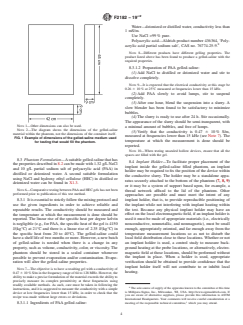
volumeinsidethephantomwhichmaybeusedisshowninFig.
procedure, involving a specific frequency of RF irradiation of
1. The volume in this example is approximately 24.6 L.
a passive implant. The method allows characterization of the
heating propensity of an implant rather than the prediction of
8.2 Phantom Material—Phantom material for the RF-
heatingduringaspecificMRprocedureinapatient.Theresults
induced heating testing of an implant shall meet the following
may be used as an input to a computational model for
criteria:
estimating �T due to the presence of that implant in a patient.
8.2.1 ElectricalConductivity—Electricalconductivityofthe
The combination of the test results and the computational
phantom material at the test temperature shall be 0.47 6 10%
model results may then be used to help assess the safety of a
S/m.
patient with the implant during an MR examination.
NOTE 4—The conductivity at the test temperature was originally
selected to be similar to the average conductivity of human body tissue at
6. Apparatus
body temperature for frequencies in the range 64 MHz to 128 MHz
6.1 TestApparatus—Thetestapparatusconsistsofasuitable (corresponding to 1.5 and 3 T, respectively). However, as an option, the
conductivity of the phantom material in the range 64 MHz to 128 MHz
phantom and an MR RF test system, with characterized
can be measured at lower frequencies. (See Stuchly et al. (4) for data on
uncertainty.
tissue electrical properties and Athey et al. (5, 6) for procedures for
measurement of electrical properties.)
6.2 Temperature Sensor—Asuitable temperature-measuring
device(e.g.,fiberopticorfluoropticthermometryprobe),which
8.2.2 Dielectric Constant—The dielectric constant, or rela-
meets accuracy requirements in the electromagnetic (EM)
tiveelectricpermittivity(ɛ)shallbe80 620attheappropriate
r
exposure environment is used to measure temperature versus
test frequency (64 MHz or 128 MHz).
timeduringtheRFexposurewithandwithouttheimplantinan
NOTE5—Basedontherecipeprovided,thephantommaterialwillhave
appropriatepositionwithinagelled-salinefilledphantom.The
-7 2
diffusivitythermalpropertiesofabout1.3×10 m /sandheatcapacityof
temperatureprobeshallhaveaprecisionofnolessthan0.1°C,
4150 J/(kg·°C) and a relative permittivity in the range of 80 6 20, as
an accuracy of 60.5°C, a sensitive element not larger than 1
specified above.
mm in any direction, and with temporal resolution of at least
8.2.3 Viscosity—The viscosity shall be great enough so that
2s.
the phantom material does not allow bulk transport or convec-
6.3 Electric Field Sensor—Asuitable device for measuring tion currents. Generally, this is achieved by inclusion of a
the electric field on at least one axis at the RF exposure level gelling agent.
´2
F2182 − 19
Water—deionized or distilled water, conductivity less than
1 mS/m.
Use NaCl >99% pure.
Polyacrylic acid—Aldrich product number 436364, ‘Poly-
acrylic acid partial sodium salt’, CAS no. 76774-25-9.
NOTE 8—Different products have different gelling properties. The
product listed above has been found to produce a gelled-saline with the
required properties.
8.3.1.2 Preparation of PAA gelled-saline:
(1)Add NaCl to distilled or deionized water and stir to
dissolve completely.
NOTE 9—It is expected that the electrical conductivity at this stage be
0.26 6 10% at 25°C measured at frequencies lower than 15 kHz.
(2)Add PAA slowly to avoid lumps, stir to suspend
completely.
(3)After one hour, blend the suspension into a slurry. A
slow blender has been found to be satisfactory to minimize
bubbles.
(4)The slurry is ready to use after 24 h. Stir occasionally.
The appearance of the slurry should be semi-transparent, with
NOTE 1—Other dimensions can also be used.
a minimal amount of bubbles, and free of lumps.
NOTE 2—The diagram shows the dimensions of the gelled-saline
(5)Verify that the conductivity is 0.47 6 10% S/m,
material within the phantom, not the dimensions of the container itself.
measured at frequencies lower than 15 kHz (see Note 7). The
FIG. 1 Example of dimensions of the gelled-saline medium used
temperature at which the measurement is done should be
for testing that would fill the phantom.
reported.
NOTE 10—When testing unsealed hollow devices, ensure that all the
spaces are filled with the gel.
8.3 Phantom Formulation—Asuitablegelled-salinethathas
8.4 Implant Holder—To facilitate proper placement of the
thepropertiesdescribedin8.2canbemadewith1.32g/LNaCl
implant inside the gelled-saline filled phantom, an implant
and 10 g/L partial sodium salt of polyacrylic acid (PAA) in
holder may be required to fix the position of the device within
distilled or deionized water. A second suitable formulation
the conductive slurry. The holder may be a standalone appa-
using NaCl and hydroxy ethyl cellulose (HEC) in distilled or
ratus securely attached to the bottom of the phantom (7, 8, 9)
deionized water can be found in X1.3.
or it may be a system of support based upon, for example, a
NOTE6—ComparativetestingbetweenPAAandHECgelshasnotbeen thread network affixed to the lid of the phantom. Other
performed prior to publication of this test method.
approaches are possible and must meet the intent of any
implant holder, that is, to provide reproducible positioning of
8.3.1 Itisessentialtostrictlyfollowthemixingprotocoland
use the given ingredients in order to achieve reliable and the implant while not interfering with implant heating within
the test. Because any physical implant holder may have an
repeatable results. The conductivity should be measured and
the temperature at which the measurement is done should be effectonthelocalelectromagneticfield,ifanimplantholderis
used it must be made of appropriate materials (i.e., electrically
reported. The linear rise of the specific heat per degree kelvin
is negligible (e.g., for PAA, the specific heat of the gel is 4150 nonconductive, nonmetallic, and nonmagnetic), must be small
J/(kg°C) at 21°C and there is a linear rise of 2.35 J/(kg°C) in enough, appropriately oriented, and far enough away from the
temperature measurement locations so as not to disturb the
the specific heat from 20 to 40°C). The gelled-saline could
haveashelflifeoftwomonthsormore.However,anewbatch local field distribution close to these locations. Whether or not
an implant holder is used, a control study to measure back-
of gelled-saline is needed when there is a change in any
property, such as volume, conductivity, color, or viscosity.The ground heating at the probe locations, or alternatively, electro-
magnetic field at those locations, should be performed without
phantom should be stored in a sealed container whenever
possible to prevent evaporation and/or contamination. Evapo- the implant in place. When a holder is used, appropriate
verification should be obtained to provide confidence that the
ration will alter the gelled-saline properties.
implant holder itself will not contribute to or inhibit local
NOTE 7—The objective is to have a resulting gel with a conductivity of
heating.
0.47 610%S/minthefrequencyrangeof64to128MHz.However,the
abilitytomakeapreciseformulationofthematerialexceedstheabilityto
precisely measure its complex permittivity at these frequencies using
readily available methods. As such, care must be taken in following the
Thesolesourceofsupplyoftheapparatusknowntothecommitteeatthistime
instructions,anditissuggestedtomeasuretheconductivitywithasimple
is Millipore-Sigma, Inc., Milwaukee, WI, USA. http://www.sigmaaldrich.com. If
device at low frequencies lower than 15 kHz, in order to check that the
you are aware of alternative suppliers, please provide this information to ASTM
recipe was made without large errors or deviations.
International Headquarters. Your comments will receive careful consideration at a
8.3.1.1 Ingredients of PAA gelled-saline: meeting of the responsible technical committee, which you may attend.
´2
F2182 − 19
8.5 Implant Placement and Orientation—The implant must the entire implant surface, additional analysis will be needed
bepositionedwithinthegelled-salinefilledphantomwherethe by means of modified phantoms and/or computational models.
local background RF exposure is known and of sufficient
8.7 Implant and Control Measurement Setup
magnitude to heat the implant-free region at least 10 times the
8.7.1 Secureasufficientnumberoftemperatureprobesonor
precision of the temperature sensor (e.g., 1°C for sensors with
near those locations with a repeatable probe placement preci-
0.1°C precision) by the completion of the run without the
sionof 61mmbetweenthesensingportionofthetemperature
implant in place, if temperature measurement is used for
probeandtheimplant.Thenumberofprobesshouldbeenough
evaluationofthelocalbackgroundSAR(8.10).Additionally,a
to characterize the device heating, noting that multiple runs
volumeinthephantomshouldbeselectedinwhichtheimplant
may be necessary. Within this suggested tolerance, the tem-
isplacedsothattheincidentE-fielddoesnotvarysubstantially
perature probe can be in contact with the implant. Because the
over that volume. When the primary dimension of the implant
sensing portion of the temperature probe varies for different
cannot be identified (i.e., the implant does not have an
probes, the location of the sensing portion of the probe needs
elongatedstructure),inducedheatingforseveralorientationsof
to be precisely determined for each individual temperature
theimplant with respecttotheincidentfieldshallbeevaluated
probe (11).
in order to determine the worst-case for implant heating (6).
8.7.2 Take a photograph of the implant showing a dimen-
Finally,tominimizeRFcouplingwiththephantomsurfaceand
sional scale.Additionally, take photographs showing the posi-
heat transfer into the environment, position the implant so that
tion of the implant in the phantom and the relative locations of
it is at least 2 cm from the gelled-saline surface, bottom, and
the temperature probes with respect to the implant.
wallsofthecontainer.SeeX1.5.Thepositioningoftheimplant
8.7.3 Fill the phantom with the gelled-saline (8.3). Stir the
under test shall be established and maintained with sufficient
phantomgelled-salinetoensurethatitisthoroughlymixed.Be
precision and accuracy such that the test is reproducible. For
sure that there are no air bubbles at the temperature probes.
typical implant geometries and dimensions, experience has
Visually examine the location of the temperature probes
shownthatpositioningasdescribedaboveestablishesavolume
relativetotheimplantimmediatelybeforeandaftertheheating
for testing that spans 10 to 15 cm from the sidewall of the
assessment because significant variations in the measured �T
phantom and 10 to 15 cm from the supero-inferior midline of
mayoccurwithslightvariationsintemperatureprobepositions
the phantom where results will be substantially equivalent
relative to the implant.
(Note 11). The actual position of the implant before the test
NOTE 14—The order of actions described in 8.7.2 and 8.7.3 can be
shall be documented (e.g., using digital photographs) and the
reversed (i.e., the assessment of the position of the implant can be done
position immediately upon completion of the test shall be
after filling the phantom.The overarching requirement is that the position
verified as consistent.
of the device within the phantom and of the probes is established to the
degree necessary to ensure reproducibility of the study.
NOTE11—Animplantholdermaynotberequiredifthedeviceexhibits
neutral buoyancy in the slurry. Such an implant may be placed at the
8.7.4 If the testing is performed in an MR system room, the
desired test location with probes affixed to the implant itself. Control
patientcomfortfaninsidetheboreoftheMRsystemshouldbe
studies for such a test should be conducted such that the probes are held
turned off or the air flow blocked or directed away from the
at the test position via a suitable non-conductive holder dimensionally
similar to the implant under evaluation. Medical grade paper tape, of a
phantom so that there is no movement of air inside the bore
composition that saturates and is permeable to the gelled-saline has been
while performing the temperature measurements. If the patient
found useful for securing the temperature probes to devices and holders.
comfort fan cannot be turned off, the phantom should be
As an example, 3M Micropore 1530-0 surgical tape (3M Company) is a
covered after the implant is in place in order to minimize the
product that has been determined to be appropriate. Notably, direct
effect of air flow on the temperature measurements.
coupling of the temperature probe to the implant undergoing testing as
described herein ensures that all actual heating related to RF energy
NOTE 15—Covering the phantom is advisable and covering the phan-
deposition is captured.
tomwillmitigateeffectsofcirculatingairflowintheeventthatthepatient
NOTE 12—For the standard rectangular phantom geometry, with the
comfort fan cannot be turned off.
phantomcenteredintheboreofthevolumecoil,andthelateralsideofthe
implant placed 2 cm from the phantom wall, this location provides a high
8.7.5 Begin RF esposure. Record the �T for 15 min with a
uniform tangential electric field over a length of approximately 15 cm at
temporalresolutionofatleast2s.Includeinthereportplotsof
64 MHz for RF coil length of 65 cm or longer.
measured (i.e., unscaled) �T versus time. Recording times
NOTE 13—Amjad et. al (10) provides information on how to determine
other than 15 min can also be accepted, as long as properly
the E-fields and gives E-field distribution in the phantom in a 64-MHz
justified. Calculate maximum �T scaled to local background
transmit RF body coil.
2 2
RF exposure (i.e., SAR = 1 W/kg or ||E|| = 1 (V/m) ) and
8.6 RF Exposure—Use an MRI pulse sequence or select a
include this value and the time of RF application in the report.
transmit power generating a level of RF power sufficient to
Report the value at the end of the heating run of �T per unit
achieve the required �T, as indicated in 8.7. When evaluating
local background RF exposure and per unit time (i.e., °C/((W/
RF-induced heating of an implant in the ASTM International 2 2
kg)*minute) or °C/((V /m )*minutes).
phantom,itisimportanttoensurethattheincidentelectricfield
NOTE16—Fifteenminutesisatimeincrementthathasbeenhistorically
is sufficiently homogeneous (i.e., 61 dB variability) in ampli-
used for RF exposure duration for testing of RF-induced heating of
tude and phase (see ISO TS 10974). Such distribution will
passiveimplantsinMRI.Intheinterestofimprovingtestefficiencywhile
depend on implant dimensions, implant orientation within the
ensuringmeasurementintegrity,thestandardallowsthetestdurationtobe
phantom,andtransmitRFcoilgeometry.Insituationswhereit
reduced (i.e., less than 15 min) as long as temperature measurements of
is not possible to ensure a homogeneous electric field across sufficient magnitude to establish a meaningful result occur.
´2
F2182 − 19
should be stable to 62.0°C/h, unless otherwise specified.
Record the temperature from each temperature probe at least
onceevery2s.AftertheRFexposureisturnedoff,monitorand
record the temperature for at least two additional minutes to
ensure that RF exposure, rather than other sources, is indeed
the cause of the observed temperature rise.
NOTE 17—Stirring of the gelled-saline in between experiments is
recommended to establish a homogeneous background temperature dis-
tribution of the medium.
8.9 Measurements Without the Implant in Place (Local
Background RF Exposure)—ForthesameRFexposureapplied
in 8.7, the local �T at the same temperature probe locations
should be determined without the implant present by measur-
ing the
...