

ASTM E2948-22
(Test Method)Standard Test Method for Conducting Rotating Bending Fatigue Tests of Solid Round Fine Wire
General Information
- Abstract
SIGNIFICANCE AND USE
5.1 A method for obtaining fatigue strain (stress) at a specific life is of interest to the wire manufacturer, designer and consumer. The method is useful in production control, material acceptance and determination of the fatigue strain (stress) of the wire at a specific fatigue life, that is, fatigue strength. Rotating bending fatigue testing of small diameter solid round wire is possible by looping a specimen of predetermined length through an arc of 90° to 180°. The bending strain (stress) is determined from the geometry of the loop thusly formed. The methodology is capable of high frequency testing provided the temperature of the test article is constant and there is no adiabatic heating of the wire. A constant temperature can be maintained by immersing the specimen in a constant temperature fluid bath or test media. This makes it practical to quickly test a sufficient number of specimens to provide a statistical frequency distribution or survival probability distribution of fatigue life at a given strain (stress). Fatigue life information is useful to ascertain wire in-service durability and to assess, for example, the effects of melt practice and cold work processing.
SCOPE
1.1 This test method is intended as a procedure for the performance of rotating bending fatigue tests of solid round fine wire to obtain the fatigue strength of metallic materials at a specified life in the fatigue regime where the strains (stresses) are predominately and nominally linear elastic. This test method is limited to the fatigue testing of small diameter solid round wire subjected to a constant amplitude periodic strain (stress). The methodology can be useful in assessing the effects of internal material structure, such as inclusions, in melt technique and cold work processing studies. However, there is a caveat. The strain, due to the radial strain gradient imposed by the test methodology, is a maximum at the surface and zero at the centerline. Thus the test method may not seek out the “weakest link,” largest inclusions, that govern uniaxial high cycle fatigue life where the strain is uniform across the cross section and where fatigue damage initiates at a subsurface location (1-5).2 Also, pre-strain, which can influence fatigue life, is not included in this test method.
Note 1: The following documents, although not specifically mentioned, are considered sufficiently important to be listed in this test method:
ASTM STP 566 Handbook of Fatigue Testing
ASTM STP 588 Manual on Statistical Planning and Analysis for Fatigue Experiments
ASTM STP 731 Tables for Estimating Median Fatigue Limits (6-8)
1.2 The values stated in inch-pound units are to be regarded as standard. The values given in parentheses are mathematical conversions to SI units that are provided for information only and are not considered standard.
1.3 This international standard was developed in accordance with internationally recognized principles on standardization established in the Decision on Principles for the Development of International Standards, Guides and Recommendations issued by the World Trade Organization Technical Barriers to Trade (TBT) Committee.
- Status
- Published
- Publication Date
- 31-Jan-2022
- Technical Committee
- E08 - Fatigue and Fracture
- Drafting Committee
- E08.05 - Cyclic Deformation and Fatigue Crack Formation
Buy Documents
ASTM E2948-22 - Standard Test Method for Conducting Rotating Bending Fatigue Tests of Solid Round Fine Wire
REDLINE ASTM E2948-22 - Standard Test Method for Conducting Rotating Bending Fatigue Tests of Solid Round Fine Wire
Overview
ASTM E2948-22, titled Standard Test Method for Conducting Rotating Bending Fatigue Tests of Solid Round Fine Wire, establishes a consistent procedure for assessing the fatigue behavior of small-diameter metallic wires. This test method evaluates the fatigue strength of fine round wires when subjected to cyclic rotating bending strains (stresses), under conditions where material behavior is nominally linear elastic. The standard is widely used in wire production control, material acceptance, and research into materials processing or structural integrity.
Key Topics
- Rotating Bending Fatigue Testing: The method specifies procedures for rotating bending fatigue tests, applicable to round fine wires with diameters typically up to 1.60 mm (0.063 in.).
- Test Types: It details both non-guided and guided rotating bending fatigue test setups, allowing the selection of the most appropriate system depending on strain levels, material properties, and test objectives.
- Measurement and Detection: Fatigue cycles are counted until wire fracture occurs, utilizing electrical, optical, or laser fracture detection systems.
- Environmental Control: Emphasizes the need for temperature stability through fluid immersion or environmental chambers to prevent adiabatic heating, particularly during high-frequency testing.
- Reporting and Precision: The methodology requires documentation of test configuration, specimen geometry, environmental conditions, cycles to failure, and statistical fatigue data, in line with ASTM guidance on precision and repeatability.
- Limitations: The test method is ideally suited for cases where surface strain dominates fatigue life. It may not capture subsurface-initiated cracks typical in uniaxial high-cycle fatigue.
Applications
- Production Quality Control: Helps wire manufacturers monitor process consistency and material quality by quickly generating fatigue life data for statistical process control.
- Material Acceptance: Used by engineers and purchasers to verify that wire products meet required fatigue strength criteria for end-use applications.
- Materials Design and Research: Supports research into the effects of internal material structure, inclusions, melt techniques, or cold working on fatigue performance.
- Service Life Prediction: Provides valuable input for predicting the durability and maintenance intervals of wire components in practical applications, such as medical devices, springs, cables, and electronic contacts.
Common industries and applications include:
- Medical Device Manufacturing (e.g., surgical wires and implants)
- Automotive and Aerospace Engineering
- Electrical and Electronic Components
- Precision Instrumentation
Related Standards
Several ASTM documents complement or are referenced by ASTM E2948-22, enhancing the robustness and applicability of fatigue testing procedures:
- ASTM E468: Practice for Presentation of Constant Amplitude Fatigue Test Results for Metallic Materials
- ASTM E177: Practice for Use of the Terms Precision and Bias in ASTM Test Methods
- ASTM E691: Practice for Conducting an Interlaboratory Study to Determine the Precision of a Test Method
- ASTM E739: Practice for Statistical Analysis of Linear or Linearized Stress-Life (S–N) and Strain-Life (ε–N) Fatigue Data
- ASTM F562: Specification for Wrought 35Cobalt-35Nickel-20Chromium-10Molybdenum Alloy for Surgical Implant Applications
- ASTM STP 566, 588, 731: Handbooks and guides for fatigue testing, statistical planning, and fatigue limit estimation
- ANSI B4.1: Standard Limits and Fits, especially for bushing clearance.
Practical Value
ASTM E2948-22 is an essential international standard that delivers a reliable rotating bending fatigue test method for fine round wires. Its consistent procedures, environmental controls, and clear reporting requirements equip manufacturers, designers, and quality engineers with actionable data to optimize material selection, production processes, and product performance. The standard enhances confidence in material durability and provides a scientific foundation for understanding and improving the fatigue life of metallic wire products.
Keywords: rotating bending fatigue, fine wire testing, fatigue strength, ASTM E2948-22, metallic wire durability, material acceptance, production control, guided fatigue testing, statistical fatigue analysis.
Relations
- Effective Date
- 15-Feb-2024
- Effective Date
- 01-Feb-2024
- Effective Date
- 01-Feb-2020
- Effective Date
- 01-May-2014
- Effective Date
- 01-May-2013
- Effective Date
- 01-May-2013
- Effective Date
- 15-Dec-2012
- Effective Date
- 15-Nov-2012
- Effective Date
- 01-Sep-2012
- Effective Date
- 01-Aug-2012
- Effective Date
- 15-May-2012
- Effective Date
- 15-Mar-2012
- Effective Date
- 01-Nov-2011
- Effective Date
- 01-Oct-2011
- Effective Date
- 01-Jun-2011
Buy Documents
ASTM E2948-22 - Standard Test Method for Conducting Rotating Bending Fatigue Tests of Solid Round Fine Wire
REDLINE ASTM E2948-22 - Standard Test Method for Conducting Rotating Bending Fatigue Tests of Solid Round Fine Wire
Get Certified
Connect with accredited certification bodies for this standard

Element Materials Technology
Materials testing and product certification.

Inštitut za kovinske materiale in tehnologije
Institute of Metals and Technology. Materials testing, metallurgical analysis, NDT.
Sponsored listings
Frequently Asked Questions
ASTM E2948-22 is a standard published by ASTM International. Its full title is "Standard Test Method for Conducting Rotating Bending Fatigue Tests of Solid Round Fine Wire". This standard covers: SIGNIFICANCE AND USE 5.1 A method for obtaining fatigue strain (stress) at a specific life is of interest to the wire manufacturer, designer and consumer. The method is useful in production control, material acceptance and determination of the fatigue strain (stress) of the wire at a specific fatigue life, that is, fatigue strength. Rotating bending fatigue testing of small diameter solid round wire is possible by looping a specimen of predetermined length through an arc of 90° to 180°. The bending strain (stress) is determined from the geometry of the loop thusly formed. The methodology is capable of high frequency testing provided the temperature of the test article is constant and there is no adiabatic heating of the wire. A constant temperature can be maintained by immersing the specimen in a constant temperature fluid bath or test media. This makes it practical to quickly test a sufficient number of specimens to provide a statistical frequency distribution or survival probability distribution of fatigue life at a given strain (stress). Fatigue life information is useful to ascertain wire in-service durability and to assess, for example, the effects of melt practice and cold work processing. SCOPE 1.1 This test method is intended as a procedure for the performance of rotating bending fatigue tests of solid round fine wire to obtain the fatigue strength of metallic materials at a specified life in the fatigue regime where the strains (stresses) are predominately and nominally linear elastic. This test method is limited to the fatigue testing of small diameter solid round wire subjected to a constant amplitude periodic strain (stress). The methodology can be useful in assessing the effects of internal material structure, such as inclusions, in melt technique and cold work processing studies. However, there is a caveat. The strain, due to the radial strain gradient imposed by the test methodology, is a maximum at the surface and zero at the centerline. Thus the test method may not seek out the “weakest link,” largest inclusions, that govern uniaxial high cycle fatigue life where the strain is uniform across the cross section and where fatigue damage initiates at a subsurface location (1-5).2 Also, pre-strain, which can influence fatigue life, is not included in this test method. Note 1: The following documents, although not specifically mentioned, are considered sufficiently important to be listed in this test method: ASTM STP 566 Handbook of Fatigue Testing ASTM STP 588 Manual on Statistical Planning and Analysis for Fatigue Experiments ASTM STP 731 Tables for Estimating Median Fatigue Limits (6-8) 1.2 The values stated in inch-pound units are to be regarded as standard. The values given in parentheses are mathematical conversions to SI units that are provided for information only and are not considered standard. 1.3 This international standard was developed in accordance with internationally recognized principles on standardization established in the Decision on Principles for the Development of International Standards, Guides and Recommendations issued by the World Trade Organization Technical Barriers to Trade (TBT) Committee.
SIGNIFICANCE AND USE 5.1 A method for obtaining fatigue strain (stress) at a specific life is of interest to the wire manufacturer, designer and consumer. The method is useful in production control, material acceptance and determination of the fatigue strain (stress) of the wire at a specific fatigue life, that is, fatigue strength. Rotating bending fatigue testing of small diameter solid round wire is possible by looping a specimen of predetermined length through an arc of 90° to 180°. The bending strain (stress) is determined from the geometry of the loop thusly formed. The methodology is capable of high frequency testing provided the temperature of the test article is constant and there is no adiabatic heating of the wire. A constant temperature can be maintained by immersing the specimen in a constant temperature fluid bath or test media. This makes it practical to quickly test a sufficient number of specimens to provide a statistical frequency distribution or survival probability distribution of fatigue life at a given strain (stress). Fatigue life information is useful to ascertain wire in-service durability and to assess, for example, the effects of melt practice and cold work processing. SCOPE 1.1 This test method is intended as a procedure for the performance of rotating bending fatigue tests of solid round fine wire to obtain the fatigue strength of metallic materials at a specified life in the fatigue regime where the strains (stresses) are predominately and nominally linear elastic. This test method is limited to the fatigue testing of small diameter solid round wire subjected to a constant amplitude periodic strain (stress). The methodology can be useful in assessing the effects of internal material structure, such as inclusions, in melt technique and cold work processing studies. However, there is a caveat. The strain, due to the radial strain gradient imposed by the test methodology, is a maximum at the surface and zero at the centerline. Thus the test method may not seek out the “weakest link,” largest inclusions, that govern uniaxial high cycle fatigue life where the strain is uniform across the cross section and where fatigue damage initiates at a subsurface location (1-5).2 Also, pre-strain, which can influence fatigue life, is not included in this test method. Note 1: The following documents, although not specifically mentioned, are considered sufficiently important to be listed in this test method: ASTM STP 566 Handbook of Fatigue Testing ASTM STP 588 Manual on Statistical Planning and Analysis for Fatigue Experiments ASTM STP 731 Tables for Estimating Median Fatigue Limits (6-8) 1.2 The values stated in inch-pound units are to be regarded as standard. The values given in parentheses are mathematical conversions to SI units that are provided for information only and are not considered standard. 1.3 This international standard was developed in accordance with internationally recognized principles on standardization established in the Decision on Principles for the Development of International Standards, Guides and Recommendations issued by the World Trade Organization Technical Barriers to Trade (TBT) Committee.
ASTM E2948-22 is classified under the following ICS (International Classification for Standards) categories: 77.140.65 - Steel wire, wire ropes and link chains. The ICS classification helps identify the subject area and facilitates finding related standards.
ASTM E2948-22 has the following relationships with other standards: It is inter standard links to ASTM E1823-24a, ASTM E1823-24, ASTM E1823-20, ASTM E177-14, ASTM E177-13, ASTM E691-13, ASTM E1823-12e, ASTM E1823-12d, ASTM E1823-12c, ASTM E1823-12b, ASTM E1823-12a, ASTM E1823-12, ASTM E691-11, ASTM E468-11, ASTM E1823-11. Understanding these relationships helps ensure you are using the most current and applicable version of the standard.
ASTM E2948-22 is available in PDF format for immediate download after purchase. The document can be added to your cart and obtained through the secure checkout process. Digital delivery ensures instant access to the complete standard document.
Standards Content (Sample)
This international standard was developed in accordance with internationally recognized principles on standardization established in the Decision on Principles for the
Development of International Standards, Guides and Recommendations issued by the World Trade Organization Technical Barriers to Trade (TBT) Committee.
Designation: E2948 − 22
Standard Test Method for
Conducting Rotating Bending Fatigue Tests of Solid Round
Fine Wire
This standard is issued under the fixed designation E2948; the number immediately following the designation indicates the year of
original adoption or, in the case of revision, the year of last revision.Anumber in parentheses indicates the year of last reapproval.A
superscript epsilon (´) indicates an editorial change since the last revision or reapproval.
1. Scope mendations issued by the World Trade Organization Technical
Barriers to Trade (TBT) Committee.
1.1 This test method is intended as a procedure for the
performance of rotating bending fatigue tests of solid round
2. Referenced Documents
fine wire to obtain the fatigue strength of metallic materials at
2.1 ASTM Standards:
aspecifiedlifeinthefatigueregimewherethestrains(stresses)
E177Practice for Use of the Terms Precision and Bias in
are predominately and nominally linear elastic. This test
ASTM Test Methods
method is limited to the fatigue testing of small diameter solid
E468Practice for Presentation of Constant Amplitude Fa-
round wire subjected to a constant amplitude periodic strain
tigue Test Results for Metallic Materials
(stress).Themethodologycanbeusefulinassessingtheeffects
E691Practice for Conducting an Interlaboratory Study to
of internal material structure, such as inclusions, in melt
Determine the Precision of a Test Method
technique and cold work processing studies. However, there is
F562 Specification for Wrought 35Cobalt-35Nickel-
a caveat. The strain, due to the radial strain gradient imposed
20Chromium-10Molybdenum Alloy for Surgical Implant
by the test methodology, is a maximum at the surface and zero
Applications (UNS R30035)
at the centerline. Thus the test method may not seek out the
E739PracticeforStatisticalAnalysisofLinearorLinearized
“weakest link,” largest inclusions, that govern uniaxial high
Stress-Life (S-N) and Strain-Life (ε-N) Fatigue Data
cycle fatigue life where the strain is uniform across the cross
E1823TerminologyRelatingtoFatigueandFractureTesting
section and where fatigue damage initiates at a subsurface
2.2 ANSI Standard:
location (1-5). Also, pre-strain, which can influence fatigue
ANSI B4.1Standard Limits and Fits
life, is not included in this test method.
NOTE 1—The following documents, although not specifically
3. Terminology
mentioned, are considered sufficiently important to be listed in this test
3.1 Definitions:
method:
ASTM STP 566 Handbook of Fatigue Testing
3.1.1 Terms used in this practice shall be as defined in
ASTM STP 588 Manual on Statistical Planning andAnalysis for Fatigue
Terminology E1823.
Experiments
ASTM STP 731 Tables for Estimating Median Fatigue Limits (6-8)
4. Summary of Test Method
1.2 The values stated in inch-pound units are to be regarded
4.1 Thistestmethodologydescribesameanstocharacterize
as standard. The values given in parentheses are mathematical
the fatigue response of small diameter solid round wire using
conversions to SI units that are provided for information only
a rotating bending test. Small diameter wire, to be consistent
and are not considered standard.
withSpecificationF562definitionof“finewire”,islessthanor
1.3 This international standard was developed in accor-
equal to a diameter of 0.063 in. (1.60 mm). The wire is
dance with internationally recognized principles on standard-
subjected to a constant-amplitude bending strain (stress) while
ization established in the Decision on Principles for the
it rotates at a fixed speed. This creates a fully reversed, R =
Development of International Standards, Guides and Recom-
(minimum strain (stress)/ maximum strain (stress))= –1, bend-
ing strain at any point on the circumference of the wire. The
number of revolutions or cycles is counted until a failure
This test method is under the jurisdiction ofASTM Committee E08 on Fatigue
and Fracture and is the direct responsibility of Subcommittee E08.05 on Cyclic
Deformation and Fatigue Crack Formation. For referenced ASTM standards, visit the ASTM website, www.astm.org, or
Current edition approved Feb. 1, 2022. Published February 2022. Originally contact ASTM Customer Service at service@astm.org. For Annual Book of ASTM
approved in 2014. Last previous edition approved in 2016 as E2948–16a. DOI: Standards volume information, refer to the standard’s Document Summary page on
10.1520/E2948-22 the ASTM website.
2 4
The boldface numbers in parentheses refer to a list of references at the end of Available fromAmerican National Standards Institute (ANSI), 25 W. 43rd St.,
this standard. 4th Floor, New York, NY 10036, http://www.ansi.org.
Copyright © ASTM International, 100 Barr Harbor Drive, PO Box C700, West Conshohocken, PA 19428-2959. United States
E2948 − 22
(fracture into two or more distinct pieces) is detected. Surface 6. Methods
effects due to environmental factors (for example corrosion or
6.1 Non-guidedorguidedrotatingbendingtests,orbothare
cavitation) can be extremely important in assessing fatigue
includedinthistestmethod.Typicaltestfrequencyrangesfrom
performance. Such effects can be assessed in a myriad of
1 to 37000 cycles per minute. Test frequency should be
environments (air, phosphate buffered saline (PBS), NaCl, O ,
selected carefully since it can influence the rate at which
N , varying humidity, etc.) using the protocol outlined in the
fatigue damage accumulates. In the guided rotating bending
standard.
test,theguidingmandrelmaintainsthetestspecimengeometry
and is recommended for test specimens under high bending
5. Significance and Use
strain (stress); test specimens that exhibit strain (stress)-
5.1 A method for obtaining fatigue strain (stress) at a inducedphasetransformations;testspecimenswithasymmetri-
specificlifeisofinteresttothewiremanufacturer,designerand cal tension and compression behavior; test specimens with a
consumer.Themethodisusefulinproductioncontrol,material non-central neutral axis and test specimens exhibiting exces-
acceptance and determination of the fatigue strain (stress) of sive vibration during high speed tests (9, 10).
the wire at a specific fatigue life, that is, fatigue strength. 6.1.1 Non-guidedrotatingbendingfatiguetest—Theendsof
Rotating bending fatigue testing of small diameter solid round the precut wire are attached to two driven, parallel, counter-
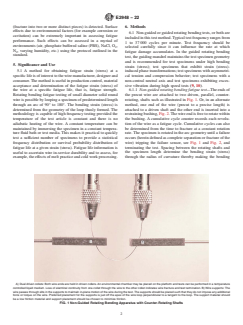
rotating, shafts such as illustrated in Fig. 1. Or, in an alternate
wireispossiblebyloopingaspecimenofpredeterminedlength
through an arc of 90° to 180°. The bending strain (stress) is method, one end of the wire (precut to a precise length) is
determined from the geometry of the loop thusly formed. The attached to a driven shaft and the other end is inserted into a
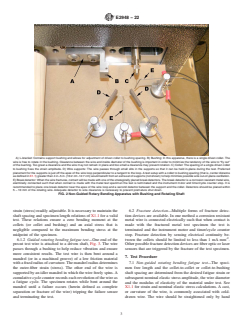
methodology is capable of high frequency testing provided the restrainingbushing,Fig.2.Thewireendisfreetorotatewithin
temperature of the test article is constant and there is no the bushing. A cumulative cycle counter records each revolu-
adiabatic heating of the wire. A constant temperature can be tion of the wire as a fatigue cycle. Cumulative cycles can also
maintained by immersing the specimen in a constant tempera- be determined from the time to fracture at a constant rotation
ture fluid bath or test media. This makes it practical to quickly rate.Thespecimenisrotatedinthearcgeometryuntilafailure
test a sufficient number of specimens to provide a statistical occurs(hereindefinedascompleteseparationorfractureofthe
frequency distribution or survival probability distribution of wire) tripping the failure sensor, see Fig. 1 and Fig. 2, and
fatigue life at a given strain (stress). Fatigue life information is terminating the test. Spacing between the rotating shafts and
useful to ascertain wire in-service durability and to assess, for the specimen length determine the bending strain (stress)
example,theeffectsofmeltpracticeandcoldworkprocessing. through the radius of curvature thereby making the bending
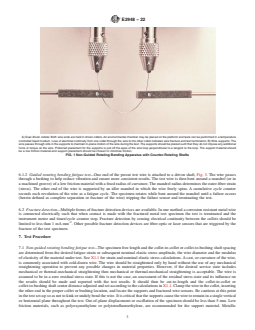
A) Dual driven collets: Both wire ends are held in driven collets. An environmental chamber may be placed on the platform and tests can be performed in a temperature
controlled liquid medium. Loss of electrical continuity from one collet through the wire to the other collet indicates wire fracture and test termination. B) Wire supports: The
wire passes through slits in the supports to maintain in-plane motion of the wire during the test. The supports should be placed such that they do not impose any additional
force or torque on the wire. Preferred placement for the supports is just off the apex of the wire loop perpendicular to a tangent to the loop. The support material should
be a low friction material and support placement should be chosen to minimize friction.
FIG. 1 Non-Guided Rotating Bending Apparatus with Counter-Rotating Shafts
E2948 − 22
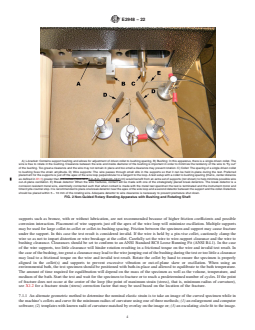
A) L-bracket: Contains support bushing and allows for adjustment of driven collet to bushing spacing. B) Bushing: In this apparatus, there is a single driven collet. The
wire is free to rotate in the bushing. Clearance between the wire and inside diameter of the bushing is important in order to minimize the tendency of the wire to “fly out”
of the bushing. Too great a clearance and the wire may not remain in place and too small a clearance may prevent rotation. C) Collet: The spacing of a single driven collet
to bushing fixes the strain amplitude. D) Wire supports: The wire passes through small slits in the supports so that it can be held in-plane during the test. Preferred
placement for the supports is just off the apex of the wire loop perpendicular to a tangent to the loop. A test setup with a collet to bushing spacing (that is, center distance
as defined in X1.1) greater than 4 in.-5 in. (10.2 cm -12.7 cm) would benefit from an extra set of supports (not shown) to help minimize possible wire out-of-plane oscillation.
E) Break detector: When the wire fractures, contact will be made with one of the strategically placed break detectors. The break detector is a corrosion resistant metal wire,
electrically connected such that when contact is made with the metal test specimen the test is terminated and the instrument motor and timer/cycle counter stop. It is
recommended to place one break detector near the apex of the wire loop and a second detector between the support and the collet. Detectors should be placed within
5 – 10 mm of the rotating wire. Adequate detector to wire clearance is necessary to prevent premature shut down.
FIG. 2 Non-Guided Rotary Bending Apparatus with Bushing and Rotating Shaft
strain (stress) readily adjustable. It is necessary to maintain the 6.2 Fracture detection—Multiple forms of fracture detec-
shaft spacing and specimen length relations of X1.1 for a valid tion devices are available. In one method a corrosion resistant
test. These relations ensure a zero bending moment at the metal wire is connected electrically such that when contact is
collets (or collet and bushing) and an axial stress that is made with the fractured metal test specimen the test is
negligible compared to the maximum bending stress at the terminated and the instrument motor and timer/cycle counter
midpoint of the specimen. stop. Fracture detection by sensing electrical continuity be-
-2
6.1.2 Guided rotating bending fatigue test—One end of the tween the collets should be limited to less than 1 mA mm .
precut test wire is attached to a driven shaft, Fig. 3. The wire Otherpossiblefracturedetectiondevicesarefiberopticorlaser
passes through a bushing to help reduce vibration and ensure sensors that are triggered by the fracture of the test specimen.
more consistent results. The test wire is then bent around a
7. Test Procedure
mandrel (or in a machined groove) of a low friction material
withafixedradiusofcurvature.Themandrelradiusdetermines 7.1 Non-guided rotating bending fatigue test—The speci-
the outer-fiber strain (stress). The other end of the wire is men free length and the collet-to-collet or collet-to-bushing
supportedbyanidlermandrelinwhichthewirefreelyspins.A shaft spacing are determined from the desired fatigue strain or
cumulativecyclecounterrecordseachrevolutionofthewireas subsequent nominal elastic stress amplitude, the wire diameter
a fatigue cycle. The specimen rotates while bent around the and the modulus of elasticity of the material under test. See
mandrel until a failure occurs (herein defined as complete X1.1 for strain and nominal elastic stress calculations. A cast,
separation or fracture of the wire) tripping the failure sensor or curvature of the wire, is commonly associated with cold-
and terminating the test. drawn wire. The wire should be straightened only by hand
E2948 − 22
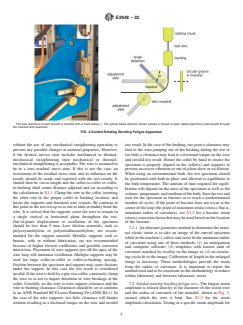
The wire specimen is bent around a mandrel with a fixed radius, ρ. The optical break detector shown senses a closed or open (failed specimen) optical path through
the mandrel and specimen.
FIG. 3 Guided Rotating Bending Fatigue Apparatus
without the use of any mechanical straightening operation to testresult.Inthecaseofthebushing,toogreataclearancemay
prevent any possible changes in material properties. However, lead to the wire jumping out of the bushing during the test or
if the desired service state includes mechanical or thermal-
toolittleaclearancemayleadtoafrictionaltorqueonthewire
mechanical straightening then mechanical or thermal- and invalid test result. Rotate the collet by hand to ensure the
mechanical straightening is acceptable.The wire is assumed to
specimen is properly aligned in the collet(s) and supports to
be in a zero residual stress state. If this is not the case, an
preventexcessivevibrationorout-of-planeskeworoscillation.
assessment of the residual stress state and its influence on the
When using an environmental bath, the test specimen should
results should be made and reported with the test results. It
be positioned with bath-in-place and allowed to equilibrate to
should then be cut-to-length and the collet-to-collet or collet-
the bath temperature. The amount of time required for equili-
to-bushing shaft center distance adjusted and set according to
bration will depend on the mass of the specimen as well as the
thecalculationsinX1.1.Clampthewireinthecollet,inserting
volume,temperature,andmediumofthebath.Startthetestand
the other end in the proper collet or bushing location, and
wait for the specimen to fracture or to reach a predetermined
locate the supports and fractured wire sensors. Be cautious at
number of cycles. If the point of fracture does not occur at the
thispointinthetestset-upsoasnottokinkorundulybendthe
centeroftheloop(thepointofmaximumstrain(stress),thatis,
wire. It is critical that the supports cause the wire to remain in
minimum radius of curvature), see X1.2 for a fracture strain
a single vertical or horizontal plane throughout the test.
(stress)correctionfactorthatmaybeusedbasedonthelocation
Out-of-plane displacement or oscillation of the specimen
of the fracture.
should be less than 5 mm. Low friction materials, such as
7.1.1 Analternategeometricmethodtodeterminethenomi-
polyoxymethylene or polytetrafluoroethylene, are recom-
nal elastic strain is to take an image of the curved specimen
mended for the support material. Metallic supports such as
whileinthemachine’scolletsandcurvefittheminimumradius
bronze, with or without lubrication, are not recommended
of curvature using one of three methods; (1) an enlargement
because of higher friction coefficients and possible corrosion
and computer software; (2) templates with known radii of
interaction. Placement of wire supports just off the apex of the
curvature matched by overlay on the image or; (3) an osculat-
wire loop will minimize oscillation. Multiple supports may be
ing circle fit to the image. Calibration of length in the enlarged
used for large collet-to-collet or collet-to-bushing spacing.
image is necessary. These methodologies provide the strain
Friction between the specimen and support may cause fracture
from the radius of curvature. It is important to report the
under the support. In this case the test result is considered
methodusedandtobeconsistentinthismethodologytoreduce
invalid.Ifthewireisheldbyapin-visecollet,cautiouslyclamp
within laboratory and between laboratory errors.
the wire so as not to impart distortion or wire breakage at the
collet. Carefully set the wire to wire-support clearance and the 7.2 Guided rotating bending fatigue test—Thefatiguestrain
amplitude is related directly to the diameter of the tested wire
wiretobushingclearance.Clearancesshouldbesettoconform
to anANSI Standard RC8 Loose Running Fit (ANSI B4.1). In and the radius of curvature of the mandrel, shown in Fig. 3,
around which the wire is bent. See X1.3 for the strain
the case of the wire supports, too little clearance will hinder
rotation resulting in a frictional torque on the wire and invalid amplitudecalculation.Testingataspecificstrainamplitudefor
E2948 − 22
agivenwirediameterrequiresamandrelwithaspecificradius. 8.1.1 The fatigue test specimens, procedures, and results
As such, a
...
This document is not an ASTM standard and is intended only to provide the user of an ASTM standard an indication of what changes have been made to the previous version. Because
it may not be technically possible to adequately depict all changes accurately, ASTM recommends that users consult prior editions as appropriate. In all cases only the current version
of the standard as published by ASTM is to be considered the official document.
Designation: E2948 − 16a E2948 − 22
Standard Test Method for
Conducting Rotating Bending Fatigue Tests of Solid Round
Fine Wire
This standard is issued under the fixed designation E2948; the number immediately following the designation indicates the year of
original adoption or, in the case of revision, the year of last revision. A number in parentheses indicates the year of last reapproval. A
superscript epsilon (´) indicates an editorial change since the last revision or reapproval.
1. Scope
1.1 This test method is intended as a procedure for the performance of rotating bending fatigue tests of solid round fine wire to
obtain the fatigue strength of metallic materials at a specified life in the fatigue regime where the strains (stresses) are
predominately and nominally linear elastic. This test method is limited to the fatigue testing of small diameter solid round wire
subjected to a constant amplitude periodic strain (stress). The methodology can be useful in assessing the effects of internal
material structure, such as inclusions, in melt technique and cold work processing studies. However, there is a caveat. The strain,
due to the radial strain gradient imposed by the test methodology, is a maximum at the surface and zero at the centerline. Thus
the test method may not seek out the “weakest link,” largest inclusions, that govern uniaxial high cycle fatigue life where the strain
is uniform across the cross section and where fatigue damage initiates at a subsurface location (1-5). Also, pre-strain, which can
influence fatigue life, is not included in this test method.
NOTE 1—The following documents, although not specifically mentioned, are considered sufficiently important to be listed in this test method:
ASTM STP 566 Handbook of Fatigue Testing
ASTM STP 588 Manual on Statistical Planning and Analysis for Fatigue Experiments
ASTM STP 731 Tables for Estimating Median Fatigue Limits (6-8)
1.2 The values stated in inch-pound units are to be regarded as standard. The values given in parentheses are mathematical
conversions to SI units that are provided for information only and are not considered standard.
1.3 This international standard was developed in accordance with internationally recognized principles on standardization
established in the Decision on Principles for the Development of International Standards, Guides and Recommendations issued
by the World Trade Organization Technical Barriers to Trade (TBT) Committee.
2. Referenced Documents
2.1 ASTM Standards:
E177 Practice for Use of the Terms Precision and Bias in ASTM Test Methods
E468 Practice for Presentation of Constant Amplitude Fatigue Test Results for Metallic Materials
E691 Practice for Conducting an Interlaboratory Study to Determine the Precision of a Test Method
F562 Specification for Wrought 35Cobalt-35Nickel-20Chromium-10Molybdenum Alloy for Surgical Implant Applications
(UNS R30035)
This test method is under the jurisdiction of ASTM Committee E08 on Fatigue and Fracture and is the direct responsibility of Subcommittee E08.05 on Cyclic
Deformation and Fatigue Crack Formation.
Current edition approved Oct. 1, 2016Feb. 1, 2022. Published November 2016February 2022. Originally approved in 2014. Last previous edition approved in 2016 as
ɛ1
E2948–16–16a. . DOI: 10.1520/E2948-16A10.1520/E2948-22
The boldface numbers in parentheses refer to a list of references at the end of this standard.
For referenced ASTM standards, visit the ASTM website, www.astm.org, or contact ASTM Customer Service at service@astm.org. For Annual Book of ASTM Standards
volume information, refer to the standard’s Document Summary page on the ASTM website.
Copyright © ASTM International, 100 Barr Harbor Drive, PO Box C700, West Conshohocken, PA 19428-2959. United States
E2948 − 22
E739 Practice for Statistical Analysis of Linear or Linearized Stress-Life (S-N) and Strain-Life (ε-N) Fatigue Data
E1823 Terminology Relating to Fatigue and Fracture Testing
2.2 ANSI Standard:
ANSI B4.1 Standard Limits and Fits
3. Terminology
3.1 Definitions:
3.1.1 Terms used in this practice shall be as defined in Terminology E1823.
4. Summary of Test Method
4.1 This test methodology describes a means to characterize the fatigue response of small diameter solid round wire using a
rotating bending test. Small diameter wire, to be consistent with Specification F562 definition of “fine wire”, is less than or equal
to a diameter of 0.063 in. (1.60 mm). The wire is subjected to a constant-amplitude bending strain (stress) while it rotates at a fixed
speed. This creates a fully reversed, R = (minimum strain (stress)/ maximum strain (stress))= –1, bending strain at any point on
the circumference of the wire. The number of revolutions or cycles is counted until a failure (fracture into two or more distinct
pieces) is detected. Surface effects due to environmental factors (for example corrosion or cavitation) can be extremely important
in assessing fatigue performance. Such effects can be assessed in a myriad of environments (air, phosphate buffered saline (PBS),
NaCl, O , N , varying humidity, etc.) using the protocol outlined in the standard.
2 2
5. Significance and Use
5.1 A method for obtaining fatigue strain (stress) at a specific life is of interest to the wire manufacturer, designer and consumer.
The method is useful in production control, material acceptance and determination of the fatigue strain (stress) of the wire at a
specific fatigue life, that is, fatigue strength. Rotating bending fatigue testing of small diameter solid round wire is possible by
looping a specimen of predetermined length through an arc of 90° to 180°. The bending strain (stress) is determined from the
geometry of the loop thusly formed. The methodology is capable of high frequency testing provided the temperature of the test
article is constant and there is no adiabatic heating of the wire. A constant temperature can be maintained by immersing the
specimen in a constant temperature fluid bath or test media. This makes it practical to quickly test a sufficient number of specimens
to provide a statistical frequency distribution or survival probability distribution of fatigue life at a given strain (stress). Fatigue
life information is useful to ascertain wire in-service durability and to assess, for example, the effects of melt practice and cold
work processing.
6. Methods
6.1 Non-guided or guided rotating bending tests, or both are included in this test method. Typical test frequency ranges from 1
to 37 000 cycles per minute. Test frequency should be selected carefully since it can influence the rate at which fatigue damage
accumulates. In the guided rotating bending test, the guiding mandrel maintains the test specimen geometry and is recommended
for test specimens under high bending strain (stress); test specimens that exhibit strain (stress)-induced phase transformations; test
specimens with asymmetrical tension and compression behavior; test specimens with a non-central neutral axis and test specimens
exhibiting excessive vibration during high speed tests (9, 10).
6.1.1 Non-guided rotating bending fatigue test—The ends of the precut wire are attached to two driven, parallel, counter-rotating,
shafts such as illustrated in Fig. 1. Or, in an alternate method, one end of the wire (precut to a precise length) is attached to a driven
shaft and the other end is inserted into a restraining bushing, Fig. 2. The wire end is free to rotate within the bushing. A cumulative
cycle counter records each revolution of the wire as a fatigue cycle. Cumulative cycles can also be determined from the time to
fracture at a constant rotation rate. The specimen is rotated in the arc geometry until a failure occurs (herein defined as complete
separation or fracture of the wire) tripping the failure sensor, see Fig. 1 and Fig. 2, and terminating the test. Spacing between the
rotating shafts and the specimen length determine the bending strain (stress) through the radius of curvature thereby making the
bending strain (stress) readily adjustable. It is necessary to maintain the shaft spacing and specimen length relations of X1.1 for
a valid test. These relations ensure a zero bending moment at the collets (or collet and bushing) and an axial stress that is negligible
compared to the maximum bending stress at the midpoint of the specimen.
Available from American National Standards Institute (ANSI), 25 W. 43rd St., 4th Floor, New York, NY 10036, http://www.ansi.org.
E2948 − 22
A) Dual driven collets: Both wire ends are held in driven collets. An environmental chamber may be placed on the platform and tests can be performed in a temperature
controlled liquid medium. Loss of electrical continuity from one collet through the wire to the other collet indicates wire fracture and test termination. B) Wire supports: The
wire passes through slits in the supports to maintain in-plane motion of the wire during the test. The supports should be placed such that they do not impose any additional
force or torque on the wire. Preferred placement for the supports is just off the apex of the wire loop perpendicular to a tangent to the loop. The support material should
be a low friction material and support placement should be chosen to minimize friction.
FIG. 1 Non-Guided Rotating Bending Apparatus with Counter-Rotating Shafts
6.1.2 Guided rotating bending fatigue test—One end of the precut test wire is attached to a driven shaft, Fig. 3. The wire passes
through a bushing to help reduce vibration and ensure more consistent results. The test wire is then bent around a mandrel (or in
a machined groove) of a low friction material with a fixed radius of curvature. The mandrel radius determines the outer-fiber strain
(stress). The other end of the wire is supported by an idler mandrel in which the wire freely spins. A cumulative cycle counter
records each revolution of the wire as a fatigue cycle. The specimen rotates while bent around the mandrel until a failure occurs
(herein defined as complete separation or fracture of the wire) tripping the failure sensor and terminating the test.
6.2 Fracture detection—Multiple forms of fracture detection devices are available. In one method a corrosion resistant metal wire
is connected electrically such that when contact is made with the fractured metal test specimen the test is terminated and the
instrument motor and timer/cycle counter stop. Fracture detection by sensing electrical continuity between the collets should be
-2
limited to less than 1 mA mm . Other possible fracture detection devices are fiber optic or laser sensors that are triggered by the
fracture of the test specimen.
7. Test Procedure
7.1 Non-guided rotating bending fatigue test—The specimen free length and the collet-to-collet or collet-to-bushing shaft spacing
are determined from the desired fatigue strain or subsequent nominal elastic stress amplitude, the wire diameter and the modulus
of elasticity of the material under test. See X1.1 for strain and nominal elastic stress calculations. A cast, or curvature of the wire,
is commonly associated with cold-drawn wire. The wire should be straightened only by hand without the use of any mechanical
straightening operation to prevent any possible changes in material properties. However, if the desired service state includes
mechanical or thermal-mechanical straightening then mechanical or thermal-mechanical straightening is acceptable. The wire is
assumed to be in a zero residual stress state. If this is not the case, an assessment of the residual stress state and its influence on
the results should be made and reported with the test results. It should then be cut-to-length and the collet-to-collet or
collet-to-bushing shaft center distance adjusted and set according to the calculations in X1.1. Clamp the wire in the collet, inserting
the other end in the proper collet or bushing location, and locate the supports and fractured wire sensors. Be cautious at this point
in the test set-up so as not to kink or unduly bend the wire. It is critical that the supports cause the wire to remain in a single vertical
or horizontal plane throughout the test. Out-of-plane displacement or oscillation of the specimen should be less than 5 mm. Low
friction materials, such as polyoxymethylene or polytetrafluoroethylene, are recommended for the support material. Metallic
E2948 − 22
A) L-bracket: Contains support bushing and allows for adjustment of driven collet to bushing spacing. B) Bushing: In this apparatus, there is a single driven collet. The
wire is free to rotate in the bushing. Clearance between the wire and inside diameter of the bushing is important in order to minimize the tendency of the wire to “fly out”
of the bushing. Too great a clearance and the wire may not remain in place and too small a clearance may prevent rotation. C) Collet: The spacing of a single driven collet
to bushing fixes the strain amplitude. D) Wire supports: The wire passes through small slits in the supports so that it can be held in-plane during the test. Preferred
placement for the supports is just off the apex of the wire loop perpendicular to a tangent to the loop. A test setup with a collet to bushing spacing (that is, center distance
as defined in X1.1) greater than 4-5 inches (10.2-12.7 4 in.-5 in. (10.2 cm -12.7 cm) would benefit from an extra set of supports (not shown) to help minimize possible wire
out-of-plane oscillation. E) Break detector: When the wire fractures, contact will be made with one of the strategically placed break detectors. The break detector is a
corrosion resistant metal wire, electrically connected such that when contact is made with the metal test specimen the test is terminated and the instrument motor and
timer/cycle counter stop. It is recommended to place one break detector near the apex of the wire loop and a second detector between the support and the collet. Detectors
should be placed within 5 – 10 mm of the rotating wire. Adequate detector to wire clearance is necessary to prevent premature shut down.
FIG. 2 Non-Guided Rotary Bending Apparatus with Bushing and Rotating Shaft
supports such as bronze, with or without lubrication, are not recommended because of higher friction coefficients and possible
corrosion interaction. Placement of wire supports just off the apex of the wire loop will minimize oscillation. Multiple supports
may be used for large collet-to-collet or collet-to-bushing spacing. Friction between the specimen and support may cause fracture
under the support. In this case the test result is considered invalid. If the wire is held by a pin-vise collet, cautiously clamp the
wire so as not to impart distortion or wire breakage at the collet. Carefully set the wire to wire-support clearance and the wire to
bushing clearance. Clearances should be set to conform to an ANSI Standard RC8 Loose Running Fit (ANSI B4.1). In the case
of the wire supports, too little clearance will hinder rotation resulting in a frictional torque on the wire and invalid test result. In
the case of the bushing, too great a clearance may lead to the wire jumping out of the bushing during the test or too little a clearance
may lead to a frictional torque on the wire and invalid test result. Rotate the collet by hand to ensure the specimen is properly
aligned in the collet(s) and supports to prevent excessive vibration or out-of-plane skew or oscillation. When using an
environmental bath, the test specimen should be positioned with bath-in-place and allowed to equilibrate to the bath temperature.
The amount of time required for equilibration will depend on the mass of the specimen as well as the volume, temperature, and
medium of the bath. Start the test and wait for the specimen to fracture or to reach a predetermined number of cycles. If the point
of fracture does not occur at the center of the loop (the point of maximum strain (stress), that is, minimum radius of curvature),
see X1.2 for a fracture strain (stress) correction factor that may be used based on the location of the fracture.
7.1.1 An alternate geometric method to determine the nominal elastic strain is to take an image of the curved specimen while in
the machine’s collets and curve fit the minimum radius of curvature using one of three methods; (1) an enlargement and computer
software; (2) templates with known radii of curvature matched by overlay on the image or; (3) an osculating circle fit to the image.
E2948 − 22
The wire specimen is bent around a mandrel with a fixed radius, ρ. The optical break detector shown senses a closed or open (failed specimen) optical path through
the mandrel and specimen.
FIG. 3 Guided Rotating Bending Fatigue Apparatus
Calibration of length in the enlarged image is necessary. These methodologies provide the strain from the radius of curvature. It
is important to report the method used and to be consistent in this methodology to reduce within laboratory and between laboratory
errors.
7.2 Guided rotating bending fatigue test—The fatigue strain amplitude is related directly to the diameter of the tested wire and
the radius of curvature of the mandrel, shown in Fig. 3, around which the wire is bent. See X1.3 for the strain amplitude calculation.
Testing at a specific strain amplitude for a given wire diameter requires a mandrel with a specific radius. As such, a series of
ma
...