

ASTM E2069-19
(Test Method)Standard Test Method for Temperature Calibration on Cooling of Differential Scanning Calorimeters
General Information
- Abstract
SIGNIFICANCE AND USE
5.1 This test method is useful in calibrating the temperature signal of a DSC for cooling experiments such as the determination of crystallization temperatures in Test Method D3418 and Test Method E794.
5.2 This test method may be used for research, development, analytical, specification acceptance, quality assurance, and control purposes.
SCOPE
1.1 This test method describes the temperature calibration of differential scanning calorimeters (DSCs) on cooling using the difference between transition temperatures upon heating and cooling in the temperature range of 65 °C to 420 °C. An offset in the indicated temperature between heating and cooling experiments, within this temperature range, may be used to provide temperature calibration on cooling at other temperature ranges.
1.2 The values stated in SI units are to be regarded as standard. No other units of measurement are included in this standard.
1.3 Test Method E3142 is an alternative to this test method.
1.4 This standard does not purport to address all of the safety concerns, if any, associated with its use. It is the responsibility of the user of this standard to establish appropriate safety, health, and environmental practices and determine the applicability of regulatory limitations prior to use. Specific precautionary statements are given in Section 6.
1.5 This international standard was developed in accordance with internationally recognized principles on standardization established in the Decision on Principles for the Development of International Standards, Guides and Recommendations issued by the World Trade Organization Technical Barriers to Trade (TBT) Committee.
- Status
- Published
- Publication Date
- 31-Aug-2019
- Technical Committee
- E37 - Thermal Measurements
- Drafting Committee
- E37.01 - Calorimetry and Mass Loss
Buy Documents
ASTM E2069-19 - Standard Test Method for Temperature Calibration on Cooling of Differential Scanning Calorimeters
REDLINE ASTM E2069-19 - Standard Test Method for Temperature Calibration on Cooling of Differential Scanning Calorimeters
Overview
ASTM E2069-19: Standard Test Method for Temperature Calibration on Cooling of Differential Scanning Calorimeters (DSC) defines a systematic approach for calibrating the temperature signal of DSCs during cooling cycles in the temperature range of 65°C to 420°C. Accurate temperature calibration is essential for reliable thermal analysis, especially in experiments where determining crystallization and transition temperatures is critical. This standard method applies to industries and laboratories engaged in research, development, analytical testing, quality assurance, and specification acceptance.
Key Topics
Scope and Significance
- Describes calibration of DSCs for cooling, using the offset between transition temperatures obtained from both heating and cooling in the specified temperature range.
- Ensures accuracy in determining thermal transitions, essential for thermal analysis applications like melting, crystallization, and purity studies.
- Standardizes procedures to ensure consistency and reliability in cooling data across various DSC models and laboratories.
Calibration Materials and Equipment
- Recommends high purity liquid crystal substances (such as M-24, BP-53, BCH-52) for calibration purposes.
- Specifies requirements for DSC equipment, including furnace, temperature and differential sensors, precise temperature controllers, and inert sample containers.
- Stipulates controlled use of inert gases to avoid oxidation and unwanted reactions during analysis.
Calibration and Procedure
- Advises performing initial heating calibration (typically at 10°C/min) using reliable reference materials like Indium.
- Defines step-by-step protocol: measuring transition temperatures on both heating and cooling cycles, calculating the offset temperature (ΔT), and applying this offset to subsequent experimental results.
- Addresses recording, reporting data, and maintaining documentation for traceability and reproducibility.
Safety and Precautions
- Highlights potential hazards related to toxic or corrosive effluents and the need for suitable safety, health, and environmental practices.
- Emphasizes the user’s responsibility to follow appropriate guidelines and regulatory compliance.
Applications
Research and Development
- Enables accurate study of thermal properties and behavior of new materials, especially polymers, pharmaceuticals, and specialty chemicals.
- Supports innovation by providing reliable data for material selection and formulation.
Analytical Testing and Quality Assurance
- Used to verify material properties during manufacturing and product development.
- Provides critical data for specification acceptance and regulatory compliance in industries such as plastics, composites, and specialty materials.
Process Control
- Monitors and verifies consistency of material properties in production, ensuring high product quality and minimizing defects.
- Assists in troubleshooting and optimization of thermal processes.
Related Standards
- ASTM D3418 - Test Method for Transition Temperatures and Enthalpies of Fusion and Crystallization of Polymers by DSC
- ASTM E794 - Test Method for Melting and Crystallization Temperatures by Thermal Analysis
- ASTM E928 - Test Method for Purity by Differential Scanning Calorimetry
- ASTM E967 - Test Method for Temperature Calibration of DSC and Differential Thermal Analyzers
- ASTM E3142 - Practice for Statistical Treatment of Thermoanalytical Data (alternative method for thermal lag determination)
- ASTM E473 - Terminology Relating to Thermal Analysis and Rheology
Practical Value
Using ASTM E2069-19 ensures the accuracy and reliability of temperature measurements during cooling cycles in DSC analysis. This leads to enhanced quality assurance, supports material research, and helps meet stringent industry standards. Laboratories and manufacturers benefit from harmonized calibration procedures, aiding in global trade and compliance with technical barriers to trade as outlined by the WTO. Routine implementation of this standard maximizes data consistency across instruments and operators.
Relations
- Effective Date
- 01-Sep-2019
- Effective Date
- 01-Oct-2023
- Effective Date
- 01-May-2019
- Effective Date
- 15-Jan-2018
- Effective Date
- 15-Aug-2014
- Effective Date
- 15-Aug-2014
- Effective Date
- 01-Sep-2012
- Effective Date
- 01-Aug-2012
- Effective Date
- 01-Aug-2012
- Effective Date
- 15-Jun-2011
- Effective Date
- 01-Apr-2011
- Effective Date
- 01-Mar-2010
- Effective Date
- 01-Aug-2009
- Refers
ASTM E928-08 - Standard Test Method for Determination of Purity by Differential Scanning Calorimetry - Effective Date
- 01-Sep-2008
- Effective Date
- 01-Sep-2008
Buy Documents
ASTM E2069-19 - Standard Test Method for Temperature Calibration on Cooling of Differential Scanning Calorimeters
REDLINE ASTM E2069-19 - Standard Test Method for Temperature Calibration on Cooling of Differential Scanning Calorimeters
Get Certified
Connect with accredited certification bodies for this standard

BSMI (Bureau of Standards, Metrology and Inspection)
Taiwan's standards and inspection authority.
Sponsored listings
Frequently Asked Questions
ASTM E2069-19 is a standard published by ASTM International. Its full title is "Standard Test Method for Temperature Calibration on Cooling of Differential Scanning Calorimeters". This standard covers: SIGNIFICANCE AND USE 5.1 This test method is useful in calibrating the temperature signal of a DSC for cooling experiments such as the determination of crystallization temperatures in Test Method D3418 and Test Method E794. 5.2 This test method may be used for research, development, analytical, specification acceptance, quality assurance, and control purposes. SCOPE 1.1 This test method describes the temperature calibration of differential scanning calorimeters (DSCs) on cooling using the difference between transition temperatures upon heating and cooling in the temperature range of 65 °C to 420 °C. An offset in the indicated temperature between heating and cooling experiments, within this temperature range, may be used to provide temperature calibration on cooling at other temperature ranges. 1.2 The values stated in SI units are to be regarded as standard. No other units of measurement are included in this standard. 1.3 Test Method E3142 is an alternative to this test method. 1.4 This standard does not purport to address all of the safety concerns, if any, associated with its use. It is the responsibility of the user of this standard to establish appropriate safety, health, and environmental practices and determine the applicability of regulatory limitations prior to use. Specific precautionary statements are given in Section 6. 1.5 This international standard was developed in accordance with internationally recognized principles on standardization established in the Decision on Principles for the Development of International Standards, Guides and Recommendations issued by the World Trade Organization Technical Barriers to Trade (TBT) Committee.
SIGNIFICANCE AND USE 5.1 This test method is useful in calibrating the temperature signal of a DSC for cooling experiments such as the determination of crystallization temperatures in Test Method D3418 and Test Method E794. 5.2 This test method may be used for research, development, analytical, specification acceptance, quality assurance, and control purposes. SCOPE 1.1 This test method describes the temperature calibration of differential scanning calorimeters (DSCs) on cooling using the difference between transition temperatures upon heating and cooling in the temperature range of 65 °C to 420 °C. An offset in the indicated temperature between heating and cooling experiments, within this temperature range, may be used to provide temperature calibration on cooling at other temperature ranges. 1.2 The values stated in SI units are to be regarded as standard. No other units of measurement are included in this standard. 1.3 Test Method E3142 is an alternative to this test method. 1.4 This standard does not purport to address all of the safety concerns, if any, associated with its use. It is the responsibility of the user of this standard to establish appropriate safety, health, and environmental practices and determine the applicability of regulatory limitations prior to use. Specific precautionary statements are given in Section 6. 1.5 This international standard was developed in accordance with internationally recognized principles on standardization established in the Decision on Principles for the Development of International Standards, Guides and Recommendations issued by the World Trade Organization Technical Barriers to Trade (TBT) Committee.
ASTM E2069-19 is classified under the following ICS (International Classification for Standards) categories: 17.200.10 - Heat. Calorimetry. The ICS classification helps identify the subject area and facilitates finding related standards.
ASTM E2069-19 has the following relationships with other standards: It is inter standard links to ASTM E2069-06(2018), ASTM E473-23b, ASTM E928-19, ASTM E3142-18, ASTM E473-14, ASTM E928-08(2014), ASTM E794-06(2012), ASTM D3418-12, ASTM D3418-12e1, ASTM E473-11a, ASTM E473-11, ASTM E473-10, ASTM E473-09, ASTM E928-08, ASTM E967-08. Understanding these relationships helps ensure you are using the most current and applicable version of the standard.
ASTM E2069-19 is available in PDF format for immediate download after purchase. The document can be added to your cart and obtained through the secure checkout process. Digital delivery ensures instant access to the complete standard document.
Standards Content (Sample)
This international standard was developed in accordance with internationally recognized principles on standardization established in the Decision on Principles for the
Development of International Standards, Guides and Recommendations issued by the World Trade Organization Technical Barriers to Trade (TBT) Committee.
Designation: E2069 − 19
Standard Test Method for
Temperature Calibration on Cooling of Differential Scanning
Calorimeters
This standard is issued under the fixed designation E2069; the number immediately following the designation indicates the year of
original adoption or, in the case of revision, the year of last revision. A number in parentheses indicates the year of last reapproval. A
superscript epsilon (´) indicates an editorial change since the last revision or reapproval.
1. Scope E473 Terminology Relating to Thermal Analysis and Rhe-
ology
1.1 This test method describes the temperature calibration
E794 Test Method for MeltingAnd CrystallizationTempera-
of differential scanning calorimeters (DSCs) on cooling using
tures By Thermal Analysis
the difference between transition temperatures upon heating
E928 Test Method for Purity by Differential Scanning Calo-
and cooling in the temperature range of 65 °C to 420 °C. An
rimetry
offsetintheindicatedtemperaturebetweenheatingandcooling
E967 Test Method for Temperature Calibration of Differen-
experiments, within this temperature range, may be used to
providetemperaturecalibrationoncoolingatothertemperature
tial Scanning Calorimeters and Differential Thermal Ana-
ranges.
lyzers
E3142 Test Method for Thermal Lag of Thermal Analysis
1.2 The values stated in SI units are to be regarded as
Apparatus
standard. No other units of measurement are included in this
standard.
3. Terminology
1.3 Test Method E3142 is an alternative to this test method.
3.1 Specific technical terms used in this test method are
1.4 This standard does not purport to address all of the
defined in Terminology E473.
safety concerns, if any, associated with its use. It is the
responsibility of the user of this standard to establish appro-
priate safety, health, and environmental practices and deter- 4. Summary of Test Method
mine the applicability of regulatory limitations prior to use.
4.1 The temperature sensor of the DSC, used to determine
Specific precautionary statements are given in Section 6.
the temperature of a transition, is located close to but external
1.5 This international standard was developed in accor-
to the test specimen. This arrangement causes the indicated
dance with internationally recognized principles on standard-
temperature to lead or lag the actual specimen temperature on
ization established in the Decision on Principles for the
heating/cooling causing the reported temperature to be higher
Development of International Standards, Guides and Recom-
on heating and lower on cooling than the actual specimen
mendations issued by the World Trade Organization Technical
transition temperature. A DSC apparatus temperature sensor,
Barriers to Trade (TBT) Committee.
that has been calibrated for heating experiments, needs to be
2. Referenced Documents re-calibrated for cooling experiments. Such a calibration on
cooling is performed using a liquid crystal, polymorphic, or
2.1 ASTM Standards:
other material, the transition(s) for which are not subject to
D3418 Test Method for Transition Temperatures and En-
super-heating or super-cooling.
thalpies of Fusion and Crystallization of Polymers by
Differential Scanning Calorimetry
4.2 The transition temperature of a rapid, non-superheating
and non-supercooling transition is determined upon heating
and upon cooling. The difference between these two indicated
ThistestmethodisunderthejurisdictionofASTMCommitteeE37onThermal
temperatures provides an offset temperature value between
Measurements and is the direct responsibility of Subcommittee E37.01 on Calo-
heating and cooling experiments at the indicated rate. This
rimetry and Mass Loss.
Current edition approved Sept. 1, 2019. Published September 2019. Originally offset temperature value, when used with a precise temperature
approved in 2000. Last previous edition approved in 2018 as E2069 – 06 (2018).
calibration upon heating, may serve as an instrument calibra-
DOI: 10.1520/E2069-19.
tion function upon cooling.
For referenced ASTM standards, visit the ASTM website, www.astm.org, or
contact ASTM Customer Service at service@astm.org. For Annual Book of ASTM
4.3 The determination and use of thermal lag using Test
Standards volume information, refer to the standard’s Document Summary page on
the ASTM website. Method E3142 is an alternative to this test method.
Copyright © ASTM International, 100 Barr Harbor Drive, PO Box C700, West Conshohocken, PA 19428-2959. United States
E2069 − 19
5. Significance and Use 7.2 ABalance, to weigh specimen and/or containers to 610
µg with a capacity of 100 mg or greater.
5.1 This test method is useful in calibrating the temperature
signal of a DSC for cooling experiments such as the determi-
8. Calibration Materials
nation of crystallization temperatures in Test Method D3418
8.1 For the temperature range covered by many
and Test Method E794.
applications, the transitions of 99.8 % to 99.9 % pure materials
5.2 This test method may be used for research,
in Table 1 may be used for calibration. The calibrating liquid
development, analytical, specification acceptance, quality
crystal materials are known as M-24, BP-53, and BCH-52,
assurance, and control purposes.
and other materials shown in Table 1 are useful for this
purpose.
6. Precautions
6.1 Toxic or corrosive effluents, or both, may be released NOTE 3—The purity of these materials may be determined by Test
Method E928 using the first indicated transition prior to use.
when heating the material of this test method and may be
NOTE 4—The approximate heat of transitions for these samples is
harmful to personnel and to the apparatus.
shown in Table 1. The enthalpy of transition for M-24 is so small that it
is detectable only on the most sensitive DSC instrument.
7. Apparatus
8.2 The actual specimen used for this test should be pre-
7.1 DifferentialScanningCalorimeter(DSC)—Theessential
melted in the crucible for the lowest variance.
instrumentation required providing the minimum DSC capa-
bility for this test method includes:
9. Calibration
7.1.1 A DSC Test Chamber, composed of:
9.1 Perform any temperature calibration procedures recom-
7.1.1.1 A Furnace(s), to provide uniform controlled heating
mended by the manufacturer of the DSC as described in the
and cooling of a specimen and reference material to a constant
operations manual.
temperature or at a constant rate within the applicable tempera-
ture range of this test method.
7.1.1.2 A Temperature Sensor, that indicates specimen or
furnace temperature to 60.01 °C.
7.1.1.3 ADifferentialSensor, to detect a heat flow difference
The sole source of supply of these materials known to the committee at this
between the specimen and reference with a range of at least
time is EMD Chemicals Inc., 480 S. Democrat Road, Gibbstown, NJ 08027–1296.
The part numbers for these chemicals are as follows: M-24 is pn 1.00008.9005,
100 mW readable to 61µW.
BP-53 is pn 1.00007.9005 and BCH-52 is pn 1.00006.9005. If you are aware of
7.1.1.4 Ameansofsustainingapurgegasrateof10mL/min
alternative suppliers, please provide this information to ASTM headquarters. Your
to 100 6 5 mL/min in the test chamber.
comments will receive careful consideration at a meeting of the responsible
technical committee, which you may attend.
NOTE1—Typicallyinertpurgegasesthatinhibitspecimenoxidationare
99+ % pure nitrogen, argon or helium. Subambient operation requires dry
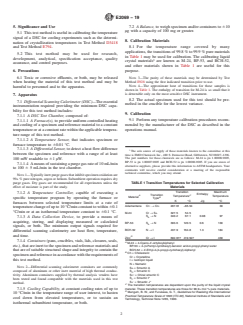
purge gases. Dry gases are recommended for all experiments unless the TABLE 1 Transition Temperatures for Selected Calibration
effect of moisture is part of the study. Materials
Transition Maximum
7.1.2 A Temperature Controller, capable of executing a
Enthalpy
Transition C
A
Temperature Temperature
Material
B
specific temperature program by operating the furnace or
Type
K°C J/g °C
furnaces between selected temperature limits at a rate of
Adamantane Cr → Cr 207.61 –65.54 30
1 2
temperaturechangeofupto10°C/minconstanttowithin 60.1
°C/min or at an isothermal temperature constant to 60.1 °C.
M-24 Cr→ S 327.5 54.5
A
S → N 340.2 67.1 0.08 97
A
7.1.3 A Data Collection Device, to provide a means of
acquiring, storing, and displaying measured or calculated
BP-53 S → N 393.6 120.5 0.6 130
A
signals, or both. The minimum output signals required for
BCH-52 N→ I 437.9 164.8 1.3 184
differential scanning calorimetry are heat flow, temperature,
and time. D
Zinc Cr→ I 692.677 419.527 439
7.1.4 Containers (pans, crucibles, vials, lids, closures, seals,
A
M-24 = 4-Cyano-4’-octyloxybiphenyl
etc.), that are inert to the specimen and reference materials and
BP-53 = 4-(4-Pentyl-cyclohexyl)-benzoic acid-4-propyl-ph
...
This document is not an ASTM standard and is intended only to provide the user of an ASTM standard an indication of what changes have been made to the previous version. Because
it may not be technically possible to adequately depict all changes accurately, ASTM recommends that users consult prior editions as appropriate. In all cases only the current version
of the standard as published by ASTM is to be considered the official document.
Designation: E2069 − 06 (Reapproved 2018) E2069 − 19
Standard Test Method for
Temperature Calibration on Cooling of Differential Scanning
Calorimeters
This standard is issued under the fixed designation E2069; the number immediately following the designation indicates the year of
original adoption or, in the case of revision, the year of last revision. A number in parentheses indicates the year of last reapproval. A
superscript epsilon (´) indicates an editorial change since the last revision or reapproval.
1. Scope
1.1 This test method coversdescribes the temperature calibration of differential scanning calorimeters (DSCs) on cooling using
the difference between transition temperatures upon heating and cooling in the temperature range of 50 to 185°C. 65 °C to 420
°C. An offset in the indicated temperature between heating and cooling experiments, within this temperature range, may be used
to provide temperature calibration on cooling at other temperature ranges.
1.2 The values stated in SI units are to be regarded as standard. No other units of measurement are included in this standard.
1.3 Test Method E3142 is an alternative to this test method.
1.4 This standard does not purport to address all of the safety concerns, if any, associated with its use. It is the responsibility
of the user of this standard to establish appropriate safety, health, and environmental practices and determine the applicability of
regulatory limitations prior to use. Specific precautionary statements are given in Section 6.
1.5 This international standard was developed in accordance with internationally recognized principles on standardization
established in the Decision on Principles for the Development of International Standards, Guides and Recommendations issued
by the World Trade Organization Technical Barriers to Trade (TBT) Committee.
2. Referenced Documents
2.1 ASTM Standards:
D3418 Test Method for Transition Temperatures and Enthalpies of Fusion and Crystallization of Polymers by Differential
Scanning Calorimetry
E473 Terminology Relating to Thermal Analysis and Rheology
E794 Test Method for Melting And Crystallization Temperatures By Thermal Analysis
E928 Test Method for Purity by Differential Scanning Calorimetry
E967 Test Method for Temperature Calibration of Differential Scanning Calorimeters and Differential Thermal Analyzers
E1970E3142 Practice for Statistical Treatment of Thermoanalytical DataTest Method for Thermal Lag of Thermal Analysis
Apparatus
3. Terminology
3.1 Specific technical terms used in this test method are defined in Terminology E473.
4. Summary of Test Method
4.1 The temperature sensor of the DSC, used to determine the temperature of a transition, is located close to but external to the
test specimen. This arrangement causes the indicated temperature to lead or lag the actual specimen temperature on heating/cooling
causing the reported temperature to be higher on heating and lower on cooling than the actual specimen transition temperature.
A DSC apparatus temperature, temperature sensor, that has been calibrated for heating experiments, needs to be re-calibrated for
cooling experiments. Such a calibration on cooling is performed using a liquid crystal crystal, polymorphic, or other material, the
transition(s) for which are not subject to super-heating or super-cooling.
This test method is under the jurisdiction of ASTM Committee E37 on Thermal Measurements and is the direct responsibility of Subcommittee E37.01 on Calorimetry
and Mass Loss.
Current edition approved April 1, 2018Sept. 1, 2019. Published May 2018September 2019. Originally approved in 2000. Last previous edition approved in 20122018 as
E2069 – 06 (2012).(2018). DOI: 10.1520/E2069-06R18.10.1520/E2069-19.
For referenced ASTM standards, visit the ASTM website, www.astm.org, or contact ASTM Customer Service at service@astm.org. For Annual Book of ASTM Standards
volume information, refer to the standard’sstandard’s Document Summary page on the ASTM website.
Copyright © ASTM International, 100 Barr Harbor Drive, PO Box C700, West Conshohocken, PA 19428-2959. United States
E2069 − 19
4.2 The transition temperature of a rapid, non-superheating and non-supercooling transition is determined upon heating and
upon cooling. The difference between these two indicated temperatures provides an offset temperature value between heating and
cooling experiments at the indicated rate. This offset temperature value, when used with a precise temperature calibration upon
heating, may serve as an instrument calibration function upon cooling.
4.3 The determination and use of thermal lag using Test Method E3142 is an alternative to this test method.
5. Significance and Use
5.1 This test method is useful in calibrating the temperature signal of a differential scanning calorimeter DSC for cooling
experiments such as the determination of crystallization temperatures in Test Method D3418 and Test Method E794.
5.2 This test method may be used for research, development, analytical, specification acceptance, quality assurance, and control
purposes.
6. Precautions
6.1 Toxic or corrosive effluents, or both, may be released when heating the material of this test method and may be harmful to
personnel and to the apparatus.
7. Apparatus
7.1 Differential Scanning Calorimeter (DSC)—The essential instrumentation required providing the minimum differential
scanning calorimeter DSC capability for this test method includes:
7.1.1 A DSC Test Chamber, composed of:
7.1.1.1 A Furnace(s), to provide uniform controlled heating and cooling of a specimen and reference material to a constant
temperature or at a constant rate within the applicable temperature range of this test method.
7.1.1.2 A Temperature Sensor, that indicates specimen or furnace temperature to 60.01°C.60.01 °C.
7.1.1.3 A Differential Sensor, to detect a heat flow difference (DSC) between the specimen and reference with a range of at least
100 mW readable to 61 μW (DSC).μW.
7.1.1.4 A means of sustaining a purge gas rate of 10 mL/min to 100 6 5 mL/min in the test chamber.
NOTE 1—Typically inert purge gases that inhibit specimen oxidation are 99+ % pure nitrogen, argon or helium. Subambient operation requires dry
purge gases. Dry gases are recommended for all experiments unless the effect of moisture is part of the study.
7.1.2 A Temperature Controller, capable of executing a specific temperature program by operating the furnace or furnaces
between selected temperature limits at a rate of temperature change of 10°C/min up to 10 °C/min constant to within 60.1°C/min
60.1 °C/min or at an isothermal temperature constant to 60.1°C.60.1 °C.
7.1.3 A Recording Data Collection Device, capable of recording and displaying fractions of the heat flow signal (DSC curve),
including the signal noise, on the Y-axis versus fractions of temperature signal, including the signal noise, on the X-axis.to provide
a means of acquiring, storing, and displaying measured or calculated signals, or both. The minimum output signals required for
differential scanning calorimetry are heat flow, temperature, and time.
7.1.4 Containers,Containers (pans, crucibles, vials, lids, closures, seals, etc.)etc.), that are inert to the specimen and reference
materials and that are of suitable structural shape and integrity to contain the specimen and reference in accordance with the
requirements of this test method.
NOTE 2—DSC Differential scanning calorimeter containers are commonly composed of aluminum or other inert material of high thermal conductivity.
Aluminum has containers supplied by thermal analysis venders have been tested and found compatible with the materials used in this test method.
7.1.5 Cooling Capability, at constant cooling rates of up to 10°C/min 10 °C/min in the temperature range of 185 to 50°C, to
user interest, to hasten cool down from elevated temperatures, or to sustain an isothermal subambient temperature, or both.
7.2 A Balance, to weigh specimen and/or containers to 610 μg with a capacity of 100 mg or greater.
8. Calibration Materials
8.1 For the temperature range covered by many applications, the liquid crystal transitions of 99.8 % to 99.9 % pure materials
in Table 1 may be used for calibration. The calibrating liquid crystal materials are known as M-24, BP-53 and BCH-52.BP-53,
and BCH-52, and other materials shown in Table 1 are useful for this purpose.
NOTE 3—The purity of these liquid crystal materials may be determined by Test Method E928 using the first liquid crystal indicated transition prior
to use (see use.Table 2).
The sole source of supply of these materials known to the committee at this time is EMD Chemicals Inc., 480 S. Democrat Road, Gibbstown, NJ 08027–1296. The part
numbers for these chemicals are as follows: M-24 is pn 1.00008.9005, BP-53 is pn 1.00007.9005 and BCH-52 is pn 1.00006.9005. If you are aware of alternative suppliers,
please provide this information to ASTM headquarters. Your comments will receive careful consideration at a meeting of the responsible technical committee, which you may
attend.
E2069 − 19
TABLE 1 Transition Temperatures for Selected Liquid Crystal
Calibration Materials
Transition
Liquid Crystal Transition C
Temperature,
A B
Material Type
K °C
M-24 Cr →S 327.5 54.5
A
S → N 340.2 67.1
A
BP-53 S → N 393.6 120.5
A
BCH-52 N → I 437.9 164.8
TABLE 1 Transition Temperatures for Selected Calibration
Materials
Transition Maximum
Enthalpy
Transition C
A
Temperature Temperature
Material
B
Type
K °C J/g °C
Adamantane Cr → Cr 207.61 –65.54 30
1 2
M-24 Cr → S 327.5 54.5
A
S → N 340.2 67.1 0.08 97
A
BP-53 S → N 393.6 120.5 0.6 130
A
BCH-52 N → I 437.9 164.8 1.3 184
D
Zinc Cr → I 692.677 419.527 439
A
M-24 = 4-Cyano-4’-octyloxybiphenyl
BP-53 = 4-(4-Pentyl-cyclohexyl)-benzoic acid-4-propyl-phenyl ester
BCH-52 = 4’-Ethyl-4-(4-propyl-cyclohexyl)-biphenyl
B
Ch = Cholesteric
Cr = Crystalline
I = Isotropic liquid
N = Nematic
S = Smectic A
A
S = Smectic C
C
S = Chira
...