

ASTM F3276-22
(Guide)Standard Guide for Using a Force Tester to Evaluate the Performance of a Brush Part Designed to Clean the External Surface of a Medical Device
General Information
- Abstract
SIGNIFICANCE AND USE
5.1 This guide provides two test methods for evaluating the performance characteristics of a brush part designed to clean external surface(s) of a medical device by utilizing force testers.
5.1.1 The first test method utilizes a force tester to measure the force required to actuate a brush part across a surface. This is an indicator of the friction a brush exerts on a surface, a parameter of cleaning effectiveness.
5.1.2 The second test method measures the removal of soil from a surface by a brush part actuated across the surface. This is a further indicator of the effectiveness of a brush part to loosen and remove soil from a surface.
5.2 By providing objective, repeatable methods for evaluating performance under test conditions, this guide can improve the ability to assess the effectiveness of various brush part designs
SCOPE
1.1 This guide describes methods for characterizing the efficacy, under prescribed laboratory conditions, of a brush part designed to clean the external surface of a medical device. The method utilizes force testers to mechanically actuate a brush part across a surface at a constant rate and constant pressure. In the first method, the force required to actuate across the surface is measured. In the next method, which utilizes the same force testers and protocol (actuation motion), the brush part is actuated on a soiled surface and the amount of soil removed is measured, as another indicator of performance.
1.2 Brushes designed to clean medical devices after clinical use play an important role in the effective reprocessing of those medical devices.
1.3 Inclusions:
1.3.1 This guide describes objective, quantifiable, and reproducible methods for evaluating the cleaning characteristics of a brush part, under prescribed laboratory conditions, with a test method that simulates the cleaning challenge of a defined target area(s) of a medical device. This also makes it possible to compare one brush part design to another.
1.3.2 By use of this guide, manufacturers of cleaning brushes will be able to evaluate and characterize the cleaning performance of their brushes for the target area(s) of medical device(s) and evaluate modifications to design and construction that might improve performance.
1.3.3 By use of this guide, this information can also be shared with the users of the brushes (medical device reprocessors) to help them evaluate the performance of commercially available brushes.
1.4 Exclusions:
1.4.1 This guide is not intended to be used for brushes designed to clean medical devices using rotational motion.
1.4.2 This guide does not assess potential damage that may be inflicted by the brush, or degradation of the brush that may occur during repeated use. Brushes with rigid bristles (for example, stainless steel or other metals) are predicted to be more likely to damage medical devices than brushes with flexible bristles (for example, nylon); damage from rigid-bristled brushes should be assessed. Assessing repeated use would require a greatly increased number of test repetitions than what is described in this guide.
1.4.3 This guide does not specify acceptance criteria, and the results will be dependent on the specific parameters that are tested (for example, test soil, drying time, surface area, and materials, etc.) that are tested.
1.4.4 This guide is not intended to constitute all steps required to conduct validation of cleaning instructions for a medical device, including use of brushes for this purpose, but provides methods that may be part of a broader protocol to conduct a complete cleaning instructions validation. Separate medical device cleaning instruction validation studies must be conducted.
1.5 Units—The values stated in SI units are to be regarded as standard. No other units of measurement are included in this standard.
1.6 This standard does not purport to address all of the safety concerns, if any, associated...
- Status
- Published
- Publication Date
- 31-Dec-2021
- Technical Committee
- F04 - Medical and Surgical Materials and Devices
- Drafting Committee
- F04.15 - Material Test Methods
Buy Documents
ASTM F3276-22 - Standard Guide for Using a Force Tester to Evaluate the Performance of a Brush Part Designed to Clean the External Surface of a Medical Device
REDLINE ASTM F3276-22 - Standard Guide for Using a Force Tester to Evaluate the Performance of a Brush Part Designed to Clean the External Surface of a Medical Device
Overview
ASTM F3276-22 is the Standard Guide for Using a Force Tester to Evaluate the Performance of a Brush Part Designed to Clean the External Surface of a Medical Device. Published by ASTM International, this guidance provides objective, quantifiable, and reproducible test methods to assess the cleaning effectiveness of brush parts used on reusable medical devices. The guide outlines standardized laboratory procedures for evaluating both the frictional force and cleaning efficacy of brushes, supporting manufacturers, healthcare facilities, and regulators in comparing and selecting appropriate cleaning tools for medical device reprocessing.
Key Topics
- Force Tester Evaluation: This standard details the use of a force tester to measure the resistance encountered when actuating a brush part across a test surface, simulating manual cleaning actions.
- Soil Removal Assessment: It outlines a method for applying a standardized test soil, actuating the brush, and quantifying the amount of soil removed, which is critical for validating cleaning performance.
- Repeatable Test Conditions: Prescribed constant rates and pressures ensure consistency in test results, improving comparability between different brush designs.
- Test Parameters Selection: Includes guidance on selecting representative substrate materials, test soils, and cleaning solutions that simulate real-world cleaning challenges faced by medical devices after clinical use.
- Reporting and Documentation: Provides a template for recording essential test parameters and results, including bristle characteristics, force measurements, soil coverage, and cleaning outcomes.
Applications
ASTM F3276-22 is directly applicable to:
- Medical Device Brush Manufacturers: Enables product development teams to evaluate design modifications and demonstrate the efficacy of cleaning brushes in removing soils typical in clinical practice.
- Validation of Cleaning Procedures: Provides an evidence-based approach to support cleaning validation studies as required in under healthcare regulations and device instructions for use.
- Healthcare Facilities: Assists reprocessing staff in selecting brushes based on objective cleaning performance data, supporting infection prevention efforts.
- Comparative Product Assessment: Makes it possible to benchmark and compare brushes from different suppliers or variations in bristle material, density, and construction.
- Regulatory Submissions: Offers standardized methodology that can be referenced for FDA or international compliance documentation.
Note: The guide is specific to brushes used with linear and reciprocating movements and does not cover brushes employing rotational motion. It also does not address potential device damage, brush durability over repeated use, or specify pass/fail acceptance criteria.
Related Standards
For a comprehensive approach to cleaning efficacy evaluation and validation, refer to these related standards and guidance documents:
- ASTM F3208: Guide for Selecting Test Soils for Validation of Cleaning Methods for Reusable Medical Devices
- ISO/TS 15883-5: Washer-disinfectors-Test soils and methods for demonstrating cleaning efficacy
- ISO 22254: Dentistry-Manual toothbrushes-Resistance of tufted portion to deflection
- AAMI TIR12 & TIR30: Guidance on designing, testing, and labeling reusable medical devices for reprocessing, including cleaning protocols and criteria
- FDA Guidance, 2017: Processing/Reprocessing Medical Devices in Health Care Settings: Validation Methods and Labeling
- ASTM E4: Standard Practices for Force Verification of Testing Machines
By following ASTM F3276-22, organizations contribute to improved patient safety, device reusability, and regulatory compliance through standardized evaluation of brush cleaning performance for medical devices.
Relations
- Effective Date
- 15-Jul-2020
- Effective Date
- 15-Nov-2019
- Effective Date
- 01-Oct-2018
- Effective Date
- 15-Jan-2017
Buy Documents
ASTM F3276-22 - Standard Guide for Using a Force Tester to Evaluate the Performance of a Brush Part Designed to Clean the External Surface of a Medical Device
REDLINE ASTM F3276-22 - Standard Guide for Using a Force Tester to Evaluate the Performance of a Brush Part Designed to Clean the External Surface of a Medical Device
Get Certified
Connect with accredited certification bodies for this standard

BSI Group
BSI (British Standards Institution) is the business standards company that helps organizations make excellence a habit.

TÜV Rheinland
TÜV Rheinland is a leading international provider of technical services.

TÜV SÜD
TÜV SÜD is a trusted partner of choice for safety, security and sustainability solutions.
Sponsored listings
Frequently Asked Questions
ASTM F3276-22 is a guide published by ASTM International. Its full title is "Standard Guide for Using a Force Tester to Evaluate the Performance of a Brush Part Designed to Clean the External Surface of a Medical Device". This standard covers: SIGNIFICANCE AND USE 5.1 This guide provides two test methods for evaluating the performance characteristics of a brush part designed to clean external surface(s) of a medical device by utilizing force testers. 5.1.1 The first test method utilizes a force tester to measure the force required to actuate a brush part across a surface. This is an indicator of the friction a brush exerts on a surface, a parameter of cleaning effectiveness. 5.1.2 The second test method measures the removal of soil from a surface by a brush part actuated across the surface. This is a further indicator of the effectiveness of a brush part to loosen and remove soil from a surface. 5.2 By providing objective, repeatable methods for evaluating performance under test conditions, this guide can improve the ability to assess the effectiveness of various brush part designs SCOPE 1.1 This guide describes methods for characterizing the efficacy, under prescribed laboratory conditions, of a brush part designed to clean the external surface of a medical device. The method utilizes force testers to mechanically actuate a brush part across a surface at a constant rate and constant pressure. In the first method, the force required to actuate across the surface is measured. In the next method, which utilizes the same force testers and protocol (actuation motion), the brush part is actuated on a soiled surface and the amount of soil removed is measured, as another indicator of performance. 1.2 Brushes designed to clean medical devices after clinical use play an important role in the effective reprocessing of those medical devices. 1.3 Inclusions: 1.3.1 This guide describes objective, quantifiable, and reproducible methods for evaluating the cleaning characteristics of a brush part, under prescribed laboratory conditions, with a test method that simulates the cleaning challenge of a defined target area(s) of a medical device. This also makes it possible to compare one brush part design to another. 1.3.2 By use of this guide, manufacturers of cleaning brushes will be able to evaluate and characterize the cleaning performance of their brushes for the target area(s) of medical device(s) and evaluate modifications to design and construction that might improve performance. 1.3.3 By use of this guide, this information can also be shared with the users of the brushes (medical device reprocessors) to help them evaluate the performance of commercially available brushes. 1.4 Exclusions: 1.4.1 This guide is not intended to be used for brushes designed to clean medical devices using rotational motion. 1.4.2 This guide does not assess potential damage that may be inflicted by the brush, or degradation of the brush that may occur during repeated use. Brushes with rigid bristles (for example, stainless steel or other metals) are predicted to be more likely to damage medical devices than brushes with flexible bristles (for example, nylon); damage from rigid-bristled brushes should be assessed. Assessing repeated use would require a greatly increased number of test repetitions than what is described in this guide. 1.4.3 This guide does not specify acceptance criteria, and the results will be dependent on the specific parameters that are tested (for example, test soil, drying time, surface area, and materials, etc.) that are tested. 1.4.4 This guide is not intended to constitute all steps required to conduct validation of cleaning instructions for a medical device, including use of brushes for this purpose, but provides methods that may be part of a broader protocol to conduct a complete cleaning instructions validation. Separate medical device cleaning instruction validation studies must be conducted. 1.5 Units—The values stated in SI units are to be regarded as standard. No other units of measurement are included in this standard. 1.6 This standard does not purport to address all of the safety concerns, if any, associated...
SIGNIFICANCE AND USE 5.1 This guide provides two test methods for evaluating the performance characteristics of a brush part designed to clean external surface(s) of a medical device by utilizing force testers. 5.1.1 The first test method utilizes a force tester to measure the force required to actuate a brush part across a surface. This is an indicator of the friction a brush exerts on a surface, a parameter of cleaning effectiveness. 5.1.2 The second test method measures the removal of soil from a surface by a brush part actuated across the surface. This is a further indicator of the effectiveness of a brush part to loosen and remove soil from a surface. 5.2 By providing objective, repeatable methods for evaluating performance under test conditions, this guide can improve the ability to assess the effectiveness of various brush part designs SCOPE 1.1 This guide describes methods for characterizing the efficacy, under prescribed laboratory conditions, of a brush part designed to clean the external surface of a medical device. The method utilizes force testers to mechanically actuate a brush part across a surface at a constant rate and constant pressure. In the first method, the force required to actuate across the surface is measured. In the next method, which utilizes the same force testers and protocol (actuation motion), the brush part is actuated on a soiled surface and the amount of soil removed is measured, as another indicator of performance. 1.2 Brushes designed to clean medical devices after clinical use play an important role in the effective reprocessing of those medical devices. 1.3 Inclusions: 1.3.1 This guide describes objective, quantifiable, and reproducible methods for evaluating the cleaning characteristics of a brush part, under prescribed laboratory conditions, with a test method that simulates the cleaning challenge of a defined target area(s) of a medical device. This also makes it possible to compare one brush part design to another. 1.3.2 By use of this guide, manufacturers of cleaning brushes will be able to evaluate and characterize the cleaning performance of their brushes for the target area(s) of medical device(s) and evaluate modifications to design and construction that might improve performance. 1.3.3 By use of this guide, this information can also be shared with the users of the brushes (medical device reprocessors) to help them evaluate the performance of commercially available brushes. 1.4 Exclusions: 1.4.1 This guide is not intended to be used for brushes designed to clean medical devices using rotational motion. 1.4.2 This guide does not assess potential damage that may be inflicted by the brush, or degradation of the brush that may occur during repeated use. Brushes with rigid bristles (for example, stainless steel or other metals) are predicted to be more likely to damage medical devices than brushes with flexible bristles (for example, nylon); damage from rigid-bristled brushes should be assessed. Assessing repeated use would require a greatly increased number of test repetitions than what is described in this guide. 1.4.3 This guide does not specify acceptance criteria, and the results will be dependent on the specific parameters that are tested (for example, test soil, drying time, surface area, and materials, etc.) that are tested. 1.4.4 This guide is not intended to constitute all steps required to conduct validation of cleaning instructions for a medical device, including use of brushes for this purpose, but provides methods that may be part of a broader protocol to conduct a complete cleaning instructions validation. Separate medical device cleaning instruction validation studies must be conducted. 1.5 Units—The values stated in SI units are to be regarded as standard. No other units of measurement are included in this standard. 1.6 This standard does not purport to address all of the safety concerns, if any, associated...
ASTM F3276-22 is classified under the following ICS (International Classification for Standards) categories: 11.040.01 - Medical equipment in general. The ICS classification helps identify the subject area and facilitates finding related standards.
ASTM F3276-22 has the following relationships with other standards: It is inter standard links to ASTM F3208-20, ASTM F3208-19, ASTM F3208-18, ASTM F3208-17. Understanding these relationships helps ensure you are using the most current and applicable version of the standard.
ASTM F3276-22 is available in PDF format for immediate download after purchase. The document can be added to your cart and obtained through the secure checkout process. Digital delivery ensures instant access to the complete standard document.
Standards Content (Sample)
This international standard was developed in accordance with internationally recognized principles on standardization established in the Decision on Principles for the
Development of International Standards, Guides and Recommendations issued by the World Trade Organization Technical Barriers to Trade (TBT) Committee.
Designation: F3276 − 22
Standard Guide for
Using a Force Tester to Evaluate the Performance of a
Brush Part Designed to Clean the External Surface of a
Medical Device
This standard is issued under the fixed designation F3276; the number immediately following the designation indicates the year of
original adoption or, in the case of revision, the year of last revision. A number in parentheses indicates the year of last reapproval. A
superscript epsilon (´) indicates an editorial change since the last revision or reapproval.
1. Scope 1.4 Exclusions:
1.4.1 This guide is not intended to be used for brushes
1.1 This guide describes methods for characterizing the
designed to clean medical devices using rotational motion.
efficacy,underprescribedlaboratoryconditions,ofabrushpart
1.4.2 This guide does not assess potential damage that may
designed to clean the external surface of a medical device. The
be inflicted by the brush, or degradation of the brush that may
method utilizes force testers to mechanically actuate a brush
occur during repeated use. Brushes with rigid bristles (for
part across a surface at a constant rate and constant pressure. In
example, stainless steel or other metals) are predicted to be
thefirstmethod,theforcerequiredtoactuateacrossthesurface
more likely to damage medical devices than brushes with
is measured. In the next method, which utilizes the same force
flexible bristles (for example, nylon); damage from rigid-
testers and protocol (actuation motion), the brush part is
bristled brushes should be assessed. Assessing repeated use
actuated on a soiled surface and the amount of soil removed is
would require a greatly increased number of test repetitions
measured, as another indicator of performance.
than what is described in this guide.
1.2 Brushes designed to clean medical devices after clinical
1.4.3 This guide does not specify acceptance criteria, and
useplayanimportantroleintheeffectivereprocessingofthose
theresultswillbedependentonthespecificparametersthatare
medical devices.
tested (for example, test soil, drying time, surface area, and
materials, etc.) that are tested.
1.3 Inclusions:
1.3.1 This guide describes objective, quantifiable, and re- 1.4.4 This guide is not intended to constitute all steps
required to conduct validation of cleaning instructions for a
producible methods for evaluating the cleaning characteristics
medical device, including use of brushes for this purpose, but
of a brush part, under prescribed laboratory conditions, with a
test method that simulates the cleaning challenge of a defined provides methods that may be part of a broader protocol to
conduct a complete cleaning instructions validation. Separate
target area(s) of a medical device. This also makes it possible
to compare one brush part design to another. medical device cleaning instruction validation studies must be
conducted.
1.3.2 By use of this guide, manufacturers of cleaning
brushes will be able to evaluate and characterize the cleaning
1.5 Units—The values stated in SI units are to be regarded
performance of their brushes for the target area(s) of medical
as standard. No other units of measurement are included in this
device(s)andevaluatemodificationstodesignandconstruction
standard.
that might improve performance.
1.6 This standard does not purport to address all of the
1.3.3 By use of this guide, this information can also be
safety concerns, if any, associated with its use. It is the
shared with the users of the brushes (medical device reproces-
responsibility of the user of this standard to establish appro-
sors) to help them evaluate the performance of commercially
priate safety, health, and environmental practices and deter-
available brushes.
mine the applicability of regulatory limitations prior to use.
1.7 This international standard was developed in accor-
dance with internationally recognized principles on standard-
This guide is under the jurisdiction of ASTM Committee F04 on Medical and
Surgical Materials and Devices and is the direct responsibility of Subcommittee
ization established in the Decision on Principles for the
F04.15 on Material Test Methods.
Development of International Standards, Guides and Recom-
Current edition approved Jan. 1, 2022. Published January 2022. Originally
mendations issued by the World Trade Organization Technical
approved in 2019. Last previous edition approved in 2019 as F3276 – 19. DOI:
10.1520/F3276-22. Barriers to Trade (TBT) Committee.
Copyright © ASTM International, 100 Barr Harbor Drive, PO Box C700, West Conshohocken, PA 19428-2959. United States
F3276 − 22
2. Referenced Documents 4.4 Composition and application of the test soil should be
2 based upon an evaluation of the clinical use of the device
2.1 ASTM Standards:
(Guide F3208, FDA 2017, AAMI TIR12, ISO/TS 15883-5).
F3208 Guide for Selecting Test Soils for Validation of
Cleaning Methods for Reusable Medical Devices
5. Significance and Use
2.2 ISO Standards:
5.1 This guide provides two test methods for evaluating the
ISO/TS 15883-5 Washer-disinfectors—Part 5: Test soils and
performance characteristics of a brush part designed to clean
methods for demonstrating cleaning efficacy
external surface(s) of a medical device by utilizing force
ISO 22254:2005 Dentistry—Manual toothbrushes—
testers.
Resistance of tufted portion to deflection
5.1.1 The first test method utilizes a force tester to measure
2.3 AAMI Documents:
the force required to actuate a brush part across a surface. This
AAMI:TIR12 Designing, testing and labeling reusable
is an indicator of the friction a brush exerts on a surface, a
medical devices for reprocessing in health care facilities:
parameter of cleaning effectiveness.
A guide for medical device manufacturers
5.1.2 The second test method measures the removal of soil
AAMI:TIR30 A compendium of processes, materials, test
from a surface by a brush part actuated across the surface.This
methods, and acceptance criteria for cleaning reusable
is a further indicator of the effectiveness of a brush part to
medical devices
loosen and remove soil from a surface.
2.4 FDA Document:
5.2 By providing objective, repeatable methods for evaluat-
FDA Guidance for Industry and FDA Staff Processing/
ing performance under test conditions, this guide can improve
Reprocessing Medical Devices in Health Care Settings:
the ability to assess the effectiveness of various brush part
Validation Methods and Labeling, 2017
designs
3. Terminology
6. Description of Test Apparatus
3.1 Definitions:
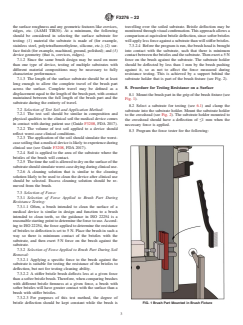
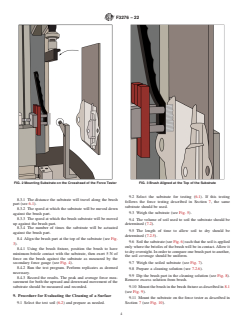
6.1 A force testing machine with moving crosshead, force
3.1.1 cleaning—removal of contamination from a medical
gauge, and a suitable clamp for substrates (see Fig. 2).
device to the extent necessary for further processing or for its
6.1.1 The crosshead shall be programmable for the speed
intended use.
and the distance it travels.
3.2 Definitions of Terms Specific to This Standard:
6.1.2 The force required to move the brush up and down
3.2.1 brush part—working end of the brush that comes in
shall be measured.
contact with the targeted surface of the substrate.
6.1.3 The clamp attaches to the crosshead and holds the test
substrates in place.
3.2.2 surface roughness—the shorter frequency of real sur-
faces relative to the troughs.
6.2 Brush Fixture:
6.2.1 The brush fixture is secured underneath the crosshead
4. Summary of Practice
of the force tester.
6.2.2 The clamp to hold brushes shall be adjustable to
4.1 This guide provides details for testing the resistance of
accommodate different size brushes.
a brush part moved across a surface to simulate the resistance
6.2.3 The brush clamp shall be on a sliding track that is
of a brush used to clean the external surface of a medical
adjustablehorizontallysothebrushcanbemovedclosertoand
device.
further from the substrate.
4.2 This guide also provides details for soiling a surface,
6.2.4 Aforce gauge is attached to the fixture to measure the
actuating a brush part across that surface, and measuring the
force of the brush pushing against the substrate. This force
soil removed from that surface to simulate the cleaning of the
gauge should be able to measure over 5 N force.
external surface of a medical device.
6.2.5 Thebrushfixturealsoincludesasupporttopreventthe
4.3 Surface substrate selection is based upon the physical
substrate holder from being deflected. This support also does
characteristics (that is, smoothness, material, etc.) of the
not cause resistance against the substrate holder from being
medical device being simulated.
actuated up and down.
6.3 Sensitive Analytical Scale:
6.3.1 To determine the weight differences in the soiled
For referenced ASTM standards, visit the ASTM website, www.astm.org, or
substrates, the scale shall be sensitive to at least 0.1 mg.
contact ASTM Customer Service at service@astm.org. For Annual Book of ASTM
6.3.2 The scale shall have a large enough stage to weigh the
Standards volume information, refer to the standard’s Document Summary page on
the ASTM website. selected substrate size.
Available from International Organization for Standardization (ISO), ISO
Central Secretariat, BIBC II, Chemin de Blandonnet 8, CP 401, 1214 Vernier,
7. Selection Criteria for Testing Parameters
Geneva, Switzerland, http://www.iso.org.
Available from Association for the Advancement of Medical Instrumentation
7.1 Selection of Surface Substrate for Testing:
(AAMI), 4301 N. Fairfax Dr., Suite 301, Arlington, VA 22203-1633, http://
7.1.1 The physical characteristics of the surface should be
www.aami.org.
similar to the physical characteristics of the surface of the
https://www.fda.gov/downloads/medicaldevices/deviceregulationandguidance/
guidancedocuments/ucm253010.pdf medical device(s) the brush is intended to clean. This includes
F3276 − 22
the surface roughness and any geometric features like crevices, travelling over the soiled substrate. Bristle deflection may be
ridges, etc. (AAMI TIR30). At a minimum, the following monitored through visual confirmation.This approach allows a
should be considered in selecting the surface substrate for comparison at equivalent bristle deflection, since softer bristles
testing: (1) material the substrate is made of (for example, willapplylessforceagainstasubstratethanwillstifferbristles.
stainless steel, polytetrafluoroethylene, silicone, etc.); (2) sur- 7.3.2.4 Before the program is run, the brush head is brought
face finish (for example, machined, ground, polished); and (3) into contact with the substrate, such that there is minimum
device geometry (that is, crevices, ridges). contact between the bristles and the substrate.Then exert a 5 N
7.1.2 Since the same brush design may be used on more force on the brush against the substrate. The substrate holder
than one type of device, testing of multiple substrates with should be deflected by less than 1 mm by the brush pushing
different material compositions may be necessary to fully against it, so as not to affect the force measured during
characterize performance. resistance testing. This is achieved by a support behind the
7.1.3 The length of the surface substrate should be at least substrate holder that is part of the brush fixture (see Fig. 2).
long enough to allow the complete travel of the brush part
8. Procedure for Testing Resistance on a Surface
across the surface. Complete travel may be defined as a
displacement equal to the length of the brush part, with contact
8.1 Mount the brush part in the grip of the brush fixture (see
maintained between the full length of the brush part and the
Fig. 1).
substrate during the entirety of travel.
8.2 Select a substrate for testing (see 6.1) and clamp the
7.2 Selection of Test Soil and Application Method:
substrate into the substrate holder. Mount the substrate holder
7.2.1 The test soil should be similar in composition and
to the crosshead (see Fig. 2). The substrate holder moun
...
This document is not an ASTM standard and is intended only to provide the user of an ASTM standard an indication of what changes have been made to the previous version. Because
it may not be technically possible to adequately depict all changes accurately, ASTM recommends that users consult prior editions as appropriate. In all cases only the current version
of the standard as published by ASTM is to be considered the official document.
Designation: F3276 − 19 F3276 − 22
Standard Guide for
Using a Force Tester to Evaluate the Performance of a
Brush Part Designed to Clean the External Surface of a
Medical Device
This standard is issued under the fixed designation F3276; the number immediately following the designation indicates the year of
original adoption or, in the case of revision, the year of last revision. A number in parentheses indicates the year of last reapproval. A
superscript epsilon (´) indicates an editorial change since the last revision or reapproval.
1. Scope
1.1 This guide describes methods for characterizing the efficacy, under prescribed laboratory conditions, of a brush part designed
to clean the external surface of a medical device. The method utilizes force testers to mechanically actuate a brush part across a
surface at a constant rate and constant pressure. In the first method, the force required to actuate across the surface is measured.
In the next method, which utilizes the same force testers and protocol (actuation motion), the brush part is actuated on a soiled
surface and the amount of soil removed is measured, as another indicator of performance.
1.2 Brushes designed to clean medical devices after clinical use play an important role in the effective reprocessing of those
medical devices.
1.3 Inclusions:
1.3.1 This guide describes objective, quantifiable, and reproducible methods for evaluating the cleaning characteristics of a brush
part, under prescribed laboratory conditions, with a test method that simulates the cleaning challenge of a defined target area(s)
of a medical device. This also makes it possible to compare one brush part design to another.
1.3.2 By use of this guide, manufacturers of cleaning brushes will be able to evaluate and characterize the cleaning performance
of their brushes for the target area(s) of medical device(s) and evaluate modifications to design and construction that might improve
performance.
1.3.3 By use of this guide, this information can also be shared with the users of the brushes (medical device reprocessors) to help
them evaluate the performance of commercially available brushes.
1.4 Exclusions:
1.4.1 This guide is not intended to be used for brushes designed to clean medical devices using rotational motion.
1.4.2 This guide does not assess potential damage that may be inflicted by the brush, or degradation of the brush that may occur
during repeated use. Brushes with rigid bristles (e.g., (for example, stainless steel or other metals) are predicted to be more likely
This test method guide is under the jurisdiction of ASTM Committee F04 on Medical and Surgical Materials and Devices and is the direct responsibility of Subcommittee
F04.15 on Material Test Methods.
Current edition approved Feb. 15, 2019Jan. 1, 2022. Published March 2019January 2022. Originally approved in 2019. Last previous edition approved in 2019 as
F3276 – 19. DOI: 10.1520/F3276-19.10.1520/F3276-22.
Copyright © ASTM International, 100 Barr Harbor Drive, PO Box C700, West Conshohocken, PA 19428-2959. United States
F3276 − 22
to damage medical devices than brushes with flexible bristles (e.g., (for example, nylon); damage from rigid-bristled brushes
should be assessed. Assessing repeated use would require a greatly increased number of test repetitions than what is described in
this guide.
1.4.3 This guide does not specify acceptance criteria, and the results will be dependent on the specific parameters that are tested
(e.g., (for example, test soil, drying time, surface area, and materials, etc.) that are tested.
1.4.4 This guide is not intended to constitute all steps required to conduct validation of cleaning instructions for a medical device,
including use of brushes for this purpose, but provides methods that may be part of a broader protocol to conduct a complete
cleaning instructions validation. Separate medical device cleaning instruction validation studies must be conducted.
1.5 Units—The values stated in SI units are to be regarded as standard. No other units of measurement are included in this
standard.
1.6 This standard does not purport to address all of the safety concerns, if any, associated with its use. It is the responsibility
of the user of this standard to establish appropriate safety, health, and environmental practices and determine the applicability of
regulatory limitations prior to use.
1.7 This international standard was developed in accordance with internationally recognized principles on standardization
established in the Decision on Principles for the Development of International Standards, Guides and Recommendations issued
by the World Trade Organization Technical Barriers to Trade (TBT) Committee.
2. Referenced Documents
2.1 ASTM Standards:
F3208 Guide for Selecting Test Soils for Validation of Cleaning Methods for Reusable Medical Devices
2.2 ISO Standards:
ISO/TS 15883-5 Washer-disinfectors—Part 5: Test soils and methods for demonstrating cleaning efficacy
ISO 22254:2005 Dentistry—Manual toothbrushes—Resistance of tufted portion to deflection
2.3 AAMI Documents:
AAMI:TIR12 Designing, testing and labeling reusable medical devices for reprocessing in health care facilities: A guide for
medical device manufacturers
AAMI:TIR30 A compendium of processes, materials, test methods, and acceptance criteria for cleaning reusable medical
devices
2.4 FDA Document:
FDA Guidance for Industry and FDA Staff for Industry and FDA Staff, Processing/Reprocessing Medical Devices in Health Care
Settings: Validation Methods and Labeling, 2017
3. Terminology
3.1 Definitions:
3.1.1 cleaning—removal of contamination from a medical device to the extent necessary for further processing or for its intended
use.
3.2 Definitions of Terms Specific to This Standard:
3.2.1 brush part—working end of the brush that comes in contact with the targeted surface of the substrate.
3.2.2 surface roughness—the shorter frequency of real surfaces relative to the troughs.
4. Summary of Practice
4.1 This guide provides details for testing the resistance of a brush part moved across a surface to simulate the resistance of a brush
used to clean the external surface of a medical device.
For referenced ASTM standards, visit the ASTM website, www.astm.org, or contact ASTM Customer Service at service@astm.org. For Annual Book of ASTM Standards
volume information, refer to the standard’s Document Summary page on the ASTM website.
Available from International Organization for Standardization (ISO), ISO Central Secretariat, BIBC II, Chemin de Blandonnet 8, CP 401, 1214 Vernier, Geneva,
Switzerland, http://www.iso.org.
Available from Association for the Advancement of Medical Instrumentation (AAMI), 4301 N. Fairfax Dr., Suite 301, Arlington, VA 22203-1633, http://www.aami.org.
https://www.fda.gov/downloads/medicaldevices/deviceregulationandguidance/guidancedocuments/ucm253010.pdf
F3276 − 22
4.2 This guide also provides details for soiling a surface, actuating a brush part across that surface, and measuring the soil removed
from that surface to simulate the cleaning of the external surface of a medical device.
4.3 Surface substrate selection is based upon the physical characteristics (i.e., (that is, smoothness, material, etc.) of the medical
device being simulated.
4.4 Composition and application of the test soil should be based upon an evaluation of the clinical-use clinical use of the device
(Guide F3208, FDA 2017, AAMI TIR12, ISO/TS 15883-5).
5. Significance and Use
5.1 This guide provides two test methods for evaluating the performance characteristics of a brush part designed to clean external
surface(s) of a medical device by utilizing force testers.
5.1.1 The first test method utilizes a force tester to measure the force required to actuate a brush part across a surface. This is an
indicator of the friction a brush exerts on a surface, a parameter of cleaning effectiveness.
5.1.2 The second test method measures the removal of soil from a surface by a brush part actuated across the surface. This is a
further indicator of the effectiveness of a brush part to loosen and remove soil from a surface.
5.2 By providing objective, repeatable methods for evaluating performance,performance under test conditions, this guide can
improve the ability to assess the effectiveness of various brush part designs
6. Description of Test Apparatus
6.1 A force testing machine with moving crosshead, force gauge, and a suitable clamp for substrates (see Fig. 2).
6.1.1 The crosshead shall be programmable for the speed and the distance it travels.
6.1.2 The force required to move the brush up and down shall be measured.
6.1.3 The clamp attaches to the crosshead and holds the test substrates in place.
6.2 Brush Fixture:
6.2.1 The brush fixture is secured underneath the crosshead of the force tester.
6.2.2 The clamp to hold brushes shall be adjustable to accommodate different size brushes.
6.2.3 The brush clamp shall be on a sliding track that is adjustable horizontally so the brush can be moved closer to and further
from the substrate.
6.2.4 A force gauge is attached to the fixture to measure the force of the brush pushing against the substrate. This force gauge
should be able to measure aover 5 N force.
6.2.5 The brush fixture also includes a support to prevent the substrate holder from being deflected. This support also does not
cause resistance against the substrate holder from being actuated up and down.
6.3 Sensitive Analytical Scale:
6.3.1 To determine the weight differences in the soiled substrates, the scale shall be sensitive to at least 0.1 mg.
6.3.2 The scale shall have a large enough stage to weigh the selected substrate size.
F3276 − 22
7. Selection Criteria for Testing Parameters
7.1 Selection of Surface Substrate for Testing:
7.1.1 The physical characteristics of the surface should be similar to the physical characteristics of the surface of the medical
device(s) the brush is intended to clean. This includes the surface roughness and any geometric features like crevices, ridges, etc.
(AAMI TIR30). At a minimum, the following should be considered in selecting the surface substrate for testing: (1) material the
substrate is made of (e.g., (for example, stainless steel, polytetrafluoroethylene, silicone, etc.); (2) surface finish (e.g. (for example,
machined, ground, polished); and (3) device geometry (i.e., (that is, crevices, ridges).
7.1.2 Since the same brush design may be used on more than one type of device, testing of multiple substrates with different
material compositioncompositions may be necessary to fully characterize performance.
7.1.3 The length of the surface substrate should be at least long enough to allow the complete travel of the brush part across the
surface. Complete travel may be defined as a displacement equal to the length of the brush part, with contact maintained between
the full length of the brush part and the substrate during the entirety of travel.
7.2 Selection of Test Soil and Application Method:
7.2.1 The test soil should be similar in composition and physical qualities to the clinical soil the medical device comes in contact
with during patient use (Guide F3208, FDA 2017).
7.2.2 The volume of test soil applied to a device should reflect worst-case clinical conditions.
7.2.3 The application of the soil should simulate the worst-case soiling that a medical device is likely to experience during clinical
use (see Guide F3208, FDA 2017).
7.2.4 Soil is applied to the area of the substrate where the bristles of the brush will contact.
7.2.5 The time the soil is allowed to dry on the surface of the substrate should simulate worst-case drying during clinical use.
7.2.6 A cleaning solution that is similar to the cleaning solution likely to be used to clean the device after clinical use should be
selected. Excess cleaning solution should be removed from the brush.
7.3 Selection of Force:
7.3.1 Selection of Force Applied to Brush Part duringDuring Resistance Testing:
7.3.1.1 Often, a brush intended to clean the surface of a medical device is similar in design and function to a brush intended to
clean teeth, so the guidance in ISO 22254 is a reasonable starting point to determine the force to use. According to ISO 22254,
the force applied to determine the resistance of bristles to d
...