

ASTM B976-21
(Specification)Standard Specification for Fiber Reinforced Aluminum Matrix Composite (AMC) Core Wire for Aluminum Conductors Aluminum Matrix Composite Reinforced (ACAMCR) (formerly known as ACCR)
General Information
- Abstract
ABSTRACT
This specification covers fiber reinforced, aluminum matrix composite wire used for mechanical reinforcement in the manufacture of aluminum conductor, composite reinforced (ACCR). This wire consists of continuous filament fibers of aluminum oxide in a matrix of aluminum. The fiber reinforcement shall be continuous tows of aluminum oxide. Before stranding, the composite core wire of any diameter shall conform to the tensile breaking load requirements.
SCOPE
1.1 This specification covers fiber reinforced, aluminum matrix composite core wire used for mechanical reinforcement in the manufacture of aluminum conductor, aluminum matrix composite reinforced (ACAMCR). This wire consists of continuous filament fibers of aluminum oxide in a matrix of aluminum.
1.2 The values stated in inch-pound units are to be regarded as standard. The values given in parentheses are mathematical conversions to SI units that are provided for information only and are not considered standard.
1.2.1 Exception—Some non-standard SI units provided for information only do not appear in brackets.
1.3 This standard does not purport to address all of the safety concerns, if any, associated with its use. It is the responsibility of the user of this standard to establish appropriate safety, health, and environmental practices and determine the applicability of regulatory limitations prior to use.
1.4 This international standard was developed in accordance with internationally recognized principles on standardization established in the Decision on Principles for the Development of International Standards, Guides and Recommendations issued by the World Trade Organization Technical Barriers to Trade (TBT) Committee.
- Status
- Published
- Publication Date
- 30-Sep-2021
- Technical Committee
- B01 - Electrical Conductors
- Drafting Committee
- B01.07 - Conductors of Light Metals
Buy Documents

ASTM B976-21 - Standard Specification for Fiber Reinforced Aluminum Matrix Composite (AMC) Core Wire for Aluminum Conductors Aluminum Matrix Composite Reinforced (ACAMCR) (formerly known as ACCR)
REDLINE ASTM B976-21 - Standard Specification for Fiber Reinforced Aluminum Matrix Composite (AMC) Core Wire for Aluminum Conductors Aluminum Matrix Composite Reinforced (ACAMCR) (formerly known as ACCR)
Overview
ASTM B976-21 is the international standard specification for fiber reinforced aluminum matrix composite (AMC) core wire, which is primarily used in manufacturing aluminum conductor, aluminum matrix composite reinforced (ACAMCR) cables. Formerly recognized as ACCR (Aluminum Conductor Composite Reinforced), this wire specification defines the essential properties and requirements for high-performance composite core wires utilized for mechanical reinforcement in overhead electrical conductors. The composite core wire consists of continuous aluminum oxide fibers embedded within an aluminum matrix, resulting in a product that combines excellent mechanical strength with optimal electrical conductivity.
Key Topics
Composition and Structure:
The AMC core wire comprises continuous filament fibers of aluminum oxide (Al₂O₃) as reinforcement within an aluminum matrix. This unique construction increases tensile strength and thermal resistance.Physical Properties:
- Tensile breaking load requirements specified by wire diameter
- Density: 0.122 lb/in³ (3370 kg/m³)
- Electrical resistivity: Maximum 43.2 µΩ·cmil/ft (0.0718 µΩ·mm²/m) at 68°F (20°C)
- Thermal expansion coefficient: 3.5×10⁻⁶/°F (6.3×10⁻⁶/°C) between 68-464°F (20-240°C)
- Elongation: 0.65%
These metrics ensure durability, stability under thermal load, and compatibility with electrical utility demands.
Dimensional Accuracy:
Specified diameters must be controlled precisely, with tolerances not exceeding ±0.0035 in. (±0.09 mm). Accurate diameter measurement procedures are outlined to ensure product quality.Testing and Quality Assurance:
- Tensile testing is required on production specimens
- Electrical resistivity testing per ASTM B193
- Retest and rejection criteria in case of test failures
- Package identification, protection, and minimum bend radius to prevent damage during shipping and handling
Ordering and Documentation:
The standard details necessary ordering information, including wire size, quantity, inspection site, and specific packaging or marking requirements for traceability.
Applications
Overhead Transmission Lines:
AMC core wire is designed for use as the reinforcing element in ACAMCR conductors, supporting overhead power lines that demand high mechanical strength and reduced sag, even under elevated temperatures.Upgrading Existing Grid Infrastructure:
Utility companies can use ACAMCR conductors to replace traditional steel-reinforced conductors, enhancing capacity without significant increases in line weight or tower redesign.Special Environments:
The fiber reinforced aluminum matrix composite wire offers superior corrosion resistance and is well-suited for harsh weather or chemically aggressive environments compared to traditional alternatives.High-Temperature Operations:
Thanks to its enhanced thermal properties, AMC core wire enables conductors to carry higher current loads at elevated temperatures, improving power delivery efficiency.
Related Standards
- ASTM B193 – Test Method for Resistivity of Electrical Conductor Materials: Specifies test methods for measuring electrical resistivity, a critical property for AMC wire performance.
- ASTM B830 – Specification for Uniform Test Methods and Frequency: Ensures consistency in wire testing and quality assurance.
- ASTM D3552 – Test Method for Tensile Properties of Fiber Reinforced Metal Matrix Composites: Governs mechanical testing for composite wires.
Practical Value
Adhering to ASTM B976-21 enables manufacturers and utilities to specify, produce, and deploy high-performance fiber reinforced aluminum matrix core wires with confidence. This standard ensures the mechanical integrity, electrical conductivity, and long-term reliability required for modern overhead power transmission systems. By leveraging AMC wire, stakeholders can future-proof electrical infrastructure while meeting demanding operational and environmental requirements.
Keywords: aluminum composite wire, AMC core wire, aluminum matrix composite, ACAMCR, fiber reinforced aluminum wire, ASTM B976, overhead conductor, electrical transmission standard.
Relations
- Effective Date
- 15-Apr-2024
- Effective Date
- 15-Jun-2018
- Effective Date
- 15-Oct-2017
- Effective Date
- 01-Apr-2016
- Effective Date
- 01-Apr-2014
- Effective Date
- 01-Dec-2012
- Effective Date
- 01-Oct-2011
- Effective Date
- 01-Sep-2008
- Effective Date
- 01-May-2007
- Effective Date
- 01-Oct-2003
- Effective Date
- 10-Apr-2002
- Effective Date
- 10-Apr-2002
- Effective Date
- 10-Apr-2002
- Refers
ASTM D3552-96(2002) - Test Method for Tensile Properties of Fiber Reinforced Metal Matrix Composites - Effective Date
- 10-Oct-1996
- Refers
ASTM D3552-96e1 - Test Method for Tensile Properties of Fiber Reinforced Metal Matrix Composites - Effective Date
- 01-Jan-1996
Buy Documents
ASTM B976-21 - Standard Specification for Fiber Reinforced Aluminum Matrix Composite (AMC) Core Wire for Aluminum Conductors Aluminum Matrix Composite Reinforced (ACAMCR) (formerly known as ACCR)
REDLINE ASTM B976-21 - Standard Specification for Fiber Reinforced Aluminum Matrix Composite (AMC) Core Wire for Aluminum Conductors Aluminum Matrix Composite Reinforced (ACAMCR) (formerly known as ACCR)
Get Certified
Connect with accredited certification bodies for this standard

IMQ S.p.A. (Certification)
Italian electrical product certification.

SLG Prüf- und Zertifizierungs GmbH
German testing and certification body.

UL Solutions
Global safety science company with testing, inspection and certification.
Sponsored listings
Frequently Asked Questions
ASTM B976-21 is a technical specification published by ASTM International. Its full title is "Standard Specification for Fiber Reinforced Aluminum Matrix Composite (AMC) Core Wire for Aluminum Conductors Aluminum Matrix Composite Reinforced (ACAMCR) (formerly known as ACCR)". This standard covers: ABSTRACT This specification covers fiber reinforced, aluminum matrix composite wire used for mechanical reinforcement in the manufacture of aluminum conductor, composite reinforced (ACCR). This wire consists of continuous filament fibers of aluminum oxide in a matrix of aluminum. The fiber reinforcement shall be continuous tows of aluminum oxide. Before stranding, the composite core wire of any diameter shall conform to the tensile breaking load requirements. SCOPE 1.1 This specification covers fiber reinforced, aluminum matrix composite core wire used for mechanical reinforcement in the manufacture of aluminum conductor, aluminum matrix composite reinforced (ACAMCR). This wire consists of continuous filament fibers of aluminum oxide in a matrix of aluminum. 1.2 The values stated in inch-pound units are to be regarded as standard. The values given in parentheses are mathematical conversions to SI units that are provided for information only and are not considered standard. 1.2.1 Exception—Some non-standard SI units provided for information only do not appear in brackets. 1.3 This standard does not purport to address all of the safety concerns, if any, associated with its use. It is the responsibility of the user of this standard to establish appropriate safety, health, and environmental practices and determine the applicability of regulatory limitations prior to use. 1.4 This international standard was developed in accordance with internationally recognized principles on standardization established in the Decision on Principles for the Development of International Standards, Guides and Recommendations issued by the World Trade Organization Technical Barriers to Trade (TBT) Committee.
ABSTRACT This specification covers fiber reinforced, aluminum matrix composite wire used for mechanical reinforcement in the manufacture of aluminum conductor, composite reinforced (ACCR). This wire consists of continuous filament fibers of aluminum oxide in a matrix of aluminum. The fiber reinforcement shall be continuous tows of aluminum oxide. Before stranding, the composite core wire of any diameter shall conform to the tensile breaking load requirements. SCOPE 1.1 This specification covers fiber reinforced, aluminum matrix composite core wire used for mechanical reinforcement in the manufacture of aluminum conductor, aluminum matrix composite reinforced (ACAMCR). This wire consists of continuous filament fibers of aluminum oxide in a matrix of aluminum. 1.2 The values stated in inch-pound units are to be regarded as standard. The values given in parentheses are mathematical conversions to SI units that are provided for information only and are not considered standard. 1.2.1 Exception—Some non-standard SI units provided for information only do not appear in brackets. 1.3 This standard does not purport to address all of the safety concerns, if any, associated with its use. It is the responsibility of the user of this standard to establish appropriate safety, health, and environmental practices and determine the applicability of regulatory limitations prior to use. 1.4 This international standard was developed in accordance with internationally recognized principles on standardization established in the Decision on Principles for the Development of International Standards, Guides and Recommendations issued by the World Trade Organization Technical Barriers to Trade (TBT) Committee.
ASTM B976-21 is classified under the following ICS (International Classification for Standards) categories: 29.060.10 - Wires. The ICS classification helps identify the subject area and facilitates finding related standards.
ASTM B976-21 has the following relationships with other standards: It is inter standard links to ASTM D3552-24, ASTM B830-18, ASTM D3552-17, ASTM B193-16, ASTM B193-02(2014), ASTM D3552-12, ASTM B830-11, ASTM B193-02(2008), ASTM D3552-96(2007), ASTM B830-97(2003), ASTM B193-01, ASTM B193-02, ASTM B193-00, ASTM D3552-96(2002), ASTM D3552-96e1. Understanding these relationships helps ensure you are using the most current and applicable version of the standard.
ASTM B976-21 is available in PDF format for immediate download after purchase. The document can be added to your cart and obtained through the secure checkout process. Digital delivery ensures instant access to the complete standard document.
Standards Content (Sample)
This international standard was developed in accordance with internationally recognized principles on standardization established in the Decision on Principles for the
Development of International Standards, Guides and Recommendations issued by the World Trade Organization Technical Barriers to Trade (TBT) Committee.
Designation:B976 −21
Standard Specification for
Fiber Reinforced Aluminum Matrix Composite (AMC) Core
Wire for Aluminum Conductors Aluminum Matrix Composite
Reinforced (ACAMCR) (formerly known as ACCR)
This standard is issued under the fixed designation B976; the number immediately following the designation indicates the year of
original adoption or, in the case of revision, the year of last revision. A number in parentheses indicates the year of last reapproval. A
superscript epsilon (´) indicates an editorial change since the last revision or reapproval.
1. Scope B193 Test Method for Resistivity of Electrical Conductor
Materials
1.1 This specification covers fiber reinforced, aluminum
B830 Specification for Uniform Test Methods and Fre-
matrix composite core wire used for mechanical reinforcement
quency
in the manufacture of aluminum conductor, aluminum matrix
D3552 Test Method for Tensile Properties of Fiber Rein-
composite reinforced (ACAMCR). This wire consists of con-
forced Metal Matrix Composites
tinuous filament fibers of aluminum oxide in a matrix of
aluminum.
3. Terminology
1.2 The values stated in inch-pound units are to be regarded
3.1 Definitions of Terms Specific to This Standard:
as standard. The values given in parentheses are mathematical
3.1.1 ACAMCR, n—Aluminum Conductor Aluminum Ma-
conversions to SI units that are provided for information only
trix Composite Reinforced, a concentric-lay-stranded conduc-
and are not considered standard.
tor made up of outer aluminum strands of hard, heat resistant
1.2.1 Exception—Some non-standard SI units provided for
aluminum wires and a core of round, aluminum matrix
information only do not appear in brackets.
composite wire(s), for use as overhead electrical conductors.
1.3 This standard does not purport to address all of the
3.1.2 AMC, n—Aluminum Matrix Composite, a material
safety concerns, if any, associated with its use. It is the
consisting of two constituents: the first a series of continuous
responsibility of the user of this standard to establish appro-
fibers of aluminum oxide which is embedded in the second
priate safety, health, and environmental practices and deter-
constituent of aluminum metal.
mine the applicability of regulatory limitations prior to use.
3.1.3 fiber reinforced aluminum matrix composite wire, n—a
1.4 This international standard was developed in accor-
wire consisting of two constituents: the first a number of
dance with internationally recognized principles on standard-
ization established in the Decision on Principles for the continuous fibers of aluminum oxide along the axis of the wire,
which is embedded in the second constituent of aluminum
Development of International Standards, Guides and Recom-
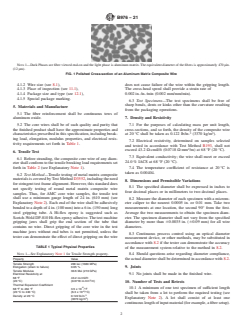
metal, as shown in Fig. 1.
mendations issued by the World Trade Organization Technical
Barriers to Trade (TBT) Committee.
3.1.4 lot, n—unless otherwise specified in the contract or
order, a lot shall consist of all coils of wire of the same
2. Referenced Documents
diameter submitted for inspection at the same time.
2.1 The following documents of the issue in effect on date
3.1.5 production unit, n—a reel, spool, or other package of
of material purchase form a part of this specification to the
wire that represents a single usable length.
extent referenced herein.
3.1.6 sample, n—the production unit(s) from which a test
2.2 ASTM Standards:
specimen(s) has been removed, and which is considered to
have properties representative of the lot.
3.1.7 specimen, n—a length of wire removed for test pur-
This specification is under the jurisdiction of ASTM Committee B01 on
poses.
Electrical Conductors and is the direct responsibility of Subcommittee B01.07 on
Conductors of Light Metals.
3.1.8 tow, n—a bundle, containing multiple fibers.
Current edition approved Oct. 1, 2021. Published October 2021. Originally
approved in 2011. Last previous edition approved in 2015 as B976 – 11 (2015).
4. Ordering Information
DOI: 10.1520/B0976-21.
For referenced ASTM standards, visit the ASTM website, www.astm.org, or
4.1 Orders for material under this specification shall include
contact ASTM Customer Service at service@astm.org. For Annual Book of ASTM
the following information:
Standards volume information, refer to the standard’s Document Summary page on
the ASTM website. 4.1.1 Quantity of each size,
Copyright © ASTM International, 100 Barr Harbor Drive, PO Box C700, West Conshohocken, PA 19428-2959. United States
B976−21
NOTE 1—Dark Phases are fiber viewed end-on and the light phase is aluminum matrix. The equivalent diameter of the fibers is approximately 470 µin.
(12 µm).
FIG. 1Polished Cross-section of an Aluminum Matrix Composite Wire
4.1.2 Wire size (see 8.1), does not cause failure of the wire within the gripping length.
4.1.3 Place of inspection (see 11.1), The cross-head speed shall provide a strain rate of
4.1.4 Package size and type (see 12.1), 0.002 in.⁄in.⁄min (0.002 mm/mm/min).
4.1.5 Special package marking.
6.3 Test Specimens—The test specimens shall be free of
sharp bends, dents or kinks other than the curvature resulting
5. Materials and Manufacture
from the packaging operations.
5.1 The fiber reinforcement shall be continuous tows of
aluminum oxide. 7. Density and Resistivity
5.2 The core wires shall be of such quality and purity that 7.1 For the purposes of calculating mass per unit length,
the finished product shall have the approximate properties and cross-sections, and so forth, the density of the composite wire
3 3
characteristics prescribed in this specification, including break- at 20 °C shall be taken as 0.122 lb/in. (3370 kg/m ).
ing load, elongation, modulus properties, and electrical resis-
7.2 Electrical resistivity, determined on samples selected
tivity requirements set forth in Table 1.
and tested in accordance with Test Method B193, shall not
exceed 43.2Ω·cmil/ft (0.0718Ω·mm /m) at 68 °F (20 °C).
6. Tensile Test
7.3 Equivalent conductivity; the wire shall meet or exceed
6.1 Before stranding, the composite core wire of any diam-
24.0 % IACS at 68 °F (20 °C).
eter shall conform to the tensile breaking load requirements set
forth in Table 2 (see Explanatory Note 1). 7.4 The temperature coefficient of resistance at 20 °C is
taken as 0.00404.
6.2 Test Method—Tensile testing of metal matrix composite
materials is covered byTest MethodD3552, including the need
8. Dimensions and Permissible Variations
for stringent test frame alignment. However, this standard does
8.1 The specified diameter shall be expressed in inches to
not specify testing of round metal matrix composite wire
four decimal places or in millimeters to two decimal places.
samples. Thus, for AMC core wire samples, the tensile test
shall use a minimum gauge length of 24 in. (610 mm) (see
8.2 Measure the diameter of each specimen with a microm-
Explanatory Note 2). Each end of the wire shall be adhesively eter caliper to the nearest 0.0005 in. or 0.01 mm. Take two
bonded to a depth of 4 in. (100 mm) into a 6 in. (150 mm) long measurements at one location, the second 90° from the first.
steel gripping tube. A Hi-flex epoxy is suggested such as Average the two measurements to obtain the specimen diam-
Scotch-WeldDP-810Hi-flexepoxyadhesive.Thetestmachine eter. The specimen diameter shall not vary from the
...
This document is not an ASTM standard and is intended only to provide the user of an ASTM standard an indication of what changes have been made to the previous version. Because
it may not be technically possible to adequately depict all changes accurately, ASTM recommends that users consult prior editions as appropriate. In all cases only the current version
of the standard as published by ASTM is to be considered the official document.
Designation: B976 − 11 (Reapproved 2015) B976 − 21
Standard Specification for
Fiber Reinforced Aluminum Matrix Composite (AMC) Core
Wire for Aluminum Conductors, Composite Reinforced
(ACCR)Conductors Aluminum Matrix Composite Reinforced
(ACAMCR) (formerly known as ACCR)
This standard is issued under the fixed designation B976; the number immediately following the designation indicates the year of
original adoption or, in the case of revision, the year of last revision. A number in parentheses indicates the year of last reapproval. A
superscript epsilon (´) indicates an editorial change since the last revision or reapproval.
1. Scope
1.1 This specification covers fiber reinforced, aluminum matrix composite core wire used for mechanical reinforcement in the
manufacture of aluminum conductor, aluminum matrix composite reinforced (ACCR).(ACAMCR). This wire consists of
continuous filament fibers of aluminum oxide in a matrix of aluminum.
1.2 The values stated in inch-pound units are to be regarded as standard. The values given in parentheses are mathematical
conversions to SI units that are provided for information only and are not considered standard.
1.2.1 Exception—Some non-standard SI units provided for information only do not appear in brackets.
1.3 This standard does not purport to address all of the safety concerns, if any, associated with its use. It is the responsibility
of the user of this standard to establish appropriate safety safety, health, and healthenvironmental practices and determine the
applicability of regulatory limitations prior to use.
1.4 This international standard was developed in accordance with internationally recognized principles on standardization
established in the Decision on Principles for the Development of International Standards, Guides and Recommendations issued
by the World Trade Organization Technical Barriers to Trade (TBT) Committee.
2. Referenced Documents
2.1 The following documents of the issue in effect on date of material purchase form a part of this specification to the extent
referenced herein.
2.2 ASTM Standards:
B193 Test Method for Resistivity of Electrical Conductor Materials
B830 Specification for Uniform Test Methods and Frequency
D3552 Test Method for Tensile Properties of Fiber Reinforced Metal Matrix Composites
3. Terminology
3.1 Definitions of Terms Specific to This Standard:
This specification is under the jurisdiction of ASTM Committee B01 on Electrical Conductors and is the direct responsibility of Subcommittee B01.07 on Conductors
of Light Metals.
Current edition approved Oct. 1, 2015Oct. 1, 2021. Published October 2015October 2021. Originally approved in 2011. Last previous edition approved in 20112015 as
B976B976 – 11 (2015). – 11. DOI: 10.1520/B0976-11R15.10.1520/B0976-21.
For referenced ASTM standards, visit the ASTM website, www.astm.org, or contact ASTM Customer Service at service@astm.org. For Annual Book of ASTM Standards
volume information, refer to the standard’s Document Summary page on the ASTM website.
Copyright © ASTM International, 100 Barr Harbor Drive, PO Box C700, West Conshohocken, PA 19428-2959. United States
B976 − 21
3.1.1 ACAMCR, n—Aluminum Conductor Aluminum Matrix Composite Reinforced, a concentric-lay-stranded conductor made up
of outer aluminum strands of hard, heat resistant aluminum wires and a core of round, aluminum matrix composite wire(s), for
use as overhead electrical conductors.
3.1.2 AMC, n—Aluminum Matrix Composite, a material consisting of two constituents: the first a series of continuous fibers of
aluminum oxide which is embedded in the second constituent of aluminum metal.
3.1.3 fiber reinforced aluminum matrix composite wire, n—a wire consisting of two constituents: the first a number of continuous
fibers of aluminum oxide along the axis of the wire, which is embedded in the second constituent of aluminum metal, as shown
in Fig. 1.
3.1.4 lot, n—unless otherwise specified in the contract or order, a lot shall consist of all coils of wire of the same diameter
submitted for inspection at the same time.
3.1.5 production unit, n—a reel, spool, or other package of wire that represents a single usable length.
3.1.6 sample, n—the production unit(s) from which a test specimen(s) has been removed, and which is considered to have
properties representative of the lot.
3.1.7 specimen, n—a length of wire removed for test purposes.
3.1.8 tow, n—a bundle, containing multiple fibers.
3.1.7 AMC, n—Aluminum Matrix Composite, a material consisting of two constituents: the first a series of continuous fibers of
aluminum oxide which is embedded in the second constituent of aluminum metal.
3.1.8 ACCR, n—Aluminum Conductor Composite Reinforced, a concentric-lay-stranded conductor made up of outer aluminum
strands of hard, heat resistant aluminum wires and a core of round, aluminum matrix composite wire(s), for use as overhead
electrical conductors.
4. Ordering Information
4.1 Orders for material under this specification shall include the following information:
4.1.1 Quantity of each size,
4.1.2 Wire size (see 8.1),
4.1.3 Place of inspection (see 11.1),
4.1.4 Package size and type (see 12.1),
4.1.5 Special package marking.
NOTE 1—Dark Phases are fiber viewed end-on and the light phase is aluminum matrix. The equivalent diameter of the fibers is approximately 470 μin.
(12 μm).470 μin. (12 μm).
FIG. 1 Polished Cross-section of an Aluminum Matrix Composite Wire
B976 − 21
5. Materials and Manufacture
5.1 The fiber reinforcement shall be continuous tows of aluminum oxide.
5.2 The core wires shall be of such quality and purity that the finished product shall have the approximate properties and
characteristics prescribed in this specification, including breaking load, elongation, modulus properties, and electrical resistivity
requirements set forth in Table 1.
6. Tensile Test
6.1 Before stranding, the composite core wire of any diameter shall conform to the tensile breaking load requirements set forth
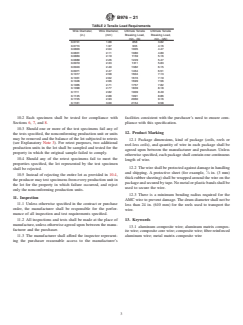
in Table 2 (see Explanatory Note 1).
6.2 Test Method—Tensile testing of metal matrix composite materials is covered by Test Method D3552, including the need for
stringent test frame alignment. However, this standard does not specify testing of round metal matrix composite wire samples.
Thus, for AMC core wire samples, the tensile test shall use a minimum gauge length of 24 in. (610 mm) (see Explanatory Note
2). Each end of the wire shall be adhesively bonded to a depth of 4 in. (100 mm) into a 6 in. (150 mm) long steel gripping tube.
A Hi-flex epoxy is suggested such as Scotch-Weld DP-810 Hi-flex epoxy adhesive. The test machine gripping jaws shall grip the
end section of the tube that contains no wire. Direct gripping of the core wire in the test machine jaws without end tubes is not
permitted, unless the tester can demonstrate the effect of direct gripping on the wire does not cause failure of the wire within the
gripping length. The cross-head speed shall provide a strain rate of
0.002in./in./min0.002 in. ⁄in. ⁄min (0.002 mm/mm/min).
6.3 Test Specimens—The test specimens shall be free of sharp bends, dents or kinks other than the curvature resulting from the
packaging operations.
7. Density and Resistivity
7.1 For the purposes of calculating mass per unit length, cross-sections, and so forth, the density of the composite wire at
3 3
20°C20 °C shall be taken as 0.122 lb/in. (3370 kg/m ).
7.2 Electrical resistivity, determined on samples selected and tested in accordance with Test Method B193, shall not exceed 43.2
Ω·cmil/ft (0.0718 Ω·mm /m) at 68°F (20°C).68 °F (20 °C).
7.3 Equivalent conductivity; the wire shall meet or exceed 24.0 % 24.0 % IACS at 68°F (20°C).68 °F (20 °C).
TABLE 1 Typical Physical Properties
NOTE 1—See Explanatory Note 1
...