

ASTM D7685-11(2022)
(Practice)Standard Practice for In-Line, Full Flow, Inductive Sensor for Ferromagnetic and Non-ferromagnetic Wear Debris Determination and Diagnostics for Aero-Derivative and Aircraft Gas Turbine Engine Bearings
General Information
- Abstract
SIGNIFICANCE AND USE
4.1 This practice is intended for the application of in-line, full-flow inductive wear debris sensors. According to (1), passing the entire lubrication oil flow for aircraft and aero-derivative gas turbines through a debris-monitoring device is a preferred approach to ensure sufficient detection efficiency.
4.2 Periodic sampling and analysis of lubricants have long been used as a means to determine overall machinery health (2). The implementation of smaller oil filter pore sizes for machinery operating at higher rotational speeds and energies has reduced the effectiveness of sampled oil analysis for determining abnormal wear prior to severe damage. In addition, sampled oil analysis for equipment that is remote or otherwise difficult to monitor or access is not practical. For these machinery systems, in-line wear debris sensors can be very useful to provide real-time and near-real-time condition monitoring data.
4.3 In-line full-flow inductive debris sensors have demonstrated the capability to detect and quantify both ferromagnetic and non-ferromagnetic metallic wear debris. These sensors record metallic wear debris according to size, count, and type (ferromagnetic or non-ferromagnetic). Sensors are available for a variety of oil pipe sizes. The sensors are designed specifically for the protection of rolling element bearings and gears in critical machine applications. Bearings are key elements in machines since their failure often leads to significant secondary damage that can adversely affect safety, operational availability, or operational/maintenance costs, or a combination thereof.
4.4 The main advantage of the sensor is the ability to detect early bearing damage and to quantify the severity of damage and rate of progression of failure towards some predefined bearing surface fatigue damage limiting wear scar. Sensor capabilities are summarized as follows:
4.4.1 In-line full flow non-intrusive inductive metal detector with no moving parts.
4.4.2 Det...
SCOPE
1.1 This practice covers the minimum requirements for an in-line, non-intrusive, through-flow oil debris monitoring system that monitors ferromagnetic and non-ferromagnetic metallic wear debris from both industrial aero-derivative and aircraft gas turbine engine bearings. Gas turbine engines are rotating machines fitted with high-speed ball and roller bearings that can be the cause of failure modes with high secondary damage potential. (1)2
1.2 Metallic wear debris considered in this practice range in size from 120 μm (micron) and greater. Metallic wear debris over 1000 μm are sized as over 1000 μm.
1.3 This practice is suitable for use with the following lubricants: polyol esters, phosphate esters, petroleum industrial gear oils and petroleum crankcase oils.
1.4 This practice is for metallic wear debris detection, not cleanliness.
1.5 The values stated in SI units are to be regarded as standard. The values given in parentheses are provided for information only.
1.6 This standard does not purport to address all of the safety concerns, if any, associated with its use. It is the responsibility of the user of this standard to establish appropriate safety, health, and environmental practices and determine the applicability of regulatory limitations prior to use.
1.7 This international standard was developed in accordance with internationally recognized principles on standardization established in the Decision on Principles for the Development of International Standards, Guides and Recommendations issued by the World Trade Organization Technical Barriers to Trade (TBT) Committee.
- Status
- Published
- Publication Date
- 31-Mar-2022
- Technical Committee
- D02 - Petroleum Products, Liquid Fuels, and Lubricants
Overview
ASTM D7685-11(2022) is the standard practice developed by ASTM International for the use of in-line, full-flow, inductive sensors to detect and diagnose both ferromagnetic and non-ferromagnetic metallic wear debris in bearings of aero-derivative and aircraft gas turbine engines. This practice outlines the minimum requirements for oil debris monitoring systems, enabling early detection of abnormal wear, supporting real-time and near-real-time condition monitoring, and ultimately providing actionable diagnostics to enhance machinery health and safety.
By processing the entire flow of lubricating oil through an inductive debris sensor, operators gain granular insight into the state of engine bearings and gears-components critical to operational reliability and safety in high-performance rotating machines such as gas turbines. Suitable for a range of lubricants including polyol esters, phosphate esters, and petroleum-based oils, this standard is a cornerstone for predictive maintenance in challenging environments where routine sampling is ineffective or impractical.
Key Topics
- Inductive Sensing: Utilizes electromagnetic fields to detect metallic wear debris, distinguishing between ferromagnetic and non-ferromagnetic particles.
- Full-Flow, In-Line Monitoring: Ensures that all oil passing through the system is analyzed, providing high-efficiency detection that outperforms periodic oil sampling, especially in remote or inaccessible machinery.
- Data Processing & Diagnostics: The system records debris by size, type, and count, offering the ability to trend data, trigger warnings, and set alarm limits for maintenance actions.
- Condition Monitoring: Enables continuous assessment of machinery health, providing early warnings of abnormal wear and supporting decision-making for safe, cost-effective maintenance scheduling.
- Calibration & Accuracy: Calibration with traceable particles ensures reliable detection thresholds and consistent system performance across various sensor and pipe sizes.
- Real-Time Alerts: Built-in test (BIT) functions and communication protocols (such as Modbus or serial interfaces) support integration with centralized monitoring systems.
Applications
- Aero-Derivative and Aircraft Gas Turbines: Ideal for real-time monitoring of high-speed ball and roller bearings, where early detection of wear can prevent catastrophic failure and secondary damage.
- Industrial Machinery: Applicable to other critical rotating equipment fitted with rolling element bearings and gears that are susceptible to wear and secondary impact.
- Remote & Harsh Environments: Particularly valuable for machinery in locations where regular oil sampling and inspection are not feasible.
- Predictive and Preventive Maintenance: Supports the transition from reactive to proactive maintenance strategies by providing quantifiable trends that inform maintenance schedules and reduce unplanned downtime.
- Operational Safety & Cost Savings: Mitigates risks of secondary damage, enhances equipment uptime, and lowers long-term maintenance costs by catching problems before they escalate.
Related Standards
- ASTM D7416 – Practice for Condition Monitoring of Used Lubricants by Trend Analysis of Oil Debris
- ASTM E2981 – Practice for Collection of Particulate Material via In-Line Monitors in Fluid Power Systems
- ISO 13373-2 – Condition monitoring and diagnostics of machines - Vibration condition monitoring
- ISO 17359 – Condition monitoring and diagnostics of machines - General guidelines
Keywords: in-line wear debris monitoring, gas turbine engine bearings, full-flow inductive sensor, ferromagnetic debris detection, non-ferromagnetic wear particles, machinery health, condition monitoring, ASTM D7685-11, predictive maintenance, oil debris analysis, aircraft engines, real-time diagnostics, alarm/warning limits, calibration, predictive maintenance.
Get Certified
Connect with accredited certification bodies for this standard

BUREAU VERITAS Certification Germany
Bureau Veritas certification in Germany.

Element Materials Technology
Materials testing and product certification.

AQMS Ltd.
AQMS provides ISO certification to SMEs across the UK.
Sponsored listings
Frequently Asked Questions
ASTM D7685-11(2022) is a standard published by ASTM International. Its full title is "Standard Practice for In-Line, Full Flow, Inductive Sensor for Ferromagnetic and Non-ferromagnetic Wear Debris Determination and Diagnostics for Aero-Derivative and Aircraft Gas Turbine Engine Bearings". This standard covers: SIGNIFICANCE AND USE 4.1 This practice is intended for the application of in-line, full-flow inductive wear debris sensors. According to (1), passing the entire lubrication oil flow for aircraft and aero-derivative gas turbines through a debris-monitoring device is a preferred approach to ensure sufficient detection efficiency. 4.2 Periodic sampling and analysis of lubricants have long been used as a means to determine overall machinery health (2). The implementation of smaller oil filter pore sizes for machinery operating at higher rotational speeds and energies has reduced the effectiveness of sampled oil analysis for determining abnormal wear prior to severe damage. In addition, sampled oil analysis for equipment that is remote or otherwise difficult to monitor or access is not practical. For these machinery systems, in-line wear debris sensors can be very useful to provide real-time and near-real-time condition monitoring data. 4.3 In-line full-flow inductive debris sensors have demonstrated the capability to detect and quantify both ferromagnetic and non-ferromagnetic metallic wear debris. These sensors record metallic wear debris according to size, count, and type (ferromagnetic or non-ferromagnetic). Sensors are available for a variety of oil pipe sizes. The sensors are designed specifically for the protection of rolling element bearings and gears in critical machine applications. Bearings are key elements in machines since their failure often leads to significant secondary damage that can adversely affect safety, operational availability, or operational/maintenance costs, or a combination thereof. 4.4 The main advantage of the sensor is the ability to detect early bearing damage and to quantify the severity of damage and rate of progression of failure towards some predefined bearing surface fatigue damage limiting wear scar. Sensor capabilities are summarized as follows: 4.4.1 In-line full flow non-intrusive inductive metal detector with no moving parts. 4.4.2 Det... SCOPE 1.1 This practice covers the minimum requirements for an in-line, non-intrusive, through-flow oil debris monitoring system that monitors ferromagnetic and non-ferromagnetic metallic wear debris from both industrial aero-derivative and aircraft gas turbine engine bearings. Gas turbine engines are rotating machines fitted with high-speed ball and roller bearings that can be the cause of failure modes with high secondary damage potential. (1)2 1.2 Metallic wear debris considered in this practice range in size from 120 μm (micron) and greater. Metallic wear debris over 1000 μm are sized as over 1000 μm. 1.3 This practice is suitable for use with the following lubricants: polyol esters, phosphate esters, petroleum industrial gear oils and petroleum crankcase oils. 1.4 This practice is for metallic wear debris detection, not cleanliness. 1.5 The values stated in SI units are to be regarded as standard. The values given in parentheses are provided for information only. 1.6 This standard does not purport to address all of the safety concerns, if any, associated with its use. It is the responsibility of the user of this standard to establish appropriate safety, health, and environmental practices and determine the applicability of regulatory limitations prior to use. 1.7 This international standard was developed in accordance with internationally recognized principles on standardization established in the Decision on Principles for the Development of International Standards, Guides and Recommendations issued by the World Trade Organization Technical Barriers to Trade (TBT) Committee.
SIGNIFICANCE AND USE 4.1 This practice is intended for the application of in-line, full-flow inductive wear debris sensors. According to (1), passing the entire lubrication oil flow for aircraft and aero-derivative gas turbines through a debris-monitoring device is a preferred approach to ensure sufficient detection efficiency. 4.2 Periodic sampling and analysis of lubricants have long been used as a means to determine overall machinery health (2). The implementation of smaller oil filter pore sizes for machinery operating at higher rotational speeds and energies has reduced the effectiveness of sampled oil analysis for determining abnormal wear prior to severe damage. In addition, sampled oil analysis for equipment that is remote or otherwise difficult to monitor or access is not practical. For these machinery systems, in-line wear debris sensors can be very useful to provide real-time and near-real-time condition monitoring data. 4.3 In-line full-flow inductive debris sensors have demonstrated the capability to detect and quantify both ferromagnetic and non-ferromagnetic metallic wear debris. These sensors record metallic wear debris according to size, count, and type (ferromagnetic or non-ferromagnetic). Sensors are available for a variety of oil pipe sizes. The sensors are designed specifically for the protection of rolling element bearings and gears in critical machine applications. Bearings are key elements in machines since their failure often leads to significant secondary damage that can adversely affect safety, operational availability, or operational/maintenance costs, or a combination thereof. 4.4 The main advantage of the sensor is the ability to detect early bearing damage and to quantify the severity of damage and rate of progression of failure towards some predefined bearing surface fatigue damage limiting wear scar. Sensor capabilities are summarized as follows: 4.4.1 In-line full flow non-intrusive inductive metal detector with no moving parts. 4.4.2 Det... SCOPE 1.1 This practice covers the minimum requirements for an in-line, non-intrusive, through-flow oil debris monitoring system that monitors ferromagnetic and non-ferromagnetic metallic wear debris from both industrial aero-derivative and aircraft gas turbine engine bearings. Gas turbine engines are rotating machines fitted with high-speed ball and roller bearings that can be the cause of failure modes with high secondary damage potential. (1)2 1.2 Metallic wear debris considered in this practice range in size from 120 μm (micron) and greater. Metallic wear debris over 1000 μm are sized as over 1000 μm. 1.3 This practice is suitable for use with the following lubricants: polyol esters, phosphate esters, petroleum industrial gear oils and petroleum crankcase oils. 1.4 This practice is for metallic wear debris detection, not cleanliness. 1.5 The values stated in SI units are to be regarded as standard. The values given in parentheses are provided for information only. 1.6 This standard does not purport to address all of the safety concerns, if any, associated with its use. It is the responsibility of the user of this standard to establish appropriate safety, health, and environmental practices and determine the applicability of regulatory limitations prior to use. 1.7 This international standard was developed in accordance with internationally recognized principles on standardization established in the Decision on Principles for the Development of International Standards, Guides and Recommendations issued by the World Trade Organization Technical Barriers to Trade (TBT) Committee.
ASTM D7685-11(2022) is classified under the following ICS (International Classification for Standards) categories: 49.050 - Aerospace engines and propulsion systems. The ICS classification helps identify the subject area and facilitates finding related standards.
ASTM D7685-11(2022) is available in PDF format for immediate download after purchase. The document can be added to your cart and obtained through the secure checkout process. Digital delivery ensures instant access to the complete standard document.
Standards Content (Sample)
This international standard was developed in accordance with internationally recognized principles on standardization established in the Decision on Principles for the
Development of International Standards, Guides and Recommendations issued by the World Trade Organization Technical Barriers to Trade (TBT) Committee.
Designation: D7685 − 11 (Reapproved 2022)
Standard Practice for
In-Line, Full Flow, Inductive Sensor for Ferromagnetic and
Non-ferromagnetic Wear Debris Determination and
Diagnostics for Aero-Derivative and Aircraft Gas Turbine
Engine Bearings
This standard is issued under the fixed designation D7685; the number immediately following the designation indicates the year of
original adoption or, in the case of revision, the year of last revision. A number in parentheses indicates the year of last reapproval. A
superscript epsilon (´) indicates an editorial change since the last revision or reapproval.
INTRODUCTION
In-line wear debris sensors have been in operation since the early 1990s. There are now thousands
ofthesedevicesoperatinginawidevarietyofmachineryapplicationsaccruingmillionsofoperational
hours. Wear debris sensors provide early warning for the abnormal conditions that lead to failure.
Improved machine reliability is possible due to the enhanced sensor data granularity, which provides
better diagnostics and prognostics of tribological problems from the initiating event through failure.
1. Scope 1.6 This standard does not purport to address all of the
safety concerns, if any, associated with its use. It is the
1.1 This practice covers the minimum requirements for an
responsibility of the user of this standard to establish appro-
in-line, non-intrusive, through-flow oil debris monitoring sys-
priate safety, health, and environmental practices and deter-
tem that monitors ferromagnetic and non-ferromagnetic metal-
mine the applicability of regulatory limitations prior to use.
lic wear debris from both industrial aero-derivative and aircraft
1.7 This international standard was developed in accor-
gas turbine engine bearings. Gas turbine engines are rotating
dance with internationally recognized principles on standard-
machines fitted with high-speed ball and roller bearings that
ization established in the Decision on Principles for the
can be the cause of failure modes with high secondary damage
Development of International Standards, Guides and Recom-
potential. (1)
mendations issued by the World Trade Organization Technical
1.2 Metallic wear debris considered in this practice range in
Barriers to Trade (TBT) Committee.
size from 120 µm (micron) and greater. Metallic wear debris
2. Terminology
over 1000 µm are sized as over 1000 µm.
2.1 Definitions of Terms Specific to This Standard:
1.3 This practice is suitable for use with the following
2.1.1 condition monitoring, n—field of technical activity in
lubricants: polyol esters, phosphate esters, petroleum industrial
which selected physical parameters associated with an operat-
gear oils and petroleum crankcase oils.
ing machine are periodically or continuously sensed, measured
1.4 This practice is for metallic wear debris detection, not
and recorded for the interim purpose of reducing, analyzing,
cleanliness.
comparing and displaying the data and information so obtained
1.5 The values stated in SI units are to be regarded as
and for the ultimate purpose of using interim result to support
standard. The values given in parentheses are provided for
decisions related to the operation and maintenance of the
information only.
machine. (2)
2.1.2 control unit, n—electronic controller assembly, which
This practice is under the jurisdiction ofASTM Committee D02 on Petroleum processes the raw signal from the sensor and extracts informa-
Products, Liquid Fuels, and Lubricants and is the direct responsibility of Subcom-
tion about the size and type of the metallic debris detected.
mittee D02.96.07 on Integrated Testers, Instrumentation Techniques for In-Service
2.1.2.1 Discussion—A computer(s), accessories, and data
Lubricants.
link equipment that an operator uses to control, communicate
Current edition approved April 1, 2022. Published May 2022. Originally
approved in 2011. Last previous edition approved in 2016 as D7685 – 11 (2016).
and receive data and information.
DOI: 10.1520/D7685-11R22.
2 2.1.3 full flow sensor, n—monitoring device that installs
The boldface numbers in parentheses refer to a list of references at the end of
this standard. in-line with the lubrication system and is capable of allowing
Copyright © ASTM International, 100 Barr Harbor Drive, PO Box C700, West Conshohocken, PA 19428-2959. United States
D7685 − 11 (2022)
thefullflowofthelubricationfluidtotravelthroughthesensor.
Also referred to as a through-flow sensor.
2.1.4 inductive debris sensor, n—device that creates an
electromagnetic field as a medium to permit the detection and
measurement of metallic wear debris via permeability for
ferromagnetic debris and eddy current effects for non-
ferromagnetic debris.
2.1.4.1 Discussion—A device that detects metallic wear
debris that cause fluctuations of the magnetic field. A device
that generates a signal proportional to the size and presence of
metallic wear debris with respect to time.
2.1.5 machinery health, n—qualitative expression of the
operational status of a machine sub-component, component or
entire machine, used to communicate maintenance and opera-
FIG. 1 Wear Debris Characterization
tional recommendations or requirements in order to continue
operation, schedule maintenance or take immediate mainte-
nance action.
specifically for the protection of rolling element bearings and
2.1.6 metallic wear debris, n—in tribology, metallic par-
gears in critical machine applications. Bearings are key ele-
ticles that have become detached in a wear or erosion process. ments in machines since their failure often leads to significant
secondary damage that can adversely affect safety, operational
2.1.7 sensor cable, n—specialized cable that connects the
availability,oroperational/maintenancecosts,oracombination
sensor output to the electronic control module.
thereof.
2.1.8 trend analysis, n—monitoring of the level and rate of
4.4 The main advantage of the sensor is the ability to detect
change over operating time of measured parameters.
early bearing damage and to quantify the severity of damage
3. Summary of Practice
and rate of progression of failure towards some predefined
bearing surface fatigue damage limiting wear scar. Sensor
3.1 A full flow sensor is fitted in the oil line to detect
capabilities are summarized as follows:
metallic wear debris. The system counts wear debris, sizes
4.4.1 In-linefullflownon-intrusiveinductivemetaldetector
debris, and calculates debris mass estimates as a function of
with no moving parts.
time. This diagnostic information is then used to assess
4.4.2 Detects both ferromagnetic and non-ferromagnetic
machine health relative to cumulative debris count, or esti-
metallic wear debris.
mated cumulative debris mass warning and alarm limits, or a
4.4.3 Detects 95 % or more of metallic wear debris above
combination thereof. From this information, estimates of
some minimum particle size threshold.
remaining useful life of the machine can also be made.
4.4.4 Counts and sizes wear debris detected.
4. Significance and Use
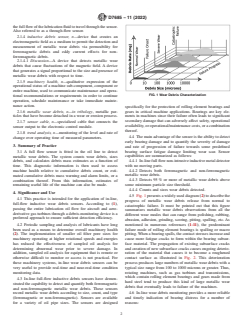
4.5 Fig.1presentsawidelyuseddiagram (2)todescribethe
4.1 This practice is intended for the application of in-line,
progress of metallic wear debris release from normal to
full-flow inductive wear debris sensors. According to (1),
catastrophic failure. It must be pointed out that this figure
passing the entire lubrication oil flow for aircraft and aero-
summarizes metallic wear debris observations from all the
derivative gas turbines through a debris-monitoring device is a
different wear modes that can range from polishing, rubbing,
preferred approach to ensure sufficient detection efficiency.
abrasion, adhesion, grinding, scoring, pitting, spalling, etc. As
4.2 Periodic sampling and analysis of lubricants have long mentioned in numerous references (1-11), the predominant
been used as a means to determine overall machinery health failure mode of rolling element bearings is spalling or macro
pitting.Whenabearingspalls,thecontactstressesincreaseand
(2). The implementation of smaller oil filter pore sizes for
machinery operating at higher rotational speeds and energies cause more fatigue cracks to form within the bearing subsur-
face material. The propagation of existing subsurface cracks
has reduced the effectiveness of sampled oil analysis for
determining abnormal wear prior to severe damage. In and creation of new subsurface cracks causes ongoing deterio-
addition, sampled oil analysis for equipment that is remote or ration of the material that causes it to become a roughened
otherwise difficult to monitor or access is not practical. For contact surface as illustrated in Fig. 2. This deterioration
these machinery systems, in-line wear debris sensors can be process produces large numbers of metallic wear debris with a
very useful to provide real-time and near-real-time condition typical size range from 100 to 1000 microns or greater. Thus,
monitoring data. rotating machines, such as gas turbines and transmissions,
which contain rolling element bearings and gears made from
4.3 In-line full-flow inductive debris sensors have demon-
hard steel tend to produce this kind of large metallic wear
strated the capability to detect and quantify both ferromagnetic
debris that eventually leads to failure of the machines.
and non-ferromagnetic metallic wear debris. These sensors
record metallic wear debris according to size, count, and type 4.6 In-line wear debris monitoring provides a more reliable
(ferromagnetic or non-ferromagnetic). Sensors are available and timely indication of bearing distress for a number of
for a variety of oil pipe sizes. The sensors are designed reasons:
D7685 − 11 (2022)
FIG. 3 Sensor Major Components (3)
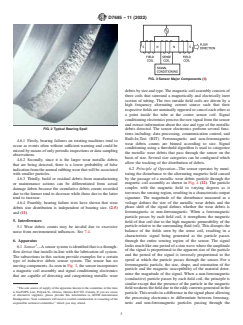
debrisbysizeandtype.Themagneticcoilassemblyconsistsof
three coils that surround a magnetically and electrically inert
section of tubing. The two outside field coils are driven by a
high frequency alternating current source such that their
respective fields are nominally opposed or cancel each other at
a point inside the tube at the center sensor coil. Signal
conditioning electronics process the raw signal from the sensor
and extract information about the size and type of the metallic
FIG. 2 Typical Bearing Spall
debris detected. The sensor electronics perform several func-
tions including: data processing, communication control, and
Built-In-Test (BIT). Ferromagnetic and non-ferromagnetic
4.6.1 Firstly, bearing failures on rotating machines tend to
wear debris counts are binned according to size. Signal
occur as events often without sufficient warning and could be
conditioning using a threshold algorithm is used to categorize
missed by means of only periodic inspections or data sampling
the metallic wear debris that pass through the sensor on the
observations.
basis of size. Several size categories can be configured which
4.6.2 Secondly, since it is the larger wear metallic debris
allow the tracking of the distribution of debris.
that are being detected, there is a lower probability of false
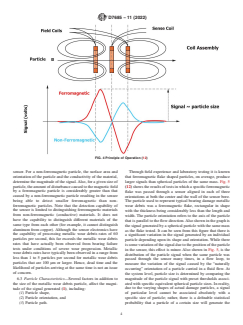
6.2 Principle of Operation—The sensor operates by moni-
indicationfromthenormalrubbingwearthatwillbeassociated
toring the disturbance to the alternating magnetic field caused
with smaller particles.
by the passage of a metallic wear debris particle through the
4.6.3 Thirdly, build or residual debris from manufacturing
magnetic coil assembly as shown in Fig. 4 (12). The particle
or maintenance actions can be differentiated from actual
couples with the magnetic field to varying degrees as it
damage debris because the cumulative debris counts recorded
traverses the sensing region, resulting in a characteristic output
due to the former tend to decrease while those due to the latter
signature. The magnitude of the disturbance measured as a
tend to increase.
voltage defines the size of the metallic wear debris and the
4.6.4 Fourthly, bearing failure tests have shown that wear
phase shift of the signal defines whether the wear debris is
debris size distribution is independent of bearing size. (2-5)
ferromagnetic or non-ferromagnetic. When a ferromagnetic
and (11).
particle passes by each field coil, it strengthens the magnetic
5. Interferences
field of that coil due to the high magnetic permeability of the
particle relative to the surrounding fluid (oil). This disrupts the
5.1 Wear debris counts may be invalid due to excessive
balance of the fields seen by the sense coil, resulting in a
noise from environmental influences. See 7.4.
characteristic signal being generated as the particle passes
6. Apparatus through the entire sensing region of the sensor. The signal
3 looks much like one period of a sine wave where the amplitude
6.1 Sensor —Asensorsystemisidentifiedthatisathrough-
of the signal is proportional to the apparent size of the particle
flow device that installs in-line with the lubrication oil system.
and the period of the signal is inversely proportional to the
The subsections in this section provide examples for a certain
speed at which the particle passes through the sensor. For a
type of inductive debris sensor system. The sensor has no
ferromagnetic particle, the size, shape, and orientation of the
moving components.As seen in Fig. 3, the sensor incorporates
particle and the magnetic susceptibility of the material deter-
a magnetic coil assembly and signal conditioning electronics
mine the magnitude of the signal. When a non-ferromagnetic
that are capable of detecting and categorizing metallic wear
(conductive) particle passes by each field coil, the principle is
similar except that the presence of the particle in the magnetic
The sole source of supply of the apparatus known to the committee at this time
fieldweakensthefieldduetotheeddycurrentsgeneratedinthe
is GasTOPS, Ltd., Polytek St., Ottawa, Ontario K1J 9J3, Canada. If you are aware
particle.Thisresultsinadifferenceinthesignalphaseallowing
of alternative suppliers, please provide this information to ASTM International
the processing electronics to differentiate between ferromag-
Headquarters.Your comments will receive careful consideration at a meeting of the
responsible technical committee, which you may attend. netic and non-ferromagnetic particles passing through the
D7685 − 11 (2022)
FIG. 4 Principle of Operation (12)
sensor. For a non-ferromagnetic particle, the surface area and Through field experience and laboratory testing it is known
orientation of the particle and the conductivity of the material, that ferromagnetic flake shaped particles, on average, produce
determine the magnitude of the signal.Also, for a given size of
larger signals than spherical particles of the same mass. Fig. 5
particle,theamountofdisturbancecausedtothemagneticfield (12)showstheresultsoftestsinwhichaspecificferromagnetic
by a ferromagnetic particle is considerably greater than that
flake was passed through a sensor aligned in each of three
caused by a non-ferromagnetic particle resulting in the sensor
orientations at both the center and the wall of the sensor bore.
being able to detect smaller ferromagnetic than non-
The particle used to represent typical bearing damage metallic
ferromagnetic particles. Note that the detection capability of
wear debris was a ferromagnetic flake, rectangular in shape
the sensor is limited to distinguishing ferromagnetic materials
with the thickness being considerably less than the length and
from non-ferromagnetic (conductive) materials. It does not
width. The particle orientation refers to the axis of the particle
have the capability to distinguish different materials of the
that is parallel to the flow direction.Also shown in the graph is
same type from each other (for example, it cannot distinguish
the signal generated by a spherical particle with the same mass
aluminum from copper). Although the sensor electronics have
as the flake tested. It can be seen from this figure that there is
the capability of processing metallic wear debris rates of 60
a significant variation in the signal generated by an individual
particles per second, this far exceeds the metallic wear debris
particle depending upon its shape and orientation. While there
rates that have actually been observed from bearing failure
issomevariationofthesignalduetothepositionoftheparticle
tests under conditions of severe wear progression. Metallic
in the sensor, this effect is minor. Also shown in Fig. 5,isthe
wear debris rates have typically been observed in a range from
distribution of the particle signal when the same particle was
less than 1 to 5 particles per second for metallic wear debris
passed through the sensor many times, in a flow loop, to
particles that are 100 µm or larger. Hence, dead time and the
measure the variation of the signal caused by the “naturally
likelihood of particles arriving at the same time is not an issue
occurring” orientation of a particle carried in a fluid flow. At
of concern.
the system level, particle size is determined by comparing the
magnitude of the particle signal with preset thresholds associ-
6.3 Particle Characteristics—Several factors in addition to
the size of the metallic wear debris particle, affect the magni- ated with specific equivalent spherical particle sizes. In reality,
due to the varying shapes of actual damage particles, a signal
tude of the signal generated (1), including:
(1) Particle shape, of particular level cannot be associated absolutely with a
(2) Particle orientation, and specific size of particle; rather, there is a definable statistical
(3) Particle path. probability that a particle of a certain size will generate the
D7685 − 11 (2022)
FIG. 5 Effects of Particle Shape/Orientation/Path for a Particle of Equivalent Mass (12)
mean signal. Given that large numbers of particles are usually precision spherical particles provides a traceable particle size
released as bearings spall, a mean signal can be expected and reference that facilitates comparative measurements of sensor
it is usually at least 2 to 3 times larger than the one for a sphere performance in development, qualification and production
of equivalent mass. testing.
6.5.2 Non-ferromagnetic Wear Debris—Since eddy currents
6.4 Material Magnetic Properties—All materials show
generated in a non-ferromagnetic particle are also proportional
some response to an applied magnetic field. In some materials,
to the electrical conductivity of the material of the particle,
the magnetization is in the same direction as the applied
different non-ferromagnetic materials will have different detec-
magnetic field and the material is said to be paramagnetic. In
tion thresholds.As a default, the sensor conductivity is usually
other materials, the magnetization is in the opposite direction
set for aluminum. Nonetheless, the conductivity can be se-
to the applied magnetic field and the material is said to be
lected as required to detect a specific non-ferromagnetic
diagmagnetic. For some metals, notably iron, nickel, cobalt,
element for some applications.
there exists a spontaneous magnetization even when the
applied magnetic field is zero and the metals are said to be
6.6 Dynamic Range—The dynamic range depends on the
ferromagnetic. In an applied magnetic field, the magnetization
3 3 1
nominal line diameter, ⁄8 in., ⁄4 in. and 1 ⁄4 in.; see Table 1.
of ferromagnetic metals is increased further in the same
6.7 Operating Temperature Range—A sensor can be
direction as the applied field. The magnetization due to
mounted in harsh environments in the same space as the
paramagnetic and diagmagnetic effects are very small by
monitored machinery. Minimum ambient temperature range is
orders of magnitude compared with ferromagnetic effects.
–40 °F ⁄ –40 °C. Maximum ambient temperature range is
Thus, it is only in the ferromagnetic materials that the
375 °F / 190 °C; see Table 2.
magnetization effects are large enough to be readily observ-
able. Since rolling element bearings and gears contain largely
6.8 Operating Pressure Range—A sensor is installed di-
iron as one of the elements, inductive sensing devices essen-
rectly into the fluid line without adversely affecting the
tially detect the ferromagnetic wear debris from these compo-
lubrication system. The allowable maximum operating pres-
nents.
sures depend on the bore size of the sensor; see Table 2.
6.5 Metallic Wear Debris Detection Threshold:
6.9 Flow Rate—Minimum and maximum flow rates are
6.5.1 Ferromagnetic Wear Debris—Particle detection
necessary for accurate and repeatable sensor response; see
threshold depends on the bore diameter of the sensor and
Table 2.
whether the wear debris is ferromagnetic or non-ferromagnetic
as defined in Table 1 and illustrated in Fig. 6. Particle detection 6.10 Placement—The recommended location for the sensor
thresholds are stated in terms of minimum spherical particle is directly downstream of the system components subject to
sizes that can be detected because the use of manufactured wear. Specifically, the sensors are placed after the component
D7685 − 11 (2022)
TABLE 1 Metallic Wear Debris Size Range Detected for Specified Bore Diameter
3 3 1
Nominal Line Size ⁄8 in. ⁄4 in. 1 ⁄4 in.
Bore 0.30 in. / 7.6 mm 0.7 in. / 18.0 mm 1.06 in. / 26.9 mm
Minimum Detectable Particle Size:
Ferromagnetic (spherical equivalent) 120 µm 225 µm 330 µm
Non-ferromagnetic (spherical 440 µm 605 µm 900 µm
equivalent) (spherical aluminum )
(3) Rate of metallic wear debris detected,
(4) Comparison of health indices to preset limits,
(5) Annunciate warning/alarm,
(6) Display time trends of metallic wear debris count and
mass,
(7) Display size distribution in the form of histogram plots,
(8) Monitor and display system status, and
(9) Displaycurrentparticlecountsandmasstables.Current
particlecountsormassfromthesensorshowhowmanycounts
or how much mass have accumulated in each of the configured
FIG. 6 Sensors with Different Bore Diameters
particle size bins since last reset. This includes a cumulative
total of the counts or mass detected and the size distribution.
7.2 Data Processing—Data processing is performed by the
wear-generating source (bearing or gear) in the fluid return
electronics of the control unit including, metallic wear debris
lines prior to the filtration system. The sensor is most effective
recognition; discrimination on the basis of material (ferromag-
when there are no traps or filters between the sensor and the
netic or non-ferromagnetic); and metallic wear debris size.
components being monitored. The sensor can be mounted in
Once the debris has been detected, classified, and sized, this
harsh environments in the same space as the monitored
information is passed to accumulating counters that record the
machineryandcanbeinstalledinanyphysicalorientationwith
total number of particles of a given type. The data can be
the fluid
...