

ASTM F2180-17
(Specification)Standard Specification for Metallic Implantable Strands and Cables
General Information
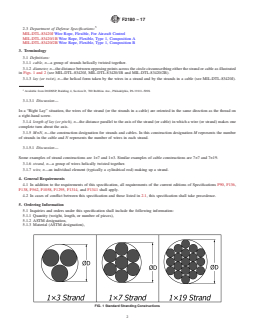
- Abstract
ABSTRACT
This specification covers the materials, dimensional tolerances, constructions, and mechanical properties for standard metallic implantable strands and cables. Materials shall be manufactured using equivalent size wires in the cold-worked and stress-relieved or annealed condition. Standard strand constructions shall be 1×3, 1×7, and 1×19 strand. Cabling constructions shall be 7×7 and 7×19 cable. Mechanical requirements include ultimate tensile strength and minimum breaking force. Strand or cable shall have no welds or splices, free of imperfections, and shall conform to dimensions, surface finish, and tolerances indicated in this specification.
SCOPE
1.1 This specification covers the materials, dimensional tolerances, constructions, and mechanical properties for standard metallic implantable strands and cables.
1.2 This specification is intended to assist in the development of specific strand and cable specifications. It is particularly appropriate for high load bearing applications. It is not intended however, to address all of the possible variations in construction, material, or properties.
1.3 The values stated in SI units are to be regarded as standard. No other units of measurement are included in this standard.
1.4 This international standard was developed in accordance with internationally recognized principles on standardization established in the Decision on Principles for the Development of International Standards, Guides and Recommendations issued by the World Trade Organization Technical Barriers to Trade (TBT) Committee.
- Status
- Published
- Publication Date
- 31-Jan-2017
- Technical Committee
- F04 - Medical and Surgical Materials and Devices
- Drafting Committee
- F04.21 - Osteosynthesis
Buy Documents

ASTM F2180-17 - Standard Specification for Metallic Implantable Strands and Cables
REDLINE ASTM F2180-17 - Standard Specification for Metallic Implantable Strands and Cables
Overview
ASTM F2180-17: Standard Specification for Metallic Implantable Strands and Cables is an internationally recognized standard developed by ASTM International. This specification defines the essential material requirements, construction types, dimensional tolerances, surface finishes, and mechanical properties for metallic strands and cables intended for surgical implantation. The standard ensures that implantable cables and strands meet stringent quality, reliability, and biocompatibility needs for high load-bearing applications in the medical device sector.
ASTM F2180-17 applies to strands and cables produced from a variety of biocompatible metallic alloys such as titanium, cobalt alloys, and stainless steel, focusing on constructions commonly used in medical implants.
Key Topics
Material Requirements and Construction
- Covers materials such as cobalt alloys, titanium and titanium alloys (e.g., ASTM F90, F136, F138, F562), and various grades of stainless steel.
- Specifies that all wires must be of equivalent size and provided in cold-worked, stress-relieved, or annealed state.
- Standard strand constructions: 1×3, 1×7, and 1×19.
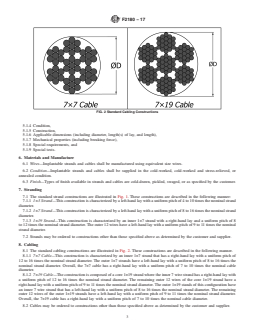
- Standard cable constructions: 7×7 and 7×19.
Dimensional and Mechanical Properties
- Includes strict dimensional tolerances and out-of-round tolerances across a full diameter range.
- Provides minimum mechanical requirements, including ultimate tensile strength and breaking force, based on the alloy and product type.
Surface Quality and Handling
- Surfaces must be free from imperfections such as marks, scratches, cracks, or contaminants that can impact service life.
- Specifies proper handling and packaging procedures to prevent damage or contamination.
- Allows for customer-specified surface finishes, including cold-drawn and passivated conditions.
Testing and Quality Assurance
- Mechanical testing is conducted following ASTM methods to confirm tensile and breaking strengths.
- Certification must be provided showing compliance with mechanical and dimensional specification before shipment.
- Manufacturers are required to maintain a quality management system aligned with ISO 9001 or other recognized standards.
Applications
Primary Uses
- Metallic implantable strands and cables covered by ASTM F2180-17 are crucial in various surgical implants requiring high mechanical strength and reliability.
- Common applications include:
- Orthopedic fixation systems
- Spinal and trauma devices
- Sternal closure systems
- Temporary or permanent bone stabilization
- Other medical devices where robust and reliable cable or strand configurations are critical
Selection Advantages
- High load-bearing capacity and consistent mechanical properties.
- Customizable construction and finish to adapt to specific surgical requirements.
- Stringent quality and certification protocols minimize risk for medical device manufacturers and end users.
Related Standards
Referenced ASTM Standards
- ASTM E8 – Tension Testing of Metallic Materials
- ASTM F86 – Surface Preparation and Marking of Metallic Surgical Implants
- ASTM F90, F136, F138, F562, F1058, F1295, F1314, F1341 – Surgical implant alloy specifications
- ASTM F2503 – Marking medical devices for MR safety
Other Relevant Standards
- MIL-DTL-83420 – Department of Defense standard for flexible wire ropes
- ISO 9001 / ASQ C1 – Quality management systems requirements for manufacturers
By adhering to ASTM F2180-17, medical device manufacturers and suppliers ensure that their metallic implantable strands and cables not only meet strict safety and performance criteria but also align with global standards for quality and patient care. Proper application of this standard reduces failure risk, enhances device reliability, and ensures regulatory compliance in international markets.
Relations
- Effective Date
- 01-Feb-2017
- Effective Date
- 15-Mar-2024
- Effective Date
- 01-Apr-2023
- Effective Date
- 01-Dec-2019
- Effective Date
- 01-Feb-2018
- Effective Date
- 01-Nov-2016
- Effective Date
- 01-Oct-2013
- Effective Date
- 01-Oct-2013
- Effective Date
- 01-Jun-2013
- Effective Date
- 01-Apr-2013
- Effective Date
- 01-Apr-2013
- Refers
ASTM F86-12a - Standard Practice for Surface Preparation and Marking of Metallic Surgical Implants - Effective Date
- 01-Dec-2012
- Effective Date
- 01-Dec-2012
- Effective Date
- 01-Nov-2012
- Refers
ASTM F86-12 - Standard Practice for Surface Preparation and Marking of Metallic Surgical Implants - Effective Date
- 15-May-2012
Buy Documents
ASTM F2180-17 - Standard Specification for Metallic Implantable Strands and Cables
REDLINE ASTM F2180-17 - Standard Specification for Metallic Implantable Strands and Cables
Get Certified
Connect with accredited certification bodies for this standard

BSI Group
BSI (British Standards Institution) is the business standards company that helps organizations make excellence a habit.

TÜV Rheinland
TÜV Rheinland is a leading international provider of technical services.

TÜV SÜD
TÜV SÜD is a trusted partner of choice for safety, security and sustainability solutions.
Sponsored listings
Frequently Asked Questions
ASTM F2180-17 is a technical specification published by ASTM International. Its full title is "Standard Specification for Metallic Implantable Strands and Cables". This standard covers: ABSTRACT This specification covers the materials, dimensional tolerances, constructions, and mechanical properties for standard metallic implantable strands and cables. Materials shall be manufactured using equivalent size wires in the cold-worked and stress-relieved or annealed condition. Standard strand constructions shall be 1×3, 1×7, and 1×19 strand. Cabling constructions shall be 7×7 and 7×19 cable. Mechanical requirements include ultimate tensile strength and minimum breaking force. Strand or cable shall have no welds or splices, free of imperfections, and shall conform to dimensions, surface finish, and tolerances indicated in this specification. SCOPE 1.1 This specification covers the materials, dimensional tolerances, constructions, and mechanical properties for standard metallic implantable strands and cables. 1.2 This specification is intended to assist in the development of specific strand and cable specifications. It is particularly appropriate for high load bearing applications. It is not intended however, to address all of the possible variations in construction, material, or properties. 1.3 The values stated in SI units are to be regarded as standard. No other units of measurement are included in this standard. 1.4 This international standard was developed in accordance with internationally recognized principles on standardization established in the Decision on Principles for the Development of International Standards, Guides and Recommendations issued by the World Trade Organization Technical Barriers to Trade (TBT) Committee.
ABSTRACT This specification covers the materials, dimensional tolerances, constructions, and mechanical properties for standard metallic implantable strands and cables. Materials shall be manufactured using equivalent size wires in the cold-worked and stress-relieved or annealed condition. Standard strand constructions shall be 1×3, 1×7, and 1×19 strand. Cabling constructions shall be 7×7 and 7×19 cable. Mechanical requirements include ultimate tensile strength and minimum breaking force. Strand or cable shall have no welds or splices, free of imperfections, and shall conform to dimensions, surface finish, and tolerances indicated in this specification. SCOPE 1.1 This specification covers the materials, dimensional tolerances, constructions, and mechanical properties for standard metallic implantable strands and cables. 1.2 This specification is intended to assist in the development of specific strand and cable specifications. It is particularly appropriate for high load bearing applications. It is not intended however, to address all of the possible variations in construction, material, or properties. 1.3 The values stated in SI units are to be regarded as standard. No other units of measurement are included in this standard. 1.4 This international standard was developed in accordance with internationally recognized principles on standardization established in the Decision on Principles for the Development of International Standards, Guides and Recommendations issued by the World Trade Organization Technical Barriers to Trade (TBT) Committee.
ASTM F2180-17 is classified under the following ICS (International Classification for Standards) categories: 11.040.40 - Implants for surgery, prosthetics and orthotics. The ICS classification helps identify the subject area and facilitates finding related standards.
ASTM F2180-17 has the following relationships with other standards: It is inter standard links to ASTM F2180-02(2015), ASTM F1295-24, ASTM F2503-23e1, ASTM F138-19, ASTM F1314-18, ASTM F1058-16, ASTM F138-13a, ASTM F1314-13ae1, ASTM F2503-13, ASTM F138-13, ASTM F1314-13, ASTM F86-12a, ASTM F136-12a, ASTM F136-12, ASTM F86-12. Understanding these relationships helps ensure you are using the most current and applicable version of the standard.
ASTM F2180-17 is available in PDF format for immediate download after purchase. The document can be added to your cart and obtained through the secure checkout process. Digital delivery ensures instant access to the complete standard document.
Standards Content (Sample)
This international standard was developed in accordance with internationally recognized principles on standardization established in the Decision on Principles for the
Development of International Standards, Guides and Recommendations issued by the World Trade Organization Technical Barriers to Trade (TBT) Committee.
Designation:F2180 −17
Standard Specification for
Metallic Implantable Strands and Cables
This standard is issued under the fixed designation F2180; the number immediately following the designation indicates the year of
original adoption or, in the case of revision, the year of last revision.Anumber in parentheses indicates the year of last reapproval.A
superscript epsilon (´) indicates an editorial change since the last revision or reapproval.
1. Scope F562 Specification for Wrought 35Cobalt-35Nickel-
20Chromium-10Molybdenum Alloy for Surgical Implant
1.1 This specification covers the materials, dimensional
Applications (UNS R30035)
tolerances, constructions, and mechanical properties for stan-
F1058Specification for Wrought 40Cobalt-20Chromium-
dard metallic implantable strands and cables.
16Iron-15Nickel-7Molybdenum Alloy Wire, Strip, and
1.2 This specification is intended to assist in the develop-
StripBarforSurgicalImplantApplications(UNSR30003
ment of specific strand and cable specifications. It is particu-
and UNS R30008)
larly appropriate for high load bearing applications. It is not
F1295 Specification for Wrought Titanium-6Aluminum-
intended however, to address all of the possible variations in
7Niobium Alloy for Surgical Implant Applications (UNS
construction, material, or properties.
R56700)
1.3 The values stated in SI units are to be regarded as F1314Specification for Wrought Nitrogen Strengthened 22
Chromium–13 Nickel–5 Manganese–2.5 Molybdenum
standard. No other units of measurement are included in this
standard. Stainless Steel Alloy Bar and Wire for Surgical Implants
(UNS S20910)
1.4 This international standard was developed in accor-
F1341Specification for Unalloyed Titanium Wire UNS
dance with internationally recognized principles on standard-
R50250, UNS R50400, UNS R50550, UNS R50700, for
ization established in the Decision on Principles for the
Surgical Implant Applications (Withdrawn 2006)
Development of International Standards, Guides and Recom-
F2503Practice for Marking Medical Devices and Other
mendations issued by the World Trade Organization Technical
Items for Safety in the Magnetic Resonance Environment
Barriers to Trade (TBT) Committee.
2.2 ISO Standards:
ISO 9001Quality Management Systems—Requirements
2. Referenced Documents
2.3 Department of Defense Specifications:
2.1 ASTM Standards:
MIL-DTL-83420JWireRope,Flexible,ForAircraftControl
E8Test Methods for Tension Testing of Metallic Materials
MIL-DTL-83420/1BWire Rope, Flexible, Type 1, Compo-
F86Practice for Surface Preparation and Marking of Metal-
sition A
lic Surgical Implants
MIL-DTL-83420/2BWire Rope, Flexible, Type 1, Compo-
F90 Specification for Wrought Cobalt-20Chromium-
sition B
15Tungsten-10NickelAlloy for Surgical ImplantApplica-
tions (UNS R30605)
3. Terminology
F136 Specification for Wrought Titanium-6Aluminum-
3.1 Definitions:
4VanadiumELI(ExtraLowInterstitial)AlloyforSurgical
3.1.1 cable,n—agroupofstrandshelicallytwistedtogether.
Implant Applications (UNS R56401)
F138 Specification for Wrought 18Chromium-14Nickel-
3.1.2 diameter, n—the distance between opposing points
2.5MolybdenumStainlessSteelBarandWireforSurgical across the circle circumscribing either the strand or cable as
Implants (UNS S31673)
illustrated in Figs. 1 and 2 (see MIL-DTL-83420J, MIL-DTL-
83420/1B and MIL-DTL-83420/2B).
3.1.3 lay(ortwist),n—thehelicalformtakenbythewiresin
This specification is under the jurisdiction of ASTM Committee F04 on
a strand and by the strands in a cable (see MIL-DTL-83420J).
Medical and Surgical Materials and Devicesand is the direct responsibility of
Subcommittee F04.21 on Osteosynthesis.
Current edition approved Feb. 1, 2017. Published March 2017. Originally
approved in 2002. Last previous edition approved in 2015 as F2180–02 (2015). The last approved version of this historical standard is referenced on
DOI: 10.1520/F2180-17. www.astm.org.
2 4
For referenced ASTM standards, visit the ASTM website, www.astm.org, or Available fromAmerican National Standards Institute (ANSI), 25 W. 43rd St.,
contact ASTM Customer Service at service@astm.org. For Annual Book of ASTM 4th Floor, New York, NY 10036, http://www.ansi.org.
Standards volume information, refer to the standard’s Document Summary page on Available from DODSSP, Building 4, Section D, 700 Robbins Ave.,
the ASTM website. Philadelphia, PA 19111–5098.
Copyright © ASTM International, 100 Barr Harbor Drive, PO Box C700, West Conshohocken, PA 19428-2959. United States
F2180−17
FIG. 1Standard Stranding Constructions
FIG. 2Standard Cabling Constructions
3.1.3.1 Discussion—In a “Right Lay” situation, the wires of 4.2 In cases of conflict between this specification and those
the strand (or the strands in a cable) are oriented in the same listed in 2.1, this specification shall take precedence.
direction as the thread on a right-hand screw.
5. Ordering Information
3.1.4 length of lay (or pitch), n—the distance parallel to the
5.1 Inquiries and orders under this specification shall in-
axis of the strand (or cable) in which a wire (or strand) makes
clude the following information:
one complete turn about the axis.
5.1.1 Quantity (weight, length, or number of pieces),
3.1.5 M×N, n—the construction designation for strands and
5.1.2 ASTM designation,
cables. In this construction designation M represents the
5.1.3 Material (ASTM designation),
number of strands in the cable and N represents the number of
5.1.4 Condition,
wires in each strand.
5.1.5 Construction,
3.1.5.1 Discussion— Some examples of strand construc-
5.1.6 Applicable dimensions (including diameter, length(s)
tionsare1×7and1×3.Similarexamplesofcableconstructions
of lay, and length),
are 7×7 and 7×19.
5.1.7 Mechanical properties (including breaking force),
3.1.6 strand, n—a group of wires helically twisted together.
5.1.8 Special requirements, and
5.1.9 Special tests.
3.1.7 wire, n—an individual element (typically a cylindrical
rod) making up a strand.
6. Materials and Manufacture
4. General Requirements
6.1 Wires—Implantable strands and cables shall be manu-
factured using equivalent size wires.
4.1 In addition to the requirements of this specification, all
requirements of the current editions of Specifications F90, 6.2 Condition—Implantable strands and cables shall be
F136, F138, F562, F1058, F1295, F1314, and F1341 shall supplied in the cold-worked, cold-worked and stress-relieved,
apply. or annealed condition.
F2180−17
TABLE 1 Dimensional Requirements for Metallic Implantable
6.3 Finish—Types of finish available in strands and cables
Strands and Cables
are cold-drawn, pickled, swaged, or as specified by the
Specified Diameter, Diameter Tolerance, Out-of-Round Tolerance,
customer.
mm ±mm mm
7. Stranding Under 0.12 0.0075 0.0075
0.12 to under 0.20 0.015 0.015
7.1 The standard strand constructions are illustrated in Fig.
0.20 to under 0.30 0.022 0.022
1. These constructions are described in the following manner: 0.30 to under 0.60 0.030 0.030
0.60 to under 0.82 0.037 0.037
7.1.1 1×3 Strand—This construction is characterized by a
0.82 to under 1.10 0.060 0.060
left-hand lay with a uniform pitch of 4 to 10 times the nominal
1.10 to under 2.50 0.075 0.075
2.50 to under 4.10 0.150 0.150
strand diameter.
7.1.2 1×7 Strand—This construction is characterized by a
left-hand lay with a uniform pitch of 8 to 16 times the nominal
strand diameter.
11.2 Use the following formulas for determining the effec-
7.1.3 1×19Strand—Thisconstructionischaracterizedbyan
tive cross-sectional area for standard construction strands or
inner 1×7 strand with a right-hand lay and a uni
...
This document is not an ASTM standard and is intended only to provide the user of an ASTM standard an indication of what changes have been made to the previous version. Because
it may not be technically possible to adequately depict all changes accurately, ASTM recommends that users consult prior editions as appropriate. In all cases only the current version
of the standard as published by ASTM is to be considered the official document.
Designation: F2180 − 02 (Reapproved 2015) F2180 − 17
Standard Specification for
Metallic Implantable Strands and Cables
This standard is issued under the fixed designation F2180; the number immediately following the designation indicates the year of
original adoption or, in the case of revision, the year of last revision. A number in parentheses indicates the year of last reapproval. A
superscript epsilon (´) indicates an editorial change since the last revision or reapproval.
1. Scope
1.1 This specification covers the materials, dimensional tolerances, constructions, and mechanical properties for standard
metallic implantable strands and cables.
1.2 This specification is intended to assist in the development of specific strand and cable specifications. It is particularly
appropriate for high load bearing applications. It is not intended however, to address all of the possible variations in construction,
material, or properties.
1.3 The values stated in SI units are to be regarded as standard. No other units of measurement are included in this standard.
1.4 This international standard was developed in accordance with internationally recognized principles on standardization
established in the Decision on Principles for the Development of International Standards, Guides and Recommendations issued
by the World Trade Organization Technical Barriers to Trade (TBT) Committee.
2. Referenced Documents
2.1 ASTM Standards:
E8 Test Methods for Tension Testing of Metallic Materials
F86 Practice for Surface Preparation and Marking of Metallic Surgical Implants
F90 Specification for Wrought Cobalt-20Chromium-15Tungsten-10Nickel Alloy for Surgical Implant Applications (UNS
R30605)
F136 Specification for Wrought Titanium-6Aluminum-4Vanadium ELI (Extra Low Interstitial) Alloy for Surgical Implant
Applications (UNS R56401)
F138 Specification for Wrought 18Chromium-14Nickel-2.5Molybdenum Stainless Steel Bar and Wire for Surgical Implants
(UNS S31673)
F562 Specification for Wrought 35Cobalt-35Nickel-20Chromium-10Molybdenum Alloy for Surgical Implant Applications
(UNS R30035)
F1058 Specification for Wrought 40Cobalt-20Chromium-16Iron-15Nickel-7Molybdenum Alloy Wire, Strip, and Strip Bar for
Surgical Implant Applications (UNS R30003 and UNS R30008)
F1295 Specification for Wrought Titanium-6Aluminum-7Niobium Alloy for Surgical Implant Applications (UNS R56700)
F1314 Specification for Wrought Nitrogen Strengthened 22 Chromium–13 Nickel–5 Manganese–2.5 Molybdenum Stainless
Steel Alloy Bar and Wire for Surgical Implants (UNS S20910)
F1341 Specification for Unalloyed Titanium Wire UNS R50250, UNS R50400, UNS R50550, UNS R50700, for Surgical
Implant Applications (Withdrawn 2006)
F2503 Practice for Marking Medical Devices and Other Items for Safety in the Magnetic Resonance Environment
2.2 American Society for Quality (ASQ) Standard:ISO Standards:
ASQ C1ISO 9001 Specification of General Requirements for a Quality ProgramQuality Management Systems—Requirements
This specification is under the jurisdiction of ASTM Committee F04 on Medical and Surgical Materials and Devices and is the direct responsibility of Subcommittee
F04.21 on Osteosynthesis.
Current edition approved Sept. 1, 2015Feb. 1, 2017. Published October 2015March 2017. Originally approved in 2002. Last previous edition approved in 20112015 as
ε1
F2180 – 02 (2011)(2015). . DOI: 10.1520/F2180-02R15.10.1520/F2180-17.
For referenced ASTM standards, visit the ASTM website, www.astm.org, or contact ASTM Customer Service at service@astm.org. For Annual Book of ASTM Standards
volume information, refer to the standard’s Document Summary page on the ASTM website.
The last approved version of this historical standard is referenced on www.astm.org.
Available from American Society for Quality (ASQ), 600 N. Plankinton Ave., Milwaukee, WI 53203, http://www.asq.org.National Standards Institute (ANSI), 25 W. 43rd
St., 4th Floor, New York, NY 10036, http://www.ansi.org.
Copyright © ASTM International, 100 Barr Harbor Drive, PO Box C700, West Conshohocken, PA 19428-2959. United States
F2180 − 17
2.3 Department of Defense Specifications:
MIL-DTL-83420J Wire Rope, Flexible, For Aircraft Control
MIL-DTL-83420/1B Wire Rope, Flexible, Type 1, Composition A
MIL-DTL-83420/2B Wire Rope, Flexible, Type 1, Composition B
3. Terminology
3.1 Definitions:
3.1.1 cable, n—a group of strands helically twisted together.
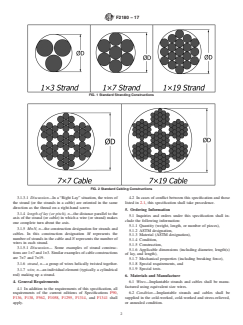
3.1.2 diameter, n—the distance between opposing points across the circle circumscribing either the strand or cable as illustrated
in Figs. 1 and 2 (see MIL-DTL-83420J, MIL-DTL-83420/1B and MIL-DTL-83420/2B).
3.1.3 lay (or twist), n—the helical form taken by the wires in a strand and by the strands in a cable (see MIL-DTL-83420J).
Available from DODSSP, Building 4, Section D, 700 Robbins Ave., Philadelphia, PA 19111–5098.
3.1.3.1 Discussion—
In a “Right Lay” situation, the wires of the strand (or the strands in a cable) are oriented in the same direction as the thread on
a right-hand screw.
3.1.4 length of lay (or pitch), n—the distance parallel to the axis of the strand (or cable) in which a wire (or strand) makes one
complete turn about the axis.
3.1.5 M×N, n—the construction designation for strands and cables. In this construction designation M represents the number
of strands in the cable and N represents the number of wires in each strand.
3.1.5.1 Discussion—
Some examples of strand constructions are 1×7 and 1×3. Similar examples of cable constructions are 7×7 and 7×19.
3.1.6 strand, n—a group of wires helically twisted together.
3.1.7 wire, n—an individual element (typically a cylindrical rod) making up a strand.
4. General Requirements
4.1 In addition to the requirements of this specification, all requirements of the current editions of Specifications F90, F136,
F138, F562, F1058, F1295, F1314, and F1341 shall apply.
4.2 In cases of conflict between this specification and those listed in 2.1, this specification shall take precedence.
5. Ordering Information
5.1 Inquiries and orders under this specification shall include the following information:
5.1.1 Quantity (weight, length, or number of pieces),
5.1.2 ASTM designation,
5.1.3 Material (ASTM designation),
FIG. 1 Standard Stranding Constructions
F2180 − 17
FIG. 2 Standard Cabling Constructions
5.1.4 Condition,
5.1.5 Construction,
5.1.6 Applicable dimensions (including diameter, length(s) of lay, and length),
5.1.7 Mechanical properties (including breaking force),
5.1.8 Special requirements, and
5.1.9 Special tests.
6. Materials and Manufacture
6.1 Wires—Implantable strands and cables shall be manufactured using equivalent size wires.
6.2 Condition—Implantable strands and cables shall be supplied in the cold-worked, cold-worked and stress-relieved, or
annealed condition.
6.3 Finish—Types of finish available in strands and cables are cold-drawn, pickled, swaged, or as specified by the customer.
7. Stranding
7.1 The standard strand constructions are illustrated in Fig. 1. These constructions are described in the following manner:
7.1.1 1×3 Strand—This construction is characterized by a left-hand lay with a uniform pitch of 4 to 10 times the nominal strand
diameter.
7.1.2 1×7 Strand—This construction is characterized by a left-hand lay with a uniform pitch of 8 to 16 times the nominal strand
diameter.
7.1.3 1×19 Strand—This construction is characterized by an inner 1×7 strand with a right-hand lay and a uniform pitch of 8
to 12 times the nominal strand diameter. The outer 12 wires have a left-hand lay with a uniform pitch of 9 to 11 times the nominal
strand diameter.
7.2 Strands may be ordered to constructions other than those specified above as determined by the customer and supplier.
8. Cabling
8.1 The standard cabling constructions are illustrated in Fig. 2. These constructions
...