

ASTM C279-23
(Specification)Standard Specification for Chemical-Resistant Masonry Units
General Information
- Abstract
ABSTRACT
This specification covers chemical-resistant masonry units, specifically, solid kiln fired bricks and tiles made from clay, shale, or mixtures thereof, suitable for indoor and outdoor use in masonry construction subjected to chemical environments. The bricks and tiles are considered to be of three types as follows: Type I, for use where low absorption and high acid resistance are not major factors; Type II, for use where lower absorption and higher acid resistance are required; and Type III, for use where minimum absorption and maximum acid resistance are required. The masonry units shall undergo tests and adhere accordingly to the following physical and chemical requirements: water absorption, warpage, surface texture, size and dimension, flexural strength, modulus of rupture, sulfuric acid solubility, and percent weight loss.
SCOPE
1.1 This specification covers solid, kiln fired brick and tile made from clay, shale, or mixtures thereof, suitable for indoor and outdoor use in masonry construction subjected to chemical environments.
1.2 The brick and tile covered herein are intended for use in chemical environments where resistance to thermal shock may be a consideration. The brick and tile are normally used with chemical-resistant mortars.
1.3 The values stated in inch-pound units are to be regarded as standard. The values given in parentheses are mathematical conversions to SI units that are provided for information only and are not considered standard.
1.4 This standard does not purport to address all of the safety concerns, if any, associated with its use. It is the responsibility of the user of this standard to establish appropriate safety, health, and environmental practices and determine the applicability of regulatory limitations prior to use.
1.5 This international standard was developed in accordance with internationally recognized principles on standardization established in the Decision on Principles for the Development of International Standards, Guides and Recommendations issued by the World Trade Organization Technical Barriers to Trade (TBT) Committee.
- Status
- Published
- Publication Date
- 31-May-2023
- Technical Committee
- C15 - Masonry – Manufactured Masonry Units, Mortars and Grouts
- Drafting Committee
- C15.02 - Brick and Structural Clay Tile



Overview
ASTM C279-23 - Standard Specification for Chemical-Resistant Masonry Units defines the requirements for solid, kiln-fired bricks and tiles manufactured from clay, shale, or their mixtures. These chemical-resistant masonry units are designed for both indoor and outdoor applications where exposure to harsh chemical environments and thermal shock resistance is required. The standard supports the performance and durability of masonry construction in environments subject to chemical attack, specifying rigorous test methods and quality criteria to ensure that materials meet demanding construction needs.
Key Topics
Types and Classification:
ASTM C279-23 classifies chemical-resistant bricks and tiles into three types based on their absorption and acid resistance:- Type I: For environments where low absorption and high acid resistance are not critical.
- Type II: For applications needing lower absorption and enhanced acid resistance.
- Type III: For the most demanding situations requiring minimum absorption and maximum acid resistance. These are further divided into:
- Class S: Standard dimensional tolerance.
- Class X: Stricter, high-precision dimensional tolerance.
Physical and Chemical Requirements:
- Modulus of Rupture (Flexural Strength): Units must meet specified strength levels.
- Water Absorption: Limits are set based on type for resistance to liquid penetration.
- Sulfuric Acid Solubility: Bricks and tiles must demonstrate minimal weight loss when tested for acid resistance.
- Dimensional Accuracy & Warpage: Strict tolerances based on the intended application class.
- Surface Texture & Finish: Units must be free of defects that could impair performance.
Testing and Sampling:
Consistent application of ASTM test methods, such as for porosity and absorption (ASTM C20), flexural strength (ASTM C67/C67M), and acid solubility, ensures results are reliable and comparable.
Applications
Chemical-resistant masonry units manufactured to ASTM C279-23 are essential in a range of environments where building materials must withstand exposure to chemicals, acids, and thermal cycling. Practical applications include:
- Industrial Facilities: Acid storage tanks, chemical processing plants, and battery rooms, where masonry must resist corrosive attack.
- Laboratory Spaces: Floors, walls, and other surfaces exposed to chemicals.
- Food and Beverage Processing: Environments requiring both hygiene and resistance to cleaning chemicals.
- Water Treatment Plants: Areas exposed to aggressive substances and cleaning protocols.
- Outdoor Installations: Where weather resistance and occasional chemical exposure are concerns.
These units are typically installed using chemical-resistant mortars, further enhancing their performance in aggressive environments.
Related Standards
To assure comprehensive compliance and performance, ASTM C279-23 references several associated standards and terminology:
- ASTM C20: Test Methods for Apparent Porosity, Water Absorption, Apparent Specific Gravity, and Bulk Density of Burned Refractory Brick and Shapes by Boiling Water
- ASTM C67/C67M: Test Methods for Sampling and Testing Brick and Structural Clay Tile, including flexural strength and durability assessments
- ASTM C1232: Terminology for Masonry, providing authoritative definitions
- ASTM E11: Specification for Woven Wire Test Sieve Cloth and Test Sieves, ensuring consistency in particle size assessments
For those specifying, purchasing, or inspecting chemical-resistant masonry units, ASTM C279-23 provides a reliable, internationally recognized benchmark to ensure materials perform as expected in challenging chemical environments.
Keywords: ASTM C279-23, chemical-resistant masonry units, acid-resistant bricks, chemical environment masonry, water absorption, sulfuric acid solubility, flexural strength, industrial masonry, chemical-resistant tile
Relations
- Effective Date
- 15-Dec-2023
- Refers
ASTM C67/C67M-19 - Standard Test Methods for Sampling and Testing Brick and Structural Clay Tile - Effective Date
- 01-Jul-2019
- Refers
ASTM C67/C67M-18 - Standard Test Methods for Sampling and Testing Brick and Structural Clay Tile - Effective Date
- 01-Feb-2018
- Effective Date
- 01-Jun-2017
- Effective Date
- 01-Sep-2015
- Effective Date
- 01-Jun-2015
- Effective Date
- 01-Oct-2013
- Effective Date
- 01-Jun-2012
- Effective Date
- 15-Dec-2010
- Effective Date
- 15-Jun-2010
- Effective Date
- 01-May-2010
- Effective Date
- 01-Jan-2010
- Effective Date
- 15-Dec-2009
- Effective Date
- 01-Jul-2009
- Effective Date
- 01-May-2009
Get Certified
Connect with accredited certification bodies for this standard

DIBt (Deutsches Institut für Bautechnik)
German Institute for Building Technology.
DIN CERTCO
DIN Group product certification.

Aboma Certification B.V.
Specialized in construction, metal, and transport sectors.
Sponsored listings
Frequently Asked Questions
ASTM C279-23 is a technical specification published by ASTM International. Its full title is "Standard Specification for Chemical-Resistant Masonry Units". This standard covers: ABSTRACT This specification covers chemical-resistant masonry units, specifically, solid kiln fired bricks and tiles made from clay, shale, or mixtures thereof, suitable for indoor and outdoor use in masonry construction subjected to chemical environments. The bricks and tiles are considered to be of three types as follows: Type I, for use where low absorption and high acid resistance are not major factors; Type II, for use where lower absorption and higher acid resistance are required; and Type III, for use where minimum absorption and maximum acid resistance are required. The masonry units shall undergo tests and adhere accordingly to the following physical and chemical requirements: water absorption, warpage, surface texture, size and dimension, flexural strength, modulus of rupture, sulfuric acid solubility, and percent weight loss. SCOPE 1.1 This specification covers solid, kiln fired brick and tile made from clay, shale, or mixtures thereof, suitable for indoor and outdoor use in masonry construction subjected to chemical environments. 1.2 The brick and tile covered herein are intended for use in chemical environments where resistance to thermal shock may be a consideration. The brick and tile are normally used with chemical-resistant mortars. 1.3 The values stated in inch-pound units are to be regarded as standard. The values given in parentheses are mathematical conversions to SI units that are provided for information only and are not considered standard. 1.4 This standard does not purport to address all of the safety concerns, if any, associated with its use. It is the responsibility of the user of this standard to establish appropriate safety, health, and environmental practices and determine the applicability of regulatory limitations prior to use. 1.5 This international standard was developed in accordance with internationally recognized principles on standardization established in the Decision on Principles for the Development of International Standards, Guides and Recommendations issued by the World Trade Organization Technical Barriers to Trade (TBT) Committee.
ABSTRACT This specification covers chemical-resistant masonry units, specifically, solid kiln fired bricks and tiles made from clay, shale, or mixtures thereof, suitable for indoor and outdoor use in masonry construction subjected to chemical environments. The bricks and tiles are considered to be of three types as follows: Type I, for use where low absorption and high acid resistance are not major factors; Type II, for use where lower absorption and higher acid resistance are required; and Type III, for use where minimum absorption and maximum acid resistance are required. The masonry units shall undergo tests and adhere accordingly to the following physical and chemical requirements: water absorption, warpage, surface texture, size and dimension, flexural strength, modulus of rupture, sulfuric acid solubility, and percent weight loss. SCOPE 1.1 This specification covers solid, kiln fired brick and tile made from clay, shale, or mixtures thereof, suitable for indoor and outdoor use in masonry construction subjected to chemical environments. 1.2 The brick and tile covered herein are intended for use in chemical environments where resistance to thermal shock may be a consideration. The brick and tile are normally used with chemical-resistant mortars. 1.3 The values stated in inch-pound units are to be regarded as standard. The values given in parentheses are mathematical conversions to SI units that are provided for information only and are not considered standard. 1.4 This standard does not purport to address all of the safety concerns, if any, associated with its use. It is the responsibility of the user of this standard to establish appropriate safety, health, and environmental practices and determine the applicability of regulatory limitations prior to use. 1.5 This international standard was developed in accordance with internationally recognized principles on standardization established in the Decision on Principles for the Development of International Standards, Guides and Recommendations issued by the World Trade Organization Technical Barriers to Trade (TBT) Committee.
ASTM C279-23 is classified under the following ICS (International Classification for Standards) categories: 91.100.15 - Mineral materials and products. The ICS classification helps identify the subject area and facilitates finding related standards.
ASTM C279-23 has the following relationships with other standards: It is inter standard links to ASTM C1232-23, ASTM C67/C67M-19, ASTM C67/C67M-18, ASTM C1232-17, ASTM C1232-15a, ASTM C1232-15, ASTM E11-13, ASTM C1232-12, ASTM C1232-10c, ASTM C1232-10b, ASTM C1232-10a, ASTM C1232-10, ASTM C1232-09b, ASTM C1232-09a, ASTM E11-09e1. Understanding these relationships helps ensure you are using the most current and applicable version of the standard.
ASTM C279-23 is available in PDF format for immediate download after purchase. The document can be added to your cart and obtained through the secure checkout process. Digital delivery ensures instant access to the complete standard document.
Standards Content (Sample)
This international standard was developed in accordance with internationally recognized principles on standardization established in the Decision on Principles for the
Development of International Standards, Guides and Recommendations issued by the World Trade Organization Technical Barriers to Trade (TBT) Committee.
Designation: C279 − 23
Standard Specification for
Chemical-Resistant Masonry Units
This standard is issued under the fixed designation C279; the number immediately following the designation indicates the year of
original adoption or, in the case of revision, the year of last revision. A number in parentheses indicates the year of last reapproval. A
superscript epsilon (´) indicates an editorial change since the last revision or reapproval.
1. Scope* E11 Specification for Woven Wire Test Sieve Cloth and Test
Sieves
1.1 This specification covers solid, kiln fired brick and tile
made from clay, shale, or mixtures thereof, suitable for indoor
3. Terminology
and outdoor use in masonry construction subjected to chemical
3.1 Definitions—For definitions relating to chemical-
environments.
resistant masonry units, refer to Terminology C1232.
1.2 The brick and tile covered herein are intended for use in
4. Classification
chemical environments where resistance to thermal shock may
be a consideration. The brick and tile are normally used with
4.1 The physical and chemical properties of brick and tile
chemical-resistant mortars.
differ from supplier to supplier, mainly because their compo-
sition is determined by the source of raw materials. Regardless
1.3 The values stated in inch-pound units are to be regarded
of the differences, brick and tile are considered to be one of
as standard. The values given in parentheses are mathematical
three types and one of two classes as follows:
conversions to SI units that are provided for information only
4.1.1 Type I—For use where low absorption and high acid
and are not considered standard.
resistance are not major factors.
1.4 This standard does not purport to address all of the
4.1.2 Type II—For use where lower absorption and higher
safety concerns, if any, associated with its use. It is the
acid resistance are required.
responsibility of the user of this standard to establish appro-
4.1.3 Type III—For use where minimum absorption and
priate safety, health, and environmental practices and deter-
maximum acid resistance are required.
mine the applicability of regulatory limitations prior to use.
1.5 This international standard was developed in accor- NOTE 1—Types I, II, and III may not differ significantly in thermal
shock resistance. The suitability of a given brick, for a particular
dance with internationally recognized principles on standard-
application should be determined at the time of purchase by agreement
ization established in the Decision on Principles for the
between the purchaser and the supplier.
Development of International Standards, Guides and Recom-
NOTE 2—Types I and III were formerly designated Type “H” and “L”
mendations issued by the World Trade Organization Technical
respectively.
Barriers to Trade (TBT) Committee.
4.1.4 Class S—For use in standard applications.
4.1.5 Class X—For use where a higher degree of precision
2. Referenced Documents
and lower permissible variation in size than that permitted for
2.1 ASTM Standards:
Class S is required.
C20 Test Methods for Apparent Porosity, Water Absorption,
5. Physical Properties and Chemical Resistance
Apparent Specific Gravity, and Bulk Density of Burned
Requirements
Refractory Brick and Shapes by Boiling Water
C67/C67M Test Methods for Sampling and Testing Brick
5.1 Strength—The brick and tile when tested in accordance
and Structural Clay Tile
with Test Methods C67/C67M shall conform to the require-
C1232 Terminology for Masonry
ments for modulus of rupture (flexural strength) for the type
specified, as prescribed in Table 1.
5.2 Water Absorption—The brick and tile when tested in
This specification is under the jurisdiction of ASTM Committee C15 on
accordance with Test Methods C20 shall conform to the
Manufactured Masonry Units and is the direct responsibility of Subcommittee
C15.02 on Brick and Structural Clay Tile.
requirements for water absorption (based on the 2 h boil) for
Current edition approved June 1, 2023. Published June 2023. Originally
the type specified, as prescribed in Table 1.
approved in 1951. Last previous edition approved in 2017 as C279 – 17. DOI:
10.1520/C0279-23.
5.3 Sulfuric Acid Solubility—When tested in accordance
For referenced ASTM standards, visit the ASTM website, www.astm.org, or
with Section 8, the brick and tile shall conform to the
contact ASTM Customer Service at service@astm.org. For Annual Book of ASTM
requirements for sulfuric acid solubility for the type specified,
Standards volume information, refer to the standard’s Document Summary page on
the ASTM website. as prescribed in Table 1.
*A Summary of Changes section appears at the end of this standard
Copyright © ASTM International, 100 Barr Harbor Drive, PO Box C700, West Conshohocken, PA 19428-2959. United States
C279 − 23
TABLE 1 Physical Properties and Chemical Resistance
8.1.2 Sieves, ⁄4-in. (6.3-mm) and No. 4 (4.75-mm) sieves
Requirements for Brick and Tile
(equivalent to 3-mesh and 4-mesh sieves, respectively, in the
Modulus of Rupture Water Absorption H SO Solubility
2 4 Tyler series), conforming to Specification E11.
(Brick or Tile Flat- Maximum % by Maximum %
8.1.3 Mechanical Shaking Device, producing a lateral and
wise) min. psi (MPa) 2 h Boiling Test Weight Loss
Designation
vertical motion of the sieve, accompanied by a jarring action so
Average of 5 Average of 5
Average of 5
Brick or Tile Brick or Tile
as to keep the sample moving continuously over the surface of
Brick or Tile
Low Individual High Individual
the sieve.
Type I 1250 (8.6) 1000 (6.9) 6.0 7.0 20
Type II 1250 (8.6) 1000 (6.9) 4.0 5.0 12 8.1.4 Drying Oven.
Type III 1250 (8.6) 1000 (6.9) 1.0 1.5 8
8.1.5 Analytical Balance and Weights, 0.01-g sensitivity.
8.1.6 Desiccator.
8.1.7 Erlenmeyer Flask, 750-mL, of heat-resistant and
chemically resistant glass.
6. Dimensions and Permissible Variations
8.1.8 Water-Cooled Condenser.
8.1.9 Hot Plate.
6.1 Sizes—The sizes of the brick and tile shall be as
8.1.10 Fritted-Glass Funnel, fine porosity.
specified by the purchaser. The length, width, and depth
8.1.11 Suction Pump.
measurements of the brick or tile shall be within 63 % of the
specified dimensions for Class S units and within 61.5 % of
8.2 Preparation of Sample—Prepare the sample from at
the specified dimensions for Class X units.
least fi
...
This document is not an ASTM standard and is intended only to provide the user of an ASTM standard an indication of what changes have been made to the previous version. Because
it may not be technically possible to adequately depict all changes accurately, ASTM recommends that users consult prior editions as appropriate. In all cases only the current version
of the standard as published by ASTM is to be considered the official document.
Designation: C279 − 17 C279 − 23
Standard Specification for
Chemical-Resistant Masonry Units
This standard is issued under the fixed designation C279; the number immediately following the designation indicates the year of
original adoption or, in the case of revision, the year of last revision. A number in parentheses indicates the year of last reapproval. A
superscript epsilon (´) indicates an editorial change since the last revision or reapproval.
1. Scope*
1.1 This specification covers solid, kiln fired brick and tile made from clay, shale, or mixtures thereof, suitable for indoor and
outdoor use in masonry construction subjected to chemical environments (see Terminology environments.C1232).
1.2 The brick and tile covered herein are intended for use in chemical environments where resistance to thermal shock may be
a consideration. The brick and tile are normally used with chemical-resistant mortars.
1.3 The values stated in inch-pound units are to be regarded as standard. The values given in parentheses are mathematical
conversions to SI units that are provided for information only and are not considered standard.
1.4 This standard does not purport to address all of the safety concerns, if any, associated with its use. It is the responsibility
of the user of this standard to establish appropriate safety and healthsafety, health, and environmental practices and determine
the applicability of regulatory limitations prior to use.
1.5 This international standard was developed in accordance with internationally recognized principles on standardization
established in the Decision on Principles for the Development of International Standards, Guides and Recommendations issued
by the World Trade Organization Technical Barriers to Trade (TBT) Committee.
2. Referenced Documents
2.1 ASTM Standards:
C20 Test Methods for Apparent Porosity, Water Absorption, Apparent Specific Gravity, and Bulk Density of Burned Refractory
Brick and Shapes by Boiling Water
C67C67/C67M Test Methods for Sampling and Testing Brick and Structural Clay Tile
C1232 Terminology for Masonry
E11 Specification for Woven Wire Test Sieve Cloth and Test Sieves
3. Terminology
3.1 Definitions—For definitions relating to chemical-resistant masonry units, refer to Terminology C1232.
This specification is under the jurisdiction of ASTM Committee C15 on Manufactured Masonry Units and is the direct responsibility of Subcommittee C15.02 on Brick
and Structural Clay Tile.
Current edition approved June 1, 2017June 1, 2023. Published July 2017June 2023. Originally approved in 1951. Last previous edition approved in 20132017 as
C279 – 13a.C279 – 17. DOI: 10.1520/C0279-17.10.1520/C0279-23.
For referenced ASTM standards, visit the ASTM website, www.astm.org, or contact ASTM Customer Service at service@astm.org. For Annual Book of ASTM Standards
volume information, refer to the standard’s Document Summary page on the ASTM website.
*A Summary of Changes section appears at the end of this standard
Copyright © ASTM International, 100 Barr Harbor Drive, PO Box C700, West Conshohocken, PA 19428-2959. United States
C279 − 23
4. Classification
4.1 The physical and chemical properties of brick and tile differ from supplier to supplier, mainly because their composition is
determined by the source of raw materials. Regardless of the differences, brick and tile are considered to be one of three types and
one of two classes as follows:
4.1.1 Type I—For use where low absorption and high acid resistance are not major factors.
4.1.2 Type II—For use where lower absorption and higher acid resistance are required.
4.1.3 Type III—For use where minimum absorption and maximum acid resistance are required.
NOTE 1—Types I, II, and III may not differ significantly in thermal shock resistance. The suitability of a given brick, for a particular application should
be determined at the time of purchase by agreement between the purchaser and the supplier.
NOTE 2—Types I and III were formerly designated Type “H” and “L” respectively.
4.1.4 Class S—For use in standard applications.
4.1.5 Class X—For use where a higher degree of precision and lower permissible variation in size than that permitted for Class
S is required.
5. Physical Properties and Chemical Resistance Requirements
5.1 Strength—The brick and tile when tested in accordance with Test Methods C67C67/C67M shall conform to the requirements
for modulus of rupture (flexural strength) for the type specified, as prescribed in Table 1.
5.2 Water Absorption—The brick and tile when tested in accordance with Test Methods C20 shall conform to the requirements
for water absorption (based on the 2 h boil) for the type specified, as prescribed in Table 1.
5.3 Sulfuric Acid Solubility—When tested in accordance with Section 8, the brick and tile shall conform to the requirements for
sulfuric acid solubility for the type specified, as prescribed in Table 1.
6. Dimensions and Permissible Variations
6.1 Sizes—The sizes of the brick and tile shall be as specified by the purchaser. The length, width, and depth measurements of the
brick or tile shall be within 63 % of the specified dimensions for Class S units and within 61.5 % of the specified dimensions
for Class X units.
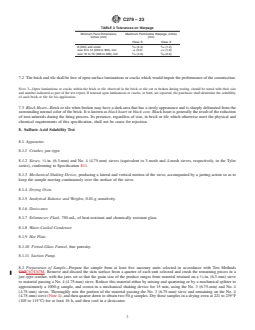
6.2 Warpage—The brick and tile shall conform to the requirements as shown in Table 2.
7. Finish and Appearance
7.1 Surface Textures—Brick or tile surfaces are often textured in order to promote better bonding. Texturing is accomplished by
scoring, wire cutting, matting, or other means consistent with a manufacturer’s process. If texturing is done, the protrusion or
indentation shall not exceed ⁄8 in. (3 mm) in depth.
TABLE 1 Physical Properties and Chemical Resistance
Requirements for Brick and Tile
Modulus of Rupture Water Absorption H SO Solubility
2 4
(Brick or Tile Flat- Maximum % by Maximum %
wise) min. psi (MPa) 2 h Boiling Test Weight Loss
Designation
Average of 5 Average of 5
Average of 5
Brick or Tile Brick or Tile
Brick or Tile
Low Individual High Individual
Type I 1250 (8.6) 1000 (6.9) 6.0 7.0 20
Type II 1250 (8.6) 1000 (6.9) 4.0 5.0 12
Type III 1250 (8.6) 1000 (6.9) 1.0 1.5 8
C279 − 23
TABLE 2 Tolerances on Warpage
Minimum Face Dimensions, Maximum Permissible Warpage, inches
inches (mm) (mm)
Class S Class X
3 3
8 (203) and under ⁄32 (2.4) ⁄64 (1.2)
1 1
over 8 to 12 (203 to 305), incl ⁄8 (3.2) ⁄
...