

ASTM F1370-92(2019)e1
(Specification)Standard Specification for Pressure-Reducing Valves for Water Systems, Shipboard
General Information
- Abstract
ABSTRACT
This specification establishes the construction, coding, and performance requirements for self-contained, globe style, pressure-reducing valves used in water systems of shipboard installations that are limited to discharge pressure settings of 200 psig (1379 kPa) and below. The valves shall be either the pressurized spring chamber type (Type I) or unpressurized spring chamber type (Type II). They shall be tested for their conformance with hydrostatic proof, seat tightness, set pressure limits, and capacity.
SCOPE
1.1 This specification covers self-contained, globe style, pressure-reducing valves for use in water systems of shipboard installations. These valves are limited to discharge pressure settings of 200 psig (1379 kPa) and below.
1.2 The values stated in inch-pound units are to be regarded as standard. The values given in parentheses are mathematical conversions to SI units that are provided for information only and are not considered standard.
1.3 The following precautionary caveat pertains only to the tests portion, Section 8, of this specification: This standard does not purport to address all of the safety concerns, if any, associated with its use. It is the responsibility of the user of this standard to establish appropriate safety, health, and environmental practices and determine the applicability of regulatory limitations prior to use.
1.4 This international standard was developed in accordance with internationally recognized principles on standardization established in the Decision on Principles for the Development of International Standards, Guides and Recommendations issued by the World Trade Organization Technical Barriers to Trade (TBT) Committee.
- Status
- Published
- Publication Date
- 31-Jul-2019
- Technical Committee
- F25 - Ships and Marine Technology
- Drafting Committee
- F25.11 - Machinery and Piping Systems
Overview
ASTM F1370-92(2019)e1 is the international standard specification for pressure-reducing valves used in shipboard water systems, published by ASTM International. This standard covers the construction, marking, and performance requirements for globe-style, self-contained, spring-loaded, direct-operated pressure-reducing valves. These valves are designed for shipboard installations where discharge pressure must not exceed 200 psig (1379 kPa), ensuring consistent and safe water system operation aboard marine vessels.
The specification distinguishes between two types of valves based on the spring chamber: Type I (pressurized spring chamber) and Type II (unpressurized spring chamber), with strict guidelines regarding materials, performance tests, and coding for easy identification and ordering.
Key Topics
Valve Types:
- Type I: Pressurized spring chamber, capable of withstanding full hydrostatic proof test pressure.
- Type II: Unpressurized spring chamber, not part of the pressure envelope.
Performance Requirements:
- Valves must reliably regulate pressure up to 200 psig.
- Tested for hydrostatic proof, seat tightness, set pressure range, accuracy of regulation, capacity, vibration (per MIL-STD-167-1), and shock resistance (per MIL-S-901).
Construction Features:
- Materials selected to resist corrosion, galling, and erosion.
- Replaceable seats and diaphragms for longevity and ease of maintenance.
- Spring-loaded, direct operation ensures fast response to pressure changes.
- Must feature standardized end connections and be adjustable under pressure.
Marking and Identification:
- Bodies are to be permanently marked for size, pressure rating, manufacturer, and flow direction.
- Attached metal plate must designate manufacturer, valve code, set pressure range, and model/part number.
Quality Assurance:
- Manufacturers are required to have a robust quality assurance system.
- All valves must meet requirements proven by representative type testing.
Applications
Primary Use Cases:
Shipboard Water Systems:
- Regulation of water pressure in potable, process, or firefighting applications aboard naval and commercial ships.
- Essential for maintaining safe and controlled water system operation under varying inlet pressures.
Marine Engineering:
- Used in ships’ piping networks to protect downstream components from overpressure and ensure optimal flow.
Key Benefits:
- Safety and Compliance: Meets internationally recognized safety and performance criteria relevant to marine environments.
- Reliability: Ensures accurate downstream pressure control and consistent valve performance under vibration and shock typical of shipboard environments.
- Serviceability: Designed for easy adjustment and maintenance without line removal, reducing downtime.
Related Standards
When specifying or procuring pressure-reducing valves for marine applications, consider these related standards for full compliance and compatibility:
- ASME B1.1 & ASME B1.12: Thread standards for mechanical fitting compatibility.
- MIL-S-901 & MIL-STD-167-1: Shock and vibration testing protocols for shipboard equipment.
- ISA S75.01 & ISA S75.02: Valve sizing and capacity test methodologies.
- ASTM B61, B62, B148, B150/B150M: Material standards for bronze, aluminum-bronze, and other alloys commonly used in marine valves.
- Federal and Military Specifications: Specifications covering nuts, bolts, coatings, and materials relevant to naval procurement (e.g., QQ-B-637, QQ-N-281, MIL-S-81733).
Keywords: ASTM F1370, pressure-reducing valves, shipboard water systems, marine valves, globe valves, valve performance standards, marine engineering, water pressure control, ASTM standards, valve specification, vibration testing, corrosion-resistant valves.
Relations
- Effective Date
- 01-Aug-2019
- Effective Date
- 01-Mar-2024
- Effective Date
- 01-Dec-2023
- Effective Date
- 01-May-2020
- Effective Date
- 01-Apr-2020
- Effective Date
- 01-Apr-2019
- Effective Date
- 01-Apr-2019
- Effective Date
- 01-Oct-2018
- Effective Date
- 01-Oct-2018
- Effective Date
- 01-Sep-2018
- Effective Date
- 01-Sep-2018
- Effective Date
- 01-Sep-2018
- Effective Date
- 01-Sep-2018
- Effective Date
- 01-Sep-2018
- Effective Date
- 01-Jun-2018
Get Certified
Connect with accredited certification bodies for this standard

DNV
DNV is an independent assurance and risk management provider.

Lloyd's Register
Lloyd's Register is a global professional services organisation specialising in engineering and technology.

FSC International
Forest Stewardship Council certification.
Sponsored listings
Frequently Asked Questions
ASTM F1370-92(2019)e1 is a technical specification published by ASTM International. Its full title is "Standard Specification for Pressure-Reducing Valves for Water Systems, Shipboard". This standard covers: ABSTRACT This specification establishes the construction, coding, and performance requirements for self-contained, globe style, pressure-reducing valves used in water systems of shipboard installations that are limited to discharge pressure settings of 200 psig (1379 kPa) and below. The valves shall be either the pressurized spring chamber type (Type I) or unpressurized spring chamber type (Type II). They shall be tested for their conformance with hydrostatic proof, seat tightness, set pressure limits, and capacity. SCOPE 1.1 This specification covers self-contained, globe style, pressure-reducing valves for use in water systems of shipboard installations. These valves are limited to discharge pressure settings of 200 psig (1379 kPa) and below. 1.2 The values stated in inch-pound units are to be regarded as standard. The values given in parentheses are mathematical conversions to SI units that are provided for information only and are not considered standard. 1.3 The following precautionary caveat pertains only to the tests portion, Section 8, of this specification: This standard does not purport to address all of the safety concerns, if any, associated with its use. It is the responsibility of the user of this standard to establish appropriate safety, health, and environmental practices and determine the applicability of regulatory limitations prior to use. 1.4 This international standard was developed in accordance with internationally recognized principles on standardization established in the Decision on Principles for the Development of International Standards, Guides and Recommendations issued by the World Trade Organization Technical Barriers to Trade (TBT) Committee.
ABSTRACT This specification establishes the construction, coding, and performance requirements for self-contained, globe style, pressure-reducing valves used in water systems of shipboard installations that are limited to discharge pressure settings of 200 psig (1379 kPa) and below. The valves shall be either the pressurized spring chamber type (Type I) or unpressurized spring chamber type (Type II). They shall be tested for their conformance with hydrostatic proof, seat tightness, set pressure limits, and capacity. SCOPE 1.1 This specification covers self-contained, globe style, pressure-reducing valves for use in water systems of shipboard installations. These valves are limited to discharge pressure settings of 200 psig (1379 kPa) and below. 1.2 The values stated in inch-pound units are to be regarded as standard. The values given in parentheses are mathematical conversions to SI units that are provided for information only and are not considered standard. 1.3 The following precautionary caveat pertains only to the tests portion, Section 8, of this specification: This standard does not purport to address all of the safety concerns, if any, associated with its use. It is the responsibility of the user of this standard to establish appropriate safety, health, and environmental practices and determine the applicability of regulatory limitations prior to use. 1.4 This international standard was developed in accordance with internationally recognized principles on standardization established in the Decision on Principles for the Development of International Standards, Guides and Recommendations issued by the World Trade Organization Technical Barriers to Trade (TBT) Committee.
ASTM F1370-92(2019)e1 is classified under the following ICS (International Classification for Standards) categories: 23.060.40 - Pressure regulators; 47.020.30 - Piping systems. The ICS classification helps identify the subject area and facilitates finding related standards.
ASTM F1370-92(2019)e1 has the following relationships with other standards: It is inter standard links to ASTM F1370-92(2011), ASTM A193/A193M-24, ASTM B637-23, ASTM A194/A194M-20, ASTM B21/B21M-20, ASTM B150/B150M-19, ASTM B21/B21M-18(2019), ASTM B148-18, ASTM B21/B21M-18, ASTM A313/A313M-18, ASTM A689-97(2018), ASTM A231/A231M-18, ASTM F467-13(2018), ASTM A125-96(2018), ASTM B689-97(2018). Understanding these relationships helps ensure you are using the most current and applicable version of the standard.
ASTM F1370-92(2019)e1 is available in PDF format for immediate download after purchase. The document can be added to your cart and obtained through the secure checkout process. Digital delivery ensures instant access to the complete standard document.
Standards Content (Sample)
This international standard was developed in accordance with internationally recognized principles on standardization established in the Decision on Principles for the
Development of International Standards, Guides and Recommendations issued by the World Trade Organization Technical Barriers to Trade (TBT) Committee.
´1
Designation:F1370 −92 (Reapproved 2019) An American National Standard
Standard Specification for
Pressure-Reducing Valves for Water Systems, Shipboard
This standard is issued under the fixed designation F1370; the number immediately following the designation indicates the year of
original adoption or, in the case of revision, the year of last revision. A number in parentheses indicates the year of last reapproval. A
superscript epsilon (´) indicates an editorial change since the last revision or reapproval.
This standard has been approved for use by agencies of the U.S. Department of Defense.
ε NOTE—A Keywords section was added editorially in August 2019.
1. Scope and Stainless Steel Nuts for Bolts for High Pressure or
High Temperature Service, or Both
1.1 This specification covers self-contained, globe style,
A231/A231M Specification for Chromium-Vanadium Alloy
pressure-reducing valves for use in water systems of shipboard
Steel Spring Wire
installations. These valves are limited to discharge pressure
A276 Specification for Stainless Steel Bars and Shapes
settings of 200 psig (1379 kPa) and below.
A313/A313M Specification for Stainless Steel Spring Wire
1.2 The values stated in inch-pound units are to be regarded
A689 Specification for Carbon and Alloy Steel Bars for
as standard. The values given in parentheses are mathematical
Springs
conversions to SI units that are provided for information only
B21/B21M Specification for Naval Brass Rod, Bar, and
and are not considered standard.
Shapes
1.3 The following precautionary caveat pertains only to the
B26/B26M Specification for Aluminum-Alloy Sand Cast-
tests portion, Section 8, of this specification: This standard ings
does not purport to address all of the safety concerns, if any,
B61 Specification for Steam or Valve Bronze Castings
associated with its use. It is the responsibility of the user of this B62 Specification for Composition Bronze or Ounce Metal
standard to establish appropriate safety, health, and environ-
Castings
mental practices and determine the applicability of regulatory B148 Specification for Aluminum-Bronze Sand Castings
limitations prior to use.
B150/B150M Specification forAluminum Bronze Rod, Bar,
1.4 This international standard was developed in accor- and Shapes
dance with internationally recognized principles on standard-
B637 Specification for Precipitation-Hardening and Cold
ization established in the Decision on Principles for the
Worked Nickel Alloy Bars, Forgings, and Forging Stock
Development of International Standards, Guides and Recom- for Moderate or High Temperature Service
mendations issued by the World Trade Organization Technical
B689 Specification for Electroplated Engineering Nickel
Barriers to Trade (TBT) Committee. Coatings
F467 Specification for Nonferrous Nuts for General Use
2. Referenced Documents
F468 Specification for Nonferrous Bolts, Hex Cap Screws,
Socket Head Cap Screws, and Studs for General Use
2.1 ASTM Standards:
F593 Specification for Stainless Steel Bolts, Hex Cap
A125 Specification for Steel Springs, Helical, Heat-Treated
Screws, and Studs
A193/A193M Specification for Alloy-Steel and Stainless
F594 Specification for Stainless Steel Nuts
Steel Bolting for High Temperature or High Pressure
2.2 ASME Standards:
Service and Other Special Purpose Applications
ASME B1.1 Unified Inch Screw Threads, UN and UNR
A194/A194M Specification for Carbon Steel, Alloy Steel,
Thread Form
ASME B1.12 Class 5 Interfence-Fit Thread
2.3 ISA Standards:
This specification is under the jurisdiction of ASTM Committee F25 on Ships
ISA S75.01 Flow Equations for Sizing Control Valves
and Marine Technology and is the direct responsibility of Subcommittee F25.11 on
Machinery and Piping Systems.
ISA S75.02 Control Valve Capacity Test Procedure
Current edition approved Aug. 1, 2019. Published August 2019. Originally
approved in 1992. Last previous edition approved in 2011 as F1370 – 92 (2011).
DOI: 10.1520/F1370-92R19E01. Available from American Society of Mechanical Engineers (ASME), ASME
For referenced ASTM standards, visit the ASTM website, www.astm.org, or International Headquarters, Two Park Ave., New York, NY 10016-5990, http://
contact ASTM Customer Service at service@astm.org. For Annual Book of ASTM www.asme.org.
Standards volume information, refer to the standard’s Document Summary page on Available from International Society of Automation (ISA), 67 T.W. Alexander
the ASTM website. Drive, PO Box 12277, Research Triangle Park, NC 27709, https://www.isa.org.
Copyright © ASTM International, 100 Barr Harbor Drive, PO Box C700, West Conshohocken, PA 19428-2959. United States
´1
F1370−92 (2019)
2.4 Federal Specifications: 803-1385947 Flanges, Bronze, 700 PSI WOG for UT In-
QQ-B-637 Brass, Naval: Rod, Wire, Shapes, Forgings, and spection
Flat Products with Finished Edges (Bar, Flat Wire, and
3. Terminology
Strip)
QQ-C-390 Copper Alloy Casting (Including Cast Bar)
3.1 Definitions of Terms Specific to This Standard:
QQ-C-465 Copper-Aluminum Alloys (Aluminum Bronze)
3.1.1 accuracy of regulation, n—the amount by which the
(CopperAlloy Numbers 606, 6014, 630, 632M, and 642);
downstream pressure may vary when the valve is set at any
Rod, Flat Products with Finished Edges (Flat Wire, Strip,
pressure within the required set pressure limit and is subjected
and Bar) Shapes, and Forgings
to any combination of inlet pressure, flow demand, and
QQ-N-281 Nickel-Copper Alloy Bar, Rod, Plate, Sheet,
ambient temperature variations within the specified limits.
Strip, Wire, Forgings, and Structural and Special Shaped
3.1.2 design pressure and temperature, n—the maximum
Sections
pressure and temperature the valve should be subjected to
QQ-N-286 Nickel-Copper-AluminumAlloy, Wrought (UNS
under any condition; these are the pressure and temperature
N05500)
upon which the strength of the pressure-containing envelope is
QQ-N-288 Nickel-Copper Alloy and Nickel-CopperSilicon
based.
Alloy, Castings
3.1.3 hydrostatic proof test pressure, n—the maximum test
QQ-S-763 Steel Bars, Wire, Shapes, and Forgings, Corro-
pressure that the valve is required to withstand without
sion Resisting
damage; valve operation is not required during application of
QQ-S-766 Steel Corrosion Resisting Plate, Sheet and Strip
this test pressure, but the valve must meet all performance
QQ-W-390 Wire, Nickel-Chromium-Iron Alloy
requirements after the pressure has been removed.
TT-P-645 Primer Paint, Zinc Chromate, Alkyd Type
3.1.4 lockup pressure, n—the outlet pressure delivered by a
2.5 Military Standards and Specifications:
MIL-V-3 Valves, Fittings, and Flanges (Except for Systems pressure-reducing valve when the flow is reduced to zero;
lockup pressure is always greater than set pressure, and in
Indicated Herein), Packaging of
MIL-S-901 Shock Tests, H.I. (High Impact), Shipboard actual practice it may vary with the specific valve design,
Machinery, Equipment and Systems, Requirements for tolerances,methodofsensingdownstreampressure,andpiping
MIL-F-1183 Fittings, Pipe, Cast Bronze, Silver-Brazing, configurations.
General Specification for
3.1.5 nominal pressure, n—theapproximatemaximumpres-
DOD-P-15328 Primer (Wash), Pretreatment (Formula No.
sure to which the valve will be subjected in service under
117 for Metals) (Metric)
normal conditions.
MIL-F-20042 Flanges, Pipe and Bulkhead, Bronze (Silver
3.1.6 set pressure, n—the downstream pressure that the
Brazing)
valve is set to maintain under a given set of operating
MIL-C-20159 Copper-Nickel Alloy Casting (UNS No.
conditions (that is, inlet pressure and flow); the valve should
C96200 and C96400)
ideally be set at downstream pressure approximately equal to
MIL-F-24227 Fittings and Flanges, Cast Bronze, Silver
the midpoint of the set pressure limits (defined in 3.1.7).
Brazing Suitable for Ultrasonic Inspection
3.1.7 set pressure limits (set pressure adjustable range),
MIL-B-24480 Bronze, Nickel-Aluminum (UNS No.
n—the range of set pressure over which the valve can be
C95800) Castings for Seawater Service
adjusted while meeting the specified performance require-
MIL-S-81733 Sealing and Coating Compound, Corrosion
ments.
Inhibitive
MIL-STD-167-1 Mechanical Vibrations of Shipboard
4. Classification
Equipment (Type I—Environmental, and Type II—
Internally Excited) 4.1 Valves shall be of the following types and pressure
MIL-STD-248 Welding and Brazing Procedure and Perfor-
ratings, as specified (see Section 5 and 6.1.21).
mance Qualification 4.1.1 Type I—Pressurized spring chamber, and
MIL-STD-278 Welding and Casting Standard
4.1.2 Type II—Unpressurized spring chamber.
MIL-STD-798 Non-destructive Testing, Welding, Quality
4.2 Pressure Ratings—Valves shall have nominal inlet pres-
Control,MaterialControlandIdentification,andHi-shock
sure ratings of 150 or 250 psig (1034 or 1724 kPa), or as
Test Requirements for Piping System Components for
specified (see 6.1.21).
Naval Shipboard Use
2.6 Other Publications:
5. Ordering Information
Naval Sea Systems Command (NAVSEA)
5.1 Ordering documentation for valves in accordance with
2.7 Drawings:
this specification shall include the following information, as
803-1385946 Union Bronze, Silver Brazing WOG for UT
required, to describe the equipment adequately.
Inspection
5.1.1 ASTM designation and year of issue,
5.1.2 Valve specification code (see 6.1.21),
5.1.3 Quantity of valves,
Available from DLA Document Services, Building 4/D, 700 Robbins Ave.,
Philadelphia, PA 19111-5094, http://quicksearch.dla.mil. 5.1.4 Set pressure required,
´1
F1370−92 (2019)
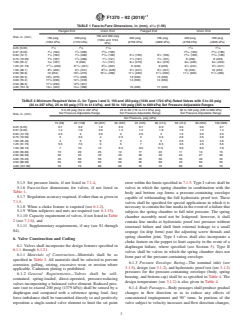
TABLE 1 Face-to-Face Dimensions, in. (mm), ± ⁄16 (1.59)
Flanged End Union End Flanged End Union End
150 and 250 psig
Size, in. (mm)
150 psig 250 psig 400 psig 700 psig 400 psig 700 psig
(1034 and 1724
(1034 kPa) (1724 kPa) (2758 kPa) (4826 kPa) (2758 kPa) (4826 kPa)
kPa)
1 7 7 7 7
0.25 (6.35) 7 ⁄4 7 ⁄8 7 ⁄32 7 ⁄8 7 ⁄32
1 7 9 9 9
0.37 (9.40) 7 ⁄4 (184) 7 ⁄8 (200) 7 ⁄32 (185) 7 ⁄32 (185) 7 ⁄32 (185)
1 7 9 1 1 9 9
0.50 (12.7) 7 ⁄4 (184) 7 ⁄8 (200) 7 ⁄32 (185) 6 ⁄2 (165) 6 ⁄2 (165) 7 ⁄32 (185) 7 ⁄32 (185)
3 7 1 1 1
0.75 (19.05) 7 ⁄8 (187) 7 ⁄8 (200) 7 ⁄2 (191) 7 ⁄2 (191) 7 ⁄2 (191) 8 (203) 8 (203)
3 1 1 1 3 3
1.00 (25.4) 7 ⁄8 (187) 8 (203) 7 ⁄2 (191) 8 ⁄2 (216) 8 ⁄2 (216) 8 ⁄4 (222) 8 ⁄4 (222)
15 11 5 1 1
1.25 (31.75) 7 ⁄16 (202) 8 ⁄16 (221) 8 ⁄32 (207) 9 (229) 9 (229) 9 ⁄2 (241) 9 ⁄2 (241)
3 1 31 1 1
1.50 (38.1) 8 ⁄4 (222) 9 ⁄2 (241) 8 ⁄32 (228) 9 ⁄2 (241) 9 ⁄2 (241) 10 (254) 10 (254)
3 7 1 1 7 7
2.00 (50.8) 10 (254) 10 ⁄4 (273) 10 ⁄32 (260) 11 ⁄2 (292) 11 ⁄2 (292) 11 ⁄8 (302) 11 ⁄8 (302)
7 3
2.50 (63.5) 10 ⁄8 (276) 11 ⁄4 (298) 13 (330) 13 (330)
5 1
3.00 (76.2) 11 ⁄8 (295) 12 ⁄2 (318) 14 (356) 14 (356)
5 5
3.50 (88.9) 11 ⁄8 (295) 12 ⁄8 (321)
1 1
4.00 (101.6) 13 ⁄2 (343) 14 ⁄2 (368) 16 (406) 17 (432)
TABLE 2 Minimum Required Valve C for Types I and II, 150 and 250 psig (1034 and 1724 kPa) Rated Valves with 5 to 30 psig
v
(34 to 207 kPa), 25 to 60 psig (172 to 414 kPa), and 50 to 100 psig (345 to 689 kPa) Set Pressure Adjustable Ranges
5 to 30 psig (34 to 207 kPa) 25 to 60 (172 to 414 kPa) psig 50 to 100 psig (345 to 689 kPa)
Set Pressure Adjustable Range Set Pressure Adjustable Range Set Pressure Adjustable Range
Size, in. (mm)
Set Pressure, psig (kPa)
10 (69) 20 (138) 30 (207) 30 (207) 45 (310) 60 (414) 60 (414) 80 (552) 100 (689)
0.25 (6.35) 0.7 0.9 1.0 0.6 0.7 0.9 0.5 0.6 0.7
0.37 (9.40) 1.4 1.8 2.0 1.2 1.4 1.8 1.0 1.2 1.4
0.50 (12.70) 2.5 3 3.5 2 2.5 3 1.5 2.0 2.5
0.75 (19.05) 3 3.5 4 2.5 3 3.5 2.0 2.5 3.0
1.00 (25.40) 4 5 6 3 4 5 2.6 3.3 4.0
1.25 (31.75) 5.5 7.5 9 5 7 8.5 3.5 4.5 5.5
1.50 (38.10) 7 10 12 6.5 9.5 11.5 5.0 6.0 7.0
2.00 (50.80) 15 20 25 12 17 22 11 13 15
2.50 (63.50) 30 35 40 25 30 35 24 27 30
3.00 (76.20) 45 50 55 40 45 50 35 40 45
3.50 (88.90) 55 60 65 50 55 60 45 50 55
4.00 (101.60) 70 75 80 65 70 75 60 65 70
5.1.5 Set pressure limits, if not listed in 7.1.4, error within the limits specified in 7.1.5. Type I valves shall be
5.1.6 Face-to-face dimensions for valves, if not listed in valves in which the spring chamber in combination with the
Table 1,
body and bottom cap forms a pressure-containing envelope
5.1.7 Regulation accuracy required, if other than as given in
capable of withstanding the full hydrostatic proof test. These
7.1.5,
valves shall be specified for special applications in which it is
5.1.8 When a choke feature is required (see 6.1.2),
necessarytocontainthelinemediaintheeventofafailurethat
5.1.9 When tailpieces and nuts are required (see 6.1.15),
subjects the spring chamber to full inlet pressure. The spring
5.1.10 Capacity requirement of valves, if not listed in Table
chamber assembly need not be leakproof; however, it shall
2 (see 7.1.6), and
contain line media at hydrostatic proof test pressure without
5.1.11 Supplementary requirements, if any (see S1 through
structural failure and shall limit external leakage to a small
S4).
seepage (in drip form) past the adjusting screw threads and
spring chamber joint. Type I valves shall also incorporate a
6. Valve Construction and Coding
choke feature on the poppet to limit capacity in the event of a
6.1 Valves shall incorporate the design features specified in
diaphragm failure, where specified (see Section 5). Type II
6.1.1 through 6.1.21.
valves shall be valves in which the spring chamber does not
6.1.1 Materials of Construction—Materials shall be as
form part of the pressure-containing envelope.
specified in Table 3. All materials shall be selected to prevent
6.1.3 Pressure Envelope Rating—The nominal inlet (see
corrosion, galling, seizing, excessive wear, or erosion where
3.1.5), design (see 3.1.2), and hydrostatic proof test (see 3.1.3)
applicable. Cadmium plating is prohibited.
pressures for the pressure-containing envelope (body, spring
6.1.2 General Requirements—Valves shall be self-
housing, and bottom cap) shall be as specified in Table 4. The
contained, spring-loaded, direct-operated, pressure-reducing
design temperature (see 3.1.2) is also given in Table 4.
valves incorporating a balanced valve element. Reduced pres-
6.1.4 Body Passages—Body passages shall produce gradual
sure (not to exceed 200 psig (1379 kPa)) shall be sensed by a
diaphragm and compared with a reference spring load. Any changes in flow direction so as to reduce any effects of
concentrated impingement and 90° turns. In portions of the
force imbalance shall be transmitted directly to and positively
reposition a single-seated valve element to limit the set point valve subject to velocity increases and flow direction changes,
´1
F1370−92 (2019)
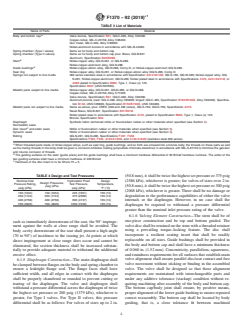
TABLE 3 List of Materials
Name of Parts Material
A
Body and bottom cap Valve bronze, Specification B61, QQ-C-390, Alloy C92200.
Copper-nickel, MIL-C-20159, Alloy C96400.
Gun metal, QQ-C-390, Alloy C90300.
Nickel-aluminum-bronze in accordance with MIL-B-24480.
Spring chamber (Type I valves) Same as for body and bottom cap.
Spring chamber (Type II valves) Same as for body and bottom cap plus: Brass, QQ-B-637.
Aluminum, Specification B26/B26M.
B
Stem Nickel-copper alloy, QQ-N-281, or QQ-N-288.
Nickel-copper-aluminum alloy, QQ-N-286.
B
Guide bushings Nickel-copper-silicon alloy, QQ-N-288, Comp D; or Nickel-copper-aluminum QQ-N-286.
Seat ring Nickel-copper alloy, QQ-N-281, or Nickel-copper-silicon alloy QQ-N-288, Comp D.
Springs not subject to line media 300 series stainless steel in accordance with Specification A313/A313M; QQ-S-763, QQ-W-390; Nickel-copper alloy, QQ-
N-281; Nickel-copper-aluminum, QQ-N-286; Nickel plated steel in accordance with Specifications A125, A231/A231M,or
A689 plated to Specification B689, Type 1, Class (x) 125.
Specification B637 (UNS N07500).
Metallic parts subject to line media Nickel-copper alloy, QQ-N-281, QQ-N-286, or QQ-N-288.
Copper-nickel, MIL-C-20159, Alloy C71500.
Valve bronze, Specification B61, QQ-C-390, Alloy C92200.
Aluminum-bronze (cast: QQ-C-390, Alloy C95800; forged: QQ-C-465, Specification B150/B150M, Alloy C63200). Specifica-
tion B148, UNS C95800, Specification B150/B150M, UNS C63200.
Metallic parts not subject to line media Same as above, plus: CRES (300 and 400 series), QQ-S-763, QQ-S-766, Specification A276.
Naval Brass, QQ-B-637, Specification B21/B21M.
Nickel plated steel in accordance with Specification A125, plated to Specification B689, Type 1, Class (x) 125.
Bronze, Specification B62.
Diaphragm Synthetic fabric reinforced nitrile or fluorocarbon rubber or other materials when specified (see Section 5).
Nonmetallic seals
C
Disc insert and static seals Nitrile or fluorocarbon rubber or other materials when specified (see Section 5).
Dynamic seals Nitrile or fluorocarbon rubber or other materials when specified (see Section 5).
Bolting QQ-N-281, QQ-N-286, Specifications F467, F468.
Specifications F593, F594, A193/A193M, and A194/A194M (stainless steel 300 series).
A
When threaded parts made of nickel-copper alloys, such as seat ring, guide bushings, and so forth are screwed into a bronze body, the threads on these parts as well
as the mating threads in the body shall be given a corrosion-inhibitive coating (polysulfate chromate elastomer) in accordance with MIL-S-81733 to minimize the galvanic
and crevice corrosion of threads.
B
The guiding surfaces on the stem (guide posts) and the guide bushings shall have a minimum hardness differential of 50 Brinell hardness numbers. The softerofthe
two guiding surfaces shall have a minimum hardness of 200 Brinell.
C
Hardness of the disc insert is to be Shore 75 ± 5.
TABLE 4 Design and Test Pressures
(50.8mm),itshallbetwicethehighestsetpressureor375psig
Nominal Inlet Hydrostatic Proof Design (2586 kPa), whichever is greater; for valves of sizes over 2 in.
Design Pressures,
Pressure Rating, Test Pressure, Temperature,
(50.8mm),itshallbetwicethehighestsetpressureor300psig
psig (kPa)
psig (kPa) psig (kPa) °F (°C)
(2068 kPa), whichever is greater. There shall be no damage or
150 (1034) 150 (1034) 225 (1551) 165 (74)
degradation to the performance capabilities of either the valve
250 (1724) 250 (1724) 375 (2586) 165 (74)
400 (2758) 400 (2758) 600 (4137) 165 (74)
internals or the diaphragm. However, in no case shall the
700 (4826) 700 (4826) 1050 (7239) 165 (74)
diaphragm be required to withstand a pressure differential
greater than the nominal inlet pressure rating of the valve.
6.1.6 Valving Element Construction—The stem shall be of
one-piece construction and be top and bottom guided. The
such as immediately downstream of the seat, the 90° impinge-
valvediscshallberetainedonthestemwithathreadedretainer
ment against the walls at close range shall be avoided. The
using a prevailing torque–locking feature. The disc shall
body cavity downstream of the seat shall present a high angle
incorporate a resilient seating insert that shall be readily
(70 to 90°) of incidence to the issuing jet. At points at which
replaceable on all sizes. Guide bushings shall be provided in
direct impingement at close range does occur and cannot be
the body and bottom cap and shall have a minimum thickness
eliminated, the section thickness shall be increased substan-
of 0.060 in. (1.52 mm). Concentricity, parallelism, squareness,
tially to provide adequate material to withstand the additional
and roundness requirements for all surfaces that establish main
erosive effect.
valve alignment shall ensure parallel disc/seat contact and free
6.1.5 Diaphragm Construction—The main diaphragm shall
valve movement without sticking or binding in the assembled
beclampedbetweenflangesonthebodyandspringchamberto
valve. The valve shall be designed so that these alignment
ensure a leaktight flange seal. The flange faces shall have
sufficient width, and all edges in contact with the diaphragm requirements are maintained with interchangeable parts and
under any additive tolerance (stackup) condition without re-
shall be properly chamfered or rounded to prevent cutting or
tearing of the diaphragm. The valve and diaphragm shall quiring machining after assembly of the body and bottom cap.
The bottom cap/body joint shall ensure, by positive means,
withstand a pressure differential across the diaphragm of twice
the highest set pressure or 200 psig (1379 kPa), whichever is properalignmentofthelowerguidebushingtoensurerepeated
greater, for Type I valves. For Type II valves, this pressure correct reassembly. The bottom cap shall be located by body
differential shall be as follows: For valves of sizes up to 2 in. guiding, that is, a close tolerance fit between machined
´1
F1370−92 (2019)
TABLE 5 End Connections
diametersonthebodyandbottomcapratherthandependingon
studs or bolts for location. Where the bottom cap/body joint is Nominal Pressure
Union End Flanged End
Rating, psig (kPa)
of flanged construction, proper parallel alignment of the lower
150 (1034) MIL-F-1183 MIL-F-20042
guide bushing shall be ensured by metal-to-metal takeup of at
250 (1724) MIL-F-1183 MIL-F-20042
least a portion of the flange faces, which shall be machined
400 (2758) MIL-F-24227 MIL-F-20042
true. The finish of the guiding surfaces shall have a roughness 700 (4826) 803-1385946 803-1385947
height rating (RHR) of 32 or better. The guiding surfaces shall
not be used as sealing surfaces.
6.1.7 Valving Element Balance—The valve element shall be
parts shall prevent galling of the threads. Pipe threads shall not
completely pressure balanced when in the seated position. The
be used for main connections, but they may be used for
dynamic seal shall be accomplished by use of either a
low-stressed internal parts, such as attachment of a pitot tube.
diaphragm or a fully retained U-cup or O-ring. Where a U-cup
When required in Table 3, threads shall be coated.
or O-ring is used, the surface moving against the seal shall
6.1.13 Interchangeability—Parts having the same manufac-
have a finish of RHR 16 or better and shall not be used for
turer’s parts numbers shall be directly interchangeable with
guiding the stem.
each other with respect to installation and performance without
6.1.8 Seat Ring—A replaceable threaded seat ring (or a
requiring selection or fitting. In no case shall parts for a given
piston chamber for valves with the cage construction design)
valve be physically interchangeable or reversible unless such
shallbeprovidedsothatitcanbereplacedwithhandtools(see
parts are also interchangeable or reversible with regard to
6.1.18) and does not require machining after assembly. The
function, performance, and strength.
seat ring shall shoulder against the body to provide a positive
6.1.14 Accessibility—Adjustment and repair of the valve
pressure-tight joint in which the threads are not used to seal.
shall be possible without removal from the line.
Where a nonmetallic sealing element is used, a precision-
6.1.15 End Connections—Valve ends shall be in accordance
dimensioned gland or cavity shall be provided in either the
with the applicable documents listed in Table 5. The valve end
body or seat ring to ensure proper and controlled retention of
connectiontypeshallbeasspecified(seeSection5and6.1.21).
the sealing element.
Unless otherwise specified in the ordering information (see
6.1.9 Bolting Requirements—The spring chamber/body
Section 5), valves with union-ends shall be supplied with the
flange and bottom cap/body flange (if applicable) shall be
male threadpieces only, without the tailpieces and the union
secured by one of the following methods:
nuts. Flanges and union-end thread pieces shall be cast or
(1) Bolts threaded the entire length and fitted with a nut on
forged integral with the valve body. Inlet and outlet connec-
each end. Threads on bolts and nuts shall have a Class 2 fit in
tions shall be of the same size and pressure rating.
accordance with ASME B1.1.
6.1.16 Face-to-Face Dimensions—Face-to-face dimensions
(2) Tap-end studs with a Class 5 interference fit at the tap
for valves shall be in accordance with Table 1. Face-to-face
end and a Class 2 fit at the nut end. The fit shall be in
dimensions for valves not covered in Table 1 shall be as
accordance with ASME B1.12.
specified (see Section 5). For union-end valves, the face-to-
(3) Hexagonal head bolts or cap screws.
face dimension is defined as the distance between the parallel
The bearing surfaces of nuts and bolts and their respective
faces of the threaded ends of the valve body.
matingsurfacesonthevalveshallbecastorforgedsmoothand
6.1.17 Body Configuration—Valves shall have globe con-
true or be finish-machined. The bottom cap/body joint may
figuration with in-line inlet and outlet ports. Pressure lines,
have either a flanged construction, in accordance with the
including the reduced pressure sensing line, shall be internally
above,orathreadedconstruction.Aproperlyretainedgasketor
ported in the body.
O-ring shall be provided to seal against external leakage.
6.1.18 Special Tools—Special tools shall not be required for
6.1.10 SpringConstruction—Springsshallnotbefullycom-
installing or removing the valve from the pipe line. Special
pressed under any normal operation or adjustment of the valve.
tools may be furnished for servicing valve internals if it can be
Spring ends shall be squared and ground.
demonst
...