

ASTM F1408-20a
(Practice)Standard Practice for Subcutaneous Screening Test for Implant Materials
General Information
- Abstract
SIGNIFICANCE AND USE
4.1 This practice is a guideline for a short-term screening test for the evaluation of the tissue response to materials that may be selected for implantation in the human body and should be done in accordance with good laboratory practices. This test may be performed prior to long-term testing (for example, Practice F981) to eliminate unsuitable candidate materials early and to avoid unnecessary animal testing.
4.2 This practice may be used to detect toxic effects of materials in general (see Appendix X1). However, it is particularly suitable for the testing of materials that are intended to have contact with subcutaneous tissues or soft tissues in general. For materials intended to be inserted specifically into muscle tissues, Practice F763 should be considered as a short-term test method.
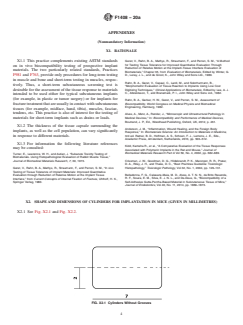
4.3 The suggested implant specimens are cylindrical. A special grooved type of cylinder may be used (see Fig. X2.1 of Appendix X2) to allow tissue interlocking that could keep the implant in place and minimize tissue irritation through motion at the interface that otherwise could contribute to increased variance of the results. In case ungrooved cylinders are used (see Fig. X1.2 of Appendix X2), probable motion at the implant/tissue interface must be taken into account. Control cylinders should be shaped like the test cylinders.
4.4 The type of surface preparation of the specimens can affect the tissue reaction; therefore the preparation procedure should be noted in the report. The test may be used to compare the effect of different surface structures or conditions of the same material or to assess the effect of various treatments of modifications of a material.
Note 1: If this method is used for material research, testing for endotoxin prior to implantation should be considered.
SCOPE
1.1 This practice covers a short-term testing method to screen the subcutaneous tissue reaction to implant candidate materials in small laboratory animals. The material may be dense or porous. This method may not work for absorbable materials, depending on the absorption kinetics. The tissue reactions will be evaluated in comparison to those evoked by control materials that are accepted as clinical implant materials.
1.2 This practice, along with other appropriate biological tests (including other ASTM test methods), may be used to assess the biocompatibility of candidate materials for use in the fabrication of devices for clinical application. It may also be applied to evaluate the effect of special surface textures and preparations of known materials.
1.3 This practice does not provide a comprehensive assessment of the systemic toxicity, carcinogenicity, teratogenicity, or mutagenicity of the material. Additional information may be needed on the material in its final finished form, such as implantation assessment at the clinically relevant location.
1.4 The values stated in SI units, including units officially accepted for use with SI, are to be regarded as standard. No other systems of measurement are included in this standard.
1.5 This standard does not purport to address all of the safety concerns, if any, associated with its use. It is the responsibility of the user of this standard to establish appropriate safety, health, and environmental practices and determine the applicability of regulatory limitations prior to use.
1.6 This international standard was developed in accordance with internationally recognized principles on standardization established in the Decision on Principles for the Development of International Standards, Guides and Recommendations issued by the World Trade Organization Technical Barriers to Trade (TBT) Committee.
- Status
- Published
- Publication Date
- 31-Jul-2020
- Technical Committee
- F04 - Medical and Surgical Materials and Devices
- Drafting Committee
- F04.16 - Biocompatibility Test Methods
Overview
ASTM F1408-20a: Standard Practice for Subcutaneous Screening Test for Implant Materials establishes a short-term testing methodology to evaluate the subcutaneous tissue response to candidate implant materials using small laboratory animals. This standard is essential in the early-stage biocompatibility assessment of materials intended for medical device implantation, allowing for the detection of undesirable tissue reactions prior to more extensive and long-term studies. Conducted in accordance with good laboratory practices, this screening test reduces the risk of advancing unsuitable materials and helps minimize unnecessary animal testing.
Key Topics
Purpose and Scope
- Provides guidelines for a short-term, in vivo screening test.
- Focuses on evaluating subcutaneous tissue response in small laboratory animals, typically mice.
- Enables comparison of novel or modified materials against clinically accepted control materials.
Test Procedure
- Cylindrical implant specimens, grooved or ungrooved, are inserted subcutaneously in animals.
- Control and candidate materials are implanted using identical dimensions and surface preparation.
- Animals are observed over predefined time points, after which necropsy and histological analysis are performed to assess tissue response.
Biocompatibility Assessment
- Reviews local tissue reactions such as inflammation or encapsulation.
- Suitable for both dense and porous materials (may not be applicable to absorbable materials).
- Encourages documentation of surface preparation, sterilization, and animal care.
Reporting and Analysis
- Detailed reporting of implant characteristics, animal use, test procedures, and histological findings.
- Comparative assessments with control materials.
- Emphasizes ethical animal use and adherence to regulatory and safety requirements.
Applications
Medical Device Material Screening
- Used by manufacturers and researchers to pre-screen materials for subcutaneous implants such as orthopedic plates, plastic surgery implants, catheter leads, and other devices with soft tissue contact.
- Assesses compatibility and tissue response for both newly developed materials and modified versions of established materials.
Surface Modification Studies
- Evaluates the effect of special textures or surface treatments to optimize tissue integration or minimize adverse reactions.
- Enables direct comparison of different surface preparations within the same material class.
Regulatory and R&D Support
- Supports regulatory submissions by providing evidence of biocompatibility in line with international expectations.
- Prunes unsuitable materials early, reducing the cost and duration of product development.
Related Standards
- ASTM F981: Practice for Assessment of Compatibility of Biomaterials for Surgical Implants with Respect to Effect of Materials on Muscle and Insertion into Bone - covers long-term testing in muscle and bone.
- ASTM F763: Practice for Short-Term Screening of Implant Materials - addresses short-term testing within muscle tissue.
- ASTM F86: Practice for Surface Preparation and Marking of Metallic Surgical Implants.
- ASTM F67, F75, F136, F138, F648: Specifications for materials commonly used in implants, including titanium alloys, cobalt-chromium alloys, stainless steel, and UHMWPE.
- ISO 10993-6:2016: Biological evaluation of medical devices - Part 6: Local effects after implantation, referenced for grading scales and consistency in biocompatibility evaluation.
Keywords: biocompatibility, subcutaneous tissue screening, implant materials testing, short-term biocompatibility, medical devices, toxicity, tissue compatibility, ASTM F1408, implant material evaluation, animal models, laboratory testing.
By implementing ASTM F1408-20a, organizations can efficiently assess candidate materials for medical implants, streamline research and development, comply with international standards, and make informed decisions rooted in biological safety and efficacy.
Relations
- Effective Date
- 01-Aug-2020
- Effective Date
- 01-Dec-2019
- Effective Date
- 01-Mar-2017
- Effective Date
- 01-Oct-2013
- Effective Date
- 01-Jul-2013
- Effective Date
- 01-Jun-2013
- Effective Date
- 01-Apr-2013
- Refers
ASTM F86-12a - Standard Practice for Surface Preparation and Marking of Metallic Surgical Implants - Effective Date
- 01-Dec-2012
- Effective Date
- 01-Dec-2012
- Effective Date
- 01-Nov-2012
- Effective Date
- 15-May-2012
- Refers
ASTM F86-12 - Standard Practice for Surface Preparation and Marking of Metallic Surgical Implants - Effective Date
- 15-May-2012
- Effective Date
- 15-Dec-2011
- Effective Date
- 01-Dec-2010
- Effective Date
- 15-Sep-2010
Get Certified
Connect with accredited certification bodies for this standard

BSI Group
BSI (British Standards Institution) is the business standards company that helps organizations make excellence a habit.

TÜV Rheinland
TÜV Rheinland is a leading international provider of technical services.

TÜV SÜD
TÜV SÜD is a trusted partner of choice for safety, security and sustainability solutions.
Sponsored listings
Frequently Asked Questions
ASTM F1408-20a is a standard published by ASTM International. Its full title is "Standard Practice for Subcutaneous Screening Test for Implant Materials". This standard covers: SIGNIFICANCE AND USE 4.1 This practice is a guideline for a short-term screening test for the evaluation of the tissue response to materials that may be selected for implantation in the human body and should be done in accordance with good laboratory practices. This test may be performed prior to long-term testing (for example, Practice F981) to eliminate unsuitable candidate materials early and to avoid unnecessary animal testing. 4.2 This practice may be used to detect toxic effects of materials in general (see Appendix X1). However, it is particularly suitable for the testing of materials that are intended to have contact with subcutaneous tissues or soft tissues in general. For materials intended to be inserted specifically into muscle tissues, Practice F763 should be considered as a short-term test method. 4.3 The suggested implant specimens are cylindrical. A special grooved type of cylinder may be used (see Fig. X2.1 of Appendix X2) to allow tissue interlocking that could keep the implant in place and minimize tissue irritation through motion at the interface that otherwise could contribute to increased variance of the results. In case ungrooved cylinders are used (see Fig. X1.2 of Appendix X2), probable motion at the implant/tissue interface must be taken into account. Control cylinders should be shaped like the test cylinders. 4.4 The type of surface preparation of the specimens can affect the tissue reaction; therefore the preparation procedure should be noted in the report. The test may be used to compare the effect of different surface structures or conditions of the same material or to assess the effect of various treatments of modifications of a material. Note 1: If this method is used for material research, testing for endotoxin prior to implantation should be considered. SCOPE 1.1 This practice covers a short-term testing method to screen the subcutaneous tissue reaction to implant candidate materials in small laboratory animals. The material may be dense or porous. This method may not work for absorbable materials, depending on the absorption kinetics. The tissue reactions will be evaluated in comparison to those evoked by control materials that are accepted as clinical implant materials. 1.2 This practice, along with other appropriate biological tests (including other ASTM test methods), may be used to assess the biocompatibility of candidate materials for use in the fabrication of devices for clinical application. It may also be applied to evaluate the effect of special surface textures and preparations of known materials. 1.3 This practice does not provide a comprehensive assessment of the systemic toxicity, carcinogenicity, teratogenicity, or mutagenicity of the material. Additional information may be needed on the material in its final finished form, such as implantation assessment at the clinically relevant location. 1.4 The values stated in SI units, including units officially accepted for use with SI, are to be regarded as standard. No other systems of measurement are included in this standard. 1.5 This standard does not purport to address all of the safety concerns, if any, associated with its use. It is the responsibility of the user of this standard to establish appropriate safety, health, and environmental practices and determine the applicability of regulatory limitations prior to use. 1.6 This international standard was developed in accordance with internationally recognized principles on standardization established in the Decision on Principles for the Development of International Standards, Guides and Recommendations issued by the World Trade Organization Technical Barriers to Trade (TBT) Committee.
SIGNIFICANCE AND USE 4.1 This practice is a guideline for a short-term screening test for the evaluation of the tissue response to materials that may be selected for implantation in the human body and should be done in accordance with good laboratory practices. This test may be performed prior to long-term testing (for example, Practice F981) to eliminate unsuitable candidate materials early and to avoid unnecessary animal testing. 4.2 This practice may be used to detect toxic effects of materials in general (see Appendix X1). However, it is particularly suitable for the testing of materials that are intended to have contact with subcutaneous tissues or soft tissues in general. For materials intended to be inserted specifically into muscle tissues, Practice F763 should be considered as a short-term test method. 4.3 The suggested implant specimens are cylindrical. A special grooved type of cylinder may be used (see Fig. X2.1 of Appendix X2) to allow tissue interlocking that could keep the implant in place and minimize tissue irritation through motion at the interface that otherwise could contribute to increased variance of the results. In case ungrooved cylinders are used (see Fig. X1.2 of Appendix X2), probable motion at the implant/tissue interface must be taken into account. Control cylinders should be shaped like the test cylinders. 4.4 The type of surface preparation of the specimens can affect the tissue reaction; therefore the preparation procedure should be noted in the report. The test may be used to compare the effect of different surface structures or conditions of the same material or to assess the effect of various treatments of modifications of a material. Note 1: If this method is used for material research, testing for endotoxin prior to implantation should be considered. SCOPE 1.1 This practice covers a short-term testing method to screen the subcutaneous tissue reaction to implant candidate materials in small laboratory animals. The material may be dense or porous. This method may not work for absorbable materials, depending on the absorption kinetics. The tissue reactions will be evaluated in comparison to those evoked by control materials that are accepted as clinical implant materials. 1.2 This practice, along with other appropriate biological tests (including other ASTM test methods), may be used to assess the biocompatibility of candidate materials for use in the fabrication of devices for clinical application. It may also be applied to evaluate the effect of special surface textures and preparations of known materials. 1.3 This practice does not provide a comprehensive assessment of the systemic toxicity, carcinogenicity, teratogenicity, or mutagenicity of the material. Additional information may be needed on the material in its final finished form, such as implantation assessment at the clinically relevant location. 1.4 The values stated in SI units, including units officially accepted for use with SI, are to be regarded as standard. No other systems of measurement are included in this standard. 1.5 This standard does not purport to address all of the safety concerns, if any, associated with its use. It is the responsibility of the user of this standard to establish appropriate safety, health, and environmental practices and determine the applicability of regulatory limitations prior to use. 1.6 This international standard was developed in accordance with internationally recognized principles on standardization established in the Decision on Principles for the Development of International Standards, Guides and Recommendations issued by the World Trade Organization Technical Barriers to Trade (TBT) Committee.
ASTM F1408-20a is classified under the following ICS (International Classification for Standards) categories: 11.040.40 - Implants for surgery, prosthetics and orthotics. The ICS classification helps identify the subject area and facilitates finding related standards.
ASTM F1408-20a has the following relationships with other standards: It is inter standard links to ASTM F1408-20, ASTM F138-19, ASTM F67-13(2017), ASTM F138-13a, ASTM F648-13, ASTM F67-13, ASTM F138-13, ASTM F86-12a, ASTM F136-12a, ASTM F136-12, ASTM F75-12, ASTM F86-12, ASTM F136-11, ASTM F648-10a, ASTM F648-10. Understanding these relationships helps ensure you are using the most current and applicable version of the standard.
ASTM F1408-20a is available in PDF format for immediate download after purchase. The document can be added to your cart and obtained through the secure checkout process. Digital delivery ensures instant access to the complete standard document.
Standards Content (Sample)
This international standard was developed in accordance with internationally recognized principles on standardization established in the Decision on Principles for the
Development of International Standards, Guides and Recommendations issued by the World Trade Organization Technical Barriers to Trade (TBT) Committee.
Designation: F1408 − 20a
Standard Practice for
Subcutaneous Screening Test for Implant Materials
This standard is issued under the fixed designation F1408; the number immediately following the designation indicates the year of
original adoption or, in the case of revision, the year of last revision. A number in parentheses indicates the year of last reapproval. A
superscript epsilon (´) indicates an editorial change since the last revision or reapproval.
1. Scope 2. Referenced Documents
2.1 ASTM Standards:
1.1 This practice covers a short-term testing method to
F67 Specification for Unalloyed Titanium, for Surgical Im-
screen the subcutaneous tissue reaction to implant candidate
plant Applications (UNS R50250, UNS R50400, UNS
materials in small laboratory animals. The material may be
R50550, UNS R50700)
dense or porous. This method may not work for absorbable
F75 Specification for Cobalt-28 Chromium-6 Molybdenum
materials, depending on the absorption kinetics. The tissue
Alloy Castings and Casting Alloy for Surgical Implants
reactions will be evaluated in comparison to those evoked by
(UNS R30075)
control materials that are accepted as clinical implant materi-
F86 Practice for Surface Preparation and Marking of Metal-
als.
lic Surgical Implants
1.2 This practice, along with other appropriate biological
F136 Specification for Wrought Titanium-6Aluminum-
tests (including other ASTM test methods), may be used to
4Vanadium ELI (Extra Low Interstitial)Alloy for Surgical
assessthebiocompatibilityofcandidatematerialsforuseinthe
Implant Applications (UNS R56401)
fabrication of devices for clinical application. It may also be
F138 Specification for Wrought 18Chromium-14Nickel-
applied to evaluate the effect of special surface textures and
2.5Molybdenum Stainless Steel Bar and Wire for Surgical
preparations of known materials.
Implants (UNS S31673)
F648 Specification for Ultra-High-Molecular-Weight Poly-
1.3 This practice does not provide a comprehensive assess-
ethylene Powder and Fabricated Form for Surgical Im-
mentofthesystemictoxicity,carcinogenicity,teratogenicity,or
plants
mutagenicity of the material. Additional information may be
F763 Practice for Short-Term Screening of Implant Materi-
needed on the material in its final finished form, such as
als
implantation assessment at the clinically relevant location.
F981 Practice for Assessment of Compatibility of Biomate-
1.4 The values stated in SI units, including units officially rials for Surgical Implants with Respect to Effect of
accepted for use with SI, are to be regarded as standard. No Materials on Muscle and Insertion into Bone
other systems of measurement are included in this standard.
2.2 ISO Standard:
ISO 10993-6:2016 Biological Evaluation of Medical
1.5 This standard does not purport to address all of the
Devices—Part 6: Tests for Local Effects After Implanta-
safety concerns, if any, associated with its use. It is the
tion
responsibility of the user of this standard to establish appro-
priate safety, health, and environmental practices and deter-
3. Summary of Practice
mine the applicability of regulatory limitations prior to use.
3.1 Under strict aseptic conditions, test or control samples
1.6 This international standard was developed in accor-
are implanted subcutaneously as close as and, if possible, in
dance with internationally recognized principles on standard-
parallel to the dorsal midline at the level of the cervical or
ization established in the Decision on Principles for the
thoracic vertebrae of an anesthetized animal. The size of the
Development of International Standards, Guides and Recom-
implant should not impede the normal movement of the
mendations issued by the World Trade Organization Technical
animal. After one, four, and nine to twelve weeks the animals
Barriers to Trade (TBT) Committee.
For referenced ASTM standards, visit the ASTM website, www.astm.org, or
ThispracticeisunderthejurisdictionofASTMCommitteeF04onMedicaland contact ASTM Customer Service at service@astm.org. For Annual Book of ASTM
Surgical Materials and Devices and is the direct responsibility of Subcommittee Standards volume information, refer to the standard’s Document Summary page on
F04.16 on Biocompatibility Test Methods. the ASTM website.
Current edition approved Aug. 1, 2020. Published August 2020. Originally Available from International Organization for Standardization (ISO), ISO
approved in 1992. Last previous edition approved in 2020 as F1408 – 20. DOI: Central Secretariat, BIBC II, Chemin de Blandonnet 8, CP 401, 1214 Vernier,
10.1520/F1408-20A. Geneva, Switzerland, http://www.iso.org.
Copyright © ASTM International, 100 Barr Harbor Drive, PO Box C700, West Conshohocken, PA 19428-2959. United States
F1408 − 20a
are euthanized, and a comprehensive necropsy is performed. However, insertion of test and control implants in the same
The samples are excised with an intact tissue envelope for animal may prevent analysis of systemic toxicity.
histological evaluation. The tissue response to the test sample
6. Implant Specimens
is compared to the response of the control material.
6.1 Specimen Design—Cylinders of 7 mm length and 4 mm
4. Significance and Use
diameter are prepared for implantation in mice. Special speci-
mens with two grooves are designed corresponding to the
4.1 This practice is a guideline for a short-term screening
figures in Appendix X2. If larger animal hosts are used, the
test for the evaluation of the tissue response to materials that
implant dimensions may be increased proportionally. If it is
maybeselectedforimplantationinthehumanbodyandshould
impossible to prepare specimens of this kind, the specimen
be done in accordance with good laboratory practices.This test
configuration used must be described fully in the report.
may be performed prior to long-term testing (for example,
Implant specimens from the candidate and control material
Practice F981) to eliminate unsuitable candidate materials
should always have the same dimensions. Control articles with
early and to avoid unnecessary animal testing.
a clinically established acceptable biocompatibility response
4.2 This practice may be used to detect toxic effects of
should be matched as closely as reasonably possible for
materials in general (see Appendix X1). However, it is particu-
significant physical characteristics such as surface features (for
larly suitable for the testing of materials that are intended to
example, smooth solid sheet versus highly porous mesh,
have contact with subcutaneous tissues or soft tissues in
presence of surface finish, etc.).
general. For materials intended to be inserted specifically into
6.2 Selection of Control Materials—Recommended metals
muscle tissues, Practice F763 should be considered as a
for use as control materials include those given in Specifica-
short-term test method.
tions F67, F75, F136, and F138. However, for specific
4.3 The suggested implant specimens are cylindrical. A
applications, any metal of known compatibility and standard-
special grooved type of cylinder may be used (see Fig. X2.1 of
izedasimplantmaterialmaybeemployedasacontrolmaterial
Appendix X2) to allow tissue interlocking that could keep the
for comparison. To study adverse tissue reactions, a non-
implant in place and minimize tissue irritation through motion
compatible material like copper may be used as a positive
at the interface that otherwise could contribute to increased
control material.Asuitable polymeric control material like the
variance of the results. In case ungrooved cylinders are used
polyethylene USP negative control plastic, Referenced Stan-
(see Fig. X1.2 of Appendix X2), probable motion at the
dard (RS), or ultrahigh molecular weight polyethylene (see
implant/tissue interface must be taken into account. Control
Specification F648) may be used.
cylinders should be shaped like the test cylinders.
6.3 Specimen Surface—The surface of specimens from pro-
4.4 The type of surface preparation of the specimens can
spective implant materials should be treated in the same
affect the tissue reaction; therefore the preparation procedure
manner as the implant intended for clinical application in the
should be noted in the report. The test may be used to compare
human patient. Depending on the objective of the test, the
the effect of different surface structures or conditions of the
control specimens should have either a surface condition as it
same material or to assess the effect of various treatments of
is normally used for clinical applications or a surface condition
modifications of a material.
most similar to that of the test material. For preparation of
NOTE 1—If this method is used for material research, testing for metallic materials, Practice F86 should be considered.
endotoxin prior to implantation should be considered.
6.4 Numbers of Test and Control Implants—Per each time
period, at least six implant specimens of each candidate and
5. Test Animals and Sites
control material should be evaluated in mice (one per mouse).
5.1 Laboratory mice (for example, C57BL/6, BALB/c) are
If more than one specimen is implanted in larger (non-mouse)
used.Thetestmaybeadaptedtoothersuitabletestanimals(for
test hosts, at least four animals should be used per material and
example, rats). Both sexes should be represented unless other-
time period.
wise justified (for example, with evidence that one sex is more
6.5 Conditioning—The cleaning, sterilization, and packag-
sensitive). Institutional and government animal use and care
ing should be the same as used for implantation in the human
policies and regulations shall be followed.
patient.After surface preparation and sterilization, the implant
5.2 In mice, the implant specimens are inserted subcutane-
specimens should be protected from surface alterations and
ously in the neck. One implant (either test or control) is
contamination and should be handled with non-metallic for-
inserted per mouse. Therefore, the number of animals is
ceps when appropriate. When plastic forceps are used, be sure
identical with the number of implants.
that no plastic material is transferred to the implant surface.
5.3 If rats or other larger suitable animals are used, more
7. Procedure
than one implant may be inserted per animal, but the implants
should never be allowed to come in contact with each other. If 7.1 Implantation:
this is the case, cylinders of the test and control material may 7.1.1 Implant the specimens under sterile conditions in
be implanted separately on the right and the left side as close anesthetizedanimals.Theincisionsiteshallberemotefromthe
as and, if possible, in parallel to the dorsal midline at the level implantation site to prevent infection around the implant. In
of the cervical or thoracic vertebrae in a single animal. mice, makea1cm long incision on the dorsal midline at the
F1408
...
This document is not an ASTM standard and is intended only to provide the user of an ASTM standard an indication of what changes have been made to the previous version. Because
it may not be technically possible to adequately depict all changes accurately, ASTM recommends that users consult prior editions as appropriate. In all cases only the current version
of the standard as published by ASTM is to be considered the official document.
Designation: F1408 − 20 F1408 − 20a
Standard Practice for
Subcutaneous Screening Test for Implant Materials
This standard is issued under the fixed designation F1408; the number immediately following the designation indicates the year of
original adoption or, in the case of revision, the year of last revision. A number in parentheses indicates the year of last reapproval. A
superscript epsilon (´) indicates an editorial change since the last revision or reapproval.
1. Scope
1.1 This practice covers a short-term testing method to screen the subcutaneous tissue reaction to implant candidate materials in
small laboratory animals. The material may be dense or porous. This method may not work for absorbable materials, depending
on the absorption kinetics. The tissue reactions will be evaluated in comparison to those evoked by control materials that are
accepted as clinical implant materials.
1.2 This practice, along with other appropriate biological tests (including other ASTM test methods), may be used to assess the
biocompatibility of candidate materials for use in the fabrication of devices for clinical application. It may be also be applied to
evaluate the effect of special surface textures and preparations of known materials.
1.3 This practice does not provide a comprehensive assessment of the systemic toxicity, carcinogenicity, teratogenicity, or
mutagenicity of the material. Additional information may be needed on the material in its final finished form, such as implantation
assessment at the clinically relevant location.
1.4 The values stated in SI units, including units officially accepted for use with SI, are to be regarded as standard. No other
systems of measurement are included in this standard.
1.5 This standard does not purport to address all of the safety concerns, if any, associated with its use. It is the responsibility
of the user of this standard to establish appropriate safety, health, and environmental practices and determine the applicability of
regulatory limitations prior to use.
1.6 This international standard was developed in accordance with internationally recognized principles on standardization
established in the Decision on Principles for the Development of International Standards, Guides and Recommendations issued
by the World Trade Organization Technical Barriers to Trade (TBT) Committee.
2. Referenced Documents
2.1 ASTM Standards:
F67 Specification for Unalloyed Titanium, for Surgical Implant Applications (UNS R50250, UNS R50400, UNS R50550, UNS
R50700)
F75 Specification for Cobalt-28 Chromium-6 Molybdenum Alloy Castings and Casting Alloy for Surgical Implants (UNS
R30075)
F86 Practice for Surface Preparation and Marking of Metallic Surgical Implants
This practice is under the jurisdiction of ASTM Committee F04 on Medical and Surgical Materials and Devices and is the direct responsibility of Subcommittee F04.16
on Biocompatibility Test Methods.
Current edition approved June 1, 2020Aug. 1, 2020. Published August 2020. Originally approved in 1992. Last previous edition approved in 20132020 as F1408 – 97
(2013).F1408 – 20. DOI: 10.1520/F1408-20.10.1520/F1408-20A.
For referenced ASTM standards, visit the ASTM website, www.astm.org, or contact ASTM Customer Service at service@astm.org. For Annual Book of ASTM Standards
volume information, refer to the standard’s Document Summary page on the ASTM website.
Copyright © ASTM International, 100 Barr Harbor Drive, PO Box C700, West Conshohocken, PA 19428-2959. United States
F1408 − 20a
F136 Specification for Wrought Titanium-6Aluminum-4Vanadium ELI (Extra Low Interstitial) Alloy for Surgical Implant
Applications (UNS R56401)
F138 Specification for Wrought 18Chromium-14Nickel-2.5Molybdenum Stainless Steel Bar and Wire for Surgical Implants
(UNS S31673)
F648 Specification for Ultra-High-Molecular-Weight Polyethylene Powder and Fabricated Form for Surgical Implants
F763 Practice for Short-Term Screening of Implant Materials
F981 Practice for Assessment of Compatibility of Biomaterials for Surgical Implants with Respect to Effect of Materials on
Muscle and Insertion into Bone
2.2 ISO Standard:
ISO 10993-6:2016 Biological Evaluation of Medical Devices—Part 6: Tests for Local Effects After Implantation
3. Summary of Practice
3.1 Under strict aseptic conditions, test or control samples are implanted subcutaneously along as close as and, if possible, in
parallel to the dorsal midline at the level of the cervical or thoracic vertebravertebrae of an anesthetized animal. The size of the
implant should not impede the normal movement of the animal. After one, four, and nine to twelve weeks the animals are
euthanized, and a comprehensive necropsy is performed. The samples are excised with an intact tissue envelope for histological
evaluation. The tissue response to the test sample is compared to the response of the control material.
4. Significance and Use
4.1 This practice is a guideline for a short-term screening test for the evaluation of the tissue response to materials that may be
selected for implantation in the human body and should be done in accordance with good laboratory practices. This test may be
performed prior to long-term testing (for example, Practice F981) to eliminate unsuitable candidate materials early and to avoid
unnecessary animal testing.
4.2 This practice may be used to detect toxic effects of materials in general (see Appendix X1). However, it is particularly suitable
for the testing of materials that are intended to have contact with subcutaneous tissues or soft tissues in general. For materials
intended to be inserted specifically into muscle tissues, Practice F763 should be considered as a short-term test method.
4.3 The suggested implant specimens are cylindrical. A special grooved type of cylinder may be used (see Fig. X2.1 of Appendix
X2) to allow tissue interlocking that could keep the implant in place and minimize tissue irritation through motion at the interface
that otherwise could contribute to increased variance of the results. In case ungrooved cylinders are used (see Fig. X1.2 of
Appendix X2), probable motion at the implant/tissue interface must be taken into account. Control cylinders should be shaped like
the test cylinders.
4.4 The type of surface preparation of the specimens can affect the tissue reaction; therefore the preparation procedure should be
noted in the report. The test may be used to compare the effect of different surface structures or conditions of the same material
or to assess the effect of various treatments of modifications of a material.
NOTE 1—If this method is used for material research, testing for endotoxin prior to implantation should be considered.
5. Test Animals and Sites
5.1 Laboratory mice (for example, C57BL/6, BALB/c) are used. The test may be adapted to other suitable test animals (for
example, rats). Both sexes should be represented unless otherwise justified (for example, with evidence that one sex is more
sensitive). Institutional and government animal use and care policies and regulations shall be followed.
5.2 The implant specimens are inserted subcutaneously in the neck of the host.
5.2 In mice, the implant specimens are inserted subcutaneously in the neck. One implant (either test or control) is inserted per
mouse. Therefore, the number of animals is identical with the number of implants.
Available from International Organization for Standardization (ISO), ISO Central Secretariat, BIBC II, Chemin de Blandonnet 8, CP 401, 1214 Vernier, Geneva,
Switzerland, http://www.iso.org.
F1408 − 20a
5.3 If rats or other larger suitable animals are used, more than one implant may be inserted per animal, but the implants should
never be allowed to come in contact with each other. If this is the case, cylinders of the test and control material may be implanted
separately on the right and the left side of the neck as close as and, if possible, in parallel to the dorsal midline at the level of the
cervical or thoracic vertebrae in a single animal. However, insertion of test and control implants in the same animal may prevent
analysis of systemic toxicity.
6. Implant Specimens
6.1 Specimen Design—Cylinders of 7 mm length and 4 mm diameter are prepared for implantation in mice. Special specimens
with two grooves are designed corresponding to the figures in Appendix X2. If larger animal hosts are used, the implant dimensions
may be increased proportionally. If it is impossible to prepare specimens of this kind, the specimen configuration used must be
described fully in the report. Implant specimens from the candidate and control material should always have the same dimensions.
Control articles with a clinically established acceptable biocompatibility response should be matched as closely as reasonably
possible for significant physical characteristics such as surface features (for example, smooth solid sheet versus highly porous
mesh, presence of surface finish, etc.).
6.2 Selection of Control Materials—Recommended metals for use as control materials include those given in Specifications F67,
F75, F136, and F138. However, for specific applications, any metal of known compatibility and standardized as implant material
may be employed as a control material for comparison. To study adverse tissue reactions, a non-compatible material like copper
may be used as a positive control material. A suitable polymeric control material like the polyethylene USP negative control plastic,
Referenced Standard (RS), or ultrahigh molecular weight polyethylene (see Specification F648) may be used.
6.3 Specimen Surface—The surface of specimens from prospective implant materials should be treated in the same manner as the
implant intended for clinical application in the human patient. Depending on the objective of the test, the control specimens should
have either a surface condition as it is normally used for clinical applications or a surface condition most similar to that of the test
material. For preparation of metallic materials, Practice F86 should be considered.
6.4 Numbers of Test and Control Implants—Per each time period, at least six implant specimens of each candidate and control
material should be evaluated in mice (one per mouse). If more than one specimen is implanted in larger (non-mouse) test hosts,
at least four animals should be used per material and time period.
6.5 Conditioning—The cleaning, sterilization, and packaging should be the same as used for implantation in the human patient.
After surface preparation and sterilization, the implant specimens should be protected from surface alterations and contamination
and should be handled with non-metallic forceps when appropriate. When plastic forceps are used, be sure that no plastic material
is transferred to the implant surface.
7. Procedure
7.1 Implantation:
7.1.1 Implant the specimens under sterile conditions in anesthetized animals. The incision site is shall be remote from the
implantation site to prevent infection around the implant. In mice, make a 1 cm long incision on the dorsal midline
...