

ASTM E794-06(2018)
(Test Method)Standard Test Method for Melting And Crystallization Temperatures By Thermal Analysis
General Information
- Abstract
SIGNIFICANCE AND USE
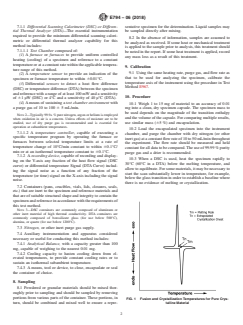
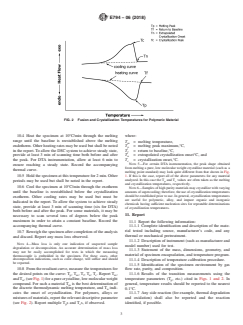
5.1 Differential scanning calorimetry and differential thermal analysis provide a rapid method for determining the fusion and crystallization temperatures of crystalline materials.
5.2 This test is useful for quality control, specification acceptance, and research.
SCOPE
1.1 This test method describes the determination of melting (and crystallization) temperatures of pure materials by differential scanning calorimetry (DSC) and differential thermal analysis (DTA).
1.2 This test method is generally applicable to thermally stable materials with well-defined melting temperatures.
1.3 The normal operating range is from −120 to 600°C for DSC and 25 to 1500°C for DTA. The temperature range can be extended depending upon the instrumentation used.
1.4 Computer or electronic based instruments, techniques, or data treatment equivalent to those in this test method may be used.
1.5 The values stated in SI units are to be regarded as standard. No other units of measurement are included in this standard.
1.6 This standard does not purport to address all of the safety concerns, if any, associated with its use. It is the responsibility of the user of this standard to establish appropriate safety, health, and environmental practices and determine the applicability of regulatory limitations prior to use.
1.7 This international standard was developed in accordance with internationally recognized principles on standardization established in the Decision on Principles for the Development of International Standards, Guides and Recommendations issued by the World Trade Organization Technical Barriers to Trade (TBT) Committee.
- Status
- Published
- Publication Date
- 31-Mar-2018
- Technical Committee
- E37 - Thermal Measurements
- Drafting Committee
- E37.01 - Calorimetry and Mass Loss

Overview
ASTM E794-06(2018): Standard Test Method for Melting and Crystallization Temperatures by Thermal Analysis provides a reliable procedure for determining the melting and crystallization temperatures of pure and stable crystalline materials. Utilizing differential scanning calorimetry (DSC) and differential thermal analysis (DTA), this method allows laboratories and industries to rapidly assess these critical thermal properties, which are essential for material characterization, quality control, and compliance with specifications. The standard is broadly applicable to various materials and is a key reference in the field of thermal analysis.
Key Topics
- Differential Scanning Calorimetry (DSC): A technique for measuring heat flow associated with thermal transitions, such as melting and crystallization, as a function of temperature.
- Differential Thermal Analysis (DTA): A method that monitors temperature differences between a substance and a reference under controlled temperature changes.
- Applicability: Suitable for thermally stable materials with distinct melting points within the typical operating temperature ranges of −120°C to 600°C for DSC and 25°C to 1500°C for DTA.
- Instrumentation: Test equipment must include temperature-controlled chambers (furnaces), sensitive temperature sensors, differential detectors, data recording devices, and inert sample containers.
- Precision and Repeatability: ASTM E794 provides criteria for both repeatability (within-laboratory consistency) and reproducibility (between-laboratory consistency) for the determination of melting and crystallization temperatures.
- Sample Handling: Emphasizes homogeneous sampling, appropriate encapsulation, and careful record keeping for thermal and mechanical pretreatment.
- Reporting Requirements: Comprehensive reporting, including material identification, detailed instrument description, calibration procedures, and measurement results with specified temperature parameters.
Applications
- Quality Control: Routine testing of raw materials, intermediates, and finished products in sectors such as polymers, pharmaceuticals, chemicals, and metallurgy to confirm thermal properties meet specifications.
- Research and Development: Characterization of new materials or formulations for fundamental research, ensuring accurate data for melting and crystallization temperatures.
- Specification Compliance: Ensuring materials conform to required standards and customer criteria through certified test results.
- Material Identification: Differentiating between pure substances, mixtures, and detecting impurities based on the precision of melting and crystallization transitions.
- Process Optimization: Adjusting manufacturing processes based on reliable thermal property data, ultimately improving performance and material consistency.
Related Standards
Below are ASTM standards related to thermal analysis and temperature measurement:
- ASTM E793: Standard Test Method for Enthalpies of Fusion and Crystallization by Differential Scanning Calorimetry
- ASTM E967: Standard Test Method for Temperature Calibration of Differential Scanning Calorimeters and Differential Thermal Analyzers
- ASTM E473: Terminology Relating to Thermal Analysis and Rheology
- ASTM E1142: Terminology Relating to Thermophysical Properties
These documents complement ASTM E794 by providing additional methods for analyzing enthalpic changes, calibration procedures, and standardized terminology.
For laboratories and industries requiring accurate and efficient determination of melting and crystallization temperatures, ASTM E794-06(2018) remains a foundational standard for DSC and DTA methodologies, supporting quality assurance and research in thermal analysis.
Relations
- Effective Date
- 01-Oct-2023
- Effective Date
- 01-Oct-2023
- Effective Date
- 01-May-2015
- Effective Date
- 15-Aug-2014
- Effective Date
- 15-Aug-2014
- Effective Date
- 01-Apr-2014
- Effective Date
- 15-Feb-2014
- Effective Date
- 01-Sep-2012
- Effective Date
- 01-Sep-2012
- Effective Date
- 01-Aug-2011
- Effective Date
- 15-Jun-2011
- Effective Date
- 15-Jun-2011
- Effective Date
- 01-Apr-2011
- Effective Date
- 01-Apr-2011
- Effective Date
- 01-Mar-2010
Get Certified
Connect with accredited certification bodies for this standard

BSMI (Bureau of Standards, Metrology and Inspection)
Taiwan's standards and inspection authority.
Sponsored listings
Frequently Asked Questions
ASTM E794-06(2018) is a standard published by ASTM International. Its full title is "Standard Test Method for Melting And Crystallization Temperatures By Thermal Analysis". This standard covers: SIGNIFICANCE AND USE 5.1 Differential scanning calorimetry and differential thermal analysis provide a rapid method for determining the fusion and crystallization temperatures of crystalline materials. 5.2 This test is useful for quality control, specification acceptance, and research. SCOPE 1.1 This test method describes the determination of melting (and crystallization) temperatures of pure materials by differential scanning calorimetry (DSC) and differential thermal analysis (DTA). 1.2 This test method is generally applicable to thermally stable materials with well-defined melting temperatures. 1.3 The normal operating range is from −120 to 600°C for DSC and 25 to 1500°C for DTA. The temperature range can be extended depending upon the instrumentation used. 1.4 Computer or electronic based instruments, techniques, or data treatment equivalent to those in this test method may be used. 1.5 The values stated in SI units are to be regarded as standard. No other units of measurement are included in this standard. 1.6 This standard does not purport to address all of the safety concerns, if any, associated with its use. It is the responsibility of the user of this standard to establish appropriate safety, health, and environmental practices and determine the applicability of regulatory limitations prior to use. 1.7 This international standard was developed in accordance with internationally recognized principles on standardization established in the Decision on Principles for the Development of International Standards, Guides and Recommendations issued by the World Trade Organization Technical Barriers to Trade (TBT) Committee.
SIGNIFICANCE AND USE 5.1 Differential scanning calorimetry and differential thermal analysis provide a rapid method for determining the fusion and crystallization temperatures of crystalline materials. 5.2 This test is useful for quality control, specification acceptance, and research. SCOPE 1.1 This test method describes the determination of melting (and crystallization) temperatures of pure materials by differential scanning calorimetry (DSC) and differential thermal analysis (DTA). 1.2 This test method is generally applicable to thermally stable materials with well-defined melting temperatures. 1.3 The normal operating range is from −120 to 600°C for DSC and 25 to 1500°C for DTA. The temperature range can be extended depending upon the instrumentation used. 1.4 Computer or electronic based instruments, techniques, or data treatment equivalent to those in this test method may be used. 1.5 The values stated in SI units are to be regarded as standard. No other units of measurement are included in this standard. 1.6 This standard does not purport to address all of the safety concerns, if any, associated with its use. It is the responsibility of the user of this standard to establish appropriate safety, health, and environmental practices and determine the applicability of regulatory limitations prior to use. 1.7 This international standard was developed in accordance with internationally recognized principles on standardization established in the Decision on Principles for the Development of International Standards, Guides and Recommendations issued by the World Trade Organization Technical Barriers to Trade (TBT) Committee.
ASTM E794-06(2018) is classified under the following ICS (International Classification for Standards) categories: 17.200.10 - Heat. Calorimetry. The ICS classification helps identify the subject area and facilitates finding related standards.
ASTM E794-06(2018) has the following relationships with other standards: It is inter standard links to ASTM E1142-23b, ASTM E473-23b, ASTM E1142-15, ASTM E1142-14b, ASTM E473-14, ASTM E1142-14a, ASTM E1142-14, ASTM E793-06(2012), ASTM E1142-12, ASTM E1142-11b, ASTM E1142-11a, ASTM E473-11a, ASTM E1142-11, ASTM E473-11, ASTM E473-10. Understanding these relationships helps ensure you are using the most current and applicable version of the standard.
ASTM E794-06(2018) is available in PDF format for immediate download after purchase. The document can be added to your cart and obtained through the secure checkout process. Digital delivery ensures instant access to the complete standard document.
Standards Content (Sample)
This international standard was developed in accordance with internationally recognized principles on standardization established in the Decision on Principles for the
Development of International Standards, Guides and Recommendations issued by the World Trade Organization Technical Barriers to Trade (TBT) Committee.
Designation: E794 − 06 (Reapproved 2018)
Standard Test Method for
Melting And Crystallization Temperatures By Thermal
Analysis
This standard is issued under the fixed designation E794; the number immediately following the designation indicates the year of
original adoption or, in the case of revision, the year of last revision.Anumber in parentheses indicates the year of last reapproval.A
superscript epsilon (´) indicates an editorial change since the last revision or reapproval.
1. Scope E793Test Method for Enthalpies of Fusion and Crystalliza-
tion by Differential Scanning Calorimetry
1.1 This test method describes the determination of melting
E967Test Method for Temperature Calibration of Differen-
(and crystallization) temperatures of pure materials by differ-
tial Scanning Calorimeters and Differential ThermalAna-
ential scanning calorimetry (DSC) and differential thermal
lyzers
analysis (DTA).
E1142Terminology Relating to Thermophysical Properties
1.2 This test method is generally applicable to thermally
stable materials with well-defined melting temperatures.
3. Terminology
1.3 The normal operating range is from −120 to 600°C for
3.1 Definitions—Specialized terms used in this test method
DSCand25to1500°CforDTA.Thetemperaturerangecanbe
are defined in Terminologies E473 and E1142.
extended depending upon the instrumentation used.
4. Summary of Test Method
1.4 Computer or electronic based instruments, techniques,
ordatatreatmentequivalenttothoseinthistestmethodmaybe
4.1 The test method involves heating (or cooling) a test
used.
specimen at a controlled rate in a controlled environment
throughtheregionoffusion(orcrystallization).Thedifference
1.5 The values stated in SI units are to be regarded as
in heat flow (for DSC) or temperature (for DTA) between the
standard. No other units of measurement are included in this
test material and a reference material due to energy changes is
standard.
continuously monitored and recorded. A transition is marked
1.6 This standard does not purport to address all of the
by absorption (or release) of energy by the specimen resulting
safety concerns, if any, associated with its use. It is the
in a corresponding endothermic (or exothermic) peak in the
responsibility of the user of this standard to establish appro-
heating (or cooling) curve.
priate safety, health, and environmental practices and deter-
mine the applicability of regulatory limitations prior to use. NOTE 1—Enthalpies of fusion and crystallization are sometimes deter-
minedinconjunctionwithmeltingorcrystallizationtemperaturemeasure-
1.7 This international standard was developed in accor-
ments. These enthalpy values may be obtained by Test Method E793.
dance with internationally recognized principles on standard-
ization established in the Decision on Principles for the
5. Significance and Use
Development of International Standards, Guides and Recom-
5.1 Differential scanning calorimetry and differential ther-
mendations issued by the World Trade Organization Technical
malanalysisprovidearapidmethodfordeterminingthefusion
Barriers to Trade (TBT) Committee.
and crystallization temperatures of crystalline materials.
2. Referenced Documents
5.2 This test is useful for quality control, specification
2.1 ASTM Standards:
acceptance, and research.
E473Terminology Relating to Thermal Analysis and Rhe-
ology
6. Interferences
6.1 Test specimens need to be homogeneous, since milli-
ThistestmethodisunderthejurisdictionofASTMCommitteeE37onThermal
gram quantities are used.
Measurements and is the direct responsibility of Subcommittee E37.01 on Calo-
rimetry and Mass Loss.
6.2 Toxic or corrosive effluents, or both, may be released
Current edition approved April 1, 2018. Published May 2018. Originally
when heating the material and could be harmful to personnel
approved in 1981. Last previous edition approved in 2012 as E794–06 (2012).
and to apparatus.
DOI: 10.1520/E0794-06R18.
For referenced ASTM standards, visit the ASTM website, www.astm.org, or
contact ASTM Customer Service at service@astm.org. For Annual Book of ASTM
7. Apparatus
Standards volume information, refer to the standard’s Document Summary page on
the ASTM website. 7.1 Apparatus shall be of either type listed below:
Copyright © ASTM International, 100 Barr Harbor Drive, PO Box C700, West Conshohocken, PA 19428-2959. United States
E794 − 06 (2018)
7.1.1 Differential Scanning Calorimeter (DSC) or Differen- sentative specimen for the determination. Liquid samples may
tial Thermal Analyzer (DTA)—The essential instrumentation be sampled directly after mixing.
required to provide the minimum differential scanning calori-
8.2 In the absence of information, samples are assumed to
metric or differential thermal analyzer capability for this
be analyzed as received. If some heat or mechanical treatment
method includes:
is applied to the sample prior to analysis, this treatment should
7.1.1.1 Test Chamber composed of:
benotedinthereport.Ifsomeheattreatmentisapplied,record
(1)A furnace or furnaces to provide uniform controlled
any mass loss as a result of this treatment.
heating (cooling) of a specimen and reference to a constant
temperatureorataconstantratewithintheapplicabletempera-
9. Calibration
ture range of this method.
9.1 Using the same heating rate, purge gas, and flow rate as
(2)A temperature sensor to provide an indication of the
that to be used for analyzing the specimen, calibrate the
specimen or furnace temperature to within 60.01°C.
temperature axis of the instrument using the procedure in Test
(3)Differential sensors to detect a heat flow difference
Method E967.
(DSC) or temperature difference (DTA) between the specimen
andreferencewitharangeofatleast100mWandasensitivity
10. Procedure
of 61 µW (DSC) or 4°C and a sensitivity of 40 µ°C (DTA).
(4)Ameansofsustaininga test chamber environmentwith
10.1 Weigh 1 to 15 mg of material to an accuracy of 0.01
a purge gas of 10 to 100 6 5 mL/min.
mg into a clean, dry specimen capsule. The specimen mass to
be used depends on the magnitude of the transition enthalpy
NOTE2—Typically99.9+%purenitrogen,argonorheliumisemployed
and the volume of the capsule. For comparing multiple results,
when oxidation in air is a concern. Unless effects of moisture are to be
studied, use of dry purge gas is recommended and is essential for use similar mass (65%) and encapsulation.
operation at subambient temperatures.
10.2 Load the encapsulated specimen into the instrument
7.1.1.2 A temperature controller, capable of executing a
chamber, and purge the chamber with dry nitrogen (or other
specific temperature program by operating the furnace or
inertgas)ataconstantflowrateof10to50mL/minthroughout
furnaces between selected temperature limits at a rate of
the experiment. The flow rate should be measured and held
temperature change of 10°C/min constant to within 60.1°C/
constantforalldatatobecompared.Theuseof99.99%purity
min or at an isothermal temperature constant to 60.1°C.
purge gas and a drier is recommended.
7.1.2 A recording device, capable of recording and display-
10.3 When a DSC is used, heat the specimen rapidly to
ing on the Y-axis any fraction of the heat flow signal (DSC
30°C (60°C in a DTA) below the melting temperature, and
curve) or differential temperature Signal (DTA Curve) includ-
allowtoequilibrate.Forsomematerials,itmaybenecessaryto
ing the signal noise as a function of any fraction of the
start the scan substantially lower in temperature, for example,
temperature (or time) signal on the X-axis including the signal
belowtheglasstransitioninordertoestablishabaselinewhere
noise.
there is no evidence of melting or crystallization.
7.2 Containers (pans, crucibles, vials, lids, closures, seals,
etc.) that are inert to the specimen and reference materials and
that are of suitable structural shape and integrity to contain the
specimenandreferenceinaccordancewiththerequirementsof
this test method.
NOTE 3—DSC containers are commonly composed of aluminum or
other inert material of high thermal conductivity. DTA containers are
commonly composed of borosilicate glass (for use below 500°C),
alumina, or quartz (for use below 1200°C).
7.3 Nitrogen, or other inert purge gas supply.
7.4 Auxiliary instrumentation and apparatus considered
necessary or useful for conducting this method includes:
7.4.1 Analytical Balance, with a capacity greater than 100
mg, capable of weighing to the nearest 0.01 mg.
7.4.2 Cooling capacity to hasten cooling down from el-
evated temperatures, to provide constant cooling rates or to
sustain an isothermal subambient temperature.
7.4.3 A means, tool or device, to close, encapsulate or seal
the container of choice.
8. Sampling
8.1 Powdered or granular materials should be mixed thor-
oughly prior to sampling and should be sampled by removing
portions from various parts of the container.These portions, in
FIG. 1 Fusion and Crystallization Temperatures for Pure Crys-
turn, should be combined and mixed well to ensure a repre- talline Material
E794 − 06 (2018)
FIG. 2 Fusion and Crystallization Temperatures for Polymeric Material
10.4 Heat the specimen at 10°C/min through the melting where:
range until the basel
...