


ASTM C648-20
(Test Method)Standard Test Method for Breaking Strength of Ceramic Tile
Standard Test Method for Breaking Strength of Ceramic Tile
SIGNIFICANCE AND USE
5.1 The test method provides means for establishing whether or not a lot of ceramic tile meets the strength requirements which may appear in tile specifications. Tile strength is the force in pounds-force (or newtons), as read from the pressure gage, necessary to cause the tile to break.
SCOPE
1.1 This test method covers the determination of the breaking strength of ceramic tile, ceramic mosaic tile, quarry tile, porcelain tile and paver tile, having a facial area of at least 1 in.2 (6.4 cm2). Tiles may be glazed or unglazed.
1.2 The values stated in inch-pound units are to be regarded as standard. The values given in parentheses are mathematical conversions to SI units that are provided for information only and are not considered standard.
1.3 This standard does not purport to address all of the safety concerns, if any, associated with its use. It is the responsibility of the user of this standard to establish appropriate safety, health, and environmental practices and determine the applicability of regulatory limitations prior to use.
1.4 This international standard was developed in accordance with internationally recognized principles on standardization established in the Decision on Principles for the Development of International Standards, Guides and Recommendations issued by the World Trade Organization Technical Barriers to Trade (TBT) Committee.
General Information
- Status
- Published
- Publication Date
- 31-Mar-2020
- Technical Committee
- C21 - Ceramic Whitewares and Related Products
- Drafting Committee
- C21.06 - Ceramic Tile
Relations
- Effective Date
- 01-Apr-2020
- Effective Date
- 01-Feb-2020
- Effective Date
- 01-Oct-2019
- Effective Date
- 01-Aug-2019
- Effective Date
- 01-Feb-2018
- Effective Date
- 01-Jun-2016
- Effective Date
- 01-Mar-2015
- Effective Date
- 01-Feb-2014
- Effective Date
- 01-May-2012
- Effective Date
- 01-Oct-2008
- Effective Date
- 01-Nov-2007
- Effective Date
- 10-May-2002
- Effective Date
- 10-Jul-2001
- Effective Date
- 10-Jul-2001
- Effective Date
- 10-Jul-2001
Overview
ASTM C648-20: Standard Test Method for Breaking Strength of Ceramic Tile establishes a precise and uniform test procedure for determining the breaking strength of a wide range of ceramic tiles, including ceramic wall tile, mosaic tile, quarry tile, porcelain tile, and paver tile. This test method is essential in assessing whether lots of ceramic tiles meet specified strength requirements, ensuring quality, performance, and safety in both residential and commercial installation. ASTM International developed this standard following recognized international principles for standardization, making it widely respected and adopted.
Key Topics
Purpose of the Standard:
ASTM C648-20 is used to determine the force required to break ceramic tiles, expressed in pounds-force (lbf) or newtons (N), by applying a load at the center of a supported tile until it fractures.Scope of Application:
- Applies to glazed or unglazed tiles with a facial area of at least 1 in² (6.4 cm²).
- Relevant for various tile products, including ceramic, porcelain, mosaic, and quarry tiles.
Testing Procedure:
- The tile is supported at three points forming an equilateral triangle, and a centered force is applied until breaking occurs.
- Test apparatus and sample preparation are carefully specified to ensure repeatability.
Safety and Units:
- The standard identifies safety, health, and environmental responsibility as the user's duty.
- Inch-pound units are the standard, with SI units provided for reference.
Data Reporting and Precision:
- Details the information required in test reporting, such as tile type, number of specimens, average breaking strength, machine type, and support configuration.
- Addresses acceptable variability between laboratory results.
Applications
Quality Control:
Manufacturers and quality assurance teams use ASTM C648-20 to verify the breaking strength of ceramic tiles prior to market release or installation, helping to assure compliance with technical specifications and avoid potential failures.Product Development:
The test is fundamental in research and development when designing new types of tile or evaluating alternative manufacturing processes, materials, or finishes.Specification Compliance:
The standard provides a benchmark for acceptance quality levels, helping both producers and buyers ensure products meet performance criteria in construction projects, including public infrastructure, commercial buildings, and residential developments.Comparison of Tile Performance:
By providing a uniform method to assess breaking strength, ASTM C648-20 supports fair product comparisons in the marketplace, assisting architects, engineers, and contractors in material selection based on durability needs.
Related Standards
ASTM C242:
Terminology of Ceramic Whitewares and Related Products - offers definitions critical for understanding tile types and specifications referenced in ASTM C648-20.ASTM E178:
Practice for Dealing With Outlying Observations - guides handling abnormal test results to ensure statistical accuracy when calculating average breaking forces.Other ASTM Tile Standards:
Complementary standards for absorption, frost resistance, and dimensional specifications, such as ASTM C373 (Water Absorption) and ASTM C1026 (Frost Resistance), often work in conjunction with ASTM C648-20 for comprehensive ceramic tile evaluation.
Keywords: breaking strength, ceramic tile, ASTM C648, ceramic tile testing, tile breaking strength, quality control, tile standards, porcelain tile, construction testing, ASTM International
Buy Documents

ASTM C648-20 - Standard Test Method for Breaking Strength of Ceramic Tile
REDLINE ASTM C648-20 - Standard Test Method for Breaking Strength of Ceramic Tile
Get Certified
Connect with accredited certification bodies for this standard

ICC Evaluation Service
Building products evaluation and certification.

QAI Laboratories
Building and construction product testing and certification.

Aboma Certification B.V.
Specialized in construction, metal, and transport sectors.
Sponsored listings
Frequently Asked Questions
ASTM C648-20 is a standard published by ASTM International. Its full title is "Standard Test Method for Breaking Strength of Ceramic Tile". This standard covers: SIGNIFICANCE AND USE 5.1 The test method provides means for establishing whether or not a lot of ceramic tile meets the strength requirements which may appear in tile specifications. Tile strength is the force in pounds-force (or newtons), as read from the pressure gage, necessary to cause the tile to break. SCOPE 1.1 This test method covers the determination of the breaking strength of ceramic tile, ceramic mosaic tile, quarry tile, porcelain tile and paver tile, having a facial area of at least 1 in.2 (6.4 cm2). Tiles may be glazed or unglazed. 1.2 The values stated in inch-pound units are to be regarded as standard. The values given in parentheses are mathematical conversions to SI units that are provided for information only and are not considered standard. 1.3 This standard does not purport to address all of the safety concerns, if any, associated with its use. It is the responsibility of the user of this standard to establish appropriate safety, health, and environmental practices and determine the applicability of regulatory limitations prior to use. 1.4 This international standard was developed in accordance with internationally recognized principles on standardization established in the Decision on Principles for the Development of International Standards, Guides and Recommendations issued by the World Trade Organization Technical Barriers to Trade (TBT) Committee.
SIGNIFICANCE AND USE 5.1 The test method provides means for establishing whether or not a lot of ceramic tile meets the strength requirements which may appear in tile specifications. Tile strength is the force in pounds-force (or newtons), as read from the pressure gage, necessary to cause the tile to break. SCOPE 1.1 This test method covers the determination of the breaking strength of ceramic tile, ceramic mosaic tile, quarry tile, porcelain tile and paver tile, having a facial area of at least 1 in.2 (6.4 cm2). Tiles may be glazed or unglazed. 1.2 The values stated in inch-pound units are to be regarded as standard. The values given in parentheses are mathematical conversions to SI units that are provided for information only and are not considered standard. 1.3 This standard does not purport to address all of the safety concerns, if any, associated with its use. It is the responsibility of the user of this standard to establish appropriate safety, health, and environmental practices and determine the applicability of regulatory limitations prior to use. 1.4 This international standard was developed in accordance with internationally recognized principles on standardization established in the Decision on Principles for the Development of International Standards, Guides and Recommendations issued by the World Trade Organization Technical Barriers to Trade (TBT) Committee.
ASTM C648-20 is classified under the following ICS (International Classification for Standards) categories: 91.100.25 - Terracotta building products. The ICS classification helps identify the subject area and facilitates finding related standards.
ASTM C648-20 has the following relationships with other standards: It is inter standard links to ASTM C648-04(2014), ASTM C242-20, ASTM C242-19a, ASTM C242-19, ASTM C242-18, ASTM E178-16, ASTM C242-15, ASTM C242-14, ASTM C242-12, ASTM E178-08, ASTM C242-01(2007), ASTM E178-02, ASTM C242-01, ASTM C242-00a, ASTM C242-00. Understanding these relationships helps ensure you are using the most current and applicable version of the standard.
ASTM C648-20 is available in PDF format for immediate download after purchase. The document can be added to your cart and obtained through the secure checkout process. Digital delivery ensures instant access to the complete standard document.
Standards Content (Sample)
This international standard was developed in accordance with internationally recognized principles on standardization established in the Decision on Principles for the
Development of International Standards, Guides and Recommendations issued by the World Trade Organization Technical Barriers to Trade (TBT) Committee.
Designation: C648 − 20
Standard Test Method for
Breaking Strength of Ceramic Tile
This standard is issued under the fixed designation C648; the number immediately following the designation indicates the year of
original adoption or, in the case of revision, the year of last revision. A number in parentheses indicates the year of last reapproval. A
superscript epsilon (´) indicates an editorial change since the last revision or reapproval.
2 2
1. Scope having an actual facial area of 9 in. (58 cm ) or less, arranged
in an equilateral triangle, and applying force at a definite rate
1.1 This test method covers the determination of the break-
to the center of the tile, which coincides with the center of the
ing strength of ceramic tile, ceramic mosaic tile, quarry tile,
triangular support, until the specimen breaks.
porcelain tile and paver tile, having a facial area of at least
2 2
1 in. (6.4 cm ). Tiles may be glazed or unglazed.
NOTE 1—The size (facial dimensions) of otherwise equal tile affects the
value of breaking strength obtained by this test method. For instance, a 6
1.2 The values stated in inch-pound units are to be regarded
by 6-in. (152 by 152 mm) tile equal in mature body properties and
as standard. The values given in parentheses are mathematical
1 1
thickness to a 4 ⁄4 by 4 ⁄4-in. (108 by 108 mm) tile will have a breaking
conversions to SI units that are provided for information only 1 1
strength higher than the 4 ⁄4 by 4 ⁄4-in. tile.
and are not considered standard.
5. Significance and Use
1.3 This standard does not purport to address all of the
safety concerns, if any, associated with its use. It is the
5.1 The test method provides means for establishing
responsibility of the user of this standard to establish appro-
whether or not a lot of ceramic tile meets the strength
priate safety, health, and environmental practices and deter-
requirements which may appear in tile specifications. Tile
mine the applicability of regulatory limitations prior to use.
strength is the force in pounds-force (or newtons), as read from
1.4 This international standard was developed in accor-
the pressure gage, necessary to cause the tile to break.
dance with internationally recognized principles on standard-
ization established in the Decision on Principles for the
6. Apparatus
Development of International Standards, Guides and Recom-
1 1
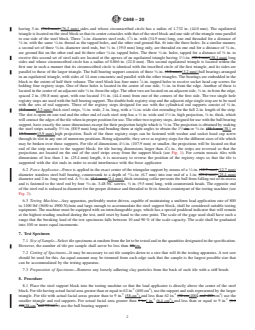
6.1 Specimen-support, consisting of a 5 ⁄2 by 5 ⁄2 by 1-in.
mendations issued by the World Trade Organization Technical
(139.7 by 139.7 by 25.4 mm) steel block. Three ⁄4-in.
Barriers to Trade (TBT) Committee.
(6.4 mm) diameter and ⁄8-in. (9.5 mm) deep tapped holes are
2. Referenced Documents arranged in an equilateral triangle having 3-in. (76.2 mm) sides
and whose circumscribed circle has a radius of 1.732 in.
2.1 ASTM Standards:
(44.0 mm).Theequilateraltriangleislocatedonthe steel block
C242 Terminology of Ceramic Whitewares and Related
so that its center coincides with that of the steel block and one
Products
side of the triangle runs parallel to one side of the steel block.
E178 Practice for Dealing With Outlying Observations
3 3
Three ⁄8-in. diameter steel rods, 1 ⁄8 in. with (34.9 mm) long,
3. Terminology 3 1
one end threaded for a distance of ⁄8 in. with the same ⁄4-in.
threadasthetappedholes,andtheotherendgroundflat,fitinto
3.1 Definitions:
the three holes. In a similar manner, a second set of three ⁄8-in.
3.1.1 For definitions of the types of tile listed in Section 1,
diameter steel rods, but ⁄4 in. (19.0 mm) long only, are
refer to Terminology C242.
threaded on one end for a distance of ⁄8-in., are ground flat on
4. Summary of Test Method
the other end and fit three other ⁄4-in. tapped holes. The three
1 3
4.1 The test method consists of supporting the tile on the ⁄4-in. holes, tapped for a distance of ⁄8 in. to receive this
ends of three cylindrical rods, or on three ball bearings for tiles
second set of steel rods are located at the apexes of an
equilateral triangle having 1 ⁄2-in. (38.1 mm) long sides and
This test method is under the jurisdiction ofASTM Committee C21 on Ceramic
whosecircumscribedcirclehasaradiusof0.866in.(22.0mm).
Whitewares and Related Productsand is the direct responsibility of Subcommittee
Thissecondequilateraltriangleislocatedwithinthefirstonein
C21.06 on Ceramic Tile.
such a manner that its circumscribed circle is identical with the
Current edition approved April 1, 2020. Published April 2020. Originally
inscribed circle of the first triangle, and its sides are parallel to
approved in 1970. Last previous edition approved in 2014 as C648 – 04 (2014).
DOI: 10.1520/C0648-20.
those of the larger triangle.The ball bearing support consists of
For referenced ASTM standards, visit the ASTM website, www.astm.org, or
three ⁄8-in. (3.2 mm) ball bearings arranged in an equilateral
contact ASTM Customer Service at service@astm.org. For Annual Book of ASTM
triangle, with sides of 14 mm concentric and parallel with the
Standards volume information, refer to the standard’s Document Summary page on
the ASTM website. other triangles. The bearings are embedded in the block to the
Copyright © ASTM International, 100 Barr Harbor Drive, PO Box C700, West Conshohocken, PA 19428-2959. United States
C648 − 20
extent of half their volume. The steel block has four more designed for use with the ball bearing support, have exactly the
⁄4-in. tapped holes to receive socket head cap screws for same dimensions except for their projection height which is
holding four registry stops. One of these holes is located in the
⁄8 in. The projection is obtained by making the steel strips
center of one side, ⁄4 in. in from the edge. Another of these is
actually 3 ⁄2 in. (88.9 mm) long and bending them at right
located in the center of an adjacent side ⁄4 in. from the edge. 1 5
angles to obtain the 1 ⁄2 or ⁄8-in. (38.1 or 15.9 mm) high
Theothertwoarelocatedonanadjacentside, ⁄4 in.infromthe
projection.Eachofthethreeregistrystopscanbefastenedwith
edge, spaced 2 in. (50.8 mm) apart, with one located 1 ⁄4 in.
washer and socket head cap screw through its slot in any one
(44.4 mm) from one of the corners of the first side. The two
of numerous positions. Being adjustable, they serve as registry
single hole registry stops are used with the ball bearing
stops for the different sizes of tile which may be broken over
support. The double hole registry stop and the adjacent edge
these supports. For tile of dimensions 4 ⁄4 in. (107.9 mm) or
single stop are to be used with the sets of rod supports. Three
smaller, the projections will be located on that end of the strip
of the registry stops designed for use with the cylindrical rod
nearest to the support block; for tile having dimensions larger
1 3
supports consist of ⁄8-in. (3.2 mm) thick steel strips, ⁄4 in.
than 4 ⁄4 in., the strips are reversed so that the projections are
wide, 2 in. long, with a ⁄4-in. wide slot extending for the full
located on the end of the steel strips away from the support
2-in. length of the strip. The slot is open on one end and the
block (see Fig. 1). For certain mosaic tiles with dimensions of
3 1
other end of each steel strip has a ⁄4 in. wide and 1 ⁄2 in. high
less than 1 in. (25.4 mm) length, it is necessary to reverse the
projection, ⁄8 in. thick, which will contact the edges of the tile
when in proper position for use. The other two registry stops,
FIG. 1 Support Block Assembly (See Table 1)
C648 − 20
position of the registry stops so that the tile is supported with
the slot ends in order to avoid interference with the force
applicator.
6.2 Force Applicator—Force is applied in the exact center
of the triangular support by means of a ⁄2-in. (12.7 mm)
diameter stainless steel ball bearing, countersunk to a depth of
⁄64 in. (6.7 mm) into one end of a 1
...
This document is not an ASTM standard and is intended only to provide the user of an ASTM standard an indication of what changes have been made to the previous version. Because
it may not be technically possible to adequately depict all changes accurately, ASTM recommends that users consult prior editions as appropriate. In all cases only the current version
of the standard as published by ASTM is to be considered the official document.
Designation: C648 − 04 (Reapproved 2014) C648 − 20
Standard Test Method for
Breaking Strength of Ceramic Tile
This standard is issued under the fixed designation C648; the number immediately following the designation indicates the year of
original adoption or, in the case of revision, the year of last revision. A number in parentheses indicates the year of last reapproval. A
superscript epsilon (´) indicates an editorial change since the last revision or reapproval.
1. Scope
1.1 This test method covers the determination of the breaking strength of glazed ceramic wall tile, ceramic mosaic tile, quarry
2 2
tile, porcelain tile and paver tile, having a facial area of at least 1 in.1 in. (6.4 cm(6.4 cm ). Tiles may be glazed or unglazed.
1.2 The values stated in inch-pound units are to be regarded as standard. The values given in parentheses are mathematical
conversions to SI units that are provided for information only and are not considered standard.
1.3 This standard does not purport to address all of the safety concerns, if any, associated with its use. It is the responsibility
of the user of this standard to establish appropriate safety safety, health, and healthenvironmental practices and determine the
applicability of regulatory limitations prior to use.
1.4 This international standard was developed in accordance with internationally recognized principles on standardization
established in the Decision on Principles for the Development of International Standards, Guides and Recommendations issued
by the World Trade Organization Technical Barriers to Trade (TBT) Committee.
2. Referenced Documents
2.1 ASTM Standards:
C242 Terminology of Ceramic Whitewares and Related Products
E178 Practice for Dealing With Outlying Observations
3. Terminology
3.1 Definitions:
3.1.1 For definitions of the types of tile listed in Section 1, refer to Terminology C242.
4. Summary of Test Method
4.1 The test method consists of supporting the tile on the ends of three cylindrical rods, or on three ball bearings for tiles having
2 2
an actual facial area of 9 in. (58 cm ) (or less),or less, arranged in an equilateral triangle, and applying force at a definite rate to
the center of the tile, which coincides with the center of the triangular support, until the specimen breaks.
NOTE 1—The size (facial dimensions) of otherwise equal tile affects the value of breaking strength obtained by this test method. For instance, a 6 by
1 1
6-in. (152 by 152-mm)152 mm) tile equal in mature body properties and thickness to a 4 ⁄4 by 4 ⁄4-in. (108 by 108-mm) 108 mm) tile will have a breaking
1 1
strength higher than the 4 ⁄4 by 4 ⁄4-in. tile.
5. Significance and Use
5.1 The test method provides means for establishing whether or not a lot of ceramic tile meets the strength requirements which
may appear in tile specifications. Tile strength is the force in pounds-force (or newtons), as read from the pressure gage, necessary
to cause the tile to break.
6. Apparatus
1 1
6.1 Specimen-Support,Specimen-support, consisting of a 5 ⁄2 by 5 ⁄2 by 1-in. (139.7 by 139.7 by 25.4-mm) 25.4 mm) steel block.
1 3
Three ⁄4-in. (6.4-mm)(6.4 mm) diameter and ⁄8-in. (9.5-mm) (9.5 mm) deep tapped holes are arranged in an equilateral triangle
This test method is under the jurisdiction of ASTM Committee C21 on Ceramic Whitewares and Related Productsand is the direct responsibility of Subcommittee C21.06
on Ceramic Tile.
Current edition approved Dec. 1, 2014April 1, 2020. Published December 2014April 2020. Originally approved in 1970. Last previous edition approved in 20092014 as
C648 – 04 (2009).(2014). DOI: 10.1520/C0648-04R14.10.1520/C0648-20.
For referenced ASTM standards, visit the ASTM website, www.astm.org, or contact ASTM Customer Service at service@astm.org. For Annual Book of ASTM Standards
volume information, refer to the standard’s Document Summary page on the ASTM website.
Copyright © ASTM International, 100 Barr Harbor Drive, PO Box C700, West Conshohocken, PA 19428-2959. United States
C648 − 20
having 3-in. (76.2-mm) (76.2 mm) sides and whose circumscribed circle has a radius of 1.732 in. (44.0 mm). The equilateral
triangle is located on the steel block so that its center coincides with that of the steel block and one side of the triangle runs parallel
3 3
to one side of the steel block. Three ⁄8-in. diameter steel rods, 1 ⁄8 in. with (34.9 mm) long, one end threaded for a distance of
3 1
⁄8 in. with the same ⁄4-in. thread as the tapped holes, and the other end ground flat, fit into the three holes. In a similar manner,
3 3 3
a second set of three ⁄8-in. diameter steel rods, but ⁄4 in. (19.0 mm) long only, are threaded on one end for a distance of ⁄8-in.,
1 1 3
are ground flat on the other end and fit three other ⁄4-in. tapped holes. The three ⁄4-in. holes, tapped for a distance of ⁄8 in. to
receive this second set of steel rods are located at the apexes of an equilateral triangle having 1 ⁄2-in. (38.1-mm)(38.1 mm) long
sides and whose circumscribed circle has a radius of 0.866 in. (22.0 mm). This second equilateral triangle is located within the
first one in such a manner that its circumscribed circle is identical with the inscribed circle of the first triangle, and its sides are
parallel to those of the larger triangle. The ball bearing support consists of three ⁄8-in. (3.2-mm) (3.2 mm) ball bearings arranged
in an equilateral triangle, with sides of 14 mm concentric and parallel with the other triangles. The bearings are embedded in the
block to the extent of half their volume. The steel block has four more ⁄4-in. tapped holes to receive socket head cap screws for
holding four registry stops. One of these holes is located in the center of one side, ⁄4 in. in from the edge. Another of these is
1 1
located in the center of an adjacent side ⁄4 in. from the edge. The other two are located on an adjacent side, ⁄4 in. in from the edge,
spaced 2 in. (50.8 mm) apart, with one located 1 ⁄4 in. (44.4 mm) from one of the corners of the first side. The two single hole
registry stops are used with the ball bearing support. The double hole registry stop and the adjacent edge single stop are to be used
with the sets of rod supports. Three of the registry stops designed for use with the cylindrical rod supports consist of ⁄8-in.
3 1
(3.2-mm) (3.2 mm) thick steel strips, ⁄4 in. wide, 2 in. long, with a ⁄4-in. wide slot extending for the full 2-in. length of the strip.
3 1 1
The slot is open on one end and the other end of each steel strip has a ⁄4 in. wide and 1 ⁄2 in. high projection, ⁄8 in. thick, which
will contact the edges of the tile when in proper position for use. The other two registry stops, designed for use with the ball bearing
support, have exactly the same dimensions except for their projection height which is ⁄8 in. The projection is obtained by making
1 1 5
the steel strips actually 3 ⁄2 in. (88.9 mm) long and bending them at right angles to obtain the 1 ⁄2-in. or ⁄8-in. (38.1-mm(38.1 or
15.9-mm) 15.9 mm) high projection. Each of the three registry stops can be fastened with washer and socket head cap screw
through its slot in any one of numerous positions. Being adjustable, they serve as registry stops for the different sizes of tile which
may be broken over these supports. For tile of dimensions 4 ⁄4 in. (107.9 mm) or smaller, the projections will be located on that
end of the strip nearest to the support block; for tile having dimensions larger than 4 ⁄4 in., the strips are reversed so that the
projections are located on the end of the steel strips away from the support block (see Fig. 1). For certain mosaic tiles with
dimensions of less than 1 in. (25.4 mm) length, it is necessary to reverse the position of the registry stops so that the tile is
supported with the slot ends in order to avoid interference with the force applicator.
6.2 Force Applicator—Force is applied in the exact center of the triangular support by means of a ⁄2-in. (12.7-mm) (12.7 mm)
diameter stainless steel ball bearing, countersunk to a depth of ⁄64 in. (6.7 mm) into one end of a 1-in
...
Questions, Comments and Discussion
Ask us and Technical Secretary will try to provide an answer. You can facilitate discussion about the standard in here.
Loading comments...