

ASTM D4060-19
(Test Method)Standard Test Method for Abrasion Resistance of Organic Coatings by the Taber Abraser
General Information
- Abstract
SIGNIFICANCE AND USE
5.1 Coating on substrates can be damaged by abrasion during its service life. This test method has been useful in evaluating the abrasion resistance of coatings. Ratings produced by this test method have correlated well with ratings produced by the falling abrasive values in Test Method D968.
5.2 For some materials, abrasion tests utilizing the Taber Abraser may be subject to variation due to changes in the abrasive characteristics of the wheel during testing. Depending on abradant type and test specimen, the wheel surface may change (that is, become clogged) due to the adhesion of debris generated during the test and must be resurfaced at more frequent intervals as agreed upon by the interested parties. To determine if more frequent resurfacing is required, plot the total weight loss every 50 cycles. If a significant negative change in slope is observed prior to 500 cycles, the point at which the slope changes determines the resurfacing frequency.
5.3 When evaluating resistance to abrasion of two or more coatings, other factors may need to be considered for an accurate comparison. Flexible coatings that include air entrainment bubbles could alter the mass loss during comparison tests. Coatings that include dense fillers may result in greater mass loss but have less change in coating thickness. Coatings that include silica, metal oxides or other extremely dense particulates, may wear the abrasive wheel. Wear debris that includes extremely dense particulates may cause three-body abrasion that contributes to the break-down of the coating if not removed by the vacuum suction system. Coatings that have a hardness value or coefficient of friction greater than the abrasive wheel may cause the abrasive wheel to break down faster. Coatings that have different coefficient of friction ratings, must be taken into consideration during comparison tests. Examples of coatings that may be impacted include, but are not limited to; epoxies, polymethyl-methacrylate (PMMA), polyu...
SCOPE
1.1 This test method covers the determination of the resistance of organic coatings to abrasion produced by the Taber Abraser on coatings applied to a plane, rigid surface, such as a metal panel.
1.2 The values stated in SI units are to be regarded as the standard, with the exception of mils when determining coating thickness.
1.3 This standard is similar in content (but not technically equivalent) to ISO 7784–2.
1.4 This standard does not purport to address all of the safety concerns, if any, associated with its use. It is the responsibility of the user of this standard to establish appropriate safety, health, and environmental practices and determine the applicability of regulatory limitations prior to use.
1.5 This international standard was developed in accordance with internationally recognized principles on standardization established in the Decision on Principles for the Development of International Standards, Guides and Recommendations issued by the World Trade Organization Technical Barriers to Trade (TBT) Committee.
- Status
- Published
- Publication Date
- 30-Sep-2019
- Technical Committee
- D01 - Paint and Related Coatings, Materials, and Applications
- Drafting Committee
- D01.23 - Physical Properties of Applied Paint Films
Buy Documents
ASTM D4060-19 - Standard Test Method for Abrasion Resistance of Organic Coatings by the Taber Abraser
REDLINE ASTM D4060-19 - Standard Test Method for Abrasion Resistance of Organic Coatings by the Taber Abraser
Overview
ASTM D4060-19: Standard Test Method for Abrasion Resistance of Organic Coatings by the Taber Abraser establishes a widely recognized procedure for evaluating the abrasion resistance of organic coatings. Developed by ASTM International, this standard is essential for manufacturers, quality assurance professionals, and laboratories concerned with the durability and wear performance of paint, coatings, and similar materials applied to rigid, plane surfaces such as metal panels. The test simulates wear using the Taber Abraser, allowing users to compare the relative abrasion resistance of different coating formulations under controlled, reproducible conditions.
Key Topics
- Abrasion Resistance Testing: The method assesses the resistance to physical wear of organic coatings through the controlled action of abrasion wheels on coated test panels.
- Taber Abraser: Utilizes a rotary platform, abrading wheels, and a vacuum system to reproduce typical service wear.
- Reporting Results: Abrasion is quantified by metrics such as wear index, weight loss, or wear cycles per mil of coating thickness.
- Specimen Preparation: Emphasizes the importance of uniformly applying coatings and standardizing thickness for reliable results.
- Test Repeatability: Procedures are provided to ensure consistency, including periodic resurfacing of abrasion wheels and controlling environmental conditions.
- Material Considerations: Notes on factors affecting the test, such as filler content, material hardness, and debris removal, which may influence comparison of different coatings.
Applications
ASTM D4060-19 is applied across industries to:
- Evaluate Coating Durability: Assess how well coatings resist abrasion during manufacture, transport, or service life, supporting product development and quality control.
- Product Comparison: Compare different coating types or formulations, such as epoxies, polyurethanes, or powder coatings, under standardized test conditions.
- Regulatory and Contractual Compliance: Meet customer requirements or industry regulations by qualifying coatings for use in environments demanding high abrasion resistance, such as automotive, architectural, and industrial applications.
- Process Control: Monitor ongoing production quality by routinely testing samples for consistent wear performance.
- R&D and Material Selection: Aid in the selection or improvement of coating compositions to achieve specified durability goals.
Related Standards
When implementing ASTM D4060-19, consider the following related standards for a comprehensive coating evaluation:
- ASTM D968: Test Methods for Abrasion Resistance of Organic Coatings by Falling Abrasive - Provides a complementary approach to abrasion resistance testing.
- ASTM D16: Terminology for Paint, Related Coatings, Materials, and Applications - Offers standardized vocabulary for clear communication.
- ASTM D823: Practices for Producing Films of Uniform Thickness of Paint, Coatings, and Related Products on Test Panels - Ensures consistent specimen preparation.
- ASTM D1005/D7091: Methods for Measurement of Dry Film Thickness of Organic Coatings - Vital for accurate abrasion resistance calculations.
- ISO 7784-2: Paints and varnishes - Determination of resistance to abrasion - Part 2: Rotating abrasive rubber wheel method - Internationally recognized, similar but not technically equivalent to ASTM D4060-19.
Practical Value
ASTM D4060-19 provides a reliable, reproducible procedure to assess the abrasion resistance of organic coatings, supporting product quality, longevity, and customer satisfaction. By standardizing specimen preparation, test execution, and result interpretation, this method enables meaningful comparison and benchmarking of coating performance in service environments where wear resistance is crucial. For manufacturers, specifiers, and testing laboratories, adherence to ASTM D4060-19 helps ensure coatings meet rigorous industry standards for durability and can withstand real-world abrasion challenges.
Relations
- Effective Date
- 01-Jan-2024
- Effective Date
- 01-Jun-2020
- Effective Date
- 01-Dec-2017
- Effective Date
- 01-Jul-2016
- Effective Date
- 01-Apr-2016
- Effective Date
- 01-Dec-2014
- Effective Date
- 01-Nov-2013
- Effective Date
- 01-Jul-2013
- Effective Date
- 01-Nov-2012
- Effective Date
- 01-Nov-2012
- Effective Date
- 01-Aug-2012
- Effective Date
- 01-Apr-2012
- Effective Date
- 01-Jun-2011
- Effective Date
- 01-Jun-2011
- Effective Date
- 01-Jan-2011
Buy Documents
ASTM D4060-19 - Standard Test Method for Abrasion Resistance of Organic Coatings by the Taber Abraser
REDLINE ASTM D4060-19 - Standard Test Method for Abrasion Resistance of Organic Coatings by the Taber Abraser
Get Certified
Connect with accredited certification bodies for this standard

DVS-ZERT GmbH
German welding certification society.
CARES (UK Certification Authority for Reinforcing Steels)
UK certification for reinforcing steels and construction.
EWF/IIW (European/International Welding Federation)
International welding personnel certification.
Sponsored listings
Frequently Asked Questions
ASTM D4060-19 is a standard published by ASTM International. Its full title is "Standard Test Method for Abrasion Resistance of Organic Coatings by the Taber Abraser". This standard covers: SIGNIFICANCE AND USE 5.1 Coating on substrates can be damaged by abrasion during its service life. This test method has been useful in evaluating the abrasion resistance of coatings. Ratings produced by this test method have correlated well with ratings produced by the falling abrasive values in Test Method D968. 5.2 For some materials, abrasion tests utilizing the Taber Abraser may be subject to variation due to changes in the abrasive characteristics of the wheel during testing. Depending on abradant type and test specimen, the wheel surface may change (that is, become clogged) due to the adhesion of debris generated during the test and must be resurfaced at more frequent intervals as agreed upon by the interested parties. To determine if more frequent resurfacing is required, plot the total weight loss every 50 cycles. If a significant negative change in slope is observed prior to 500 cycles, the point at which the slope changes determines the resurfacing frequency. 5.3 When evaluating resistance to abrasion of two or more coatings, other factors may need to be considered for an accurate comparison. Flexible coatings that include air entrainment bubbles could alter the mass loss during comparison tests. Coatings that include dense fillers may result in greater mass loss but have less change in coating thickness. Coatings that include silica, metal oxides or other extremely dense particulates, may wear the abrasive wheel. Wear debris that includes extremely dense particulates may cause three-body abrasion that contributes to the break-down of the coating if not removed by the vacuum suction system. Coatings that have a hardness value or coefficient of friction greater than the abrasive wheel may cause the abrasive wheel to break down faster. Coatings that have different coefficient of friction ratings, must be taken into consideration during comparison tests. Examples of coatings that may be impacted include, but are not limited to; epoxies, polymethyl-methacrylate (PMMA), polyu... SCOPE 1.1 This test method covers the determination of the resistance of organic coatings to abrasion produced by the Taber Abraser on coatings applied to a plane, rigid surface, such as a metal panel. 1.2 The values stated in SI units are to be regarded as the standard, with the exception of mils when determining coating thickness. 1.3 This standard is similar in content (but not technically equivalent) to ISO 7784–2. 1.4 This standard does not purport to address all of the safety concerns, if any, associated with its use. It is the responsibility of the user of this standard to establish appropriate safety, health, and environmental practices and determine the applicability of regulatory limitations prior to use. 1.5 This international standard was developed in accordance with internationally recognized principles on standardization established in the Decision on Principles for the Development of International Standards, Guides and Recommendations issued by the World Trade Organization Technical Barriers to Trade (TBT) Committee.
SIGNIFICANCE AND USE 5.1 Coating on substrates can be damaged by abrasion during its service life. This test method has been useful in evaluating the abrasion resistance of coatings. Ratings produced by this test method have correlated well with ratings produced by the falling abrasive values in Test Method D968. 5.2 For some materials, abrasion tests utilizing the Taber Abraser may be subject to variation due to changes in the abrasive characteristics of the wheel during testing. Depending on abradant type and test specimen, the wheel surface may change (that is, become clogged) due to the adhesion of debris generated during the test and must be resurfaced at more frequent intervals as agreed upon by the interested parties. To determine if more frequent resurfacing is required, plot the total weight loss every 50 cycles. If a significant negative change in slope is observed prior to 500 cycles, the point at which the slope changes determines the resurfacing frequency. 5.3 When evaluating resistance to abrasion of two or more coatings, other factors may need to be considered for an accurate comparison. Flexible coatings that include air entrainment bubbles could alter the mass loss during comparison tests. Coatings that include dense fillers may result in greater mass loss but have less change in coating thickness. Coatings that include silica, metal oxides or other extremely dense particulates, may wear the abrasive wheel. Wear debris that includes extremely dense particulates may cause three-body abrasion that contributes to the break-down of the coating if not removed by the vacuum suction system. Coatings that have a hardness value or coefficient of friction greater than the abrasive wheel may cause the abrasive wheel to break down faster. Coatings that have different coefficient of friction ratings, must be taken into consideration during comparison tests. Examples of coatings that may be impacted include, but are not limited to; epoxies, polymethyl-methacrylate (PMMA), polyu... SCOPE 1.1 This test method covers the determination of the resistance of organic coatings to abrasion produced by the Taber Abraser on coatings applied to a plane, rigid surface, such as a metal panel. 1.2 The values stated in SI units are to be regarded as the standard, with the exception of mils when determining coating thickness. 1.3 This standard is similar in content (but not technically equivalent) to ISO 7784–2. 1.4 This standard does not purport to address all of the safety concerns, if any, associated with its use. It is the responsibility of the user of this standard to establish appropriate safety, health, and environmental practices and determine the applicability of regulatory limitations prior to use. 1.5 This international standard was developed in accordance with internationally recognized principles on standardization established in the Decision on Principles for the Development of International Standards, Guides and Recommendations issued by the World Trade Organization Technical Barriers to Trade (TBT) Committee.
ASTM D4060-19 is classified under the following ICS (International Classification for Standards) categories: 25.220.60 - Organic coatings. The ICS classification helps identify the subject area and facilitates finding related standards.
ASTM D4060-19 has the following relationships with other standards: It is inter standard links to ASTM D16-24, ASTM D1005-95(2020), ASTM D823-17, ASTM D16-16, ASTM D3924-16, ASTM D16-14, ASTM G195-13a, ASTM G195-13, ASTM D823-95(2012), ASTM D1475-98(2012), ASTM D16-12, ASTM D7091-12, ASTM D16-11a, ASTM D3924-80(2011), ASTM D16-11. Understanding these relationships helps ensure you are using the most current and applicable version of the standard.
ASTM D4060-19 is available in PDF format for immediate download after purchase. The document can be added to your cart and obtained through the secure checkout process. Digital delivery ensures instant access to the complete standard document.
Standards Content (Sample)
This international standard was developed in accordance with internationally recognized principles on standardization established in the Decision on Principles for the
Development of International Standards, Guides and Recommendations issued by the World Trade Organization Technical Barriers to Trade (TBT) Committee.
Designation: D4060 − 19
Standard Test Method for
Abrasion Resistance of Organic Coatings by the Taber
Abraser
This standard is issued under the fixed designation D4060; the number immediately following the designation indicates the year of
original adoption or, in the case of revision, the year of last revision. A number in parentheses indicates the year of last reapproval. A
superscript epsilon (´) indicates an editorial change since the last revision or reapproval.
This standard has been approved for use by agencies of the U.S. Department of Defense.
1. Scope* D1005 Test Method for Measurement of Dry-Film Thick-
ness of Organic Coatings Using Micrometers
1.1 This test method covers the determination of the resis-
D1475 Test Method for Density of Liquid Coatings, Inks,
tance of organic coatings to abrasion produced by the Taber
and Related Products
Abraser on coatings applied to a plane, rigid surface, such as a
D3924 Specification for Standard Environment for Condi-
metal panel.
tioning and Testing Paint, Varnish, Lacquer, and Related
1.2 The values stated in SI units are to be regarded as the 3
Materials (Withdrawn 2016)
standard, with the exception of mils when determining coating
D7091 Practice for Nondestructive Measurement of Dry
thickness.
Film Thickness of Nonmagnetic Coatings Applied to
Ferrous Metals and Nonmagnetic, Nonconductive Coat-
1.3 This standard is similar in content (but not technically
equivalent) to ISO 7784–2. ings Applied to Non-Ferrous Metals
G195 Guide for Conducting Wear Tests Using a Rotary
1.4 This standard does not purport to address all of the
Platform Abraser
safety concerns, if any, associated with its use. It is the
2.2 Other Standards:
responsibility of the user of this standard to establish appro-
ISO 7784–2 Paints and varnishes—Determination of resis-
priate safety, health, and environmental practices and deter-
tance to abrasion—Part 2: Rotating abrasive rubber wheel
mine the applicability of regulatory limitations prior to use.
method
1.5 This international standard was developed in accor-
dance with internationally recognized principles on standard-
3. Terminology
ization established in the Decision on Principles for the
Development of International Standards, Guides and Recom-
3.1 Definitions of Terms Specific to This Standard:
mendations issued by the World Trade Organization Technical
3.1.1 Abrasion resistance can be expressed as one or more
Barriers to Trade (TBT) Committee.
of the following terms:
3.1.2 wear index, n—the average loss in weight in milli-
2. Referenced Documents
grams per thousand cycles of abrasion.
2.1 ASTM Standards:
3.1.3 weight loss, n—the loss in weight in milligrams,
D16 TerminologyforPaint,RelatedCoatings,Materials,and
determined at a specified number of cycles.
Applications
3.1.4 wear cycles per mil, n—the number of cycles of
D823 Practices for Producing Films of Uniform Thickness
abrasionrequiredtowearafilmthroughtothesubstratepermil
of Paint, Coatings and Related Products on Test Panels
(0.001 in.) of film thickness.
D968 Test Methods for Abrasion Resistance of Organic
3.2 For definitions of other terms used in this standard, refer
Coatings by Falling Abrasive
to Terminology D16.
4. Summary of Test Method
This test method is under the jurisdiction of ASTM Committee D01 on Paint
and Related Coatings, Materials, andApplications and is the direct responsibility of
4.1 The organic coating is applied at uniform thickness to a
Subcommittee D01.23 on Physical Properties of Applied Paint Films.
plane,rigidpaneland,aftercuring,thesurfaceisabradedusing
Current edition approved Oct. 1, 2019. Published October 2019. Originally
approved in 1981. Last previous edition approved in 2014 as D4060 – 14. DOI:
10.1520/D4060-19.
2 3
For referenced ASTM standards, visit the ASTM website, www.astm.org, or The last approved version of this historical standard is referenced on
contact ASTM Customer Service at service@astm.org. For Annual Book of ASTM www.astm.org.
Standards volume information, refer to the standard’s Document Summary page on Available fromAmerican National Standards Institute (ANSI), 25 W. 43rd St.,
the ASTM website. 4th Floor, New York, NY 10036, http://www.ansi.org.
*A Summary of Changes section appears at the end of this standard
Copyright © ASTM International, 100 Barr Harbor Drive, PO Box C700, West Conshohocken, PA 19428-2959. United States
D4060 − 19
rotary rubbing action under controlled conditions of pressure mentbubblescouldalterthemasslossduringcomparisontests.
and abrasive action.The test specimen, mounted on a turntable Coatings that include dense fillers may result in greater mass
platform, turns on a vertical axis, against the sliding rotation of loss but have less change in coating thickness. Coatings that
two abrading wheels. The wheels shall be mounted in such a include silica, metal oxides or other extremely dense
way that when they are in contact with the rotating test particulates, may wear the abrasive wheel. Wear debris that
specimen, they rotate in opposing directions. One abrading includes extremely dense particulates may cause three-body
wheel rubs the specimen outward toward the periphery and the abrasionthatcontributestothebreak-downofthecoatingifnot
other, inward toward the center. The resulting abrasion marks removed by the vacuum suction system. Coatings that have a
form a pattern of crossed arcs over an area of approximately hardness value or coefficient of friction greater than the
30 cm . abrasive wheel may cause the abrasive wheel to break down
faster. Coatings that have different coefficient of friction
4.2 Abrasion resistance is calculated as loss in weight at a
ratings, must be taken into consideration during comparison
specified number of abrasion cycles, as average loss in weight
tests. Examples of coatings that may be impacted include, but
per thousand cycles of abrasion, or as number of cycles
are not limited to; epoxies, polymethyl-methacrylate (PMMA),
required to remove a unit amount of coating thickness.
polyurethane-methacrylate (PUMA), methyl-methacrylate
(MMA), and carbon resin.
5. Significance and Use
5.1 Coating on substrates can be damaged by abrasion NOTE 1—Example—Aurethane coating of 20 mil thickness, embedded
with 1.2 µm titanium particles resulted in a 2.1 mil loss in coating
during its service life. This test method has been useful in
thickness and 110 mg mass loss. A similar urethane coating without
evaluating the abrasion resistance of coatings. Ratings pro-
titanium particles, resulted in a 2.9 mil to 3.1 mil loss in coating thickness
duced by this test method have correlated well with ratings
and 44 mg mass loss.
produced by the falling abrasive values in Test Method D968.
6. Apparatus
5.2 For some materials, abrasion tests utilizing the Taber
6.1 Taber Abraser (Fig. 1), as described in Guide G195
Abraser may be subject to variation due to changes in the
and consisting of the following elements:
abrasive characteristics of the wheel during testing. Depending
6.1.1 Ahorizontal turntable platform; comprised of a rubber
on abradant type and test specimen, the wheel surface may
pad, clamp plate, and nut to secure the specimen to the
change (that is, become clogged) due to the adhesion of debris
turntable.Aclampingringisprovidedtosecuretheresurfacing
generated during the test and must be resurfaced at more
medium.
frequent intervals as agreed upon by the interested parties. To
6.1.2 Amotor capable of rotating the turntable platform at a
determine if more frequent resurfacing is required, plot the
speed of either 72 r/min 6 2 r/min for 110v/60Hz or 60 r/min
total weight loss every 50 cycles. If a significant negative
6 2 r/min for 230v/50Hz.
change in slope is observed prior to 500 cycles, the point at
6.1.3 A pair of pivoted arms, to which the abrasive wheels
which the slope changes determines the resurfacing frequency.
and auxiliary masses may be attached; loads of 250 g, 500 g,
5.3 When evaluating resistance to abrasion of two or more
coatings, other factors may need to be considered for an
accurate comparison. Flexible coatings that include air entrain-
Available from Taber Industries, 455 Bryant St., North Tonawanda, NY14120.
Note: Vacuum Suction System not shown.
FIG. 1 Taber Abraser
D4060 − 19
or 1000 g on each wheel may be obtained by use of these 8. Calibration
changeable masses. Counterweight attachments of 125 g or
8.1 VerifycalibrationoftheTaberAbraserasdirectedbythe
175gareavailabletoreducetheloadagainstthespecimen,and
equipment manufacturer (see Appendix X1).
can be used with or without the auxiliary masses.
NOTE 2—Without auxiliary masses or counterweights, each arm will 9. Standardization
apply a load against the specimen of 250 g per wheel (exclusive of the
9.1 To ensure that the abrading function of the wheels is
mass of the wheel itself).
maintained at a constant level, prepare the abrading wheels
6.1.4 Avacuum suction system and vacuum pick-up nozzle
prior to each test and after every 500 cycles unless otherwise
to remove debris and abrasive particles from the specimen
agreed to by the interested parties.
surface during testing.The height of the vacuum pickup nozzle
shall be adjustable, and the nozzle openings shall be 8 mm in
NOTE 7—Inorganic coatings do not require the abrasive wheels to be
resurfaced after every 500 test cycles.
diameter. The vacuum system shall operate when testing
commences.
9.1.1 Mounttheselectedabrasivewheelsontheirrespective
6.1.5 Acounter to record the number of cycles (revolutions)
flange holders, taking care not to handle them by their abrasive
made by the turntable platform.
surfaces.
6.2 Abrasive Wheels —ResilientCalibrasewheelsCS-10or 9.1.2 A load of 1000 g (per wheel) shall be used, unless
CS-17, as required, shall be used unless otherwise agreed upon otherwise agreed upon by the interested parties.
by the interested parties. Because of the slow hardening of the
9.1.3 Mounttheresurfacingmedium(S-11abrasivedisk)on
bonding material, resilient wheels shall not be used after the
the turntable and secure in place with the clamp plate, nut and
date marked on them.
clamping ring. Lower the pivoted arms carefully until the
wheels rest squarely on the abrasive disk. Place the vacuum
NOTE 3—The CS-17 wheels produce a harsher abrasion than the CS-10
pick–up nozzle in position and adjust it to a distance of 3 mm
wheels.
6 1 mm, or as agreed upon between the interested parties,
6.2.1 The wheels shall be cylindrically shaped, have a
above the abrasive disk.
diameter between 52.4 mm and 44.4 mm, a width of 12.7 mm
9.1.4 Set the vacuum suction force to 100. The vacuum
6 0.3 mm, and an axial hole 16.0 mm 6 0.1 mm in diameter
suctionforcemaybedecreasedifagreeduponbytheinterested
to allow the wheel to be mounted to the flanged holder on the
parties.
pivoted arms.
9.1.5 Resurface the wheels by running them 25 or 50 cycles
6.3 Resurfacing Medium, an S-11 abrasive disk, used for
against the resurfacing medium. Each S-11 resurfacing disk is
resurfacing the abrasion wheels. The resurfacing disk shall be
good for one resurfacing operation, after which it shall be
silicon carbide coated abrasive with an average particle size of
discarded. Warning—Do not brush or touch the surface of the
92 µm (150 grit CAMI-grade), approximately 102 mm diam-
wheels after they are resurfaced.
eter witha7mm center hole.
NOTE8—Ifresurfacingdidnotrefreshthewheelssufficiently, it may be
necessary to resurface the wheels a second time using a new S-11
7. Test Specimens resurfacing disk.
7.1 Apply a uniform coating of the material to be tested to
10. Conditioning
a rigid panel having both surfaces substantially plane and
parallel. Specimens shall be a disk or a square plate with a
10.1 Cure the coated panel under conditions of humidity
6.5 mm hole centrally located on each panel. Typical dimen-
and temperature as agreed upon between the interested parties.
sions for a test panel are 100 mm in diameter or 100 mm by
For additional information, reference Specification D3924.
100 mm. Thickness of the specimen should be no greater than
10.2 Unless otherwise agreed upon between the interested
6.5 mm unless an S-21 extension nut or arm height extension
parties, condition the coated panel for at least 24 h at 23 °C 6
kit is utilized.
2 °Cand50 % 65 %relativehumidity.Conductthetestinthe
NOTE 4—The coatings should be applied in accordance with Practices same environment or immediately on removal therefrom.
D823, or as agreed upon between the interested parties.
NOTE 5—The thickness of the dry coatings should be measured in
11. Procedure
accordance with Test Method D1005 or Practice D7091.
NOTE6—Forthosematerialsgreaterthan6.3mmbutlessthan12.7mm
11.1
...
This document is not an ASTM standard and is intended only to provide the user of an ASTM standard an indication of what changes have been made to the previous version. Because
it may not be technically possible to adequately depict all changes accurately, ASTM recommends that users consult prior editions as appropriate. In all cases only the current version
of the standard as published by ASTM is to be considered the official document.
Designation: D4060 − 14 D4060 − 19
Standard Test Method for
Abrasion Resistance of Organic Coatings by the Taber
Abraser
This standard is issued under the fixed designation D4060; the number immediately following the designation indicates the year of
original adoption or, in the case of revision, the year of last revision. A number in parentheses indicates the year of last reapproval. A
superscript epsilon (´) indicates an editorial change since the last revision or reapproval.
This standard has been approved for use by agencies of the U.S. Department of Defense.
1. Scope*
1.1 This test method covers the determination of the resistance of organic coatings to abrasion produced by the Taber Abraser
on coatings applied to a plane, rigid surface, such as a metal panel.
1.2 The values stated in SI units are to be regarded as the standard, with the exception of mils when determining coating
thickness.
1.3 This standard is similar in content (but not technically equivalent) to ISO 7784–2.
1.4 This standard does not purport to address all of the safety concerns, if any, associated with its use. It is the responsibility
of the user of this standard to establish appropriate safety safety, health, and healthenvironmental practices and determine the
applicability of regulatory limitations prior to use.
1.5 This international standard was developed in accordance with internationally recognized principles on standardization
established in the Decision on Principles for the Development of International Standards, Guides and Recommendations issued
by the World Trade Organization Technical Barriers to Trade (TBT) Committee.
2. Referenced Documents
2.1 ASTM Standards:
D16 Terminology for Paint, Related Coatings, Materials, and Applications
D823 Practices for Producing Films of Uniform Thickness of Paint, Coatings and Related Products on Test Panels
D968 Test Methods for Abrasion Resistance of Organic Coatings by Falling Abrasive
D1005 Test Method for Measurement of Dry-Film Thickness of Organic Coatings Using Micrometers
D2240D1475 Test Method for Rubber Property—Durometer HardnessDensity of Liquid Coatings, Inks, and Related Products
D3924 Specification for Standard Environment for Conditioning and Testing Paint, Varnish, Lacquer, and Related Materials
(Withdrawn 2016)
D7091 Practice for Nondestructive Measurement of Dry Film Thickness of Nonmagnetic Coatings Applied to Ferrous Metals
and Nonmagnetic, Nonconductive Coatings Applied to Non-Ferrous Metals
G195 Guide for Conducting Wear Tests Using a Rotary Platform Abraser
2.2 Other Standards:
ISO 7784–2 Paints and varnishes—Determination of resistance to abrasion—Part 2: Rotating abrasive rubber wheel method
3. Terminology
3.1 Definitions of Terms Specific to This Standard:
3.1.1 Abrasion resistance can be expressed as one or more of the following terms:
3.1.2 wear index, n—1000 times the average loss in weight in milligrams per cycle.thousand cycles of abrasion.
3.1.3 weight loss, n—the loss in weight in milligrams, determined at a specified number of cycles.
This test method is under the jurisdiction of ASTM Committee D01 on Paint and Related Coatings, Materials, and Applications and is the direct responsibility of
Subcommittee D01.23 on Physical Properties of Applied Paint Films.
Current edition approved Dec. 1, 2014Oct. 1, 2019. Published January 2015October 2019. Originally approved in 1981. Last previous edition approved in 20102014 as
D4060 – 10.D4060 – 14. DOI: 10.1520/D4060–14.10.1520/D4060-19.
For referenced ASTM standards, visit the ASTM website, www.astm.org, or contact ASTM Customer Service at service@astm.org. For Annual Book of ASTM Standards
volume information, refer to the standard’s Document Summary page on the ASTM website.
The last approved version of this historical standard is referenced on www.astm.org.
Available from American National Standards Institute (ANSI), 25 W. 43rd St., 4th Floor, New York, NY 10036, http://www.ansi.org.
*A Summary of Changes section appears at the end of this standard
Copyright © ASTM International, 100 Barr Harbor Drive, PO Box C700, West Conshohocken, PA 19428-2959. United States
D4060 − 19
3.1.4 wear cycles per mil, n—the number of cycles of abrasion required to wear a film through to the substrate per mil (0.001
in.) of film thickness.
3.2 For definitions of other terms used in this standard, refer to Terminology D16.
4. Summary of Test Method
4.1 The organic coating is applied at uniform thickness to a plane, rigid panel and, after curing, the surface is abraded using
rotary rubbing action under controlled conditions of pressure and abrasive action. The test specimen, mounted on a turntable
platform, turns on a vertical axis, against the sliding rotation of two abrading wheels. The wheels shall be mounted in such a way
that when they are in contact with the rotating test specimen, they rotate in opposing directions. One abrading wheel rubs the
specimen outward toward the periphery and the other, inward toward the center. The resulting abrasion marks form a pattern of
crossed arcs over an area of approximately 30 cm30 cm .
4.2 Abrasion resistance is calculated as loss in weight at a specified number of abrasion cycles, as average loss in weight per
cycle, thousand cycles of abrasion, or as number of cycles required to remove a unit amount of coating thickness.
5. Significance and Use
5.1 Coating on substrates can be damaged by abrasion during manufacturing and service.its service life. This test method has
been useful in evaluating the abrasion resistance of coatings. Ratings produced by this test method have correlated well with ratings
produced by the falling abrasive values in Test Method D968.
5.2 For some materials, abrasion tests utilizing the Taber Abraser may be subject to variation due to changes in the abrasive
characteristics of the wheel during testing. Depending on abradant type and test specimen, the wheel surface may change (that is,
become clogged) due to the adhesion of debris generated during the test and must be resurfaced at more frequent intervals as agreed
upon by the interested parties. To determine if more frequent resurfacing is required, plot the total weight loss every 50 cycles.
If a significant negative change in slope is observed prior to 500 cycles, the point at which the slope changes determines the
resurfacing frequency.
5.3 When evaluating resistance to abrasion of two or more coatings, other factors may need to be considered for an accurate
comparison. Flexible coatings that include air entrainment bubbles could alter the mass loss during comparison tests. Coatings that
include dense fillers may result in greater mass loss but have less change in coating thickness. Coatings that include silica, metal
oxides or other extremely dense particulates, may wear the abrasive wheel. Wear debris that includes extremely dense particulates
may cause three-body abrasion that contributes to the break-down of the coating if not removed by the vacuum suction system.
Coatings that have a hardness value or coefficient of friction greater than the abrasive wheel may cause the abrasive wheel to break
down faster. Coatings that have different coefficient of friction ratings, must be taken into consideration during comparison tests.
Examples of coatings that may be impacted include, but are not limited to; epoxies, polymethyl-methacrylate (PMMA),
polyurethane-methacrylate (PUMA), methyl-methacrylate (MMA), and carbon resin.
NOTE 1—Example—A urethane coating of 20 mil thickness, embedded with 1.2 μm titanium particles resulted in a 2.1 mil loss in coating thickness
Note: Vacuum Suction System not shown.
FIG. 1 Taber Abraser
D4060 − 19
and 110 mg mass loss. A similar urethane coating without titanium particles, resulted in a 2.9 mil to 3.1 mil loss in coating thickness and 44 mg mass
loss.
6. Apparatus
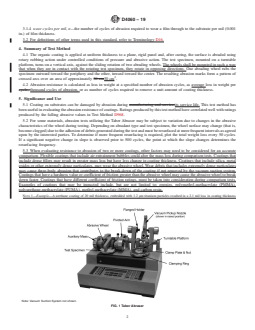
6.1 Taber Abraser (Fig. 1), as described in Guide G195 and consisting of the following elements:
6.1.1 A horizontal turntable platform; comprised of a rubber pad, clamp plate, and nut to secure the specimen to the turntable.
A clamping ring is provided to secure the resurfacing mediummedium.
6.1.2 A motor capable of rotating the turntable platform at a speed of either 72 r/min 6 2 r/min for 110v/60Hz or 60 r/min 6
2 r/min for 230v/50Hz,230v/50Hz.
6.1.3 A pair of pivoted arms, to which the abrasive wheels and auxiliary masses may be attached; loads of 250, 500, 250 g, 500
g, or 1000 g on each wheel may be obtained by use of these changeable masses. Counterweight attachments of 125 g or 175 g
are available to reduce the load against the specimen, and can be used with or without the auxiliary masses.
NOTE 2—Without auxiliary masses or counterweights, each arm will apply a load against the specimen of 250 g per wheel (exclusive of the mass of
the wheel itself).
6.1.4 A vacuum suction system and vacuum pick-up nozzle to remove debris and abrasive particles from the specimen surface
during testing. The height of the vacuum pickup nozzle shall be adjustable, and the nozzle openings shall be 8 mm in diameter.
The vacuum system shall operate when testing commences.
6.1.5 A counter to record the number of cycles (revolutions) made by the turntable platform.
6.2 Abrasive Wheels—Wheels —Resilient Calibrase wheels No. CS-10 or CS-17, as required, shall be used unless otherwise
agreed upon by the interested parties. Because of the slow hardening of the bonding material, resilient wheels shouldshall not be
used after the date marked on them, or one year after their purchase if the wheels are not dated.them.
NOTE 3—The CS-17 wheels produce a harsher abrasion than the CS-10 wheels.
6.2.1 The wheels shall be 12.7 6 0.3 mm thick and have an external diameter of 51.9 6 0.5 mm when new, and in no case less
than 44.4 mm.cylindrically shaped, have a diameter between 52.4 mm and 44.4 mm, a width of 12.7 mm 6 0.3 mm, and an axial
hole 16.0 mm 6 0.1 mm in diameter to allow the wheel to be mounted to the flanged holder on the pivoted arms.
NOTE 2—The hardness of the wheels can be checked by Test Method D2240. Measure at least four points equally spaced on the side surface of the
wheel. The reading shall be taken 10 s after full application of the pressure, and then averaged. An acceptable hardness for both types of wheels is 81
6 5 units on Shore Durometer A-2 Scale.
NOTE 3—The CS-17 wheels produce a harsher abrasion than the CS-10 wheels.
6.3 Resurfacing Medium, an S-11 abrasive disk, used for resurfacing the abrasion wheels. The resurfacing disk shall be silicon
carbide coated abrasive with an average particle size of 92 μm (150 grit CAMI-grade), approximately 102 mm diameter with a
7 mm center hole.
7. Test Specimens
7.1 Apply a uniform coating of the material to be tested to a rigid panel having both surfaces substantially plane and parallel.
Specimens shall be a disk or a square plate with a 6.5 mm 6.5 mm hole centrally located on each panel. Typical dimensions for
a test panel are 100 mm in diameter or 100 mm by 100 mm. Thickness of the specimen should be no greater than 6.36.5 mm unless
5 5
an S-21 extension nut or arm height extension kit is utilized. Prepare a minimum of two coated panels for the material.
NOTE 4—While the minimum of two coated panels is acceptable, evaluating three or more panels per material will provide greater confidence in your
test results.
NOTE 4—The coatings should be applied in accordance with Practices D823, or as agreed upon between the interested parties.
NOTE 5—The thickness of the dry coatings should be measured in accordance with Test Method D1005 or Practice D7091.
NOTE 6—For those materials greater than 6.3 mm but less than 12.7 mm thick, the S-21 extension nut may be used to affix the specimen to the turntable.
This requires a 9.5 mm center hole in the specimen. Alternatively, an arm height extension kit will permit testing of specimens up to 40 mm thick and
requires the center hole to be 14.5 mm.
8. Calibration
8.1 Verify calibration of the Taber Abraser as directed by the equipment manufacturer (see Appendix X1).
9. Standardization
9.1 To ensure that the abrading function of the wheels is maintained at a constant level, prepare the abrading wheels prior to
each test.test and after every 500 cycles unless otherwise agreed to by the interested parties.
NOTE 7—Inorganic coatings do not require the abrasive wheels to be resurfaced after every 500 test cycles.
Available from Taber Industries, 455 Bryant St., North Tonawanda, NY 14120.
The sole source of supply of the apparatus known to the committee at this time is Taber Industries, 455 Bryant Street, North Tonawanda, NY 14120. If you are aware
of alternative suppliers, please provide this information to ASTM International Headquarters. Your comments will receive careful consideration at a meeting of the responsible
technical committee, which you may attend.
D4060 − 19
9.1.1 Mount the selected abrasive wheels on their respective flange holders, taking care not to handle them by their abrasive
surfaces.
9.1.2 A load of 1000 g (per wheel) shouldshall be used, unless otherwise agreed upon by the interested parties.
9.1.3 Mount the resurfacing medium (S-11 abrasive disk) on the turntable and secure in place with the clamp plate, nut and
clamping ring. Lower the abrading headspivoted arms carefully until the wheels rest squarely on the abrasive disk. Place the
vacuum pick–up nozzle in position and adjust it to a distance of 3 mm 6 1.0 mm,1 mm, or as agreed upon between buyer and
seller,the interested parties, above the abrasive disk.
9.1.4 Set the vacuum suction force to 100. The vacuum suction force may be decreased if agreed upon by the interested parties.
9.1.5 Resurface the wheels by running them 25 or 50 cycles against the resurfacing medium. Each S-11 resurfacing disk is good
for one res
...