

ASTM E854-19
(Test Method)Standard Test Method for Application and Analysis of Solid State Track Recorder (SSTR) Monitors for Reactor Surveillance
General Information
- Abstract
SIGNIFICANCE AND USE
4.1 The SSTR method provides for the measurement of absolute-fission density per unit mass. Absolute-neutron fluence can then be inferred from these SSTR-based absolute fission rate observations if an appropriate neutron spectrum average fission cross section is known. This method is highly discriminatory against other components of the in-core radiation field. Gamma rays, beta rays, and other lightly ionizing particles do not produce observable tracks in appropriate LWR SSTR candidate materials. However, photofission can contribute to the observed fission track density and should therefore be accounted for when nonnegligible. For a more detailed discussion of photofission effects, see 14.4.
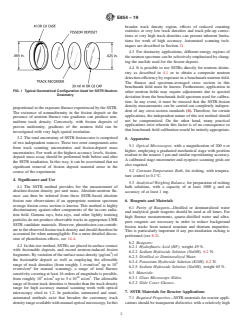
4.2 In this test method, SSTRs are placed in surface contact with fissionable deposits and record neutron-induced fission fragments. By variation of the surface mass density (μg/cm 2) of the fissionable deposit as well as employing the allowable range of track densities (from roughly 1 event/cm2 up to 105 events/cm2 for manual scanning), a range of total fluence sensitivity covering at least 16 orders of magnitude is possible, from roughly 102 n/cm 2 up to 5 × 10 18 n/cm2. The allowable range of fission track densities is broader than the track density range for high accuracy manual scanning work with optical microscopy cited in 1.2. In particular, automated and semi-automated methods exist that broaden the customary track density range available with manual optical microscopy. In this broader track density region, effects of reduced counting statistics at very low track densities and track pile-up corrections at very high track densities can present inherent limitations for work of high accuracy. Automated scanning techniques are described in Section 11.
4.3 For dosimetry applications, different energy regions of the neutron spectrum can be selectively emphasized by changing the nuclide used for the fission deposit.
4.4 It is possible to use SSTRs directly for neutron ...
SCOPE
1.1 This test method describes the use of solid-state track recorders (SSTRs) for neutron dosimetry in light-water reactor (LWR) applications. These applications extend from low neutron fluence to high neutron fluence, including high power pressure vessel surveillance and test reactor irradiations as well as low power benchmark field measurement. (1)2 Special attention is given to the use of state-of-the-art manual and automated track counting methods to attain high absolute accuracies. In-situ dosimetry in actual high fluence-high temperature LWR applications is emphasized.
1.2 This test method includes SSTR analysis by both manual and automated methods. To attain a desired accuracy, the track scanning method selected places limits on the allowable track density. Typically, good results are obtained in the range of 5 to 800 000 tracks/cm2 and accurate results at higher track densities have been demonstrated for some cases. (2) Track density and other factors place limits on the applicability of the SSTR method at high fluences. Special care must be exerted when measuring neutron fluences (E>1MeV) above 1016 n/cm2 (3) .
1.3 Low fluence and high fluence limitations exist. These limitations are discussed in detail in Sections 13 and 14 and in Refs (3-5).
1.4 SSTR observations provide time-integrated reaction rates. Therefore, SSTRs are truly passive-fluence detectors. They provide permanent records of dosimetry experiments without the need for time-dependent corrections, such as decay factors that arise with radiometric monitors.
1.5 Since SSTRs provide a spatial record of the time-integrated reaction rate at a microscopic level, they can be used for “fine-structure” measurements. For example, spatial distributions of isotopic fission rates can be obtained at very high resolution with SSTRs.
1.6 This standard does not purport to address all of the safety concerns, if any, associated with its use. It is the ...
- Status
- Published
- Publication Date
- 31-Oct-2019
- Technical Committee
- E10 - Nuclear Technology and Applications
- Drafting Committee
- E10.05 - Nuclear Radiation Metrology
Buy Documents
ASTM E854-19 - Standard Test Method for Application and Analysis of Solid State Track Recorder (SSTR) Monitors for Reactor Surveillance
REDLINE ASTM E854-19 - Standard Test Method for Application and Analysis of Solid State Track Recorder (SSTR) Monitors for Reactor Surveillance
Overview
ASTM E854-19: Standard Test Method for Application and Analysis of Solid State Track Recorder (SSTR) Monitors for Reactor Surveillance establishes procedures for using solid-state track recorders to perform neutron dosimetry in light-water reactor (LWR) environments. This method covers a wide fluence range and supports both high-power reactor surveillance as well as low-power benchmark measurements. Emphasis is placed on high-accuracy measurements attainable through both manual and automated track scanning techniques, making it highly relevant for reactor operators, nuclear safety professionals, and research laboratories involved in reactor surveillance and neutron field characterization.
Key Topics
- SSTR Functionality: Solid State Track Recorders (SSTRs) measure neutron fluence indirectly by capturing tracks from neutron-induced fission fragments in a fissionable deposit. These tracks provide a permanent, time-integrated record of neutron exposure.
- Material Selection: SSTR materials must be transparent dielectrics like mica or quartz, chosen for high ionization thresholds and minimal sensitivity to gamma, beta, or other non-neutron radiation.
- Accuracy Considerations: The accuracy of neutron fluence measurements depends on the quality of the fissionable deposit (mass, isotopic purity, uniformity) and the chosen counting method (manual or automated).
- Counting Methods: Manual track scanning uses high-magnification microscopes with precise stage positioners, suitable for moderate track densities. For high accuracy or high fluence conditions, automated or semi-automated scanning extends the feasible range.
- Calibration and Sensitivity: Absolute fluence sensitivity can be modified by adjusting the surface mass density of the fission deposit. Calibration is critical, especially for ultra-low or ultra-high fluence measurements.
- Selective Spectrum Response: By varying the nuclides used in the fission deposit, the SSTR technique can emphasize different energy portions of the neutron spectrum, providing flexibility in dosimetry applications.
Applications
- Reactor Pressure Vessel Surveillance: SSTR methods support the long-term monitoring of neutron exposure in pressure vessels to assess material integrity over operational lifespans.
- Test Reactor Irradiation Experiments: SSTRs serve in benchmarking neutron fields in research and experimental reactors.
- High/Low Fluence Dosimetry: The method is applicable from very low to extremely high neutron fluences, offering a broad operational range for different nuclear facilities.
- Passive Neutron Dosimetry: As passive, time-integrated detectors, SSTRs require no electronic readout or time-dependent correction, making them reliable for unattended deployment.
- Fine-Structure Neutron Mapping: High spatial resolution measurements allow precise mapping of neutron flux distributions at a microscopic scale-for example, to resolve isotopic fission rate gradients in reactor materials.
Related Standards
- ASTM E418 - Fast-Neutron Flux Measurements by Track-Etch Techniques (withdrawn)
- ASTM E844 - Guide for Sensor Set Design and Irradiation for Reactor Surveillance
Practical Value
ASTM E854-19 provides a comprehensive, standardized approach to neutron dosimetry in LWR environments, enabling:
- Reliable, traceable neutron fluence measurement methods supporting regulatory compliance and safe reactor operation.
- Enhanced accuracy in neutron monitoring through detailed guidance on material preparation, manual/automated scanning, and calibration procedures.
- Applicability for a range of reactor surveillance and research needs, from routine reactor health checks to fine-scale experimental investigations.
- Flexibility to adapt to different neutron spectra and dosimetry requirements through selection of appropriate SSTR materials and fissionable deposits.
Integrating SSTR-based neutron dosimetry as outlined in ASTM E854-19 ensures robust, auditable reactor surveillance practices and facilitates international comparability of neutron exposure data across nuclear programs.
Relations
- Effective Date
- 01-Nov-2019
- Effective Date
- 01-Nov-2019
- Effective Date
- 01-Nov-2019
- Effective Date
- 01-Nov-2019
- Effective Date
- 01-Nov-2019
- Referred By
ASTM E798-16 - Standard Practice for Conducting Irradiations at Accelerator-Based Neutron Sources - Effective Date
- 01-Nov-2019
- Effective Date
- 01-Nov-2019
- Effective Date
- 01-Nov-2019
- Effective Date
- 01-Nov-2019
- Effective Date
- 01-Nov-2019
- Effective Date
- 01-Nov-2019
- Referred By
ASTM E1018-20e1 - Standard Guide for Application of ASTM Evaluated Cross Section Data File - Effective Date
- 01-Nov-2019
Buy Documents
ASTM E854-19 - Standard Test Method for Application and Analysis of Solid State Track Recorder (SSTR) Monitors for Reactor Surveillance
REDLINE ASTM E854-19 - Standard Test Method for Application and Analysis of Solid State Track Recorder (SSTR) Monitors for Reactor Surveillance
Get Certified
Connect with accredited certification bodies for this standard

DNV
DNV is an independent assurance and risk management provider.

Lloyd's Register
Lloyd's Register is a global professional services organisation specialising in engineering and technology.
DNV Energy Systems
Energy and renewable energy certification.
Sponsored listings
Frequently Asked Questions
ASTM E854-19 is a standard published by ASTM International. Its full title is "Standard Test Method for Application and Analysis of Solid State Track Recorder (SSTR) Monitors for Reactor Surveillance". This standard covers: SIGNIFICANCE AND USE 4.1 The SSTR method provides for the measurement of absolute-fission density per unit mass. Absolute-neutron fluence can then be inferred from these SSTR-based absolute fission rate observations if an appropriate neutron spectrum average fission cross section is known. This method is highly discriminatory against other components of the in-core radiation field. Gamma rays, beta rays, and other lightly ionizing particles do not produce observable tracks in appropriate LWR SSTR candidate materials. However, photofission can contribute to the observed fission track density and should therefore be accounted for when nonnegligible. For a more detailed discussion of photofission effects, see 14.4. 4.2 In this test method, SSTRs are placed in surface contact with fissionable deposits and record neutron-induced fission fragments. By variation of the surface mass density (μg/cm 2) of the fissionable deposit as well as employing the allowable range of track densities (from roughly 1 event/cm2 up to 105 events/cm2 for manual scanning), a range of total fluence sensitivity covering at least 16 orders of magnitude is possible, from roughly 102 n/cm 2 up to 5 × 10 18 n/cm2. The allowable range of fission track densities is broader than the track density range for high accuracy manual scanning work with optical microscopy cited in 1.2. In particular, automated and semi-automated methods exist that broaden the customary track density range available with manual optical microscopy. In this broader track density region, effects of reduced counting statistics at very low track densities and track pile-up corrections at very high track densities can present inherent limitations for work of high accuracy. Automated scanning techniques are described in Section 11. 4.3 For dosimetry applications, different energy regions of the neutron spectrum can be selectively emphasized by changing the nuclide used for the fission deposit. 4.4 It is possible to use SSTRs directly for neutron ... SCOPE 1.1 This test method describes the use of solid-state track recorders (SSTRs) for neutron dosimetry in light-water reactor (LWR) applications. These applications extend from low neutron fluence to high neutron fluence, including high power pressure vessel surveillance and test reactor irradiations as well as low power benchmark field measurement. (1)2 Special attention is given to the use of state-of-the-art manual and automated track counting methods to attain high absolute accuracies. In-situ dosimetry in actual high fluence-high temperature LWR applications is emphasized. 1.2 This test method includes SSTR analysis by both manual and automated methods. To attain a desired accuracy, the track scanning method selected places limits on the allowable track density. Typically, good results are obtained in the range of 5 to 800 000 tracks/cm2 and accurate results at higher track densities have been demonstrated for some cases. (2) Track density and other factors place limits on the applicability of the SSTR method at high fluences. Special care must be exerted when measuring neutron fluences (E>1MeV) above 1016 n/cm2 (3) . 1.3 Low fluence and high fluence limitations exist. These limitations are discussed in detail in Sections 13 and 14 and in Refs (3-5). 1.4 SSTR observations provide time-integrated reaction rates. Therefore, SSTRs are truly passive-fluence detectors. They provide permanent records of dosimetry experiments without the need for time-dependent corrections, such as decay factors that arise with radiometric monitors. 1.5 Since SSTRs provide a spatial record of the time-integrated reaction rate at a microscopic level, they can be used for “fine-structure” measurements. For example, spatial distributions of isotopic fission rates can be obtained at very high resolution with SSTRs. 1.6 This standard does not purport to address all of the safety concerns, if any, associated with its use. It is the ...
SIGNIFICANCE AND USE 4.1 The SSTR method provides for the measurement of absolute-fission density per unit mass. Absolute-neutron fluence can then be inferred from these SSTR-based absolute fission rate observations if an appropriate neutron spectrum average fission cross section is known. This method is highly discriminatory against other components of the in-core radiation field. Gamma rays, beta rays, and other lightly ionizing particles do not produce observable tracks in appropriate LWR SSTR candidate materials. However, photofission can contribute to the observed fission track density and should therefore be accounted for when nonnegligible. For a more detailed discussion of photofission effects, see 14.4. 4.2 In this test method, SSTRs are placed in surface contact with fissionable deposits and record neutron-induced fission fragments. By variation of the surface mass density (μg/cm 2) of the fissionable deposit as well as employing the allowable range of track densities (from roughly 1 event/cm2 up to 105 events/cm2 for manual scanning), a range of total fluence sensitivity covering at least 16 orders of magnitude is possible, from roughly 102 n/cm 2 up to 5 × 10 18 n/cm2. The allowable range of fission track densities is broader than the track density range for high accuracy manual scanning work with optical microscopy cited in 1.2. In particular, automated and semi-automated methods exist that broaden the customary track density range available with manual optical microscopy. In this broader track density region, effects of reduced counting statistics at very low track densities and track pile-up corrections at very high track densities can present inherent limitations for work of high accuracy. Automated scanning techniques are described in Section 11. 4.3 For dosimetry applications, different energy regions of the neutron spectrum can be selectively emphasized by changing the nuclide used for the fission deposit. 4.4 It is possible to use SSTRs directly for neutron ... SCOPE 1.1 This test method describes the use of solid-state track recorders (SSTRs) for neutron dosimetry in light-water reactor (LWR) applications. These applications extend from low neutron fluence to high neutron fluence, including high power pressure vessel surveillance and test reactor irradiations as well as low power benchmark field measurement. (1)2 Special attention is given to the use of state-of-the-art manual and automated track counting methods to attain high absolute accuracies. In-situ dosimetry in actual high fluence-high temperature LWR applications is emphasized. 1.2 This test method includes SSTR analysis by both manual and automated methods. To attain a desired accuracy, the track scanning method selected places limits on the allowable track density. Typically, good results are obtained in the range of 5 to 800 000 tracks/cm2 and accurate results at higher track densities have been demonstrated for some cases. (2) Track density and other factors place limits on the applicability of the SSTR method at high fluences. Special care must be exerted when measuring neutron fluences (E>1MeV) above 1016 n/cm2 (3) . 1.3 Low fluence and high fluence limitations exist. These limitations are discussed in detail in Sections 13 and 14 and in Refs (3-5). 1.4 SSTR observations provide time-integrated reaction rates. Therefore, SSTRs are truly passive-fluence detectors. They provide permanent records of dosimetry experiments without the need for time-dependent corrections, such as decay factors that arise with radiometric monitors. 1.5 Since SSTRs provide a spatial record of the time-integrated reaction rate at a microscopic level, they can be used for “fine-structure” measurements. For example, spatial distributions of isotopic fission rates can be obtained at very high resolution with SSTRs. 1.6 This standard does not purport to address all of the safety concerns, if any, associated with its use. It is the ...
ASTM E854-19 is classified under the following ICS (International Classification for Standards) categories: 27.120.20 - Nuclear power plants. Safety. The ICS classification helps identify the subject area and facilitates finding related standards.
ASTM E854-19 has the following relationships with other standards: It is inter standard links to ASTM E854-14e1, ASTM E2059-20, ASTM E1005-21, ASTM E2005-21, ASTM E1006-21, ASTM E798-16, ASTM E1035-18(2023), ASTM E853-23, ASTM E261-16(2021), ASTM E944-19, ASTM E910-18, ASTM E1018-20e1. Understanding these relationships helps ensure you are using the most current and applicable version of the standard.
ASTM E854-19 is available in PDF format for immediate download after purchase. The document can be added to your cart and obtained through the secure checkout process. Digital delivery ensures instant access to the complete standard document.
Standards Content (Sample)
This international standard was developed in accordance with internationally recognized principles on standardization established in the Decision on Principles for the
Development of International Standards, Guides and Recommendations issued by the World Trade Organization Technical Barriers to Trade (TBT) Committee.
Designation:E854 −19
Standard Test Method for
Application and Analysis of Solid State Track Recorder
(SSTR) Monitors for Reactor Surveillance
This standard is issued under the fixed designation E854; the number immediately following the designation indicates the year of
original adoption or, in the case of revision, the year of last revision.Anumber in parentheses indicates the year of last reapproval.A
superscript epsilon (´) indicates an editorial change since the last revision or reapproval.
1. Scope butions of isotopic fission rates can be obtained at very high
resolution with SSTRs.
1.1 This test method describes the use of solid-state track
1.6 This standard does not purport to address all of the
recorders (SSTRs) for neutron dosimetry in light-water reactor
safety concerns, if any, associated with its use. It is the
(LWR) applications. These applications extend from low
responsibility of the user of this standard to establish appro-
neutron fluence to high neutron fluence, including high power
priate safety, health, and environmental practices and deter-
pressurevesselsurveillanceandtestreactorirradiationsaswell
mine the applicability of regulatory limitations prior to use.
as low power benchmark field measurement. (1) Special
1.7 This international standard was developed in accor-
attention is given to the use of state-of-the-art manual and
dance with internationally recognized principles on standard-
automated track counting methods to attain high absolute
ization established in the Decision on Principles for the
accuracies. In-situ dosimetry in actual high fluence-high tem-
Development of International Standards, Guides and Recom-
perature LWR applications is emphasized.
mendations issued by the World Trade Organization Technical
1.2 This test method includes SSTR analysis by both
Barriers to Trade (TBT) Committee.
manual and automated methods. To attain a desired accuracy,
the track scanning method selected places limits on the
2. Referenced Documents
allowable track density. Typically, good results are obtained in
2.1 ASTM Standards:
the range of 5 to 800 000 tracks/cm and accurate results at
E844Guide for Sensor Set Design and Irradiation for
higher track densities have been demonstrated for some cases.
Reactor Surveillance
(2) Track density and other factors place limits on the appli-
cability of the SSTR method at high fluences. Special care
3. Summary of Test Method
must be exerted when measuring neutron fluences (E>1MeV)
16 2
3.1 SSTRs are usually placed in firm surface contact with a
above 10 n/cm (3).
fissionable nuclide that has been deposited on a pure nonfis-
1.3 Low fluence and high fluence limitations exist. These
sionable metal substrate (backing). This typical SSTR geom-
limitations are discussed in detail in Sections 13 and 14 and in
etry is depicted in Fig. 1. Neutron-induced fission produces
Refs (3-5).
latent fission-fragment tracks in the SSTR. These tracks may
1.4 SSTR observations provide time-integrated reaction
be developed by chemical etching to a size that is observable
rates. Therefore, SSTRs are truly passive-fluence detectors. with an optical microscope. Microphotographs of etched fis-
They provide permanent records of dosimetry experiments
siontracksinmica,quartzglass,andnaturalquartzcrystalscan
withouttheneedfortime-dependentcorrections,suchasdecay be seen in Fig. 2.
factors that arise with radiometric monitors.
3.1.1 While the conventional SSTR geometry depicted in
Fig. 1 is not mandatory, it does possess distinct advantages for
1.5 Since SSTRs provide a spatial record of the time-
dosimetry applications. In particular, it provides the highest
integratedreactionrateatamicroscopiclevel,theycanbeused
efficiency and sensitivity while maintaining a fixed and easily
for “fine-structure” measurements. For example, spatial distri-
reproducible geometry.
3.1.2 Thetrackdensity(thatis,thenumberoftracksperunit
area) is proportional to the fission density (that is, the number
ThistestmethodisunderthejurisdictionofASTMCommitteeE10onNuclear
of fissions per unit area). The fission density is, in turn,
Technology and Applications and is the direct responsibility of Subcommittee
E10.05 on Nuclear Radiation Metrology.
Current edition approved Nov. 1, 2019. Published December 2019. Originally
ɛ1
approved in 1981. Last previous edition approved in 2014 as E854–14 . DOI: For referenced ASTM standards, visit the ASTM website, www.astm.org, or
10.1520/E0854-19. contact ASTM Customer Service at service@astm.org. For Annual Book of ASTM
The boldface numbers in parentheses refer to the list of references appended to Standards volume information, refer to the standard’s Document Summary page on
this test method. the ASTM website.
Copyright © ASTM International, 100 Barr Harbor Drive, PO Box C700, West Conshohocken, PA 19428-2959. United States
E854−19
broader track density region, effects of reduced counting
statistics at very low track densities and track pile-up correc-
tions at very high track densities can present inherent limita-
tions for work of high accuracy. Automated scanning tech-
niques are described in Section 11.
4.3 For dosimetry applications, different energy regions of
the neutron spectrum can be selectively emphasized by chang-
ing the nuclide used for the fission deposit.
4.4 It is possible to use SSTRs directly for neutron dosim-
etry as described in 4.1 or to obtain a composite neutron
detection efficiency by exposure in a benchmark neutron field.
The fluence and spectrum-averaged cross section in this
benchmark field must be known. Furthermore, application in
FIG. 1 Typical Geometrical Configuration Used for SSTR Neutron
other neutron fields may require adjustments due to spectral
Dosimetry
deviation from the benchmark field spectrum used for calibra-
tion. In any event, it must be stressed that the SSTR-fission
density measurements can be carried out completely indepen-
proportionaltotheexposurefluenceexperiencedbytheSSTR.
dent of any cross-section standards (6). Therefore, for certain
The existence of nonuniformity in the fission deposit or the
applications, the independent nature of this test method should
presence of neutron fluence rate gradients can produce non-
not be compromised. On the other hand, many practical
uniform track density. Conversely, with fission deposits of
applications exist wherein this factor is of no consequence so
proven uniformity, gradients of the neutron field can be
that benchmark field calibration would be entirely appropriate.
investigated with very high spatial resolution.
3.2 The total uncertainty of SSTR fission rates is comprised
5. Apparatus
of two independent sources.These two error components arise
5.1 Optical Microscopes, with a magnification of 200×or
from track counting uncertainties and fission-deposit mass
higher, employing a graduated mechanical stage with position
uncertainties. For work at the highest accuracy levels, fission-
readout to the nearest 1 µm and similar repositioning accuracy.
deposit mass assay should be performed both before and after
Acalibrated stage micrometer and eyepiece scanning grids are
the SSTR irradiation. In this way, it can be ascertained that no
also required.
significant removal of fission deposit material arose in the
5.2 Constant-Temperature Bath, for etching, with tempera-
course of the experiment.
ture control to 0.1°C.
4. Significance and Use
5.3 Analytical Weighing Balance, for preparation of etching
4.1 The SSTR method provides for the measurement of
bath solutions, with a capacity of at least 1000 g and an
absolute-fission density per unit mass. Absolute-neutron flu-
accuracy of at least 1 mg.
ence can then be inferred from these SSTR-based absolute
fission rate observations if an appropriate neutron spectrum
6. Reagents and Materials
average fission cross section is known. This method is highly
6.1 Purity of Reagents—Distilled or demineralized water
discriminatory against other components of the in-core radia-
and analytical grade reagents should be used at all times. For
tion field. Gamma rays, beta rays, and other lightly ionizing
high fluence measurements, quartz-distilled water and ultra-
particles do not produce observable tracks in appropriate LWR
pure reagents are necessary in order to reduce background
SSTR candidate materials. However, photofission can contrib-
fission tracks from natural uranium and thorium impurities.
utetotheobservedfissiontrackdensityandshouldthereforebe
This is particularly important if any pre-irradiation etching is
accounted for when nonnegligible. For a more detailed discus-
performed (see 8.2).
sion of photofission effects, see 14.4.
6.2 Reagents:
4.2 In this test method, SSTRs are placed in surface contact
6.2.1 Hydrofluoric Acid (HF), weight 49%.
with fissionable deposits and record neutron-induced fission
6.2.2 Sodium Hydroxide Solution (NaOH), 6.2 N.
fragments.Byvariationofthesurfacemassdensity(µg/cm )of
6.2.3 Distilled or Demineralized Water.
the fissionable deposit as well as employing the allowable
6.2.4 Potassium Hydroxide Solution (KOH), 6.2 N.
2 5
range of track densities (from roughly 1 event/cm up to 10
6.2.5 Sodium Hydroxide Solution (NaOH), weight 65%.
events/cm for manual scanning), a range of total fluence
6.3 Materials:
sensitivitycoveringatleast16ordersofmagnitudeispossible,
2 2 18 2
6.3.1 Glass Microscope Slides.
from roughly 10 n/cm up to 5×10 n/cm . The allowable
6.3.2 Slide Cover Glasses.
rangeoffissiontrackdensitiesisbroaderthanthetrackdensity
range for high accuracy manual scanning work with optical
7. SSTR Materials for Reactor Applications
microscopy cited in 1.2. In particular, automated and semi-
automated methods exist that broaden the customary track 7.1 Required Properties—SSTR materials for reactor appli-
densityrangeavailablewithmanualopticalmicroscopy.Inthis cations should be transparent dielectrics with a relatively high
E854−19
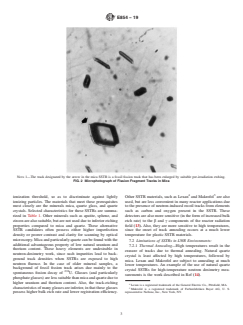
NOTE 1—The track designated by the arrow in the mica SSTR is a fossil fission track that has been enlarged by suitable pre-irradiation etching.
FIG. 2 Microphotograph of Fission Fragment Tracks in Mica
4 5
ionization threshold, so as to discriminate against lightly Other SSTR materials, such as Lexan and Makrofol are also
ionizing particles. The materials that meet these prerequisites used, but are less convenient in many reactor applications due
most closely are the minerals mica, quartz glass, and quartz to the presence of neutron-induced recoil tracks from elements
crystals. Selected characteristics for these SSTRs are summa- such as carbon and oxygen present in the SSTR. These
rized in Table 1. Other minerals such as apatite, sphene, and detectorsarealsomoresensitive(intheformofincreasedbulk
zirconarealsosuitable,butarenotusedduetoinferioretching etch rate) to the β and γ components of the reactor radiation
properties compared to mica and quartz. These alternative field (13). Also, they are more sensitive to high temperatures,
SSTR candidates often possess either higher imperfection since the onset of track annealing occurs at a much lower
density or poorer contrast and clarity for scanning by optical temperature for plastic SSTR materials.
microscopy.Micaandparticularlyquartzcanbefoundwiththe
7.2 Limitations of SSTRs in LWR Environments:
additional advantageous property of low natural uranium and
7.2.1 Thermal Annealing—High temperatures result in the
thorium content. These heavy elements are undesirable in
erasure of tracks due to thermal annealing. Natural quartz
neutron-dosimetry work, since such impurities lead to back-
crystal is least affected by high temperatures, followed by
ground track densities when SSTRs are exposed to high
mica. Lexan and Makrofol are subject to annealing at much
neutron fluence. In the case of older mineral samples, a
lower temperatures. An example of the use of natural quartz
background of fossil fission track arises due mainly to the
crystal SSTRs for high-temperature neutron dosimetry mea-
spontaneous fission decay of U. Glasses (and particularly
surements is the work described in Ref (14).
phosphateglasses)arelesssuitablethanmicaandquartzdueto
higher uranium and thorium content. Also, the track-etching
Lexan is a registered trademark of the General Electric Co., Pittsfield, MA.
characteristicsofmanyglassesareinferior,inthattheseglasses 5
Makrofol is a registered trademark of Farbenfabriken Bayer AG, U. S.
possess higher bulk etch rate and lower registration efficiency. representative Naftone, Inc., New York, NY.
E854−19
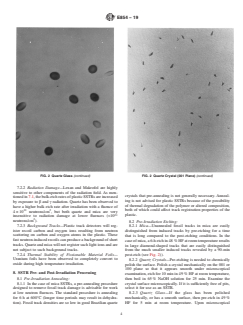
FIG. 2 Quartz Glass (continued)
FIG. 2 Quartz Crystal (001 Plane) (continued)
7.2.2 Radiation Damage—Lexan and Makrofol are highly
sensitive to other components of the radiation field. As men-
crystals that pre-annealing is not generally necessary. Anneal-
tionedin7.1,thebulk-etchratesofplasticSSTRsareincreased
ing is not advised for plastic SSTRs because of the possibility
by exposure to β and γ radiation. Quartz has been observed to
of thermal degradation of the polymer or altered composition,
have a higher bulk etch rate after irradiation with a fluence of
21 2
both of which could affect track registration properties of the
4×10 neutrons/cm , but both quartz and mica are very
plastic.
insensitive to radiation damage at lower fluences (<10
neutrons/cm ).
8.2 Pre-Irradiation Etching:
7.2.3 Background Tracks—Plastic track detectors will reg-
8.2.1 Mica—Unannealed fossil tracks in mica are easily
ister recoil carbon and oxygen ions resulting from neutron
distinguished from induced tracks by pre-etching for a time
scattering on carbon and oxygen atoms in the plastic. These
that is long compared to the post-etching conditions. In the
fastneutron-inducedrecoilscanproduceabackgroundofshort
caseofmica,a6-hetchin48%HFatroomtemperatureresults
tracks.Quartzandmicawillnotregistersuchlightionsandare
in large diamond-shaped tracks that are easily distinguished
not subject to such background tracks.
from the much smaller induced tracks revealed by a 90-min
7.2.4 Thermal Stability of Fissionable Material Foils—
post-etch (see Fig. 2)).
Uranium foils have been observed to completely convert to
8.2.2 Quartz Crystals—Pre-etching is needed to chemically
oxide during high temperature irradiation.
polish the surface. Polish a crystal mechanically on the 001 or
100 plane so that it appears smooth under microscopical
8. SSTR Pre- and Post-Irradiation Processing
examination, etch for 10 min in 49% HF at room temperature,
8.1 Pre-Irradiation Annealing: then boil in 65% NaOH solution for 25 min. Examine the
8.1.1 In the case of mica SSTRs, a pre-annealing procedure crystal surface microscopically. If it is sufficiently free of pits,
designed to remove fossil track damage is advisable for work select it for use as an SSTR.
at low neutron fluences. The standard procedure is annealing 8.2.3 Quartz Glass—If the glass has been polished
for6hat 600°C (longer time periods may result in dehydra- mechanically, or has a smooth surface, then pre-etch in 49%
tion). Fossil track densities are so low in good Brazilian quartz HF for 5 min at room temperature. Upon microscopical
E854−19
TABLE 1 Characteristics of SSTR Candidates for LWR Reactor Applications
Conditions Under
Which Accurate An- Track
A
SSTR Optical Efficiency, % Asymptotic Sensitivity
nealing Corrections Reduction, %
Can Be Made
B 19 C C
Muscovite mica 0.9875 ± 0.0085 (1.144 ± 0.018) × 10 501°C, 146.5 h 0
238 2B
U atoms/cm
D
Makrofol N 95.2 ± 0.53 . . .
E C C
Quartz glass ;70 . 402°C, 8 h 73
E F F
Natural quartz ;80 . 857°C, 1 h 20
Crystal
A
Needs to be known only if used with asymptotically thick sources.
B
Etched 90 min in 49 % HF (6, 7, 8).
C
Data from Ref (9).
D
Etched ;20 h in 6.2 N KOH solution at room temperature (6).
E
Quartz glass etched 5 min in 48 % HF at room temperature. Quartz crystal etched in boiling 65 % NaOH solution for 25 min (10, 11).
F
Data from Ref (12).
examination a few etch pits may be present even in good- 9.1.1.1 Accurately known total mass and mass density. The
qualityquartzglass.Ifso,theywillbelargerthantracksdueto overall accuracy of the mass calibration must be consistent
fission fragments revealed in the post-etch, and readily distin- with the desired overall accuracy of the measurement.
guished from them. 9.1.1.2 Accurately known isotopic composition. Possible
8.2.4 Plastic-Track Recorders—If handled properly, back-
interfering isotopes must be minimized and the overall fission
ground from natural sources, such as radon, will be negligible. rate must be corrected for contributions from interfering
Consequently, both pre-annealing and pre-etching should be
isotopes.
unnecessary.
9.1.1.3 Negligible Impurities—Impurities that contribute to
the measured fission rate must be minimized (< 1% contribu-
8.3 Post-Irradiation Etching:
tion) and the overall fission rate must be corrected for
8.3.1 Mica—Customaryetchingisfor90minin49%HFat
contributions from impurities.
room temperature. Both the etch time and temperature may be
9.1.1.4 High uniformity is recommended. An independent
varied to give optimum track sizes for the particular type of
measurement is required which verifies the uniformity of the
mica used. Except for work at the highest accuracy levels,
deposit to an uncertainty commensurate with the desired
precise control of the temperature is not necessary due to the
accuracy of subsequent measurements using the deposit.
zero bulk etch rate of the mica perpendicular to the cleavage
Conversely,useofnonuniformdepositsentailsscanningofthe
planes. In the event that precise etching control is necessary, a
entire SSTR surface to attain accurate results.
technique has been demonstrated for mica that permits highly
9.1.2 As has already been stated in 3.2, the accuracy of
reproducible and standardized track size distributions (10).
fission deposit characterization provides a fundamental limita-
8.3.2 Quartz Crystals—Etch for 25 min in boiling 65%
tion for the accuracy of the SSTR method. Fission-deposit
NaOH solution. Minimize evaporation by covering the nickel
massassayaswellasuniformityareimportant.Dosimetrygoal
or platinum crucible in which the solution is heated. If left
accuracies provide bounds for the acceptable quality of SSTR
open, condense evaporated water and return to the solution.
fissiondeposits.Forworkatthehighestaccuracylevels,fission
The value of the optical efficiency is dependent on the etching
deposits can be prepared at close to or better than 1% mass
conditions (since the bulk etch rate is not zero), so both the
assay. Less accurate SSTR dosimetry can, however, be per-
concentration of the NaOH solution and the etching tempera-
formed at a lower cost with less stringent requirements for
ture must be controlled.
fission deposit characterization. The deposit backing should
8.3.3 Quartz Glass—Etch for 5 min in 48% HF at room
contribute negligible background and the deposit should be
temperature. Temperature control is essential because of the
flat, rigid, and capable of maintaining good contact with the
high bulk etch rate.
4 5
SSTR. The deposit should be firmly adherent to the backing.
8.3.4 Lexan, or Makrofol , N—Various time temperature
The appropriate mass density for a particular LWR application
combinations in 6.2 N NaOH or KOH solution have proved
may be calculated from:
satisfactory, depending upon the desired purpose. Examples of
appropriate conditions are: (1)50hin 6.2N NaOH solution at
ρM
φt 3 W 5 (1)
20°C, (2)24hin 6.2 N KOH solution at 20°C, and (3)30min
ηN σ¯I
o
in 6.2 N KOH solution at 50°C.
where:
9. SSTR Fissionable Deposits
φt = the expected fluence,
W = the mass density of the deposit, g/cm ,
9.1 Properties:
ρ = the track density (the optimum track density for most
9.1.1 Fission Deposit Characteristics— Perhaps the most
4 2
manual scanning is about 5×10 tracks/cm ),
critical factor in attaining high accuracy in SSTR neutron
I = the isotopic abundance (atomic fraction),
dosimetry is the quality of the fission deposit. High quality
η = the optical efficiency of the SSTR,
SSTR fission deposits possess the following characteristics:
σ = the spectral average fission cross section,
(6-17)
E854−19
239 241
neighbors Puand Pumustbeminimized.Forlowfluence
M = the average atomic weight of the isotopic mixture
rate measurements, contributions from spontaneously fission-
used, and
ing nuclides must be minimized and if necessary spontaneous
N = Avogadro’s number (6.022×10 ).
o
fission track contributions must be subtracted.
9.1.3 In Eq 1, the assumption is made that the thickness
(mass density) of the deposit is much less than the range of a
9.3 Source Preparation:
fission fragment in the deposit material. Under these
9.3.1 Electrodepositionandvacuumdepositionarethemost
conditions, self-absorption is negligible and sensitivity de-
frequently used and the most effective techniques. The latter
pendslinearlyon W.Fordepositthicknessesgreaterthanabout
method normally results in more uniform deposits, but
100 µ/cm , self-absorption of fission fragments by the deposit
economyofmaterialandconveniencemayfavortheformer.In
becomes increasingly important. For deposit thicknesses
both cases, actinide deposits are produced more easily in the
greaterthantwicetherangeofafissionfragmentinthedeposit
oxidethaninthemetallicform.Adherenceofthedeposittothe
material, the effective thickness may be represented by a
backing material can often be accomplished by heating the
constant value. This constant value is referred to as the
deposit to red heat in an inert atmosphere. Uniformity can be
asymptotic sensitivity, s . It can be analytically shown (6) for
∞
demonstratedbyα-autoradiographyusinganα-sensitiveSSTR
a uniform deposit with no fluence rate depression that the
such as cellulose nitrate or by fission track radiography with
asymptotic sensitivity is approximately given by:
uniform neutron field irradiations.
R
~ !
9.3.2 Metallic backing for the fission deposit should be
s .η (2)
`
chosen to meet a number of requirements. For dosimetry
purposes the backing should only be thick enough to ensure
where:
firm contact between the track recorder and the deposit (see
^R& = the mean fission fragment range in the deposit.
Fig. 1). Furthermore, since it is preferable that no foreign
In the case of uranium metal, an asymptotic sensitivity of
elementsbeintroducedintotheradiationenvironment,backing
4.522 6 0.070 mg/cm has been measured (6,8). Thicknesses
materialsshouldbechosenwhereverpossiblefromconstituent
in the approximate range from 0.1 to 30 mg/cm should be
elements that already exist in the radiation environment.
avoidedduetoproblemsarisingfromself-absorptionoffission
Neutron field perturbations due to the backing are considered
fragments in the source. While it is possible to work in this
in Section 12. For high-fluence measurements, extremely
range, additional error will be incurred due to the need to
pure-backing materials are required in order to reduce back-
correct for self-absorption. In the region beyond 30 mg/cm ,
ground fission tracks from natural uranium and thorium impu-
one should use the asymptotic sensitivity.
rities.The surface of the backing material must be smooth and
9.2 Isotopes Required—In general, when performing reac-
preferably possess a mirror finish.
tionratemeasurementsforaparticularisotope,contributionsto
9.4 Mass Assay:
thefissionratefromotherisotopesmustbeeithernegligibleor
corrected with sufficient accuracy. For example, use of the 9.4.1 Absolute Disintegration Rate—Mass assay may be
accomplished by absolute α-counting using a low geometry
threshold reaction U (n,f) in a neutron field where the
thermal fluence rate is appreciable requires highly depleted α-counter (6). In many cases, the alpha decay constant is
known to an accuracy of better than 1%. In fact, the uncer-
uranium in order to minimize contributions from U (n,f).
Similarly chemical purity must be taken into account. When tainty of the alpha decay constant provides a fundamental
limitation in this mass-assay method. Relative masses of
measuring the reaction rate for an even-even nuclide such as
Pu, the abundance of the fissionable even-odd isotopic severalsourcesofthesameisotopemaybeestablishedtobetter
TABLE 2 Decay Constants and Associated Uncertainties Used in Actinide Mass Quantification
Reference (15)
−1
Nuclide t (years) λ(s ) Uncertainty, %
1/2
Vol Year Page
230 4 −13
Th (7.538 ± 0.030) × 10 2.914 × 10 0.40 77 1996 433
232 10 −18
Th (1.405± 0.006) × 10 1.563 × 10 0.43 80 1997 723
233 5 −13
U (1.592 ± 0.020) × 10 1.380 × 10 1.26 109 2008 2657
234 5 −14
U (2.455 ± 0.006) × 10 8.947 × 10 0.24 113 2012 2113
235 8 −17
U (7.038 ± 0.005) × 10 3.121 × 10 0.07 114 2013 751
237 A −6
U 6.75 ± 0.01 days 1.189 × 10 0.15 107 2006 3323
238 9 −18
U (4.468 ± 0.003) × 10 4.916 × 10 0.07 108 2007 681
237 6 −14
Np (2.144 ± 0.007) × 10 1.024 × 10 0.33 105 2005 109
239 A −6
Np 2.356 ± 0.003 days 3.405 × 10 0.13 98 2003 665
236 A −9
Pu 2.858 ± 0.008 7.685 × 10 0.28 107 2006 2579
238 1 −10
Pu (8.770 ± 0.010) × 10 2.505 × 10 0.11 108 2007 681
239 4 −13
Pu (2.411 ± 0.003) × 10 9.110×10 0.12 98 2003 665
240 3 −12
Pu (6.561 ± 0.007) × 10 3.348 × 10 0.11 107 2006 2649
241 B 1 −9
Pu (1.429 ± 0.0006) × 10 1.537 × 10 0.04 106 2005 89
242 5 −14
Pu (3.735 ± 0.011) × 10 5.881 × 10 0.29 97 2002 129
A
Tracer materials used for quantification of low mass primary deposits (may be α or β/γ emitters, or both).
B −3 5
The branching ratio for alpha emission is (2.46 ± 0.01) × 10 %. The partial half-life for alpha decay is 5.79 × 10 years (±3.2 %).
E854−19
than 1% by α-counting in a 2π proportional counter. (See oftheuncertaintiesinherentinthemeasurementsoftherelative
Table 2 for a summary of alpha decay constants of the actinide U gamma decay rates must be taken into account. Among
elements (15).) these uncertainties are the precision of the source to detector
geometry and the Poisson statistics of the number of gamma
9.4.2 Mass Spectrometry—Mass spectrometry combined
ray counts recorded for each deposit. In order to determine an
withisotopicdilutiontechniquesisapotentiallyusefulmethod
absolute mass scale, a measurement of gamma decay rate to
for mass assay of deposits. Mass spectrometry is particularly
absolute mass must be performed. Often this measurement
useful for low specific activity isotopes or isotopes with decay
corresponds to a relative gamma decay rate to absolute alpha
constants that have not been measured to an accuracy of 1%.
decay rate measurement for a sample where both rates can be
While mass spectrometry can provide accuracies of better than
measured with sufficient accuracy. When an alpha emitting
1%, it suffers from an inherent disadvantage, namely the need
236 239
spike is used, such as Pu to measure relative Pu masses,
for destructive analysis.
only the relative alpha peak intensities need be measured.
9.4.3 Isotopic Spikes—High specific activity isotopes may
However, the uncertainties in the alpha decay constants (half-
be used as a tracer to indicate target mass. Alpha active
230 236 238
lives) of both the spike isotope and the fissionable deposit
isotopes such as Th, Pu, and Pu as well as
237 239
isotope contribute to the overall uncertainty. For short-lived
γ-emitting isotopes such as U and Np are useful for
237 239
spikes such as U (6.75 d) or Np (2.34 d), decay
relative mass determinations.When using isotopic spikes, care
corrections must be made. An alternative method (3) which
must be taken to ensure that the source isotope and the spike
eliminates the uncertainties contributed by the decay correc-
are chemically equivalent.Also, the fission rate of the isotopic
tionsistousemultipledetectorswhichareoperatedinparallel.
spike and its daughter products should be kept negligible
Relative gamma decay rates for U can be determined with a
compared to the fission rate of the isotope of interest. The use
set of ten thin-window proportional counters setting aside one
of isotopic spikes that feed complex decay chains (such as
228 232
counter for a standard that is also a fissionable deposit. In each
Th and U) should be avoided.
set of ten counts, the decay rate of nine deposits is measured
9.4.4 Less Frequently Used Methods—Ion, X-ray, and Au-
relative to the standard that is following the same radioactive
ger microprobe analysis, X-ray fluorescence, neutron activa-
half-life. However, corrections must be made for small effi-
tion analysis, and wet chemical analysis methods may be
ciencydifferencesinasetoften“identical”detectorsaswellas
useful for specific applications, but rarely attain an accuracy
for detector cross-link and detector background, and the
comparable to previously mentioned methods.
uncertainties in these corrections all contribute to the overall
9.5 Ultra Low-mass Deposits—Methods for producing and
uncertainty. A useful strategy in ultra low-mass deposit cali-
calibrating ultra low-mass fissionable deposits are described in
bration is to ensure that the additional uncertainties added by
reference (3). Because of the low masses involved, typically
the addition of the spiking step are kept smaller than 0.5% by
−14 −9
10 to10 grams,caremustbetakentoavoidcontamination
the design of the spiking procedures.
of the deposits. Therefore, the deposits must be made under
9.5.3 Independent Mass Calibration Verification—Because
clean conditions using high-purity materials and chemical
of the added complexities of the production and calibration of
reagents.
the ultra low-mass deposits used in reactor cavity neutron
9.5.1 Mass Calibration—Isotopic spiking methods (see
dosimetry (2-5), deposits made for this application have been
9.4.3)areused,andoftenthelimitationontheamountofspike
subjectedtoindependentmasscalibrationaccuracyverification
isotope that can be added is the extent of the contribution of
through irradiations in standard reference neutron fields at
either impurity isotopes or daughter isotopes to the overall
NIST and elsewhere (16). Typically, one deposit from each
fission rate of the deposit. For the case when short-lived Np
ultra low-mass electroplating series is subjected to a bench-
is used as a tracer for Np, the eventual decay of the spike to
mark irradiation, although, in some cases, multiple deposits
Pu must be considered as it will contribute to the overall
fromaserieshavebeenirradiated.TheseirradiationsandNIST
239 37
fissionrateofthedeposit.Therefore,the Np/ Npratiomust
comparisons are consistent with the expected uncertainty of
239 237
be kept small enough to ensure that the resultant Pu/ Np
2% for the spike measurement mass scales and show that the
fission rate ratio in the measured neutron spectrum will be
absolute mass scales are consistent to 5%. Because ultra
small (typically less than 0.5%). After the fission rate mea-
low-massdepositsaremadebyelectroplatingmethods,unifor-
surements are performed, the spike contribution to the fission
mityismoredifficulttocontrolthanforvacuum-evaporatedor
rate must be confirmed to be small by calculating the fission
sputtered deposits, but the uncertainty contribution of this
rate due to the known amount of Pu from the spike using
non-uniformity is less than 2%. The overall uniformity does
the measured fission rate from a Pu deposit exposed in the
contributetothefluencelimitthatcanbeobtainedasdiscussed
same dosimetry location.
subsequently in Section 11.4.2.1.
9.5.2 Ultra Low-Mass Deposit Calibration Uncertainties—
Additional uncertainties exist in the calibration of ultra low-
10. Manual Track-Scanning Procedures
mass deposits because of the additional steps necessary in the
10.1 Equipment and Calibration:
overall calibration.When isotopic spiking methods are used to
determine the relative mass scale for a set of fissionable 10.1.1 For manual scanning, a good research quality bin-
deposits, the uncertainty in the measurement of the relative ocular microscope is required, having a stage equipped with
radioactivity must be taken into account. For example, when two dials or micrometers that make it possible to estimate the
237 235 238
short-lived U is used as a tracer for either Uor U, all x and y position of the stage to the nearest micrometer. One
E854−19
eyepieceshouldcontainasquaregrid(onewith36squareshas 10.2.4 Count tracks with a tally counter; the scanner should
been found to be highly satisfactory). The grid should cover a be free to work the fine focus control while tracks are being
counted so that tracks will be kept in sharp focus.
large fraction of the field of view. Take care to adjust the
10.2.5 When scanners are first trained, they should not be
microscopes so that good Kohler illumination and adequate
told what to count. Rather, they should be asked to examine
image contrast is obtained. This is especially true when
regions of the SSTR that do not contain tracks, so that they
asymptotically thick deposits are used (since many of the
teach themselves to distinguish surface blemishes from fission
tracks are short and possess lower optical contrasts).
tracks.Inthisway,carefulscannersgenerallyconvergequickly
10.1.2 Calibrate the width of the grid for each lens combi-
to good agreement. If difficulties persist, different scanners
nation with a stage micrometer and estimate to the nearest 1
may be asked to count tracks in the same field in order to
µm. The linearity and accuracy of the dials or micrometers
remove small discrepancies. By using this procedure, observer
mustalsobecheckedandcalibratedwiththestagemicrometer.
biases are generally minimized and objectivity is established.
10.1.3 Itisimportantthattheinstructionsinthemicroscope
10.2.6 It is important that the SSTR surface be clean when
manual be studied and followed to optimize contrast and
scanned. Accomplish this by putting a cover glass over the
resolution. If transmitted bright field illumination is used
surface of a clean SSTR ready for counting. If this is not
5 4
(highly satisfactory for mica and Makrofol N or Lexan ),
feasible the SSTR should be cleaned, if necessary, before the
contrast and resolution may be improved by using oblique
tracks are counted.
instead of axial illumination, if available. Especially good
contrastisobtainedinquartzglasswhenreflectedlightisused.
11. Automated Track Counting
10.2 Manual Track Counting Procedure: 11.1 Introduction:
11.1.1 A major inconvenience of detection methods using
10.2.1 Two situations need to be considered: (1) When it is
tracks is the necessity for manual, visual measurement of
essential to count all of the fission tracks in the SSTR, which
tracks, a task that requires care, patience, and dedication. This
canarisewhenthefissiondepositisnotsufficientlyuniformfor
drawback is especially significant for precision measurements,
thedesiredaccuracy,and(2)whenonlyafractionofthetracks
where inherent statistical limitations require the observation of
need be counted to obtain the desired statistical accuracy.
large numbers of tracks, making the task time consuming and
10.2.2 For case (1), the scanner should find one edge of the
expensive.Asaconsequence,worldwideexpertiseinprecision
region containing tracks and systematically cover the total
applicationsofSSTRmethodsisquitelimited.Amoredetailed
area.Aproven method (6) is to align the grid carefully so that
discussion of these requirements can be found in a critical
theverticallinesareparalleltothe ymotion—atrackorsurface
review of the SSTR method (17).
blemishshouldmoveonagridlineasthestageismovedalong
11.1.2 Eliminationofthehumanelementishighlydesirable
the y-axis.Donotcounttrackstouchingorcrossingtheleftand
for precise track measurements, since it allows the observation
top grid lines, count those touching or crossing the right and
of larger numbers of tracks and permits the introduction of
bottom grid lines. When all the tracks in a given field are
more quantitative standards of track identification and back-
countedfromlefttorightandfromtoptobottomasinreading,
ground subtraction. Such standards would obviate problems of
atrackorblemishcrossingortouchingthetoplineismovedin
personal bias in manual track measurements, which can other-
the y direction until it is in the corresponding position on the
wise compromise experimental accuracy. In order to attain
bottom line. After the tracks moved into the field are counted
high accuracy, such biases must constantly be guarded against
as before, repeat the process until all the tracks in the given y
in manual track scanning. Therefore, a considerable interest
swath have been counted. If tracks on the right edge of the
has existed, and continues to exist, in the automation of this
region containing the tracks have been counted, move a track
scanning task. A perhaps tacit, but certainly reasonable as-
orsurfaceblemishontheleftlinetothecorrespondingposition
sumption is that any such automated system must provide at
on the right grid line, and count all of the tracks in a new y
least comparable accuracy to manual scanning techniques.
swath. Repeat this procedure over the entire area containing
Only under such a condition can the high accuracy goals of
tracks; count all tracks. If track densities are sufficiently small,
current SSTR applications be maintained.
tracksmaybecountedastheycrossahorizontalgridlineasthe
11.2 Background:
SSTR is moved continuously in the y direction, instead of
11.2.1 Since the late 1960s, considerable effort has been
counting tracks field by field.
expended by many groups in attempts to automate track
10.2.3 In case (2), the procedure is the same, except that a
scanning. Spark scanning methods have been developed (18-
region removed from the edges of the track distribution is
21) but have not been widely used due to limitations in
3 3
selected for counting. The area scanned is determined by
accuracy (10-20%) and track density (less than 10 /cm ).
observingtheinitialandfinalreadingsofthecalibrateddialfor
More sophisticated systems employed an optical microscope
the y-axis, and multiplying the difference by the width of the
undercomputercontrol (22-30)Theavailabilityofinexpensive
grid as measured by a stage micrometer. This may be repeated
computers has afforded considerable progress in automated
for more scanning swaths which need not be adjacent. This
scanningcapability (31-33).Ofequalsignificancehasbeenthe
case offers the advantage to the scanner of selecting the best development high-quality video camera image analysis sys-
counting region if surface blemishes mar certain regions of the
tems. In addition to scarcely compromising microscopic reso-
SSTR. lution and contrast, contemporary camera systems provide
E854−19
digital signals that afford dramatic improvements for auto- performdetaileduniformitymeasurementstohighaccuracyon
mated pattern recognition. It is best to consult the most recent each deposit to be used. For track densities lower than8×10
literature for details on these highly-specialized techniques. tracks/cm , 2% uncertainties were shown to be generally
attainable using fissionable deposits made with ultra law-mass
11.3 Automated Track Counting System:
electroplating techniques (4,34) and having uniformities typi-
11.3.1 Equipment and Calibration:
cal of deposits made with these methods. It has been shown
11.3.1.1 A good research-quality microscope is required,
that this track pile-up limitation is allayed by using the Buffon
equipped with a motor-driven stage that can be controlled by a
Needle Method (31) of track scanning which may provide a
computer and can be repositioned with an accuracy of 61 µm.
method to obtain acceptable results at higher track densities.
11.3.1.2 A computer input corresponding to the visual
The Buffon Needle method is, in turn, particularly well suited
imagefromthemicroscopemustbeobtained.Onemethodisto
for automated scanning systems. It has been demonstrated that
view the microscope image with a video camera and digitize
the random sampling procedure of the Buffon Needle method
the video image for input to a suitable image analysis com-
can be replaced by sampling on a fixed network or grid of
puter.
points on the SSTR surface (32, 33).
11.3.2 Automated Track Counting Procedure:
11.4.2.2 In these efforts, the probability distribution for
11.3.2.1 A consistent and verifiable procedure (software or
fixed grid sampling has been rigorously derived and this result
hardware,orboth)mustbedevelopedfortheidentificationand
has been proven through comparison with experiment down to
counting of tracks. This procedure may include gray level
the level of approximately 1% (1σ). Moreover, fixed grid
discrimination, image-enhancement, pattern recognition or
sampling provides significantly more alleviation from pile-up
otherproceduresthataidintrackidentification,orcombination
effects than even the Buffon Needle method. Using such
thereof.
techniques, automation promises to render practical many key
11.3.2.2 Following optimization of the automated track
experiments for power reactor environments that were hereto-
counter parameters, counting of a series of track standards is
fore not feasible.
required to verify the operation of the scanner within the
11.4.2.3 Track counting methods used for low track densi-
desired accuracy. Whenever the scanning parameters are
ties can also be extended to the higher track regime. This
changed,recalibrationwithstandardsusingthenewparameters
involves using pattern recognition and statistical analysis to
is required.
decode patterns of touching and overlapping tracks and to
11.3.2.3 ItisimportantthattheSSTRsurfacebecleanwhen
correct for overlapping tracks that are not observed. Empirical
scanned. Accomplish this by putting a cover glass over the
approaches can be used to establish system calibrations.
surface of a clean SSTR ready for counting. For automated
Another method that may be applied to minimize pile-up is to
scanning, the quality of the SSTR can be particularly impor-
underdevelop the tracks.
tant.CareshouldbetakentoensurethattheSSTRsurfaceisas
11.4.2.4 Each of the above methods has limitations that
free as possible of cracks, scratches, dust, or other sources of
increase the uncertainty. It is therefore important for each
visual interference.
laboratory to rigorously assess the accuracy of the method
11.4 High Precision Applications:
chosen to analyze automated track data.
11.4.1 Low and Medium Track Density Analysis—Analysis
11.5 Automated System Calibration:
of an SSTR with low track densities can be done by counting
11.5.1 Precision automated analysis of an SSTR requires
trackstakingeachcontiguousareaasonetrack.Correctionsfor
detailed calibration of the system to ensure accurate results
pile-up are small and may be made by a variety of methods. It
over the range of track recorders analyzed. Calibration meth-
is also necessary to correct for background arising from
ods include:
imperfections in the track recorder, which the automated
11.5.1.1 Comparison with manual scanning results,
systemmayidentifyastracks.Othermethodsnormallyapplied
11.5.1.2 Analysis of standards, and
forhightrackdensitiescanalsobeusedforlowtrackdensities,
11.5.1.3 Comparison between automated methods.
if the background can be handled accurately.
11.5.2 In addition to initial calibration of the system, the
11.4.2 High Track Density Analysis:
experimentermustbeawareofthevariousparametersaffecting
11.4.2.1 Atextremelyhightrackdensities,overlapoftracks
the result (including, for example, track size, light level, SSTR
can become so great that individual tracks can no longer be
quality, background, and track density uniformity).Aprogram
distinguished. An analysis of track density uncertainty as a
for periodic analysis of standards is therefore necessary to
function of track density appears in reference 34. The uncer-
preclude system changes. In addition, each batch of track
tainty attained in track density measurements will likely be a
recorders should be checked to ensure that no unexpected
different function of track density for different automated
differences are affecting the results.
scanningsystems.Inonestudy (34),trackdensityuncertainties
less than 2% were found to be generally unattainable for track
5 2 12. Neutron Field Perturbations
densities greater than8×10 tracks/cm . The high track
density limit will also depend on the degree of uniformity of 12.1 Introduction of a pa
...
This document is not an ASTM standard and is intended only to provide the user of an ASTM standard an indication of what changes have been made to the previous version. Because
it may not be technically possible to adequately depict all changes accurately, ASTM recommends that users consult prior editions as appropriate. In all cases only the current version
of the standard as published by ASTM is to be considered the official document.
´1
Designation: E854 − 14 E854 − 19
Standard Test Method for
Application and Analysis of Solid State Track Recorder
(SSTR) Monitors for Reactor Surveillance
This standard is issued under the fixed designation E854; the number immediately following the designation indicates the year of
original adoption or, in the case of revision, the year of last revision. A number in parentheses indicates the year of last reapproval. A
superscript epsilon (´) indicates an editorial change since the last revision or reapproval.
ε NOTE—The title of this test method and the Referenced Documents were updated editorially in May 2017.
1. Scope
1.1 This test method describes the use of solid-state track recorders (SSTRs) for neutron dosimetry in light-water reactor (LWR)
applications. These applications extend from low neutron fluence to high neutron fluence, including high power pressure vessel
surveillance and test reactor irradiations as well as low power benchmark field measurement. (1) This test method replaces
Method Special E418. This test method is more detailed and special attention is given to the use of state-of-the-art manual and
automated track counting methods to attain high absolute accuracies. In-situ dosimetry in actual high fluence-high temperature
LWR applications is emphasized.
1.2 This test method includes SSTR analysis by both manual and automated methods. To attain a desired accuracy, the track
scanning method selected places limits on the allowable track density. Typically, good results are obtained in the range of 5 to
800 000 tracks/cm and accurate results at higher track densities have been demonstrated for some cases. (2) Track density and
other factors place limits on the applicability of the SSTR method at high fluences. Special care must be exerted when measuring
16 2
neutron fluences (E>1MeV) above 10 n/cm (3).
1.3 Low fluence and high fluence limitations exist. These limitations are discussed in detail in Sections 13 and 14 and in Refs
(3-5).
1.4 SSTR observations provide time-integrated reaction rates. Therefore, SSTRSSTRs are truly passive-fluence detectors. They
provide permanent records of dosimetry experiments without the need for time-dependent corrections, such as decay factors that
arise with radiometric monitors.
1.5 Since SSTRSSTRs provide a spatial record of the time-integrated reaction rate at a microscopic level, they can be used for
“fine-structure” measurements. For example, spatial distributions of isotopic fission rates can be obtained at very high resolution
with SSTR.SSTRs.
1.6 This standard does not purport to address all of the safety problems concerns, if any, associated with its use. It is the
responsibility of the user of this standard to establish appropriate safety safety, health, and healthenvironmental practices and
determine the applicability of regulatory limitations prior to use.
1.7 This international standard was developed in accordance with internationally recognized principles on standardization
established in the Decision on Principles for the Development of International Standards, Guides and Recommendations issued
by the World Trade Organization Technical Barriers to Trade (TBT) Committee.
2. Referenced Documents
2.1 ASTM Standards:
E418 Test Method for Fast-Neutron Flux Measurements by Track-Etch Techniques (Withdrawn 1984)
E844 Guide for Sensor Set Design and Irradiation for Reactor Surveillance
This test method is under the jurisdiction of ASTM Committee E10 on Nuclear Technology and Applications and is the direct responsibility of Subcommittee E10.05
on Nuclear Radiation Metrology.
Current edition approved July 1, 2014Nov. 1, 2019. Published October 2014December 2019. Originally approved in 1981. Last previous edition approved in 20092014
ɛ1
as E854 – 03E854 – 14 (2009). DOI: 10.1520/E0854-14E01.10.1520/E0854-19.
The boldface numbers in parentheses refer to the list of references appended to this test method.
For referenced ASTM standards, visit the ASTM website, www.astm.org, or contact ASTM Customer Service at service@astm.org. For Annual Book of ASTM Standards
volume information, refer to the standard’s Document Summary page on the ASTM website.
Copyright © ASTM International, 100 Barr Harbor Drive, PO Box C700, West Conshohocken, PA 19428-2959. United States
E854 − 19
3. Summary of Test Method
3.1 SSTRSSTRs are usually placed in firm surface contact with a fissionable nuclide that has been deposited on a pure
nonfissionable metal substrate (backing). This typical SSTR geometry is depicted in Fig. 1. Neutron-induced fission produces latent
fission-fragment tracks in the SSTR. These tracks may be developed by chemical etching to a size that is observable with an optical
microscope. Microphotographs of etched fission tracks in mica, quartz glass, and natural quartz crystals can be seen in Fig. 2.
3.1.1 While the conventional SSTR geometry depicted in Fig. 1 is not mandatory, it does possess distinct advantages for
dosimetry applications. In particular, it provides the highest efficiency and sensitivity while maintaining a fixed and easily
reproducible geometry.
3.1.2 The track density (that is, the number of tracks per unit area) is proportional to the fission density (that is, the number of
fissions per unit area). The fission density is, in turn, proportional to the exposure fluence experienced by the SSTR. The existence
of nonuniformity in the fission deposit or the presence of neutron fluence rate gradients can produce non-uniform track density.
Conversely, with fission deposits of proven uniformity, gradients of the neutron field can be investigated with very high spatial
resolution.
3.2 The total uncertainty of SSTR fission rates is comprised of two independent sources. These two error components arise from
track counting uncertainties and fission-deposit mass uncertainties. For work at the highest accuracy levels, fission-deposit mass
assay should be performed both before and after the SSTR irradiation. In this way, it can be ascertained that no significant removal
of fission deposit material arose in the course of the experiment.
4. Significance and Use
4.1 The SSTR method provides for the measurement of absolute-fission density per unit mass. Absolute-neutron fluence can
then be inferred from these SSTR-based absolute fission rate observations if an appropriate neutron spectrum average fission cross
section is known. This method is highly discriminatory against other components of the in-core radiation field. Gamma rays, beta
rays, and other lightly ionizing particles do not produce observable tracks in appropriate LWR SSTR candidate materials. However,
photofission can contribute to the observed fission track density and should therefore be accounted for when nonnegligible. For
a more detailed discussion of photofission effects, see 14.4.
4.2 In this test method, SSTRSSTRs are placed in surface contact with fissionable deposits and record neutron-induced fission
fragments. By variation of the surface mass density (μg/cm ) of the fissionable deposit as well as employing the allowable range
2 5 2
of track densities (from roughly 1 event/cm up to 10 events/cm for manual scanning), a range of total fluence sensitivity
2 2 18 2
covering at least 16 orders of magnitude is possible, from roughly 10 n/cm up to 5 × 10 n/cm . The allowable range of fission
track densities is broader than the track density range for high accuracy manual scanning work with optical microscopy cited in
1.2. In particular, automated and semi-automated methods exist that broaden the customary track density range available with
manual optical microscopy. In this broader track density region, effects of reduced counting statistics at very low track densities
and track pile-up corrections at very high track densities can present inherent limitations for work of high accuracy. Automated
scanning techniques are described in Section 11.
4.3 For dosimetry applications, different energy regions of the neutron spectrum can be selectively emphasized by changing the
nuclide used for the fission deposit.
4.4 It is possible to use SSTRSSTRs directly for neutron dosimetry as described in 4.1 or to obtain a composite neutron
detection efficiency by exposure in a benchmark neutron field. The fluence and spectrum-averaged cross section in this benchmark
field must be known. Furthermore, application in other neutron fields may require adjustments due to spectral deviation from the
benchmark field spectrum used for calibration. In any event, it must be stressed that the SSTR-fission density measurements can
be carried out completely independent of any cross-section standards (6). Therefore, for certain applications, the independent
FIG. 1 Typical Geometrical Configuration Used for SSTR Neutron Dosimetry
E854 − 19
NOTE 1—The track designated by the arrow in the mica SSTR is a fossil fission track that has been enlarged by suitable pre-irradiation etching.
FIG. 2 Microphotograph of Fission Fragment Tracks in Mica
nature of this test method should not be compromised. On the other hand, many practical applications exist wherein this factor is
of no consequence so that benchmark field calibration would be entirely appropriate.
5. Apparatus
5.1 Optical Microscopes, with a magnification of 200 × or higher, employing a graduated mechanical stage with position
readout to the nearest 1 μm and similar repositioning accuracy. A calibrated stage micrometer and eyepiece scanning grids are also
required.
5.2 Constant-Temperature Bath, for etching, with temperature control to 0.1°C.
5.3 Analytical Weighing Balance, for preparation of etching bath solutions, with a capacity of at least 1000 g and an accuracy
of at least 1 mg.
6. Reagents and Materials
6.1 Purity of Reagents—Distilled or demineralized water and analytical grade reagents should be used at all times. For high
fluence measurements, quartz-distilled water and ultra-pure reagents are necessary in order to reduce background fission tracks
from natural uranium and thorium impurities. This is particularly important if any pre-irradiation etching is performed (see 8.2).
6.2 Reagents:
6.2.1 Hydrofluoric Acid (HF), weight 49 %.
6.2.2 Sodium Hydroxide Solution (NaOH), 6.2 N.
6.2.3 Distilled or Demineralized Water.
6.2.4 Potassium Hydroxide Solution (KOH), 6.2 N.
6.2.5 Sodium Hydroxide Solution (NaOH), weight 65 %.
6.3 Materials:
E854 − 19
FIG. 2 Quartz Glass (continued)
6.3.1 Glass Microscope Slides.
6.3.2 Slide Cover Glasses.
7. SSTR Materials for Reactor Applications
7.1 Required Properties—SSTR materials for reactor applications should be transparent dielectrics with a relatively high
ionization threshold, so as to discriminate against lightly ionizing particles. The materials that meet these prerequisites most closely
are the minerals mica, quartz glass, and quartz crystals. Selected characteristics for these SSTRSSTRs are summarized in Table
1. Other minerals such as apatite, sphene, and zircon are also suitable, but are not used due to inferior etching properties compared
to mica and quartz. These alternative SSTR candidates often possess either higher imperfection density or poorer contrast and
clarity for scanning by optical microscopy. Mica and particularly quartz can be found with the additional advantageous property
of low natural uranium and thorium content. These heavy elements are undesirable in neutron-dosimetry work, since such
impurities lead to background track densities when SSTRSSTRs are exposed to high neutron fluence. In the case of older mineral
samples, a background of fossil fission track arises due mainly to the spontaneous fission decay of U. Glasses (and particularly
phosphate glasses) are less suitable than mica and quartz due to higher uranium and thorium content. Also, the track-etching
characteristics of many glasses are inferior, in that these glasses possess higher bulk etch rate and lower registration efficiency.
4 5
Other SSTR materials, such as Lexan and Makrofol are also used, but are less convenient in many reactor applications due to
the presence of neutron-induced recoil tracks from elements such as carbon and oxygen present in the SSTR. These detectors are
also more sensitive (in the form of increased bulk etch rate) to the β and γ components of the reactor radiation field (13). Also,
they are more sensitive to high temperatures, since the onset of track annealing occurs at a much lower temperature for plastic
SSTR materials.
7.2 Limitations of SSTRSSTRs in LWR Environments:
Lexan is a registered trademark of the General Electric Co., Pittsfield, MA.
Makrofol is a registered trademark of Farbenfabriken Bayer AG, U. S. representative Naftone, Inc., New York, NY.
E854 − 19
FIG. 2 Quartz Crystal (001 Plane) (continued)
7.2.1 Thermal Annealing—High temperatures result in the erasure of tracks due to thermal annealing. Natural quartz crystal is
least affected by high temperatures, followed by mica. Lexan and Makrofol are subject to annealing at much lower temperatures.
An example of the use of natural quartz crystal SSTRs for high-temperature neutron dosimetry measurements is the work described
in Ref (14).
7.2.2 Radiation Damage—Lexan and Makrofol are highly sensitive to other components of the radiation field. As mentioned
in 7.1, the bulk-etch rates of plastic SSTRSSTRs are increased by exposure to β and γ radiation. Quartz has been observed to have
21 2
a higher bulk etch rate after irradiation with a fluence of 4 × 10 neutrons/cm , but both quartz and mica are very insensitive to
21 2
radiation damage at lower fluences (<10 neutrons/cm ).
7.2.3 Background Tracks—Plastic track detectors will register recoil carbon and oxygen ions resulting from neutron scattering
on carbon and oxygen atoms in the plastic. These fast neutron-induced recoils can produce a background of short tracks. Quartz
and mica will not register such light ions and are not subject to such background tracks.
7.2.4 Thermal Stability of Fissionable Material Foils—Uranium foils habehave been observed to completely convert to oxide
during high temperature irradiation.
8. SSTR Pre- and Post-Irradiation Processing
8.1 Pre-Irradiation Annealing:
8.1.1 In the case of mica SSTR,SSTRs, a pre-annealing procedure designed to remove fossil track damage is advisable for work
at low neutron fluences. The standard procedure is annealing for 6 h at 600°C (longer time periods may result in dehydration).
Fossil track densities are so low in good Brazilian quartz crystals that pre-annealing is not generally necessary. Annealing is not
advised for plastic SSTRSSTRs because of the possibility of thermal degradation of the polymer or altered composition, both of
which could affect track registration properties of the plastic.
8.2 Pre-Irradiation Etching:
E854 − 19
TABLE 1 Characteristics of SSTR Candidates for LWR Reactor Applications
Conditions Under
Which Accurate An- Track
A
SSTR Optical Efficiency, % Asymptotic Sensitivity
nealing Corrections Reduction, %
Can Be Made
B 19 C C
Muscovite mica 0.9875 ± 0.0085 (1.144 ± 0.018) × 10 501°C, 146.5 h 0
238 2B
U atoms/cm
D
Makrofol N 95.2 ± 0.53 . . .
E C C
Quartz glass ;70 . 402°C, 8 h 73
E F F
Natural quartz ;80 . 857°C, 1 h 20
Crystal
A
Needs to be known only if used with asymptotically thick sources.
B
Etched 90 min in 49 % HF (6, 7, 8).
C
Data from Ref (9).
D
Etched ;20 h in 6.2 N KOH solution at room temperature (6).
E
Quartz glass etched 5 min in 48 % HF at room temperature. Quartz crystal etched in boiling 65 % NaOH solution for 25 min (10, 11).
F
Data from Ref (12).
8.2.1 Mica—Unannealed fossil tracks in mica are easily distinguished from induced tracks by pre-etching for a time that is long
compared to the post-etching conditions. In the case of mica, a 6-h etch in 48 % HF at room temperature results in large
diamond-shaped tracks that are easily distinguished from the much smaller induced tracks revealed by a 90-min post-etch (see Fig.
2)).
8.2.2 Quartz Crystals—Pre-etching is needed to chemically polish the surface. Polish a crystal mechanically on the 001 or 100
plane so that it appears smooth under microscopical examination, etch for 10 min in 49 % HF at room temperature, then boil in
65 % NaOH solution for 25 min. Examine the crystal surface microscopically. If it is sufficiently free of pits, select it for use as
an SSTR.
8.2.3 Quartz Glass—If the glass has been polished mechanically, or has a smooth surface, then pre-etch in 49 % HF for 5 min
at room temperature. Upon microscopical examination a few etch pits may be present even in good-quality quartz glass. If so, they
will be larger than tracks due to fission fragments revealed in the post-etch, and readily distinguished from them.
8.2.4 Plastic-Track Recorders—If handled properly, background from natural sources, such as radon, will be negligible.
Consequently, both pre-annealing and pre-etching should be unnecessary.
8.3 Post-Irradiation Etching:
8.3.1 Mica—Customary etching is for 90 min in 49 % HF at room temperature. Both the etch time and temperature may be
varied to give optimum track sizes for the particular type of mica used. Except for work at the highest accuracy levels, precise
control of the temperature is not necessary due to the zero bulk etch rate of the mica perpendicular to the cleavage planes. In the
event that precise etching control is necessary, a technique has been demonstrated for mica that permits highly reproducible and
standardized track size distributions (10).
8.3.2 Quartz Crystals—Etch for 25 min in boiling 65 % NaOH solution. Minimize evaporation by covering the nickel or
platinum crucible in which the solution is heated. If left open, condense evaporated water and return to the solution. The value of
the optical efficiency is dependent on the etching conditions (since the bulk etch rate is not zero), so both the concentration of the
NaOH solution and the etching temperature must be controlled.
8.3.3 Quartz Glass—Etch for 5 min in 48 % HF at room temperature. Temperature control is essential because of the high bulk
etch rate.
4 5
8.3.4 Lexan, or Makrofol , N—Various time temperature combinations in 6.2 N NaOH or KOH solution have proved
satisfactory, depending upon the desired purpose. Examples of appropriate conditions are: (1) 50 h in 6.2N NaOH solution at 20°C,
(2) 24 h in 6.2 N KOH solution at 20°C, and (3) 30 min in 6.2 N KOH solution at 50°C.
9. SSTR Fissionable Deposits
9.1 Properties:
9.1.1 Fission Deposit Characteristics— Perhaps the most critical factor in attaining high accuracy in SSTR neutron dosimetry
is the quality of the fission deposit. High quality SSTR fission deposits possess the following characteristics: (6-17)
9.1.1.1 Accurately known total mass and mass density. The overall accuracy of the mass calibration must be consistent with the
desired overall accuracy of the measurement.
9.1.1.2 Accurately known isotopic composition. Possible interfering isotopes must be minimized and the overall fission rate
must be corrected for contributions from interfering isotopes.
9.1.1.3 Negligible Impurities—Impurities that contribute to the measured fission rate must be minimized (< 1 % contribution)
and the overall fission rate must be corrected for contributions from impurities.
9.1.1.4 High uniformity is recommended. An independent measurement is required which verifies the uniformity of the deposit
to an uncertainty commensurate with the desired accuracy of subsequent measurements using the deposit. Conversely, use of
nonuniform deposits entails scanning of the entire SSTR surface to attain accurate results.
E854 − 19
9.1.2 As has already been stated in 3.2, the accuracy of fission deposit characterization provides a fundamental limitation for
the accuracy of the SSTR method. Fission-deposit mass assay as well as uniformity are important. Dosimetry goal accuracies
provide bounds for the acceptable quality of SSTR fission deposits. For work at the highest accuracy levels, fission deposits can
be prepared at close to or better than 1 % mass assay. Less accurate SSTR dosimetry can, however, be performed at a lower cost
with less stringent requirements for fission deposit characterization. The deposit backing should contribute negligible background
and the deposit should be flat, rigid, and capable of maintaining good contact with the SSTR. The deposit should be firmly adherent
to the backing. The appropriate mass density for a particular LWR application may be calculated from:
ρM
φt 3W 5 (1)
ηN σ¯ I
o
where:
φt = the expected fluence,
W = the mass density of the deposit, g/cm ,
4 2
ρ = the track density (the optimum track density for most manual scanning is about 5 × 10 tracks/cm ),
I = the isotopic abundance (atomic fraction),
η = the optical efficiency of the SSTR,
σ = the spectral average fission cross section,
M = the average atomic weight of the isotopic mixture used, and
N = Avogadro’s number (6.022 × 10 ).
o
9.1.3 In Eq 1, the assumption is made that the thickness (mass density) of the deposit is much less than the range of a fission
fragment in the deposit material. Under these conditions, self-absorption is negligible and sensitivity depends linearly on W. For
deposit thicknesses greater than about 100 μ/cm , self-absorption of fission fragments by the deposit becomes increasingly
important. For deposit thicknesses greater than twice the range of a fission fragment in the deposit material, the effective thickness
may be represented by a constant value. This constant value is referred to as the asymptotic sensitivity, s . It can be analytically
∞
shown (6) for a uniform deposit with no fluence rate depression that the asymptotic sensitivity is approximately given by:
~R!
s .η (2)
`
where:
^R& = the mean fission fragment range in the deposit.
In the case of uranium metal, an asymptotic sensitivity of 4.522 6 0.070 mg/cm has been measured (6,8). Thicknesses in the
approximate range from 0.1 to 30 mg/cm should be avoided due to problems arising from self-absorption of fission fragments in
the source. While it is possible to work in this range, additional error will be incurred due to the need to correct for self-absorption.
In the region beyond 30 mg/cm , one should use the asymptotic sensitivity.
9.2 Isotopes Required—In general, when performing reaction rate measurements for a particular isotope, contributions to the
fission rate from other isotopes must be either negligible or corrected with sufficient accuracy. For example, use of the threshold
reaction reaction U (n,f) in a neutron field where the thermal fluence rate is appreciable requires highly depleted uranium in
order to minimize contributions from U (n,f). Similarly chemical purity must be taken into account. When measuring the
240 239 241
reaction rate for an even-even nuclide such as Pu, the abundance of the fissionable even-odd isotopic neighbors Pu and Pu
must be minimized. For low fluence rate measurements, contributions from spontaneously fissioning nuclides must be minimized
and if necessary spontaneous fission track contributions must be subtracted.
9.3 Source Preparation:
9.3.1 Electrodeposition and vacuum deposition are the most frequently used and the most effective techniques. The latter
method normally results in more uniform deposits, but economy of material and convenience may favor the former. In both cases,
actinide deposits are produced more easily in the oxide than in the metallic form. Adherence of the deposit to the backing material
can often be accomplished by heating the deposit to red heat in an inert atmosphere. Uniformity can be demonstrated by
α-autoradiography using an α-sensitive SSTR such as cellulose nitrate or by fission track radiography with uniform neutron field
irradiations.
9.3.2 Metallic backing for the fission deposit should be chosen to meet a number of requirements. For dosimetry purposes the
backing should only be thick enough to ensure firm contact between the track recorder and the deposit (see Fig. 1). Furthermore,
since it is preferable that no foreign elements be introduced into the radiation environment, backing materials should be chosen
wherever possible from constituent elements that already exist in the radiation environment. Neutron field perturbations due to the
backing are considered in Section 12. For high-fluence measurements, extremely pure-backing materials are required in order to
reduce background fission tracks from natural uranium and thorium impurities. The surface of the backing material must be smooth
and preferably possess a mirror finish.
9.4 Mass Assay:
E854 − 19
9.4.1 Absolute Disintegration Rate—Mass assay may be accomplished by absolute α-counting using a low geometry α-counter
(6). In many cases, the alpha decay constant is known to an accuracy of better than 1 %. In fact, the uncertainty of the alpha decay
constant provides a fundamental limitation in this mass-assay method. Relative masses of several sources of the same isotope may
be established to better than 1 % by α-counting in a 2π proportional counter. (See Table 2 for a summary of alpha decay constants
of the actinide elements (15).)
9.4.2 Mass Spectrometry—Mass spectrometry combined with isotopic dilution techniques is a potentially useful method for
mass assay of deposits. Mass spectrometry is particularly useful for low specific activity isotopes or isotopes with decay constants
that have not been measured to an accuracy of 1 %. While mass spectrometry can provide accuracies of better than 1 %, it suffers
from an inherent disadvantage, namely the need for destructive analysis.
9.4.3 Isotopic Spikes—High specific activity isotopes may be used as a tracer to indicate target mass. Alpha active isotopes such
230 236 238 237 239
as Th, Pu, and Pu as well as γ-emitting isotopes such as U and Np are useful for relative mass determinations.
When using isotopic spikes, care must be taken to ensure that the source isotope and the spike are chemically equivalent. Also,
the fission rate of the isotopic spike and its daughter products should be kept negligible compared to the fission rate of the isotope
228 232
of interest. The use of isotopic spikes that feed complex decay chains (such as as Th and and U) should be avoided.
9.4.4 Less Frequently Used Methods—Ion, X-ray, and Auger microprobe analysis, X-ray fluorescence, neutron activation
analysis, and wet chemical analysis methods may be useful for specific applications, but rarely attain an accuracy comparable to
previously mentioned methods.
9.5 Ultra Low-mass Deposits—Methods for producing and calibrating ultra low-mass fissionable deposits are described in
−14 −9
reference (3). Because of the low masses involved, typically 10 to 10 grams, care must be taken to avoid contamination of
the deposits. Therefore, the deposits must be made under clean conditions using high-purity materials and chemical reagents.
9.5.1 Mass Calibration—Isotopic spiking methods (see 9.4.3) are used, and often the limitation on the amount of spike isotope
that can be added is the extent of the contribution of either impurity isotopes or daughter isotopes to the overall fission rate of the
239 237 239
deposit. For the case when short-lived Np is used as a tracer for Np, the eventual decay of the spike to to Pu must be
239 37
considered as it will contribute to the overall fission rate of the deposit. Therefore, the Np/ Np ratio must be kept small enough
239 237
to ensure that the resultant Pu/ Np fission rate ratio in the measured neutron spectrum will be small (typically less than 0.5 %).
After the fission rate measurements are performed, the spike contribution to the fission rate must be confirmed to be small by
239 239
calculating the fission rate due to the known amount of Pu from the spike using the measured fission rate from a Pu deposit
exposed in the same dosimetry location.
9.5.2 Ultra Low-Mass Deposit Calibration Uncertainties—Additional uncertainties exist in the calibration of ultra low-mass
deposits because of the additional steps necessary in the overall calibration. When isotopic spiking methods are used to determine
the relative mass scale for a set of fissionable deposits, the uncertainty in the measurement of the relative radioactivity must be
237 235 238
taken into account. For example, when short-lived U is used as a tracer for either U or U, all of the uncertainties inherent
in the measurements of the relative U gamma decay rates must be taken into account. Among these uncertainties are the
precision of the source to detector geometry and the Poisson statistics of the number of gamma ray counts recorded for each
deposit. In order to determine an absolute mass scale, a measurement of gamma decay rate to absolute mass must be performed.
Often this measurement corresponds to a relative gamma decay rate to absolute alpha decay rate measurement for a sample where
236 239
both rates can be measured with sufficient accuracy. When an alpha emitting spike is used, such as Pu to measure relative Pu
masses, only the relative alpha peak intensities need be measured. However, the uncertainties in the alpha decay constants (half
lives) (half-lives) of both the spike isotope and the fissionable deposit isotope contribute to the overall uncertainty. For short-lived
237 239
spikes such as U (6.75 d) or Np (2.34 d), decay corrections must be made. An alternative method (3) which eliminates the
TABLE 2 Decay Constants and Associated Uncertainties Used in Actinide Mass Quantification
Reference (15)
−1
Nuclide t (years) λ(s ) Uncertainty, %
1/2
Vol Year Page
230 4 −13
Th (7.538 ± 0.030) × 10 2.914 × 10 0.40 77 1996 433
232 10 −18
Th (1.405± 0.006) × 10 1.563 × 10 0.43 80 1997 723
233 5 −13
U (1.592 ± 0.020) × 10 1.380 × 10 1.26 109 2008 2657
234 5 −14
U (2.455 ± 0.006) × 10 8.947 × 10 0.24 113 2012 2113
235 8 −17
U (7.038 ± 0.005) × 10 3.121 × 10 0.07 114 2013 751
237 A −6
U 6.75 ± 0.01 days 1.189 × 10 0.15 107 2006 3323
238 9 −18
U (4.468 ± 0.003) × 10 4.916 × 10 0.07 108 2007 681
237 6 −14
Np (2.144 ± 0.007) × 10 1.024 × 10 0.33 105 2005 109
239 A −6
Np 2.356 ± 0.003 days 3.405 × 10 0.13 98 2003 665
236 A −9
Pu 2.858 ± 0.008 7.685 × 10 0.28 107 2006 2579
238 1 −10
Pu (8.770 ± 0.010) × 10 2.505 × 10 0.11 108 2007 681
239 4 −13
Pu (2.411 ± 0.003) × 10 9.110 × 10 0.12 98 2003 665
240 3 −12
Pu (6.561 ± 0.007) × 10 3.348 × 10 0.11 107 2006 2649
241 B 1 −9
Pu (1.429 ± 0.0006) × 10 1.537 × 10 0.04 106 2005 89
242 5 −14
Pu (3.735 ± 0.011) × 10 5.881 × 10 0.29 97 2002 129
A
Tracer materials used for quantification of low mass primary deposits (may be α or β/γ emitters, or both).
B −3 5
The branching ratio for alpha emission is (2.46 ± 0.01) × 10 %. The partial half-life for alpha decay is 5.79 × 10 years (±3.2 %).
E854 − 19
uncertainties contributed by the decay corrections is to use multiple detectors which are operated in parallel. Relative gamma decay
rates for U can be determined with a set of ten thin-window proportional counters setting aside one counter for a standard that
is also a fissionable deposit. In each set of ten counts, the decay rate of nine deposits is measured relative to the standard that is
following the same radioactive half life. half-life. However, corrections must be made for small efficiency differences in a set of
ten “identical” detectors as well as for detector cross-link and detector background, and the uncertainties in these corrections all
contribute to the overall uncertainty. A useful strategy in ultra low-mass deposit calibration is to ensure that the additional
uncertainties added by the addition of the spiking step are kept smaller than 0.5 % by the design of the spiking procedures.
9.5.3 Independent Mass Calibration Verification—Because of the added complexities of the production and calibration of the
ultra low-mass deposits used in reactor cavity neutron dosimetry (2-5), deposits made for this application have been subjected to
independent mass calibration accuracy verification through irradiations in standard reference neutron fields at NIST and elsewhere
(16). Typically, one deposit from each ultra low-mass electroplating series is subjected to a benchmark irradiation, although, in
some cases, multiple deposits from a series have been irradiated. These irradiations and NIST comparisons are consistent with the
expected uncertainty of 2 % for the spike measurement mass scales and show that the absolute mass scales are consistent to 5 %.
Because ultra low-mass deposits are made by electroplating methods, uniformity is more difficult to control than for
vacuum-evaporated or sputtered deposits, but the uncertainty contribution of this non-uniformity is less than 2 %. The overall
uniformity does contribute to the fluence limit that can be obtained as discussed subsequently in Section 11.4.2.1.
10. Manual Track-Scanning Procedures
10.1 Equipment and Calibration:
10.1.1 For manual scanning, a good research quality binocular microscope is required, having a stage equipped with two dials
or micrometers that make it possible to estimate the x and y position of the stage to the nearest micrometer. One eyepiece should
contain a square grid (one with 36 squares has been found to be highly satisfactory). The grid should cover a large fraction of the
field of view. Take care to adjust the microscopes so that good Kohler illumination and adequate image contrast is obtained. This
is especially true when asymptotically thick deposits are used (since many of the tracks are short and possess lower optical
contrasts).
10.1.2 Calibrate the width of the grid for each lens combination with a stage micrometer and estimate to the nearest 1 μm. The
linearity and accuracy of the dials or micrometers must also be checked and calibrated with the stage micrometer.
10.1.3 It is important that the instructions in the microscope manual be studied and followed to optimize contrast and resolution.
5 4
If transmitted bright field illumination is used (highly satisfactory for mica and Makrofol N or Lexan ), contrast and resolution
may be improved by using oblique instead of axial illumination, if available. Especially good contrast is obtained in quartz glass
when reflected light is used.
10.2 Manual Track Counting Procedure:
10.2.1 Two situations need to be considered: (1) When it is essential to count all of the fission tracks in the SSTR, which can
arise when the fission deposit is not sufficiently uniform for the desired accuracy, and (2) when only a fraction of the tracks need
be counted to obtain the desired statistical accuracy.
10.2.2 For case (1), the scanner should find one edge of the region containing tracks and systematically cover the total area. A
proven method (6) is to align the grid carefully so that the vertical lines are parallel to the y motion—a track or surface blemish
should move on a grid line as the stage is moved along the y-axis. Do not count tracks touching or crossing the left and top grid
lines, count those touching or crossing the right and bottom grid lines. When all the tracks in a given field are counted from left
to right and from top to bottom as in reading, a track or blemish crossing or touching the top line is moved in the y direction until
it is in the corresponding position on the bottom line. After the tracks moved into the field are counted as before, repeat the process
until all the tracks in the given y swath have been counted. If tracks on the right edge of the region containing the tracks have been
counted, move a track or surface blemish on the left line to the corresponding position on the right grid line, and count all of the
tracks in a new y swath. Repeat this procedure over the entire area containing tracks; count all tracks. If track densities are
sufficiently small, tracks may be counted as they cross a horizontal grid line as the SSTR is moved continuously in the y direction,
instead of counting tracks field by field.
10.2.3 In case (2), the procedure is the same, except that a region removed from the edges of the track distribution is selected
for counting. The area scanned is determined by observing the initial and final readings of the calibrated dial for the y-axis, and
multiplying the difference by the width of the grid as measured by a stage micrometer. This may be repeated for more scanning
swaths which need not be adjacent. This case offers the advantage to the scanner of selecting the best counting region if surface
blemishes mar certain regions of the SSTR.
10.2.4 Count tracks with a tally counter; the scanner should be free to work the fine focus control while tracks are being counted
so that tracks will be kept in sharp focus.
10.2.5 When scanners are first trained, they should not be told what to count. Rather, they should be asked to examine regions
of the SSTR that do not contain tracks, so that they teach themselves to distinguish surface blemishes from fission tracks. In this
way, careful scanners generally converge quickly to good agreement. If difficulties persist, different scanners may be asked to count
tracks in the same field in order to remove small discrepancies. By using this procedure, observer biases are generally minimized
and objectivity is established.
E854 − 19
10.2.6 It is important that the SSTR surface be clean when scanned. Accomplish this by putting a cover glass over the surface
of a clean SSTR ready for counting. If this is not feasible the SSTR should be cleaned, if necessary, before the tracks are counted.
11. Automated Track Counting
11.1 Introduction:
11.1.1 A major inconvenience of detection methods using tracks is the necessity for manual, visual measurement of tracks, a
task that requires care, patience, and dedication. This drawback is especially significant for precision measurements, where inherent
statistical limitations require the observation of large numbers of tracks, making the task time consuming and expensive. As a
consequence, worldwide expertise in precision applications of SSTR methods is quite limited. A more detailed discussion of these
requirements can be found in a critical review of the SSTR method (17).
11.1.2 Elimination of the human element is highly desirable for precise track measurements, since it allows the observation of
larger numbers of tracks and permits the introduction of more quantitative standards of track identification and background
subtraction. Such standards would obviate problems of personal bias in manual track measurements, which can otherwise
compromise experimental accuracy. In order to attain high accuracy, such biases must constantly be guarded against in manual
track scanning. Therefore, a considerable interest has existed, and continues to exist, in the automation of this scanning task. A
perhaps tacit, but certainly reasonable assumption is that any such automated system must provide at least comparable accuracy
to manual scanning techniques. Only under such a condition can the high accuracy goals of current SSTR applications be
maintained.
11.2 Background:
11.2.1 Since the late 1960s, considerable effort has been expended by many groups in attempts to automate track scanning.
Spark scanning methods have been developed (18-21) but have not been widely used due to limitations in accuracy (10-20 %) and
3 3
track density (less than 10 /cm ). More sophisticated systems employed an optical microscope under computer control (22-30) The
availability of inexpensive minicomputers and microprocessors computers has afforded considerable progress in automated
scanning capability (31-33). Of equal significance has been the development high-quality video camera image analysis systems.
In addition to scarcely compromising microscopic resolution and contrast, modern CCD contemporary camera systems provide fast
digital signals that afford dramatic improvements for automated pattern recognition. In view of this rapid evolution, it It is best
to consult the most recent literature for details on these highly-specialized techniques.
11.3 Automated Track Counting System:
11.3.1 Equipment and Calibration:
11.3.1.1 A good research-quality microscope is required, equipped with a motor-driven stage that can be controlled by a
computer and can be repositioned with an accuracy of 61 μm.
11.3.1.2 A computer input corresponding to the visual image from the microscope must be obtained. One method is to view the
microscope image with a video camera and digitize the video image for input to a suitable image analysis computer.
11.3.1.3 A computer with sufficient speed and capacity to carry out the necessary steps for identification and correlation of track
data is required.
11.3.2 Automated Track Counting Procedure:
11.3.2.1 A consistent and verifiable procedure (software or hardware, or both) must be developed for the identification and
counting of tracks. This procedure may include gray level discrimination, image-enhancement, pattern recognition or other
procedures that aid in track identification, or combination thereof.
11.3.2.2 Following optimization of the automated track counter parameters, counting of a series of track standards is required
to verify the operation of the scanner within the desired accuracy. Whenever the scanning parameters are changed, recalibration
with standards using the new parameters is required.
11.3.2.3 It is important that the SSTR surface be clean when scanned. Accomplish this by putting a cover glass over the surface
of a clean SSTR ready for counting. For automated scanning, the quality of the SSTR can be particularly important. Care should
be taken to ensure that the SSTR surface is as free as possible of cracks, scratches, dust, or other sources of visual interference.
11.4 High Precision Applications:
11.4.1 Low and Medium Track Density Analysis—Analysis of an SSTR with low track densities can be done by counting tracks
taking each contiguous area as one track. Corrections for pile-up are small and may be made by a variety of methods. It is also
necessary to correct for background arising from imperfections in the track recorder, which the automated system may identify as
tracks. Other methods normally applied for high track densities can also be used for low track densities, if the background can be
handled accurately.
11.4.2 High Track Density Analysis:
11.4.2.1 At extremely high track densities, overlap of tracks can become so great that individual tracks can no longer be
distinguished. An analysis of track density uncertainty as a function of track density appears in reference 34. The uncertainty
attained in track density measurements will likely be a different function of track density for different automated scanning systems.
In recent effortsone study (34), track density uncertainties less than 2 % were found to be generally unattainable for track densities
5 2
greater than 8 × 10 tracks/cm . The high track density limit will also depend on the degree of uniformity of the fissionable
E854 − 19
deposits, and the highest track densities will be possible with the most uniform deposits where problems associated with local
regions of high track pileup will be avoided. However, in most applications it is impractical to perform detailed uniformity
5 2
measurements to high accuracy on each deposit to be used. For track densities lower than 8 × 10 tracks/cm , 2 % uncertainties
were shown to be generally attainable using fissionable deposits made with ultra law-mass electroplating techniques (4,34) and
having uniformities typical of deposits made with these methods. It has been shown that this track pile-up limitation is allayed by
using the Buffon Needle Method (31) of track scanning which may provide a method to obtain acceptable results at higher track
densities. The Buffon Needle method is, in turn, particularly well suited for automated scanning systems. More recently, it It has
been demonstrated that the random sampling procedure of the Buffon Needle method can be replaced by sampling on a fixed
network or grid of points on the SSTR surface (32, 33).
11.4.2.2 In these efforts, the probability distribution for fixed grid sampl
...