

ASTM C1794-19
(Test Method)Standard Test Methods for Determination of the Water Absorption Coefficient by Partial Immersion
General Information
- Abstract
SIGNIFICANCE AND USE
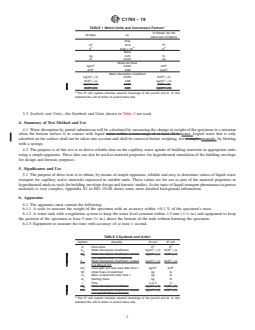
5.1 The purpose of these tests is to obtain, by means of simple apparatus, reliable and easy to determine values of liquid water transport for capillary active materials expressed in suitable units. These values are for use as part of the material properties in hygrothermal analysis tools for building envelope design and forensic studies. As the topic of liquid transport phenomena in porous materials is very complex, Appendix X1 in ISO 15148 shows some more detailed background information.
SCOPE
1.1 This test method defines a procedure to determine the water absorption coefficient of a material by partial submersion. The scope is to evaluate the rate of absorption of water due to capillary forces for building materials in contact with normal or driving rain above grade. The procedure is typically suitable mainly for masonry material, plaster, or a coating in combination with a substrate; but it can also be used for insulation materials. This test method is designed to be used only on homogeneous materials and does not apply to materials that are composites or non-homogeneous (for example, Faced Rigid Closed-cell Insulation). It is not within the scope of this standard to determine liquid uptake phenomena in below-grade applications. The water absorption coefficient is mainly used as an input datum for numerical simulation of the combined heat and moisture transport in building envelopes for design and forensic investigation purposes.
1.2 The values stated in either SI units or inch-pound units are to be regarded separately as standard. The values stated in each system are not necessarily exact equivalents; therefore, to ensure conformance with the standard, each system shall be used independently of the other, and values from the two systems shall not be combined. However, derived results can be converted from one system to the other using appropriate conversion factors (see Table 1).
1.3 This standard does not purport to address all of the safety concerns, if any, associated with its use. It is the responsibility of the user of this standard to establish appropriate safety, health, and environmental practices and determine the applicability of regulatory limitations prior to use.
1.4 This international standard was developed in accordance with internationally recognized principles on standardization established in the Decision on Principles for the Development of International Standards, Guides and Recommendations issued by the World Trade Organization Technical Barriers to Trade (TBT) Committee.
- Status
- Published
- Publication Date
- 14-Sep-2019
- Technical Committee
- C16 - Thermal Insulation
- Drafting Committee
- C16.33 - Insulation Finishes and Moisture
Buy Documents
ASTM C1794-19 - Standard Test Methods for Determination of the Water Absorption Coefficient by Partial Immersion
REDLINE ASTM C1794-19 - Standard Test Methods for Determination of the Water Absorption Coefficient by Partial Immersion
Overview
ASTM C1794-19: Standard Test Methods for Determination of the Water Absorption Coefficient by Partial Immersion provides a reliable procedure for evaluating the capillary water absorption characteristics of homogeneous building materials. By determining the water absorption coefficient, this test method delivers essential data used in hygrothermal analysis tools for building envelope design and forensic investigations. This standard is particularly relevant for masonry, plaster, coatings (with substrate), and insulation materials exposed to above-grade moisture sources, such as normal or driving rain.
ASTM C1794-19 ensures consistency and comparability when assessing the rate at which materials absorb water due to capillary action, contributing to improved building envelope performance and moisture management.
Key Topics
- Water Absorption Coefficient: The principal value determined by the standard, representing the mass of water absorbed per face area and per square root of time.
- Partial Immersion Method: Test specimens are partially submerged in water, simulating contact with above-grade moisture sources.
- Homogeneous Materials: The method applies only to materials with uniform properties throughout; composite or non-homogeneous products (such as faced rigid closed-cell insulation) are excluded.
- Measurement Procedure:
- Preparation and conditioning of specimens for accurate and representative results.
- Monitoring weight changes at defined intervals over a test period, typically 24 hours.
- Analysis of results using standardized graphs to determine material-specific absorption properties.
- Units and Reporting:
- Values can be reported in either SI units or inch-pound units, but systems must not be mixed during the test.
- Conversion factors are provided for mass, area, and water absorption coefficients.
- Safety and Compliance: The responsibility for implementation of appropriate safety, health, and environmental practices lies with the user.
Applications
The standardized test methods outlined in ASTM C1794-19 are used for:
- Hygrothermal Simulation: Supplying reliable water absorption data for software and modeling tools used in designing moisture-safe building envelopes.
- Forensic Analysis: Assisting in investigations of building failures related to water ingress and capillary water transport in building materials.
- Product Evaluation and Specification: Enabling architects, builders, and product manufacturers to compare material performance under wet conditions.
- Quality Assurance and Research: Providing a basis for routine quality control and scientific studies on the moisture performance of construction materials.
- Regulatory and Code Compliance: Meeting industry and organizational requirements for moisture management in the built environment.
Related Standards
For comprehensive hygrothermal and moisture transfer evaluation, the following related standards may also be relevant:
- ASTM C168 - Terminology Relating to Thermal Insulation: Defines technical terms related to insulation and moisture movement.
- ISO 9346 - Hygrothermal Performance of Buildings and Building Materials: Establishes vocabulary for mass transfer phenomena.
- ISO 15148 - Determination of Water Absorption Coefficient by Partial Immersion: Offers additional background and methodology for capillary water uptake measurement.
Keywords: ASTM C1794-19, water absorption coefficient, partial immersion, capillary water uptake, hygrothermal simulation, building envelope, masonry, insulation, moisture transport, material properties, forensic investigation, construction standards.
By following ASTM C1794-19, construction professionals, researchers, and material manufacturers can accurately assess and report the capillary absorption of homogeneous materials, supporting durability, sustainability, and high-performance building design.
Relations
- Effective Date
- 15-Sep-2019
- Effective Date
- 15-Apr-2024
- Effective Date
- 15-Apr-2018
- Effective Date
- 01-Jun-2017
- Effective Date
- 15-Oct-2015
- Effective Date
- 01-Jun-2015
- Effective Date
- 01-Apr-2013
- Effective Date
- 01-Jan-2010
- Effective Date
- 15-Dec-2008
- Effective Date
- 01-Sep-2008
- Effective Date
- 01-Jun-2008
- Effective Date
- 01-Nov-2005
- Effective Date
- 01-Jun-2005
- Effective Date
- 10-Apr-2003
- Effective Date
- 10-Jul-2002
Buy Documents
ASTM C1794-19 - Standard Test Methods for Determination of the Water Absorption Coefficient by Partial Immersion
REDLINE ASTM C1794-19 - Standard Test Methods for Determination of the Water Absorption Coefficient by Partial Immersion
Get Certified
Connect with accredited certification bodies for this standard

DIBt (Deutsches Institut für Bautechnik)
German Institute for Building Technology.
DIN CERTCO
DIN Group product certification.

Aboma Certification B.V.
Specialized in construction, metal, and transport sectors.
Sponsored listings
Frequently Asked Questions
ASTM C1794-19 is a standard published by ASTM International. Its full title is "Standard Test Methods for Determination of the Water Absorption Coefficient by Partial Immersion". This standard covers: SIGNIFICANCE AND USE 5.1 The purpose of these tests is to obtain, by means of simple apparatus, reliable and easy to determine values of liquid water transport for capillary active materials expressed in suitable units. These values are for use as part of the material properties in hygrothermal analysis tools for building envelope design and forensic studies. As the topic of liquid transport phenomena in porous materials is very complex, Appendix X1 in ISO 15148 shows some more detailed background information. SCOPE 1.1 This test method defines a procedure to determine the water absorption coefficient of a material by partial submersion. The scope is to evaluate the rate of absorption of water due to capillary forces for building materials in contact with normal or driving rain above grade. The procedure is typically suitable mainly for masonry material, plaster, or a coating in combination with a substrate; but it can also be used for insulation materials. This test method is designed to be used only on homogeneous materials and does not apply to materials that are composites or non-homogeneous (for example, Faced Rigid Closed-cell Insulation). It is not within the scope of this standard to determine liquid uptake phenomena in below-grade applications. The water absorption coefficient is mainly used as an input datum for numerical simulation of the combined heat and moisture transport in building envelopes for design and forensic investigation purposes. 1.2 The values stated in either SI units or inch-pound units are to be regarded separately as standard. The values stated in each system are not necessarily exact equivalents; therefore, to ensure conformance with the standard, each system shall be used independently of the other, and values from the two systems shall not be combined. However, derived results can be converted from one system to the other using appropriate conversion factors (see Table 1). 1.3 This standard does not purport to address all of the safety concerns, if any, associated with its use. It is the responsibility of the user of this standard to establish appropriate safety, health, and environmental practices and determine the applicability of regulatory limitations prior to use. 1.4 This international standard was developed in accordance with internationally recognized principles on standardization established in the Decision on Principles for the Development of International Standards, Guides and Recommendations issued by the World Trade Organization Technical Barriers to Trade (TBT) Committee.
SIGNIFICANCE AND USE 5.1 The purpose of these tests is to obtain, by means of simple apparatus, reliable and easy to determine values of liquid water transport for capillary active materials expressed in suitable units. These values are for use as part of the material properties in hygrothermal analysis tools for building envelope design and forensic studies. As the topic of liquid transport phenomena in porous materials is very complex, Appendix X1 in ISO 15148 shows some more detailed background information. SCOPE 1.1 This test method defines a procedure to determine the water absorption coefficient of a material by partial submersion. The scope is to evaluate the rate of absorption of water due to capillary forces for building materials in contact with normal or driving rain above grade. The procedure is typically suitable mainly for masonry material, plaster, or a coating in combination with a substrate; but it can also be used for insulation materials. This test method is designed to be used only on homogeneous materials and does not apply to materials that are composites or non-homogeneous (for example, Faced Rigid Closed-cell Insulation). It is not within the scope of this standard to determine liquid uptake phenomena in below-grade applications. The water absorption coefficient is mainly used as an input datum for numerical simulation of the combined heat and moisture transport in building envelopes for design and forensic investigation purposes. 1.2 The values stated in either SI units or inch-pound units are to be regarded separately as standard. The values stated in each system are not necessarily exact equivalents; therefore, to ensure conformance with the standard, each system shall be used independently of the other, and values from the two systems shall not be combined. However, derived results can be converted from one system to the other using appropriate conversion factors (see Table 1). 1.3 This standard does not purport to address all of the safety concerns, if any, associated with its use. It is the responsibility of the user of this standard to establish appropriate safety, health, and environmental practices and determine the applicability of regulatory limitations prior to use. 1.4 This international standard was developed in accordance with internationally recognized principles on standardization established in the Decision on Principles for the Development of International Standards, Guides and Recommendations issued by the World Trade Organization Technical Barriers to Trade (TBT) Committee.
ASTM C1794-19 is classified under the following ICS (International Classification for Standards) categories: 91.100.01 - Construction materials in general. The ICS classification helps identify the subject area and facilitates finding related standards.
ASTM C1794-19 has the following relationships with other standards: It is inter standard links to ASTM C1794-15, ASTM C168-24, ASTM C168-18, ASTM C168-17, ASTM C168-15a, ASTM C168-15, ASTM C168-13, ASTM C168-10, ASTM C168-08b, ASTM C168-08a, ASTM C168-08, ASTM C168-05a, ASTM C168-05, ASTM C168-03, ASTM C168-02. Understanding these relationships helps ensure you are using the most current and applicable version of the standard.
ASTM C1794-19 is available in PDF format for immediate download after purchase. The document can be added to your cart and obtained through the secure checkout process. Digital delivery ensures instant access to the complete standard document.
Standards Content (Sample)
This international standard was developed in accordance with internationally recognized principles on standardization established in the Decision on Principles for the
Development of International Standards, Guides and Recommendations issued by the World Trade Organization Technical Barriers to Trade (TBT) Committee.
Designation: C1794 − 19
Standard Test Methods for
Determination of the Water Absorption Coefficient by Partial
Immersion
This standard is issued under the fixed designation C1794; the number immediately following the designation indicates the year of
original adoption or, in the case of revision, the year of last revision. A number in parentheses indicates the year of last reapproval. A
superscript epsilon (´) indicates an editorial change since the last revision or reapproval.
1. Scope 2. Referenced Documents
1.1 This test method defines a procedure to determine the 2.1 ASTM Standards:
water absorption coefficient of a material by partial submer- C168 Terminology Relating to Thermal Insulation
sion. The scope is to evaluate the rate of absorption of water
2.2 Other Standards:
due to capillary forces for building materials in contact with
ISO9346 Hygrothermalperformanceofbuildingsandbuild-
normal or driving rain above grade. The procedure is typically
ing materials—Physical quantities for mass transfer—
suitable mainly for masonry material, plaster, or a coating in
Vocabulary
combination with a substrate; but it can also be used for
ISO 15148 Determination of water absorption coefficient by
insulation materials. This test method is designed to be used
partial immersion
onlyonhomogeneousmaterialsanddoesnotapplytomaterials
that are composites or non-homogeneous (for example, Faced 3. Terminology
Rigid Closed-cell Insulation). It is not within the scope of this
3.1 Definitions of Terms—For definitions associated with
standardtodetermineliquiduptakephenomenainbelow-grade
thermal insulation issues refer to Terminology C168. For
applications.Thewaterabsorptioncoefficientismainlyusedas
definitions associated with water absorption refer to the terms
an input datum for numerical simulation of the combined heat
and definitions given in ISO 9346.
and moisture transport in building envelopes for design and
3.2 Definitions of Terms Specific to This Standard:
forensic investigation purposes.
3.2.1 homogeneous material, n—materials, which proper-
1.2 The values stated in either SI units or inch-pound units
ties are uniform on a macroscopic scale.
are to be regarded separately as standard. The values stated in
3.2.2 water absorption coeffıcient, n—mass of water ab-
each system are not necessarily exact equivalents; therefore, to
sorbed by a test specimen per face area and per square root of
ensure conformance with the standard, each system shall be
time (see Eq 2).
used independently of the other, and values from the two
systems shall not be combined. However, derived results can 3.3 Symbols and Units—the Symbols and Units shown in
Table 2 are used.
be converted from one system to the other using appropriate
conversion factors (see Table 1).
4. Summary of Test Method and Use
1.3 This standard does not purport to address all of the
4.1 Water absorption by partial submersion will be calcu-
safety concerns, if any, associated with its use. It is the
lated by measuring the change in weight of the specimen in a
responsibility of the user of this standard to establish appro-
situation when the bottom surface is in contact with liquid
priate safety, health, and environmental practices and deter-
water. Liquid water that is only adsorbed on the surface shall
mine the applicability of regulatory limitations prior to use.
not be taken into account and shall be removed before
1.4 This international standard was developed in accor-
weighing, for example, by blotting with a sponge.
dance with internationally recognized principles on standard-
ization established in the Decision on Principles for the
4.2 The purpose is of this test is to derive reliable data on
Development of International Standards, Guides and Recom-
the capillary water uptake of building materials in appropriate
mendations issued by the World Trade Organization Technical
units using a simple apparatus. These data can also be used as
Barriers to Trade (TBT) Committee.
1 2
ThistestmethodisunderthejurisdictionofASTMCommitteeC16onThermal For referenced ASTM standards, visit the ASTM website, www.astm.org, or
Insulation and is the direct responsibility of Subcommittee C16.33 on Insulation contact ASTM Customer Service at service@astm.org. For Annual Book of ASTM
Finishes and Moisture. Standards volume information, refer to the standard’s Document Summary page on
Current edition approved Sept. 15, 2019. Published November 2019. Originally the ASTM website.
approved in 2015. Last previous edition approved in 2015 as C1794 – 15. DOI: Available from American National Standards Institute (ANSI), 25 W. 43rd St.,
10.1520/C1794-19. 4th Floor, New York, NY 10036, http://www.ansi.org.
Copyright © ASTM International, 100 Barr Harbor Drive, PO Box C700, West Conshohocken, PA 19428-2959. United States
C1794 − 19
A
TABLE 1 Metric Units and Conversion Factors
7.2 Area—The area which is in contact with the water must
2 2
To Obtain (for the
be at least 50 cm (8 in. ). However, in the case of materials
Multiply by
same test condition)
including macroscopic particles such as aggregates, the side of
Area
a square specimen or the smallest diameter of the face shall be
2 2
m 10.8 ft
2 -2 2
ft 9.29 × 10 m atleasttentimesthelargestparticlesize.Influencesofirregular
Mass
surface structures shall be neglected if those irregular surface
kg 2.20 lb
structures are part of the materials’ design.
lb 0.454 kg
Mass per Area
NOTE 1—Larger specimens, preferably with a face area of at least 100
2 2
2 2
kg/m 0.205 lb/ft
cm (16 in. ), are advised as they will lead to greater accuracy.
2 2
lb/ft 4.88 kg/m
Water Absorption Coefficient
7.3 Thickness—Where possible, use a specimen thickness
2 2
kg/(m ·=s) 0.205 lb/(ft ·=s)
which represents the full product thickness. When specimens
2 2
lb/(ft ·=s) 4.88 kg/(m ·=s)
are cut from products they shall be representative of the
A
The IP unit system includes several meanings of the pound unit lb. In this
material to be assessed and thick enough to enable handling
standard the unit lb refers to pound mass only.
without damage. In the case of materials including macro-
scopic particles such as aggregates, it is preferable that the
A
TABLE 2 Symbols and Units
thickness be at least ten times the largest particle size, but shall
Symbol Quantity SI unit IP unit
be no less than five times, the largest particle size.
2 2
A Face Area m ft
2 2
A Water Absorption Coefficient kg/(m ·=s) lb/(ft ·=s) 7.4 Number—At least three specimens shall be tested. If the
w
2 2
A Water Absorption Coefficient, related kg/(m ·=s) lb/(ft ·=s)
w4
water contact area of the individual specimens is less than 100
to a time of 4 h
2 2
2 2 cm (16in. ),atleastsixspecimensshallbetestedrepresenting
∆m mass gain per face area after time t kg/m lb/ft
t
2 2
M Initial mass of specimen kg lb
a total area of at least 300 cm (47 in ).
i
m Mass of specimen after time t kg lb
t
m Starting mass kg lb
7.5 Preparation—Test specimens shall be representative of
i
t Time s or h h
the whole material and shall be cut so that they do not include
A
The IP unit system includes several meanings of the pound unit lb. In this
product edges. In the case of materials known to be non-
standard the unit lb refers to pound mass only.
isotropic, sets of test specimens shall be prepared in all
orientations of the potential use of the material. The test
specimens shall be prepared by methods that do not change the
material properties for hygrothermal simulation of the building
original structure of the product; any skins, facings or coatings
envelope for design and forensic purposes.
shall be retained. In the case of products such as coatings, thin
rendering or plasterwork that are normally adhered to a
5. Significance and Use
substrate in use, specimens shall be made up from the product
5.1 The purpose of these tests is to obtain, by means of
and a normal substrate combined. The total thickness then is
simple apparatus, reliable and easy to determine values of
the sum of the coating and the substrate. The sides of a solid
liquid water transport for capillary active materials expressed
specimen shall be sealed with a water and vapor tight sealant
insuitableunits.Thesevaluesareforuseaspartofthematerial
that does not react chemically with it or significantly penetrate
properties in hygrothermal analysis tools for building envelope
the pores of the product as shown in Fig. 1. It is especially
design and forensic studies. As the topic of liquid transport
important that the sides of specimens with surface coatings are
phenomena in porous materials is very complex,Appendix X1
sealed to prevent bypassing of the coating. If sealing is not
in ISO 15148 shows some more detailed background informa-
possible in the case of very low density fibrous or loose fill
tion.
materials place them in a tightly fitting tube supported on a
wire mesh placed over the mouth of the tube. The open area of
6. Apparatus
the mesh shall be as large as possible while completely
6.1 The apparatus must contain the following:
supporting the sample during the whole course of the test. In
6.1.1 Ascale to measure the weight of the specimen with an
this case, to minimize the edge effects, the face area of the
accuracy within 60.1 % of the specimen’s mass.
2 2
specimen shall be at least 100 cm (16 in ). The surface in
6.1.2 A water tank with a regulation system to keep the
contact with the water shall be plane, allowing for the normal
water level constant within 63mm(6 ⁄8 in.) and equipment to
surface roughness of the material.
keep the position of the specimen at least 5 mm ( ⁄4 in.) above
the bottom of the tank without harming the specimen. 7.6 Conditioning—The test specimens shall be stored under
6.1.3 Equipment to measure the time with accuracy of at the test conditions (see 8.1) until the mass of each spec
...
This document is not an ASTM standard and is intended only to provide the user of an ASTM standard an indication of what changes have been made to the previous version. Because
it may not be technically possible to adequately depict all changes accurately, ASTM recommends that users consult prior editions as appropriate. In all cases only the current version
of the standard as published by ASTM is to be considered the official document.
Designation: C1794 − 15 C1794 − 19
Standard Test Methods for
Determination of the Water Absorption Coefficient by Partial
Immersion
This standard is issued under the fixed designation C1794; the number immediately following the designation indicates the year of
original adoption or, in the case of revision, the year of last revision. A number in parentheses indicates the year of last reapproval. A
superscript epsilon (´) indicates an editorial change since the last revision or reapproval.
1. Scope
1.1 This test method defines a procedure to determine the water absorption coefficient of a material by partial submersion. The
scope is to evaluate the rate of absorption of water due to capillary forces for building materials in contact with normal or driving
rain above grade. The procedure is typically suitable mainly for masonry material, plaster, or a coating in combination with a
substrate; but it can also be used for insulation materials. This test method is designed to be used only on homogeneous materials
and does not apply to materials that are composites or non-homogeneous (for example, Faced Rigid Closed-cell Insulation). It is
not within the scope of this standard to determine liquid uptake phenomena in below-grade applications. The water absorption
coefficient is mainly used as an input datum for numerical simulation of the combined heat and moisture transport in building
envelopes for design and forensic investigation purposes.
1.2 The values stated in either SI units or inch-pound units are to be regarded separately as standard. The values stated in each
system are not necessarily exact equivalents; therefore, to ensure conformance with the standard, each system shall be used
independently of the other, and values from the two systems shall not be combined. However, derived results can be converted
from one system to the other using appropriate conversion factors (see Table 1).
1.3 This standard does not purport to address all of the safety concerns, if any, associated with its use. It is the responsibility
of the user of this standard to establish appropriate safety safety, health, and healthenvironmental practices and determine the
applicability of regulatory limitations prior to use.
1.4 This international standard was developed in accordance with internationally recognized principles on standardization
established in the Decision on Principles for the Development of International Standards, Guides and Recommendations issued
by the World Trade Organization Technical Barriers to Trade (TBT) Committee.
2. Referenced Documents
2.1 ASTM Standards:
C168 Terminology Relating to Thermal Insulation
2.2 Other Standards:
ISO 9346 Hygrothermal performance of buildings and building materials—Physical quantities for mass transfer—Vocabulary
ISO 15148 Determination of water absorption coefficient by partial immersion
3. Terminology
3.1 Definitions of Terms—For definitions associated with thermal insulation issues refer to Terminology C168. For definitions
associated with water absorption refer to the terms and definitions given in ISO 9346.
3.2 Definitions of Terms Specific to This Standard:
3.2.1 homogeneous material, n—materials, which properties are uniform on a macroscopic scale.
3.2.2 water absorption coeffıcient, n—mass of water absorbed by a test specimen per face area and per square root of time (see
Eq 2).
This test method is under the jurisdiction of ASTM Committee C16 on Thermal Insulation and is the direct responsibility of Subcommittee C16.33 on Insulation Finishes
and Moisture.
Current edition approved March 1, 2015Sept. 15, 2019. Published April 2015November 2019. Originally approved in 2015. Last previous edition approved in 2015 as
C1794 – 15. DOI: 10.1520/C1794-15.10.1520/C1794-19.
For referenced ASTM standards, visit the ASTM website, www.astm.org, or contact ASTM Customer Service at service@astm.org. For Annual Book of ASTM Standards
volume information, refer to the standard’s Document Summary page on the ASTM website.
Available from American National Standards Institute (ANSI), 25 W. 43rd St., 4th Floor, New York, NY 10036, http://www.ansi.org.
Copyright © ASTM International, 100 Barr Harbor Drive, PO Box C700, West Conshohocken, PA 19428-2959. United States
C1794 − 19
A
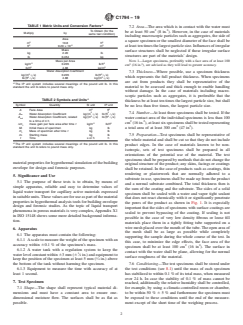
TABLE 1 Metric Units and Conversion Factors
To Obtain (for the
Multiply by
same test condition)
Area
2 2
m 10.8 ft
2 -2 2
ft 9.29 × 10 m
Mass
kg 2.20 lb
lb 0.454 kg
Mass per Area
2 2
kg/m 0.205 lb/ft
2 2
lb/ft 4.88 kg/m
Water Absorption Coefficient
2 2
kg/(m ·=s) 0.205 lb/(ft ·=s)
2 2
lb/(ft ·=s) 4.88 kg/(m ·=s)
2 2
kg/(m ·=h) 0.205 lb/(ft ·=h)
2 2
lb/(ft ·=h) 4.88 kg/(m ·=h)
A
The IP unit system includes several meanings of the pound unit lb. In this
standard the unit lb refers to pound mass only.
3.3 Symbols and Units—the Symbols and Units shown in Table 2 are used.
4. Summary of Test Method and Use
4.1 Water absorption by partial submersion will be calculated by measuring the change in weight of the specimen in a situation
when the bottom surface is in contact with liquid water within a time range of at least 24 h. water. Liquid water that is only
adsorbed on the surface shall not be taken into account and shall be removed before weighing, for example.,example, by blotting
with a sponge.
4.2 The purpose is of this test is to derive reliable data on the capillary water uptake of building materials in appropriate units
using a simple apparatus. These data can also be used as material properties for hygrothermal simulation of the building envelope
for design and forensic purposes.
5. Significance and Use
5.1 The purpose of these tests is to obtain, by means of simple apparatus, reliable and easy to determine values of liquid water
transport for capillary active materials expressed in suitable units. These values are for use as part of the material properties in
hygrothermal analysis tools for building envelope design and forensic studies. As the topic of liquid transport phenomena in porous
materials is very complex, Appendix X1 in ISO 15148 shows some more detailed background information.
6. Apparatus
6.1 The apparatus must contain the following:
6.1.1 A scale to measure the weight of the specimen with an accuracy within 60.1 % of the specimen’s mass.
6.1.2 A water tank with a regulation system to keep the water level constant within 63 mm (6 ⁄8 in.) and equipment to keep
the position of the specimen at least 5 mm ( ⁄4 in.) above the bottom of the tank without harming the specimen.
6.1.3 Equipment to measure the time with accuracy of at least 1 second.
A
TABLE 2 Symbols and Units
Symbol Quantity SI unit IP unit
2 2
A Face Area m ft
2 2
A Water Absorption Coefficient kg/(m ·=s) lb/(ft ·=s)
w
2 2
A Water Absorption Coefficient, related kg/(m ·=s) lb/(ft ·=s)
wt
to a specific time, t, in seconds
2 2
A Water Absorption Coefficient, related kg/(m ·=s) lb/(ft ·=s)
w4
to a time of 4 h
2 2
Δm mass gain per face area after time t kg/m lb/ft
t
M Initial mass of specimen kg lb
i
m Mass of specimen after time t kg lb
t
m Starting mass kg lb
i
t Time s or h h
2 2
W Water Absorption Coefficient kg/(m ·=h) lb/(ft ·=h)
w
2 2
W Water Absorption Coefficient, related kg/(m ·=h) lb/(ft ·=h)
wt
to a specific time, t, in hours
A
The IP unit system includes several meanings of the pound unit lb. In this
standard the unit lb refers to pound mass only.
C1794 − 19
7. Test Specimen
7.1 Shape—The shape shall represent typical material dimensions and must have a constant area to ensure one-dimensional
moisture flow. The surfaces shall be as flat as possible.
2 2
7.2 Area—The area which is in contact with the water must be at least 50 cm (8 in. ). However, in the case of materials
including macroscopic particles such as aggregates, the side of a square specimen or the smallest diameter of the face shall be at
least ten times the largest particle size. Influences of irregular surface structures shall be neglected if those irregular surface
structures are part of the materials’ design.
2 2
NOTE 1—Larger specimens, preferably with a face area of at least 100 cm (16 in. ), are advised as they will lead to greater accuracy.
7.3 Thickness—Where possible, use a specimen thickness which represents the full product thickness. When specimens are cut
from products they shall be representative of the material to be assessed and thick enough to enable handling without damage. In
the case of materials including macroscopic particles such as aggregates, it is preferable that the thickness be at least ten times the
largest particle size, but shall be no less than five times, the largest particle size.
7.4 Number—At least three specimens shall be tested. If the water contact area of the individual specimens is less than 100 cm
2 2 2
(16 in. ), at least six specimens shall be tested representing a total area of at least 300 cm (47 in ).
7.5 Preparation—Test specimens shall be representative of the whole material and shall be cut so that they do not include
product edges. In the case of materials known to be non-isotropic, sets of test specimens shall be prepared in all orientations of
the potential use of the material. The test specimens shall be prepared by methods that do not change the original structure of the
product; any skins, facings or coatings shall be retained. In the case of products such as coatings, thin rendering or plasterwork
that are normally adhered to a substrate in use, specimens shall be made up from the product and a normal substrate combined.
The total thickness then is the sum of the coating and the substrate. The sides of a solid specimen shall be sealed with a water and
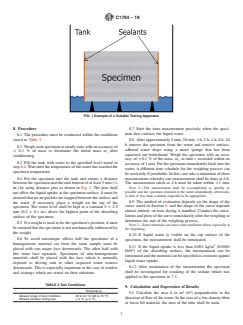
vapor tight sealant that does not react chemically with it or significantly penetrate the pores of the product as shown in Fig. 1. It
is especially important that the sides of specimens with surface coatings are sealed to prevent bypassing of the coating. If sealing
is not possible in the case of very low density fibrous or loose fill materials place them in a tightly fitting tube supported on a wire
mesh placed over the mouth of the tube. The open area of the mesh shall be as large as possible while completely supporting the
sample during the whole course of the test. In this case, to minimize the edge effects, the face area of the specimen shall be at least
2 2
100 cm (16
...