


August 2026: New Standard Advances Energy Management for Smart Buildings and Transport
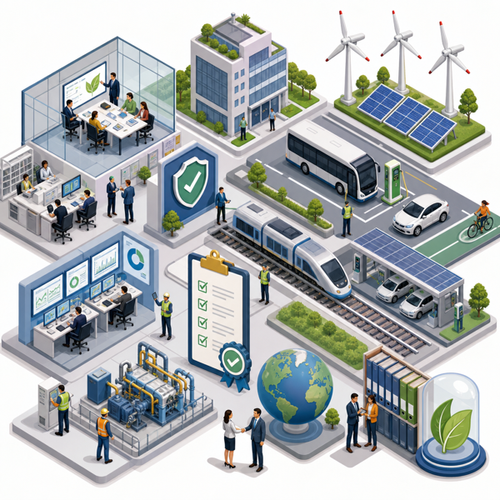
In August 2026, the landscape for energy efficiency and digital integration within company organization, management, administration, transport, and social domains took a decisive step forward with the publication of a major new standard: FprEN IEC 63402-2-2:2026. Providing cutting-edge guidelines for customer energy management systems (CEMS), this standard establishes the foundational data models and messaging protocols that underpin semantic interoperability between customer energy managers and resource managers within smart grids and buildings. This single, highly anticipated standard carries broad implications for building management, utilities, smart grid operators, transport facilities, and IT solution providers aiming to optimize energy consumption and meet the latest compliance requirements.
Overview / Introduction
In today's competitive, digitalized economy, managing energy efficiently is a complex challenge that bridges technical systems, organizational processes, and user comfort. From smart buildings to e-mobility infrastructure, the need for standardized, robust communication interfaces and data models is critical. International standards like FprEN IEC 63402-2-2:2026 are instrumental for harmonizing stakeholder efforts across:
- Building automation solutions
- Smart grid operations
- Corporate and public administration
- Transport sector infrastructure
- Research and sociological analysis of technology adoption
By driving interoperability, clarity, and technical confidence, this new standard enables a major leap toward sustainable, resilient, and user-centric energy management. In this article, you'll find comprehensive coverage of the new requirements, implementation guidelines, and strategic benefits of compliance.
Detailed Standards Coverage
FprEN IEC 63402-2-2:2026 - Energy Efficiency for the Digital Age
Energy efficiency - Customer energy management system - Part 2-2: Data model and messaging - Interface between the customer energy manager and resource managers
The scope of FprEN IEC 63402-2-2:2026 is to specify technology-independent data models and messaging routines for the S2 interface—the crucial link between a Customer Energy Manager (CEM) and multiple Resource Managers (RMs) within a premises or building. This interface directly supports energy optimization, device flexibility, demand response, and integration with broader smart grid strategies, without dictating how lower-level device communications or protocols (like XML, JSON, or security layers) are implemented.
Key Requirements and Specifications
- Semantic Interoperability: Defines consistent data structures, enumerations, and interaction patterns to ensure seamless communication between CEMs and RMs, regardless of device manufacturer or underlying technology.
- Control Types: Supports five major energy control schemes—Power Envelope, Power Profile, Operation Mode, Fill Rate, and Demand Driven Based Control—to handle the wide spectrum of devices (e.g., electric vehicles, water heaters, batteries, HVACs).
- Role Modeling: Formalizes roles for energy producers, consumers, storage systems, and prosumers, providing clear guidance on how devices expose and manage capabilities and constraints.
- Forecasting and Measurement: Standardizes the transfer of real-time measurements and multi-period forecasts, feeding into both local and grid-level optimization strategies.
- Interaction Patterns: Lays out detailed task flows for updates (e.g., resource manager status, control activation, instruction status), supporting advanced automation and analytics.
Who Needs to Comply?
This standard is targeted at:
- Building operators and facility managers
- Utilities and grid service providers
- Electric vehicle infrastructure designers
- IT system integrators for energy automation
- Regulatory and compliance professionals
- Corporate sustainability and energy managers
Practical Implications for Implementation
Transitioning to compliance means analyzing device portfolios, system architectures, and IT workflows to accommodate the standardized data models and communication patterns. This is particularly relevant in new constructions, retrofits of smart campuses, transport hubs, and city-wide energy initiatives. Implementers should focus on:
- Mapping current interfaces to the S2 model
- Updating device firmware/software for new message handling
- Training IT and operational staff on interaction and troubleshooting
Notable Changes Over Previous Standards
- Introduction of a unified, technology-agnostic data model supporting cross-vendor deployments
- Enhanced flexibility for managing fluctuating loads (such as EVs, HVACs, renewables)
- Stronger support for use cases involving abnormal conditions and user comfort management
- Clearer division of responsibilities between Customer Energy Managers and Resource Managers
- Expanded use case documentation (see Annex A) covering realistic scenarios, such as EV charging with dynamic tariffs or managing conflicting power loads among multiple devices
Key highlights:
- Establishes S2 interface for future-proof smart grid and building management
- Standardizes five distinct control types for comprehensive device interaction
- Supports power measurement, forecasting, and adaptive optimization
Access the full standard:View FprEN IEC 63402-2-2:2026 on iTeh Standards
Industry Impact & Compliance
Business Implications
The adoption of FprEN IEC 63402-2-2:2026 will have wide-ranging effects across energy management:
- Competitive Advantage: Early adopters can differentiate with greater interoperability, enabling integration of diverse devices and software platforms.
- Regulatory Alignment: As policy trends move toward mandatory energy reporting, demand response, and flexibility services, this standard helps organizations future-proof their operations.
- Operational Efficiency: Automated energy optimization translates to lower operational costs, improved user comfort, and maximized use of on-site renewable generation.
Compliance Considerations
- Timelines: Organizations should begin mapping legacy systems and devices against the new standard immediately, targeting integration within 1-2 years of publication.
- Certification and Testing: Coordinate with equipment vendors and software providers for upgrade paths and conformance testing.
- Documentation: Maintain up-to-date records of device capabilities, tested configurations, and exception management to support audits and regulatory review.
Benefits of Adoption
- Lower energy costs and increased flexibility
- Enhanced resilience to grid fluctuations and emergency conditions
- Better data for performance analytics and predictive maintenance
- Streamlined integration with future standards in smart transportation and automation
Risks of Non-Compliance
- Loss of eligibility for future incentive programs or performance-based contracts
- Greater risk of system integration failures
- Lower asset value and increased maintenance costs for non-compliant or isolated equipment
Technical Insights
Core Technical Features
The standard's technical foundation addresses the most common requirements across modern smart energy systems:
- Generic but Extensible Data Modeling: Allows for standard schemas covering commodities, power values, forecasting, status reporting, and instructions, while supporting custom extensions.
- Interaction Patterns: Robust task definitions (update, activate, revoke, process instruction, etc.) provide a uniform way for smart devices—like batteries, electric vehicle chargers, and HVAC—to be orchestrated.
- Enumeration and Roles: Defines clear data enumerations for role types, commodities, quantities, currencies (ISO 4217 compliant), and control modes, minimizing ambiguity in messaging.
- Abnormal Condition Handling: Encodes device ability to sacrifice user comfort or restrict operation during grid emergencies, with precise protocols for activation.
- Separation of Concerns: Device-side resource managers handle technical constraints/capabilities, while customer energy managers implement strategies based on local policies, grid signals, or market incentives.
Implementation Best Practices
- Perform System Architecture Reviews: Inventory all devices and their management systems. Identify which are capable of S2 compliance and map out upgrade requirements.
- Develop Testbeds: Establish a simulation environment for staging S2-compliant interactions and verifying data model integration.
- Collaborate Closely with Vendors: Seek updates and compliance declarations from all technology partners. Opt for modular upgrades if full system refits are impractical.
- Prioritize Critical Infrastructure: Begin with high-impact systems (e.g., EV charging, on-site battery storage) and expand as capabilities mature.
Testing and Certification Considerations
- Run full lifecycle tests on all interaction patterns: updates, activation, revocation, and abnormal instructions.
- Monitor real-time response and logging for conformance and performance bottlenecks.
- Document edge cases—such as unexpected device states or out-of-band communication—and update response plans.
Conclusion / Next Steps
The August 2026 introduction of FprEN IEC 63402-2-2:2026 marks a new era in customer energy management across services, administration, transport, and digital building automation. By standardizing data exchange and control strategies, this international specification empowers organizations to build robust, flexible, and scalable energy solutions—critical for cost savings, sustainability, and user satisfaction.
Key Takeaways:
- The new standard delivers comprehensive interoperability for modern energy systems.
- Implementation enables future-readiness across industries, from commercial real estate to transport.
- Early engagement with the standard's requirements positions organizations for innovation, regulatory compliance, and operational efficiency.
Recommendations:
- Start by reviewing your current energy management setups and engaging internal and external experts.
- Develop a roadmap for phased compliance, prioritizing mission-critical systems.
- Stay informed on related standards, updates, and evolving best practices through trusted platforms.
Explore the full text and implementation guides for FprEN IEC 63402-2-2:2026 and other energy management standards on iTeh Standards.
Stay ahead—be part of the next generation of energy-smart organizations.
Categories
- Latest News
- New Arrivals
- Generalities
- Services and Management
- Natural Sciences
- Health Care
- Environment
- Metrology and Measurement
- Testing
- Mechanical Systems
- Fluid Systems
- Manufacturing
- Energy and Heat
- Electrical Engineering
- Electronics
- Telecommunications
- Information Technology
- Image Technology
- Precision Mechanics
- Road Vehicles
- Railway Engineering
- Shipbuilding
- Aircraft and Space
- Materials Handling
- Packaging
- Textile and Leather
- Clothing
- Agriculture
- Food technology
- Chemical Technology
- Mining and Minerals
- Petroleum
- Metallurgy
- Wood technology
- Glass and Ceramics
- Rubber and Plastics
- Paper Technology
- Paint Industries
- Construction
- Civil Engineering
- Military Engineering
- Entertainment