


Advanced Ceramics Standards: A Practical Guide to Key ISO Specifications and Their Business Impact
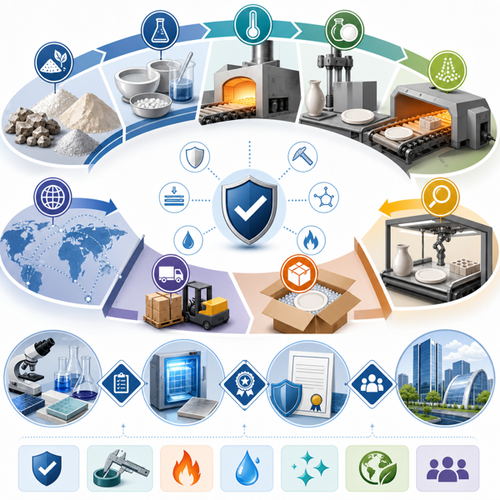
Advanced ceramics are at the core of some of today's most innovative industries, from clean energy and electronics to construction, aerospace, and healthcare. As high-performance glass and ceramic materials become more vital in advanced manufacturing, the need for consistent, reliable, and globally recognized standards has never been greater. For organizations adopting new technologies or scaling up operations, compliance with the latest international standards is not just about ticking boxes—it's a powerful way to ensure product quality, improve safety, boost productivity, and streamline global market access. In this guide, we break down four key ISO standards that define the current landscape in advanced ceramics, offering practical insights into their scope, requirements, and direct business impact.
Overview / Introduction
The field of advanced ceramics—also known as fine ceramics or advanced technical ceramics—is rapidly transforming sectors such as electronics, transportation, environmental engineering, and medical devices. Thanks to exceptional mechanical, thermal, and chemical properties, these materials are enabling safer, longer-lasting, and higher-performing products than ever before.
But with innovation comes complexity. Advanced ceramics are engineered at the micro- and nano-levels, often as composite materials with tailored characteristics. The only way global manufacturers, laboratories, and end-users can trust that a product does what it claims is through robust international standards.
Why do advanced ceramics standards matter now more than ever?
- Rapid industry innovation creates new challenges in quality control and interoperability
- Sustainability and safety requirements are growing
- Digitalization and smarter manufacturing demand tightly controlled and reproducible processes
- Businesses need to scale up production while reducing risk and cost
This article explores four critical ISO standards shaping the advanced ceramics sector:
- ISO 15733:2026 — Mechanical properties testing of ceramic composites
- ISO 17168-1:2025 — Air-purification performance of semiconducting photocatalytic materials
- ISO 19630:2025 — Tensile properties of ceramic reinforcement filaments
- ISO 19634:2026 — Notations and symbols for ceramic composites
You'll learn what each standard covers, why it's important for both technical teams and business leaders, and how implementing these guidelines helps future-proof your operations.
Detailed Standards Coverage
ISO 15733:2026 - Testing Mechanical Properties of Advanced Ceramic Composites
Fine ceramics (advanced ceramics, advanced technical ceramics) — Mechanical properties of ceramic composites at ambient temperature in air atmospheric pressure — Determination of tensile properties
What does ISO 15733:2026 cover? This international standard provides a comprehensive method for determining the tensile properties of ceramic matrix composites with continuous fibre reinforcement at room temperature, in atmospheric air. It applies to composites with unidirectional, bi-directional, or multi-directional reinforcement—loaded along a primary axis of strength. Relevant sectors include aerospace, automotive, industrial, and materials research.
The standard covers:
- Test conditions for measuring tensile modulus, Poisson’s ratio, tensile strength, strain at maximum force, and fracture strain
- Requirements for specimen preparation, including machining and surface finish
- Procedures for valid test execution and result calculation
- Detailed terms, definitions, and measurement protocols
Key requirements and specifications:
- Use of calibrated test machines (following ISO 7500-1)
- Consistent specimen geometry and preparation
- Careful mounting to ensure accurate force distribution
- Simultaneous recording of force and deformation
- Calculation of both apparent and effective modulus/strength, correcting for any coatings
Who should comply?
- Manufacturers of ceramic composites, especially for high-stress applications
- Materials testing laboratories
- R&D departments in aerospace, automotive, defense, and electronics
- Quality assurance and regulatory teams
Practical implications for implementation: By standardizing tensile testing, organizations can:
- Optimize processes and catch defects early
- Benchmark new materials or suppliers
- Support certification and customer requirements
- Lower liability and improve market acceptance
Notable features:
- Addresses a broader range of tensile properties, including fracture strain
- Explicit protocols for test validity—even for non-linear force/deformation curves
- Aligns with terminology and measurement best practices in the sector
Key highlights:
- Comprehensive method for tensile testing of all major advanced ceramic composites
- Essential for certification, benchmarking, and R&D
- Supported by updated definitions and calculation procedures
Access the full standard:View ISO 15733:2026 on iTeh Standards
ISO 17168-1:2025 - Air Purification Performance of Photocatalytic Ceramics
Fine ceramics (advanced ceramics, advanced technical ceramics) — Test method for air-purification performance of semiconducting photocatalytic materials under indoor lighting environment — Part 1: Removal of nitric oxide
What does ISO 17168-1:2025 cover? This standard defines a rigorous and industry-accepted test method for determining how effectively ceramic-based materials with photocatalytic properties can remove nitric oxide (NO) from air, specifically under the challenging conditions of indoor lighting (non-UV). Common in building materials, tiles, panels, and air-cleaning equipment, such technologies are vital for healthier indoor environments.
The protocol details:
- Preparation and handling of test samples, including construction materials with photocatalytic coatings
- The air flow system (with pollutant dosing and precise humidity/temperature control)
- Use of a specialized photoreactor and light sources mimicking indoor conditions
- Analytical procedures for measuring NO breakdown and converted nitrogen oxides
- Methods for evaluating adsorption/desorption and regeneration via water washing
Key requirements and specifications:
- Only applicable to materials in sheet, plate, board, or honeycomb form (not powders)
- Specifies model air pollutant and control gases
- Outlines light source parameters and UV filtering (per ISO 14605 and ISO 24448)
- Demands accurate pollutant analysis and proper handling of hazardous outputs
Who should comply?
- Manufacturers of air-purifying ceramics and related building products
- Environmental engineers and HVAC system developers
- Testing laboratories and certification bodies
- Green building consultants and construction material developers
Practical implications for implementation: This standard helps organizations:
- Validate product claims with trusted, comparative performance data
- Meet green building and indoor quality standards
- Minimize liability and improve consumer trust
- Simplify global marketing by using a recognized benchmark
Notable features:
- Focuses on the specific challenge of activating photocatalysts under typical indoor lights
- Allows for broad application across many advanced ceramic forms used in construction
- Designed to foster the commercialization of greener, safer materials
Key highlights:
- Standardized lab testing for air purification via photocatalysis
- Essential for health, safety, and environmental certifications
- Supports continuous improvement and innovation in green ceramics
Access the full standard:View ISO 17168-1:2025 on iTeh Standards
ISO 19630:2025 - Tensile Properties of Ceramic Reinforcement Filaments
Fine ceramics (advanced ceramics, advanced technical ceramics) — Methods of test for reinforcements — Determination of tensile properties of filaments at ambient temperature
What does ISO 19630:2025 cover? This standard presents a unified approach for evaluating the tensile strength, Young modulus, and fracture strain of individual ceramic filaments—key building blocks in advanced composite materials. The focus is on continuous filaments from tows, yarns, or braids that are used to reinforce ceramic matrices. The standard specifically covers those with relatively brittle fracture behavior (strain to fracture ≤5%), making it ideal for oxide and non-oxide ceramic fibres but not for carbon fibers.
The standard lays out:
- Definitions for critical test dimensions (gauge length, initial cross-sectional area)
- Equipment requirements (e.g., precision test frames, compliant sample holders)
- Procedures for sample mounting and measurement
- Validity checks and statistical approaches for interpreting data
Key requirements and specifications:
- Strict specimen preparation: handling, gripping, gauge length measurement
- Control of displacement rate during the test
- Calculation methods for key mechanical properties
- Statistical evaluation to account for variability inherent to filaments
Who should comply?
- Ceramic fibre manufacturers and users (aerospace, automotive, energy)
- Quality assurance labs testing reinforcement materials
- Composite material designers and researchers
Practical implications for implementation:
- Ensures reliable, reproducible measurement of reinforcement properties
- Reduces the risk of undetected defects in high-reliability components
- Facilitates comparison of suppliers and batch quality
- Supports rapid material selection and certification for advanced applications
Notable features:
- Not limited by reinforcement form—applies to tows, yarns, and knittings
- Includes guidance on handling statistical data
- Harmonized with other key ISO references in advanced ceramics
Key highlights:
- Consistent evaluation of ceramic reinforcement filaments
- Widely applicable across composite manufacturing sectors
- Improves material traceability and performance predictability
Access the full standard:View ISO 19630:2025 on iTeh Standards
ISO 19634:2026 - Notations and Symbols for Ceramic Composites
Fine ceramics (advanced ceramics, advanced technical ceramics) — Ceramic composites — Notations and symbols
What does ISO 19634:2026 cover? While many technical professionals overlook the importance of standardized notation, clear and uniform symbols are essential for unambiguous communication, documentation, and data sharing. ISO 19634:2026 defines the internationally accepted symbols and nomenclature for describing physical, mechanical, and thermal properties specific to ceramic matrix composites, including their reinforcement schemes.
The standard specifies:
- Comprehensive lists of symbols for density, porosity, mass, length, area, modulus, strength, strain, etc.
- Guidelines matching ISO 80000 for quantities and units
- Rules for notating composite chemical content (e.g., SiC/C/SiC)
- Usage in technical documentation, reports, and data sheets
Key requirements and specifications:
- Mandated use of specified symbols in testing, certification, R&D reporting
- Conformance with international scientific notation principles
- Terminology suited to multidirectional and specialty composites
Who should comply?
- Researchers, engineers, and data managers in the advanced ceramics industry
- Product developers and documentation specialists
- Testing laboratories and certification services
Practical implications for implementation:
- Removes ambiguity in material specifications and exchange
- Facilitates digital data integration and automated reporting
- Supports international collaboration and technical communication
Notable features:
- Aligns with broader ISO conventions for scientific notation
- Applies to emerging composite architectures (1D/2D/xD)
- Flexible for expanded chemical notation as new materials emerge
Key highlights:
- Enables global consistency in reporting ceramic composite properties
- Reduces misinterpretation in engineering or procurement
- Helps organizations scale and communicate more effectively
Access the full standard:View ISO 19634:2026 on iTeh Standards
Industry Impact & Compliance
Global businesses in high-performance ceramics face unprecedented pressure to innovate while managing safety, sustainability, and costs. Adopting these ISO standards provides:
- Reliability: Uniform methods increase trust in test results and lower product failure risk
- Productivity: Streamlined procedures and fewer ambiguities accelerate testing and manufacturing
- Compliance: Satisfy regulatory and customer requirements, easing certification and market entry
- Scalability: Standardization enables smooth expansion or technology upgrades
- Security: Reduces risk from mischaracterized materials or performance claims
Compliance considerations:
- Internal and external audits increasingly require proof of adoption of relevant standards
- Certification bodies reference ISO specifications in awarding marks of quality
- Non-compliance can result in product recalls, legal penalties, or reputational damage
For any organization striving to be seen as a leader in advanced ceramics—whether developing next-generation filters, structural parts, or environmental products—compliance is a strategic advantage.
Implementation Guidance
Common implementation approaches
- Gap analysis: Review current practices against standard requirements
- Training: Educate staff about test methods, documentation, and symbol use
- Equipment upgrades: Ensure testing apparatus meets ISO calibration and accuracy
- Documentation: Revise reports and technical literature to use standardized notation
- Supplier alignment: Require third-party suppliers to provide data in standard formats
Best practices
- Engage quality and engineering teams early in the adoption process
- Use pilot runs to validate new protocols and iron out any issues
- Leverage the detailed methodologies in the standards for internal audits
- Stay updated with standards revisions to remain compliant and competitive
Resources for organizations
- The iTeh Standards Platform provides direct access to the latest versions of all referenced standards
- Many industry associations offer implementation workshops and audits
- ISO and iTeh Standards regularly publish guidance notes, FAQs, and case studies
Conclusion / Next Steps
The world of advanced ceramics is dynamic, high-stakes, and built on trust—and trust depends on standards. Embracing ISO 15733:2026, ISO 17168-1:2025, ISO 19630:2025, and ISO 19634:2026 is more than an act of compliance: it's investment in quality, reliability, safety, and long-term growth. Whether you are developing ceramics for smart buildings, cutting-edge electronics, or clean energy systems, these international specifications are your foundation for success.
Key takeaways:
- ISO advanced ceramics standards drive quality, consistency, and global competitiveness
- Adopting them increases productivity, security, and scaling potential
- Now, more than ever, these standards are essential for any forward-thinking ceramics business
Recommendations:
- Audit your current processes and materials against these ISO standards
- Train your teams and update documentation for seamless compliance
- Access the full standards and additional resources at iTeh Standards
- Stay informed—regularly review and update your procedures as the industry evolves
Ready to take your advanced ceramics operations to the next level? Explore, implement, and lead with ISO standards.
Categories
- Latest News
- New Arrivals
- Generalities
- Services and Management
- Natural Sciences
- Health Care
- Environment
- Metrology and Measurement
- Testing
- Mechanical Systems
- Fluid Systems
- Manufacturing
- Energy and Heat
- Electrical Engineering
- Electronics
- Telecommunications
- Information Technology
- Image Technology
- Precision Mechanics
- Road Vehicles
- Railway Engineering
- Shipbuilding
- Aircraft and Space
- Materials Handling
- Packaging
- Textile and Leather
- Clothing
- Agriculture
- Food technology
- Chemical Technology
- Mining and Minerals
- Petroleum
- Metallurgy
- Wood technology
- Glass and Ceramics
- Rubber and Plastics
- Paper Technology
- Paint Industries
- Construction
- Civil Engineering
- Military Engineering
- Entertainment