

ASTM B429/B429M-20
(Specification)Standard Specification for Aluminum-Alloy Extruded Structural Pipe and Tube
General Information
- Abstract
ABSTRACT
This specification covers UNS A96061 or A96063 aluminum alloy extruded pipes and tubes intended for use in structural applications. The structural pipes and tubes that may be produced through a bridge/porthole type die or other approved methods are not for use in fluid-carrying applications involving pressure. Both alloys may be extrusion press solution heat treated to produce the specified tempers. Each pipe or tube should be supplied with plain square-cut ends and mill finished unless otherwise specified. Samples for chemical analysis should be taken from the materials by drilling, sawing, turning, or clipping and subjected to suitable chemical or spectrochemical methods of analysis.
SCOPE
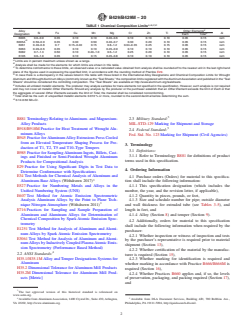
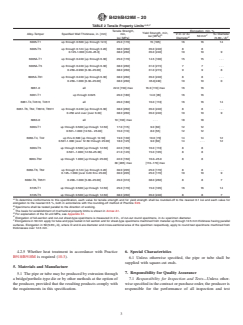
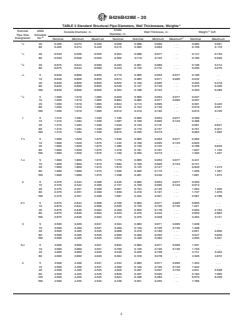
1.1 This specification covers aluminum-alloy extruded structural pipe and tube in those selected alloys shown in Table 1 and tempers shown in Table 2, and in those standard sizes shown in Tables 3-5, as well as in other nonstandard sizes as agreed upon between the purchaser and supplier. Such pipe and tube is intended for use in structural applications such as highway and bridge rails, chain-link fence posts, handrails, sign structures, awning supports, lighting brackets, etc. Structural pipe and tube is not intended for fluid-carrying applications involving pressure.
Note 1: For drawn seamless tube used in pressure applications see Specifications B210/B210M, for seamless pipe and seamless extruded tube used in pressure applications see Specifications B241/B241M, and for drawn tube and pipe for general purpose applications see Specification B483/B483M.
1.2 Alloy and temper designations are in accordance with ANSI H35.1/H35.1M. The equivalent Unified Numbering System alloy designations are those of Table 1 preceded by A9 (for example, A96061 for alloy 6061 in accordance with Practice E527).
1.3 For acceptance criteria for inclusion of new aluminum and aluminum alloys in this specification, see Annex A2.
1.4 Units—The values stated in either SI units or inch-pound units are to be regarded separately as standard. SI units are shown in brackets. The values stated in each system are not necessarily exact equivalents; therefore, to ensure conformance with the standard, each system shall be used independently of the other, and values from the two systems shall not be combined.
1.4.1 Metric Sizes—While this is a combined SI and inch-pound units specification, there are no standard equivalent metric designations for pipe. Metric sizes are converted and shown only for user convenience.
1.4.2 While this is a combined SI and inch-pound units specification, standard pipe sizes are not applicable to SI units, therefore non-rationalized SI units (soft conversions) are shown for reader convenience. Rationalized [hard converted] SI units are shown in brackets while non-rationalized (soft converted) SI units are shown in parentheses.
1.5 This standard does not purport to address all of the safety concerns, if any, associated with its use. It is the responsibility of the user of this standard to establish appropriate safety, health, and environmental practices and determine the applicability of regulatory limitations prior to use.
1.6 This international standard was developed in accordance with internationally recognized principles on standardization established in the Decision on Principles for the Development of International Standards, Guides and Recommendations issued by the World Trade Organization Technical Barriers to Trade (TBT) Committee.
- Status
- Published
- Publication Date
- 31-Oct-2020
- Technical Committee
- B07 - Light Metals and Alloys
- Drafting Committee
- B07.03 - Aluminum Alloy Wrought Products
Overview
ASTM B429/B429M-20 is the standard specification developed by ASTM International for aluminum-alloy extruded structural pipe and tube. This international standard applies specifically to extruded aluminum pipes and tubes produced from alloys such as 6061 (UNS A96061) and 6063 (UNS A96063), intended for structural-not pressure fluid-carrying-applications. The specification covers a wide range of standard and nonstandard sizes, tempers, and tolerance requirements, supporting safe and consistent material selection for construction and infrastructure projects worldwide.
This standard is widely recognized and relied upon by engineers, architects, and manufacturers to ensure the quality and interoperability of aluminum extruded pipes and tubes for non-fluid, load-bearing structural uses.
Key Topics
Scope and Coverage
- Applicable to aluminum-alloy extruded structural pipes and tubes for non-pressurized, structural applications.
- Specifies relevant alloys and tempers in accordance with ANSI H35.1/H35.1M.
- Allows for both standard and custom sizes as agreed between purchaser and supplier.
- Pipes and tubes are delivered with plain, square-cut ends and mill finish unless otherwise specified.
Material and Manufacturing
- Permits production by extrusion through appropriate dies or other approved methods.
- Focuses exclusively on alloys registered with defined chemical compositions and mechanical property limits.
- Excludes use for pressurized or fluid service-pressure applications are covered by other ASTM standards (e.g., B210/B210M, B241/B241M).
Mechanical and Chemical Requirements
- Mandates adherence to specific tensile properties, chemical composition limits, and dimensional tolerances.
- Details on sampling and chemical analysis per industry-accepted practices to ensure uniform quality.
- Guidance on heat treatment to achieve required tempers.
Quality, Inspection, and Marking
- Outlines procedures for product identification, certification, quality assurance, and packaging.
- Includes requirements for marking and packaging appropriate to safe transport and traceability.
- Source inspection and retest procedures are established to support compliance verification.
Applications
ASTM B429/B429M-20 extruded aluminum structural pipes and tubes are essential for a variety of architectural, civil, and industrial structures where lightweight, corrosion-resistant, and high-strength materials are required. Common practical applications include:
- Highway and bridge railings
- Chain-link fence posts
- Handrails for staircases and walkways
- Structural supports for signs and signals
- Awning and canopy supports
- Lighting pole structures
- Building frameworks and lightweight exterior supports
The specification is fundamentally used in sectors such as transportation infrastructure, commercial construction, public facilities, and general fabrication, where non-pressurized, load-bearing aluminum sections are specified for strength, durability, and sustainability.
Related Standards
For successful selection and combination of materials, it’s essential to consult related ASTM standards that cover aluminum pipe and tube products for other purposes:
- ASTM B210/B210M: Aluminum and Aluminum-Alloy Drawn Seamless Tubes (for pressure applications)
- ASTM B241/B241M: Aluminum and Aluminum-Alloy Seamless Pipe and Seamless Extruded Tube (for pressure applications)
- ASTM B483/B483M: Aluminum and Aluminum-Alloy Drawn Tube and Pipe for General Purpose Applications
- ASTM B557/B557M: Test Methods for Tension Testing Wrought and Cast Aluminum- and Magnesium-Alloy Products
- ASTM B666/B666M: Practice for Identification Marking of Aluminum and Magnesium Products
These related standards provide further guidance on selection for fluid-carrying, general, or specialized applications and should be referenced to ensure compliance with project requirements.
Keywords: ASTM B429, aluminum-alloy structural pipe, extruded tube, non-pressurized aluminum pipe, alloy 6061, alloy 6063, architectural aluminum standards, aluminum structural applications, ASTM aluminum pipe standards
Relations
- Effective Date
- 01-Nov-2023
- Refers
ASTM B210/B210M-19 - Standard Specification for Aluminum and Aluminum-Alloy Drawn Seamless Tubes - Effective Date
- 01-Jan-2019
- Effective Date
- 01-Nov-2017
- Effective Date
- 01-Oct-2017
- Effective Date
- 15-Sep-2017
- Effective Date
- 01-Aug-2017
- Effective Date
- 01-May-2017
- Effective Date
- 15-Jan-2017
- Effective Date
- 01-Nov-2016
- Effective Date
- 15-May-2014
- Effective Date
- 15-May-2014
- Effective Date
- 01-Jun-2013
- Effective Date
- 01-May-2013
- Effective Date
- 01-May-2013
- Effective Date
- 01-Dec-2012
Get Certified
Connect with accredited certification bodies for this standard

Element Materials Technology
Materials testing and product certification.

Inštitut za kovinske materiale in tehnologije
Institute of Metals and Technology. Materials testing, metallurgical analysis, NDT.
Sponsored listings
Frequently Asked Questions
ASTM B429/B429M-20 is a technical specification published by ASTM International. Its full title is "Standard Specification for Aluminum-Alloy Extruded Structural Pipe and Tube". This standard covers: ABSTRACT This specification covers UNS A96061 or A96063 aluminum alloy extruded pipes and tubes intended for use in structural applications. The structural pipes and tubes that may be produced through a bridge/porthole type die or other approved methods are not for use in fluid-carrying applications involving pressure. Both alloys may be extrusion press solution heat treated to produce the specified tempers. Each pipe or tube should be supplied with plain square-cut ends and mill finished unless otherwise specified. Samples for chemical analysis should be taken from the materials by drilling, sawing, turning, or clipping and subjected to suitable chemical or spectrochemical methods of analysis. SCOPE 1.1 This specification covers aluminum-alloy extruded structural pipe and tube in those selected alloys shown in Table 1 and tempers shown in Table 2, and in those standard sizes shown in Tables 3-5, as well as in other nonstandard sizes as agreed upon between the purchaser and supplier. Such pipe and tube is intended for use in structural applications such as highway and bridge rails, chain-link fence posts, handrails, sign structures, awning supports, lighting brackets, etc. Structural pipe and tube is not intended for fluid-carrying applications involving pressure. Note 1: For drawn seamless tube used in pressure applications see Specifications B210/B210M, for seamless pipe and seamless extruded tube used in pressure applications see Specifications B241/B241M, and for drawn tube and pipe for general purpose applications see Specification B483/B483M. 1.2 Alloy and temper designations are in accordance with ANSI H35.1/H35.1M. The equivalent Unified Numbering System alloy designations are those of Table 1 preceded by A9 (for example, A96061 for alloy 6061 in accordance with Practice E527). 1.3 For acceptance criteria for inclusion of new aluminum and aluminum alloys in this specification, see Annex A2. 1.4 Units—The values stated in either SI units or inch-pound units are to be regarded separately as standard. SI units are shown in brackets. The values stated in each system are not necessarily exact equivalents; therefore, to ensure conformance with the standard, each system shall be used independently of the other, and values from the two systems shall not be combined. 1.4.1 Metric Sizes—While this is a combined SI and inch-pound units specification, there are no standard equivalent metric designations for pipe. Metric sizes are converted and shown only for user convenience. 1.4.2 While this is a combined SI and inch-pound units specification, standard pipe sizes are not applicable to SI units, therefore non-rationalized SI units (soft conversions) are shown for reader convenience. Rationalized [hard converted] SI units are shown in brackets while non-rationalized (soft converted) SI units are shown in parentheses. 1.5 This standard does not purport to address all of the safety concerns, if any, associated with its use. It is the responsibility of the user of this standard to establish appropriate safety, health, and environmental practices and determine the applicability of regulatory limitations prior to use. 1.6 This international standard was developed in accordance with internationally recognized principles on standardization established in the Decision on Principles for the Development of International Standards, Guides and Recommendations issued by the World Trade Organization Technical Barriers to Trade (TBT) Committee.
ABSTRACT This specification covers UNS A96061 or A96063 aluminum alloy extruded pipes and tubes intended for use in structural applications. The structural pipes and tubes that may be produced through a bridge/porthole type die or other approved methods are not for use in fluid-carrying applications involving pressure. Both alloys may be extrusion press solution heat treated to produce the specified tempers. Each pipe or tube should be supplied with plain square-cut ends and mill finished unless otherwise specified. Samples for chemical analysis should be taken from the materials by drilling, sawing, turning, or clipping and subjected to suitable chemical or spectrochemical methods of analysis. SCOPE 1.1 This specification covers aluminum-alloy extruded structural pipe and tube in those selected alloys shown in Table 1 and tempers shown in Table 2, and in those standard sizes shown in Tables 3-5, as well as in other nonstandard sizes as agreed upon between the purchaser and supplier. Such pipe and tube is intended for use in structural applications such as highway and bridge rails, chain-link fence posts, handrails, sign structures, awning supports, lighting brackets, etc. Structural pipe and tube is not intended for fluid-carrying applications involving pressure. Note 1: For drawn seamless tube used in pressure applications see Specifications B210/B210M, for seamless pipe and seamless extruded tube used in pressure applications see Specifications B241/B241M, and for drawn tube and pipe for general purpose applications see Specification B483/B483M. 1.2 Alloy and temper designations are in accordance with ANSI H35.1/H35.1M. The equivalent Unified Numbering System alloy designations are those of Table 1 preceded by A9 (for example, A96061 for alloy 6061 in accordance with Practice E527). 1.3 For acceptance criteria for inclusion of new aluminum and aluminum alloys in this specification, see Annex A2. 1.4 Units—The values stated in either SI units or inch-pound units are to be regarded separately as standard. SI units are shown in brackets. The values stated in each system are not necessarily exact equivalents; therefore, to ensure conformance with the standard, each system shall be used independently of the other, and values from the two systems shall not be combined. 1.4.1 Metric Sizes—While this is a combined SI and inch-pound units specification, there are no standard equivalent metric designations for pipe. Metric sizes are converted and shown only for user convenience. 1.4.2 While this is a combined SI and inch-pound units specification, standard pipe sizes are not applicable to SI units, therefore non-rationalized SI units (soft conversions) are shown for reader convenience. Rationalized [hard converted] SI units are shown in brackets while non-rationalized (soft converted) SI units are shown in parentheses. 1.5 This standard does not purport to address all of the safety concerns, if any, associated with its use. It is the responsibility of the user of this standard to establish appropriate safety, health, and environmental practices and determine the applicability of regulatory limitations prior to use. 1.6 This international standard was developed in accordance with internationally recognized principles on standardization established in the Decision on Principles for the Development of International Standards, Guides and Recommendations issued by the World Trade Organization Technical Barriers to Trade (TBT) Committee.
ASTM B429/B429M-20 is classified under the following ICS (International Classification for Standards) categories: 77.150.10 - Aluminium products. The ICS classification helps identify the subject area and facilitates finding related standards.
ASTM B429/B429M-20 has the following relationships with other standards: It is inter standard links to ASTM B660-23, ASTM B210/B210M-19, ASTM B881-17, ASTM E1251-17a, ASTM E1251-17, ASTM B918/B918M-17a, ASTM B918/B918M-17, ASTM E3061-17, ASTM B985-12(2016), ASTM B557M-14, ASTM B557-14, ASTM B807/B807M-13, ASTM B483/B483M-13e1, ASTM B483/B483M-13, ASTM B985-12. Understanding these relationships helps ensure you are using the most current and applicable version of the standard.
ASTM B429/B429M-20 is available in PDF format for immediate download after purchase. The document can be added to your cart and obtained through the secure checkout process. Digital delivery ensures instant access to the complete standard document.
Standards Content (Sample)
This international standard was developed in accordance with internationally recognized principles on standardization established in the Decision on Principles for the
Development of International Standards, Guides and Recommendations issued by the World Trade Organization Technical Barriers to Trade (TBT) Committee.
Designation:B429/B429M −20
Standard Specification for
Aluminum-Alloy Extruded Structural Pipe and Tube
This standard is issued under the fixed designation B429/B429M; the number immediately following the designation indicates the year
of original adoption or, in the case of revision, the year of last revision. A number in parentheses indicates the year of last reapproval.
A superscript epsilon (´) indicates an editorial change since the last revision or reapproval.
This standard has been approved for use by agencies of the U.S. Department of Defense.
1. Scope* 1.4.2 While this is a combined SI and inch-pound units
specification, standard pipe sizes are not applicable to SI units,
1.1 This specification covers aluminum-alloy extruded
therefore non-rationalized SI units (soft conversions) are
structural pipe and tube in those selected alloys shown in Table
shown for reader convenience. Rationalized [hard converted]
1 and tempers shown in Table 2, and in those standard sizes
SI units are shown in brackets while non-rationalized (soft
shown in Tables 3-5, as well as in other nonstandard sizes as
converted) SI units are shown in parentheses.
agreeduponbetweenthepurchaserandsupplier.Suchpipeand
1.5 This standard does not purport to address all of the
tube is intended for use in structural applications such as
safety concerns, if any, associated with its use. It is the
highway and bridge rails, chain-link fence posts, handrails,
responsibility of the user of this standard to establish appro-
sign structures, awning supports, lighting brackets, etc. Struc-
priate safety, health, and environmental practices and deter-
tural pipe and tube is not intended for fluid-carrying applica-
mine the applicability of regulatory limitations prior to use.
tions involving pressure.
1.6 This international standard was developed in accor-
NOTE 1—For drawn seamless tube used in pressure applications see
Specifications B210/B210M, for seamless pipe and seamless extruded
dance with internationally recognized principles on standard-
tube used in pressure applications see Specifications B241/B241M, and
ization established in the Decision on Principles for the
for drawn tube and pipe for general purpose applications see Specification
Development of International Standards, Guides and Recom-
B483/B483M.
mendations issued by the World Trade Organization Technical
1.2 Alloy and temper designations are in accordance with
Barriers to Trade (TBT) Committee.
ANSI H35.1/H35.1M. The equivalent Unified Numbering
System alloy designations are those of Table 1 preceded byA9
2. Referenced Documents
(for example, A96061 for alloy 6061 in accordance with
2.1 ASTM Standards:
Practice E527).
B210/B210M Specification for Aluminum and Aluminum-
1.3 For acceptance criteria for inclusion of new aluminum
Alloy Drawn Seamless Tubes
and aluminum alloys in this specification, see Annex A2.
B241/B241M Specification for Aluminum and Aluminum-
Alloy Seamless Pipe and Seamless Extruded Tube
1.4 Units—The values stated in either SI units or inch-
B483/B483M Specification for Aluminum and Aluminum-
pound units are to be regarded separately as standard. SI units
Alloy Drawn Tube and Drawn Pipe for General Purpose
are shown in brackets.The values stated in each system are not
Applications
necessarilyexactequivalents;therefore,toensureconformance
B557 Test Methods for Tension Testing Wrought and Cast
with the standard, each system shall be used independently of
Aluminum- and Magnesium-Alloy Products
the other, and values from the two systems shall not be
B557M Test Methods for Tension Testing Wrought and Cast
combined.
Aluminum- and Magnesium-Alloy Products (Metric)
1.4.1 Metric Sizes—While this is a combined SI and inch-
B660 Practices for Packaging/Packing of Aluminum and
pound units specification, there are no standard equivalent
Magnesium Products
metric designations for pipe. Metric sizes are converted and
B666/B666M Practice for Identification Marking of Alumi-
shown only for user convenience.
num and Magnesium Products
B807/B807M Practice for Extrusion Press Solution Heat
Treatment for Aluminum Alloys
This specification is under the jurisdiction of ASTM Committee B07 on Light
Metals and Alloys and is the direct responsibility of Subcommittee B07.03 on
Aluminum Alloy Wrought Products.
Current edition approved Nov. 1, 2020. Published November 2020. Originally For referenced ASTM standards, visit the ASTM website, www.astm.org, or
ε1
approved in 1965. Last previous edition approved in 2010 as B429/B429M – 10 contact ASTM Customer Service at service@astm.org. For Annual Book of ASTM
which was withdrawn in January 2019 and reinstated in November 2020. DOI: Standards volume information, refer to the standard’s Document Summary page on
10.1520/B0429_B0429M-20. the ASTM website.
*A Summary of Changes section appears at the end of this standard
Copyright © ASTM International, 100 Barr Harbor Drive, PO Box C700, West Conshohocken, PA 19428-2959. United States
B429/B429M−20
A,B,C,D
TABLE 1 Chemical Composition Limits
E
Alloy Other Elements
Si Fe Cu Mn Mg Cr Zn Ti Al
F
Designation Each Total
6005 0.6–0.9 0.35 0.10 0.10 0.40–0.6 0.10 0.10 0.10 0.05 0.15 rem
G
6005A 0.50–0.9 0.35 0.30 0.50 0.40–0.7 0.30 0.20 0.10 0.05 0.15 rem
6061 0.40–0.8 0.7 0.15–0.40 0.15 0.8–1.2 0.04–0.35 0.25 0.15 0.05 0.15 rem
6063 0.20–0.6 0.35 0.10 0.10 0.45–0.9 0.10 0.10 0.10 0.05 0.15 rem
6082 0.7–1.3 0.50 0.10 0.40–1.0 0.6–1.2 0.25 0.20 0.10 0.05 0.15 rem
6105 0.6–1.0 0.35 0.10 0.15 0.45–0.8 0.10 0.10 0.10 0.05 0.15 rem
A
Limits are in percent maximum unless shown as a range.
B
Analysis shall be made for the elements for which limits are shown in this table.
C
To determine conformance to these limits, an observed value or a calculated value obtained from analysis shall be rounded-off to the nearest unit in the last right-hand
place of the figures used in expressing the specified limit, in accordance with the rounding method of Practice E29.
D
In case there is a discrepancy in the values listed in this table with those listed in the International Alloy Designations and Chemical Composition Limits for Wrought
Aluminum and Wrought Aluminum Alloys (commonly known as the “Teal Sheets,” the composition limits registered with the Aluminum Association and published in the “Teal
Sheets” should be considered the controlling composition. The “Teal Sheets” are available at http://www.aluminum.org/tealsheets.
E
Includes all unlisted metallic elements. The producer may analyze samples for trace elements not specified in the specification. However, such analysis is not required
and may not cover all metallic Other Elements. Should any analysis by the producer or the purchaser establish that an Other Element exceeds the limit of Each or that
the aggregate of several Other Elements exceeds the limit of Total, the material shall be considered nonconforming.
F
Total shall be the sum of unspecified metallic elements 0.010 % or more, rounded to the second decimal before determining the sum.
G
0.12-0.50 Mn+Cr.
B881 Terminology Relating toAluminum- and Magnesium- 2.3 Military Standard:
Alloy Products MIL-STD-129 Marking for Shipment and Storage
B918/B918M Practice for Heat Treatment of Wrought Alu-
2.4 Federal Standard:
minum Alloys
Fed. Std. No. 123 Marking for Shipment (Civil Agencies)
B945 Practice forAluminumAlloy Extrusions Press Cooled
from an Elevated Temperature Shaping Process for Pro-
3. Terminology
duction of T1, T2, T5 and T10–Type Tempers
3.1 Definitions:
B985 Practice for SamplingAluminum Ingots, Billets, Cast-
3.1.1 Refer to Terminology B881 for definitions of product
ings and Finished or Semi-Finished Wrought Aluminum
terms used in this specification.
Products for Compositional Analysis
E29 Practice for Using Significant Digits in Test Data to
4. Ordering Information
Determine Conformance with Specifications
E34 Test Methods for Chemical Analysis of Aluminum and
4.1 Purchase orders (Orders) for material to this specifica-
Aluminum-Base Alloys (Withdrawn 2017) tion shall include the following information:
E527 Practice for Numbering Metals and Alloys in the
4.1.1 This specification designation (which includes the
Unified Numbering System (UNS) number, the year, and the revision letter, if applicable),
E607 Test Method for Atomic Emission Spectrometric
4.1.2 Quantity in pieces, pounds, or feet,
Analysis Aluminum Alloys by the Point to Plane Tech- 4.1.3 Size and schedule number for pipe; outside diameter
nique Nitrogen Atmosphere (Withdrawn 2011)
and wall thickness for extruded tube (see Tables 3-5), and
E716 Practices for Sampling and Sample Preparation of length in feet, and
Aluminum and Aluminum Alloys for Determination of 4.1.4 Alloy (Section 8) and temper (Section 9).
Chemical Composition by Spark Atomic Emission Spec-
4.2 Additionally, orders for material to this specification
trometry
shall include the following information when required by the
E1251 Test Method for Analysis of Aluminum and Alumi-
purchaser:
num Alloys by Spark Atomic Emission Spectrometry
4.2.1 Whether inspection or witness of inspection and tests
E3061 Test Method for Analysis of Aluminum and Alumi-
by the purchaser’s representative is required prior to material
numAlloys by Inductively Coupled PlasmaAtomic Emis-
shipment (Section 13),
sion Spectrometry (Performance Based Method)
4.2.2 Whether certification of the material by the manufac-
2.2 ANSI Standards:
turer is required (Section 15),
H35.1/H35.1M Alloy and Temper Designations Systems for
4.2.3 Whether marking for identification is required and
Aluminum
whether marking in accordance with Practice B666/B666M is
H35.2 Dimensional Tolerance for Aluminum Mill Products
required (Section 16),
H35.2M Dimensional Tolerance for Aluminum Mill Prod-
4.2.4 Whether Practices B660 applies and, if so, the levels
ucts [Metric]
of preservation, packaging, and packing required (Section 17),
and
The last approved version of this historical standard is referenced on
www.astm.org.
4 5
Available fromAluminumAssociation, 1400 Crystal Dr., Suite 430,Arlington, Available from DLA Document Services, Building 4/D, 700 Robbins Ave.,
VA 22202, http://www.aluminum.org. Philadelphia, PA 19111-5094, http://quicksearch.dla.mil.
B429/B429M−20
A,B,C
TABLE 2 Tensile Property Limits
Tensile Strength, Elongation, min, %
Yield Strength, min,
Alloy-Temper Specified Wall Thickness, in. [mm] min, 2 in. or 4× 5× Diameter
D F
ksi [MPa] 50 mm
E F
ksi [MPa] Diameter (5.65=A)
6005-T1 up through 0.500 [up through 12.5] 25.0 [170] 15 [105] 16 16 14
6005-T5 up through 0.124 [up through 3.20] 38.0 [260] 35.0 [240] 8 8
0.125-1.000 [3.20–25.0] 38.0 [260] 35.0 [240] 10 10 9
6005A-T1 up through 0.249 [up through 6.30] 25.0 [170] 14.5 [100] 15 15 . . .
6005A-T5 up through 0.249 [up through 6.30] 38.0 [260] 31.0 [215] 7 7 . . .
0.250–0.999 [6.30–25.00] 38.0 [260] 31.0 [215] 9 9 8
6005A-T61 up through 0.249 [up through 6.30] 38.0 [260] 35.0 [240] 8 8 . . .
0.250–1.000 [6.30–25.00] 38.0 [260] 35.0[240] 10 10 0
6061-0 all 22.0 [150] max 16.0 [110] max 16 16
6061-T1 up through 0.625 26.0 [180] 14.0 [95] 16 16
6061-T4,T4510, T4511 all 26.0 [180] 16.0 [110] 16 16 14
6061-T6, T62, T6510, T6511 up through 0.249 [up through 6.30] 38.0 [260] 35.0 [240] 8 8 . . .
0.250 and over [over 6.30] 38.0 [260] 35.0 [240] 10 10 9
6063-0 all 19 [130] max . . . 18 18
6063-T1 up through 0.500 [up through 12.50] 17.0 [115] 9.0 [60] 12 12
0.501–1.000 [12.50– 25.00] 16.0 [110] 8.0 [55] 12 12
6063-T4, T42 up thru 0.500 [up through 12.50] 19.0 [130] 10.0 [70] 14 14 12
0.501-1.000 [over 12.50 through 25.00] 18.0 [125] 9.0 [60] 14 . . . 12
6063-T5 up through 0.500 [up through 12.50] 22.0 [150] 16.0 [110] 8 8
0.501–1.000 [12.50–25.00] 21.0 [145] 15.0 [105] 8 8
6063-T52 up through 1.000 [up through 25.00] 22.0 [150] 16.0–25.0 8 8
30 [205] max [110–170] max
6063-T6, T62 up through 0.124 [up through 3.20] 30.0 [205] 25.0 [170] 8 8 . . .
0.125–1.000 [over 3.20 thru 25.00] 30.0 [205] 25.0 [170] 10 10 9
6082-T6, T6511 0.200–1.000 [5.00–25.00] 45.0 [310] 38.0 [260] 8 8 7
6105-T1 up through 0.500 [up through 12.50] 25.0 [170] 15.0 [105] 16 16 14
6105-T5 up through 0.500 [up through 12.50] 38.0 [260] 35.0 [240] 8 8 7
A
To determine conformance to this specification, each value for tensile strength and for yield strength shall be rounded-off to the nearest 0.1 ksi and each value for
elongation to the nearest 0.5 %, both in accordance with the rounding-off method of Practice E29.
B
Specimens shall be tested parallel to the direction of working.
C
The basis for establishment of mechanical property limits is shown in Annex A1.
D
For explanation of the SI unit MPa, see Appendix X1.
E
Elongation of full-section and cut-out sheet-type specimens is measured in 2 in., of cut-out round specimens, in 4× specimen diameter.
F
Elongations in 50 mm apply for tube and pipe tested in full section and for sheet-type specimens machined from material up through 12.5 mm thickness having parallel
surfaces. Elongation in 5D(5.65=A), where D and A are diameter and cross-sectional area of the specimen respectively, apply to round test specimens machined from
thicknesses over 12.5 mm.
4.2.5 Whether heat treatment in accordance with Practice 6. Special Characteristics
B918/B918M is required (10.3).
6.1 Unless otherwise specified, the pipe or tube shall be
supplied with square-cut ends.
5. Materials and Manufacture
7. Responsibility for Quality Assurance
5.1 The pipe or tube may be produced by extrusion through
a bridge/porthole-type die or by other methods at the option of
7.1 Responsibility for Inspection and Tests—Unless other-
the producer, provided that the resulting products comply with wise specified in the contract or purchase order, the producer is
the requirements in this specification. responsible for the performance of all inspection and test
B429/B429M−20
A
TABLE 3 Standard Structural Pipe Diameters, Wall Thicknesses, Weights
Inside
Nominal ANSI C
Outside Diameter, in. Wall Thickness, in. Weight, lb/ft
Diameter, in.
Pipe Size Schedule
B
D
Designation No.
Nominal Minimum Maximum Nominal Nominal Minimum Maximum Nominal Maximum
⁄8 40 0.405 0.374 0.420 0.269 0.068 0.060 . 0.085 0.091
80 0.405 0.374 0.420 0.215 0.095 0.083 . 0.109 0.118
⁄4 40 0.540 0.509 0.555 0.364 0.088 0.077 . 0.147 0.159
80 0.540 0.509 0.555 0.302 0.119 0.104 . 0.185 0.200
⁄8 40 0.675 0.644 0.690 0.493 0.091 0.080 . 0.196 0.212
80 0.675 0.644 0.690 0.423 0.126 0.110 . 0.256 0.276
⁄2 5 0.840 0.809 0.855 0.710 0.065 0.053 0.077 0.186 .
10 0.840 0.809 0.855 0.674 0.083 0.071 0.095 0.232 .
40 0.840 0.809 0.855 0.622 0.109 0.095 . 0.294 0.318
80 0.840 0.809 0.855 0.546 0.147 0.129 . 0.376 0.406
160 0.840 0.809 0.855 0.464 0.188 0.164 . 0.453 0.489
⁄4 5 1.050 1.019 1.065 0.920 0.065 0.053 0.077 0.237 .
10 1.050 1.019 1.065 0.884 0.083 0.071 0.095 0.297 {
40 1.050 1.019 1.065 0.824 0.113 0.099 . 0.391 0.422
80 1.050 1.019 1.065 0.742 0.154 0.135 . 0.510 0.551
160 1.050 1.019 1.065 0.612 0.219 0.192 . 0.672 0.726
15 1.315 1.284 1.330 1.185 0.065 0.053 0.077 0.300 .
10 1.315 1.284 1.330 1.097 0.109 0.095 0.123 0.486 .
40 1.315 1.284 1.330 1.049 0.133 0.116 . 0.581 0.627
80 1.315 1.284 1.330 0.957 0.179 0.157 . 0.751 0.811
160 1.315 1.284 1.330 0.815 0.250 0.219 { 0.984 1.062
1 ⁄4 5 1.660 1.629 1.675 1.530 0.065 0.053 0.077 0.383 .
10 1.660 1.629 1.675 1.442 0.109 0.095 0.123 0.625 .
40 1.660 1.629 1.675 1.380 0.140 0.122 . 0.786 0.849
80 1.660 1.629 1.675 1.278 0.191 0.167 . 1.037 1.120
160 1.660 1.629 1.675 1.160 0.250 0.219 . 1.302 1.407
1 ⁄2 5 1.900 1.869 1.915 1.770 0.065 0.053 0.077 0.441 .
10 1.900 1.869 1.915 1.682 0.109 0.095 0.123 0.721 .
40 1.900 1.869 1.915 1.610 0.145 0.127 . 0.940 1.015
80 1.900 1.869 1.915 1.500 0.200 0.175 . 1.256 1.357
160 1.900 1.869 1.915 1.338 0.281 0.246 . 1.681 1.815
25 2.375 2.344 2.406 2.245 0.065 0.053 0.077 0.555 .
10 2.375 2.344 2.406 2.157 0.109 0.095 0.123 0.913 {
40 2.375 2.351 2.399 2.067 0.154 0.135 . 1.264 1.365
80 2.375 2.351 2.399 1.939 0.218 0.191 . 1.737 1.876
160 2.375 2.351 2.399 1.687 0.344 0.301 . 2.581 2.788
2 ⁄2 5 2.875 2.844 2.906 2.709 0.083 0.071 0.095 0.856 .
10 2.875 2.844 2.906 2.635 0.120 0.105 0.135 1.221 .
40 2.875 2.846 2.904 2.469 0.203 0.178 . 2.004 2.164
80 2.875 2.846 2.904 2.323 0.276 0.242 . 2.650 2.862
160 2.875 2.846 2.904 2.125 0.375 0.328 . 3.464 3.741
35 3.500 3.469 3.531 3.334 0.083 0.071 0.095 1.048 .
10 3.500 3.469 3.531 3.260 0.120 0.105 0.135 1.498 {
40 3.500 3.465 3.535 3.068 0.216 0.189 . 2.621 2.830
80 3.500 3.465 3.535 2.900 0.300 0.262 . 3.547 3.830
160 3.500 3.465 3.535 2.624 0.438 0.383 . 4.955 5.351
3 ⁄2 5 4.000 3.969 4.031 3.834 0.083 0.071 0.095 1.201 .
10 4.000 3.969 4.031 3.760 0.120 0.105 0.135 1.720 .
40 4.000 3.960 4.040 3.548 0.226 0.198 . 3.151 3.403
80 4.000 3.960 4.040 3.364 0.318 0.278 { 4.326 4.672
45 4.500 4.469 4.531 4.334 0.083 0.071 0.095 1.354 .
10 4.500 4.469 4.531 4.260 0.120 0.105 0.135 1.942 .
40 4.500 4.455 4.545 4.026 0.237 0.207 3.733 4.031 5.598
80 4.500 4.455 4.545 3.826 0.337 0.295 . 5.183 7.099
120 4.500 4.455 4.545 3.624 0.438 0.383 . 6.573 8.409
160 4.500 4.455 4.545 3.438 0.531 0.465 . 7.786
B429/B429M−20
TABLE 3 Continued
Inside
Nominal ANSI C
Outside Diameter, in. Wall Thickness, in. Weight, lb/ft
Diameter, in.
Pipe Size Schedule
B
D
Designation No.
Nominal Minimum Maximum Nominal Nominal Minimum Maximum Nominal Maximum
55 5.563 5.532 5.625 5.345 0.109 0.095 0.123 2.196 .
10 5.563 5.532 5.625 5.295 0.134 0.117 0.151 2.688 .
40 5.563 5.507 5.619 5.047 0.258 0.226 . 5.057 5.461
80 5.563 5.507 5.619 4.813 0.375 0.328 . 7.188 7.763
120 5.563 5.507 5.619 4.563 0.500 0.438 . 9.353 10.10
160 5.563 5.507 5.619 4.313 0.625 0.547 . 11.40 12.31
65 6.625 6.594 6.687 6.407 0.109 0.095 0.123 2.624 .
10 6.625 6.594 6.687 6.357 0.134 0.117 0.151 3.213 .
40 6.625 6.559 6.691 6.065 0.280 0.245 . 6.564 7.089
80 6.625 6.559 6.691 5.761 0.432 0.378 . 9.884 10.67
120 6.625 6.559 6.691 5.501 0.562 0.492 . 12.59 13.60
160 6.625 6.559 6.691 5.187 0.719 0.629 . 15.69 16.94
85 8.625 8.594 8.718 8.407 0.109 0.095 0.123 3.429 .
10 8.625 8.594 8.718 8.329 0.148 0.130 0.166 4.635 .
20 8.625 8.539 8.711 8.125 0.250 0.219 . 7.735 8.354
8.625 8.539 8.711 8.071 0.277 0.242 . 8.543 9.227
40 8.625 8.539 8.711 7.981 0.322 0.282 . 9.878 10.67
60 8.625 8.539 8.711 7.813 0.406 0.355 . 12.33 13.31
80 8.625 8.539 8.711 7.625 0.500 0.438 . 15.01 16.21
100 8.625 8.539 8.711 7.437 0.594 0.520 . 17.62 19.03
120 8.625 8.539 8.711 7.187 0.719 0.629 . 21.00 22.68
140 8.625 8.539 8.711 7.001 0.812 0.710 . 23.44 25.31
160 8.625 8.539 8.711 6.813 0.906 0.793 . 25.84 27.90
10 5 10.750 10.719 10.843 10.482 0.134 0.117 0.151 5.256 .
10 10.750 10.719 10.843 10.420 0.165 0.144 0.186 6.453 .
20 10.750 10.642 10.858 10.250 0.250 0.219 . 9.698 10.47
30 10.750 10.642 10.858 10.136 0.307 0.269 . 11.84 12.79
40 10.750 10.642 10.858 10.020 0.365 0.319 . 14.00 15.12
60 10.750 10.642 10.858 9.750 0.500 0.438 . 18.93 20.45
80 10.750 10.642 10.858 9.562 0.594 0.520 . 22.29 24.07
100 10.750 10.642 10.858 9.312 0.719 0.629 . 26.65 28.78
12 5 12.750 12.719 12.843 12.438 0.156 0.136 0.176 7.258 .
10 12.750 12.719 12.843 12.390 0.180 0.158 0.202 8.359 .
20 12.750 12.622 12.878 12.250 0.250 0.219 . 11.55 12.47
30 12.750 12.622 12.878 12.090 0.330 0.289 . 15.14 16.35
40 12.750 12.622 12.878 11.938 0.406 0.355 . 18.52 20.00
60 12.750 12.622 12.878 11.626 0.562 0.492 . 25.31 27.33
80 12.750 12.622 12.878 11.374 0.688 0.602 . 30.66 33.11
A
Soft metric size conversions shown for reader convenience only. Metric sizes do not exist for standard schedule pipe.
B
Schedule 40 is also designated as “standard pipe.”
C 3 3
Based on the 6005A, 6061, and 6082 alloy densities of 0.098 lb/in. (U.S. customary) and 2.70 kg/m (metric). For alloys 6063, 6005, and 6105 multiply by 0.99. For
alloy 3003 multiply by 1.011.
D
For Schedule 40, maximum wall thickness is controlled by weight tolerance.
requirements specified herein. Except as otherwise specified in determined by the producer by taking samples in accordance
the contract or order, the producer may use his own or any with Practice E716 when the ingots are poured, and analyzing
other suitable facilities for the performance of the inspection
those samples in accordance with Test Methods E607, E1251,
and test requirements specified herein, unless disapproved by
E34,or E3061. At least one sample shall be taken for each
the purchaser at the time the order is placed. The purchaser
groupofingotspouredsimultaneouslyfromthesamesourceof
shall have the right to perform any of the inspections and tests
molten metal. If the producer has determined the chemical
set forth in this specification where such inspections are
composition during pouring of the ingots, they shall not be
deemed necessary to ensure that material conforms to pre-
required to sample and analyze the finished product.
scribed requirements.
8.2 If it becomes necessary to analyze pipe or tube for
7.2 Lot Definition—An inspection lot shall consist of an
conformance to chemical composition limits, the methods of
identifiable quantity of material of the same mill form, alloy,
sampling and methods of anal
...