

ASTM D8433-22
(Specification)Standard Specification for Food Safety and Quality of Hempseed Intended for Dehulling or Oil Extraction Food Purposes
General Information
- Abstract
SCOPE
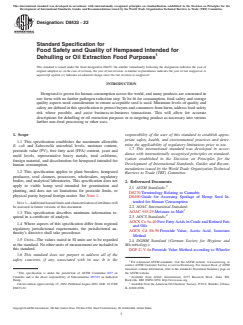
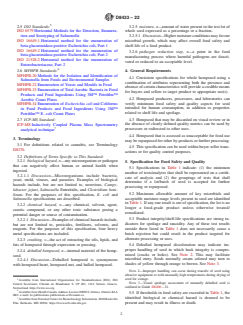
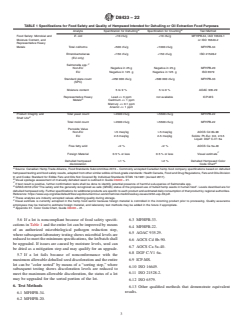
1.1 This specification establishes the maximum allowable E. coli and Salmonella microbial levels, moisture content, peroxide value (PV), free fatty acid (FFA) content, yeast and mold levels, representative heavy metals, total coliforms, foreign material, and discoloration for hempseed intended for human consumption.
1.2 This specification applies to plant breeders, hempseed producers, seed cleaners, processors, wholesalers, regulatory bodies, and analytical laboratories. This specification does not apply to viable hemp seed intended for germination and planting, and does not set limitations for pesticide limits, or physical purity beyond foreign matter. See Note 1.
Note 1: Additional hazard limits and characterization of attributes will be assessed in future versions of this document.
1.3 This specification describes minimum information required in a certificate of analysis.
1.4 Where aspects of this specification differ from regional regulatory jurisdictional requirements, the jurisdictional authority’s directive shall take precedence.
1.5 Units—The values stated in SI units are to be regarded as the standard. No other units of measurement are included in this standard.
1.6 This standard does not purport to address all of the safety concerns, if any, associated with its use. It is the responsibility of the user of this standard to establish appropriate safety, health, and environmental practices and determine the applicability of regulatory limitations prior to use.
1.7 This international standard was developed in accordance with internationally recognized principles on standardization established in the Decision on Principles for the Development of International Standards, Guides and Recommendations issued by the World Trade Organization Technical Barriers to Trade (TBT) Committee.
- Status
- Published
- Publication Date
- 14-Jul-2022
- Technical Committee
- D37 - Cannabis
- Drafting Committee
- D37.07 - Industrial Hemp

Overview
ASTM D8433-22 is the internationally recognized standard specification for the food safety and quality of hempseed intended for dehulling or oil extraction for human consumption. Developed by ASTM International, this standard sets forth clear, measurable criteria for hempseed quality, ensuring that only safe and high-quality seed enters the food supply. By defining limits for microbial levels, moisture content, heavy metals, foreign material, and visual quality factors, ASTM D8433-22 helps safeguard consumers while supporting business-to-business transparency in the rapidly growing industrial hemp food sector.
Key Topics
- Microbial Limits: The standard defines maximum allowable levels for E. coli, Salmonella, total coliforms, yeast, mold, Enterobacteriaceae (for EU markets), and the standard plate count (SPC). These criteria are critical for controlling biological hazards in hempseed products.
- Moisture Content: ASTM D8433-22 prescribes acceptable moisture ranges to mitigate microbial growth and spoilage during storage and processing.
- Heavy Metals: Acceptable limits for representative heavy metals (lead, cadmium, mercury, arsenic) are specified to prevent chemical contamination in food-grade hempseed.
- Oil Quality Indicators: Maximum levels are set for peroxide value (PV) and free fatty acid (FFA) content to ensure the freshness and integrity of hempseed oil.
- Visual Quality and Foreign Material: The standard addresses acceptable levels of foreign material and discoloration in dehulled hempseed, facilitating quality assurance and sorting processes.
- Certificate of Analysis Requirements: Producers and processors must provide minimum information for each batch, supporting traceability and regulatory compliance.
Applications
ASTM D8433-22 is essential for a broad range of stakeholders in the hemp and food industries:
- Plant Breeders and Hempseed Producers: Helps ensure harvested seed meets safety and quality benchmarks before reaching processors or wholesale buyers.
- Seed Cleaners and Processors: Employs the standard to qualify incoming seed for dehulling or oil extraction, address non-conforming lots through remediation or re-sorting, and document compliance through certificates of analysis.
- Wholesalers & Retailers: Relies on the standard to verify the safety and quality of bulk hempseed, facilitating safe distribution to food manufacturers.
- Regulatory Bodies: Uses the specification as a reference for enforcement and market surveillance to protect public health.
- Laboratories: Performs testing to certify hempseed batches using internationally recognized methods referenced in the standard.
ASTM D8433-22 improves the consistency, safety, and traceability of hempseed food products. It enables rapid decision-making for batch acceptance, upgrade, or redirection for non-food uses, supporting both public health and commercial efficiency.
Related Standards
- ASTM D8270: Terminology Relating to Cannabis - Provides specific definitions important for consistency across industry documents.
- ASTM D8400: Guide for Assessing Spoilage of Hemp Seed Intended for Human Consumption.
- AOAC 935.29: Moisture in Malt - Cited as the method for determining moisture content in hempseed.
- AOCS Ca 5a-40 / Cd 8b-90: Analytical protocols for measuring free fatty acids and peroxide values in fats and oils.
- ISO 6579 / 16649 / 21528-2: International standards for the detection and enumeration of Salmonella, E. coli, and Enterobacteriaceae.
- MFHPB Series: Canadian reference methods for microbial and mold testing in foods.
By aligning with both regional and international food safety directives, ASTM D8433-22 establishes a clear framework for safe and high-quality hempseed processing, supporting the safe integration of hemp-derived products into global food systems.
Get Certified
Connect with accredited certification bodies for this standard

BSI Group
BSI (British Standards Institution) is the business standards company that helps organizations make excellence a habit.

Bureau Veritas
Bureau Veritas is a world leader in laboratory testing, inspection and certification services.

DNV
DNV is an independent assurance and risk management provider.
Sponsored listings
Frequently Asked Questions
ASTM D8433-22 is a technical specification published by ASTM International. Its full title is "Standard Specification for Food Safety and Quality of Hempseed Intended for Dehulling or Oil Extraction Food Purposes". This standard covers: SCOPE 1.1 This specification establishes the maximum allowable E. coli and Salmonella microbial levels, moisture content, peroxide value (PV), free fatty acid (FFA) content, yeast and mold levels, representative heavy metals, total coliforms, foreign material, and discoloration for hempseed intended for human consumption. 1.2 This specification applies to plant breeders, hempseed producers, seed cleaners, processors, wholesalers, regulatory bodies, and analytical laboratories. This specification does not apply to viable hemp seed intended for germination and planting, and does not set limitations for pesticide limits, or physical purity beyond foreign matter. See Note 1. Note 1: Additional hazard limits and characterization of attributes will be assessed in future versions of this document. 1.3 This specification describes minimum information required in a certificate of analysis. 1.4 Where aspects of this specification differ from regional regulatory jurisdictional requirements, the jurisdictional authority’s directive shall take precedence. 1.5 Units—The values stated in SI units are to be regarded as the standard. No other units of measurement are included in this standard. 1.6 This standard does not purport to address all of the safety concerns, if any, associated with its use. It is the responsibility of the user of this standard to establish appropriate safety, health, and environmental practices and determine the applicability of regulatory limitations prior to use. 1.7 This international standard was developed in accordance with internationally recognized principles on standardization established in the Decision on Principles for the Development of International Standards, Guides and Recommendations issued by the World Trade Organization Technical Barriers to Trade (TBT) Committee.
SCOPE 1.1 This specification establishes the maximum allowable E. coli and Salmonella microbial levels, moisture content, peroxide value (PV), free fatty acid (FFA) content, yeast and mold levels, representative heavy metals, total coliforms, foreign material, and discoloration for hempseed intended for human consumption. 1.2 This specification applies to plant breeders, hempseed producers, seed cleaners, processors, wholesalers, regulatory bodies, and analytical laboratories. This specification does not apply to viable hemp seed intended for germination and planting, and does not set limitations for pesticide limits, or physical purity beyond foreign matter. See Note 1. Note 1: Additional hazard limits and characterization of attributes will be assessed in future versions of this document. 1.3 This specification describes minimum information required in a certificate of analysis. 1.4 Where aspects of this specification differ from regional regulatory jurisdictional requirements, the jurisdictional authority’s directive shall take precedence. 1.5 Units—The values stated in SI units are to be regarded as the standard. No other units of measurement are included in this standard. 1.6 This standard does not purport to address all of the safety concerns, if any, associated with its use. It is the responsibility of the user of this standard to establish appropriate safety, health, and environmental practices and determine the applicability of regulatory limitations prior to use. 1.7 This international standard was developed in accordance with internationally recognized principles on standardization established in the Decision on Principles for the Development of International Standards, Guides and Recommendations issued by the World Trade Organization Technical Barriers to Trade (TBT) Committee.
ASTM D8433-22 is classified under the following ICS (International Classification for Standards) categories: 07.100.30 - Food microbiology; 67.020 - Processes in the food industry. The ICS classification helps identify the subject area and facilitates finding related standards.
ASTM D8433-22 is available in PDF format for immediate download after purchase. The document can be added to your cart and obtained through the secure checkout process. Digital delivery ensures instant access to the complete standard document.
Standards Content (Sample)
This international standard was developed in accordance with internationally recognized principles on standardization established in the Decision on Principles for the
Development of International Standards, Guides and Recommendations issued by the World Trade Organization Technical Barriers to Trade (TBT) Committee.
Designation:D8433 −22
Standard Specification for
Food Safety and Quality of Hempseed Intended for
Dehulling or Oil Extraction Food Purposes
This standard is issued under the fixed designation D8433; the number immediately following the designation indicates the year of
original adoption or, in the case of revision, the year of last revision. A number in parentheses indicates the year of last reapproval. A
superscript epsilon (´) indicates an editorial change since the last revision or reapproval.
INTRODUCTION
Hempseed is grown for human consumption across the world, and many products are consumed in
raw form with no further pathogen reduction step. To be fit for consumption, food safety and storage
quality aspects need consideration to ensure acceptable seed is used. Minimum levels of quality and
safetyaredefinedinthisspecificationtoprotectbuyersandconsumersfromharm,addressfoodsafety
risk where possible, and assist business-to-business transactions. This will allow for accurate
descriptions for dehulling or oil extraction purposes or re-targeting product as necessary into various
further non-food processing or other uses.
1. Scope responsibility of the user of this standard to establish appro-
priate safety, health, and environmental practices and deter-
1.1 This specification establishes the maximum allowable
mine the applicability of regulatory limitations prior to use.
E. coli and Salmonella microbial levels, moisture content,
1.7 This international standard was developed in accor-
peroxide value (PV), free fatty acid (FFA) content, yeast and
dance with internationally recognized principles on standard-
mold levels, representative heavy metals, total coliforms,
ization established in the Decision on Principles for the
foreign material, and discoloration for hempseed intended for
Development of International Standards, Guides and Recom-
human consumption.
mendations issued by the World Trade Organization Technical
1.2 This specification applies to plant breeders, hempseed
Barriers to Trade (TBT) Committee.
producers, seed cleaners, processors, wholesalers, regulatory
bodies, and analytical laboratories. This specification does not 2. Referenced Documents
apply to viable hemp seed intended for germination and 2
2.1 ASTM Standards:
planting, and does not set limitations for pesticide limits, or
D8270 Terminology Relating to Cannabis
physical purity beyond foreign matter. See Note 1.
D8400 Guide for Assessing Spoilage of Hemp Seed In-
tended for Human Consumption
NOTE1—Additionalhazardlimitsandcharacterizationofattributeswill
be assessed in future versions of this document.
2.2 AOAC International Standard:
AOAC 935.29 Moisture in Malt
1.3 This specification describes minimum information re-
2.3 AOCS Standards:
quired in a certificate of analysis.
AOCS Ca 5a-40 Free FattyAcids in Crude and Refined Fats
1.4 Where aspects of this specification differ from regional
and Oils
regulatory jurisdictional requirements, the jurisdictional au-
AOCS Cd 8b-90 Peroxide Value, Acetic Acid, Isooctane
thority’s directive shall take precedence.
Method
1.5 Units—The values stated in SI units are to be regarded
2.4 DGHM Standard (German Society for Hygiene and
as the standard. No other units of measurement are included in
Microbiology):
this standard.
DGF C-V 6a Peroxide Value Method according to Wheeler
1.6 This standard does not purport to address all of the
safety concerns, if any, associated with its use. It is the
For referenced ASTM standards, visit the ASTM website, www.astm.org, or
contact ASTM Customer Service at service@astm.org. For Annual Book of ASTM
Standards volume information, refer to the standard’s Document Summary page on
This specification is under the jurisdiction of ASTM Committee D37 on the ASTM website.
Cannabis and is the direct responsibility of Subcommittee D37.07 on Industrial Available from AOAC International, 2275 Research Blvd., Suite 300,
Hemp. Rockville, MD 20850-3250, http://www.aoac.org.
Current edition approved July 15, 2022. Published August 2022. DOI: 10.1520/ Available from the American Oil Chemists’Society, 2710 S. Boulder, Urbana,
D8433-22. IL 61802-6996.
Copyright © ASTM International, 100 Barr Harbor Drive, PO Box C700, West Conshohocken, PA 19428-2959. United States
D8433−22
2.5 ISO Standards: 3.2.5 moisture, n—amount of water present in the test lot of
ISO 6579 Horizontal Methods for the Detection, Enumera- whole seed expressed as a percentage or a fraction.
tion and Serotyping of Salmonella
3.2.5.1 Discussion—Highermoistureconditionsmayfavour
ISO 16649-1 Horizontal method for the enumeration of microbial growth, which may affect overall food safety and
beta-glucuronidase-positive Escherichia coli, Part 1
shelf-life of a food product.
ISO 16649-2 Horizontal method for the enumeration of
3.2.6 pathogen reduction step, n—a point in the food
beta-glucuronidase-positive Escherichia coli, Part 2
manufacturing process where harmful pathogens are deacti-
ISO 21528-2 Horizontal method for the enumeration of
vated or reduced to an acceptable level.
Enterobacteriaceae, Part 2
2.6 MFHPB Standards:
4. General Requirements
MFHPB-20 Methods for the Isolation and Identification of
4.1 Consistent specifications for whole hempseed using a
Salmonella from Foods and Environmental Samples
combination of attributes representing both the presence and
MFHPB-22 Enumeration of Yeasts and Moulds in Food
absence of certain characteristics will provide a credible means
MFHPB-33 Enumeration of Total Aerobic Bacteria in Food
for buyers and sellers to target product to appropriate use(s).
Products and Food Ingredients Using 3M™ Petrifilm™
4.2 Hempseed producers, processors, and laboratories can
Aerobic Count Plates
verify minimum food safety and quality aspects for seed
MFHPB-34 Enumeration of Escherichia coli and Coliforms
intended for human consumption, in addition to properties
in Food Products and Food Ingredients Using 3M™
related to shelf life and spoilage.
Petrifilm™ E. coli Count Plates
4.3 Hempseed that may be discarded on visual review or in
2.7 ICP-MS Standard:
the absence of clearly defined quality metrics can be used by
ICP-MS Inductively Coupled Plasma Mass Spectrometry
analytical technique processors or redirected to other uses.
4.4 Hempseed that is assessed as unacceptable for food use
3. Terminology
may be repurposed for other by-products or further processing.
3.1 For definitions related to cannabis, see Terminology
4.5 This specification can be used within buyer-seller trans-
D8270.
actions or for quality control purposes.
3.2 Definitions of Terms Specific to This Standard:
3.2.1 biological hazard, n—any microorganism or pathogen
5. Specification for Food Safety and Quality
that can negatively affect human or animal health when
5.1 Specifications in Table 1 indicate: (1) the minimum
ingested.
number of tests/analytes that shall be represented on a certifi-
3.2.1.1 Discussion—Microorganisms include bacteria,
cate of analysis and (2) the groupings of tests that shall
yeast, mold, viruses, and parasites. Examples of biological
determine if a lot/batch of seed is accepted for further
hazards include, but are not limited to, norovirus, Campy-
processing or repurposed.
lobacter jejuni, Salmonella Enteritidis, and Clostridium botu-
5.2 Maximum allowable amount of key microbials and
linum. For the purposes of this specification, E. coli and
acceptable moisture range levels present in seed are identified
Salmonella specificat
...