


ASTM F3560-22
(Specification)Standard Specification for Additive Manufacturing – Data – Common Exchange Format for Particle Size Analysis by Light Scattering
Standard Specification for Additive Manufacturing – Data – Common Exchange Format for Particle Size Analysis by Light Scattering
SCOPE
1.1 This specification has been developed to facilitate exchanging and analyzing particle size distribution (PSD) by light scattering data from databases, data management systems, point of origin, or other data sources that may use different data dictionaries, schemas, or formats.
1.2 This specification prescribes the use of a common exchange format in such a way that PSD data defined through proprietary means can be easily exchanged for process understanding and qualification.
1.3 This specification facilitates the interoperability of PSD data by identifying the data elements defined in standardized terminology, as well as defining those salient terms with indisputable meanings. In doing so, this specification extends the common AM data dictionary defined in Practice F3490 to encapsulate PSD process-specific data elements. Generic data elements and relationships present in that standard are inherited and applied in this practice where relevant.
1.4 This specification specifies names that serve to uniquely identify the PSD data elements. The data type, value domain, and term definition for each data element are also specified in this practice. References are provided for those data elements with established definitions or reporting guidelines in existing standards.
1.5 This specification prescribes a file format and structure for the exchange of PSD data. This format defines a method for sharing data via the defined PSD data elements herein and provides a basis for validation of data exchanged using this format.
1.6 This specification recommends levels of data sharing that vary from minimal to robust. It prescribes best practices for checking conformance based on the common data exchange format.
1.7 This specification does not specify:
1.7.1 An exhaustive set of data items that could be exchanged related to PSD by light scattering.
1.7.2 A definition of a minimum viable data set for PSD by light scattering.
1.7.3 Data items or an exchange format for PSD methods other than light scattering, for example, imaging or sieving.
1.7.4 Data elements for data modules related to PSD (for example, for personnel, material, or equipment).
1.7.5 The implementation details of how data should be imported to proprietary data management systems from the common data exchange format.
1.7.6 The implementation details of how data should be exported from proprietary data management systems to the common data exchange format.
1.7.7 Guidelines for creating unique identifiers for data module records
1.8 The values stated in SI units are to be regarded as standard. No other units of measurement are included in this standard.
1.9 This international standard was developed in accordance with internationally recognized principles on standardization established in the Decision on Principles for the Development of International Standards, Guides and Recommendations issued by the World Trade Organization Technical Barriers to Trade (TBT) Committee.
General Information
- Status
- Published
- Publication Date
- 31-Jul-2022
- Technical Committee
- F42 - Additive Manufacturing Technologies
- Drafting Committee
- F42.08 - Data
Relations
- Effective Date
- 01-Feb-2024
- Effective Date
- 01-Apr-2019
- Effective Date
- 01-Apr-2014
- Effective Date
- 01-Sep-2010
- Effective Date
- 01-May-2010
- Effective Date
- 01-Mar-2009
- Effective Date
- 01-Oct-2007
- Effective Date
- 01-Apr-2007
- Effective Date
- 10-Oct-2002
- Effective Date
- 10-Apr-2002
- Effective Date
- 10-Apr-2002
- Effective Date
- 10-Apr-1997
- Effective Date
- 10-Apr-1997
- Effective Date
- 10-Apr-1997
Overview
ASTM F3560-22: Standard Specification for Additive Manufacturing – Data – Common Exchange Format for Particle Size Analysis by Light Scattering is an international standard developed by ASTM to streamline the exchange and analysis of particle size distribution (PSD) data obtained using light scattering techniques. This standard addresses challenges of data interoperability and consistency in additive manufacturing (AM) by defining a common file format and vocabulary for sharing PSD data, regardless of proprietary systems or data management platforms in use.
By implementing a unified approach for formatting, defining, and validating particle size distribution data, ASTM F3560-22 enhances the ability of organizations to compare, qualify, and understand PSD results, a critical factor in quality assurance and process development across additive manufacturing workflows.
Key Topics
- Common Data Exchange Format: Specifies a uniform structure (including a recommended JSON schema) for representing PSD data from light scattering, ensuring compatibility and reducing ambiguity between different databases or management systems.
- Standardized Data Elements: Clearly defines the required and optional PSD-related data elements, including their names, data types, value domains, and unambiguous definitions. This standard extends existing additive manufacturing data dictionaries for PSD-specific needs.
- Reporting Levels: Recommends three levels of data sharing, ranging from minimal (basic identifiers and essential results) to robust (full calibration, environmental, and operator data), promoting customizable data depth according to user agreement.
- Process-Specific and Generic Data: Incorporates process-specific elements (e.g., optical arrangement, refractive index) and acknowledges inheritance from broader additive manufacturing data modules.
- File Format Validation: Provides guidance on file format and structure for PSD data files using the defined data elements, supporting reliable data validation and conformance checking.
Applications
The practical value of ASTM F3560-22 is significant for the additive manufacturing industry and beyond, particularly where particle size distribution influences material properties and processing outcomes.
- Additive Manufacturing Quality Control: Ensures consistent, reliable PSD data sharing for powder bed fusion, binder jetting, and other AM methods reliant on powder characteristics.
- Data Interoperability: Facilitates data integration across different software, lab information management systems (LIMS), and enterprise resource planning (ERP) platforms, overcoming proprietary data format barriers.
- Process Qualification & Traceability: Supports robust traceability and comparison of powder batches, test conditions, and results, crucial for process qualification and regulatory compliance.
- Collaborative Research & Development: Enables standardized data exchange in multi-partner projects, consortia, and supply chains, accelerating innovation and benchmarking.
- Validation & Auditing: Provides a clear framework for establishing data pedigree and for supporting validation/audit processes required by standards bodies or regulatory agencies.
Related Standards
ASTM F3560-22 is closely linked to several other key standards that support particle size analysis and data management in manufacturing environments:
- ASTM F3490: Additive Manufacturing – General Principles – Overview of Data Pedigree (defining the common AM data dictionary)
- ASTM B821: Guide for Liquid Dispersion of Metal Powders and Related Compounds for Particle Size Analysis
- ASTM B822: Test Method for Particle Size Distribution of Metal Powders and Related Compounds by Light Scattering
- ASTM E1617: Practice for Reporting Particle Size Characterization Data
- ASTM E3340: Guide for Development of Laser Diffraction Particle Size Analysis Methods for Powder Materials
- ISO 13320: Particle size analysis – Laser diffraction methods
- ISO 8601: Date and time format (for standardizing datetime data elements)
Conclusion
Adopting ASTM F3560-22 improves data consistency, traceability, and interoperability for particle size analysis by light scattering, particularly in additive manufacturing environments. By utilizing a standardized schema and clearly defined reporting practices, stakeholders ensure streamlined data exchange, support conformance audits, and facilitate process optimization. This standard represents a vital step toward harmonized data practices in modern manufacturing and quality assurance.
Get Certified
Connect with accredited certification bodies for this standard

BSI Group
BSI (British Standards Institution) is the business standards company that helps organizations make excellence a habit.

National Aerospace and Defense Contractors Accreditation Program (NADCAP)
Global cooperative program for special process quality in aerospace.
CARES (UK Certification Authority for Reinforcing Steels)
UK certification for reinforcing steels and construction.
Sponsored listings
Frequently Asked Questions
ASTM F3560-22 is a technical specification published by ASTM International. Its full title is "Standard Specification for Additive Manufacturing – Data – Common Exchange Format for Particle Size Analysis by Light Scattering". This standard covers: SCOPE 1.1 This specification has been developed to facilitate exchanging and analyzing particle size distribution (PSD) by light scattering data from databases, data management systems, point of origin, or other data sources that may use different data dictionaries, schemas, or formats. 1.2 This specification prescribes the use of a common exchange format in such a way that PSD data defined through proprietary means can be easily exchanged for process understanding and qualification. 1.3 This specification facilitates the interoperability of PSD data by identifying the data elements defined in standardized terminology, as well as defining those salient terms with indisputable meanings. In doing so, this specification extends the common AM data dictionary defined in Practice F3490 to encapsulate PSD process-specific data elements. Generic data elements and relationships present in that standard are inherited and applied in this practice where relevant. 1.4 This specification specifies names that serve to uniquely identify the PSD data elements. The data type, value domain, and term definition for each data element are also specified in this practice. References are provided for those data elements with established definitions or reporting guidelines in existing standards. 1.5 This specification prescribes a file format and structure for the exchange of PSD data. This format defines a method for sharing data via the defined PSD data elements herein and provides a basis for validation of data exchanged using this format. 1.6 This specification recommends levels of data sharing that vary from minimal to robust. It prescribes best practices for checking conformance based on the common data exchange format. 1.7 This specification does not specify: 1.7.1 An exhaustive set of data items that could be exchanged related to PSD by light scattering. 1.7.2 A definition of a minimum viable data set for PSD by light scattering. 1.7.3 Data items or an exchange format for PSD methods other than light scattering, for example, imaging or sieving. 1.7.4 Data elements for data modules related to PSD (for example, for personnel, material, or equipment). 1.7.5 The implementation details of how data should be imported to proprietary data management systems from the common data exchange format. 1.7.6 The implementation details of how data should be exported from proprietary data management systems to the common data exchange format. 1.7.7 Guidelines for creating unique identifiers for data module records 1.8 The values stated in SI units are to be regarded as standard. No other units of measurement are included in this standard. 1.9 This international standard was developed in accordance with internationally recognized principles on standardization established in the Decision on Principles for the Development of International Standards, Guides and Recommendations issued by the World Trade Organization Technical Barriers to Trade (TBT) Committee.
SCOPE 1.1 This specification has been developed to facilitate exchanging and analyzing particle size distribution (PSD) by light scattering data from databases, data management systems, point of origin, or other data sources that may use different data dictionaries, schemas, or formats. 1.2 This specification prescribes the use of a common exchange format in such a way that PSD data defined through proprietary means can be easily exchanged for process understanding and qualification. 1.3 This specification facilitates the interoperability of PSD data by identifying the data elements defined in standardized terminology, as well as defining those salient terms with indisputable meanings. In doing so, this specification extends the common AM data dictionary defined in Practice F3490 to encapsulate PSD process-specific data elements. Generic data elements and relationships present in that standard are inherited and applied in this practice where relevant. 1.4 This specification specifies names that serve to uniquely identify the PSD data elements. The data type, value domain, and term definition for each data element are also specified in this practice. References are provided for those data elements with established definitions or reporting guidelines in existing standards. 1.5 This specification prescribes a file format and structure for the exchange of PSD data. This format defines a method for sharing data via the defined PSD data elements herein and provides a basis for validation of data exchanged using this format. 1.6 This specification recommends levels of data sharing that vary from minimal to robust. It prescribes best practices for checking conformance based on the common data exchange format. 1.7 This specification does not specify: 1.7.1 An exhaustive set of data items that could be exchanged related to PSD by light scattering. 1.7.2 A definition of a minimum viable data set for PSD by light scattering. 1.7.3 Data items or an exchange format for PSD methods other than light scattering, for example, imaging or sieving. 1.7.4 Data elements for data modules related to PSD (for example, for personnel, material, or equipment). 1.7.5 The implementation details of how data should be imported to proprietary data management systems from the common data exchange format. 1.7.6 The implementation details of how data should be exported from proprietary data management systems to the common data exchange format. 1.7.7 Guidelines for creating unique identifiers for data module records 1.8 The values stated in SI units are to be regarded as standard. No other units of measurement are included in this standard. 1.9 This international standard was developed in accordance with internationally recognized principles on standardization established in the Decision on Principles for the Development of International Standards, Guides and Recommendations issued by the World Trade Organization Technical Barriers to Trade (TBT) Committee.
ASTM F3560-22 is classified under the following ICS (International Classification for Standards) categories: 25.030 - Additive manufacturing; 35.240.50 - IT applications in industry. The ICS classification helps identify the subject area and facilitates finding related standards.
ASTM F3560-22 has the following relationships with other standards: It is inter standard links to ASTM E1617-09(2024), ASTM E1617-09(2019), ASTM E1617-09(2014)e1, ASTM B821-10, ASTM B822-10, ASTM E1617-09, ASTM B821-02(2007), ASTM E1617-97(2007), ASTM B821-02, ASTM B822-02, ASTM B822-97, ASTM E1617-97, ASTM B821-92(1997), ASTM E1617-97(2002). Understanding these relationships helps ensure you are using the most current and applicable version of the standard.
ASTM F3560-22 is available in PDF format for immediate download after purchase. The document can be added to your cart and obtained through the secure checkout process. Digital delivery ensures instant access to the complete standard document.
Standards Content (Sample)
This international standard was developed in accordance with internationally recognized principles on standardization established in the Decision on Principles for the
Development of International Standards, Guides and Recommendations issued by the World Trade Organization Technical Barriers to Trade (TBT) Committee.
Designation:F3560 −22
Standard Specification for
Additive Manufacturing – Data – Common Exchange Format
for Particle Size Analysis by Light Scattering
This standard is issued under the fixed designation F3560; the number immediately following the designation indicates the year of
original adoption or, in the case of revision, the year of last revision. A number in parentheses indicates the year of last reapproval. A
superscript epsilon (´) indicates an editorial change since the last revision or reapproval.
1. Scope 1.7.1 An exhaustive set of data items that could be ex-
changed related to PSD by light scattering.
1.1 This specification has been developed to facilitate ex-
1.7.2 Adefinition of a minimum viable data set for PSD by
changing and analyzing particle size distribution (PSD) by
light scattering.
lightscatteringdatafromdatabases,datamanagementsystems,
1.7.3 Data items or an exchange format for PSD methods
pointoforigin,orotherdatasourcesthatmayusedifferentdata
other than light scattering, for example, imaging or sieving.
dictionaries, schemas, or formats.
1.7.4 Data elements for data modules related to PSD (for
1.2 This specification prescribes the use of a common
example, for personnel, material, or equipment).
exchange format in such a way that PSD data defined through
1.7.5 The implementation details of how data should be
proprietary means can be easily exchanged for process under-
imported to proprietary data management systems from the
standing and qualification.
common data exchange format.
1.7.6 The implementation details of how data should be
1.3 This specification facilitates the interoperability of PSD
data by identifying the data elements defined in standardized exported from proprietary data management systems to the
common data exchange format.
terminology, as well as defining those salient terms with
indisputable meanings. In doing so, this specification extends 1.7.7 Guidelines for creating unique identifiers for data
module records
the common AM data dictionary defined in Practice F3490 to
encapsulate PSD process-specific data elements. Generic data
1.8 The values stated in SI units are to be regarded as
elementsandrelationshipspresentinthatstandardareinherited
standard. No other units of measurement are included in this
and applied in this practice where relevant.
standard.
1.4 This specification specifies names that serve to uniquely
1.9 This international standard was developed in accor-
identify the PSD data elements. The data type, value domain,
dance with internationally recognized principles on standard-
and term definition for each data element are also specified in
ization established in the Decision on Principles for the
this practice. References are provided for those data elements
Development of International Standards, Guides and Recom-
with established definitions or reporting guidelines in existing
mendations issued by the World Trade Organization Technical
standards.
Barriers to Trade (TBT) Committee.
1.5 This specification prescribes a file format and structure
2. Referenced Documents
fortheexchangeofPSDdata.Thisformatdefinesamethodfor
sharing data via the defined PSD data elements herein and
2.1 ASTM Standards:
provides a basis for validation of data exchanged using this
B821 Guide for Liquid Dispersion of Metal Powders and
format.
Related Compounds for Particle Size Analysis
1.6 This specification recommends levels of data sharing
B822 Test Method for Particle Size Distribution of Metal
that vary from minimal to robust. It prescribes best practices
Powders and Related Compounds by Light Scattering
forcheckingconformancebasedonthecommondataexchange
E1617 Practice for Reporting Particle Size Characterization
format.
Data
E3340 Guide for Development of Laser Diffraction Particle
1.7 This specification does not specify:
Size Analysis Methods for Powder Materials
This specification is under the jurisdiction of ASTM Committee F42 on
Additive Manufacturing Technologies and is the direct responsibility of Subcom- For referenced ASTM standards, visit the ASTM website, www.astm.org, or
mittee F42.08 on Data. contact ASTM Customer Service at service@astm.org. For Annual Book of ASTM
Current edition approved Aug. 1, 2022. Published October 2022. DOI: 10.1520/ Standards volume information, refer to the standard’s Document Summary page on
F3560-22. the ASTM website.
Copyright © ASTM International, 100 Barr Harbor Drive, PO Box C700, West Conshohocken, PA 19428-2959. United States
F3560−22
F3490 Practice forAdditive Manufacturing — General Prin- 5. Reporting Levels
ciples — Overview of Data Pedigree
5.1 Data reporting levels are suggested and based on report-
2.2 ISO Standards:
ing guidelines in Practice E1617 and ISO 13320. Recom-
ISO 8601 Date and time format
mended reporting levels are suggested for each data element in
ISO 13320 Particle size analysis — Laser diffraction meth-
Table1,Table2,andTable3.Twopartiesexchangingdatamay
ods
agree to follow different, mutually agreed-upon reporting
requirements. Non-required data elements may be omitted
3. Terminology
when exchanging data in these cases.
3.1 Abbreviations:
5.2 A data package satisfying Recommended Reporting
3.1.1 AM—Additive Manufacturing
Level 1 shall include basic identifiers and descriptors of the
3.1.2 CDD—Common Data Dictionary
test. It includes minimal test preparation details and sample
3.1.3 CDEF—Common Data Exchange Format
information as well as the most essential results to analyze the
data. Two parties exchanging data may agree to follow
3.1.4 ID—Identifier
different, mutually agreed-upon reporting requirements. Non-
3.1.5 JSON—Java Script Object Notation
required data elements may be omitted when exchanging data
3.1.6 PSD—Particle Size Distribution
in these cases.
3.1.7 SI—International System of Units
5.3 A data package satisfying Recommended Reporting
3.1.8 TIC—Test / Inspection / Characterization
Level 2 includes additional information on ambient environ-
ment conditions and test preparation details. Test results are
3.2 Definitions:
added that can be derived from the results included in Level 1.
3.2.1 For the purposes of this document, the terms and
definitions given in Practice F3490 shall apply.
5.4 A data package satisfying Recommended Reporting
Level 3 includes full equipment calibration information and
4. PSD by Light Scattering CDEF Requirements
test performance details. Additionally, linkages to complete
4.1 Data shared according to this standard shall conform to
information module records as defined in Practice F3490 are
the data element definitions in Section 6. Any additional data
maintained. For example, the TIC Operator data element has
elements included in the data package and not defined in this
Recommended Reporting Level 1 for the operator’s name as a
standard shall have definitions agreed upon by the parties
minimum requirement. At Level 3, the operator’s unique
involved in the data exchange.
identifying ID or, equivalently, their complete record of Per-
sonnel Information Module data elements as defined in Table
4.2 If the JSON format is used, data shared according to this
24 of Practice F3490, shall be reported.
standard shall conform to the JSON schema defined in Annex
A1 up to the definition of required terms, which should be
5.5 Data elements with a Reporting Level marked as O in
established by the parties involved in the exchange of data.
Table 1, Table 2, and Table 3 are considered optional at all
Thosepartiesmayrefertotherecommendedreportinglevelsin
levels.
Section 6 to establish required data elements. Note that the
5.6 Procedures using a wet dispersion method shall include
schema in Annex A1 sets required data elements per Recom-
data elements marked with a W in the Reporting Level column
mended Reporting Level 1 with a dry dispersion method, the
in Table 1. Those using a dry dispersion method shall include
“required” tags in the schema should be updated to reflect the
data elements marked with a D.
agreed-upon data reporting level. See the JSON schema
documentation for more information about specifying required
6. PSD by Light Scattering Data Element Definitions
elements: https://json-schema.org/understanding-json-schema/
reference/object.html#required-properties. Parties involved in 6.1 Data Type and Common Value Set Definition:
the exchange of data may agree upon a different format (for
6.1.1 Data types (for example, string, integer) used by the
example, XML-based) while utilizing the structure developed data element definitions in this standard are as defined in
in Annex A1.
Practice F3490 Table 1.
NOTE 1—Descriptive information for the JSON schema defined in
6.2 Data Element Definitions:
Annex A1 is provided in Appendix X1.
6.2.1 The data elements for PSD by light scattering are
4.3 Data elements not included in this specification may be
listed and described in this section.
added to the format when agreed upon by the parties exchang-
6.2.2 Some data elements are inherited from the Test /
ing data. Data elements added thusly should have names
Inspection / Characterization information module defined in
prepended with an underscore (“_”) when included in the
Practice F3490, most notably, those beginning with TIC. PSD
JSON CDEF or corresponding JSON schema as defined in
is a specific type of Test / Inspection / Characterization and
Annex A1.
these terms are maintained as-is for consistency.
6.2.3 Adataset shall specify the version of this specification
Available from International Organization for Standardization (ISO), ISO it is conforming to in order to reduce miscommunications.
Central Secretariat, Chemin de Blandonnet 8, CP 401, 1214 Vernier, Geneva,
Switzerland, https://www.iso.org. NOTE 2—As this standard continues to evolve, the data elements,
See Referenced Link after Table 3 for an active link to this web page. relationships, or file format will be updated. It is possible that this will
F3560−22
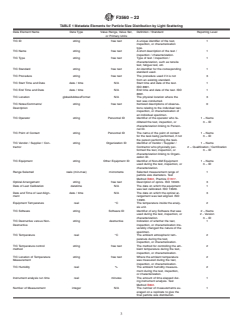
TABLE 1 Metadata Elements for Particle Size Distribution by Light Scattering
Data Element Name Data Type Value Range, Value Set, Definition / Standard Reporting Level
or Primary Units
TIC ID string free text A unique identifier of the test, 1
inspection, or characterization
type.
TIC Name string free text A short description of the test / 1
inspection / characterization.
TIC Type string free text Type of test / inspection / 1
characterization, such as tensile
test, fatigue test, etc.
TIC Standard string free text An identifier for the corresponding 1
standard used.
TIC Procedure string free text The procedure used if it is not 3
from an existing standard.
TIC Start Time and Date date / time N/A Start time and date of the test. 1
ISO 8601.
TIC End Time and Date date / time N/A End time and date of the test. ISO 1
8601.
TIC Location globalAddressFormat N/A The physical location where the 3
test was conducted.
TIC Notes/Comments/ string free text Itemized descriptions of observa- 0
Description tions relating to the individual test,
inspection, or characterization of
an individual specimen.
TIC Operator string Personnel ID Identifier of the operator who fa- 1 – Name
cilitated the test, inspection, or 3–ID
characterization linking to Person-
nel ID.
TIC Point of Contact string Personnel ID The name of the point of contact 1 – Name
for the task being performed, if not 3–ID
the person performing the task.
TIC Vendor / Supplier / Con- string Organization ID Identifier of Vendor / Supplier / 1 – Name
tractor Contractor who physically per- 2 – Qualification / Certification
formed the test, inspection, or 3–ID
characterization linking to Organi-
zation ID.
TIC Equipment string Other Equipment ID Identifier of Non-AM Equipment 1 – Name
used during the test, inspection, or 3–ID
characterization.
Range Selected reals (min-max) micrometre Selected measurement range of 1
particle size diameters. Test
Method B822, Practice E1617.
Optical Arrangement string free text Description of optics. ISO 13320. 3
Date of Last Calibration datetime N/A The date on which the equipment 1
was last calibrated. ISO 13320.
Date and Time of Last Align- date / time N/A The date on which the optical ar- 3
ment rangement was last aligned. ISO
13320.
Equipment Temperature real °C The temperature inside the analy- 2
sis unit.
TIC Software string Software ID Identifier of any Software that was 2 – Name
used during the test, inspection, or 2 - Version
characterization. 3–ID
TIC Destructive versus Non- string destructive Indication of whether the test, 1
Destructive inspection, or characterization irre-
versibly changed the nature of the
specimen.
TIC Temperature real °C The ambient atmospheric tem- 2
perature during the test,
inspection, or characterization.
TIC Temperature control string free text The method for controlling the am- 2
method bient temperature during the test,
inspection, or characterization.
TIC Location of Temperature string free text Where the ambient temperature 2
Measurement was measured during the test,
inspection, or characterization.
TIC Humidity real % The ambient humidity measure- 2
ment during the test, inspection,
or characterization.
Instrument analysis run time real minutes The amount of time elapsed dur- 1
ing instrument analysis. Test
Method B822.
Number of Measurement integer N/A The number of measurements av- 1
eraged on a replicate to give the
final particle size distribution.
F3560−22
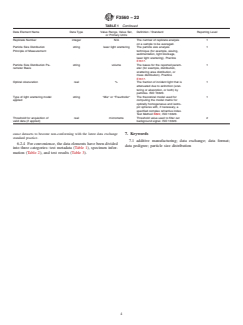
TABLE1 Continued
Data Element Name Data Type Value Range, Value Set, Definition / Standard Reporting Level
or Primary Units
Replicate Number integer N/A The number of replicate analysis 1
on a sample to be averaged.
Particle Size Distribution string laser light scattering The particle size analysis 1
Principle of Measurement technique (for example, sieving,
sedimentation, light blockage,
laser light scattering). Practice
E1617.
Particle Size Distribution Pa- string volume The bases for the reported param- 1
rameter Basis eter (for example, distribution,
scattering area distribution, or
mass distribution). Practice
E1617.
Optical obscuration real % The fraction of incident light that is 1
attenuated due to extinction (scat-
tering or absorption, or both) by
particles. ISO 13320.
Type of light scattering model string 9Mie9 or 9Fraunhofer9 The theoretical model used for 1
applied computing the model matrix for
optically homogeneous and isotro-
pic spheres with, if necessary, a
specified complex refractive index.
Test Method B822, ISO 13320.
Threshold for acquisition of real micrometre Threshold value used to filter out 2
valid data (if applied) background signal. ISO 13320.
cause datasets to become non-conforming with the latest data exchange
7. Keywords
standard practice.
7.1 additive manufacturing; data exchange; data format;
6.2.4 For convenience, the data elements have been divided
data pedigree; particle size distribution
into three categories: test metadata (Table 1), specimen infor-
mation (Table 2), and test results (Table 3).
F3560−22
TABLE 2 Specimen Data Elements for PSD by Light Scattering
Data Element Name Data Type Value Range, Value Set, or Definition / Standard Reporting Level
Primary Units
Specimen ID string free text The identifier of the individual 1
specimen.
Specimen Origin ID string Material ID The identifier of the part or Name – 1
material batch that the ID–3
specimen was extracted from.
Links to Built Part or Material
foreign key.
Specimen Type string powder sample The type of specimen, which 1
may refer to the geometry or
configuration of the specimen.
Specimen Mass real grams (g) The measured weight of the 2
individual specimen.
Specimen Description string free text A description of the O
specimen.
Specimen Sampling/ string free text The method in which the 2
Extraction/Fabrication Method sample or specimen was
extracted from the powder
batch.
Specimen Deviations from string free text Description of any differences 2
recommended specimen from recommendations made
configuration or preparation in the standards for specimen
configuration and preparation.
Real refractive index of the real N/A The positive real part of the 1
sample material (where refractive index of the sample
applicable) material. Test Method B822,
ISO 13320.
Imaginary refractive index of real N/A The positive imaginary (ab- 1
the sample material (where sorption) part of the refractive
applicable) index of the sample material.
Test Method B822,ISO
13320.
Dispersion gas ID string Material ID The identifier of the gas in 1D – Name
which the powder is dis- 2D – Chemistry Characteriza-
persed. Guide E3340. tion
3D–ID
Dry dosing/feeding device string Non-AM Equipment ID Equipment used to disperse 1D – Name
the powder in a dry medium. 3D–ID
Guide E3340, ISO 13320.
Dry dispersion dosing rate real g/min The feed rate of the dry dis- 2D
(where applicable) persed sample generated by
the dosing unit. Guide E3340,
ISO 13320.
Dry dispersion pressure real MPa Pressure of the dry dispersed 1D
sample. Guide E3340,ISO
13320.
Dispersion liquid ID string Material ID The identifier of the liquid in 1W – Name
which the powder is dis- 2W – Chemistry Character-
persed. Guide B821, Guide ization
E3340, ISO 13320 3W–ID
Dispersion liquid volume real mL The volume of the liquid in 1W
which the powder is dis-
persed. Guide B821, Guide
E3340, ISO 13320.
The real refractive index of real N/A The positive real part of the 1W
the dispersing liquid refractive index of the disper-
sion liquid. Guide B821, Test
Method B822, Guide E3340,
ISO 13320.
Dispersion liquid temperature Real °C The measured temperature of 1W
the dispersion liquid. Guide
B821, Guide E3340,ISO
13320.
Dispersion liquid pump speed Real cm /min Pumping speed for transport 1W
of liquid dispersions. Guide
B821, Guide E3340,ISO
13320.
Dispersion liquid stirring real r/min Stirring speed for transport of 1W
speed liquid dispersions. Guide
B821, Guide E3340,ISO
13320.
F3560−22
TABLE2 Continued
Data Element Name Data Type Value Range, Value Set, or Definition / Standard Reporting Level
Primary Units
Liquid dispersant ID(s) string Material IDs Dispersant(s) applied for de- 2W
agglomeration of particles
and for stabilization of the
dispersion. Guide B821,
Guide E3340, ISO 13320.
Liquid dispersant(s) concen- real % Concentration of the disper- 2W
trations sant in the dispersed sample.
Guide B821, Guide E3340,
ISO 13320.
Sonication equipment string Non-AM Equipment ID Equipment used to de- 2W – Name
agglomerate and stabilize the 3W - ID
dispersion via sonication.
Guide B821, Guide E3340,
ISO 13320.
Wet dispersion sonication fre- real kHz Frequency at which sonica- 2W
quency (energy) tion is conducted. Guide
B821, Guide E3340,ISO
13320.
Wet dispersion sonication du- real seconds (s) Duration of application of 2W
ration sonication. Guide E3340,
Guide E3340, ISO 13320.
Wet dispersion sonication real seconds (s) Length of time between soni- 2W
pause before starting mea- cation and the particle size
surement meas
...
Questions, Comments and Discussion
Ask us and Technical Secretary will try to provide an answer. You can facilitate discussion about the standard in here.
Loading comments...