

IEC 60598-2-20:2010
(Main)Luminaires - Part 2-20: Particular requirements - Lighting chains
General Information
- Abstract
IEC 60598-2-20:2010 specifies requirements for lighting chains fitted with series- or parallel- or a combination of series/parallel-connected incandescent lamps for use either indoors or outdoors on supply voltages not exceeding 250 V. This third edition cancels and replaces the second edition published in 1996, its Amendment 1 (1998), its Amendment 2 (2002) and the interpretation sheets of March 2001 (1) and July 2003 (2 and 3). This third edition is based on the second edition, its Amendments 1 and 2 and the interpretation sheets of March 2001 (1) and July 2003 (2 and 3) and incorporates some changes relating to 20.7.15. This third edition constitutes a minor revision.
This publication is to be read in conjunction with IEC 60598-1:2008.
- Status
- Published
- Publication Date
- 10-Feb-2010
- Technical Committee
- SC 34D - Luminaires
- Current Stage
- DELPUB - Deleted Publication
- Start Date
- 25-Nov-2014
- Completion Date
- 28-Aug-2026
Overview
IEC 60598-2-20:2010 is an international standard developed by the International Electrotechnical Commission (IEC) that outlines the specific safety and performance requirements for lighting chains. Lighting chains, often utilized for decorative, festive, or functional purposes, consist of a series, parallel, or combination configuration of incandescent lamps intended for indoor or outdoor use at supply voltages not exceeding 250 V. This third edition supersedes previous versions and amendments, introducing minor revisions, especially to clause 20.7.15, and is to be read in conjunction with IEC 60598-1:2008.
Key Topics
Core Areas Covered by IEC 60598-2-20:
- Scope and Definitions: Provides precise terminology for lighting chains, highlighting distinctions such as sealed chains and the role of various lamp types.
- Classification: Details how chains are categorized by electric shock protection class (Class II or Class III) and degree of ingress protection (indoor/outdoor, dust, and moisture resistance).
- Marking and Instructions: Mandates clear labeling, voltage, and wattage information, and safety warnings directly on the chain or packaging.
- Construction Requirements: Sets forth mechanical strength standards for lampholders, insulation, and cable types, including guidelines for non-standardized or push-in type lamps.
- Electrical Safety: Regulates resistance to electric shock, dust, and moisture ingress, ensuring safe operation under prescribed testing conditions.
- Endurance and Mechanical Testing: Specifies resilience benchmarks for lamp and cable assemblies using impact, pull, and torque tests.
- Wiring and Terminals: Defines the minimum cross-sectional area and cable standards for safe electrical connections, supporting both indoor and outdoor configurations.
Applications
Practical Uses for Lighting Chains:
- Seasonal and Decorative Lighting: Commonly used as Christmas tree lights or festival lighting, meeting the specific requirements for series or parallel lamp chains.
- Outdoor Illuminations: Suitable for public spaces such as promenades, parks, or ski-tracks, where weather and safety standards are critical.
- Commercial Displays and Installations: Supports applications requiring extended chains and robust safety features for permanent or temporary installations in commercial settings.
- Residential Use: Ensures home lighting chains comply with recognized international standards for user safety and product longevity.
For manufacturers, compliance with IEC 60598-2-20 is essential for market access, risk reduction, and customer assurance regarding the safety and reliability of their lighting chain products.
Related Standards
Key Supporting and Associated Standards:
- IEC 60598-1:2008 – General requirements and tests for luminaires, forming the foundational base for part 2-20.
- IEC 60083 – Plugs and socket-outlets standards.
- IEC 60227 & IEC 60245 – Specifications for polyvinyl chloride and rubber insulated cables, crucial for wiring requirements.
- IEC 60529 – Ingress protection (IP Code) for dust and moisture resistance.
- IEC 60238 & IEC 61184 – Standards for Edison screw and bayonet lampholders, ensuring compatibility and safety.
- IEC 61347-2-11 – Particular requirements for control gear used with luminaires, relevant to integrated electronic devices like flasher units.
By adopting IEC 60598-2-20:2010, stakeholders ensure lighting chains meet recognized international criteria for safety, durability, and performance across a broad range of environments and uses. This supports not only legal compliance and marketability but also promotes confidence and satisfaction for end-users in both domestic and commercial contexts.
Relations
- Effective Date
- 05-Sep-2023
- Effective Date
- 05-Sep-2023
- Effective Date
- 05-Sep-2023
- Effective Date
- 05-Sep-2023
- Revises
IEC 60598-2-20:1996 - Luminaires - Part 2: Particular requirements - Section 20: Lighting chains - Effective Date
- 05-Sep-2023
- Effective Date
- 05-Sep-2023
- Effective Date
- 05-Sep-2023
Get Certified
Connect with accredited certification bodies for this standard

IMQ S.p.A. (Certification)
Italian electrical product certification.

SLG Prüf- und Zertifizierungs GmbH
German testing and certification body.

UL Solutions
Global safety science company with testing, inspection and certification.
Sponsored listings
Frequently Asked Questions
IEC 60598-2-20:2010 is a standard published by the International Electrotechnical Commission (IEC). Its full title is "Luminaires - Part 2-20: Particular requirements - Lighting chains". This standard covers: IEC 60598-2-20:2010 specifies requirements for lighting chains fitted with series- or parallel- or a combination of series/parallel-connected incandescent lamps for use either indoors or outdoors on supply voltages not exceeding 250 V. This third edition cancels and replaces the second edition published in 1996, its Amendment 1 (1998), its Amendment 2 (2002) and the interpretation sheets of March 2001 (1) and July 2003 (2 and 3). This third edition is based on the second edition, its Amendments 1 and 2 and the interpretation sheets of March 2001 (1) and July 2003 (2 and 3) and incorporates some changes relating to 20.7.15. This third edition constitutes a minor revision. This publication is to be read in conjunction with IEC 60598-1:2008.
IEC 60598-2-20:2010 specifies requirements for lighting chains fitted with series- or parallel- or a combination of series/parallel-connected incandescent lamps for use either indoors or outdoors on supply voltages not exceeding 250 V. This third edition cancels and replaces the second edition published in 1996, its Amendment 1 (1998), its Amendment 2 (2002) and the interpretation sheets of March 2001 (1) and July 2003 (2 and 3). This third edition is based on the second edition, its Amendments 1 and 2 and the interpretation sheets of March 2001 (1) and July 2003 (2 and 3) and incorporates some changes relating to 20.7.15. This third edition constitutes a minor revision. This publication is to be read in conjunction with IEC 60598-1:2008.
IEC 60598-2-20:2010 is classified under the following ICS (International Classification for Standards) categories: 29.140.40 - Luminaires. The ICS classification helps identify the subject area and facilitates finding related standards.
IEC 60598-2-20:2010 has the following relationships with other standards: It is inter standard links to IEC 60598-2-20:1996/ISH2:2003, IEC 60598-2-20:1996/AMD1:1998, IEC 60598-2-20:1996/AMD2:2002, IEC 60598-2-20:1996/ISH3:2003, IEC 60598-2-20:1996, IEC 60598-2-20:2014, IEC 60598-2-20:1996/ISH1:2001. Understanding these relationships helps ensure you are using the most current and applicable version of the standard.
IEC 60598-2-20:2010 is available in PDF format for immediate download after purchase. The document can be added to your cart and obtained through the secure checkout process. Digital delivery ensures instant access to the complete standard document.
Standards Content (Sample)
IEC 60598-2-20 ®
Edition 3.0 2010-02
INTERNATIONAL
STANDARD
NORME
INTERNATIONALE
Luminaires –
Part 2-20: Particular requirements – Lighting chains
Luminaires –
Partie 2-20: Règles particulières – Guirlandes lumineuses
All rights reserved. Unless otherwise specified, no part of this publication may be reproduced or utilized in any form or by
any means, electronic or mechanical, including photocopying and microfilm, without permission in writing from either IEC or
IEC's member National Committee in the country of the requester.
If you have any questions about IEC copyright or have an enquiry about obtaining additional rights to this publication,
please contact the address below or your local IEC member National Committee for further information.
Droits de reproduction réservés. Sauf indication contraire, aucune partie de cette publication ne peut être reproduite
ni utilisée sous quelque forme que ce soit et par aucun procédé, électronique ou mécanique, y compris la photocopie
et les microfilms, sans l'accord écrit de la CEI ou du Comité national de la CEI du pays du demandeur.
Si vous avez des questions sur le copyright de la CEI ou si vous désirez obtenir des droits supplémentaires sur cette
publication, utilisez les coordonnées ci-après ou contactez le Comité national de la CEI de votre pays de résidence.
IEC Central Office
3, rue de Varembé
CH-1211 Geneva 20
Switzerland
Email: inmail@iec.ch
Web: www.iec.ch
About the IEC
The International Electrotechnical Commission (IEC) is the leading global organization that prepares and publishes
International Standards for all electrical, electronic and related technologies.
About IEC publications
The technical content of IEC publications is kept under constant review by the IEC. Please make sure that you have the
latest edition, a corrigenda or an amendment might have been published.
ƒ Catalogue of IEC publications: www.iec.ch/searchpub
The IEC on-line Catalogue enables you to search by a variety of criteria (reference number, text, technical committee,…).
It also gives information on projects, withdrawn and replaced publications.
ƒ IEC Just Published: www.iec.ch/online_news/justpub
Stay up to date on all new IEC publications. Just Published details twice a month all new publications released. Available
on-line and also by email.
ƒ Electropedia: www.electropedia.org
The world's leading online dictionary of electronic and electrical terms containing more than 20 000 terms and definitions
in English and French, with equivalent terms in additional languages. Also known as the International Electrotechnical
Vocabulary online.
ƒ Customer Service Centre: www.iec.ch/webstore/custserv
If you wish to give us your feedback on this publication or need further assistance, please visit the Customer Service
Centre FAQ or contact us:
Email: csc@iec.ch
Tel.: +41 22 919 02 11
Fax: +41 22 919 03 00
A propos de la CEI
La Commission Electrotechnique Internationale (CEI) est la première organisation mondiale qui élabore et publie des
normes internationales pour tout ce qui a trait à l'électricité, à l'électronique et aux technologies apparentées.
A propos des publications CEI
Le contenu technique des publications de la CEI est constamment revu. Veuillez vous assurer que vous possédez
l’édition la plus récente, un corrigendum ou amendement peut avoir été publié.
ƒ Catalogue des publications de la CEI: www.iec.ch/searchpub/cur_fut-f.htm
Le Catalogue en-ligne de la CEI vous permet d’effectuer des recherches en utilisant différents critères (numéro de référence,
texte, comité d’études,…). Il donne aussi des informations sur les projets et les publications retirées ou remplacées.
ƒ Just Published CEI: www.iec.ch/online_news/justpub
Restez informé sur les nouvelles publications de la CEI. Just Published détaille deux fois par mois les nouvelles
publications parues. Disponible en-ligne et aussi par email.
ƒ Electropedia: www.electropedia.org
Le premier dictionnaire en ligne au monde de termes électroniques et électriques. Il contient plus de 20 000 termes et
définitions en anglais et en français, ainsi que les termes équivalents dans les langues additionnelles. Egalement appelé
Vocabulaire Electrotechnique International en ligne.
ƒ Service Clients: www.iec.ch/webstore/custserv/custserv_entry-f.htm
Si vous désirez nous donner des commentaires sur cette publication ou si vous avez des questions, visitez le FAQ du
Service clients ou contactez-nous:
Email: csc@iec.ch
Tél.: +41 22 919 02 11
Fax: +41 22 919 03 00
IEC 60598-2-20 ®
Edition 3.0 2010-02
INTERNATIONAL
STANDARD
NORME
INTERNATIONALE
Luminaires –
Part 2-20: Particular requirements – Lighting chains
Luminaires –
Partie 2-20: Règles particulières – Guirlandes lumineuses
INTERNATIONAL
ELECTROTECHNICAL
COMMISSION
COMMISSION
ELECTROTECHNIQUE
PRICE CODE
INTERNATIONALE
R
CODE PRIX
ICS 29.140.40 ISBN 978-2-88910-210-5
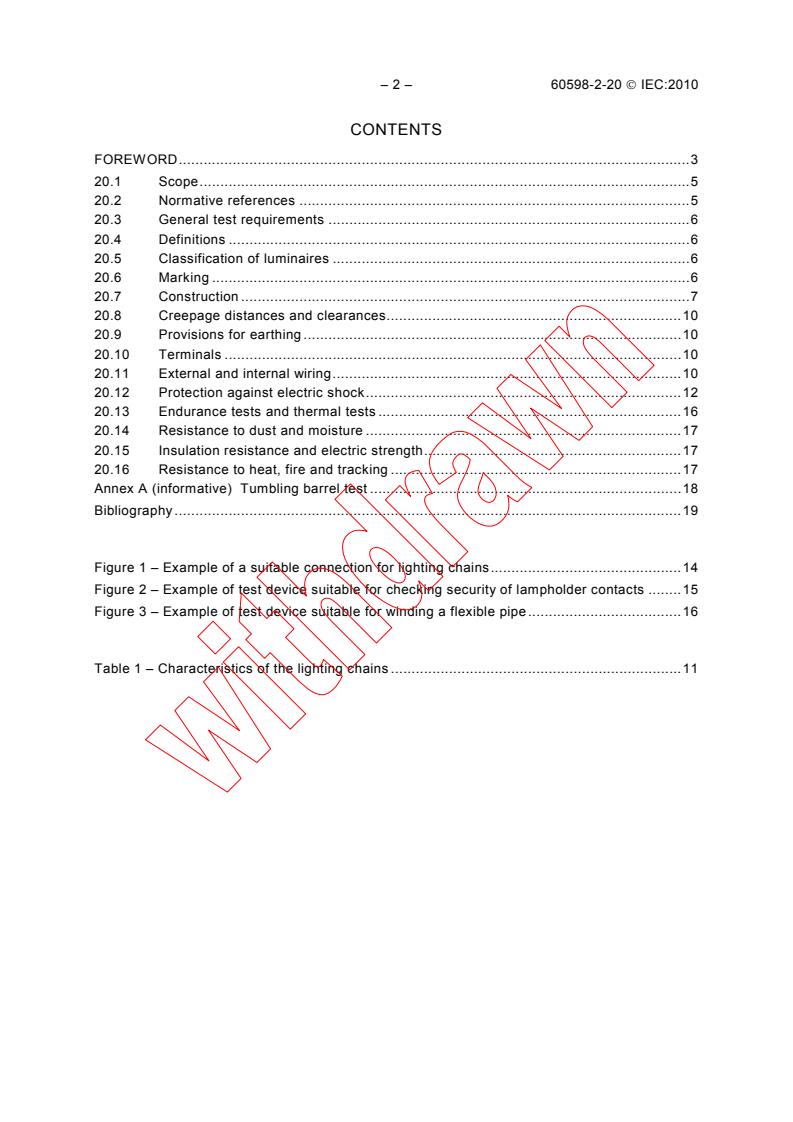
– 2 – 60598-2-20 © IEC:2010
CONTENTS
FOREWORD.3
20.1 Scope.5
20.2 Normative references .5
20.3 General test requirements .6
20.4 Definitions .6
20.5 Classification of luminaires .6
20.6 Marking .6
20.7 Construction .7
20.8 Creepage distances and clearances.10
20.9 Provisions for earthing .10
20.10 Terminals .10
20.11 External and internal wiring.10
20.12 Protection against electric shock.12
20.13 Endurance tests and thermal tests .16
20.14 Resistance to dust and moisture .17
20.15 Insulation resistance and electric strength.17
20.16 Resistance to heat, fire and tracking .17
Annex A (informative) Tumbling barrel test .18
Bibliography .19
Figure 1 – Example of a suitable connection for lighting chains.14
Figure 2 – Example of test device suitable for checking security of lampholder contacts .15
Figure 3 – Example of test device suitable for winding a flexible pipe.16
Table 1 – Characteristics of the lighting chains .11
60598-2-20 © IEC:2010 – 3 –
INTERNATIONAL ELECTROTECHNICAL COMMISSION
____________
LUMINAIRES –
Part 2-20: Particular requirements –
Lighting chains
FOREWORD
1) The International Electrotechnical Commission (IEC) is a worldwide organization for standardization comprising
all national electrotechnical committees (IEC National Committees). The object of IEC is to promote
international co-operation on all questions concerning standardization in the electrical and electronic fields. To
this end and in addition to other activities, IEC publishes International Standards, Technical Specifications,
Technical Reports, Publicly Available Specifications (PAS) and Guides (hereafter referred to as “IEC
Publication(s)”). Their preparation is entrusted to technical committees; any IEC National Committee interested
in the subject dealt with may participate in this preparatory work. International, governmental and non-
governmental organizations liaising with the IEC also participate in this preparation. IEC collaborates closely
with the International Organization for Standardization (ISO) in accordance with conditions determined by
agreement between the two organizations.
2) The formal decisions or agreements of IEC on technical matters express, as nearly as possible, an international
consensus of opinion on the relevant subjects since each technical committee has representation from all
interested IEC National Committees.
3) IEC Publications have the form of recommendations for international use and are accepted by IEC National
Committees in that sense. While all reasonable efforts are made to ensure that the technical content of IEC
Publications is accurate, IEC cannot be held responsible for the way in which they are used or for any
misinterpretation by any end user.
4) In order to promote international uniformity, IEC National Committees undertake to apply IEC Publications
transparently to the maximum extent possible in their national and regional publications. Any divergence
between any IEC Publication and the corresponding national or regional publication shall be clearly indicated in
the latter.
5) IEC itself does not provide any attestation of conformity. Independent certification bodies provide conformity
assessment services and, in some areas, access to IEC marks of conformity. IEC is not responsible for any
services carried out by independent certification bodies.
6) All users should ensure that they have the latest edition of this publication.
7) No liability shall attach to IEC or its directors, employees, servants or agents including individual experts and
members of its technical committees and IEC National Committees for any personal injury, property damage or
other damage of any nature whatsoever, whether direct or indirect, or for costs (including legal fees) and
expenses arising out of the publication, use of, or reliance upon, this IEC Publication or any other IEC
Publications.
8) Attention is drawn to the Normative references cited in this publication. Use of the referenced publications is
indispensable for the correct application of this publication.
9) Attention is drawn to the possibility that some of the elements of this IEC Publication may be the subject of
patent rights. IEC shall not be held responsible for identifying any or all such patent rights.
International Standard IEC 60598-2-20 has been prepared by subcommittee 34D: Luminaires,
of IEC technical committee 34: Lamps and related equipment
This third edition cancels and replaces the second edition published in 1996, its Amendment 1
(1998), its Amendment 2 (2002) and the interpretation sheets of March 2001 (1) and July 2003
(2 and 3). This third edition is based on the second edition, its Amendments 1 and 2 and the
interpretation sheets of March 2001 (1) and July 2003 (2 and 3) and incorporates some
changes relating to 20.7.15. This third edition constitutes a minor revision.
This publication is intended to be read in conjunction with IEC 60598-1: Luminaires – Part 1:
General requirements and tests. It was established on the basis of the seventh edition (2008)
of that standard.
– 4 – 60598-2-20 © IEC:2010
The text of this standard is based on the following documents:
FDIS Report on voting
34D/946/FDIS 34D/955/RVD
Full information on the voting for the approval of this standard can be found in the report on
voting indicated in the above table.
This publication has been drafted in accordance with the ISO/IEC Directives, Part 2.
NOTE In this standard, the following print types are used:
– requirements: in roman type;
– test specifications: in italic type;
– notes: in small roman type.
The following differences exist in the countries indicated below:
20.11.1: In the USA, the requirements for the cables are different.
A list of all parts of the IEC 60598 series, under the general title: Luminaires, can be found on
the IEC website.
The committee has decided that the contents of this publication will remain unchanged until the
stability date indicated on the IEC web site under "http://webstore.iec.ch" in the data related to
the specific publication. At this date, the publication will be
• reconfirmed,
• withdrawn,
• replaced by a revised edition, or
• amended.
60598-2-20 © IEC:2010 – 5 –
LUMINAIRES –
Part 2-20: Particular requirements –
Lighting chains
20.1 Scope
This part of IEC 60598 specifies requirements for lighting chains fitted with series- or parallel-
or a combination of series/parallel-connected incandescent lamps for use either indoors or
outdoors on supply voltages not exceeding 250 V.
NOTE 1 A Christmas tree chain is an example of a lighting chain fitted with series or series/parallel connected lamps.
A chain for illuminating ski-tracks or promenades is an example of a lighting chain fitted with parallel connected
lamps.
NOTE 2 For lighting chains fitted with lampholders of the push-in type, the appropriate requirements of this part of
IEC 60598 apply.
NOTE 3 In some countries, the term "strings" is used instead of "chains".
NOTE 4 For lighting chains with non-standardised lamps (e.g. lamps of the push-in type) the lamps are regarded
as a part of the lighting chain and consequently included in the testing (and thereby in the certificate, if any).
20.2 Normative references
The following referenced documents are indispensable for the application of this document. For
dated references, only the edition cited applies. For undated references, the latest edition of
the referenced document (including any amendments) applies.
IEC 60083, Plugs and socket-outlets for domestic and similar general use standardized in
member countries of IEC
IEC 60227 (all parts), Polyvinyl chloride insulated cables of rated voltages up to and including
450/750 V
)
IEC 60238:2004, Edison screw lampholders
Amendment 1 (2008)
IEC 60245 (all parts), Rubber insulated cables – Rated voltages up to and including 450/750 V
IEC 60529, Degrees of protection provided by enclosures (IP Code)
IEC 60598-1:2008, Luminaires – Part 1: General requirements and tests
IEC 60811-3-1:1985, Common test methods for insulating and sheathing materials of electric
cables – Part 3: Methods specific to PVC compounds – Section One: Pressure test at high
temperature – Tests for resistance to cracking
Amendment 1 (1994)
Amendment 2 (2001)
IEC 61184, Bayonet lampholders
___________
)
There exists a consolidated edition 8.1 (2008) that comprises IEC 60238 (2004) and its Amendment 1 (2008).
– 6 – 60598-2-20 © IEC:2010
IEC 61347-2-11, Safety of lamp controlgear – Part 2-11: Particular requirements for
miscellaneous electronic circuits used with luminaires
20.3 General test requirements
The provisions of section 0 of IEC 60598-1 apply. The tests described in each appropriate
section of IEC 60598-1 shall be carried out in the order listed in this part of IEC 60598.
20.4 Definitions
For the purposes of this document, the definitions given in section 1 of IEC 60598-1 apply
together with the following definitions.
20.4.1
lighting chain
luminaire comprising an assembly of series-connected lampholders, parallel-connected lamp-
holders or series/parallel-connected lampholders and interconnecting insulated conductors
NOTE 1 For lighting chains with non-standardised lamps (e.g. lamps of the push-in type) the lamps are regarded
as part of the chain.
NOTE 2 For lighting chains with non-removable lamps, the lamps are regarded as part of the chain.
NOTE 3 A lighting chain may incorporate control devices (e.g. flasher units, see 20.7.16).
20.4.2
sealed chain
a lighting chain enclosed in a rigid or flexible insulating translucent pipe or tube, sealed at the
ends and having no joints
20.5 Classification of luminaires
Luminaires shall be classified in accordance with the provisions of section 2 of IEC 60598-1
together with the requirements of 20.5.1 and 20.5.2.
NOTE As lighting chains are mandatorily required to be suitable for mounting on normally flammable surfaces they
do not require F marking nor provision of a warning notice.
20.5.1 According to the type of protection against electric shock, lighting chains shall be
classified as Class II or Class III.
20.5.2 According to the degree of protection against dust and moisture, lighting chains for
outdoor use shall be classified as "of rain-proof, splash-proof, jet-proof or watertight
construction".
20.6 Marking
The provisions of section 3 of IEC 60598-1 apply together with the requirements of 20.6.1
and 20.6.2.
20.6.1 The following information shall be marked on the lighting chains.
a) Lighting chains shall be marked with the type reference or the electrical data of the lamps
and with the rated voltage of the complete chain. Where it is impractical to mark this
information on the lighting chain, the information shall be marked on a durable non-
removable sleeve or label fitted to the cable.
b) Lighting chains shall be accompanied by the substance of the following warnings:
1) do not remove or insert lamps while the chain is connected to the supply;
60598-2-20 © IEC:2010 – 7 –
2) for series-connected lamps, replace failed lamps immediately by lamps of the same
rated voltage and wattage to prevent overheating; this requirement does not apply to
sealed chains;
3) do not connect the chain to the supply while it is in the packing unless the packing has
been adapted for display purposes;
4) for series-connected lamps where fused lamps are used to ensure compliance with
20.13.3 hereafter, do not replace a fused lamp with a non-fused lamp [see item e)].
5) ensure all lampholders are fitted with a lamp.
c) Ordinary lighting chains shall additionally be accompanied by the substance of the following
information:
"FOR INDOOR USE ONLY"
Lighting chains which rely on gaskets to provide the specified degree of protection against
dust and moisture shall additionally be accompanied by the substance of the following
information:
"WARNING – THIS LIGHTING CHAIN MUST NOT
BE USED WITHOUT ALL GASKETS BEING IN PLACE"
d) Lighting chains not intended for interconnection shall in addition be accompanied by the
substance of the following warning:
"Do not connect this chain electrically to another chain."
e) Lighting chains fitted with fused lamps to ensure compliance with 20.13.3 shall be accom-
panied by information indicating the means for identification of fused lamps (see 20.6.3).
NOTE For the purpose of this subclause, a fused lamp is a lamp designed so as to break the circuit in the
event of an overcurrent either by means of a separate fuse incorporated within the lamp or by any other means
e.g. a special filament.
f) Lighting chains with non-standardised lamps shall be accompanied by information
indicating that replacement lamps must be of the same type as delivered or of a type
specified by the manufacturer (see 20.6.2).
g) Lighting chains provided with non-replaceable lamps shall be accompanied by the
information that the lamps are not replaceable.
The information required under items b)3), f) and g) shall be indicated on the packing.
20.6.2 The following information shall be marked on the lampholder or on the cable, or on a
durable non-removable sleeve or label fitted to the cable.
a) Mark of origin (this may take the form of a trade mark, the manufacturer’s identification
mark or the name of the responsible vendor).
b) Symbol for class II or class III, if applicable.
c) Marking for degree of protection against dust and moisture, if applicable, or warning that
the chain is for indoor use only.
d) Rated voltage of class III chains.
e) Voltage and wattage of replacement lamps.
f) Use only replacement lamps of the same kind provided with this lighting chain.
20.6.3 Fused lamps used to ensure compliance with 20.13.3 shall have a suitable means of
identification, such as a special colour.
20.7 Construction
The provisions of section 4 of IEC 60598-1 apply together with the requirements of 20.7.1
to 20.7.16.
– 8 – 60598-2-20 © IEC:2010
20.7.1 Edison screw lampholders E10, E14 and E27 shall meet the requirements
of IEC 60238.
Bayonet lampholders shall meet the requirements of IEC 61184.
In lighting chains where non-standardised lamps (e.g. lamps of the push-in type) are used, the
lamps are regarded as parts of the lighting chain and tested accordingly.
E5 and similar small lampholders of the push-in type shall meet the requirements of the
appropriate clauses of IEC 60238.
In lighting chains fitted with parallel-connected lamps, E27 and B22 lampholders with insulation
piercing contacts shall meet the requirements listed in this part of IEC 60598.
20.7.2 Clause 4.6 of section 4 of IEC 60598-1 referring to terminal block does not apply.
20.7.3 Clause 4.7 of section 4 of IEC 60598-1 referring to terminals and supply connections
applies together with the following requirement:
The method of connection of wiring, external or internal, to components of chains shall give
reliable electrical contact over the service life of the component.
Compliance is checked by inspection and by carrying out the tests of this standard.
20.7.4 Only 4.11.4 and 4.11.5 of 4.11 of section 4 of IEC 60598-1, referring to electrical
connections and current-carrying parts, apply.
20.7.5 Gaskets used to provide the specified degree of protection against dust and moisture
of lighting chains for outdoor use shall be weather resistant. Such gaskets shall remain in place
on the chain when the lamp is removed and shall fit tightly round the inserted lamp.
Compliance shall be checked by inspection and by manual test.
No requirements are specified at present for checking the weather resistance of gaskets.
20.7.6 Compliance with the mechanical strength requirements of Clause 4.13 of section 4 of
IEC 60598-1 for Edison screw lampholders, and small lampholders of the push-in type shall be
checked by the tests given in Clause 15 of IEC 60238.
The tests are made on three samples of the lampholder without the lamp inserted. After the
test, the relevant compliance requirements of Clause 4.13 of section 4 of IEC 60598-1 shall be
met.
20.7.7 E5 and E10 lampholders and similar small lampholders of the push-in type shall be
used only if the rated voltage of each lamp does not exceed:
– for E5 and similar small lampholders 25 V;
– for series connected E10 and similar small lampholders 60 V;
– for parallel connected E10 lampholders 250 V.
Compliance is checked by inspection.
60598-2-20 © IEC:2010 – 9 –
20.7.8 For lighting chains fitted with series-connected lamps, resistors, if any, for bridging the
lamp filaments shall be contained within the lamps. The protection against electric shock and
fire shall not be impaired when these resistors are functioning.
Compliance is checked by inspection and, where appropriate, by a test during which the
filaments of the lamps are interrupted.
20.7.9 Flasher units forming an integral part of the lighting chain, shall be enclosed in non-
flammable insulating material; they shall be securely fixed to the cable of the chain.
Compliance is checked by inspection and, for the non-flammability of the insulating material, by
the test of 20.16.
20.7.10 No requirement.
20.7.11 Lampholders for replaceable push-in lamps shall have a body of insulating material.
Compliance is checked by inspection.
20.7.12 The lamp (bulb) glass of push-in lamps shall not rotate in relation to the lamp cap and
the lamp cap shall not rotate in relation to the lampholder.
Compliance is checked by applying a torque of 0,025 Nm for 1 min between the glass envelope
and the lampholder. No displacement shall then occur between the parts during the test.
20.7.13 Replaceable push-in type lamps shall remain in the seated position when the lamp is
subjected to a pull force of up to 3 N. Replaceable push-in type lamps shall make electrical
contact with the lampholder contacts by applying a push-in force of between 3 N and 10 N
(under consideration). Withdrawal of the lamp from the holder shall be effected when subjected
to a pull force of between 3 N and 10 N (under consideration).
Non-replaceable lamps shall withstand a pull force of 10 N ± 1 N during which the lamp shall
remain seated and shall not have become unsafe.
During each application of the specified forces, no damage shall occur impairing safety and in
particular no breakage or separation of the lamp glass envelope from the lamp cap shall take
place.
Compliance is checked on a new sample by manual test, by measurement of the forces and by
inspection.
The sample is then placed in an oven at a temperature of 120 °C ± 5 °C for 2 h (under
consideration) following which it is allowed to cool down to room temperature.
The sample is then re-submitted to the same tests, requirements and compliance criteria as
those specified for the sample before the heating treatment.
20.7.14 Sealed lighting chains shall have adequate mechanical strength.
For rigid sealed lighting chains, compliance is checked by subjecting the pipe 45 times to each
of the following tests carried out in turn:
a) a pull of 60 N, the stress being applied to the ends of the pipe, without jerks, for 1 min;
b) a torque of 0,15 Nm, the stress being applied to the ends of the pipe in the most
unfavorable direction (alternatively in cases of doubt) without jerks for 1 min.
– 10 – 60598-2-20 © IEC:2010
For flexible sealed lighting chains, compliance is checked by the tests of a) and b) above
followed by the additional test below:
Test:
Wind the pipe on a cylinder of 250 mm diameter with a pull of 60 N for the number of
operations and at the ambient temperature given below:
– for chains having an IP number up to and including 20 10 times at 25 °C ± 5 °C
– for chains having an IP number over 20 10 times at 25 °C ± 5 °C
followed by
10 times at –15 °C ± 5 °C
After the test, the pipe shall show no damage affecting the safety of the chain and shall comply
with the electric strength test of Clause 20.15 applied between live parts and the body.
NOTE 1 Failure of lamps during the test is permitted.
NOTE 2 An example of a test device suitable for winding a flexible pipe is given in Figure 3.
20.7.15
The lamp bulbs in lighting chains shall meet the mechanical requirements of Subclause 4.13.1
of IEC 60598-1 using an impact energy of 0,2 Nm when:
a) the lamps are non-removable;
or
b) the lamps are non-standardized and parallel connected.
20.7.16 Any electronic control device (e.g. flasher units) shall, in addition to the requirements
of this standard, comply with the requirements of IEC 61347-2-11.
Compliance is checked by carrying out the relevant tests.
20.8 Creepage distances and clearances
The provisions of section 11 of IEC 60598-1 apply except that for Edison screw lampholders
and small lampholders of the push-in type, Clause 17 of IEC 60238 applies.
20.9 Provisions for earthing
The provisions of section 7 of IEC 60598-1 do not apply.
20.10 Terminals
The provisions of section 15 of IEC 60598-1 apply.
20.11 External and internal wiring
20.11.1 Subclause 5.2.2 of section 5 of IEC 60598-1 does not apply. Internal and external
cables of lighting chains shall not be lighter than the following (see Table 1):
60598-2-20 © IEC:2010 – 11 –
Table 1 – Characteristics of the lighting chains
For Class II ordinary lighting chains and ordinary sealed chains
60227 IEC 43
60227 IEC 52*
For Class II chains other than ordinary, using series-connected
60245 IEC 57*
lampholders
For Class II chains other than ordinary, using parallel-connected
60245 IEC 57*
lampholders and the connection cable for sealed lighting chains
other than ordinary
For Class II chains other than ordinary, where the length of cable
60245 IEC 66
between the point of supply and the nearest lampholder exceeds 3
m – for that part of the cable
For Class III chains and parts of chains supplied by SELV and with a
60227 IEC 42*
maximum rated wattage exceeding 50 W
For Class III chains and parts of chains supplied by SELV and with a Insulation according to
maximum rated wattage not exceeding 50 W 5.3.1 of 60598-1
* The cable may consist of a single core cable provided with a two-layer insulation
corresponding to the specified standard sheet.
Compliance is checked by inspection, measurement and by calculation.
The nominal cross-sectional area of the conductors shall not be less than the following values:
a) 0,5 mm for class II lighting chains with E5 or E10 lampholders or other small lampholders;
for class II lighting chains with E14, E27, B15 or B22 lampholders and fitted with
b) 0,75 mm
series connected lamps;
c) 1,5 mm for class II lighting chains with E14, E27, B15 or B22 lampholders and fitted with
parallel connected lamps;
d) 0,5 mm for class III chains and parts of chains supplied by SELV and with a maximum
rated wattage exceeding 50 W;
e) 0,4 mm for class III chains and parts of chains supplied by SELV and with a maximum
rated wattage not exceeding 50 W;
f) 1 mm for the cable between the plug and a sealed chain without joints;
g) 1,5 mm for the cable between the plug and a sealed chain with joints.
If the maximum rated wattage of class III lighting chains and parts of chains supplied by SELV
is less than 50 W, then the conductors of the internal and external cables may have a cross-
sectional area of 0,4 mm or less provided that the current-carrying capacity and the
mechanical properties are adequate. If the maximum rated wattage exceeds 50 W, the cables
shall comply with 60227 IEC 42 (see asterisk above). If the wattage is less than 50 W, the
insulation of the cables shall comply with the requirements of 5.3.1 of IEC 60598-1.
For sealed chains, the internal conductors may have a cross-sectional area of 0,4 mm or less
provided the current-carrying capacity and the mechanical properties are adequate. In addition,
conductors without insulation are accepted provided adequate precautions have been taken to
ensure maintenance of the minimum creepage distances and clearances and compliance with
the requirements of 5.3.1 of IEC 60598-1.
Compliance is checked by inspection, measurement and calculation.
– 12 – 60598-2-20 © IEC:2010
In the USA, cables shall:
– have a minimum insulation thickness of 0,762 mm;
– have a minimum flame rating of VW-1;
– be UV rated;
– have a temperature rating of 105 ºC;
– be rated for indoor and/or outdoor use.
20.11.2 For lighting chains incorporating a single-core cable, the test described in 5.2.10.3 of
section 5 of IEC 60598-1 is made in the following way.
The cable is subjected 50 times to a pull of 30 N. The torque test is not made.
20.11.3 Plugs of lighting chains shall meet the requirements of IEC 60083.
Lighting chains for outdoor use shall either be provided with a splash-proof plug or be suitable
for permanent connection to fixed wiring by means of a junction box.
The length of the cable between the plug and the first lampholder shall be not less than 1,5 m.
Compliance is checked by measurement.
NOTE 1 Lampholders in a non-rewirable lighting chain fitted with parallel-connected lamps may be connected to a
flat cable by means of pin contacts or edge contacts, which penetrate the insulation of the cable and provide
electric contact with the conductors.
NOTE 2 National rules in some countries do not permit plugs in accordance with IEC 60083.
20.12 Protection against electric shock
The provisions of section 8 of IEC 60598-1 apply together with the requirements of 20.12.1
to 20.12.3.
20.12.1 For lighting chains with means for retaining lamps other than E10 or larger
lampholders, the protection against electric shock shall be at least equivalent to that required
for lighting chains provided with E10 lampholders.
If the plug of a lighting chain incorporates a means for disconnecting one end of the chain to
facilitate installation, the connector fitted at the end of the cable shall have an entry such that
the diameter of the opening and the distance from the front to live parts are equal to the
corresponding dimensions specified in Figure 1. The two parts of the connector shall not
separate when subjected to a pull force of 10 N.
For metal parts of lampholders and for the cap of bayonet lamps, compliance shall be checked
by a test with the standard test finger specified in IEC 60529.
A lamp with the longest commercially available lamp-cap shall be inserted when the
inaccessibility of bayonet lamp-caps is checked.
NOTE The gasket referred to in 20.7.5 may serve as protection against accidental contact with the cap of a lamp
with a bayonet cap.
For plugs incorporating means for disconnecting one end of the chain, the degree of protection
against electric shock shall be such that it is not possible to touch the contact piece with the
standard test finger specified in IEC 60529. In general, the contact piece is a pin fitted in the
body of the plug, the pin being shrouded by the body of the plug or otherwise protected.
60598-2-20 © IEC:2010 – 13 –
20.12.2 Lighting chains shall not electrify tinsel or other metallic decorations with which they
are used.
Compliance shall be checked by means of a flat probe, 0,5 mm thick and 8 mm wide, with a
rounded tip having a radius of 4 mm. It shall not be possible to touch live parts with this probe,
when it is applied in any position with a force not exceeding 0,5 N, the chain being fitted with
the lamps with which it is delivered.
20.12.3 Lampholder contact shall be reliably secured in the lampholder body by means other
than friction to avoid such a displacement of the lampholder contacts that live parts of the
chain become accessible. An example of an adequate securing method is by the provision of
ears on the contacts of the lampholder.
Compliance is checked by inspection and by the following test.
Six lampholders are heated for 7 h according to the requirements of Clause 12.3 of section 12
of IEC 60598-1 in an orientation to reach the highest temperature. After the lampholders have
cooled down to room temperature, the incandescent lamps are removed and a force of 15 N is
applied for 1 min to each of the conductors connected. Following this, a force of 30 N is applied
for 1 min to the two conductors together. The forces are applied at a distance of
3 mm ± 0,8 mm from the insertion points in the lampholder so as to try to move the contacts
from the lampholders.
During the test, the contacts shall not move more than 0,8 mm. An example of a device
suitable for this test is shown in Figure 2.
– 14 – 60598-2-20 © IEC:2010
Dimensions in millimetres
R = 1,5 max.
+0,2
∅2,9
IEC 289/10
Figure 1 – Example of a suitable connection for lighting chains
+0,5
5,8 min.
60598-2-20 © IEC:2010 – 15 –
Dimensions in millimetres
Movable weight
Hinge pin
Lampholder
Support to raise lampholder so lever arm is
in horizontal position when force is first applied
Cut in arm to facilitate clamping
Holes for leads
of lampholder lead
IEC 290/10
Figure 2 – Example of test device suitable for checking security
of lampholder contacts
3 ± 0,8
– 16 – 60598-2-20 © IEC:2010
Dimensions in millimetres
1)
60 N 60 N
IEC 291/10
Key
1) Diameter of wooden cylinder.
2) Distance between the fixing point of the flexible pipe and the weight prior to commencement of the test.
Figure 3 – Example of test device suitable for winding a flexible pipe
20.13 Endurance tests and thermal tests
The provisions of section 12 of IEC 60598-1 apply together with the requirements of 20.13.1
to 20.13.3.
Luminaires with an IP classification greater than IP20 shall be subjected to the relevant tests of
Clauses 12.4, 12.5 and 12.6 of section 12 of IEC 60598-1 after the test(s) of Clause 9.2 but
before the test(s) of Clause 9.3 of section 9 of IEC 60598-1 specified in
Clause 20.14 of this part of IEC 60598.
20.13.1 The requirements of item d) of 12.3.1 and item d) of 12.4.1 of section 12 of
IEC 60598-1 are replaced by the following:
2)
1 000
60598-2-20 © IEC:2010 – 17 –
The tests are carried out at a voltage such that the wattage is equal to 1,05 times the wattage
measured when the lighting chain is supplied at the rated voltage.
20.13.2 The requirements of item e) of 12.3.1 and item g) of 12.4.1 of section 12 of
IEC 60598-1 apply except that lamps for sealed chains are not replaced.
20.13.3 The operation of devices for bridging the lamp filament, where fitted in accordance
with 20.7.8, shall not cause any part of the lighting chain to attain a temperature which would
impair safety.
Compliance is checked by causing the bridging device to operate successively on each lamp,
the lamp not being replaced. The temperature of the component parts of the lighting chain shall
be allowed to stabilize before each bridging device is made to operate. The temperature of
lampholders and cables shall not exceed the appropriate values given in Tables 12.1 and 12.2
of IEC 60598-1.
If a protective device (e.g. a fused lamp) operates during the test, the highest temperatures
reached shall be taken as the final temperatures.
20.14 Resistance to dust and moisture
The provisions of section 9 of IEC 60598-1 apply together with the following requirement.
For luminaires with an IP classification greater than IP20 the order of the tests specified in
section 9 of IEC 60598-1 shall be as specified in 20.13 of this part of IEC 60598.
Lighting chains are completely assembled ready for use, appropriate lamps are inserted and
the lampholders are positioned at random during the test described in Clause 9.2 of section 9
of IEC 60598-1.
20.15 Insulation resistance and electric strength
The provisions of section 10 of IEC 60598-1 apply.
20.16 Resistance to heat, fire and tracking
The provisions of section 13 of IEC 60598-1 apply, except that:
– for flexible pipes of sealed chains the test of 13.2.1 is replaced by the test of Clause 8
of IEC 60811-3-1.
– 18 – 60598-2-20 © IEC:2010
Annex A
(informative)
Tumbling barrel test
(Applicable to class II lighting chains only.)
No requirement.
60598-2-20 © IEC:2010 – 19 –
Bibliography
IEC 61347-1, Lamp controlgear – Part 1: General and safety requirements
___________
– 20 – 60598-2-20 © CEI:2010
SOMMAIRE
AVANT-PROPOS .21
20.1 Domaine d'application.23
20.2 Références normatives .23
20.3 Exigences générales d'essai.24
20.4 Définitions .24
20.5 Classification des luminaires.24
20.6 Marquage .24
20.7 Construction .26
20.8 Lignes de fuite et distances dans l'air.29
20.9 Dispositions en vue de la mise à la terre .29
20.10 Bornes.29
20.11 Câblage externe et interne.29
20.12 Protection contre les chocs électriques .31
20.13 Essais d'endurance et essais thermiques.34
20.14 Résistance aux poussières et à l'humidité .35
20.15 Résistance d'isolement et rigidité diélectrique .35
20.16 Résistance à la chaleur, au feu et aux courants de cheminement .35
Annexe A (informative) Essai au tambour tournant .36
Bibliographie .37
Figure 1 – Exemple d'un connecteur convenable pour les guirlandes lumineuses.32
Figure 2 – Exemple d'un dispositif d'essai convenable pour le contrôle de la solidité de
contacts de douille .33
Figure 3 – Exemple de dispositif d'essai convenant pour l'enroulement d'un tuyau
flexible .34
Tableau 1 – Caractéristiques des guirlandes lumineuses .29
60598-2-20 © CEI:2010 – 21 –
COMMISSION ÉLECTROTECHNIQUE INTERNATIONALE
____________
LUMINAIRES –
Partie 2-20: Règles particulières –
Guirlandes lumineuses
AVANT-PROPOS
1) La Commission Électrotechnique Internationale (CEI) est une organisation mondiale de normalisation composée
de l'ensemble des comités électrotechniques nationaux (Comités nationaux de la CEI). La CEI a pour objet de
favoriser la coopération internationale pour toutes les questions de normalisation dans les domaines de
l'électricité et de l'électronique. A cet effet, la CEI – entre autres activités – publie des Normes internationales,
des Spécifications techniques, des Rapports techniques, des Spécifications accessibles au public (PAS) et des
Guides (ci-après dénommés «Publication(s) de la CEI»). Leur élaboration est confiée à des comités d'études,
aux travaux desquels tout Comité national intéressé par le sujet traité peut participer. Les organisations
internationales, gouvernementales et non gouvernementales, en liaison avec la CEI, participent également aux
travaux. La CEI collabore étroitement avec l'Organis
...