

ISO 18851:2015
(Main)Plastics piping systems — Glass-reinforced thermosetting plastics (GRP) pipes and fittings — Test method to prove the structural design of fittings
General Information
- Abstract
ISO 18851:2015 specifies methods of test for fittings of any form, i.e. bends, branches, tapers, intended to be used in plastics piping systems for pressure and non-pressure drainage and sewerage or water supply made of glass-reinforced thermosetting plastics (GRP). It is applicable to fittings, in order to test their structural design, but is not applicable to connecting joint systems. It assumes that the fitting either is or is not intended to be subject to the effects of hydrostatic end thrust. The tests detailed in 8.1 to 8.4 are applicable to fittings intended to be used in buried or non-buried applications. These test procedures are applicable to fittings of all nominal sizes specified in the referring standard. The tests are for evaluating fittings intended for use in applications conveying liquids at temperatures specified in the referring standards. The test procedures in ISO 18851:2015 are damaging to the test piece which will not be suitable for reuse after these tests. The test procedure is applicable to type testing.
- Status
- Published
- Publication Date
- 15-Mar-2015
- Drafting Committee
- ISO/TC 138/SC 6/WG 3 - Specifications for pipe systems
- Current Stage
- 9092 - International Standard to be revised
- Start Date
- 31-Mar-2026
- Completion Date
- 29-Aug-2026
Buy Documents
ISO 18851:2015 - Plastics piping systems -- Glass-reinforced thermosetting plastics (GRP) pipes and fittings -- Test method to prove the structural design of fittings
ISO 18851:2015 - Plastics piping systems — Glass-reinforced thermosetting plastics (GRP) pipes and fittings — Test method to prove the structural design of fittings/16/2015
Overview
ISO 18851:2015 specifies a standardized test method to prove the structural design of fittings made from glass‑reinforced thermosetting plastics (GRP) used in plastics piping systems for pressure and non‑pressure drainage, sewerage or water supply. The standard applies to fittings of any form (bends, branches, tapers) and to all nominal sizes referenced by the referring standard. It is a type testing procedure that is intentionally damaging to test pieces (they are not suitable for reuse).
Key topics and requirements
- Scope: Tests fittings (not connection joint systems) and assumes fittings may be tested with or without hydrostatic end thrust.
- Test sequence:
- Initial leakage: fill and vent the fitting, apply 1.5 × PN (nominal pressure) and hold for 15 minutes; inspect for leakage.
- Resistance to internal pressure: increase to 2.5 × PN and maintain for 100 hours; fitting must show no bursting, leaking or weeping during this period.
- Failure criteria: defined as bursting, leaking (visible loss of liquid), or weeping (detectable loss).
- Apparatus & instrumentation:
- Appropriate end sealing devices, supports, and thrust arrangements (anchored or unanchored depending on end‑thrust condition).
- Hydrostatic pressure source and a pressure gauge with calibrated accuracy within 1% at the specified pressure.
- Straps/cradles and concrete encasements may be used-design must be reported.
- Conditioning & temperature:
- Condition filled test piece at the test temperature (as specified in the referring standard) for at least 24 hours or until thermal equilibrium.
- Tests are performed at temperatures set by the referring standard.
- Test pieces & reporting:
- Unless otherwise specified, one test piece is used.
- Test report must reference ISO 18851:2015 and include details such as PN, test temperatures, pressures, duration, failure observations and any interruptions.
Applications and users
ISO 18851:2015 is practical for:
- GRP fittings manufacturers validating structural design and demonstrating conformance for type approval.
- Independent testing laboratories performing hydrostatic and long‑duration strength testing.
- Design and project engineers specifying durable fittings for water, drainage and sewerage systems (buried and non‑buried).
- Procurement, quality and certification bodies requiring documented structural proof for GRP fittings.
Keywords: ISO 18851:2015, GRP pipes and fittings, glass‑reinforced thermosetting plastics, test method, hydrostatic pressure, nominal pressure PN, structural design testing, type testing.
Related standards
- Developed under ISO/TC 138 (Plastics pipes, fittings and valves), Subcommittee SC 6 (reinforced plastics).
- Note: ISO 18851:2015 is not for assessment of non‑integrated joints; consult the bibliography and relevant joint test standards for joint performance methods.
Relations
- Effective Date
- 25-Aug-2026
- Effective Date
- 01-Apr-2026
Buy Documents
ISO 18851:2015 - Plastics piping systems -- Glass-reinforced thermosetting plastics (GRP) pipes and fittings -- Test method to prove the structural design of fittings
ISO 18851:2015 - Plastics piping systems — Glass-reinforced thermosetting plastics (GRP) pipes and fittings — Test method to prove the structural design of fittings/16/2015
Get Certified
Connect with accredited certification bodies for this standard

Institut za varilstvo d.o.o. (Welding Institute)
Slovenia's leading welding institute since 1952. ISO 3834, EN 1090, pressure equipment certification, NDT personnel, welder qualification. Only IIW Au
Sponsored listings
Frequently Asked Questions
ISO 18851:2015 is a standard published by the International Organization for Standardization (ISO). Its full title is "Plastics piping systems — Glass-reinforced thermosetting plastics (GRP) pipes and fittings — Test method to prove the structural design of fittings". This standard covers: ISO 18851:2015 specifies methods of test for fittings of any form, i.e. bends, branches, tapers, intended to be used in plastics piping systems for pressure and non-pressure drainage and sewerage or water supply made of glass-reinforced thermosetting plastics (GRP). It is applicable to fittings, in order to test their structural design, but is not applicable to connecting joint systems. It assumes that the fitting either is or is not intended to be subject to the effects of hydrostatic end thrust. The tests detailed in 8.1 to 8.4 are applicable to fittings intended to be used in buried or non-buried applications. These test procedures are applicable to fittings of all nominal sizes specified in the referring standard. The tests are for evaluating fittings intended for use in applications conveying liquids at temperatures specified in the referring standards. The test procedures in ISO 18851:2015 are damaging to the test piece which will not be suitable for reuse after these tests. The test procedure is applicable to type testing.
ISO 18851:2015 specifies methods of test for fittings of any form, i.e. bends, branches, tapers, intended to be used in plastics piping systems for pressure and non-pressure drainage and sewerage or water supply made of glass-reinforced thermosetting plastics (GRP). It is applicable to fittings, in order to test their structural design, but is not applicable to connecting joint systems. It assumes that the fitting either is or is not intended to be subject to the effects of hydrostatic end thrust. The tests detailed in 8.1 to 8.4 are applicable to fittings intended to be used in buried or non-buried applications. These test procedures are applicable to fittings of all nominal sizes specified in the referring standard. The tests are for evaluating fittings intended for use in applications conveying liquids at temperatures specified in the referring standards. The test procedures in ISO 18851:2015 are damaging to the test piece which will not be suitable for reuse after these tests. The test procedure is applicable to type testing.
ISO 18851:2015 is classified under the following ICS (International Classification for Standards) categories: 23.040.20 - Plastics pipes. The ICS classification helps identify the subject area and facilitates finding related standards.
ISO 18851:2015 has the following relationships with other standards: It is inter standard links to EN ISO 23856:2021, CEN/TS 14632:2023. Understanding these relationships helps ensure you are using the most current and applicable version of the standard.
ISO 18851:2015 is available in PDF format for immediate download after purchase. The document can be added to your cart and obtained through the secure checkout process. Digital delivery ensures instant access to the complete standard document.
Standards Content (Sample)
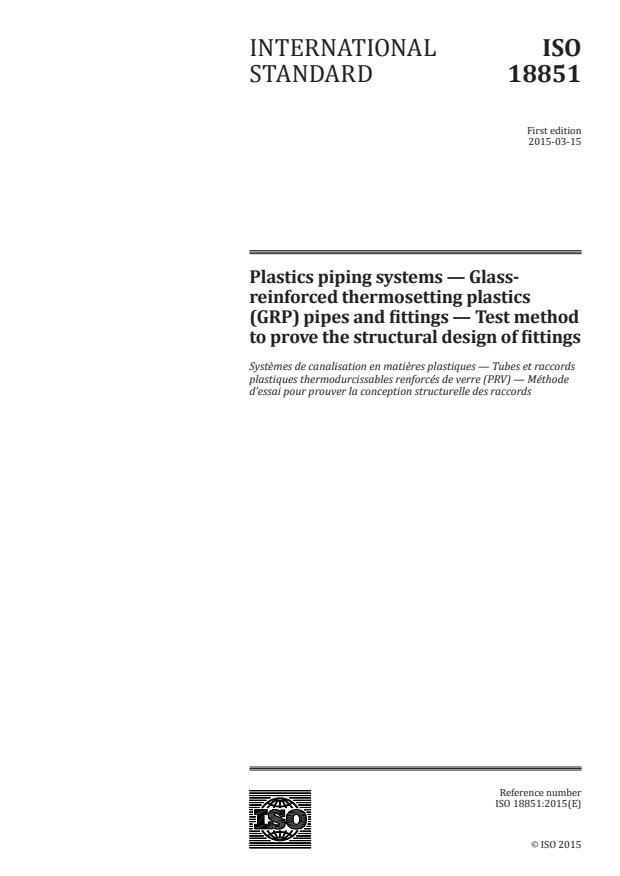
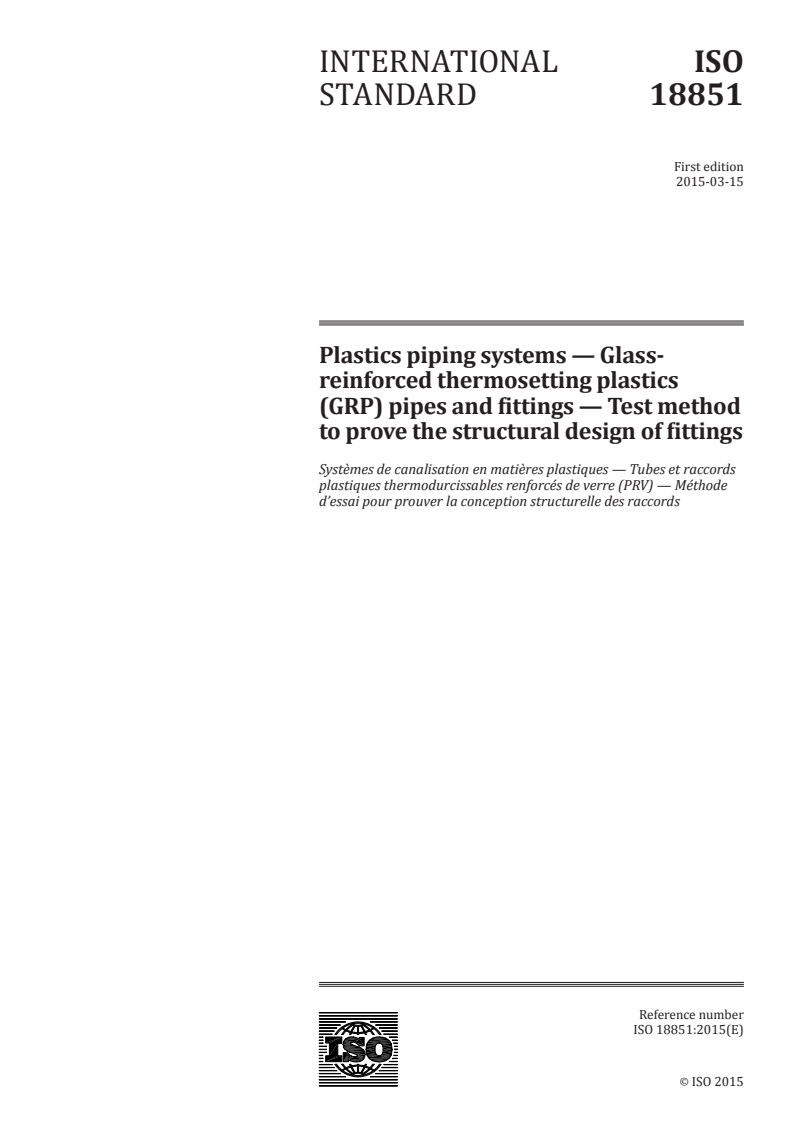
INTERNATIONAL ISO
STANDARD 18851
First edition
2015-03-15
Plastics piping systems — Glass-
reinforced thermosetting plastics
(GRP) pipes and fittings — Test method
to prove the structural design of fittings
Systèmes de canalisation en matières plastiques — Tubes et raccords
plastiques thermodurcissables renforcés de verre (PRV) — Méthode
d’essai pour prouver la conception structurelle des raccords
Reference number
©
ISO 2015
© ISO 2015
All rights reserved. Unless otherwise specified, no part of this publication may be reproduced or utilized otherwise in any form
or by any means, electronic or mechanical, including photocopying, or posting on the internet or an intranet, without prior
written permission. Permission can be requested from either ISO at the address below or ISO’s member body in the country of
the requester.
ISO copyright office
Case postale 56 • CH-1211 Geneva 20
Tel. + 41 22 749 01 11
Fax + 41 22 749 09 47
E-mail copyright@iso.org
Web www.iso.org
Published in Switzerland
ii © ISO 2015 – All rights reserved
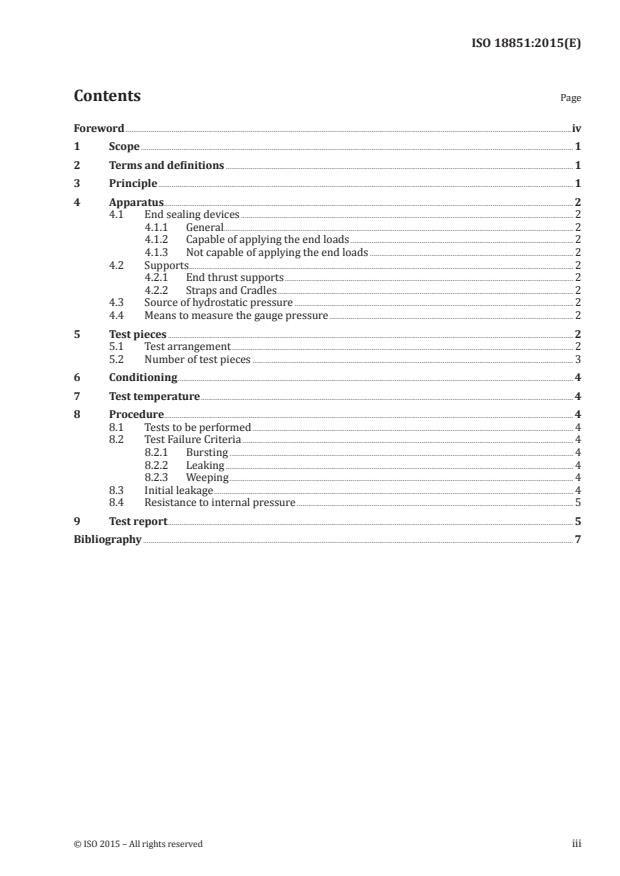
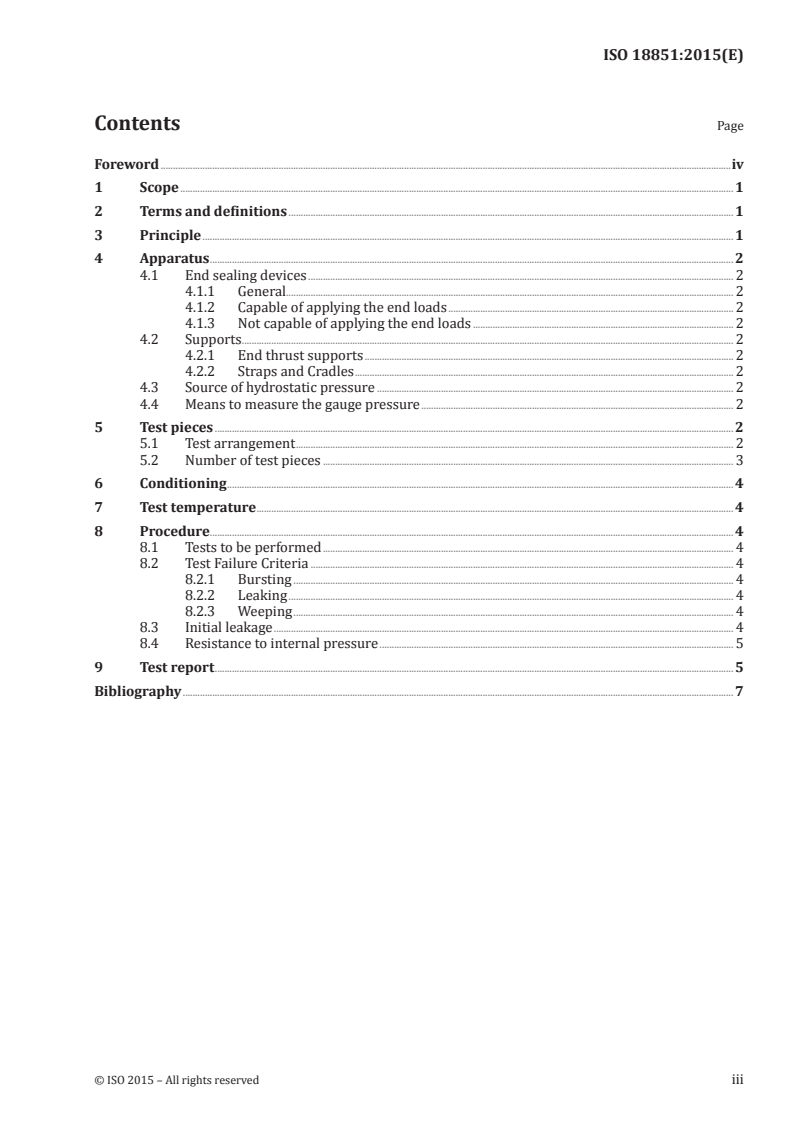
Contents Page
Foreword .iv
1 Scope . 1
2 Terms and definitions . 1
3 Principle . 1
4 Apparatus . 2
4.1 End sealing devices . 2
4.1.1 General. 2
4.1.2 Capable of applying the end loads . 2
4.1.3 Not capable of applying the end loads . 2
4.2 Supports . 2
4.2.1 End thrust supports . 2
4.2.2 Straps and Cradles . 2
4.3 Source of hydrostatic pressure . 2
4.4 Means to measure the gauge pressure . 2
5 Test pieces . 2
5.1 Test arrangement . 2
5.2 Number of test pieces . 3
6 Conditioning . 4
7 Test temperature . 4
8 Procedure. 4
8.1 Tests to be performed . 4
8.2 Test Failure Criteria . 4
8.2.1 Bursting . 4
8.2.2 Leaking . 4
8.2.3 Weeping . 4
8.3 Initial leakage . 4
8.4 Resistance to internal pressure . 5
9 Test report . 5
Bibliography . 7
Foreword
ISO (the International Organization for Standardization) is a worldwide federation of national standards
bodies (ISO member bodies). The work of preparing International Standards is normally carried out
through ISO technical committees. Each member body interested in a subject for which a technical
committee has been established has the right to be represented on that committee. International
organizations, governmental and non-governmental, in liaison with ISO, also take part in the work.
ISO collaborates closely with the International Electrotechnical Commission (IEC) on all matters of
electrotechnical standardization.
The procedures used to develop this document and those intended for its further maintenance are
described in the ISO/IEC Directives, Part 1. In particular the different approval criteria needed for the
different types of ISO documents should be noted. This document was drafted in accordance with the
editorial rules of the ISO/IEC Directives, Part 2 (see www.iso.org/directives).
Attention is drawn to the possibility that some of the elements of this document may be the subject of
patent rights. ISO shall not be held responsible for identifying any or all such patent rights. Details of
any patent rights identified during the development of the document will be in the Introduction and/or
on the ISO list of patent declarations received (see www.iso.org/patents).
Any trade name used in this document is information given for the convenience of users and does not
constitute an endorsement.
For an explanation on the meaning of ISO specific terms and expressions related to conformity
assessment, as well as information about ISO’s adherence to the WTO principles in the Technical Barriers
to Trade (TBT) see the following URL: Foreword - Supplementary information
The committee responsible for this document is ISO/TC 138, Plastics pipes, fittings and valves for the
transport of fluids, Subcommittee SC 6, Reinforced plastics pipes and fittings for all applications.
iv © ISO 2015 – All rights reserved
INTERNATIONAL STANDARD ISO 18851:2015(E)
Plastics piping systems — Glass-reinforced thermosetting
plastics (GRP) pipes and fittings — Test method to prove
the structural design of fittings
1 Scope
This International Standard specifies methods of test for fittings of any form, i.e. bends, branches, tapers,
intended to be used in plastics piping systems for pressure and non-pressure drainage and sewerage or water
supply made of glass-reinforced thermosetting plastics (GRP). This International Standard is applicable to
fittings, in order to test their structural design, but is not applicable to connecting joint systems. It assumes
that the fitting either is or is not intended to be subject to the effects of hydrostatic end thrust.
The tests detailed in 8.1 to 8.4 are applicable to fittings intended to be used in buried or non-buried
applications.
These test procedures are applicable to fittings of all nominal sizes specified in the referring standard.
The tests are for evaluating fittings intended for use in applications conveying liquids at temperatures
specified in the referring standards.
The test procedures in this International Standard are damaging to the test piece which will
...
INTERNATIONAL ISO
STANDARD 18851
First edition
2015-03-15
Plastics piping systems — Glass-
reinforced thermosetting plastics
(GRP) pipes and fittings — Test method
to prove the structural design of fittings
Systèmes de canalisation en matières plastiques — Tubes et raccords
plastiques thermodurcissables renforcés de verre (PRV) — Méthode
d’essai pour prouver la conception structurelle des raccords
Reference number
©
ISO 2015
© ISO 2015
All rights reserved. Unless otherwise specified, no part of this publication may be reproduced or utilized otherwise in any form
or by any means, electronic or mechanical, including photocopying, or posting on the internet or an intranet, without prior
written permission. Permission can be requested from either ISO at the address below or ISO’s member body in the country of
the requester.
ISO copyright office
Case postale 56 • CH-1211 Geneva 20
Tel. + 41 22 749 01 11
Fax + 41 22 749 09 47
E-mail copyright@iso.org
Web www.iso.org
Published in Switzerland
ii © ISO 2015 – All rights reserved
Contents Page
Foreword .iv
1 Scope . 1
2 Terms and definitions . 1
3 Principle . 1
4 Apparatus . 2
4.1 End sealing devices . 2
4.1.1 General. 2
4.1.2 Capable of applying the end loads . 2
4.1.3 Not capable of applying the end loads . 2
4.2 Supports . 2
4.2.1 End thrust supports . 2
4.2.2 Straps and Cradles . 2
4.3 Source of hydrostatic pressure . 2
4.4 Means to measure the gauge pressure . 2
5 Test pieces . 2
5.1 Test arrangement . 2
5.2 Number of test pieces . 3
6 Conditioning . 4
7 Test temperature . 4
8 Procedure. 4
8.1 Tests to be performed . 4
8.2 Test Failure Criteria . 4
8.2.1 Bursting . 4
8.2.2 Leaking . 4
8.2.3 Weeping . 4
8.3 Initial leakage . 4
8.4 Resistance to internal pressure . 5
9 Test report . 5
Bibliography . 7
Foreword
ISO (the International Organization for Standardization) is a worldwide federation of national standards
bodies (ISO member bodies). The work of preparing International Standards is normally carried out
through ISO technical committees. Each member body interested in a subject for which a technical
committee has been established has the right to be represented on that committee. International
organizations, governmental and non-governmental, in liaison with ISO, also take part in the work.
ISO collaborates closely with the International Electrotechnical Commission (IEC) on all matters of
electrotechnical standardization.
The procedures used to develop this document and those intended for its further maintenance are
described in the ISO/IEC Directives, Part 1. In particular the different approval criteria needed for the
different types of ISO documents should be noted. This document was drafted in accordance with the
editorial rules of the ISO/IEC Directives, Part 2 (see www.iso.org/directives).
Attention is drawn to the possibility that some of the elements of this document may be the subject of
patent rights. ISO shall not be held responsible for identifying any or all such patent rights. Details of
any patent rights identified during the development of the document will be in the Introduction and/or
on the ISO list of patent declarations received (see www.iso.org/patents).
Any trade name used in this document is information given for the convenience of users and does not
constitute an endorsement.
For an explanation on the meaning of ISO specific terms and expressions related to conformity
assessment, as well as information about ISO’s adherence to the WTO principles in the Technical Barriers
to Trade (TBT) see the following URL: Foreword - Supplementary information
The committee responsible for this document is ISO/TC 138, Plastics pipes, fittings and valves for the
transport of fluids, Subcommittee SC 6, Reinforced plastics pipes and fittings for all applications.
iv © ISO 2015 – All rights reserved
INTERNATIONAL STANDARD ISO 18851:2015(E)
Plastics piping systems — Glass-reinforced thermosetting
plastics (GRP) pipes and fittings — Test method to prove
the structural design of fittings
1 Scope
This International Standard specifies methods of test for fittings of any form, i.e. bends, branches, tapers,
intended to be used in plastics piping systems for pressure and non-pressure drainage and sewerage or water
supply made of glass-reinforced thermosetting plastics (GRP). This International Standard is applicable to
fittings, in order to test their structural design, but is not applicable to connecting joint systems. It assumes
that the fitting either is or is not intended to be subject to the effects of hydrostatic end thrust.
The tests detailed in 8.1 to 8.4 are applicable to fittings intended to be used in buried or non-buried
applications.
These test procedures are applicable to fittings of all nominal sizes specified in the referring standard.
The tests are for evaluating fittings intended for use in applications conveying liquids at temperatures
specified in the referring standards.
The test procedures in this International Standard are damaging to the test piece which will
...