

ASTM D8121/D8121M-19
(Test Method)Standard Test Method for Approximating the Shear Strength of Cohesive Soils by the Handheld Vane Shear Device
General Information
- Abstract
SIGNIFICANCE AND USE
5.1 The handheld shear vane method provides a rapid method of measuring the approximate undrained shear strength of a fine-grained, cohesive soil either in the field or laboratory. This standard does not supplement or replace D4648.
5.2 The device is intended for use in saturated cohesive soils for determining their approximate undrained shear strength. Cohesive soils with appreciable amounts of silt or fine sand may experience some degree of drainage during shear and adversely affect the results.
Note 2: The user will probably not know at the time of testing if the material is saturated. However, that would not preclude using the device for less than saturated conditions based on the knowledge and experience of the user.
5.3 The presence of coarse materials or heterogeneous soils within the testing volume will adversely affect the results and may preclude the use of this test method.
5.4 The handheld shear vane test is not used to duplicate any particular field conditions but supplements the overall investigative program. However, consistent physical parameters are used in the test such that correlations of shear strength data can be made to evaluate variability of a deposit, assess sample quality, assist in planning of laboratory testing programs, and to classify the consistency.
Note 3: The quality of the result produced by this standard is dependent on the competence of the personnel performing it, and the suitability of the equipment and facilities used. Agencies that meet the criteria of Practice D3740 are generally considered capable of competent and objective testing/sampling/inspection/etc. Users of this standard are cautioned that compliance with Practice D3740 does not in itself assure reliable results. Reliable results depend on many factors; Practice D3740 provides a means of evaluating some of those factors.
SCOPE
1.1 This test method describes approximating the shear strength of cohesive soils using a handheld (pocket) vane shear device.
1.2 The device allows for a simple and portable method for measuring the approximate undrained shear strength of saturated, fine-grained, cohesive soils. The test method can be used in the field or in the laboratory, on the ends of sample tubes, on the surface of block samples or excavations, or on the surface of other test specimens with rigid confinement.
1.3 Units—The values stated in either inch-pound units or SI units [given in brackets] are to be regarded separately as standard. The values stated in each system may not be exact equivalents; therefore, each system shall be used independently of the other. Combining values from the two systems may result in non-conformance with the standard. Tables of critical dimensions and tolerances of the described vanes are provided in separate units of inches and mm.
Note 1: The original shear vane device was developed when shear strength was often reported in tons per square foot (TSF) or kilograms per square centimeter (kg/cm2) which are approximately equivalent. These units have prevailed within the industry and are adopted herein.
1.4 All observed and calculated values shall conform to the guidelines for significant digits and rounding established in Practice D6026, unless superseded by this test method.
1.4.1 The procedures used to specify how data are collected, recorded, and calculated in this standard are regarded as the industry standard. In addition, they are representative of the significant digits that generally should be retained. The procedures used do not consider material variation, purpose for obtaining the data, special purpose studies, or any considerations for the user’s objectives, and it is common practice to increase or reduce significant digits of reported data to be commensurate with these considerations. It is beyond the scope of this test method to consider significant digits used in analysis methods for engineering design.
1.5 This standard do...
- Status
- Published
- Publication Date
- 30-Apr-2019
- Technical Committee
- D18 - Soil and Rock
- Drafting Committee
- D18.05 - Strength and Compressibility of Soils
Buy Documents
ASTM D8121/D8121M-19 - Standard Test Method for Approximating the Shear Strength of Cohesive Soils by the Handheld Vane Shear Device
REDLINE ASTM D8121/D8121M-19 - Standard Test Method for Approximating the Shear Strength of Cohesive Soils by the Handheld Vane Shear Device
Overview
ASTM D8121/D8121M-19 is an international standard issued by ASTM International that provides a test method for approximating the shear strength of cohesive soils using a handheld vane shear device. This method offers a quick and practical way to assess the approximate undrained shear strength in fine-grained, cohesive soils both in the field and laboratory settings. It is especially valuable for geotechnical investigations, providing essential input for site characterizations, quality assessments, and the planning of laboratory programs.
Key Topics
- Test Method Scope: The standard details a procedure for using a handheld (pocket) vane shear device to measure undrained shear strength of saturated, fine-grained, cohesive soils in various conditions, such as end surfaces of samples, block samples, or test excavations.
- Applicability: Primarily designed for saturated cohesive soils, the method helps determine undrained shear strength rapidly.
- Limitations:
- Results can be adversely affected by coarse materials or significant amounts of silt or sand.
- Not suitable for heterogeneous soils or conditions with partial saturation without the user's experience and judgment.
- Reporting Procedures: Emphasizes the need for accurate recording, significant digits, and clear documentation of testing conditions, sample identification, and correction factors used.
- Instrumentation: Describes the handheld vane shear device, its calibration, and the use of different vane sizes tailored to varying soil conditions.
- Calibration Requirements: Stresses the importance of calibration using recognized procedures to maintain accuracy and reliability of the testing device.
Applications
The ASTM D8121/D8121M-19 standard test method finds wide application in the following areas:
- Site Investigations: Geotechnical professionals use the handheld vane shear device for rapid, on-site assessment of cohesive subsoils, particularly for evaluating soil consistency and preliminary shear strength profiling.
- Laboratory Testing: The method supports quality control of soils sampled from the field by providing a basis for classifying consistency and selecting specimens for more advanced laboratory testing.
- Construction Engineering: Engineers employ this test to estimate soil shear strength for foundations, embankments, and soft ground improvement projects where rapid decision-making is required.
- Soil Classification and Consistency Assessment: The test supplements comprehensive investigative programs by offering consistent numerical indices that can be correlated among multiple soil samples or locations on a site.
- Planning and Quality Assurance: The method aids in evaluating the variability of soil strength within a deposit, thus supporting decisions on sampling, further testing, and construction feasibility.
Related Standards
Professionals utilizing ASTM D8121/D8121M-19 should be familiar with the following related ASTM standards:
- ASTM D4648: Laboratory Miniature Vane Shear Test for Saturated Fine-Grained Clayey Soil - a more controlled laboratory methodology.
- ASTM D653: Terminology Relating to Soil, Rock, and Contained Fluids - for consistent interpretation of terms.
- ASTM D2216: Laboratory Determination of Water (Moisture) Content of Soil and Rock by Mass.
- ASTM D3740: Requirements for Agencies Engaged in Testing/Inspection of Soil and Rock for Engineering Design - ensures quality and competence in testing.
- ASTM D6026: Practice for Using Significant Digits in Geotechnical Data - guidance on data precision and reporting.
By adhering to ASTM D8121/D8121M-19 and its related standards, engineers and technicians ensure reliable, repeatable, and standardized approaches to soil shear strength measurement, enhancing the overall quality of geotechnical data and supporting informed project decisions.
Relations
- Effective Date
- 01-May-2019
- Effective Date
- 01-Nov-2023
- Effective Date
- 01-Oct-2019
- Effective Date
- 01-Mar-2019
- Effective Date
- 01-Aug-2014
- Effective Date
- 01-May-2012
- Effective Date
- 01-Mar-2012
- Effective Date
- 01-Sep-2011
- Effective Date
- 01-Sep-2011
- Effective Date
- 01-Jul-2010
- Effective Date
- 01-Mar-2010
- Effective Date
- 01-Jan-2009
- Effective Date
- 01-Dec-2008
- Effective Date
- 01-Nov-2008
- Effective Date
- 01-Mar-2008
Buy Documents
ASTM D8121/D8121M-19 - Standard Test Method for Approximating the Shear Strength of Cohesive Soils by the Handheld Vane Shear Device
REDLINE ASTM D8121/D8121M-19 - Standard Test Method for Approximating the Shear Strength of Cohesive Soils by the Handheld Vane Shear Device
Get Certified
Connect with accredited certification bodies for this standard

CIS Institut d.o.o.
Personal Protective Equipment (PPE) certification body. Notified Body NB-2890 for EU Regulation 2016/425 PPE.

Kiwa BDA Testing
Building and construction product certification.
Kmetijski inštitut Slovenije
Agricultural Institute of Slovenia. Soil testing, plant health, agricultural product analysis.
Sponsored listings
Frequently Asked Questions
ASTM D8121/D8121M-19 is a standard published by ASTM International. Its full title is "Standard Test Method for Approximating the Shear Strength of Cohesive Soils by the Handheld Vane Shear Device". This standard covers: SIGNIFICANCE AND USE 5.1 The handheld shear vane method provides a rapid method of measuring the approximate undrained shear strength of a fine-grained, cohesive soil either in the field or laboratory. This standard does not supplement or replace D4648. 5.2 The device is intended for use in saturated cohesive soils for determining their approximate undrained shear strength. Cohesive soils with appreciable amounts of silt or fine sand may experience some degree of drainage during shear and adversely affect the results. Note 2: The user will probably not know at the time of testing if the material is saturated. However, that would not preclude using the device for less than saturated conditions based on the knowledge and experience of the user. 5.3 The presence of coarse materials or heterogeneous soils within the testing volume will adversely affect the results and may preclude the use of this test method. 5.4 The handheld shear vane test is not used to duplicate any particular field conditions but supplements the overall investigative program. However, consistent physical parameters are used in the test such that correlations of shear strength data can be made to evaluate variability of a deposit, assess sample quality, assist in planning of laboratory testing programs, and to classify the consistency. Note 3: The quality of the result produced by this standard is dependent on the competence of the personnel performing it, and the suitability of the equipment and facilities used. Agencies that meet the criteria of Practice D3740 are generally considered capable of competent and objective testing/sampling/inspection/etc. Users of this standard are cautioned that compliance with Practice D3740 does not in itself assure reliable results. Reliable results depend on many factors; Practice D3740 provides a means of evaluating some of those factors. SCOPE 1.1 This test method describes approximating the shear strength of cohesive soils using a handheld (pocket) vane shear device. 1.2 The device allows for a simple and portable method for measuring the approximate undrained shear strength of saturated, fine-grained, cohesive soils. The test method can be used in the field or in the laboratory, on the ends of sample tubes, on the surface of block samples or excavations, or on the surface of other test specimens with rigid confinement. 1.3 Units—The values stated in either inch-pound units or SI units [given in brackets] are to be regarded separately as standard. The values stated in each system may not be exact equivalents; therefore, each system shall be used independently of the other. Combining values from the two systems may result in non-conformance with the standard. Tables of critical dimensions and tolerances of the described vanes are provided in separate units of inches and mm. Note 1: The original shear vane device was developed when shear strength was often reported in tons per square foot (TSF) or kilograms per square centimeter (kg/cm2) which are approximately equivalent. These units have prevailed within the industry and are adopted herein. 1.4 All observed and calculated values shall conform to the guidelines for significant digits and rounding established in Practice D6026, unless superseded by this test method. 1.4.1 The procedures used to specify how data are collected, recorded, and calculated in this standard are regarded as the industry standard. In addition, they are representative of the significant digits that generally should be retained. The procedures used do not consider material variation, purpose for obtaining the data, special purpose studies, or any considerations for the user’s objectives, and it is common practice to increase or reduce significant digits of reported data to be commensurate with these considerations. It is beyond the scope of this test method to consider significant digits used in analysis methods for engineering design. 1.5 This standard do...
SIGNIFICANCE AND USE 5.1 The handheld shear vane method provides a rapid method of measuring the approximate undrained shear strength of a fine-grained, cohesive soil either in the field or laboratory. This standard does not supplement or replace D4648. 5.2 The device is intended for use in saturated cohesive soils for determining their approximate undrained shear strength. Cohesive soils with appreciable amounts of silt or fine sand may experience some degree of drainage during shear and adversely affect the results. Note 2: The user will probably not know at the time of testing if the material is saturated. However, that would not preclude using the device for less than saturated conditions based on the knowledge and experience of the user. 5.3 The presence of coarse materials or heterogeneous soils within the testing volume will adversely affect the results and may preclude the use of this test method. 5.4 The handheld shear vane test is not used to duplicate any particular field conditions but supplements the overall investigative program. However, consistent physical parameters are used in the test such that correlations of shear strength data can be made to evaluate variability of a deposit, assess sample quality, assist in planning of laboratory testing programs, and to classify the consistency. Note 3: The quality of the result produced by this standard is dependent on the competence of the personnel performing it, and the suitability of the equipment and facilities used. Agencies that meet the criteria of Practice D3740 are generally considered capable of competent and objective testing/sampling/inspection/etc. Users of this standard are cautioned that compliance with Practice D3740 does not in itself assure reliable results. Reliable results depend on many factors; Practice D3740 provides a means of evaluating some of those factors. SCOPE 1.1 This test method describes approximating the shear strength of cohesive soils using a handheld (pocket) vane shear device. 1.2 The device allows for a simple and portable method for measuring the approximate undrained shear strength of saturated, fine-grained, cohesive soils. The test method can be used in the field or in the laboratory, on the ends of sample tubes, on the surface of block samples or excavations, or on the surface of other test specimens with rigid confinement. 1.3 Units—The values stated in either inch-pound units or SI units [given in brackets] are to be regarded separately as standard. The values stated in each system may not be exact equivalents; therefore, each system shall be used independently of the other. Combining values from the two systems may result in non-conformance with the standard. Tables of critical dimensions and tolerances of the described vanes are provided in separate units of inches and mm. Note 1: The original shear vane device was developed when shear strength was often reported in tons per square foot (TSF) or kilograms per square centimeter (kg/cm2) which are approximately equivalent. These units have prevailed within the industry and are adopted herein. 1.4 All observed and calculated values shall conform to the guidelines for significant digits and rounding established in Practice D6026, unless superseded by this test method. 1.4.1 The procedures used to specify how data are collected, recorded, and calculated in this standard are regarded as the industry standard. In addition, they are representative of the significant digits that generally should be retained. The procedures used do not consider material variation, purpose for obtaining the data, special purpose studies, or any considerations for the user’s objectives, and it is common practice to increase or reduce significant digits of reported data to be commensurate with these considerations. It is beyond the scope of this test method to consider significant digits used in analysis methods for engineering design. 1.5 This standard do...
ASTM D8121/D8121M-19 is classified under the following ICS (International Classification for Standards) categories: 13.080.01 - Soil quality and pedology in general. The ICS classification helps identify the subject area and facilitates finding related standards.
ASTM D8121/D8121M-19 has the following relationships with other standards: It is inter standard links to ASTM D8121/D8121M-18, ASTM D3740-23, ASTM D3740-19, ASTM D2216-19, ASTM D653-14, ASTM D3740-12a, ASTM D3740-12, ASTM D653-11, ASTM D3740-11, ASTM D2216-10, ASTM D3740-10, ASTM D653-09, ASTM D653-08a, ASTM D653-08, ASTM D3740-08. Understanding these relationships helps ensure you are using the most current and applicable version of the standard.
ASTM D8121/D8121M-19 is available in PDF format for immediate download after purchase. The document can be added to your cart and obtained through the secure checkout process. Digital delivery ensures instant access to the complete standard document.
Standards Content (Sample)
This international standard was developed in accordance with internationally recognized principles on standardization established in the Decision on Principles for the
Development of International Standards, Guides and Recommendations issued by the World Trade Organization Technical Barriers to Trade (TBT) Committee.
Designation: D8121/D8121M − 19
Standard Test Method for
Approximating the Shear Strength of Cohesive Soils by the
Handheld Vane Shear Device
This standard is issued under the fixed designation D8121/D8121M; the number immediately following the designation indicates the
year of original adoption or, in the case of revision, the year of last revision. A number in parentheses indicates the year of last
reapproval. A superscript epsilon (´) indicates an editorial change since the last revision or reapproval.
1. Scope of this test method to consider significant digits used in
analysis methods for engineering design.
1.1 This test method describes approximating the shear
1.5 This standard does not purport to address all of the
strength of cohesive soils using a handheld (pocket) vane shear
safety concerns, if any, associated with its use. It is the
device.
responsibility of the user of this standard to establish appro-
1.2 The device allows for a simple and portable method for
priate safety, health, and environmental practices and deter-
measuring the approximate undrained shear strength of
mine the applicability of regulatory limitations prior to use.
saturated, fine-grained, cohesive soils. The test method can be
1.6 This international standard was developed in accor-
used in the field or in the laboratory, on the ends of sample
dance with internationally recognized principles on standard-
tubes, on the surface of block samples or excavations, or on the
ization established in the Decision on Principles for the
surface of other test specimens with rigid confinement.
Development of International Standards, Guides and Recom-
1.3 Units—The values stated in either inch-pound units or mendations issued by the World Trade Organization Technical
SI units [given in brackets] are to be regarded separately as Barriers to Trade (TBT) Committee.
standard. The values stated in each system may not be exact
equivalents;therefore,eachsystemshallbeusedindependently 2. Referenced Documents
of the other. Combining values from the two systems may 2
2.1 ASTM Standards:
result in non-conformance with the standard. Tables of critical
D653 Terminology Relating to Soil, Rock, and Contained
dimensions and tolerances of the described vanes are provided
Fluids
in separate units of inches and mm.
D2216 Test Methods for Laboratory Determination of Water
(Moisture) Content of Soil and Rock by Mass
NOTE 1—The original shear vane device was developed when shear
strength was often reported in tons per square foot (TSF) or kilograms per D3740 Practice for Minimum Requirements for Agencies
square centimeter (kg/cm ) which are approximately equivalent. These
Engaged in Testing and/or Inspection of Soil and Rock as
units have prevailed within the industry and are adopted herein.
Used in Engineering Design and Construction
1.4 All observed and calculated values shall conform to the
D4648 Test Methods for Laboratory Miniature Vane Shear
guidelines for significant digits and rounding established in Test for SaturatedFine-Grained Clayey Soil
Practice D6026, unless superseded by this test method.
D6026 Practice for Using Significant Digits in Geotechnical
Data
1.4.1 Theproceduresusedtospecifyhowdataarecollected,
recorded, and calculated in this standard are regarded as the
3. Terminology
industry standard. In addition, they are representative of the
significant digits that generally should be retained. The proce-
3.1 Definitions:
dures used do not consider material variation, purpose for
3.1.1 For common definitions of technical terms used in this
obtaining the data, special purpose studies, or any consider-
test method, refer to Terminology D653.
ations for the user’s objectives, and it is common practice to
3.2 Definitions of Terms Specific to This Standard:
increase or reduce significant digits of reported data to be
3.2.1 vane multiplier (VM), n—a multiplier to correct the
commensuratewiththeseconsiderations.Itisbeyondthescope
vane’sdialreadingbasedonthestandard(mid-size)vanetothe
larger or smaller vane (4.2).
This test method is under the jurisdiction ofASTM Committee D18 on Soil and
Rock and is the direct responsibility of Subcommittee D18.05 on Strength and
Compressibility of Soils. For referenced ASTM standards, visit the ASTM website, www.astm.org, or
Current edition approved May 1, 2019. Published June 2019. Originally contact ASTM Customer Service at service@astm.org. For Annual Book of ASTM
approved in 2018. Last previous edition approved in 2018 as D8121/D8121M – 18. Standards volume information, refer to the standard’s Document Summary page on
DOI: 10.1520/D8121_D8121M-19 the ASTM website.
Copyright © ASTM International, 100 Barr Harbor Drive, PO Box C700, West Conshohocken, PA 19428-2959. United States
D8121/D8121M − 19
3.2.2 calibration factor (CF), n—correction to the vane’s may experience some degree of drainage during shear and
dialreadingbaseduponthephysicalcalibrationofthetorsional adversely affect the results.
shear device in accordance with Annex A1.
NOTE 2—The user will probably not know at the time of testing if the
material is saturated. However, that would not preclude using the device
4. Summary of Test Method
for less than saturated conditions based on the knowledge and experience
4.1 The handheld vane shear device is comprised of a of the user.
calibrated torque spring, post, measuring scale, and one of
5.3 The presence of coarse materials or heterogeneous soils
three vanes. A flat surface is prepared on a specimen of
within the testing volume will adversely affect the results and
cohesive soil, usually confined by a sampling tube or specimen
may preclude the use of this test method.
ring; the side walls of a test pit; or exposed footing. The vane
5.4 Thehandheldshearvanetestisnotusedtoduplicateany
is pressed into the soil surface and the device is rotated at a
particular field conditions but supplements the overall investi-
specified rate until the soil shears. The failure surface is
gative program. However, consistent physical parameters are
prescribed by the face of the vane and the depth of the blades.
used in the test such that correlations of shear strength data can
A pointer retains the maximum value on the measuring scale,
ranging from 0 to 1 TSF [0 to 100 kPa], with major divisions be made to evaluate variability of a deposit, assess sample
quality, assist in planning of laboratory testing programs, and
of 0.05 TSF [5 kPa] when a standard (mid-size) shear vane is
used. to classify the consistency.
4.2 Typically, three vane sizes are provided with the device.
NOTE 3—The quality of the result produced by this standard is
The standard (mid-sized) vane has a multiplier of 1. The dependent on the competence of the personnel performing it, and the
suitability of the equipment and facilities used. Agencies that meet the
smaller vane is used for stiffer soils and typically has a
criteria of Practice D3740 are generally considered capable of competent
multiplier of 2.5. The larger vane is used for softer soils and
and objective testing/sampling/inspection/etc. Users of this standard are
typically has a multiplier of 0.2. The reading on the scale is
cautioned that compliance with Practice D3740 does not in itself assure
multiplied by the factor for the specific vane to obtain the
reliable results. Reliable results depend on many factors; Practice D3740
provides a means of evaluating some of those factors.
correct measure of strength.
5. Significance and Use
6. Apparatus
5.1 The handheld shear vane method provides a rapid
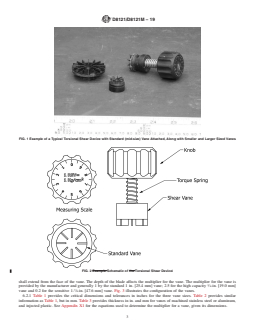
6.1 Torsional Shear Device—A mechanical device consist-
method of measuring the approximate undrained shear strength
ing of a calibrated torque spring attached to a measuring scale
of a fine-grained, cohesive soil either in the field or laboratory.
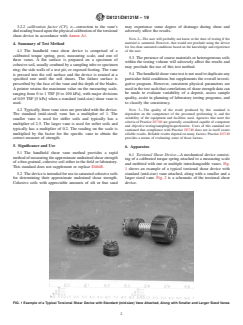
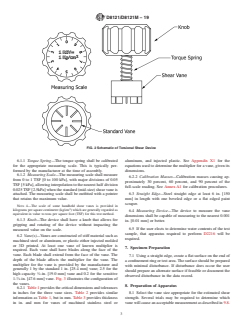
and outfitted with one or multiple interchangeable vanes. Fig.
This standard does not supplement or replace D4648.
1 shows an example of a typical torsional shear device with
5.2 Thedeviceisintendedforuseinsaturatedcohesivesoils standard (mid-size) vane attached, along with a smaller and a
for determining their approximate undrained shear strength. larger sized vane. Fig. 2 is a schematic of the torsional shear
Cohesive soils with appreciable amounts of silt or fine sand device.
FIG. 1 Example of a Typical Torsional Shear Device with Standard (mid-size) Vane Attached, Along with Smaller and Larger Sized Vanes
D8121/D8121M − 19
FIG. 2 Schematic of Torsional Shear Device
6.1.1 Torque Spring—The torque spring shall be calibrated aluminum, and injected plastic. See Appendix X1 for the
for the appropriate measuring scale. This is typically per- equations used to determine the multiplier for a vane, given its
formed by the manufacturer at the time of assembly.
dimensions.
6.1.2 Measuring Scale—The measuring scale shall measure
6.2.2 Calibration Masses—Calibration masses causing ap-
from 0 to 1 TSF [0 to 100 kPa], with major divisions of 0.05
proximately 30 percent, 60 percent, and 90 percent of the
TSF [5 kPa], allowing interpolation to the nearest half division
full-scale reading. See Annex A1 for calibration procedures.
0.025 TSF [2.5kPa] when the standard (mid-size) shear vane is
6.3 Straight Edge—Steel straight edge at least 6 in. [150
attached. The measuring scale shall be outfitted with a pointer
mm] in length with one beveled edge or a flat edged paint
that retains the maximum value.
scraper.
NOTE 4—The scale of some handheld shear vanes is provided in
kilograms per square centimeter (kg/cm ) which are generally regarded as
6.4 Measuring Device—The device to measure the vane
equivalent in value to tons per square foot (TSF) for this test method.
dimensions shall be capable of measuring to the nearest 0.001
6.1.3 Knob—The device shall have a knob that allows for
in. [0.01 mm] or better.
gripping and rotating of the device without impacting the
6.5 If the user elects to determine water contents of the test
measured value on the scale.
sample, that apparatus required to perform D2216 will be
6.2 Vane(s)—Vanes are constructed of stiff material such as
required.
machined steel or aluminum, or plastic either injected molded
or 3D printed. At least one vane of known multiplier is
7. Specimen Preparation
required. Each vane shall have blades along the face of the
vane. Each blade shall extend from the face of the vane. The
7.1 Using a straight edge, create a flat surface on the end of
depth of the blade affects the multiplier for the vane. The
a confinement ring or test area. The surface should be prepared
multiplier for the vane is provided by the manufacturer and
with minimal disturbance. If disturbance does occur the user
generally 1 by the standard 1 in. [25.4 mm] vane; 2.5 for the
should prepare an alternate surface if feasible or document the
high capacity ⁄4-in. [19.0 mm] vane and 0.2 for the sensitive
observed disturbance in the data record.
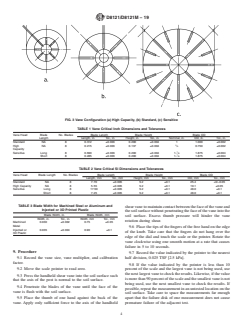
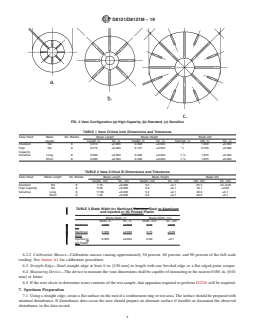
1- ⁄8-in. [47.6 mm] vane. Fig. 3 illustrates the configuration of
the vanes.
8. Preparation of Apparatus
6.2.1 Table1providesthecriticaldimensionsandtolerances
8.1 Select the vane size appropriate for the estimated shear
in inches for the three vane sizes. Table 2 provides similar
strength. Several trials may be required to determine which
information as Table 1, but in mm. Table 3 provides thickness
in in. and mm for vanes of machined stainless steel or vanewillcauseanacceptablemeasurementasdescribedin9.8.
D8121/D8121M − 19
FIG. 3 Vane Configuration (a) High Capacity, (b) Standard, (c) Sensitive
TABLE 1 Vane Critical Inch Dimensions and Tolerances
Vane Head Blade No. Blades Blade Length Blade Height Blade OD
Length Length, in. Tol., in. Height, in. Tol., in. Nominal, in. OD, in. Tol., in.
Standard NA 8 0.312 ±0.003 0.200 ±0.004 1 1.000 ±0.002
High NA 8 0.215 ±0.003 0.137 ±0.004 ⁄4 0.750 ±0.002
Capacity
Sensitive Long 8 0.690 ±0.003 0.200 ±0.004 1- ⁄8 1.875 ±0.004
Short 8 0.285 ±0.003 0.200 ±0.004 1- ⁄8 1.875 ±0.004
TABLE 2 Vane Critical SI Dimensions and Tolerances
Vane Head Blade Length No. Blades Blade Length Blade Height Blade OD
Length, mm Tol., mm Height, mm Tol., mm OD, mm Tol., mm
Standard NA 8 7.70 ±0.005 5.2 ±0.1 25.4 +0/–0.05
High Capacity NA 8 5.55 ±0.005 5.2 ±0.1 19.1 ±0.05
Sensitive Long 8 17.50 ±0.005 5.2 ±0.1 48.0 ±0.1
Short 8 7.25 ±0.005 5.2 ±0.1 48.0 ±0.1
TABLE 3 Blade Width for Machined Steel or Aluminum and
shearvanetomaintaincontactbetweenthefaceofthevaneand
Injected or 3D Printed Plastic
thesoilsurfacewithoutpenetratingthefaceofthevaneintothe
Blade Width, in. Blade Width, mm
soil surface. Excess thumb pressure will hinder the vane
Width, in. Tol., in. Width, mm Tol., mm
rotation during shear.
Machined 0.030 ±0.002 0.75 ±0.05
Metal
9.6 Place the tips of the fingers of the free hand on the edge
Injected or 0.035 ±0.004 0.90 ±0.1
of the knob. Take care that the fingers do not hang over the
3D Plastic
edge of the dial and touch the scale or the pointer. Rotate the
vane clockwise using one smooth motion at a rate that causes
failure in 5 to 10 seconds.
9. Procedure
9.7 Record the value indicated by the pointer to the nearest
9.1 Record the vane size, vane multiplier, and calibration half division, 0.025 TSF [2.5 kPa].
factor.
9.8 If the value indicated by the pointer is less than 10
9.2 Move the scale pointer to read zero.
percent of the scale and the largest vane is not being used, use
the next largest vane to check the results. Likewise, if the value
9.3 Press the handheld shear vane into the soil surface such
ismorethan90percentofthescaleandthesmallestvaneisnot
that the axis of the post is normal to the soil surface.
being used, use the next smallest vane to check the results. If
9.4 Penetrate the blades of the vane until the face of the
possible, repeat the measurement in an untested location on the
vane is flush with the soil surface.
soil surface. Take care to space the measurements far enough
9.5 Place the thumb of one hand against the back of the apart that the failure disk of one measurement does not cause
vane. Apply only sufficient force to the axis of the handheld premature failure of the adjacent test.
D8121/D8121M − 19
9.9 For optional water content determination, remove the 11.2.3 Any special selection or preparation process, such as
soil from between the blades. Place the soil in a pre-measured removal of gravel or other materials, or identification of their
tareforwatercontentdeterminationinaccordancewithD2216. presence.
11.2.4 If the specimen is reconstituted, remolded, or
9.10 Ifrequiredtomeettheminimummassrequirementsfor
trimmed in a specialized manner, provide information on the
the water content determination, remove additional soil to the
method of preparation.
depth of the device blades in the tested areas. Place the soil in
the water content tare, and obtain the water content.
11.3 Recordasaminimumthefollowingtestspecimendata:
11.3.1 If a water content determination was made, the
10. Calculations
companion water content shall be reported to the precision in
10.1 Correct each reading by the calibration factor, if
accordance with Test Method D2216.
required, and the vane multiplier for the vane used for the
11.3.2 The vane size, vane multiplier and calibration factor
determination:
used for the handheld shear vane determinations.
S 5 s 3VM 3CF (1)
u reading
11.4 Report the vane dial reading or averaged readings of
where:
the results taken at each location.
S = corrected shear strength, TSF [kPa],
u
11.5 Reported the calculated shear strength, S,tothe
u
S = reading from vane’s measuring scale, TSF [kPa],
reading
nearest 0.025TSF [2.5 kPa] corrected in accordance with 10.1.
VM = vane multiplier, that is, VM = 1 for mid-size vane;
0.2 for largest vane; 2.5 for smallest vane, and
NOTE5—Itiscustomarytodesignatetheshearstrengthfromvaneshear
CF = calibration factor associated with S (Annex
reading as S .
u
A1).
12. Precision and Bias
10.2 If several determinations were performed at the same
location, calculate the average of the readings.
12.1 Precision—Test data on precision is not presented due
to the nature of the soil materials tested by this test method. It
11. Report: Test Data Sheet(s)/Form(s)
is either not feasible or too costly at this time to have ten or
11.1 The methodology used to specify how data are re-
more laboratories participate in a round-robin testing program.
corded on the test data sheet(s)/form(s), as described below, is
Also, it is either not feasible or too costly to produce multiple
covered in 1.4.
specimensthathaveuniformphysicalproperties.Anyvariation
11.2 Record as a minimum the following general
...
This document is not an ASTM standard and is intended only to provide the user of an ASTM standard an indication of what changes have been made to the previous version. Because
it may not be technically possible to adequately depict all changes accurately, ASTM recommends that users consult prior editions as appropriate. In all cases only the current version
of the standard as published by ASTM is to be considered the official document.
Designation: D8121/D8121M − 18 D8121/D8121M − 19
Standard Test Method for
Approximating the Shear Strength of Cohesive Soils by the
Handheld Vane Shear Device
This standard is issued under the fixed designation D8121/D8121M; the number immediately following the designation indicates the
year of original adoption or, in the case of revision, the year of last revision. A number in parentheses indicates the year of last
reapproval. A superscript epsilon (´) indicates an editorial change since the last revision or reapproval.
1. Scope
1.1 This test method describes approximating the shear strength of cohesive soils using a handheld (pocket) vane shear device.
1.2 The device allows for a simple and portable method for measuring the approximate undrained shear strength of saturated,
fine-grained, cohesive soils. The test method can be used in the field or in the laboratory, on the ends of sample tubes, on the surface
of block samples or excavations, or on the surface of other test specimens with rigid confinement.
1.3 Units—The values stated in either inch-pound units or SI units [given in brackets] are to be regarded separately as standard.
The values stated in each system may not be exact equivalents; therefore, each system shall be used independently of the other.
Combining values from the two systems may result in non-conformance with the standard. Tables of critical dimensions and
tolerances of the described vanes are provided in separate units of inches and mm.
NOTE 1—The original shear vane device was developed when shear strength was often reported in tons per square foot (TSF) or kilograms per square
centimeter (kg/cm ) which are approximately equivalent. These units have prevailed within the industry and are adopted herein.
1.4 All observed and calculated values shall conform to the guidelines for significant digits and rounding established in Practice
D6026, unless superseded by this test method.
1.4.1 The procedures used to specify how data are collected, recorded, and calculated in this standard are regarded as the
industry standard. In addition, they are representative of the significant digits that generally should be retained. The procedures
used do not consider material variation, purpose for obtaining the data, special purpose studies, or any considerations for the user’s
objectives, and it is common practice to increase or reduce significant digits of reported data to be commensurate with these
considerations. It is beyond the scope of this test method to consider significant digits used in analysis methods for engineering
design.
1.5 This standard does not purport to address all of the safety concerns, if any, associated with its use. It is the responsibility
of the user of this standard to establish appropriate safety, health, and environmental practices and determine the applicability of
regulatory limitations prior to use.
1.6 This international standard was developed in accordance with internationally recognized principles on standardization
established in the Decision on Principles for the Development of International Standards, Guides and Recommendations issued
by the World Trade Organization Technical Barriers to Trade (TBT) Committee.
2. Referenced Documents
2.1 ASTM Standards:
D653 Terminology Relating to Soil, Rock, and Contained Fluids
D2216 Test Methods for Laboratory Determination of Water (Moisture) Content of Soil and Rock by Mass
D3740 Practice for Minimum Requirements for Agencies Engaged in Testing and/or Inspection of Soil and Rock as Used in
Engineering Design and Construction
D4648 Test Methods for Laboratory Miniature Vane Shear Test for SaturatedFine-Grained Clayey Soil
D6026 Practice for Using Significant Digits in Geotechnical Data
This test method is under the jurisdiction of ASTM Committee D18 on Soil and Rock and is the direct responsibility of Subcommittee D18.05 on Strength and
Compressibility of Soils.
Current edition approved June 1, 2018May 1, 2019. Published July 2018June 2019. Originally approved in 2018. Last previous edition approved in 2018 as
D8121/D8121M – 18. DOI: 10.1520/D8121_D8121M-1810.1520/D8121_D8121M-19
For referenced ASTM standards, visit the ASTM website, www.astm.org, or contact ASTM Customer Service at service@astm.org. For Annual Book of ASTM Standards
volume information, refer to the standard’s Document Summary page on the ASTM website.
Copyright © ASTM International, 100 Barr Harbor Drive, PO Box C700, West Conshohocken, PA 19428-2959. United States
D8121/D8121M − 19
3. Terminology
3.1 Definitions:
3.1.1 For common definitions of technical terms used in this test method, refer to Terminology D653.
3.2 Definitions of Terms Specific to This Standard:
3.2.1 vane multiplier (VM), n—a multiplier to correct the vane’s dial reading based on the standard (mid-size) vane to the larger
or smaller vane (4.2).
3.2.2 calibration factor (CF), n—correction to the vane’s dial reading based upon the physical calibration of the torsional shear
device in accordance with Annex A1.
4. Summary of Test Method
4.1 The handheld vane shear device is comprised of a calibrated torque spring, post, measuring scale, and one of three vanes.
A flat surface is prepared on a specimen of cohesive soil, usually confined by a sampling tube or specimen ring; the side walls of
a test pit; or exposed footing. The vane is pressed into the soil surface and the device is rotated at a specified rate until the soil
shears. The failure surface is prescribed by the face of the vane and the depth of the blades. A pointer retains the maximum value
on the measuring scale, ranging from 0 to 1 TSF [0 to 100 kPa], with major divisions of 0.05 TSF [5 kPa] when a standard
(mid-size) shear vane is used.
4.2 Typically, three vane sizes are provided with the device. The standard (mid-sized) vane has a multiplier of 1. The smaller
vane is used for stiffer soils and typically has a multiplier of 2.5. The larger vane is used for softer soils and typically has a
multiplier of 0.2. The reading on the scale is multiplied by the factor for the specific vane to obtain the correct measure of strength.
5. Significance and Use
5.1 The handheld shear vane method provides a rapid method of measuring the approximate undrained shear strength of a
fine-grained, cohesive soil either in the field or laboratory. This standard does not supplement or replace D4648.
5.2 The device is intended for use in saturated cohesive soils for determining their approximate undrained shear strength.
Cohesive soils with appreciable amounts of silt or fine sand may experience some degree of drainage during shear and adversely
affect the results.
NOTE 2—The user will probably not know at the time of testing if the material is saturated. However, that would not preclude using the device for
less than saturated conditions based on the knowledge and experience of the user.
5.3 The presence of coarse materials or heterogeneous soils within the testing volume will adversely affect the results and may
preclude the use of this test method.
5.4 The handheld shear vane test is not used to duplicate any particular field conditions but supplements the overall investigative
program. However, consistent physical parameters are used in the test such that correlations of shear strength data can be made
to evaluate variability of a deposit, assess sample quality, assist in planning of laboratory testing programs, and to classify the
consistency.
NOTE 3—The quality of the result produced by this standard is dependent on the competence of the personnel performing it, and the suitability of the
equipment and facilities used. Agencies that meet the criteria of Practice D3740 are generally considered capable of competent and objective
testing/sampling/inspection/etc. Users of this standard are cautioned that compliance with Practice D3740 does not in itself assure reliable results. Reliable
results depend on many factors; Practice D3740 provides a means of evaluating some of those factors.
6. Apparatus
6.1 Torsional Shear Device—A mechanical device consisting of a calibrated torque spring attached to a measuring scale and
outfitted with one or multiple interchangeable vanes. Fig. 1 shows an example of a typical torsional shear device with standard
,
(mid-size) vane attached, along with a smaller and a larger sized vane. Fig. 2 is an example a schematic of the torsional shear
device.
6.1.1 Torque Spring—The torque spring shall be calibrated for the appropriate measuring scale. This is typically performed by
the manufacturer at the time of assembly.
6.1.2 Measuring Scale—The measuring scale shall measure from 0 to 1 TSF [0 to 100 kPa], with major divisions of 0.05 TSF
[5 kPa], allowing interpolation to the nearest half division 0.025 TSF [2.5kPa] when the standard (mid-size) shear vane is attached.
The measuring scale shall be outfitted with a pointer that retains the maximum value.
NOTE 4—The scale of some handheld shear vanes is provided in kilograms per square centimeter (kg/cm ) which are generally regarded as equivalent
in value to tons per square foot (TSF) for this test method.
6.1.3 Knob—The device shall have a knob that allows for gripping and rotating of the device without impacting the measured
value on the scale.
6.2 Vane(s)—Vanes are constructed of stiff material such as machined steel or aluminum, or plastic either injected molded or
3D printed. At least one vane of known multiplier is required. Each vane shall have blades along the face of the vane. Each blade
D8121/D8121M − 19
FIG. 1 Example of a Typical Torsional Shear Device with Standard (mid-size) Vane Attached, Along with Smaller and Larger Sized Vanes
,
FIG. 2 Example Schematic of the Torsional Shear Device
shall extend from the face of the vane. The depth of the blade affects the multiplier for the vane. The multiplier for the vane is
provided by the manufacturer and generally 1 by the standard 1 in. [25.4 mm] vane; 2.5 for the high capacity ⁄4-in. [19.0 mm]
vane and 0.2 for the sensitive 1- ⁄8-in. [47.6 mm] vane. Fig. 3 illustrates the configuration of the vanes.
6.2.1 Table 1 provides the critical dimensions and tolerances in inches for the three vane sizes. Table 2 provides similar
information as Table 1, but in mm. Table 3 provides thickness in in. and mm for vanes of machined stainless steel or aluminum,
and injected plastic. See Appendix X1 for the equations used to determine the multiplier for a vane, given its dimensions.
D8121/D8121M − 19
FIG. 3 Vane Configuration (a) High Capacity, (b) Standard, (c) Sensitive
TABLE 1 Vane Critical Inch Dimensions and Tolerances
Vane Head Blade No. Blades Blade Length Blade Height Blade OD
Length Length, in. Tol., in. Height, in. Tol., in. Nominal, in. OD, in. Tol., in.
Standard NA 8 0.312 ±0.003 0.200 ±0.004 1 1.000 ±0.002
High NA 8 0.215 ±0.003 0.137 ±0.004 ⁄4 0.750 ±0.002
Capacity
Sensitive Long 8 0.690 ±0.003 0.200 ±0.004 1- ⁄8 1.875 ±0.004
Short 8 0.285 ±0.003 0.200 ±0.004 1- ⁄8 1.875 ±0.004
TABLE 2 Vane Critical SI Dimensions and Tolerances
Vane Head Blade Length No. Blades Blade Length Blade Height Blade OD
Length, mm Tol., mm Height, mm Tol., mm OD, mm Tol., mm
Standard NA 8 7.70 ±0.005 5.2 ±0.1 25.4 +0/–0.05
High Capacity NA 8 5.55 ±0.005 5.2 ±0.1 19.1 ±0.05
Sensitive Long 8 17.50 ±0.005 5.2 ±0.1 48.0 ±0.1
Short 8 7.25 ±0.005 5.2 ±0.1 48.0 ±0.1
TABLE 3 Blade Width for Machined Stainless Steel or Aluminum
and Injected or 3D Printed Plastic
Blade Width, in. Blade Width, mm
Width, in. Tol., in. Width, mm Tol., mm
Machined 0.030 ±0.002 0.75 ±0.05
SS
Machined 0.030 ±0.002 0.75 ±0.05
Metal
Injected or 0.035 ±0.004 0.90 ±0.1
3D Plastic
6.2.2 Calibration Masses—Calibration masses causing approximately 30 percent, 60 percent, and 90 percent of the full-scale
reading. See Annex A1 for calibration procedures.
6.3 Straight Edge—Steel straight edge at least 6 in. [150 mm] in length with one beveled edge or a flat edged paint scraper.
6.4 Measuring Device—The device to measure the vane dimensions shall be capable of measuring to the nearest 0.001 in. [0.01
mm] or better.
6.5 If the user elects to determine water contents of the test sample, that apparatus required to perform D2216 will be required.
7. Specimen Preparation
7.1 Using a straight edge, create a flat surface on the end of a confinement ring or test area. The surface should be prepared with
minimal disturbance. If disturbance does occur the user should prepare an alternate surface if feasible or document the observed
disturbance in the data record.
D8121/D8121M − 19
8. Preparation of Apparatus
8.1 Select the vane size appropriate for the estimated shear strength. Several trials may be required to determine which vane
will cause an acceptable measurement as described in 9.8.
9. Procedure
9.1 Record the vane size, vane multiplier, and calibration factor.
9.2 Move the scale pointer to read zero.
9.3 Press the handheld shear vane into the soil surface such that the axis of the post is normal to the soil surface.
9.4 Penetrate the blades of the vane until the face of the vane is flush with the soil surface.
9.5 Place the thumb of one hand against the back of the vane. Apply only sufficient force to the axis of the handheld shear vane
to maintain contact between the face of the vane and the soil surface without penetrating the face of the vane into the soil surface.
Excess thumb pressure will hinder the vane rotation during shear.
9.6 Place the tips of the fingers of the free hand on the edge of the knob. Take care that the fingers do not hang over the edge
of the dial and touch the scale or the pointer. Rotate the vane clockwise using one smooth motion at a rate that causes failure in
5 to 10 seconds.
9.7 Record the value indicated by the pointer to the nearest half division, 0.025 TSF [2.5 kPa].
9.8 If the value indicated by the pointer is less than 10 percent of the scale and the largest vane is not being used, use the next
largest vane to check the results. Likewise, if the value is more than 90 percent of the scale and the smallest vane is not being used,
use the next smallest vane to check the results. If possible, repeat the measurement in an untested location on the soil surface. Take
care to space the measurements far enough apart that the failure disk of one measurement does not cause premature failure of the
adjacent test.
9.9 For optional water content determination, remove the soil from between the blades. Place the soil in a pre-measured tare
for water content determination in accordance with D2216.
9.10 If required to meet the minimum mass requirements for the water content determination, remove additional soil to the
depth of the device blades in the tested areas. Place the soil in the water content tare, and obtain the water content.
10. Calculations
10.1 Correct each reading by the calibration factor, if required, and the vane multiplier for the vane used for the determination:
S 5 s 3VM 3CF (1)
u reading
where:
S = corrected shear strength, TSF [kPa],
u
S = reading from vane’s measuring scale, TSF [kPa],
reading
VM = vane multiplier, that is, VM = 1 for mid-size vane; 0.2 for largest vane; 2.5 for smallest vane, and
CF = calibration factor associated with S (Annex A1).
reading
10.2 If several determinations were performed at the same location, calculate the average of the readings.
11. Report: Test Data Sheet(s)/Form(s)
11.1 The methodology used to specify how data are recorded on the test data sheet(s)/form(s), as described below, is covered
in 1.4.
11.2 Record as a minimum the following general information (data):
11.2.1 General information, such as project number, project name, operator name, and date.
11.2.2 Sample and specimen identifying information, such as boring or test pit number, sample number, depth interval of the
sample, and location of the test specimen within the sample tube to the nearest 1 in. [25 mm] or depth below the test pit surface.
11.2.3 Any special selection or preparation process, such as removal of gravel or other materials, or identification of their
presence.
11.2.4 If the specimen is reconstituted, remolded, or trimmed in a specialized manner, provide information on the method of
preparation.
11.3 Record as a minimum the following test specimen data:
11.3.1 If a water content determination was made, the companion water content shall be reported to the precision in accordance
with Test Method D2216.
11.3.2 The vane size, vane multiplier and calibration factor used for the handheld shear vane determinations.
11.4 Report the vane dial reading or averaged readings of the results taken at each location.
D8121/D8121M − 19
11.5 Reported the calculated shear strength, S , to the nearest 0.025 TSF [2.5 kPa] corrected in accordance with 10.1.
u
NOTE 5—It is customary to designate the shear strength from vane shear as S .
u
12. Precision and Bias
12.1 Precision—Test data on preci
...