

ASTM E958-13(2021)
(Practice)Standard Practice for Estimation of the Spectral Bandwidth of Ultraviolet-Visible Spectrophotometers
General Information
- Abstract
SIGNIFICANCE AND USE
4.1 These practices should be used by a person who develops an analytical method to ensure that the spectral bandwidths cited in the practice are actually the ones used.
Note 2: The method developer should establish the spectral bandwidths that can be used to obtain satisfactory results.
4.2 These practices should be used to determine whether a spectral bandwidth specified in a method can be realized with a given spectrophotometer and thus whether the instrument is suitable for use in this application. If accurate absorbance measurements are to be made on compounds with sharp absorption bands (natural half band widths of less than 15 nm) the spectral bandwidth of the spectrometer used should be better than 1/8th of the natural half band width of the compound’s absorption.
4.3 These practices allow the user of a spectrophotometer to estimate the actual spectral bandwidth of the instrument under a given set of conditions and to compare the result to the spectral bandwidth calculated from data given in the manufacturer's literature or indicated by the instrument.
SCOPE
1.1 This practice describes procedures for estimating the spectral bandwidth of a spectrophotometer in the wavelength region of 185 nm to 820 nm.
1.2 These practices are applicable to all modern spectrophotometer designs utilizing computer control and data handling. This includes conventional optical designs, where the sample is irradiated by monochromatic light, and ‘reverse’ optic designs coupled to photodiode arrays, where the light is separated by a polychromator after passing through the sample. For spectrophotometers that utilize servo-operated slits and maintain a constant period and a constant signal-to-noise ratio as the wavelength is automatically scanned, and/or utilize fixed slits and maintain a constant servo loop gain by automatically varying gain or dynode voltage, refer to the procedure described in Annex A1. This procedure is identical to that described in earlier versions of this practice.
1.3 This practice does not cover the measurement of limiting spectral bandwidth, defined as the minimum spectral bandwidth achievable under optimum experimental conditions.
1.4 The values stated in SI units are to be regarded as standard. No other units of measurement are included in this standard.
1.5 This standard does not purport to address all of the safety concerns, if any, associated with its use. It is the responsibility of the user of this standard to establish appropriate safety, health, and environmental practices and determine the applicability of regulatory limitations prior to use.
1.6 This international standard was developed in accordance with internationally recognized principles on standardization established in the Decision on Principles for the Development of International Standards, Guides and Recommendations issued by the World Trade Organization Technical Barriers to Trade (TBT) Committee.
- Status
- Published
- Publication Date
- 31-Mar-2021
- Technical Committee
- E13 - Molecular Spectroscopy and Separation Science
- Drafting Committee
- E13.01 - Ultra-Violet, Visible, and Luminescence Spectroscopy
Overview
ASTM E958-13(2021), titled Standard Practice for Estimation of the Spectral Bandwidth of Ultraviolet-Visible Spectrophotometers, is an internationally recognized guideline developed by ASTM International. This standard outlines reliable procedures for estimating the spectral bandwidth of UV-Visible spectrophotometers within the wavelength region of 185 nm to 820 nm. Accurate determination of spectral bandwidth is essential for ensuring the quality and comparability of absorbance measurements, supporting effective analytical method development, and verifying instrument suitability.
Key Topics
- Spectral Bandwidth Definition: The wavelength interval of radiation, typically measured at half the peak detected radiant power, leaving the exit slit of a monochromator.
- Applicability: Relevant to both traditional monochromator-based designs (with monochromatic irradiation of samples) and reverse optic designs (using photodiode arrays with digital data handling).
- Measurement Procedures:
- Line emission source procedure utilizing sources like mercury lamps.
- Liquid ratio procedure, often involving toluene in hexane.
- Benzene vapor procedure for high-resolution bandwidth estimation.
- Instrument Compatibility: Procedures are suitable for modern, computer-controlled spectrophotometers, including those with servo-operated or fixed slits.
- Calibration: Enables users to compare actual measured bandwidth to manufacturer specifications or indicated instrument settings.
- Documentation Requirements: Emphasizes reporting appropriate spectral bandwidth data according to the complexity of the analytical method and the instrument type.
Applications
Implementing ASTM E958-13(2021) brings practical value to users of UV-Visible spectrophotometers in various fields, including analytical laboratories, quality control, pharmaceuticals, environmental monitoring, and chemical research. Practical applications include:
- Analytical Method Development:
- Ensuring the instrument’s spectral bandwidth matches the method requirements.
- Determining suitable bandwidths for accurate quantification, especially when analyzing compounds with sharp absorption bands.
- Instrument Qualification:
- Verifying that a spectrophotometer can achieve required spectral bandwidth specifications as described in in-house or published analytical methods.
- Confirming instrument performance by comparing measured bandwidths with manufacturer data.
- Data Quality Assurance:
- Guaranteeing that absorbance and transmittance readings are valid and reproducible.
- Minimizing errors stemming from bandwidth mismatches, particularly when measuring samples with closely spaced absorbance features.
- Regulatory Compliance:
- Supporting documentation and reporting practices that meet international and regulatory standards.
Related Standards
For comprehensive UV-Visible spectrophotometry quality assurance and terminology, users may reference the following ASTM standards:
- ASTM E131: Terminology Relating to Molecular Spectroscopy – Provides essential definitions associated with spectrophotometric analysis.
- ASTM E275: Practice for Describing and Measuring Performance of Ultraviolet and Visible Spectrophotometers – Offers protocols for general performance evaluation of UV-Vis instruments.
Summary
By following ASTM E958-13(2021), organizations ensure consistent and accurate estimation of spectral bandwidth on UV-Visible spectrophotometers. Using the standardized methods detailed in this practice supports method validation, instrument qualification, and high-quality spectrophotometric data, which are critical for both routine analysis and advanced research in molecular spectroscopy.
Keywords: ASTM E958-13, spectral bandwidth, ultraviolet-visible spectrophotometer, UV-Vis, instrument calibration, method development, absorbance measurement, analytical laboratory standards, molecular spectroscopy.
Get Certified
Connect with accredited certification bodies for this standard

BSMI (Bureau of Standards, Metrology and Inspection)
Taiwan's standards and inspection authority.
Sponsored listings
Frequently Asked Questions
ASTM E958-13(2021) is a standard published by ASTM International. Its full title is "Standard Practice for Estimation of the Spectral Bandwidth of Ultraviolet-Visible Spectrophotometers". This standard covers: SIGNIFICANCE AND USE 4.1 These practices should be used by a person who develops an analytical method to ensure that the spectral bandwidths cited in the practice are actually the ones used. Note 2: The method developer should establish the spectral bandwidths that can be used to obtain satisfactory results. 4.2 These practices should be used to determine whether a spectral bandwidth specified in a method can be realized with a given spectrophotometer and thus whether the instrument is suitable for use in this application. If accurate absorbance measurements are to be made on compounds with sharp absorption bands (natural half band widths of less than 15 nm) the spectral bandwidth of the spectrometer used should be better than 1/8th of the natural half band width of the compound’s absorption. 4.3 These practices allow the user of a spectrophotometer to estimate the actual spectral bandwidth of the instrument under a given set of conditions and to compare the result to the spectral bandwidth calculated from data given in the manufacturer's literature or indicated by the instrument. SCOPE 1.1 This practice describes procedures for estimating the spectral bandwidth of a spectrophotometer in the wavelength region of 185 nm to 820 nm. 1.2 These practices are applicable to all modern spectrophotometer designs utilizing computer control and data handling. This includes conventional optical designs, where the sample is irradiated by monochromatic light, and ‘reverse’ optic designs coupled to photodiode arrays, where the light is separated by a polychromator after passing through the sample. For spectrophotometers that utilize servo-operated slits and maintain a constant period and a constant signal-to-noise ratio as the wavelength is automatically scanned, and/or utilize fixed slits and maintain a constant servo loop gain by automatically varying gain or dynode voltage, refer to the procedure described in Annex A1. This procedure is identical to that described in earlier versions of this practice. 1.3 This practice does not cover the measurement of limiting spectral bandwidth, defined as the minimum spectral bandwidth achievable under optimum experimental conditions. 1.4 The values stated in SI units are to be regarded as standard. No other units of measurement are included in this standard. 1.5 This standard does not purport to address all of the safety concerns, if any, associated with its use. It is the responsibility of the user of this standard to establish appropriate safety, health, and environmental practices and determine the applicability of regulatory limitations prior to use. 1.6 This international standard was developed in accordance with internationally recognized principles on standardization established in the Decision on Principles for the Development of International Standards, Guides and Recommendations issued by the World Trade Organization Technical Barriers to Trade (TBT) Committee.
SIGNIFICANCE AND USE 4.1 These practices should be used by a person who develops an analytical method to ensure that the spectral bandwidths cited in the practice are actually the ones used. Note 2: The method developer should establish the spectral bandwidths that can be used to obtain satisfactory results. 4.2 These practices should be used to determine whether a spectral bandwidth specified in a method can be realized with a given spectrophotometer and thus whether the instrument is suitable for use in this application. If accurate absorbance measurements are to be made on compounds with sharp absorption bands (natural half band widths of less than 15 nm) the spectral bandwidth of the spectrometer used should be better than 1/8th of the natural half band width of the compound’s absorption. 4.3 These practices allow the user of a spectrophotometer to estimate the actual spectral bandwidth of the instrument under a given set of conditions and to compare the result to the spectral bandwidth calculated from data given in the manufacturer's literature or indicated by the instrument. SCOPE 1.1 This practice describes procedures for estimating the spectral bandwidth of a spectrophotometer in the wavelength region of 185 nm to 820 nm. 1.2 These practices are applicable to all modern spectrophotometer designs utilizing computer control and data handling. This includes conventional optical designs, where the sample is irradiated by monochromatic light, and ‘reverse’ optic designs coupled to photodiode arrays, where the light is separated by a polychromator after passing through the sample. For spectrophotometers that utilize servo-operated slits and maintain a constant period and a constant signal-to-noise ratio as the wavelength is automatically scanned, and/or utilize fixed slits and maintain a constant servo loop gain by automatically varying gain or dynode voltage, refer to the procedure described in Annex A1. This procedure is identical to that described in earlier versions of this practice. 1.3 This practice does not cover the measurement of limiting spectral bandwidth, defined as the minimum spectral bandwidth achievable under optimum experimental conditions. 1.4 The values stated in SI units are to be regarded as standard. No other units of measurement are included in this standard. 1.5 This standard does not purport to address all of the safety concerns, if any, associated with its use. It is the responsibility of the user of this standard to establish appropriate safety, health, and environmental practices and determine the applicability of regulatory limitations prior to use. 1.6 This international standard was developed in accordance with internationally recognized principles on standardization established in the Decision on Principles for the Development of International Standards, Guides and Recommendations issued by the World Trade Organization Technical Barriers to Trade (TBT) Committee.
ASTM E958-13(2021) is classified under the following ICS (International Classification for Standards) categories: 17.180.30 - Optical measuring instruments. The ICS classification helps identify the subject area and facilitates finding related standards.
ASTM E958-13(2021) is available in PDF format for immediate download after purchase. The document can be added to your cart and obtained through the secure checkout process. Digital delivery ensures instant access to the complete standard document.
Standards Content (Sample)
This international standard was developed in accordance with internationally recognized principles on standardization established in the Decision on Principles for the
Development of International Standards, Guides and Recommendations issued by the World Trade Organization Technical Barriers to Trade (TBT) Committee.
Designation: E958 − 13 (Reapproved 2021)
Standard Practice for
Estimation of the Spectral Bandwidth of Ultraviolet-Visible
Spectrophotometers
This standard is issued under the fixed designation E958; the number immediately following the designation indicates the year of
original adoption or, in the case of revision, the year of last revision. A number in parentheses indicates the year of last reapproval. A
superscript epsilon (´) indicates an editorial change since the last revision or reapproval.
1. Scope 2. Terminology
1.1 This practice describes procedures for estimating the 2.1 Definitions:
spectral bandwidth of a spectrophotometer in the wavelength
2.1.1 spectral bandwidth, n—the wavelength interval of
region of 185 nm to 820 nm.
radiation leaving the exit slit of a monochromator measured at
half the peak detected radiant power.
1.2 These practices are applicable to all modern spectropho-
tometer designs utilizing computer control and data handling.
3. Summary of Practice
Thisincludesconventionalopticaldesigns,wherethesampleis
irradiated by monochromatic light, and ‘reverse’optic designs
3.1 The following test procedures are written for all spec-
coupled to photodiode arrays, where the light is separated by a
trophotometer designs that have provision for recording (that
polychromator after passing through the sample. For spectro-
is, collecting and storing) spectral data digitally. Processing
photometers that utilize servo-operated slits and maintain a
may be by built-in programs or in a separate computer. Data
constant period and a constant signal-to-noise ratio as the
may be collected in either the transmittance or the absorbance
wavelength is automatically scanned, and/or utilize fixed slits
mode, although for the Liquid Ratio procedure, the peak and
and maintain a constant servo loop gain by automatically
trough values must be measured in absorbance.
varying gain or dynode voltage, refer to the procedure de-
3.2 Line Emission Source Procedure—The continuum
scribed in Annex A1. This procedure is identical to that
source is replaced with a line emission source, such as a
described in earlier versions of this practice.
mercury lamp, and the apparent half-intensity bandwidth of an
1.3 This practice does not cover the measurement of limit-
emission line occurring in the wavelength region of interest is
ing spectral bandwidth, defined as the minimum spectral
measured using the slit width, or indicated spectral bandwidth
bandwidth achievable under optimum experimental conditions.
required to be estimated. This procedure can be used for
1.4 The values stated in SI units are to be regarded as instrumentation having spectral bandwidths in the range
0.1 nm to 10 nm.
standard. No other units of measurement are included in this
standard.
NOTE 1—In photodiode array instrumentation, the array spacing be-
1.5 This standard does not purport to address all of the tween the diode elements may invalidate this procedure.
safety concerns, if any, associated with its use. It is the
3.3 Liquid Ratio Procedure—The calculated spectral peak
responsibility of the user of this standard to establish appro-
to trough ratio of a defined small percentage of toluene in
priate safety, health, and environmental practices and deter-
hexane will vary with the spectral bandwidth of the spectro-
mine the applicability of regulatory limitations prior to use.
photometer when scanned in the UV region. This procedure
1.6 This international standard was developed in accor-
can be used for all instrumentation having spectral bandwidths
dance with internationally recognized principles on standard-
in the range 0.5 nm to 3.0 nm.
ization established in the Decision on Principles for the
3.4 Benzene Vapor Procedure—The characteristics of a
Development of International Standards, Guides and Recom-
spectrum of benzene vapor in the UV region will vary
mendations issued by the World Trade Organization Technical
significantlywiththespectralbandwidthofthespectrophotom-
Barriers to Trade (TBT) Committee.
eter. This procedure can be used for instrumentation having
spectral bandwidths in the range 0.1 nm to 0.5 nm.
This practice is under the jurisdiction of ASTM Committee E13 on Molecular
4. Significance and Use
Spectroscopy and Separation Science and is the direct responsibility of Subcom-
mittee E13.01 on Ultra-Violet, Visible, and Luminescence Spectroscopy.
4.1 These practices should be used by a person who
Current edition approved April 1, 2021. Published April 2021. Originally
develops an analytical method to ensure that the spectral
approved in 1983. Last previous edition approved in 2013 as E958 – 13. DOI:
10.1520/E0958-13R21. bandwidths cited in the practice are actually the ones used.
Copyright © ASTM International, 100 Barr Harbor Drive, PO Box C700, West Conshohocken, PA 19428-2959. United States
E958 − 13 (2021)
NOTE 2—The method developer should establish the spectral band- TABLE 1 Emission Lines Useful for Measuring Spectral
Bandwidth
widths that can be used to obtain satisfactory results.
Reference Line,
4.2 These practices should be used to determine whether a
Emitter
nm
spectral bandwidth specified in a method can be realized with
194.16 Hg
a given spectrophotometer and thus whether the instrument is
205.29 Hg
suitable for use in this application. If accurate absorbance 237.83 Hg
226.22 Hg
measurements are to be made on compounds with sharp
253.65 Hg
absorption bands (natural half band widths of less than 15 nm)
275.28 Hg
the spectral bandwidth of the spectrometer used should be
289.36 Hg
1 296.73 Hg
better than ⁄8th of the natural half band width of the com-
312.57 Hg
pound’s absorption.
318.77 He
334.15 Hg
4.3 These practices allow the user of a spectrophotometer to
314.79 Ne
estimate the actual spectral bandwidth of the instrument under
359.35 Ne
365.02 Hg
a given set of conditions and to compare the result to the
388.87 He
spectral bandwidth calculated from data given in the manufac-
404.66 Hg
turer’s literature or indicated by the instrument.
427.40 Kr
435.83 Hg
447.15 He
5. Test Materials and Apparatus
471.31 He
486.00 D
5.1 Line Emission Source Procedure: 2
486.13 H
5.1.1 Table 1 lists reference emission lines that may be used
501.57 He
for measuring the spectral bandwidth of ultraviolet/visible
541.92 Xe
546.08 Hg
instruments at the levels of resolution encountered in most
557.03 Kr
commercial instruments.All of the lines listed have widths less
576.96 Hg
than 0.02 nm, suitable for measuring spectral bandwidths of 579.07 Hg
587.56 He
greater than 0.2 nm.
603.00 Ne
5.1.2 The second column in Table 1 lists the emitter gas of
614.31 Ne
various sources. Only sources operating at low pressure should
626.65 Ne
640.23 Ne
be used, as line broadening can introduce errors. The lamps
656.10 D
used to obtain these data are either the instrument source lamps
656.28 H
or “pencil-lamp” types. 667.82 He
692.95 Ne
5.2 Liquid Ratio Procedure—This procedure uses a 0.02 %
703.24 Ne
724.52 Ne
v/v solution of toluene in hexane in a 10 mm far UV quartz
743.89 Ne
cuvette measured against a similar hexane filled cuvette.
750.39 Hg
785.48 Kr
5.3 Benzene Vapor Procedure—This procedure uses a
811.53 Ar
sealed far UV 10 mm path length cuvette containing benzene
819.01 Kr
vapor.
NOTE 3—Asuitable vapor filled cell can be produced by placing a 10 µl
drop of liquid benzene in the cuvette and sealing.
6.1.1.3 Slowly scan through the region of the line to locate
the wavelength of maximum emission.
6. Procedure
6.1.1.4 Scan to longer wavelengths until the signal returns
6.1 Line Emission Source Procedure: to a level close to 0 % T and remains relatively constant over
6.1.1 Measure the spectral bandwidth of the instrument as a few nanometre range.
follows: 6.1.1.5 Estimate the baseline level by establishing reference
6.1.1.1 Position the appropriate line source so that it illumi- points on either side of the band, by ‘drawing’ a background
nates the entrance slit of the monochromator (Note 4). The line between the flat regions on each side of the band. Locate
positioning is not critical if sufficient light enters the mono- the point midway between this reference level and the maxi-
chromator. mum signal and measure the width of the band at this point.
This value, expressed in nanometres, is the spectral bandwidth
NOTE 4—The continuum source is turned off unless one of its lines is
that will be realized at this wavelength when the instrument is
used to measure the spectral bandwidth.
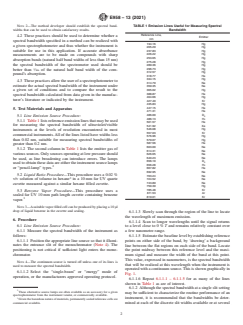
operatedwithacontinuumsource.Thisisshowngraphicallyin
6.1.1.2 Select the “single-beam” or “energy” mode of
Fig. 1.
operation, or the manufacturers approved operating protocol.
6.1.1.6 Repeat 6.1.1.1 – 6.1.1.5 for as many of the lines
shown in Table 1 as are of interest.
6.1.2 Although the spectral bandwidth at a single slit setting
These alternative source lamps are often available as an accessory for a given
may be sufficient to characterize the routine performance of an
spectrophotometer from the instrument vendor, or commercially available.
instrument, it is recommended that the bandwidths be deter-
Given the hazardous nature of materials, permanently sealed reference cells are
commercial available. mined at each of the discrete slit widths available or at several
E958 − 13 (2021)
FIG. 1 Resolution Calculation
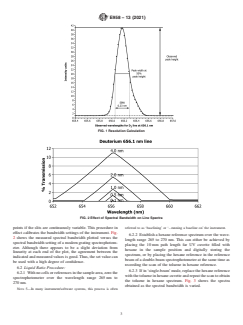
FIG. 2 Effect of Spectral Bandwidth on Line Spectra
referred to as ‘baselining’ or ‘.running a baseline on’ the instrument.
points if the slits are continuously variable. This procedure in
effect calibrates the bandwidth settings of the instrument. Fig.
6.2.2 Establish a hexane reference spectrum over the wave-
2 shows the measured spectral bandwidth plotted versus the
length range 265 to 270 nm. This can either be achieved by
spectral bandwidth setting of a modern grating spectrophotom-
placing the 10 mm path length far UV cuvette filled with
eter. Although there appears to be a slight deviation from
hexane in the sample position and digitally storing the
linearity at each end of the plot, the agreement between the
spectrum, or by placing the hexane reference in the reference
indicated and measured values is good. Thus, the set value can
beam of a double-beam spectrophotometer at the same time as
be used with a high degree of confidence.
recording the scan of the toluene in hexane reference.
6.2 Liquid Ratio Procedure:
6.2.3 If in ‘single-beam’mode, replace the hexane reference
6.2.1 Withnocellsorreferencesinthesamplearea,zerothe
with the toluene in hexane cuvette and repeat the scan to obtain
spectrophotometer over the wavelength range 265 nm to
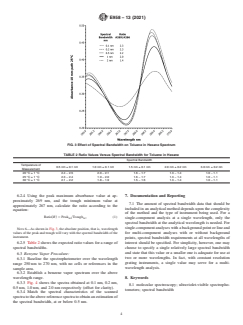
the toluene in hexane spectrum. Fig. 3 shows the spectra
270 nm.
obtained as the spectral bandwidth is varied.
NOTE 5—In many instrument/software systems, this process is often
E958 − 13 (2021)
FIG. 3 Effect of Spectral Bandwidth on Toluene in Hexane Spectrum
TABLE 2 Ratio Values Versus Spectral Bandwidth for Toluene in Hexane
Spectral Bandwidth
Temperature of
0.5nm±0.1nm 1.0nm±0.1nm 1.5nm±0.1nm 2.0nm±0.2nm 3.0nm±0.2nm
Measurement
20°C±1°C 2.4–2.5 2.0–2.1 1.6–1.7 1.3–1.4 1.0–1.1
25°C±1°C 2.3–2.4 1.9–2.0 1.6–1.7 1.3–1.4 1.0–1.1
30°C±1°C 2.1–2.2 1.8–1.9 1.5–1.6 1.3–1.4 1.0–1.1
6.2.4 Using the peak maximum absorbance value at ap- 7. Documentation and Reporting
proximately 269 nm, and the trough minimum value at
7.1 The amount of spectral bandwidth data that should be
approximately 267 nm, calculate the ratio according to the
included in an analytical method depends upon the complexity
equation:
of the method and the type of instrument being used. For a
Ratio R 5 Peak ⁄Trough (1)
~ !
269 267
single-component analysis at a single wavelength, only the
spectral bandwidth at the analytical wavelength is needed. For
single-component analyses with a background point or line and
NOTE 6—As shown in Fig. 3, the absolute position, that is, wavelength
values of the peak and trough will vary with the spectral bandwidth of the for multi-component analyses with or without background
instrument.
points, spectral bandwidth requirements at all wavelengths of
6.2.5 Table 2 shows the expected ratio values for a range of interest should be specified. For simplicity, however, one may
spectral bandwidths.
choose to specify a single relatively large spectral bandwidth
and state that this value or a smaller one is adequate for use at
6.3 Benzene Vapor Procedure:
two or more wavelengths. In fact, with constant resolution
6.3.1 Baseline the spectrophotometer over the wavelength
grating instruments, a single value may serve for a multi-
range 250 nm to 270 nm, with no cells or references in the
wavelength analysis.
sample area.
6.3.2 Establish a benzene vapor spectrum over the above
wavelength range. 8. Keywords
6.3.3 Fig. 4 shows the spectra obtained at 0.1 nm, 0.2 nm,
8.1 molecular spectroscopy; ultraviolet-visible spectropho-
0.5 nm, 1.0 nm, and 2.0 nm respectively (offset for clarity).
tometers; spectral bandwidth
6.3.4 Match the spectral characteristics of the scanned
spectratotheabovereferencespectratoobtainanestimationof
the spectral bandwidth, at or below 0.5 nm.
E958 − 13 (2021)
FIG. 4 Effect of Spectral Bandwidth on Benzene Spectrum
ANNEX
(Mandatory Information)
A1. ADDITIONAL INFORMATION
A1.1 General Concepts A1.2 Terminology
A1.1.1 This practice describes a procedure for measuring
A1.2.1 Definitions:
thepracticalspectralbandwidthofamanualspectrophotometer
A1.2.1.1 integration period, n—the time, in seconds, re-
in the wavelength region of 185 nm to 820 nm. Practical
quired for the pen or other indicator to move 98.6 % of its
spectral bandwidth is the spectral bandwidth of an instrument
maximum travel in response to a step function.
operated at a given integration period and a given signal-to-
A1.2.1.2 practical spectral bandwidth, n—designated by
noise ratio.
the symbol:
A1.1.2 This practice is applicable to instruments that utilize
π
∆λ
~ !
S/N
servo-operated slits and maintain a constant period and a
where:
constant signal-to-noise ratio as the wavelength is automati-
∆λ = spectral bandwidth,
cally scanned. It is also applicable to instruments that utilize
π = integration period, and
fixed slits and maintain a constant servo loop gain by auto-
S/N = signal-to-noise ratio measured at or near 100 % T.
maticallyvaryinggainordynodevoltage.Inthislattercase,the
signal-to-noiseratiovarieswithwavelength.Itcanalsobeused
A1.2.1.3 signal-to-noise ratio, n—the ratio of the signal, S,
on instruments that utilize some combination of the two
to the noise, N, as indicated by the readout indicator. The
designs, as well as on those that vary the period during the
recommended measure of noise is the maximum peak-to-peak
scan.
excursion of the indicator averaged over a series of five
A1.1.3 This practice does not cover the measurement of successive intervals, each of duration ten times the integration
limiting spectral bandwidth, defined as the minimum spectral period. (This measure of noise is about five times the root-
bandwidth achievable under optimum experimental conditions. mean-square noise.)
E958 − 13 (2021)
A1.3 Summary of Practices under a given set of conditions and to compare the result to the
spectral bandwidth calculated from data given in the manufac-
A1.3.1 Thepenperiodandsignal-to-noiseratioaresetatthe
turer’s literature or indicated by the instrument.
desired values when the instrument is operated with its normal
light source and adjusted to read close to 100 % T. The
A1.4.4 Instrument manufacturers can use this practice to
mechanical slit width, or the indicated spectral bandwidth,
measure and describe the practical spectral bandwidth of an
required to give the desired signal-to-noise ratio is recorded.
instrument over its entire wavelength operating range. This
The continuum source is replaced with a line emission source,
practiceishighlypreferredtothegeneralpracticeofstatingthe
such as a mercury lamp, and the apparent half-intensity
limiting or the theoretical spectral bandwidth at a single
bandwidth of an emission line occurring in the wavelength
wavelength.
region of interest is measured using the same slit width, or
indicated spectral bandwidth, as was used to establish the A1.5 Test Materials and Apparatus
signal-to-noise ratio with the continuum source.
A1.5.1 TableA1.1 lists reference emission lines that may be
usedformeasuringthespectralbandwidthofultraviolet/visible
A1.4 Significance and Use
instruments at the levels of resolution encountered in most
A1.4.1 This practice should be used by a person who
commercial instruments.All of the lines listed have widths less
develops an analytical method to ensure that the spectral
than 0.02 nm, suitable for measuring spectral bandwidths of
bandwidths cited in the practice are actually the ones used.
greater than 0.2 nm. The wavelengths of these lines in
NOTE A1.1—The method developer should establish the spectral
nanometres are listed in the first column. Values refer to
bandwidths that can be used to obtain satisfactory results.
measurements in standard air (760 nm, 15 °C) except for the
A1.4.2 This practice should be used to determine whether a
two lines below 200 nm. The wavelengths for these lines refer
spectral bandwidth specified in a method can be realized with
to a nitrogen atmosphere at 760 nm and 15 °C.
a given spectrophotometer and thus whether the instrument is
A1.5.1.1 The second column in Table A1.1 lists the emitter
suitable for use in this application.
gas of six sources. Only sources operating at low pressure
A1.4.3 This practice allows the user of a spectrophotometer should be used, as line broadening can introduce errors. The
to determine the actual spectral bandwidth of the instrument hydrogen, deuterium, and mercury lamps used to obtain these
TABLE A1.1 Emission Lines Useful for Measuring Spectral Bandwidth
Reference Line,
Emitter Intensity Nearest Neighbor, nm Separation, nm I /I Weak Neighbor, nm
Neighbor Reference
nm
184.91 Hg 8 194.17 9.26 0.13
194.17 Hg 8 184.91 9.26 0.13 197.33
205.29 Hg 4 202.70 2.59 0.08
226.22 Hg 5 237.83 11.61 0.06 226.03
253.65 Hg 10 . . . 253.48
275.28 Hg 5 280.35 5.07 0.08
289.36 Hg 6 296.73 7.37 0.42
296.73 Hg 8 302.15 5.42 0.04
318.77 He 5 294.51 24.26 0.06
334.15 Hg 7 313.18 20.97 0.70
341.79 Ne 5 344.77 2.98 0.20
359.35 Ne 5 352.05 7.30 0.14 360.02
388.87 He 7 447.15 58.28 0.04
404.66 Hg 8 407.78 3.12 0.04
427.40 Kr 5 431.96 4.56
...