


ASTM D7006-23
(Practice)Standard Practice for Ultrasonic Testing of Geomembranes
Standard Practice for Ultrasonic Testing of Geomembranes
SIGNIFICANCE AND USE
5.1 This practice covers test arrangements, measurement techniques, sampling methods, and calculations to be used for nondestructive evaluation of geomembranes using ultrasonic testing.
5.2 Wave velocity may be established for particular geomembranes (for specific polymer type, specific formulation, specific density). Relationships may be established between velocity and both density and tensile properties of geomembranes. An example of the use of ultrasound for determining density of polyethylene is presented in Test Method D4883. Velocity measurements may be used to determine thickness of geomembranes (1, 2).4 Travel time and amplitude of transmitted waves may be used to assess the condition of geomembranes and to identify defects in geomembranes including surface defects (for example, scratches, cuts), inner defects (for example, discontinuities within geomembranes), and defects that penetrate the entire thickness of geomembranes (for example, pinholes) (3, 4). Bonding between geomembrane sheets can be evaluated using travel time, velocity, or impedance measurements for seam assessment (5-10). Examples of the use of ultrasonic testing for determining the integrity of field and factory seams through travel time and velocity measurements (resulting in thickness measurements) are presented in Practices D4437 and D4545, respectively. An ultrasonic testing device is routinely used for evaluating seams in prefabricated bituminous geomembranes in the field (11). Integrity of geomembranes may be monitored in time using ultrasonic measurements.
Note 1: Differences may exist between ultrasonic measurements and measurements made using other methods due to differences in test conditions such as pressure applied and probe dimensions. An example is ultrasonic and mechanical thickness measurements.
5.3 The method is applicable to testing both in the laboratory and in the field for parent material and seams. The test durations are very short as wave transmission through ...
SCOPE
1.1 This practice provides a summary of equipment and procedures for ultrasonic testing of geomembranes using the pulse echo method.
1.2 Ultrasonic wave propagation in solid materials is correlated to physical and mechanical properties and condition of the materials. In ultrasonic testing, two wave propagation characteristics are commonly determined: velocity (based on wave travel time measurements) and attenuation (based on wave amplitude measurements). Velocity of wave propagation is used to determine thickness, density, and elastic properties of materials. Attenuation of waves in solid materials is used to determine microstructural properties of the materials. In addition, frequency characteristics of waves are analyzed to investigate the properties of a test material. Travel time, amplitude, and frequency distribution measurements are used to assess the condition of materials to identify damage and defects in solid materials. Ultrasonic measurements are used to determine the nature of materials/media in contact with a test specimen as well. Measurements are conducted in the time-domain (time versus amplitude) or frequency-domain (frequency versus amplitude).
1.3 Measurements of one or more ultrasonic wave transmission characteristics are made based on the requirements of the specific testing program.
1.4 The values stated in SI units are to be regarded as standard. No other units of measurement are included in this standard.
1.5 This standard does not purport to address all of the safety concerns, if any, associated with its use. It is the responsibility of the user of this standard to establish appropriate safety, health, and environmental practices and determine the applicability of regulatory limitations prior to use.
1.6 This international standard was developed in accordance with internationally recognized principles on standardization established in the Decision on Principles for the Development ...
General Information
- Status
- Published
- Publication Date
- 31-Oct-2023
- Technical Committee
- D35 - Geosynthetics
- Drafting Committee
- D35.10 - Geomembranes
Relations
- Effective Date
- 01-Nov-2023
- Effective Date
- 01-Feb-2024
- Effective Date
- 01-Sep-2023
- Effective Date
- 01-Nov-2023
- Effective Date
- 01-Nov-2023
Overview
ASTM D7006-23: Standard Practice for Ultrasonic Testing of Geomembranes defines the practice and equipment for conducting nondestructive ultrasonic evaluation of geomembranes, which are low-permeability synthetic membranes used widely in containment, environmental, and civil engineering applications. This standard by ASTM International covers the use of the pulse-echo ultrasonic method to examine the physical and mechanical properties, integrity, and thickness of geomembranes both in laboratory and field settings. The practice offers a reliable, rapid, and efficient means for quality assurance and structural assessment of both geomembrane sheets and seams.
Key Topics
- Ultrasonic Testing Technique: Utilizes the pulse-echo method with a single transducer acting as both sender and receiver of mechanical (ultrasonic) waves.
- Test Arrangements: Specifies two test arrangements depending on access to the geomembrane's surfaces for optimal wave transmission and defect detection.
- Measurement Parameters: Measures ultrasonic wave velocity (related to thickness, density, and elastic properties) and attenuation (related to microstructural properties and potential damage).
- Defect Identification: Detects surface flaws (scratches, cuts), internal discontinuities, and pinholes, supporting both initial installation quality control and ongoing inspection.
- Seam Evaluation: Assesses bonding integrity of field and factory seams by measuring wave travel time, velocity, or impedance, supporting strict construction quality standards.
- Sampling and Calibration: Refers to ASTM D4354 for sample preparation and discusses calibration of instruments using materials with known properties.
- Data Analysis: Supports both time-domain and frequency-domain analysis for comprehensive evaluation.
Applications
ASTM D7006-23 is applicable across a range of sectors that rely on geomembranes for environmental protection, such as:
- Landfills and Containment Facilities: Verifies the integrity of liners and covers to prevent leakage of contaminants.
- Wastewater Treatment: Evaluates the condition of basins or lagoons lined with geomembranes to ensure water-tightness.
- Mining and Industrial Sites: Ensures the performance of process ponds and tailings dams where geomembranes act as critical barriers.
- Reservoirs and Canals: Provides quality assurance during installation and maintenance by rapid, nondestructive inspection of geomembrane sheets and seams.
- Construction Quality Control: Enables inspection of seams both in the factory and on-site, ensuring compliance with performance specifications.
Using ultrasonic techniques as described in ASTM D7006-23 provides significant practical value by offering:
- Nondestructive Testing (NDT): Maintains the integrity of the geomembrane while delivering critical assessment data.
- Rapid Results: Short test durations support efficient large-scale inspections.
- Defect Prevention and Maintenance: Early detection of flaws prevents costly environmental breaches and facilitates targeted maintenance.
- Compliance and Documentation: Meets regulatory and contractual requirements for quality control in geosynthetics installation.
Related Standards
ASTM D7006-23 references or aligns with several other ASTM standards and documents which provide further requirements and methods for geosynthetics and nondestructive evaluation:
- ASTM D4354: Practice for Sampling of Geosynthetics and Rolled Erosion Control Products for Testing
- ASTM D4437: Practice for Nondestructive Testing for Determining the Integrity of Seams Used in Joining Flexible Polymeric Sheet Geomembranes
- ASTM D4545: Practice for Determining the Integrity of Factory Seams Used in Joining Manufactured Flexible Sheet Geomembranes
- ASTM D4883: Test Method for Density of Polyethylene by the Ultrasound Technique
- ASTM E1316: Terminology for Nondestructive Examinations
Conclusion
ASTM D7006-23 provides a comprehensive, standardized approach for ultrasonic testing of geomembranes, supporting high standards of quality, safety, and environmental protection. By adopting this standard, stakeholders benefit from reliable nondestructive testing, efficient defect identification, and robust documentation for critical geosynthetic barrier systems.
Buy Documents
ASTM D7006-23 - Standard Practice for Ultrasonic Testing of Geomembranes
REDLINE ASTM D7006-23 - Standard Practice for Ultrasonic Testing of Geomembranes
Get Certified
Connect with accredited certification bodies for this standard

Control Union Certifications
Global certification for agriculture and sustainability.

Bureau Veritas Bangladesh
Bureau Veritas certification services in Bangladesh.

ECOCERT France
Leader in organic and sustainability certification worldwide.
Sponsored listings
Frequently Asked Questions
ASTM D7006-23 is a standard published by ASTM International. Its full title is "Standard Practice for Ultrasonic Testing of Geomembranes". This standard covers: SIGNIFICANCE AND USE 5.1 This practice covers test arrangements, measurement techniques, sampling methods, and calculations to be used for nondestructive evaluation of geomembranes using ultrasonic testing. 5.2 Wave velocity may be established for particular geomembranes (for specific polymer type, specific formulation, specific density). Relationships may be established between velocity and both density and tensile properties of geomembranes. An example of the use of ultrasound for determining density of polyethylene is presented in Test Method D4883. Velocity measurements may be used to determine thickness of geomembranes (1, 2).4 Travel time and amplitude of transmitted waves may be used to assess the condition of geomembranes and to identify defects in geomembranes including surface defects (for example, scratches, cuts), inner defects (for example, discontinuities within geomembranes), and defects that penetrate the entire thickness of geomembranes (for example, pinholes) (3, 4). Bonding between geomembrane sheets can be evaluated using travel time, velocity, or impedance measurements for seam assessment (5-10). Examples of the use of ultrasonic testing for determining the integrity of field and factory seams through travel time and velocity measurements (resulting in thickness measurements) are presented in Practices D4437 and D4545, respectively. An ultrasonic testing device is routinely used for evaluating seams in prefabricated bituminous geomembranes in the field (11). Integrity of geomembranes may be monitored in time using ultrasonic measurements. Note 1: Differences may exist between ultrasonic measurements and measurements made using other methods due to differences in test conditions such as pressure applied and probe dimensions. An example is ultrasonic and mechanical thickness measurements. 5.3 The method is applicable to testing both in the laboratory and in the field for parent material and seams. The test durations are very short as wave transmission through ... SCOPE 1.1 This practice provides a summary of equipment and procedures for ultrasonic testing of geomembranes using the pulse echo method. 1.2 Ultrasonic wave propagation in solid materials is correlated to physical and mechanical properties and condition of the materials. In ultrasonic testing, two wave propagation characteristics are commonly determined: velocity (based on wave travel time measurements) and attenuation (based on wave amplitude measurements). Velocity of wave propagation is used to determine thickness, density, and elastic properties of materials. Attenuation of waves in solid materials is used to determine microstructural properties of the materials. In addition, frequency characteristics of waves are analyzed to investigate the properties of a test material. Travel time, amplitude, and frequency distribution measurements are used to assess the condition of materials to identify damage and defects in solid materials. Ultrasonic measurements are used to determine the nature of materials/media in contact with a test specimen as well. Measurements are conducted in the time-domain (time versus amplitude) or frequency-domain (frequency versus amplitude). 1.3 Measurements of one or more ultrasonic wave transmission characteristics are made based on the requirements of the specific testing program. 1.4 The values stated in SI units are to be regarded as standard. No other units of measurement are included in this standard. 1.5 This standard does not purport to address all of the safety concerns, if any, associated with its use. It is the responsibility of the user of this standard to establish appropriate safety, health, and environmental practices and determine the applicability of regulatory limitations prior to use. 1.6 This international standard was developed in accordance with internationally recognized principles on standardization established in the Decision on Principles for the Development ...
SIGNIFICANCE AND USE 5.1 This practice covers test arrangements, measurement techniques, sampling methods, and calculations to be used for nondestructive evaluation of geomembranes using ultrasonic testing. 5.2 Wave velocity may be established for particular geomembranes (for specific polymer type, specific formulation, specific density). Relationships may be established between velocity and both density and tensile properties of geomembranes. An example of the use of ultrasound for determining density of polyethylene is presented in Test Method D4883. Velocity measurements may be used to determine thickness of geomembranes (1, 2).4 Travel time and amplitude of transmitted waves may be used to assess the condition of geomembranes and to identify defects in geomembranes including surface defects (for example, scratches, cuts), inner defects (for example, discontinuities within geomembranes), and defects that penetrate the entire thickness of geomembranes (for example, pinholes) (3, 4). Bonding between geomembrane sheets can be evaluated using travel time, velocity, or impedance measurements for seam assessment (5-10). Examples of the use of ultrasonic testing for determining the integrity of field and factory seams through travel time and velocity measurements (resulting in thickness measurements) are presented in Practices D4437 and D4545, respectively. An ultrasonic testing device is routinely used for evaluating seams in prefabricated bituminous geomembranes in the field (11). Integrity of geomembranes may be monitored in time using ultrasonic measurements. Note 1: Differences may exist between ultrasonic measurements and measurements made using other methods due to differences in test conditions such as pressure applied and probe dimensions. An example is ultrasonic and mechanical thickness measurements. 5.3 The method is applicable to testing both in the laboratory and in the field for parent material and seams. The test durations are very short as wave transmission through ... SCOPE 1.1 This practice provides a summary of equipment and procedures for ultrasonic testing of geomembranes using the pulse echo method. 1.2 Ultrasonic wave propagation in solid materials is correlated to physical and mechanical properties and condition of the materials. In ultrasonic testing, two wave propagation characteristics are commonly determined: velocity (based on wave travel time measurements) and attenuation (based on wave amplitude measurements). Velocity of wave propagation is used to determine thickness, density, and elastic properties of materials. Attenuation of waves in solid materials is used to determine microstructural properties of the materials. In addition, frequency characteristics of waves are analyzed to investigate the properties of a test material. Travel time, amplitude, and frequency distribution measurements are used to assess the condition of materials to identify damage and defects in solid materials. Ultrasonic measurements are used to determine the nature of materials/media in contact with a test specimen as well. Measurements are conducted in the time-domain (time versus amplitude) or frequency-domain (frequency versus amplitude). 1.3 Measurements of one or more ultrasonic wave transmission characteristics are made based on the requirements of the specific testing program. 1.4 The values stated in SI units are to be regarded as standard. No other units of measurement are included in this standard. 1.5 This standard does not purport to address all of the safety concerns, if any, associated with its use. It is the responsibility of the user of this standard to establish appropriate safety, health, and environmental practices and determine the applicability of regulatory limitations prior to use. 1.6 This international standard was developed in accordance with internationally recognized principles on standardization established in the Decision on Principles for the Development ...
ASTM D7006-23 is classified under the following ICS (International Classification for Standards) categories: 59.080.70 - Geotextiles. The ICS classification helps identify the subject area and facilitates finding related standards.
ASTM D7006-23 has the following relationships with other standards: It is inter standard links to ASTM D7006-22, ASTM E1316-24, ASTM E1316-23b, ASTM D7700-22, ASTM D4437/D4437M-16(2023). Understanding these relationships helps ensure you are using the most current and applicable version of the standard.
ASTM D7006-23 is available in PDF format for immediate download after purchase. The document can be added to your cart and obtained through the secure checkout process. Digital delivery ensures instant access to the complete standard document.
Standards Content (Sample)
This international standard was developed in accordance with internationally recognized principles on standardization established in the Decision on Principles for the
Development of International Standards, Guides and Recommendations issued by the World Trade Organization Technical Barriers to Trade (TBT) Committee.
Designation: D7006 − 23
Standard Practice for
Ultrasonic Testing of Geomembranes
This standard is issued under the fixed designation D7006; the number immediately following the designation indicates the year of
original adoption or, in the case of revision, the year of last revision. A number in parentheses indicates the year of last reapproval. A
superscript epsilon (´) indicates an editorial change since the last revision or reapproval.
1. Scope mendations issued by the World Trade Organization Technical
Barriers to Trade (TBT) Committee.
1.1 This practice provides a summary of equipment and
procedures for ultrasonic testing of geomembranes using the
2. Referenced Documents
pulse echo method.
1.2 Ultrasonic wave propagation in solid materials is corre- 2.1 ASTM Standards:
lated to physical and mechanical properties and condition of
D4354 Practice for Sampling of Geosynthetics and Rolled
the materials. In ultrasonic testing, two wave propagation
Erosion Control Products (RECPs) for Testing
characteristics are commonly determined: velocity (based on
D4437 Practice for Nondestructive Testing (NDT) for De-
wave travel time measurements) and attenuation (based on
termining the Integrity of Seams Used in Joining Flexible
wave amplitude measurements). Velocity of wave propagation
Polymeric Sheet Geomembranes
is used to determine thickness, density, and elastic properties of
D4545 Practice for Determining the Integrity of Factory
materials. Attenuation of waves in solid materials is used to
Seams Used in Joining Manufactured Flexible Sheet
determine microstructural properties of the materials. In
Geomembranes (Withdrawn 2008)
addition, frequency characteristics of waves are analyzed to
D4883 Test Method for Density of Polyethylene by the
investigate the properties of a test material. Travel time,
Ultrasound Technique
amplitude, and frequency distribution measurements are used
E1316 Terminology for Nondestructive Examinations
to assess the condition of materials to identify damage and
defects in solid materials. Ultrasonic measurements are used to
3. Terminology
determine the nature of materials/media in contact with a test
specimen as well. Measurements are conducted in the time-
3.1 Definitions:
domain (time versus amplitude) or frequency-domain (fre-
3.1.1 atmosphere for testing geomembranes, n—air main-
quency versus amplitude).
tained at a relative humidity of 50 to 70 % and a temperature
1.3 Measurements of one or more ultrasonic wave transmis-
of 21 6 1 °C.
sion characteristics are made based on the requirements of the
3.1.2 geomembrane, n—an essentially impermeable geosyn-
specific testing program.
thetic composed of one or more synthetic sheets.
1.4 The values stated in SI units are to be regarded as
3.1.3 For definitions of terms related to ultrasonic testing,
standard. No other units of measurement are included in this
refer to Terminology E1316.
standard.
1.5 This standard does not purport to address all of the
4. Summary of Practice
safety concerns, if any, associated with its use. It is the
responsibility of the user of this standard to establish appro-
4.1 Mechanical waves are introduced to a geomembrane
priate safety, health, and environmental practices and deter-
from a surface of the material using an ultrasonic transducer.
mine the applicability of regulatory limitations prior to use.
Transmission characteristics of the waves in the geomembrane
1.6 This international standard was developed in accor-
are determined. The measured characteristics are used to
dance with internationally recognized principles on standard-
evaluate certain properties and condition of geomembranes.
ization established in the Decision on Principles for the
Development of International Standards, Guides and Recom-
For referenced ASTM standards, visit the ASTM website, www.astm.org, or
This practice is under the jurisdiction of ASTM Committee D35 on Geosyn- contact ASTM Customer Service at service@astm.org. For Annual Book of ASTM
thetics and is the direct responsibility of Subcommittee D35.10 on Geomembranes. Standards volume information, refer to the standard’s Document Summary page on
Current edition approved Nov. 1, 2023. Published December 2023. Originally the ASTM website.
approved in 2003. Last previous edition approved in 2022 as D7006 – 22. DOI: The last approved version of this historical standard is referenced on
10.1520/D7006-23. www.astm.org.
Copyright © ASTM International, 100 Barr Harbor Drive, PO Box C700, West Conshohocken, PA 19428-2959. United States
D7006 − 23
5. Significance and Use respectively. An ultrasonic testing device is routinely used for
evaluating seams in prefabricated bituminous geomembranes
5.1 This practice covers test arrangements, measurement
in the field (11). Integrity of geomembranes may be monitored
techniques, sampling methods, and calculations to be used for
in time using ultrasonic measurements.
nondestructive evaluation of geomembranes using ultrasonic
NOTE 1—Differences may exist between ultrasonic measurements and
testing.
measurements made using other methods due to differences in test
5.2 Wave velocity may be established for particular conditions such as pressure applied and probe dimensions. An example is
ultrasonic and mechanical thickness measurements.
geomembranes (for specific polymer type, specific
formulation, specific density). Relationships may be estab-
5.3 The method is applicable to testing both in the labora-
lished between velocity and both density and tensile properties
tory and in the field for parent material and seams. The test
of geomembranes. An example of the use of ultrasound for
durations are very short as wave transmission through
determining density of polyethylene is presented in Test
geomembranes occurs within microseconds.
Method D4883. Velocity measurements may be used to deter-
mine thickness of geomembranes (1, 2). Travel time and
6. Apparatus
amplitude of transmitted waves may be used to assess the
6.1 The test equipment consists of a single transducer (both
condition of geomembranes and to identify defects in geomem-
transmitter and receiver); a pulse generator; a pulse receiver
branes including surface defects (for example, scratches, cuts),
(includes amplifier and filters for noise reduction); electronic
inner defects (for example, discontinuities within
circuits to measure and record waveforms, to measure wave
geomembranes), and defects that penetrate the entire thickness
travel time, to measure wave amplitudes, and to display
of geomembranes (for example, pinholes) (3, 4). Bonding
received signals; electronic circuitry to time and synchronize
between geomembrane sheets can be evaluated using travel
all instrument functions; and connecting cables. The test
time, velocity, or impedance measurements for seam assess-
apparatus is shown in Fig. 1.
ment (5-10). Examples of the use of ultrasonic testing for
determining the integrity of field and factory seams through
6.2 Piezoelectric transducers are effective for wave trans-
travel time and velocity measurements (resulting in thickness
mission. Compressional waves (P-waves, longitudinal waves)
measurements) are presented in Practices D4437 and D4545,
shall be used for ultrasonic testing of geomembranes. A spacer
shall be used to obtain good near surface resolution and to
eliminate near field effects for accurate measurement of ultra-
The boldface numbers in parentheses refer to the list of references at the end of
sonic wave propagation characteristics in geomembranes. A
this standard.
FIG. 1 Test Apparatus
D7006 − 23
plastic spacer has been found to be effective for geomem- 8.2 Test specimens shall be cut such that a distance greater
branes. The thickness of the spacer shall be at least twice the than ten times the thickness of the specimen shall be left
thickness of the test specimen. The thickness of the spacer shall between the transducer and the edges of the specimen in every
be less than five to ten times the thickness of the test direction.
geomembrane. For testing geomembranes with various
8.3 In field testing, measurements shall be taken at locations
thicknesses, use the material with the largest thickness for
that are at a distance greater than ten times the thickness of the
selection of the thickness of the spacer. The spacer shall be
specimen from the edges of the geomembrane sheet in any
sufficiently large to cover the active surface area of the
direction.
transducer to ensure that the waveform generated is fully
8.4 Seam inspection tests may be conducted at locations
transmitted to the test specimen through the spacer. The center
closer to the edge of geomembranes than specified in 8.3.
frequency of the transducer shall be between 1 and 20 MHz (a
Effectiveness of the near edge measurements shall be demon-
10 MHz transducer has been found to be effective). Focused
strated prior to their routine use to ensure that potential edge
transducers shall be used for textured geomembranes to ensure
reflections do not interfere with measurements through the
measurements are made over essentially a “point” on the test
thickness of geomembranes.
material. Other means may also be used if high-frequency
mechanical waves can be generated with these devices.
9. Calibration
6.3 Pulse generator shall generate pulses of electrical energy
9.1 The electronic equipment shall be calibrated to ensure
that activate the transducer. Pulsers that generate spike or
accurate determination of the transit time. Calibration bars or
square wave type voltage pulses have been found to be
blocks with known thicknesses and wave transmission veloci-
effective for testing geomembranes.
ties shall be used for calibration procedures.
6.4 The receiver shall amplify and filter the signal received
10. Conditioning
by the transducer after the waves have been transmitted
through a test specimen. 10.1 For baseline measurements (for example, measure-
ments used to establish baseline ultrasonic properties for a
6.5 Electronic circuitry shall be used to measure travel time
particular geomembrane), specimens shall be exposed to the
of waves in a test specimen. The circuitry shall allow for
standard atmosphere for testing geomembranes for a period
determination of travel times with a precision equal to or better
sufficient to reach moisture and temperature equilibrium.
than 0.1 μs. If attenuation and amplitude measurements are
Exposure for 24 h has been found to be effective for reaching
desired, instrumentation shall be used to record the waveforms
equilibrium.
received from a test material. The circuitry shall allow for
10.2 Tests can be conducted at conditions outside the range
determination of amplitudes with a precision equal to or better
for standard atmosphere conditions for various applications
than 1 mV. Electronic circuitry may also be used to display
such as field measurements. For these measurements, speci-
received signals. Analog to digital converters and computer-
mens shall be in moisture and temperature equilibrium with
ized signal acquisition and analysis setups have been found to
be effective for testing geomembranes. their surrounding environment. Correction factors shall be used
if comparisons are to be made between standard and nonstan-
6.6 Electronic circuitry shall be used to time and synchro-
dard testing conditions. Correction factors are determined by
nize all instrument functions to eliminate uncertainty in the
taking measurements at nonstandard conditions and normaliz-
determination of wave transit times.
ing these by the measurements conducted at standard condi-
6.7 The apparatus listed here has been found to be effective
tions. A minimum of 20 tests shall be conducted at standard
for testing geomembranes. Ultrasonic testing of materials is a
and nonstandard conditions per material thickness tested.
well-established field and other types of devices may also be
10.3 Surface Preparation—The surface of the test geomem-
used for testing geomembranes. Details for various test ar-
brane shall be free of excessive dust, particles, and any other
rangements and examples of devices produced by various
materials that may interfere with wave transmission. The
manufacturers are available in (12). Effectiveness of alternative
surface of geomembranes may be cleaned with a damp cloth to
devices shall be demonstrated prior to their routine use for
ensure a clean measurement surface prior to testing.
geomembranes.
11. Procedure
7. Materials
11.1 Ultrasonic measurements in geomembranes shall be
7.1 A coupling agent shall be used to ensure good contact
conducted using the pulse echo test method. In this method,
between the transducer and test specimen. Coupling agents
ultrasonic waves are sent and
...
This document is not an ASTM standard and is intended only to provide the user of an ASTM standard an indication of what changes have been made to the previous version. Because
it may not be technically possible to adequately depict all changes accurately, ASTM recommends that users consult prior editions as appropriate. In all cases only the current version
of the standard as published by ASTM is to be considered the official document.
Designation: D7006 − 22 D7006 − 23
Standard Practice for
Ultrasonic Testing of Geomembranes
This standard is issued under the fixed designation D7006; the number immediately following the designation indicates the year of
original adoption or, in the case of revision, the year of last revision. A number in parentheses indicates the year of last reapproval. A
superscript epsilon (´) indicates an editorial change since the last revision or reapproval.
1. Scope
1.1 This practice provides a summary of equipment and procedures for ultrasonic testing of geomembranes using the pulse echo
method.
1.2 Ultrasonic wave propagation in solid materials is correlated to physical and mechanical properties and condition of the
materials. In ultrasonic testing, two wave propagation characteristics are commonly determined: velocity (based on wave travel
time measurements) and attenuation (based on wave amplitude measurements). Velocity of wave propagation is used to determine
thickness, density, and elastic properties of materials. Attenuation of waves in solid materials is used to determine microstructural
properties of the materials. In addition, frequency characteristics of waves are analyzed to investigate the properties of a test
material. Travel time, amplitude, and frequency distribution measurements are used to assess the condition of materials to identify
damage and defects in solid materials. Ultrasonic measurements are used to determine the nature of materials/media in contact with
a test specimen as well. Measurements are conducted in the time-domain (time versus amplitude) or frequency-domain (frequency
versus amplitude).
1.3 Measurements of one or more ultrasonic wave transmission characteristics are made based on the requirements of the specific
testing program.
1.4 The values stated in SI units are to be regarded as standard. No other units of measurement are included in this standard.
1.5 This standard does not purport to address all of the safety concerns, if any, associated with its use. It is the responsibility
of the user of this standard to establish appropriate safety, health, and environmental practices and determine the applicability of
regulatory limitations prior to use.
1.6 This international standard was developed in accordance with internationally recognized principles on standardization
established in the Decision on Principles for the Development of International Standards, Guides and Recommendations issued
by the World Trade Organization Technical Barriers to Trade (TBT) Committee.
2. Referenced Documents
2.1 ASTM Standards:
D4354 Practice for Sampling of Geosynthetics and Rolled Erosion Control Products (RECPs) for Testing
D4437 Practice for Nondestructive Testing (NDT) for Determining the Integrity of Seams Used in Joining Flexible Polymeric
Sheet Geomembranes
This practice is under the jurisdiction of ASTM Committee D35 on Geosynthetics and is the direct responsibility of Subcommittee D35.10 on Geomembranes.
Current edition approved Dec. 1, 2022Nov. 1, 2023. Published January 2023December 2023. Originally approved in 2003. Last previous edition approved in 2022 as
D7006 – 03 (2022).D7006 – 22. DOI: 10.1520/D7006-22.10.1520/D7006-23.
For referenced ASTM standards, visit the ASTM website, www.astm.org, or contact ASTM Customer Service at service@astm.org. For Annual Book of ASTM Standards
volume information, refer to the standard’s Document Summary page on the ASTM website.
Copyright © ASTM International, 100 Barr Harbor Drive, PO Box C700, West Conshohocken, PA 19428-2959. United States
D7006 − 23
D4545 Practice for Determining the Integrity of Factory Seams Used in Joining Manufactured Flexible Sheet Geomembranes
(Withdrawn 2008)
D4883 Test Method for Density of Polyethylene by the Ultrasound Technique
E1316 Terminology for Nondestructive Examinations
3. Terminology
3.1 Definitions:
3.1.1 atmosphere for testing geomembranes, n—air maintained at a relative humidity of 50 to 70 % and a temperature of 21 6
1 °C.
3.1.2 geomembrane, n—an essentially impermeable geosynthetic composed of one or more synthetic sheets.
3.1.3 For definitions of terms related to ultrasonic testing, refer to Terminology E1316.
4. Summary of Practice
4.1 Mechanical waves are introduced to a geomembrane from a surface of the material using an ultrasonic transducer.
Transmission characteristics of the waves in the geomembrane are determined. The measured characteristics are used to evaluate
certain properties and condition of geomembranes.
5. Significance and Use
5.1 This practice covers test arrangements, measurement techniques, sampling methods, and calculations to be used for
nondestructive evaluation of geomembranes using ultrasonic testing.
5.2 Wave velocity may be established for particular geomembranes (for specific polymer type, specific formulation, specific
density). Relationships may be established between velocity and both density and tensile properties of geomembranes. An example
of the use of ultrasound for determining density of polyethylene is presented in Test Method D4883. Velocity measurements may
be used to determine thickness of geomembranes (1, 2). Travel time and amplitude of transmitted waves may be used to assess
the condition of geomembranes and to identify defects in geomembranes including surface defects (for example, scratches, cuts),
inner defects (for example, discontinuities within geomembranes), and defects that penetrate the entire thickness of geomembranes
(for example, pinholes) (3, 4). Bonding between geomembrane sheets can be evaluated using travel time, velocity, or impedance
measurements for seam assessment (5-10). Examples of the use of ultrasonic testing for determining the integrity of field and
factory seams through travel time and velocity measurements (resulting in thickness measurements) are presented in Practices
D4437 and D4545, respectively. An ultrasonic testing device is routinely used for evaluating seams in prefabricated bituminous
geomembranes in the field (11). Integrity of geomembranes may be monitored in time using ultrasonic measurements.
NOTE 1—Differences may exist between ultrasonic measurements and measurements made using other methods due to differences in test conditions such
as pressure applied and probe dimensions. An example is ultrasonic and mechanical thickness measurements.
5.3 The method is applicable to testing both in the laboratory and in the field for parent material and seams. The test durations
are very short as wave transmission through geomembranes occurs within microseconds.
6. Apparatus
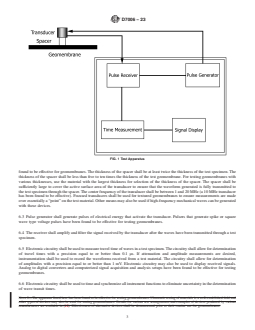
6.1 The test equipment consists of a single transducer (both transmitter and receiver); a pulse generator; a pulse receiver (includes
amplifier and filters for noise reduction); electronic circuits to measure and record waveforms, to measure wave travel time, to
measure wave amplitudes, and to display received signals; electronic circuitry to time and synchronize all instrument functions;
and connecting cables. The test apparatus is shown in Fig. 1.
6.2 Piezoelectric transducers are effective for wave transmission. Compressional waves (P-waves, longitudinal waves) shall be
used for ultrasonic testing of geomembranes. A spacer shall be used to obtain good near surface resolution and to eliminate near
field effects for accurate measurement of ultrasonic wave propagation characteristics in geomembranes. A plastic spacer has been
The last approved version of this historical standard is referenced on www.astm.org.
The boldface numbers in parentheses refer to the list of references at the end of this standard.
D7006 − 23
FIG. 1 Test Apparatus
found to be effective for geomembranes. The thickness of the spacer shall be at least twice the thickness of the test specimen. The
thickness of the spacer shall be less than five to ten times the thickness of the test geomembrane. For testing geomembranes with
various thicknesses, use the material with the largest thickness for selection of the thickness of the spacer. The spacer shall be
sufficiently large to cover the active surface area of the transducer to ensure that the waveform generated is fully transmitted to
the test specimen through the spacer. The center frequency of the transducer shall be between 1 and 20 MHz (a 10 MHz transducer
has been found to be effective). Focused transducers shall be used for textured geomembranes to ensure measurements are made
over essentially a “point” on the test material. Other means may also be used if high-frequency mechanical waves can be generated
with these devices.
6.3 Pulse generator shall generate pulses of electrical energy that activate the transducer. Pulsers that generate spike or square
wave type voltage pulses have been found to be effective for testing geomembranes.
6.4 The receiver shall amplify and filter the signal received by the transducer after the waves have been transmitted through a test
specimen.
6.5 Electronic circuitry shall be used to measure travel time of waves in a test specimen. The circuitry shall allow for determination
of travel times with a precision equal to or better than 0.1 μs. If attenuation and amplitude measurements are desired,
instrumentation shall be used to record the waveforms received from a test material. The circuitry shall allow for determination
of amplitudes with a precision equal to or better than 1 mV. Electronic circuitry may also be used to display received signals.
Analog to digital converters and computerized signal acquisition and analysis setups have been found to be effective for testing
geomembranes.
6.6 Electronic circuitry shall be used to time and synchronize all instrument functions to eliminate uncertainty in the determination
of wave transit times.
NOTE 2—The apparatus listed here has been found to be effective for testing geomembranes. Ultrasonic testing of materials is a well-established field and
other types of devices may also be used for testing geomembranes. Details for various test arrangements and examples of devices produced by various
manufacturers are available in (12). Effectiveness of alternative devices shall be demonstrated prior to their routine use for geomembranes.
D7006 − 23
6.7 The apparatus listed here has been found to be effective for testing geomembranes. Ultrasonic testing of materials is a
well-established field and other types of devices may also be used for testing geomembranes. Details for various test arrangements
and examples of devices produced by various manufacturers are available in (12). Effectiveness of alternative devices shall be
demonstrated prior to their routine use for geomembranes.
7. Materials
7.1 A coupling agent shall be used to ensure good contact between the transducer and test specimen. Coupling agents include
water, commercial ultrasonic couplants, oil, petroleum jelly, grease, glycerin, propylene glycol, or other viscous fluids. Water has
been used effectively on flat surfaces. More viscous materials may be used on inclined surfaces.
8. Sampling and Test Specimens
8.1 Use Practice D4354 for sampling geomembranes.
8.2 Test specimens shall be cut such that a distance greater than ten times the thickness of the specimen shall be left between the
transducer and the edges of the specimen in every direction.
8.3 In field testing, measurements shall be taken at locations that are at a distance greater than ten times the thickness of the
specimen from the edges of the geomembrane sheet in any direction.
NOTE 3—Seam inspection tests may be conducted at locations closer to the edge of geomembranes than specified in 8.3. Effectiveness of the near edge
measurements shall be demonstrated prior to their routine use to ensure that potential edge reflections do not interfere with measurements through the
thickness of geomembranes.
8.4 Seam inspection tests may be conducted at locations closer to the edge of geomembranes than specified in 8.3. Effectiveness
of the near edge measurements shall be demonstrated prior to their routine use to ensure that potential edge reflections do not
interfere with measurements through the thickness of geomembranes.
9. Calibration
9.1 The electronic equipment shall be calibrated to ensure accurate determination of the transit time. Calibration bars or blocks
with known thicknesses and wave transmission velocities shall be used for calibration procedures.
10. Conditioning
10.1 For baseline measurements (for example, measurements used to establish baseline ultrasonic properties for a particular
geomembrane), specimens shall be exposed to the standard atmosphere for testing geomembranes for a period sufficient to reach
moisture and temperature equilibrium. Exposure for 24 h has been found to be effective for reaching equilibrium.
10.2 Tests can be conducted at conditions outside the range for standard atmosphere conditions for various applications such as
field measurements. For these measurements, specimens shall be in moisture and temperature equilibrium with their surrounding
environment. Correction factors shall be used if comparisons are to be made
...
Questions, Comments and Discussion
Ask us and Technical Secretary will try to provide an answer. You can facilitate discussion about the standard in here.
Loading comments...