

ASTM D3454-21
(Test Method)Standard Test Method for Radium-226 in Water
General Information
- Abstract
SIGNIFICANCE AND USE
5.1 The most prevalent of the five radium isotopes in ground water, having a half life greater than one day, are 226Ra and 228Ra. These two isotopes also present the greatest health risk compared to the other naturally occurring nuclides of equal concentrations if ingested via the water pathway.
5.2 Although primarily utilized on a water medium, this technique may be applicable for the measurement of the 226Ra content of any medium once the medium has been completely decomposed and put into an aqueous solution.
5.3 This test method is based on a method previously published by Rushing, et al. (1).3 The general methodology and basis of the technique are similar to that of Ref (2).
SCOPE
1.1 This test method covers the measurement of soluble, suspended, and total 226Ra in water in concentrations above 3.7 × 10⁻³ Bq/L. This test method is not applicable to the measurement of other radium isotopes.
1.2 This test method may be used for quantitative measurements by calibrating with a 226Ra standard, or for relative measurements by comparing the measurements made with each other.
1.3 This test method does not meet the current requirements of Practice D2777.
1.4 The values stated in SI units are to be regarded as standard. The values given in parentheses are mathematical conversions to inch-pound units that are provided for information only and are not considered standard.
1.5 Hydrofluoric acid (HF) is very hazardous and should be used in a well-ventilated hood. Wear rubber gloves, safety glasses or goggles, and a laboratory coat. Avoid breathing any HF fumes. Clean up all spills promptly and wash thoroughly after using HF.
1.6 This standard does not purport to address all of the safety concerns, if any, associated with its use. It is the responsibility of the user of this standard to establish appropriate safety, health, and environmental practices and determine the applicability of regulatory limitations prior to use.
1.7 This international standard was developed in accordance with internationally recognized principles on standardization established in the Decision on Principles for the Development of International Standards, Guides and Recommendations issued by the World Trade Organization Technical Barriers to Trade (TBT) Committee.
- Status
- Published
- Publication Date
- 30-Apr-2021
- Technical Committee
- D19 - Water
- Drafting Committee
- D19.04 - Methods of Radiochemical Analysis
Overview
ASTM D3454-21, titled "Standard Test Method for Radium-226 in Water," specifies a reliable laboratory procedure for the measurement of soluble, suspended, and total radium-226 (^226Ra) in water samples. Developed by ASTM International, this standard addresses health and environmental risks associated with the ingestion of radium-226-one of the most significant naturally occurring radionuclides found in groundwater. The method is widely used for regulatory monitoring, public health studies, and environmental assessments where detecting and quantifying ^226Ra above 3.7 × 10^−3 Bq/L is required.
Key Topics
- Measurement Scope: The standard method is designed exclusively for ^226Ra and not applicable to other radium isotopes. It supports both quantitative (with calibration standards) and relative (comparative) measurements.
- Sample Types: Suitable for soluble, suspended, and total ^226Ra in various water types, including groundwater and potable water.
- Health & Safety: Stresses handling hazardous chemicals such as hydrofluoric acid (HF) with stringent laboratory safety protocols in a well-ventilated environment and with proper PPE.
- Technique Basis: Measurement is based on the emanation and scintillation counting of radon-222 (^222Rn), a radioactive decay product of ^226Ra, using specialized equipment.
- Interference: Rare interference from other gaseous alpha-emitting radionuclides like ^219Rn and ^220Rn, primarily in specific industrial effluents.
- International Alignment: Developed in accordance with World Trade Organization (WTO) standardization principles.
Applications
- Environmental Monitoring: Essential for groundwater surveys, well water safety certification, and tracking naturally occurring or anthropogenic radioactivity in surface and ground waters.
- Public Health: Used by water utilities, public health agencies, and regulators to test compliance with drinking water standards, emphasizing the risk of ^226Ra ingestion.
- Regulatory Compliance: Supports water quality management for compliance with national and international limits on radium concentrations.
- Research and Remediation: Facilitates environmental site assessments, contamination studies near uranium mining, and remediation verification.
- Adaptability: Although the primary focus is on water, the method may be applied to any medium decomposed into an aqueous solution.
Related Standards
- ASTM D1129: Terminology Relating to Water – foundational technical vocabulary.
- ASTM D1193: Specification for Reagent Water – critical for laboratory-grade water in sample prep and analysis.
- ASTM D3370: Practices for Sampling Water from Flowing Process Streams – procedures for proper sample collection.
- ASTM D3649: Practice for High-Resolution Gamma-Ray Spectrometry of Water – an alternative for radiochemical analysis.
- ASTM D5847: Practice for Writing Quality Control Specifications for Standard Test Methods for Water Analysis – guides QA procedures.
- ASTM D2777: Practice for Determination of Precision and Bias of Applicable Test Methods of Committee D19 on Water – referenced for method validation.
Practical Value
Implementing ASTM D3454-21 helps organizations:
- Ensure accurate detection of radium-226 at levels relevant to health and regulatory standards.
- Safeguard public health by monitoring drinking water supplies for radioactive contaminants.
- Comply with legal requirements for environmental monitoring and reporting.
- Maintain laboratory consistency through defined calibration, quality control, and standardization procedures.
Keywords: ASTM D3454-21, radium-226 testing, water radioactivity, ^226Ra measurement, environmental monitoring, drinking water standards, radiochemical analysis, laboratory water testing.
Relations
- Effective Date
- 01-May-2020
- Effective Date
- 01-May-2020
- Effective Date
- 01-Feb-2018
- Effective Date
- 01-Feb-2016
- Effective Date
- 15-Jan-2014
- Effective Date
- 15-Jan-2014
- Effective Date
- 15-Jun-2012
- Effective Date
- 01-Dec-2010
- Effective Date
- 01-Mar-2010
- Effective Date
- 01-Oct-2008
- Effective Date
- 15-Jan-2008
- Effective Date
- 01-Dec-2007
- Effective Date
- 15-Dec-2006
- Effective Date
- 01-Sep-2006
- Effective Date
- 01-Sep-2006
Get Certified
Connect with accredited certification bodies for this standard

CIS Institut d.o.o.
Personal Protective Equipment (PPE) certification body. Notified Body NB-2890 for EU Regulation 2016/425 PPE.

Kiwa BDA Testing
Building and construction product certification.
Kmetijski inštitut Slovenije
Agricultural Institute of Slovenia. Soil testing, plant health, agricultural product analysis.
Sponsored listings
Frequently Asked Questions
ASTM D3454-21 is a standard published by ASTM International. Its full title is "Standard Test Method for Radium-226 in Water". This standard covers: SIGNIFICANCE AND USE 5.1 The most prevalent of the five radium isotopes in ground water, having a half life greater than one day, are 226Ra and 228Ra. These two isotopes also present the greatest health risk compared to the other naturally occurring nuclides of equal concentrations if ingested via the water pathway. 5.2 Although primarily utilized on a water medium, this technique may be applicable for the measurement of the 226Ra content of any medium once the medium has been completely decomposed and put into an aqueous solution. 5.3 This test method is based on a method previously published by Rushing, et al. (1).3 The general methodology and basis of the technique are similar to that of Ref (2). SCOPE 1.1 This test method covers the measurement of soluble, suspended, and total 226Ra in water in concentrations above 3.7 × 10⁻³ Bq/L. This test method is not applicable to the measurement of other radium isotopes. 1.2 This test method may be used for quantitative measurements by calibrating with a 226Ra standard, or for relative measurements by comparing the measurements made with each other. 1.3 This test method does not meet the current requirements of Practice D2777. 1.4 The values stated in SI units are to be regarded as standard. The values given in parentheses are mathematical conversions to inch-pound units that are provided for information only and are not considered standard. 1.5 Hydrofluoric acid (HF) is very hazardous and should be used in a well-ventilated hood. Wear rubber gloves, safety glasses or goggles, and a laboratory coat. Avoid breathing any HF fumes. Clean up all spills promptly and wash thoroughly after using HF. 1.6 This standard does not purport to address all of the safety concerns, if any, associated with its use. It is the responsibility of the user of this standard to establish appropriate safety, health, and environmental practices and determine the applicability of regulatory limitations prior to use. 1.7 This international standard was developed in accordance with internationally recognized principles on standardization established in the Decision on Principles for the Development of International Standards, Guides and Recommendations issued by the World Trade Organization Technical Barriers to Trade (TBT) Committee.
SIGNIFICANCE AND USE 5.1 The most prevalent of the five radium isotopes in ground water, having a half life greater than one day, are 226Ra and 228Ra. These two isotopes also present the greatest health risk compared to the other naturally occurring nuclides of equal concentrations if ingested via the water pathway. 5.2 Although primarily utilized on a water medium, this technique may be applicable for the measurement of the 226Ra content of any medium once the medium has been completely decomposed and put into an aqueous solution. 5.3 This test method is based on a method previously published by Rushing, et al. (1).3 The general methodology and basis of the technique are similar to that of Ref (2). SCOPE 1.1 This test method covers the measurement of soluble, suspended, and total 226Ra in water in concentrations above 3.7 × 10⁻³ Bq/L. This test method is not applicable to the measurement of other radium isotopes. 1.2 This test method may be used for quantitative measurements by calibrating with a 226Ra standard, or for relative measurements by comparing the measurements made with each other. 1.3 This test method does not meet the current requirements of Practice D2777. 1.4 The values stated in SI units are to be regarded as standard. The values given in parentheses are mathematical conversions to inch-pound units that are provided for information only and are not considered standard. 1.5 Hydrofluoric acid (HF) is very hazardous and should be used in a well-ventilated hood. Wear rubber gloves, safety glasses or goggles, and a laboratory coat. Avoid breathing any HF fumes. Clean up all spills promptly and wash thoroughly after using HF. 1.6 This standard does not purport to address all of the safety concerns, if any, associated with its use. It is the responsibility of the user of this standard to establish appropriate safety, health, and environmental practices and determine the applicability of regulatory limitations prior to use. 1.7 This international standard was developed in accordance with internationally recognized principles on standardization established in the Decision on Principles for the Development of International Standards, Guides and Recommendations issued by the World Trade Organization Technical Barriers to Trade (TBT) Committee.
ASTM D3454-21 is classified under the following ICS (International Classification for Standards) categories: 13.060.50 - Examination of water for chemical substances. The ICS classification helps identify the subject area and facilitates finding related standards.
ASTM D3454-21 has the following relationships with other standards: It is inter standard links to ASTM D7902-20, ASTM D1129-13(2020)e2, ASTM D7902-18, ASTM D7902-16, ASTM D7902-14, ASTM D7902-14e1, ASTM D2777-12, ASTM D3370-10, ASTM D1129-10, ASTM D3370-08, ASTM D2777-08, ASTM D3370-07, ASTM D3649-06, ASTM D1129-06ae1, ASTM D1129-06a. Understanding these relationships helps ensure you are using the most current and applicable version of the standard.
ASTM D3454-21 is available in PDF format for immediate download after purchase. The document can be added to your cart and obtained through the secure checkout process. Digital delivery ensures instant access to the complete standard document.
Standards Content (Sample)
This international standard was developed in accordance with internationally recognized principles on standardization established in the Decision on Principles for the
Development of International Standards, Guides and Recommendations issued by the World Trade Organization Technical Barriers to Trade (TBT) Committee.
Designation: D3454 − 21
Standard Test Method for
Radium-226 in Water
This standard is issued under the fixed designation D3454; the number immediately following the designation indicates the year of
original adoption or, in the case of revision, the year of last revision.Anumber in parentheses indicates the year of last reapproval.A
superscript epsilon (´) indicates an editorial change since the last revision or reapproval.
1. Scope 2. Referenced Documents
1.1 This test method covers the measurement of soluble, 2.1 ASTM Standards:
suspended, and total Ra in water in concentrations above D1129Terminology Relating to Water
−3
3.7×10 Bq/L. This test method is not applicable to the D1193Specification for Reagent Water
measurement of other radium isotopes. D2777Practice for Determination of Precision and Bias of
Applicable Test Methods of Committee D19 on Water
1.2 This test method may be used for quantitative measure-
226 D3370Practices for Sampling Water from Flowing Process
ments by calibrating with a Ra standard, or for relative
Streams
measurements by comparing the measurements made with
D3649PracticeforHigh-ResolutionGamma-RaySpectrom-
each other.
etry of Water
1.3 Thistestmethoddoesnotmeetthecurrentrequirements
D5847Practice for Writing Quality Control Specifications
of Practice D2777.
for Standard Test Methods for Water Analysis
1.4 The values stated in SI units are to be regarded as D7902Terminology for Radiochemical Analyses
standard. The values given in parentheses are mathematical
3. Terminology
conversions to inch-pound units that are provided for informa-
tion only and are not considered standard. 3.1 Definitions:
3.1.1 For definitions of terms used in this standard, refer to
1.5 Hydrofluoric acid (HF) is very hazardous and should be
Terminologies D1129 and D7902.
used in a well-ventilated hood. Wear rubber gloves, safety
glasses or goggles, and a laboratory coat.Avoid breathing any
4. Summary of Test Method
HF fumes. Clean up all spills promptly and wash thoroughly
4.1 This test method is based on the emanation and scintil-
after using HF.
222 226
lation counting of Rn, a gaseous decay product of Ra,
1.6 This standard does not purport to address all of the
from a solution.
safety concerns, if any, associated with its use. It is the
4.2 Ra is collected from water by coprecipitation on a
responsibility of the user of this standard to establish appro-
relatively large amount of barium sulfate. The barium-radium
priate safety, health, and environmental practices and deter-
sulfateisdecomposedbyfumingwithphosphoricacid,andthe
mine the applicability of regulatory limitations prior to use.
resulting glassy melt is dissolved by evaporation with dilute
1.7 This international standard was developed in accor-
hydrochloric acid to form soluble barium-radium phosphates
dance with internationally recognized principles on standard-
and chlorides. These salts are dissolved, and the solution is
ization established in the Decision on Principles for the
stored for ingrowth of Rn.After a suitable ingrowth period,
Development of International Standards, Guides and Recom-
theradongasisremovedfromthesolutionbypurgingwithgas
mendations issued by the World Trade Organization Technical
and transferred to a scintillation counting chamber. About 4 h
Barriers to Trade (TBT) Committee.
after Rn collection, the scintillation chamber is counted for
alpha activity. The Ra concentration is calculated from the
This test method is under the jurisdiction ofASTM Committee D19 on Water
andisthedirectresponsibilityofSubcommitteeD19.04onMethodsofRadiochemi-
cal Analysis. For referenced ASTM standards, visit the ASTM website, www.astm.org, or
Current edition approved May 1, 2021. Published December 2021. Originally contact ASTM Customer Service at service@astm.org. For Annual Book of ASTM
approved in 1975. Last previous edition approved in 2018 as D3454–18. DOI: Standards volume information, refer to the standard’s Document Summary page on
10.1520/D3454-21. the ASTM website.
Copyright © ASTM International, 100 Barr Harbor Drive, PO Box C700, West Conshohocken, PA 19428-2959. United States
D3454 − 21
alpha count rate of Rn and its immediate progeny. The
radioactive decay characteristics of Ra and its immediate
decay progeny are listed in Table 1.
5. Significance and Use
5.1 Themostprevalentofthefiveradiumisotopesinground
water, having a half life greater than one day, are Ra and
Ra. These two isotopes also present the greatest health risk
compared to the other naturally occurring nuclides of equal
concentrations if ingested via the water pathway.
5.2 Although primarily utilized on a water medium, this
technique may be applicable for the measurement of the Ra
content of any medium once the medium has been completely
decomposed and put into an aqueous solution.
5.3 This test method is based on a method previously
publishedbyRushing,etal. (1). Thegeneralmethodologyand
basis of the technique are similar to that of Ref (2).
6. Interferences
6.1 Onlythegaseousalpha-emittingradionuclidesinterfere,
219 220
namely, Rn and Rn. Their half-lives are 3.98 s and 55.8
s, respectively; their presence indicates the presence of their
223 224
parents, Ra and Ra. These short-lived radon isotopes
decay before the Rn is counted; it is their alpha-emitting
decay products that would interfere. These interferences are
very rare in water samples but are frequently observed in
certain uranium mill effluents.
7. Apparatus
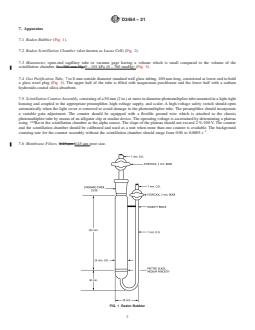
7.1 Radon Bubbler (Fig. 1).
FIG. 1 Radon Bubbler
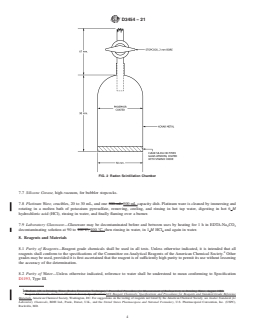
7.2 Radon Scintillation Chamber (also known as Lucas
Cell) (Fig. 2).
7.3 Manometer, open-end capillary tube or vacuum gage
tube is filled with magnesium perchlorate and the lower half
havingavolumewhichissmallcomparedtothevolumeofthe
with a sodium hydroxide-coated silica absorbent.
scintillation chamber, 0–101 kPa (0–760 mmHg) (Fig. 3).
7.5 Scintillation Counter Assembly, consisting of a 50 mm
7.4 Gas Purification Tube, 7 to 8-mm outside diameter
(2 in.) or more in diameter photomultiplier tube mounted in a
standard wall glass tubing, 100 mm long, constricted at lower
light-tighthousingandcoupledtotheappropriatepreamplifier,
end to hold a glass wool plug (Fig. 3). The upper half of the
high-voltage supply, and scaler. A high-voltage safety switch
should open automatically when the light cover is removed to
avoid damage to the photomultiplier tube. The preamplifier
3 should incorporate a variable gain adjustment. The counter
The boldface numbers in parentheses refer to a list of references at the end of
this standard. should be equipped with a flexible ground wire which is
attached to the chassis photomultiplier tube by means of an
TABLE 1 Radioactive Decay Characteristics of Ra alligator clip or similar device. The operating voltage is
and Its Progeny
ascertained by determining a plateau using Rn in the
scintillation chamber as the alpha source. The slope of the
NOTE1—MonographieBIPM-5–TableofRadionuclides,Comments
plateau should not exceed 2%⁄100 V. The counter and the
on Evaluations, Vols 1–8, Bureau International des Poids et Mesures,
2016,availablefromhttps://www.bipm.orgorhttp://www.lnhb.fr/nuclear-
scintillation chamber should be calibrated and used as a unit
data.
when more than one counter is available. The background
Radionuclide Half-Life Mode of Decay
counting rate for the counter assembly without the scintillation
–1
Ra 1600 years α
chamber should range from 0.00 to 0.0005 s .
Rn 3.8232 days α
Po 3.071 min α
7.6 Membrane Filters, 0.45 µm pore size.
Pb 26.916 min β, γ
7.7 Silicone Grease, high-vacuum, for bubbler stopcocks.
Bi 19.8 min β, γ
Po 162.3 µs α
210 7.8 Platinum Ware,crucibles,20to30mL,andone500mL
Pb 22.23 years β, γ
capacity dish. Platinum ware is cleaned by immersing and
D3454 − 21
FIG. 2 Radon Scintillation Chamber
rotating in a molten bath of potassium pyrosulfate, removing,
cooling, and rinsing in hot tap water, digesting in hot 6 M
hydrochloric acid (HCl), rinsing in water, and finally flaming
FIG. 3 De-Emanation Assembly
over a burner.
7.9 Laboratory Glassware—Glassware may be decontami-
8.2 Purity of Water—Unless otherwise indicated, reference
nated before and between uses by heating for1hinEDTA-
to water shall be understood to mean conforming to Specifi-
Na CO decontaminatingsolutionat90to100°C,thenrinsing
2 3
cation D1193, Type III.
in water, in 1 M HCl, and again in water.
8.3 Radioactive Purity of Reagents—Radioactive purity
shallbesuchthatthemeasuredresultsofblanksamplesdonot
8. Reagents and Materials
exceedthecalculatedprobableerrorofthemeasurementorare
8.1 Purity of Reagents—Reagent grade chemicals shall be
within the desired precision.
used in all tests. Unless otherwise indicated, it is intended that
8.4 Ammonium Sulfate Solution (100 g/L)—Dissolve 10 g
all reagents shall conform to the specifications of the Commit-
of ammonium sulfate ((NH ) SO ) in water and dilute to 100
teeonAnalyticalReagentsoftheAmericanChemicalSociety.
4 2 4
mL.
Other grades may be used, provided it is first ascertained that
the reagent is of sufficiently high purity to permit its use
8.5 Barium Chloride Carrier Solution Stock (17.8 g/L)—
without lessening the accuracy of the determination.
Dissolve 17.8 g of barium chloride (BaCl ·2H O) in water and
2 2
++
dilute to 1 L. This solution will contain 10 mg/mL Ba .
8.6 Barium-133 Tracer Solution—(approximately 3 kBq/
ACS Reagent Chemicals, Specifications and Procedures for Reagents and
mL).
Standard-Grade Reference Materials, American Chemical Society, Washington,
DC. For suggestions on the testing of reagents not listed by theAmerican Chemical
8.7 Barium Chloride Carrier Solution, Working—Add 100
Society, see Analar Standards for Laboratory Chemicals, BDH Ltd., Poole, Dorset,
mL of barium chloride carrier stock solution and 10 mL of
U.K., and the United States Pharmacopeia and National Formulary, U.S. Pharma-
copeial Convention, Inc. (USPC), Rockville, MD. Ba tracer solution to 890 mL of water and mix thoroughly.
D3454 − 21
++
This solution will contain approximately 1 g/Lof Ba .Allow 10. Calibration and Standardization
to stand for 24 h and filter through a membrane filter.
10.1 Close the inlet stopcock of a bubbler (Note 1), add 5
8.8 EDTA-Sodium Carbonate Decontaminating Solution— mLof BaCl ·2H O carrier solution, 1 mLof concentrated HCl
2 2
Dissolve 10 g of disodium ethylenediaminetetraacetate and 10 (sp gr 1.19), 3 mL (1.11 Bq) of standard radium solution and
2 3
g of sodium carbonate (Na CO ) in water and dilute to 1 L. fill the bubbler ⁄3 to ⁄4 full with water.
2 3
8.9 Flux—Toalargeplatinumdish(about500mLcapacity)
NOTE 1—Before using, test bubblers by placing about 10 mL of water
in them and passing air through them at the rate of 3 to 5 mL/min. This
add30mgofBaSO,65.8gofK CO,50.5gofNa CO ,and
4 2 3 2 3
should form many fine bubbles rather than a few large ones. Do not use
33.7gofNa B O ·10 H O. Mix well and heat cautiously until
2 4 7 2
bubblers requiring excessive pressure to initiate bubbling. Reject unsatis-
the water is expelled; fuse and mix thoroughly by swirling. 6
factory bubblers. Corning’s “medium-porosity” fritted glass disks are
Coolflux,grinditinaporcelainmortartopassaU.S.Standard
usually satisfactory.
No. 10 (2.00-mm) (or finer) sieve. Store in an airtight bottle.
10.2 Insert the outlet stopcock into the bubbler with the
(Flux can be prepared in smaller batches.)
stopcock open.Adjust the helium regulator (diaphragm) valve
8.10 Hydrochloric Acid (sp gr 1.19)—Concentrated HCl.
so that a very slow stream of gas will flow with the needle
valveopen.Attachtheheliumsupplytotheinletofbubblerand
8.11 Hydrochloric Acid Solution 6 M (1+1)—Mix 1 vol-
adjust the inlet pressure to produce a froth a few millimetres
ume of concentrated HCl (sp gr 1.19) with 1 volume of water.
thick.Establishazeroingrowthtimebypurgingtheliquidwith
8.12 Hydrochloric Acid Solution 1 M (11 + 1)—Mix 1
helium for 15 to 20 min.
volume of concentrated HCl (sp gr 1.19) with 11 volumes of
10.3 In rapid succession, close the inlet stopcock, remove
water.
the gas connection, and the close outlet stopcock. Record the
8.13 Hydrochloric Acid Solution 0.24 M (49 + 1)—Mix 1
dateandtimeandstorethebubblerpreferablyfor2to3weeks
volume of concentrated HCl (sp gr 1.19) with 49 volumes of 222
before collecting and counting the Rn.
water.
10.4 Attach a scintillation chamber as shown in Fig. 3;
8.14 Hydrochloric Acid Solution 0.1 M (119 + 1)—Mix 1
substitute a glass tube with a stopcock for the bubbler so that
volume of concentrated HCl (sp gr 1.19) with 119 volumes of
theheliumgascanbeturnedonandoffconveniently.Openthe
water.
stopcockonthescintillationchamber;closethestopcocktothe
8.15 Hydrofluoric Acid (sp gr 1.15)—Concentrated HF. Use gas and gradually open the stopcock to vacuum source to
evacuatethecell.Closethestopcocktothevacuumsourceand
extreme caution.
check the manometer reading for 2 min to test the system,
8.16 Hydrogen Peroxide 3 % (9 + 1)—Mix 1 volume of
especially the scintillation chamber for leaks. If leaks are
hydrogen peroxide (H O )(30%) with 9 volumes of water.
2 2
detected they should be identified and sealed.
8.17 Magnesium Perchlorate—Anhydrous magnesium per-
10.5 Open the stopcock to the helium gas and allow the gas
chlorate (Mg(ClO ) ).
4 2
to enter the chamber slowly until atmospheric pressure is
8.18 Phosphoric Acid (sp gr 1.69)—Concentrated phos-
reached. Close all the stopcocks.
phoric acid (H PO ).
3 4
10.6 Place the scintillation chamber on the photomultiplier
8.19 Radium Standard Solution (0.37 Bq/mL).
tube (in a light-tight housing), wait 10 min, and obtain a
background count rate (preferably over a period of at least 100
8.20 Sodium Hydroxide-Coated Silica Absorbent,
min). Phototube must not be exposed to external light with the
Proprietary, 8 to 20 mesh.
high voltage applied.
8.21 Sulfuric Acid (sp gr 1.84)—Concentrated sulfuric acid
10.7 Withthescintillationchamberandbubblerinpositions
(H SO ).
2 4
indicated in Fig. 3 and all stopcocks closed, open the stopcock
8.22 Sulfuric Acid Solution 0.05 M (359 + 1)—Mix 1
to vacuum and then to the scintillation chamber. Evacuate the
volume of concentrated H SO (sp gr 1.84) with 359 volumes
2 4
scintillation cell and the gas purification system. Close the
of water. This solution is 0.1 N. Slowly add acid to water.
stopcock to vacuum and check for leaks as in 10.4.
8.23 Helium, in a high-pressure cylinder with a two-stage
10.8 Adjust the helium regulator (diaphragm) valve so that
pressure regulator and needle valve.
averyslowstreamofgaswillflowwiththeneedlevalveopen.
Attach the helium supply to the inlet of the bubbler.
9. Sampling
10.9 Very cautiously open the bubbler outlet stopcock to
9.1 Collect the sample in accordance with the applicable
equalize pressure and transfer all or most of the fluid in the
standards as described in Practices D3370.
inlet side arm to the bubbler chamber.
10.10 Close the outlet stopcock and very cautiously open
the inlet stopcock to flush remaining fluid from the side arm
The sole source of supply of this material known to the committee at this time
and fritted disk. Close the inlet stopcock.
isAscariteII,producedbyArthurH.ThomasCo,Philadelphia,PA.Ifyouareaware
of alternative suppliers, please provide this information to ASTM International
Headquarters.Your comments will receive careful consideration at a meeting of the
1 6
responsible technical committee, which you may attend. A trademark by Corning Incorporated, Corning, NY.
D3454 − 21
10.11 Repeat steps 10.9 and 10.10 several times to obtain of concentrated HCl (sp gr 1.19) per litre of filtrate, heat, and
more nearly equal pressure on the two sides of the bubbler. add with vigorous stirring 50 mL of BaCl working carrier
solution.Forsamplevolumeslessthanalitre,diluteto1Lwith
10.12 With the outlet stopcock fully open, cautiously open
0.24 M HCl prior to the addition of carrier.
theinletstopcocksothattheflowofgasproducesafrothafew
11.1.2 Cautiously and with vigorous stirring, add 20 mL of
millimetres thick at the surface of bubbler solution. Maintain
H SO (sp gr 1.84). Cover the beaker and allow to stand
2 4
the flow rate by adjusting the pressure with the regulator valve
overnight.
andcontinuede-emanationuntilthepressureinthescintillation
11.1.3 Filter the supernate through a membrane filter, using
chamber reaches the atmospheric pressure. The total elapsed
0.05 M H SO to transfer the Ba-Ra precipitate to the filter.
time for de-emanation should be 15 to 20 min. 2 4
Wash the precipitate twice with 0.05 M H SO .
2 4
10.13 In rapid succession, close the stopcock to the scintil-
11.1.4 Place the filter in a platinum crucible, add 0.5 mLof
lationchamber,closethebubblerinletandtheoutletstopcocks,
concentrated HF (sp gr 1.15) and 3 drops (0.15 mL) of
shut off and disconnect the gas supply. Record the date and
(NH ) SO solution, and evaporate to dryness.
4 2 4
time, which is the end of ingrowth and the beginning of decay.
11.1.5 Carefully ignite the filter and residue over a small
10.14 Store the bubbler for another Rn ingrowth in the
flame until the carbon is burned off (after charring of filter, a
event a subsequent de-emanation is desired. The standard
Meker burner may be used).
bubbler containing the standard may be kept and reused
11.1.6 Cool, add 1 mLof concentrated H PO (sp gr 1.69),
3 4
indefinitely.
and heat on a hot plate to about 200 °C. Gradually raise
temperature to about 300 to 400 °C for 30 min.
10.15 At least four hours after de-emanation, place the
scintillation chamber on the photomultiplier tube, wait 10 min, 11.1.7 Swirl the crucible over a low Bunsen flame, adjusted
and count until desired statistical accuracy is achieved. Record toavoidspattering.Swirlsothatthecruciblewallsarecovered
with hot concentrated H PO (sp gr 1.69). Continue to heat
the date and time the counting was started and finished.
3 4
until the BaSO dissolves to give a clear melt (just below
10.16 Calculate the calibration factor E, for the scintillation
redness), and then heat for 1 min more to ensure removal of
chamber as follows:
SO .
R
N
11.1.8 Cool, fill the crucible one-half full with 6 M HCl,
E 5 (1)
2λt 2λt
1 2
A ·~1 2e !·e
R
heat on a steam bath, then gradually add the water to within 2
mm of the top of the crucible.
where:
−1
11.1.9 Evaporate on the steam bath until there are no more
R = net count rate, s (standard – background),
N
vapors of HCl.
A = activity of Ra in the bubbler (Bq),
R
t = ingrowth time of Rn (h), 11.1.10 Add 6 mLof 1 M HCl, swirl, and warm to dissolve
t = decay time of Rn occurring between de-emanation the BaCl crystals.
and the midpoint of counting (h), and 11.1.11 Close the inlet stopcock of a greased and tested
222 −1
λ = decay constant of Rn (0.00755 h ).
radon bubbler. Add a drop of water to the fritted disk and
NOTE 2—A slightly more accurate correction for decay during a long
transfer the sample from the platinum crucible to the bubbler
counting period is included in the following equation:
usingamedicinedropper.Rinsethecruciblewithatleastthree
2 3
2 mLportions of water.Add water until the bubbler is ⁄3 to ⁄4
R λt ⁄2
N 3
E 5 · (2)
2λt 2λt
1 2
A · 1 2e ·e sinh λt ⁄2 full.
~ ! ~ !
R 3
11.1.12 De-emanate the solution in accordance with 10.2
where:
and 10.3.
t = elapsed time (real time) between beginning and end of the count
11.1.13 After 3 weeks of Rn ingrowth, de-emanate and
(h).
count as described in 10.7 through 10.15.
10.17 Carryoutthebackgroundmeasurementspriortoeach
11.1.14 Transfer the solution in the bubbler to a gamma-
sample measurement. Perform calibrations with each scintilla-
countingcontainer.Washthebubblerthoroughlywith1 MHCl
tion chamber used, and repeat a
...
This document is not an ASTM standard and is intended only to provide the user of an ASTM standard an indication of what changes have been made to the previous version. Because
it may not be technically possible to adequately depict all changes accurately, ASTM recommends that users consult prior editions as appropriate. In all cases only the current version
of the standard as published by ASTM is to be considered the official document.
Designation: D3454 − 18 D3454 − 21
Standard Test Method for
Radium-226 in Water
This standard is issued under the fixed designation D3454; the number immediately following the designation indicates the year of
original adoption or, in the case of revision, the year of last revision. A number in parentheses indicates the year of last reapproval. A
superscript epsilon (´) indicates an editorial change since the last revision or reapproval.
1. Scope
226 −3
1.1 This test method covers the measurement of soluble, suspended, and total Ra in water in concentrations above 3.7 × 10
Bq/L. This test method is not applicable to the measurement of other radium isotopes.
1.2 This test method may be used for quantitative measurements by calibrating with a Ra standard, or for relative measurements
by comparing the measurements made with each other.
1.3 This test method does not meet the current requirements of Practice D2777.
1.4 The values stated in SI units are to be regarded as standard. The values given in parentheses are mathematical conversions to
inch-pound units that are provided for information only and are not considered standard.
1.5 Hydrofluoric acid (HF) is very hazardous and should be used in a well-ventilated hood. Wear rubber gloves, safety glasses or
goggles, and a laboratory coat. Avoid breathing any HF fumes. Clean up all spills promptly and wash thoroughly after using HF.
1.6 This standard does not purport to address all of the safety concerns, if any, associated with its use. It is the responsibility
of the user of this standard to establish appropriate safety, health, and environmental practices and determine the applicability of
regulatory limitations prior to use.
1.7 This international standard was developed in accordance with internationally recognized principles on standardization
established in the Decision on Principles for the Development of International Standards, Guides and Recommendations issued
by the World Trade Organization Technical Barriers to Trade (TBT) Committee.
2. Referenced Documents
2.1 ASTM Standards:
D1129 Terminology Relating to Water
D1193 Specification for Reagent Water
D2777 Practice for Determination of Precision and Bias of Applicable Test Methods of Committee D19 on Water
D3370 Practices for Sampling Water from Flowing Process Streams
D3649 Practice for High-Resolution Gamma-Ray Spectrometry of Water
D5847 Practice for Writing Quality Control Specifications for Standard Test Methods for Water Analysis
D7902 Terminology for Radiochemical Analyses
This test method is under the jurisdiction of ASTM Committee D19 on Water and is the direct responsibility of Subcommittee D19.04 on Methods of Radiochemical
Analysis.
Current edition approved Oct. 1, 2018May 1, 2021. Published November 2018December 2021. Originally approved in 1975. Last previous edition approved in 20112018
as D3454 – 11.D3454 – 18. DOI: 10.1520/D3454-18.10.1520/D3454-21.
For referenced ASTM standards, visit the ASTM website, www.astm.org, or contact ASTM Customer Service at service@astm.org. For Annual Book of ASTM Standards
volume information, refer to the standard’s Document Summary page on the ASTM website.
Copyright © ASTM International, 100 Barr Harbor Drive, PO Box C700, West Conshohocken, PA 19428-2959. United States
D3454 − 21
3. Terminology
3.1 Definitions:
3.1.1 For definitions of terms used in this standard, refer to Terminologies D1129 and D7902.
4. Summary of Test Method
222 226
4.1 This test method is based on the emanation and scintillation counting of Rn, a gaseous progenydecay product of Ra, from
a solution.
4.2 Ra is collected from water by coprecipitation on a relatively large amount of barium sulfate. The barium-radium sulfate is
decomposed by fuming with phosphoric acid, and the resulting glassy melt is dissolved by evaporation with dilute hydrochloric
acid to form soluble barium-radium phosphates and chlorides. These salts are dissolved, and the solution is stored for ingrowth
of Rn. After a suitable ingrowth period, the radon gas is removed from the solution by purging with gas and transferred to a
222 226
scintillation counting chamber. About 4 h after Rn collection, the scintillation chamber is counted for alpha activity. The Ra
concentration is calculated from the alpha count rate of Rn and its immediate progeny. The radioactive decay characteristics of
Ra and its immediate decay progeny are listed in Table 1.
5. Significance and Use
226 228
5.1 The most prevalent of the five radium isotopes in ground water, having a half life greater than one day, are Ra and Ra.
These two isotopes also present the greatest health risk compared to the other naturally occurring nuclides of equal concentrations
if ingested via the water pathway.
5.2 Although primarily utilized on a water medium, this technique may be applicable for the measurement of the Ra content
of any mediamedium once the medium has been completely decomposed and put into an aqueous solution.
5.3 This test method is based on a method previously published by Rushing, et al. (1). The general methodology and basis of
thisthe technique are similar to the methodology “Radium-226 in Drinking Water (Radon Emanation Technique)” as described in
the document EPA-600//4-80-032.that of Ref (2).
6. Interferences
219 220
6.1 Only the gaseous alpha-emitting radionuclides interfere, namely, Rn and Rn. Their half lives half-lives are 3.93.98 s and
223 224
54.555.8 s, respectively; their presence indicates the presence of their parents, Ra and Ra. These short-lived radon isotopes
decay before the Rn is counted; it is their alpha-emitting decay products that would interfere. These interferences are very rare
in water samples but are frequently observed in certain uranium mill effluents.
TABLE 1 Radioactive Decay Characteristics of Ra
and Its Progeny
NOTE 1—Monographie BIPM-5 – Table of Radionuclides, Comments
on Evaluations, Vols 1-8,1–8, Bureau International des Poids et Mesures,
2016, available from http://www.nucleide.org.https://www.bipm.org or
http://www.lnhb.fr/nuclear-data.
Radionuclide Half-Life Mode of Decay
Ra 1600 years α
Rn 3.8232 days α
Po 3.071 min α
Pb 26.916 min β, γ
Bi 19.8 min β, γ
Po 162.3 μs α
Pb 22.23 years β, γ
This test method is based on a previously published method by Rushing, D. E., Garcia, W. J., and Clark, D. A., “The Analysis of Effluents and Environmental Samples
from Uranium Mills and of Biological Samples for Radium, Polonium and Uranium,” Radiological Health and Safety in Mining and Milling of Nuclear Materials, Vol II,
IAEA, Vienna, Austria, 1964, p. 187.The boldface numbers in parentheses refer to a list of references at the end of this standard.
D3454 − 21
7. Apparatus
7.1 Radon Bubbler (Fig. 1).
7.2 Radon Scintillation Chamber (also known as Lucas Cell) (Fig. 2).
7.3 Manometer, open-end capillary tube or vacuum gage having a volume which is small compared to the volume of the
scintillation chamber, 0 − 760 mm Hg 0 – 101 kPa (0 – 760 mmHg) (Fig. 3).
7.4 Gas Purification Tube, 7 to 8-mm outside diameter standard wall glass tubing, 100 mm long, constricted at lower end to hold
a glass wool plug (Fig. 3). The upper half of the tube is filled with magnesium perchlorate and the lower half with a sodium
hydroxide-coated silica absorbent.
7.5 Scintillation Counter Assembly, consisting of a 50 mm (2 in.) or more in diameter photomultiplier tube mounted in a light-tight
housing and coupled to the appropriate preamplifier, high-voltage supply, and scaler. A high-voltage safety switch should open
automatically when the light cover is removed to avoid damage to the photomultiplier tube. The preamplifier should incorporate
a variable gain adjustment. The counter should be equipped with a flexible ground wire which is attached to the chassis
photomultiplier tube by means of an alligator clip or similar device. The operating voltage is ascertained by determining a plateau
using Rn in the scintillation chamber as the alpha source. The slope of the plateau should not exceed 2 % ⁄100 V. The counter
and the scintillation chamber should be calibrated and used as a unit when more than one counter is available. The background
–1
counting rate for the counter assembly without the scintillation chamber should range from 0.00 to 0.0005 s .
7.6 Membrane Filters, 0.45-μm 0.45 μm pore size.
FIG. 1 Radon Bubbler
D3454 − 21
FIG. 2 Radon Scintillation Chamber
7.7 Silicone Grease, high-vacuum, for bubbler stopcocks.
7.8 Platinum Ware, crucibles, 20 to 30 mL, and one 500-mL 500 mL capacity dish. Platinum ware is cleaned by immersing and
rotating in a molten bath of potassium pyrosulfate, removing, cooling, and rinsing in hot tap water, digesting in hot 6 M
hydrochloric acid (HCl), rinsing in water, and finally flaming over a burner.
7.9 Laboratory Glassware—Glassware may be decontaminated before and between uses by heating for 1 h in EDTA-Na CO
2 3
decontaminating solution at 90 to 100°C, 100 °C, then rinsing in water, in 1 M HCl, and again in water.
8. Reagents and Materials
8.1 Purity of Reagents—Reagent grade chemicals shall be used in all tests. Unless otherwise indicated, it is intended that all
reagents shall conform to the specifications of the Committee on Analytical Reagents of the American Chemical Society. Other
grades may be used, provided it is first ascertained that the reagent is of sufficiently high purity to permit its use without lessening
the accuracy of the determination.
8.2 Purity of Water—Unless otherwise indicated, reference to water shall be understood to mean conforming to Specification
D1193, Type III.
“Radium-226 in Drinking Water (Radon Emanation Technique),” Prescribed Procedures for Measurement of Radioactivity in Drinking Water, August 1980.
Reagent Chemicals, American Chemical Society Specifications,ACS Reagent Chemicals, Specifications and Procedures for Reagents and Standard-Grade Reference
Materials, American Chemical Society, Washington, DC. For suggestions on the testing of reagents not listed by the American Chemical Society, see Analar Standards for
Laboratory Chemicals, BDH Ltd., Poole, Dorset, U.K., and the United States Pharmacopeia and National Formulary, U.S. Pharmacopeial Convention, Inc. (USPC),
Rockville, MD.
D3454 − 21
FIG. 3 De-Emanation Assembly
8.3 Radioactive Purity of Reagents—Radioactive purity shall be such that the measured results of blank samples do not exceed
the calculated probable error of the measurement or are within the desired precision.
8.4 Ammonium Sulfate Solution (100 g/L)—Dissolve (100 g/L)—Dissolve 10 g of ammonium sulfate ((NH ) SO ) in water and
4 2 4
dilute to 100 mL.
8.5 Barium Chloride Carrier Solution Stock, (17.8 g/L)—Stock Dissolve (17.8 g/L)—Dissolve 17.8 g of barium chloride
+ +++
(BaCl ·2H O) in water and dilute to 1 L. This solution will contain 10 mg/mL Ba .
2 2
8.6 Barium-133 Tracer Solution—(approximately 3 kBq/mL).
8.7 Barium Chloride Carrier Solution, Working—Add 100 mL of barium chloride carrier stock solution and 10 mL of Ba tracer
+ +++
solution to 890 mL of water and mix thoroughly. This solution will contain approximately 1 g/L of Ba . Allow to stand for
24 h and filter through a membrane filter.
8.8 EDTA-Sodium Carbonate Decontaminating Solution—Dissolve 10 g of disodium ethylenediaminetetraacetate and 10 g of
sodium carbonate (Na CO ) in water and dilute to 1 L.
2 3
D3454 − 21
8.9 Flux—To a large platinum dish (about 500-mL 500 mL capacity) add 30 mg of BaSO , 65.8 g of K CO , 50.5 g of Na CO ,
4 2 3 2 3
and 33.7 g of Na B O ·10 H O. Mix well and heat cautiously until the water is expelled; fuse and mix thoroughly by swirling.
2 4 7 2
Cool flux, grind it in a porcelain mortar to pass a U.S. Standard No. 10 (2.00-mm) (or finer) sieve. Store in an airtight bottle. (Flux
can be prepared in smaller batches.)
8.10 Hydrochloric Acid (sp gr 1.19)—Concentrated (sp gr 1.19)—Concentrated HCl.
8.11 Hydrochloric Acid Solution 6M (1 + 1)—Mix6 M (1 + 1)—Mix 1 volume of concentrated HCl (sp gr 1.19) with 1 volume
of water.
8.12 Hydrochloric Acid Solution 1M (1 + 11)—Mix 1 M (11 + 1)—Mix 1 volume of concentrated HCl (sp gr 1.19) with 11
volumes of water.
8.13 Hydrochloric Acid Solution 0.24M (1 + 49)—Mix0.24 M (49 + 1)—Mix 1 volume of concentrated HCl (sp gr 1.19) with 49
volumes of water.
8.14 Hydrochloric Acid Solution 0.1M (1 + 119)—Mix0.1 M (119 + 1)—Mix 1 volume of concentrated HCl (sp gr 1.19) with 119
volumes of water.
8.15 Hydrofluoric Acid (sp gr 1.15)—Concentrated (sp gr 1.15)—Concentrated HF. Use extreme caution.
8.16 Hydrogen Peroxide 3 % (1 + 9)—Mix 3 % (9 + 1)—Mix 1 volume of hydrogen peroxide (H O ) (30 %) with 9 volumes of
2 2
water.
8.17 Magnesium Perchlorate—Anhydrous magnesium perchlorate (Mg(ClO ) ).
4 2
8.18 Phosphoric Acid (sp gr 1.69)—Concentrated (sp gr 1.69)—Concentrated phosphoric acid (H PO ).
3 4
8.19 Radium Standard Solution (0.37 Bq/mL).
6 5
8.20 Sodium Hydroxide-Coated Silica Absorbent, Proprietary, Sodium Hydroxide-Coated Silica Absorbent, Proprietary, 8 to 20
mesh.
8.21 Sulfuric Acid (sp gr 1.84)—Concentrated (sp gr 1.84)—Concentrated sulfuric acid (H SO ).
2 4
8.22 Sulfuric Acid Solution 0.05M (1 + 359)—Mix0.05 M (359 + 1)—Mix 1 volume of concentrated H SO (sp gr 1.84) with 359
2 4
volumes of water. This solution is 0.1 N. Slowly add acid to water.
8.23 Helium, in a high-pressure cylinder with a two-stage pressure regulator and needle valve.
9. Sampling
9.1 Collect the sample in accordance with the applicable standards as described in Practices D3370.
10. Calibration and Standardization
10.1 Close the inlet stopcock of a bubbler (Note 1), add 5 mL of BaCl ·2H O carrier solution, 1 mL of concentrated HCl (sp gr
2 2
2 3
1.19), 3 mL (1.11 Bq) of standard radium solution and fill the bubbler ⁄3 to ⁄4 full with water.
The sole source of supply of this material known to the committee at this time is Ascarite II, produced by Arthur H. Thomas Co, Philadelphia, PA. If you are aware of
alternative suppliers, please provide this information to ASTM International Headquarters. Your comments will receive careful consideration at a meeting of the responsible
technical committee, which you may attend.
D3454 − 21
NOTE 1—Before using, test bubblers by placing about 10 mL of water in them and passing air through them at the rate of 3 to 5 mL/min. This should
form many fine bubbles rather than a few large ones. Do not use bubblers requiring excessive pressure to initiate bubbling. Reject unsatisfactory bubblers.
Corning’s “medium-porosity” fritted glass disks are usually satisfactory.
10.2 Insert the outlet stopcock into the bubbler with the stopcock open. Adjust the helium regulator (diaphragm) valve so that a
very slow stream of gas will flow with the needle valve open. Attach the helium supply to the inlet of bubbler and adjust the inlet
pressure to produce a froth a few millimetres thick. Establish a zero ingrowth time by purging the liquid with helium for 15 to 20
min.
10.3 In rapid succession, close the inlet stopcock, remove the gas connection, and the close outlet stopcock. Record the date and
time and store the bubbler preferably for 2 to 3 weeks before collecting and counting the Rn.
10.4 Attach a scintillation chamber as shown in Fig. 3; substitute a glass tube with a stopcock for the bubbler so that the helium
gas can be turned on and off conveniently. Open the stopcock on the scintillation chamber; close the stopcock to the gas and
gradually open the stopcock to vacuum source to evacuate the cell. Close the stopcock to the vacuum source and check the
manometer reading for 2 min to test the system, especially the scintillation chamber for leaks. If leaks are detected they should
be identified and sealed.
10.5 Open the stopcock to the helium gas and allow the gas to enter the chamber slowly until atmospheric pressure is reached.
Close all the stopcocks.
10.6 Place the scintillation chamber on the photomultiplier tube (in a light-tight housing), wait 10 min, and obtain a background
count rate (preferably over a period of at least 100 min). Phototube must not be exposed to external light with the high voltage
applied.
10.7 With the scintillation chamber and bubbler in positions indicated in Fig. 3 and all stopcocks closed, open the stopcock to
vacuum and then to the scintillation chamber. Evacuate the scintillation cell and the gas purification system. Close the stopcock
to vacuum and check for leaks as in 10.4.
10.8 Adjust the helium regulator (diaphragm) valve so that a very slow stream of gas will flow with the needle valve open. Attach
the helium supply to the inlet of the bubbler.
10.9 Very cautiously open the bubbler outlet stopcock to equalize pressure and transfer all or most of the fluid in the inlet side
arm to the bubbler chamber.
10.10 Close the outlet stopcock and very cautiously open the inlet stopcock to flush remaining fluid from the side arm and fritted
disk. Close the inlet stopcock.
10.11 Repeat steps 10.9 and 10.10 several times to obtain more nearly equal pressure on the two sides of the bubbler.
10.12 With the outlet stopcock fully open, cautiously open the inlet stopcock so that the flow of gas produces a froth a few
millimetres thick at the surface of bubbler solution. Maintain the flow rate by adjusting the pressure with the regulator valve and
continue de-emanation until the pressure in the scintillation chamber reaches the atmospheric pressure. The total elapsed time for
de-emanation should be 15 to 20 min.
10.13 In rapid succession, close the stopcock to the scintillation chamber, close the bubbler inlet and the outlet stopcocks, shut
off and disconnect the gas supply. Record the date and time, which is the end of ingrowth and the beginning of decay.
10.14 Store the bubbler for another Rn ingrowth in the event a subsequent de-emanation is desired. The standard bubbler
containing the standard may be kept and reused indefinitely.
A trademark by Corning Incorporated, Corning, NY.
D3454 − 21
10.15 Four At least four hours after de-emanation, place the scintillation chamber on the photomultiplier tube, wait 10 min, and
count until desired statistical accuracy is achieved. Record the date and time the counting was started and finished.
10.16 Calculate the calibration factor E, for the scintillation chamber as follows:
R
n
E 5 (1)
2λt 2λt
1 2
A 3 12 e 3e
~ !
r
R
N
E 5 (1)
2λt 2λt
1 2
A · 12 e ·e
~ !
R
where:
−1
R = net count rate, s (standard – background),
n
−1
R = net count rate, s (standard – background),
N
A = activity of Ra in the bubbler (Bq),
r
A = activity of Ra in the bubbler (Bq),
R
t = ingrowth time of Rn (h),
t = decay time of Rn occurring between de-emanation and the midpoint of counting (h), and
222 −1
λ = decay constant of Rn (0.00755 h ).
NOTE 2—A slightly more accurate correction for decay during a long counting period is included in the following equation:
R λt ⁄2
N 3
E 5 · (2)
2λt 2λt
1 2
A · 12 e ·e sinh λt ⁄2
~ ! ~ !
R 3
where:
t = elapsed time (real time) between beginning and end of the count (h).
10.17 Carry out the background measurements prior to each sample measurement. Perform calibrations with each scintillation
chamber used, and repeat at least annually or when calibration verification shows an unacceptable change in efficiency.
10.18 To remove Rn and prepare the scintillation chamber for reuse, evacuate and cautiously refill with helium. Repeat this
evacuation and refilling twice. For chambers containing high activities of Rn, repeat the procedure more often.
11. Procedure
11.1 Soluble Ra:
11.1.1 Filter the sample through a membrane filter. Take a 1-L 1 L aliquot, or a smaller volume so as not to exceed 1.11 Bq of
Ra, and transfer to a 1500-mL 1500 mL beaker. Acidify with 20 mL of concentrated HCl (sp gr 1.19) per litre of filtrate, heat,
and add with vigorous stirring 50 mL of BaCl working carrier solution. For sample volumes less than a litre, dilute to 1 L with
0.24 M HCl prior to the addition of carrier.
11.1.2 Cautiously and with vigorous stirring, add 20 mL of H SO (sp gr 1.84). Cover the beaker and allow to stand overnight.
2 4
11.1.3 Filter the supernate through a membrane filter, using 0.05 M H SO to transfer the Ba-Ra precipitate to the filter. Wash
2 4
the precipitate twice with 0.05 M H SO .
2 4
11.1.4 Place the filter in a platinum crucible, add 0.5 mL of concentrated HF (sp gr 1.15) and 3 drops (0.15 mL) of (NH ) SO
4 2 4
solution, and evaporate to dryness.
11.1.5 Carefully ignite the filter and residue over a small flame until the carbon is burned off (after charring of filter, a Meker
burner may be used).
11.1.6 Cool, add 1 mL of concentrated H PO (sp gr 1.69), and heat on a hot plate to about 200°C. 200 °C. Gradually raise
3 4
temperature to about 300 to 400°C 400 °C for 30 min.
11.1.7 Swirl the crucible over a low Bunsen flame, adjusted to avoid spattering. Swirl so that the crucible walls are covered with
D3454 − 21
hot concentrated H PO (sp gr 1.69). Continue to heat until the BaSO dissolves to give a clear melt (just below redness), and then
3 4 4
heat for 1 min more to ensure removal of SO .
11.1.8 Cool, fill the crucible one-half full with 6 M HCl, heat on a steam bath, then gradually add the water to within 2 mm of
the top of the crucible.
11.1.9 Evaporate on the steam bath until there are no more vapors of HCl.
11.1.10 Add 6 mL of 1 M HCl, swirl, and warm to dissolve the BaCl crystals.
11.1.11 Close the inlet stopcock of a greased and tested radon bubbler. Add a drop of water to the fritted disk and transfer the
sample from the platinum crucible to the bubbler using a medicine dropper. Rinse the crucible with at least three 2-mL 2 mL
2 3
portions of water. Add water until the bubbler is ⁄3 to ⁄4 full.
11.1.12 De-emanate the solution in accordance with 10.2 and 10.3.
11.1.13 After 3 weeks of Rn ingrowth, de-emanate and count as described in 10.7 through 10.15.
11.1.14 Transfer the solution in the bubbler to a gamma-counting container. Wash the bubbler thoroughly with 1 M HCl and
combine with the sample in a container. Measure the Ba activity in a gamma-ray counter. For a discussion of gamma ray
133 133
counting refer to Practice D3649. Calculate the sample yield, RY,Y, by dividing the Ba activity of the sample by the Ba
activity of a 50-mL 50 mL aliquot of BaCl carrier working solution counted under identical conditions of volume and geometry
as the sample.
11.1.
...