

IEC 63522-35:2025
(Main)Electrical relays - Tests and measurements - Part 35: Resistance to cleaning solvents
General Information
- Abstract
IEC 63522-35:2025 is used for testing all kind of relays within the scope of technical committee 94 and evaluates their ability to perform under expected conditions of transportation, storage and all aspects of operational use.
This document defines a standard test method for resistance to cleaning solvents.
- Status
- Published
- Publication Date
- 26-Feb-2025
- Technical Committee
- TC 94 - Electrical relays
- Drafting Committee
- WG 3 - TC 94/WG 3
- Current Stage
- PPUB - Publication issued
- Start Date
- 27-Feb-2025
- Completion Date
- 14-Mar-2025
IEC 63522-35:2025 Overview
IEC 63522-35:2025 is an international standard developed by the International Electrotechnical Commission (IEC) that specifies the test methods for assessing the resistance of electrical relays to cleaning solvents. This standard applies to all types of relays within the scope of IEC technical committee 94 and ensures that relay markings remain legible and that the components maintain their integrity under typical conditions of transportation, storage, and operational cleaning processes.
The document provides a standardized test procedure to evaluate how various cleaning solvents affect ink markings on relays and verify that no damage occurs to the relay after solvent exposure. The main goal is to guarantee reliability and traceability in relay identification, critical for maintenance and operational safety in electrical systems.
Key Topics Covered
Scope and Application:
The standard encompasses all electrical relays under TC 94’s scope, focusing specifically on performance during mechanical handling and exposure to cleaning solvents encountered through transport and operational maintenance.Test Procedure:
- Tests apply primarily to ink markings on relay surfaces, as these are susceptible to solvent damage.
- Relays should be tested in an as-manufactured, uncleaned state to simulate real-world conditions.
- Tests include immersion in specific solvents such as demineralized water and petroleum-based solvents at controlled temperatures.
- Markings are assessed before and after exposure to ensure legibility is maintained.
- Visual inspections and optional electrical or mechanical measurements are conducted post-test.
Environmental Conditions:
- Testing must be conducted under controlled ambient conditions: approximately 23°C temperature, 25-75% relative humidity, and standard atmospheric pressure.
- Solvent temperatures vary by test method, typically maintained at around 55°C for water-based tests and ambient temperature for petroleum solvents.
Safety Precautions:
Handling cleaning solvents requires safety measures such as adequate ventilation, protection against skin and eye contact, and controlled storage to avoid fire hazards.
Practical Applications
IEC 63522-35:2025 is essential for manufacturers, testing laboratories, and quality assurance teams involved in:
Electrical Relay Manufacturing:
Ensuring the durability of relay markings and the structural integrity when relays are exposed to standard cleaning solvents during assembly or maintenance.Maintenance and Quality Control:
Verifying that relays maintain operational reliability and traceability after routine cleaning procedures in industries such as power distribution, automation, and electronics manufacturing.Logistics and Storage:
Assessing the impact of environmental exposure during transportation and storage to prevent degradation that could compromise relay identification or function.Regulatory Compliance:
Meeting international requirements for electrical components to withstand environmental and handling stress, including solvent resistance, thereby facilitating global market access.
Related Standards
IEC 63522-35:2025 is part of the IEC 63522 series for electrical relays and complements other test and measurement standards within this family, including:
- IEC 63522-0: General and guidance on electrical relay tests and measurements.
- IEC 63522-1: Visual inspection and dimensional checks of relays to ensure marking and physical specifications.
- IEC 63522-4: Dielectric strength test to verify electrical isolation performance.
- IEC 63522-7: Functional tests verifying relay operational reliability under various conditions.
- IEC 60068-2-45: Basic environmental testing procedures, specifically on immersion in cleaning solvents, providing foundational methods referenced in IEC 63522-35.
By aligning with these complementary standards, IEC 63522-35 supports a comprehensive quality assurance framework for electrical relays in diverse applications worldwide.
Keywords: IEC 63522-35, electrical relays, cleaning solvents resistance test, relay marking durability, relay testing standards, solvent resistance, electrical component testing, IEC relay standards, relay quality assurance, electrical relay cleaning procedures.
Get Certified
Connect with accredited certification bodies for this standard

IMQ S.p.A. (Certification)
Italian electrical product certification.

SLG Prüf- und Zertifizierungs GmbH
German testing and certification body.

UL Solutions
Global safety science company with testing, inspection and certification.
Sponsored listings
Frequently Asked Questions
IEC 63522-35:2025 is a standard published by the International Electrotechnical Commission (IEC). Its full title is "Electrical relays - Tests and measurements - Part 35: Resistance to cleaning solvents". This standard covers: IEC 63522-35:2025 is used for testing all kind of relays within the scope of technical committee 94 and evaluates their ability to perform under expected conditions of transportation, storage and all aspects of operational use. This document defines a standard test method for resistance to cleaning solvents.
IEC 63522-35:2025 is used for testing all kind of relays within the scope of technical committee 94 and evaluates their ability to perform under expected conditions of transportation, storage and all aspects of operational use. This document defines a standard test method for resistance to cleaning solvents.
IEC 63522-35:2025 is classified under the following ICS (International Classification for Standards) categories: 29.120.70 - Relays. The ICS classification helps identify the subject area and facilitates finding related standards.
IEC 63522-35:2025 is available in PDF format for immediate download after purchase. The document can be added to your cart and obtained through the secure checkout process. Digital delivery ensures instant access to the complete standard document.
Standards Content (Sample)
IEC 63522-35 ®
Edition 1.0 2025-02
INTERNATIONAL
STANDARD
NORME
INTERNATIONALE
Electrical relays – Tests and measurements –
Part 35: Resistance to cleaning solvents
Relais électriques – Essais et mesurages –
Partie 35: Résistance aux solvants de nettoyage
All rights reserved. Unless otherwise specified, no part of this publication may be reproduced or utilized in any form
or by any means, electronic or mechanical, including photocopying and microfilm, without permission in writing from
either IEC or IEC's member National Committee in the country of the requester. If you have any questions about IEC
copyright or have an enquiry about obtaining additional rights to this publication, please contact the address below or
your local IEC member National Committee for further information.
Droits de reproduction réservés. Sauf indication contraire, aucune partie de cette publication ne peut être reproduite ni
utilisée sous quelque forme que ce soit et par aucun procédé, électronique ou mécanique, y compris la photocopie et
les microfilms, sans l'accord écrit de l'IEC ou du Comité national de l'IEC du pays du demandeur. Si vous avez des
questions sur le copyright de l'IEC ou si vous désirez obtenir des droits supplémentaires sur cette publication, utilisez
les coordonnées ci-après ou contactez le Comité national de l'IEC de votre pays de résidence.
IEC Secretariat Tel.: +41 22 919 02 11
3, rue de Varembé info@iec.ch
CH-1211 Geneva 20 www.iec.ch
Switzerland
About the IEC
The International Electrotechnical Commission (IEC) is the leading global organization that prepares and publishes
International Standards for all electrical, electronic and related technologies.
About IEC publications
The technical content of IEC publications is kept under constant review by the IEC. Please make sure that you have the
latest edition, a corrigendum or an amendment might have been published.
IEC publications search - webstore.iec.ch/advsearchform IEC Products & Services Portal - products.iec.ch
The advanced search enables to find IEC publications by a Discover our powerful search engine and read freely all the
variety of criteria (reference number, text, technical publications previews, graphical symbols and the glossary.
committee, …). It also gives information on projects, replaced With a subscription you will always have access to up to date
and withdrawn publications. content tailored to your needs.
IEC Just Published - webstore.iec.ch/justpublished
Electropedia - www.electropedia.org
Stay up to date on all new IEC publications. Just Published
The world's leading online dictionary on electrotechnology,
details all new publications released. Available online and once
containing more than 22 500 terminological entries in English
a month by email.
and French, with equivalent terms in 25 additional languages.
Also known as the International Electrotechnical Vocabulary
IEC Customer Service Centre - webstore.iec.ch/csc
(IEV) online.
If you wish to give us your feedback on this publication or need
further assistance, please contact the Customer Service
Centre: sales@iec.ch.
A propos de l'IEC
La Commission Electrotechnique Internationale (IEC) est la première organisation mondiale qui élabore et publie des
Normes internationales pour tout ce qui a trait à l'électricité, à l'électronique et aux technologies apparentées.
A propos des publications IEC
Le contenu technique des publications IEC est constamment revu. Veuillez vous assurer que vous possédez l’édition la
plus récente, un corrigendum ou amendement peut avoir été publié.
Recherche de publications IEC - IEC Products & Services Portal - products.iec.ch
webstore.iec.ch/advsearchform Découvrez notre puissant moteur de recherche et consultez
La recherche avancée permet de trouver des publications IEC gratuitement tous les aperçus des publications, symboles
en utilisant différents critères (numéro de référence, texte, graphiques et le glossaire. Avec un abonnement, vous aurez
comité d’études, …). Elle donne aussi des informations sur les toujours accès à un contenu à jour adapté à vos besoins.
projets et les publications remplacées ou retirées.
Electropedia - www.electropedia.org
IEC Just Published - webstore.iec.ch/justpublished
Le premier dictionnaire d'électrotechnologie en ligne au monde,
Restez informé sur les nouvelles publications IEC. Just
avec plus de 22 500 articles terminologiques en anglais et en
Published détaille les nouvelles publications parues.
français, ainsi que les termes équivalents dans 25 langues
Disponible en ligne et une fois par mois par email.
additionnelles. Egalement appelé Vocabulaire
Electrotechnique International (IEV) en ligne.
Service Clients - webstore.iec.ch/csc
Si vous désirez nous donner des commentaires sur cette
publication ou si vous avez des questions contactez-nous:
sales@iec.ch.
IEC 63522-35 ®
Edition 1.0 2025-02
INTERNATIONAL
STANDARD
NORME
INTERNATIONALE
Electrical relays – Tests and measurements –
Part 35: Resistance to cleaning solvents
Relais électriques – Essais et mesurages –
Partie 35: Résistance aux solvants de nettoyage
INTERNATIONAL
ELECTROTECHNICAL
COMMISSION
COMMISSION
ELECTROTECHNIQUE
INTERNATIONALE
ICS 29.120.70 ISBN 978-2-8327-0232-1
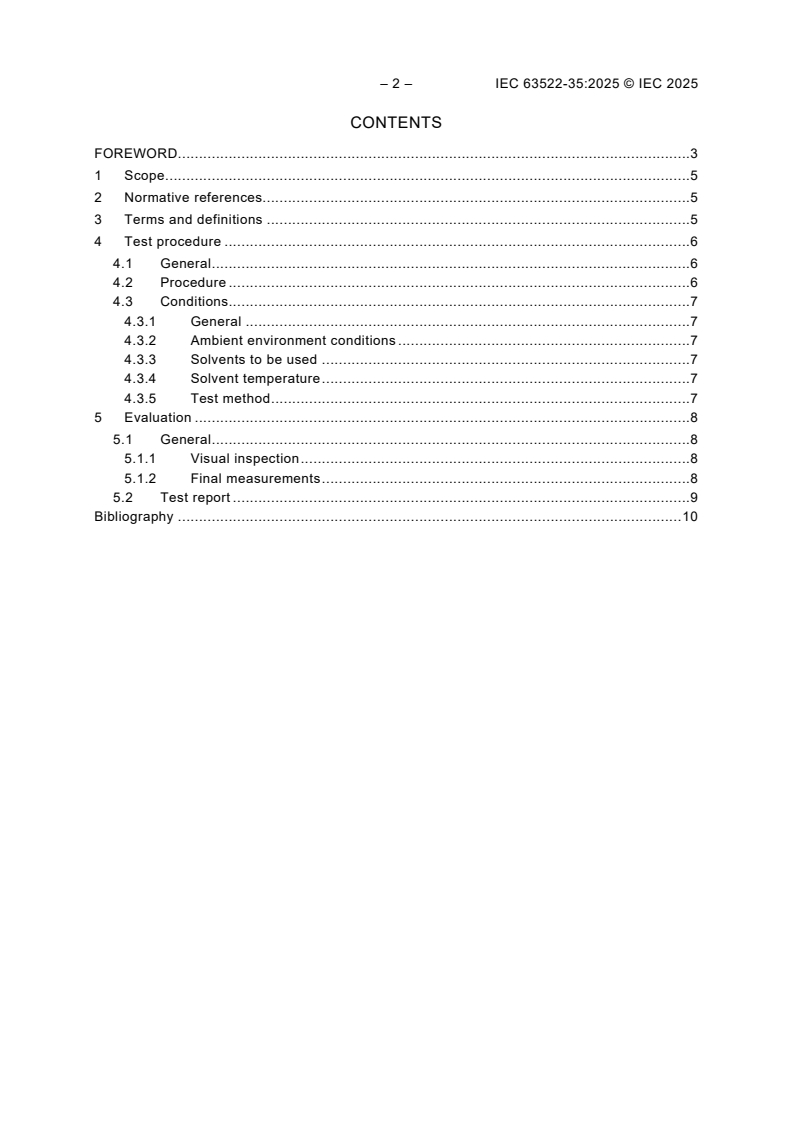
– 2 – IEC 63522-35:2025 © IEC 2025
CONTENTS
FOREWORD . 3
1 Scope . 5
2 Normative references. 5
3 Terms and definitions . 5
4 Test procedure . 6
4.1 General . 6
4.2 Procedure . 6
4.3 Conditions. 7
4.3.1 General . 7
4.3.2 Ambient environment conditions . 7
4.3.3 Solvents to be used . 7
4.3.4 Solvent temperature . 7
4.3.5 Test method . 7
5 Evaluation . 8
5.1 General . 8
5.1.1 Visual inspection . 8
5.1.2 Final measurements . 8
5.2 Test report . 9
Bibliography . 10
INTERNATIONAL ELECTROTECHNICAL COMMISSION
____________
ELECTRICAL RELAYS – TESTS AND MEASUREMENTS –
Part 35: Resistance to cleaning solvents
FOREWORD
1) The International Electrotechnical Commission (IEC) is a worldwide organization for standardization comprising
all national electrotechnical committees (IEC National Committees). The object of IEC is to promote international
co-operation on all questions concerning standardization in the electrical and electronic fields. To this end and
in addition to other activities, IEC publishes International Standards, Technical Specifications, Technical Reports,
Publicly Available Specifications (PAS) and Guides (hereafter referred to as “IEC Publication(s)”). Their
preparation is entrusted to technical committees; any IEC National Committee interested in the subject dealt with
may participate in this preparatory work. International, governmental and non-governmental organizations liaising
with the IEC also participate in this preparation. IEC collaborates closely with the International Organization for
Standardization (ISO) in accordance with conditions determined by agreement between the two organizations.
2) The formal decisions or agreements of IEC on technical matters express, as nearly as possible, an international
consensus of opinion on the relevant subjects since each technical committee has representation from all
interested IEC National Committees.
3) IEC Publications have the form of recommendations for international use and are accepted by IEC National
Committees in that sense. While all reasonable efforts are made to ensure that the technical content of IEC
Publications is accurate, IEC cannot be held responsible for the way in which they are used or for any
misinterpretation by any end user.
4) In order to promote international uniformity, IEC National Committees undertake to apply IEC Publications
transparently to the maximum extent possible in their national and regional publications. Any divergence between
any IEC Publication and the corresponding national or regional publication shall be clearly indicated in the latter.
5) IEC itself does not provide any attestation of conformity. Independent certification bodies provide conformity
assessment services and, in some areas, access to IEC marks of conformity. IEC is not responsible for any
services carried out by independent certification bodies.
6) All users should ensure that they have the latest edition of this publication.
7) No liability shall attach to IEC or its directors, employees, servants or agents including individual experts and
members of its technical committees and IEC National Committees for any personal injury, property damage or
other damage of any nature whatsoever, whether direct or indirect, or for costs (including legal fees) and
expenses arising out of the publication, use of, or reliance upon, this IEC Publication or any other IEC
Publications.
8) Attention is drawn to the Normative references cited in this publication. Use of the referenced publications is
indispensable for the correct application of this publication.
9) IEC draws attention to the possibility that the implementation of this document may involve the use of (a)
patent(s). IEC takes no position concerning the evidence, validity or applicability of any claimed patent rights in
respect thereof. As of the date of publication of this document, IEC had not received notice of (a) patent(s), which
may be required to implement this document. However, implementers are cautioned that this may not represent
the latest information, which may be obtained from the patent database available at https://patents.iec.ch. IEC
shall not be held responsible for identifying any or all such patent rights.
IEC 63522-35 has been prepared by IEC technical committee 94: Electrical relays. It is an
International Standard.
The text of this International Standard is based on the following documents:
Draft Report on voting
94/1087/FDIS 94/1135/RVD
Full information on the voting for its approval can be found in the report on voting indicated in
the above table.
The language used for the development of this International Standard is English.
– 4 – IEC 63522-35:2025 © IEC 2025
This document was drafted in accordance with ISO/IEC Directives, Part 2, and developed in
accordance with ISO/IEC Directives, Part 1 and ISO/IEC Directives, IEC Supplement, available
at www.iec.ch/members_experts/refdocs. The main document types developed by IEC are
described in greater detail at www.iec.ch/publications.
A list of all parts of IEC 63522 series, published under the general title Electrical relays can be
found on the IEC website.
The committee has decided that the contents of this document will remain unchanged until the
stability date indicated on the IEC website under webstore.iec.ch in the data related to the
specific document. At this date, the document will be
• reconfirmed,
• withdrawn, or
• revised.
ELECTRICAL RELAYS – TESTS AND MEASUREMENTS –
Part 35: Resistance to cleaning solvents
1 Scope
This document is used for testing all kind of relays within the scope of technical committee 94
and evaluates their ability to perform under expected conditions of transportation, storage and
all aspects of operational use.
This document defines a standard test method for resistance to cleaning solvents.
2 Normative references
The following documents are referred to in the text in such a way that some or all of their content
constitutes requirements of this document. For dated references, only the edition cited applies.
For undated references, the latest edition of the referenced document (including any
amendments) applies.
IEC 60068-2-45:1980, Basic environmental testing procedures – Part 2-45: Tests – Test XA
and guidance: Immersion in cleaning solvents
IEC 60068-2-45:1980/AMD1:1993
IEC 63522-0, Electrical relays – Tests and measurements – Part 0: General and guidance
IEC 63522-1, Electrical relays – Tests and measurements – Part 1: Visual inspection and check
of dimensions
IEC 63522-4, Electrical relays – Tests and measurements – Part 4: Dielectric strength test
IEC 63522-7, Electrical relays – Tests and measurements – Part 7: Functional tests
3 Terms and definitions
For the purposes of this document, the terms and definitions given in IEC 63522-0 and the
following apply.
ISO and IEC maintain terminology databases for use in standardization at the following
addresses:
• IEC Electropedia: available at https://www.electropedia.org/
• ISO Online browsing platform: available at https://www.iso.org/obp
___________
Under preparation. Stage at the time of publication: IEC CDV 63522-0:2024.
Under preparation. Stage at the time of publication: IEC FDIS 63522-1:2024.
Under preparation. Stage at the time of publication: IEC FDIS 63522-4:2024.
Under preparation. Stage at the time of publication: IEC FDIS 63522-7:2024.
– 6 – IEC 63522-35:2025 © IEC 2025
3.1
marking
identification of a relay which, when completely given to the manufacturer of this relay, allows
the unambiguous indication of its electrical, mechanical, dimensional and functional parameters
EXAMPLE Through the indication of the trademark and the type designation on the relay, all relay-specific data can
be derived from the type code.
3.2
ink marking
marking created by using ink, paint, or other pigment
3.3
laser marking
marking created by using a laser to ablate or melt the relay surface, to bond a contrasting
labelling material, or to activate a pigmented coating
3.4
moulded marking
marking created by using the process of moulding
3.5
legibility
ability of a character or symbol to be read or deciphered
4 Test procedure
4.1 General
The resistance to cleaning solvents test is to ensure that the marking legibility of relay can be
guaranteed after immersion in either cleaning solvents or subjection to manual handling, or
both, and that no damage, as visually inspected, has occurred.
When using solvents other than water (e.g. petroleum, mixture of organic hydrocarbons and
alcohols) for the test, at least the following safety precautions shall be observed because these
solvents exhibit some potential for health and safety hazards:
• Avoid contact with eyes and prolonged contact with skin;
• Provide adequate ventilation and avoid inhalation of vapours;
• Avoid exposure to open flame or hot surface;
• Solutions are to be kept in covered vessels when not in direct use.
4.2 Procedure
This test procedure applies only for ink marking.
NOTE This test has no influence on laser or moulding marked DUTs.
DUTs shall be representative of production in an as-shipped condition and shall not be
subjected to any cleaning or surface treatment process prior to test.
Before testing, the DUTs shall be subjected to the atmospheric conditions defined in 4.3.1 for
sufficient time to allow them to reach thermal equilibrium.
Before testing the DUTs shall be visually inspected according to IEC 63522-1, the relevant
specification can also require either the electrical or mechanical measurements, or both.
The DUTs shall then be subjected to the test procedure with the method selected from 4.3.4.
If either final electrical or mechanical measurements, or both, are required for evaluation, after
removal from the solvent the DUTs shall remain under the atmospheric conditions defined in
4.3.1 for not less than 1 h and not more than 2 h, or for a period as prescribed in the relevant
specification.
4.3 Conditions
4.3.1 General
The test shall be carried out under the conditions defined in 4.3.2 to 4.3.5. Deviations from
these conditions may be specified and are subject to the agreement of manufacturer and
customer, details of the deviation shall be documented in the test report.
4.3.2 Ambient environment conditions
The test shall be carried out under the following atmospheric conditions:
• Temperature: 23 °C ± 5 °C
• Relative humidity: 25 % to 75 %
• Air pressure: 86 kPa to 106 kPa
4.3.3 Solvents to be used
Demineralized or distilled water shall be used for test method A and B.
Demineralized or distilled water and petroleum shall be used for test method C.
The demineralized or distilled water shall have a resistivity of not less than 500 Ωm
corresponding to a conductivity of 2 mS/m.
NOTE The petroleum spirit used is defined as an aliphatic solvent hexane with a content of aromatics of maximum
0,1 volume %, a kauributanol-value of 29, initial boiling point approximately 65 °C, dry point approximately 69 °C and
specific gravity of 0,68 g/cm .
4.3.4 Solvent temperature
For test method A and B, the temperature of solvent is 55 °C ± 5 °C.
For test method C, the temperature of solvent(s) is same as the ambient environment.
When solvents other than those defined in 4.3.2 are used for test, the temperature of solvents
shall be prescribed by the manufacturer considering the recommended temperature for cleaning
specified by the solvent supplier.
4.3.5 Test method
4.3.5.1 Method A
The test shall be conducted in accordance with IEC 60068-2-45:1980, 5.1, the rubbing material
shall be specified by manufacturer. The solvent shall not be agitated during the test.
4.3.5.2 Method B
The test shall be conducted in accordance with IEC 60068-2-45:1980, 5.2. The solvent shall
not be agitated during the test.
– 8 – IEC 63522-35:2025 © IEC 2025
4.3.5.3 Method C
The test indicated below is applicable to ink marking only and shall be done by rubbing the
marking by hand as follows:
a) 15 back-and-forth movements in about 15 s with a piece of cloth soaked with distilled water,
followed by
b) 15 back-and-forth movements in about 15 s with a piece of cloth soaked with petroleum
spirit.
During the tests, the soaked piece of cloth shall be pressed on the marking area with a force
from 2 N to 5 N.
5 Evaluation
5.1 General
A final evaluation of the test shall be done as specified in 5.1.1 and 5.1.2.
5.1.1 Visual inspection
The visual inspection after test shall be carried out according to IEC 63522-1, any of the
following marking defects which render the marking illegible or unreadable shall be cause for
rejection (some of these defects cannot apply to all marking types).
• Bridging: e.g. a portion of the character is bridged by excess ink, yielding an unintended
character;
• Distorted marking: e.g. a character or symbol appears wavy, or undul
...