

IEC 63545:2026
(Main)Horticultural lighting - Luminaires for horticultural lighting - Safety
General Information
- Abstract
IEC 63545:2026 specifies safety requirements for horticultural luminaires, incorporating electric light sources for operation from supply voltage up to 1 000 V.
- Status
- Published
- Publication Date
- 22-Feb-2026
- Technical Committee
- TC 34 - Lighting
- Drafting Committee
- WG 19 - TC 34/WG 19
- Current Stage
- PPUB - Publication issued
- Start Date
- 23-Feb-2026
- Completion Date
- 20-Mar-2026
Buy Documents
IEC 63545:2026 - Horticultural lighting - Luminaires for horticultural lighting - Safety
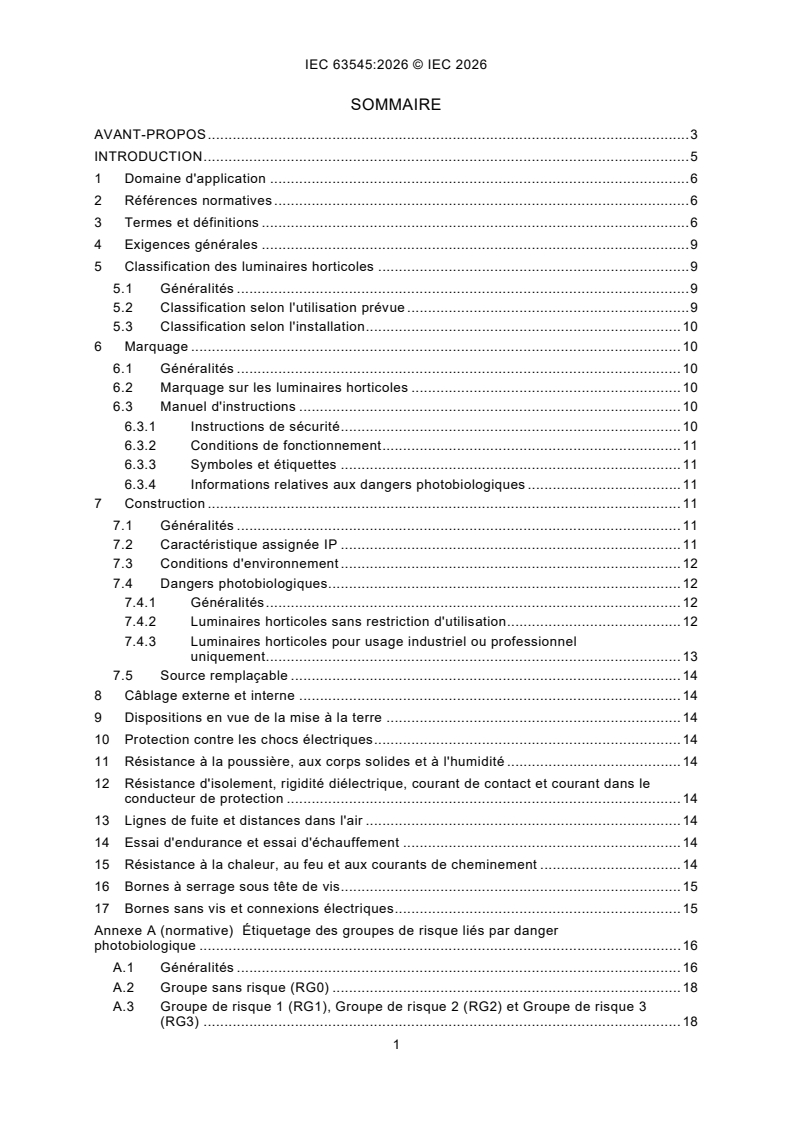
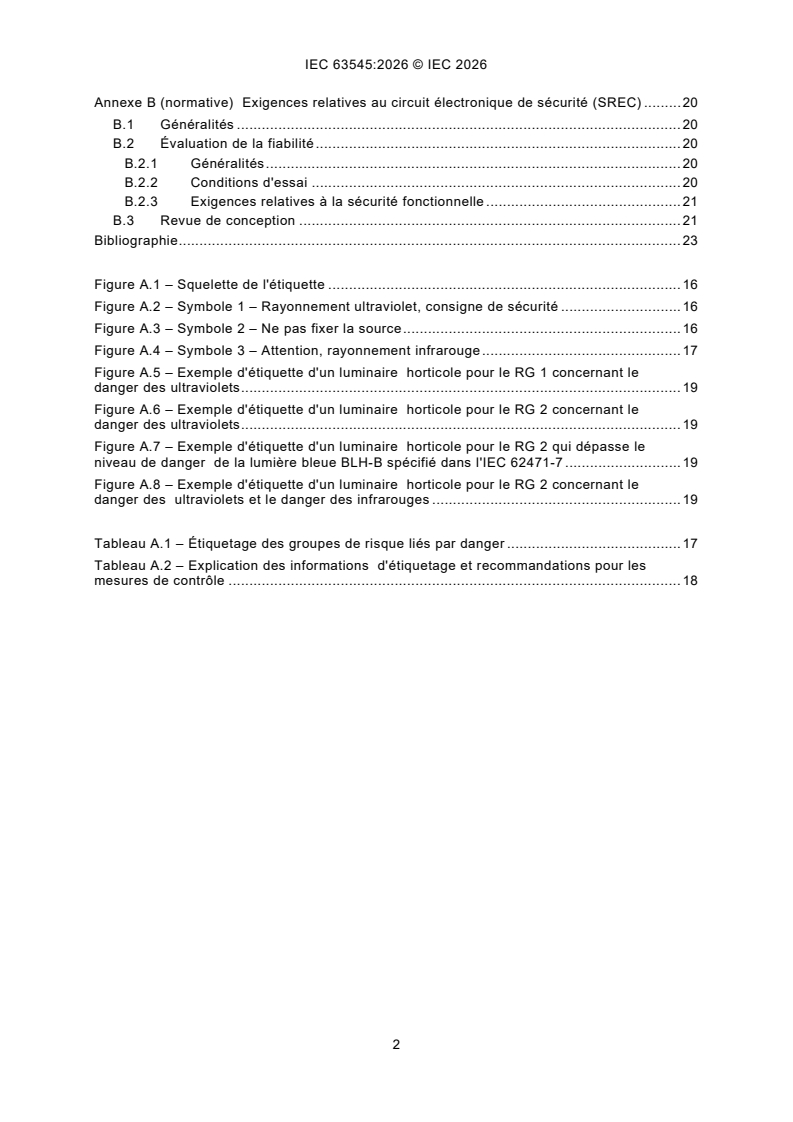
IEC 63545:2026 - Éclairage horticole - Luminaires pour éclairage horticole - Sécurité
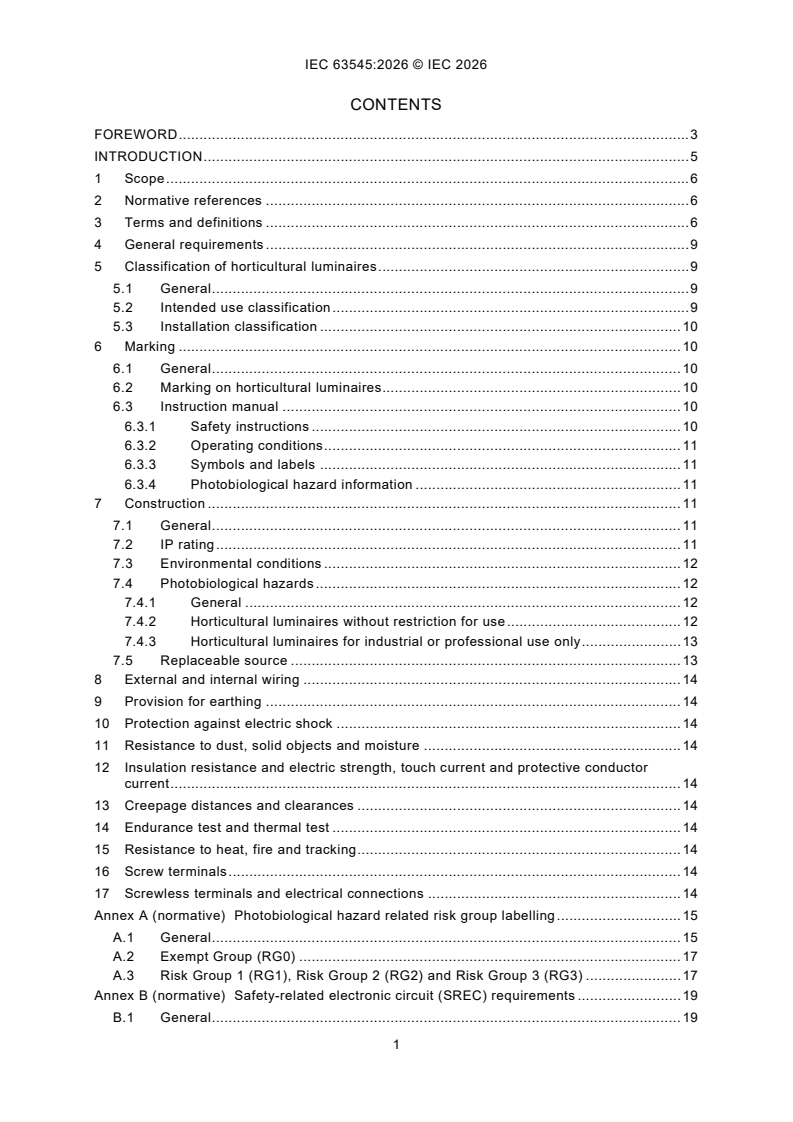
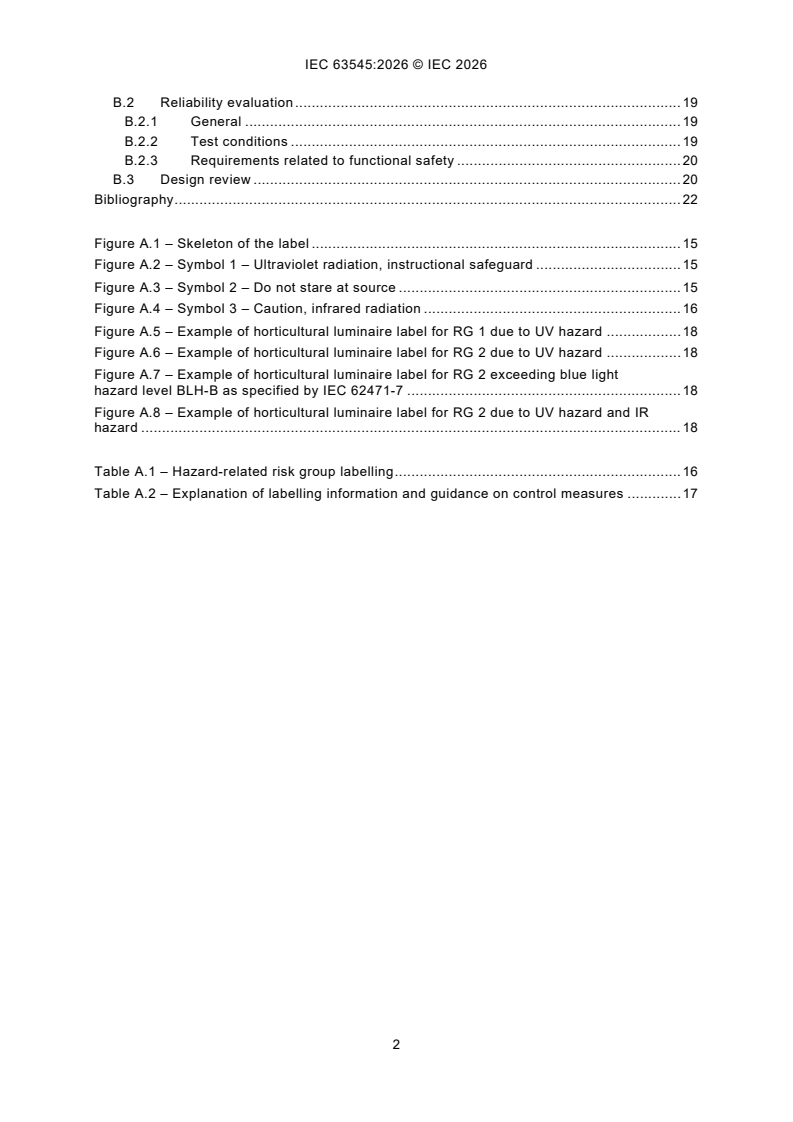
IEC 63545:2026 - Horticultural lighting - Luminaires for horticultural lighting - Safety
Overview
IEC 63545:2026 is an international safety standard developed by the International Electrotechnical Commission (IEC) for horticultural luminaires. This standard specifies safety requirements for luminaires incorporating electric light sources used in horticultural applications, operating from supply voltages up to 1,000 V. Its scope addresses environmental, electrical, and photobiological safety aspects unique to horticultural lighting systems-making it an essential reference for manufacturers, suppliers, and users of horticultural luminaires worldwide.
Horticultural luminaires differ from general lighting products due to their exposure to harsh, moisture-rich conditions and their focus on promoting plant growth rather than visual illumination. IEC 63545:2026 establishes additional requirements, particularly in areas like water and dust resistance, photobiological risk reduction, and guidance for safe installation and maintenance.
Key Topics
- Classification: The standard covers intended use (industrial/professional or unrestricted) and installation types, such as inter-plant lighting and general horticultural lighting.
- Marking and Labelling: Requirements for visible safety labels (including photobiological hazard risk groups), symbols, and clear safety instructions in documentation.
- Photobiological Safety: Provisions for assessing and mitigating risks from UV, blue light, and infrared radiation; defines assessment methods and necessary protective measures.
- Construction: Stipulates minimum ingress protection ratings (IP44, IP65, or IP66) for dust and water resistance, and corrosion resistance for industrial uses.
- Installation and Maintenance: Specifies that installation and servicing for certain products must be performed by skilled or instructed personnel, equipped with appropriate personal protective equipment (PPE).
- Wiring and Electric Safety: Covers requirements for wiring, earthing, protection against electric shock, insulation, and endurance to environmental stress.
- Replaceable Sources: Tools are required to replace sources in industrial horticultural luminaires that do not meet certain photobiological criteria.
Applications
IEC 63545:2026 is designed for horticultural luminaires used in environments such as:
- Commercial greenhouses
- Vertical farms and plant factories
- Indoor horticulture facilities
- Plant research laboratories
- Home plant-growing setups
By following this standard, manufacturers can ensure their products are safe for use in challenging indoor and controlled-climate environments characterized by high humidity and chemical exposure. Compliance helps protect users-whether skilled operators in commercial settings or ordinary household users-from electric shock, photobiological hazards, and equipment malfunctions. It also clarifies marking, installation, and maintenance instructions to facilitate safe real-world usage and reduce risk.
Related Standards
IEC 63545:2026 should be used in conjunction with several key IEC standards for lighting safety and photobiological assessment, including:
- IEC 60598-1: General requirements and tests for luminaires.
- IEC 60598-2 series: Particular requirements for specific luminaire types (e.g., fixed, recessed, portable, floodlights, lighting chains, rope lights).
- IEC 62471: Photobiological safety of lamps and lamp systems.
- IEC 62471-7: Photobiological safety for light sources and luminaires primarily emitting visible radiation.
- IEC 60068-2-11: Environmental testing methods, focusing on salt mist.
- IEC 60730-1: General requirements for automatic electrical controls.
IEC 63545:2026 supports alignment with global safety practices and complements existing international and regional electrotechnical standards for lighting products. For the latest information and compatibility with local regulations, users should cross-reference IEC 63545:2026 with applicable national standards and requirements.
Keywords: IEC 63545:2026, horticultural lighting, luminaire safety, photobiological hazards, water resistance, greenhouse lighting, IP rating, plant growth lighting, international standard.
Buy Documents
IEC 63545:2026 - Horticultural lighting - Luminaires for horticultural lighting - Safety
IEC 63545:2026 - Éclairage horticole - Luminaires pour éclairage horticole - Sécurité
IEC 63545:2026 - Horticultural lighting - Luminaires for horticultural lighting - Safety
Get Certified
Connect with accredited certification bodies for this standard

IMQ S.p.A. (Certification)
Italian electrical product certification.

SLG Prüf- und Zertifizierungs GmbH
German testing and certification body.

UL Solutions
Global safety science company with testing, inspection and certification.
Sponsored listings
Frequently Asked Questions
IEC 63545:2026 is a standard published by the International Electrotechnical Commission (IEC). Its full title is "Horticultural lighting - Luminaires for horticultural lighting - Safety". This standard covers: IEC 63545:2026 specifies safety requirements for horticultural luminaires, incorporating electric light sources for operation from supply voltage up to 1 000 V.
IEC 63545:2026 specifies safety requirements for horticultural luminaires, incorporating electric light sources for operation from supply voltage up to 1 000 V.
IEC 63545:2026 is classified under the following ICS (International Classification for Standards) categories: 29.140.40 - Luminaires. The ICS classification helps identify the subject area and facilitates finding related standards.
IEC 63545:2026 is available in PDF format for immediate download after purchase. The document can be added to your cart and obtained through the secure checkout process. Digital delivery ensures instant access to the complete standard document.
Standards Content (Sample)
IEC 63545 ®
Edition 1.0 2026-02
INTERNATIONAL
STANDARD
Horticultural lighting - Luminaires for horticultural lighting - Safety
ICS 29.140.40 ISBN 978-2-8327-1080-7
All rights reserved. Unless otherwise specified, no part of this publication may be reproduced or utilized in any form or
by any means, electronic or mechanical, including photocopying and microfilm, without permission in writing from either
IEC or IEC's member National Committee in the country of the requester. If you have any questions about IEC copyright
or have an enquiry about obtaining additional rights to this publication, please contact the address below or your local
IEC member National Committee for further information.
IEC Secretariat Tel.: +41 22 919 02 11
3, rue de Varembé info@iec.ch
CH-1211 Geneva 20 www.iec.ch
Switzerland
About the IEC
The International Electrotechnical Commission (IEC) is the leading global organization that prepares and publishes
International Standards for all electrical, electronic and related technologies.
About IEC publications
The technical content of IEC publications is kept under constant review by the IEC. Please make sure that you have the
latest edition, a corrigendum or an amendment might have been published.
IEC publications search - IEC Products & Services Portal - products.iec.ch
webstore.iec.ch/advsearchform Discover our powerful search engine and read freely all the
The advanced search enables to find IEC publications by a publications previews, graphical symbols and the glossary.
variety of criteria (reference number, text, technical With a subscription you will always have access to up to date
committee, …). It also gives information on projects, content tailored to your needs.
replaced and withdrawn publications.
Electropedia - www.electropedia.org
The world's leading online dictionary on electrotechnology,
IEC Just Published - webstore.iec.ch/justpublished
Stay up to date on all new IEC publications. Just Published containing more than 22 500 terminological entries in English
details all new publications released. Available online and and French, with equivalent terms in 25 additional languages.
once a month by email. Also known as the International Electrotechnical Vocabulary
(IEV) online.
IEC Customer Service Centre - webstore.iec.ch/csc
If you wish to give us your feedback on this publication or
need further assistance, please contact the Customer
Service Centre: sales@iec.ch.
CONTENTS
FOREWORD . 3
INTRODUCTION . 5
1 Scope . 6
2 Normative references . 6
3 Terms and definitions . 6
4 General requirements . 9
5 Classification of horticultural luminaires . 9
5.1 General . 9
5.2 Intended use classification . 9
5.3 Installation classification . 10
6 Marking . 10
6.1 General . 10
6.2 Marking on horticultural luminaires . 10
6.3 Instruction manual . 10
6.3.1 Safety instructions . 10
6.3.2 Operating conditions . 11
6.3.3 Symbols and labels . 11
6.3.4 Photobiological hazard information . 11
7 Construction . 11
7.1 General . 11
7.2 IP rating . 11
7.3 Environmental conditions . 12
7.4 Photobiological hazards . 12
7.4.1 General . 12
7.4.2 Horticultural luminaires without restriction for use . 12
7.4.3 Horticultural luminaires for industrial or professional use only . 13
7.5 Replaceable source . 13
8 External and internal wiring . 14
9 Provision for earthing . 14
10 Protection against electric shock . 14
11 Resistance to dust, solid objects and moisture . 14
12 Insulation resistance and electric strength, touch current and protective conductor
current . 14
13 Creepage distances and clearances . 14
14 Endurance test and thermal test . 14
15 Resistance to heat, fire and tracking . 14
16 Screw terminals . 14
17 Screwless terminals and electrical connections . 14
Annex A (normative) Photobiological hazard related risk group labelling . 15
A.1 General . 15
A.2 Exempt Group (RG0) . 17
A.3 Risk Group 1 (RG1), Risk Group 2 (RG2) and Risk Group 3 (RG3) . 17
Annex B (normative) Safety-related electronic circuit (SREC) requirements . 19
B.1 General . 19
B.2 Reliability evaluation . 19
B.2.1 General . 19
B.2.2 Test conditions . 19
B.2.3 Requirements related to functional safety . 20
B.3 Design review . 20
Bibliography . 22
Figure A.1 – Skeleton of the label . 15
Figure A.2 – Symbol 1 – Ultraviolet radiation, instructional safeguard . 15
Figure A.3 – Symbol 2 – Do not stare at source . 15
Figure A.4 – Symbol 3 – Caution, infrared radiation . 16
Figure A.5 – Example of horticultural luminaire label for RG 1 due to UV hazard . 18
Figure A.6 – Example of horticultural luminaire label for RG 2 due to UV hazard . 18
Figure A.7 – Example of horticultural luminaire label for RG 2 exceeding blue light
hazard level BLH-B as specified by IEC 62471-7 . 18
Figure A.8 – Example of horticultural luminaire label for RG 2 due to UV hazard and IR
hazard . 18
Table A.1 – Hazard-related risk group labelling . 16
Table A.2 – Explanation of labelling information and guidance on control measures . 17
INTERNATIONAL ELECTROTECHNICAL COMMISSION
____________
Horticultural lighting -
Luminaires for horticultural lighting - Safety
FOREWORD
1) The International Electrotechnical Commission (IEC) is a worldwide organization for standardization comprising
all national electrotechnical committees (IEC National Committees). The object of IEC is to promote international
co-operation on all questions concerning standardization in the electrical and electronic fields. To this end and
in addition to other activities, IEC publishes International Standards, Technical Specifications, Technical Reports,
Publicly Available Specifications (PAS) and Guides (hereafter referred to as "IEC Publication(s)"). Their
preparation is entrusted to technical committees; any IEC National Committee interested in the subject dealt with
may participate in this preparatory work. International, governmental and non-governmental organizations liaising
with the IEC also participate in this preparation. IEC collaborates closely with the International Organization for
Standardization (ISO) in accordance with conditions determined by agreement between the two organizations.
2) The formal decisions or agreements of IEC on technical matters express, as nearly as possible, an international
consensus of opinion on the relevant subjects since each technical committee has representation from all
interested IEC National Committees.
3) IEC Publications have the form of recommendations for international use and are accepted by IEC National
Committees in that sense. While all reasonable efforts are made to ensure that the technical content of IEC
Publications is accurate, IEC cannot be held responsible for the way in which they are used or for any
misinterpretation by any end user.
4) In order to promote international uniformity, IEC National Committees undertake to apply IEC Publications
transparently to the maximum extent possible in their national and regional publications. Any divergence between
any IEC Publication and the corresponding national or regional publication shall be clearly indicated in the latter.
5) IEC itself does not provide any attestation of conformity. Independent certification bodies provide conformity
assessment services and, in some areas, access to IEC marks of conformity. IEC is not responsible for any
services carried out by independent certification bodies.
6) All users should ensure that they have the latest edition of this publication.
7) No liability shall attach to IEC or its directors, employees, servants or agents including individual experts and
members of its technical committees and IEC National Committees for any personal injury, property damage or
other damage of any nature whatsoever, whether direct or indirect, or for costs (including legal fees) and
expenses arising out of the publication, use of, or reliance upon, this IEC Publication or any other IEC
Publications.
8) Attention is drawn to the Normative references cited in this publication. Use of the referenced publications is
indispensable for the correct application of this publication.
9) IEC draws attention to the possibility that the implementation of this document may involve the use of (a)
patent(s). IEC takes no position concerning the evidence, validity or applicability of any claimed patent rights in
respect thereof. As of the date of publication of this document, IEC had not received notice of (a) patent(s), which
may be required to implement this document. However, implementers are cautioned that this may not represent
the latest information, which may be obtained from the patent database available at https://patents.iec.ch. IEC
shall not be held responsible for identifying any or all such patent rights.
IEC 63545 has been prepared by IEC technical committee 34: Lighting. It is an International
Standard.
The text of this International Standard is based on the following documents:
Draft Report on voting
34/1419/FDIS 34/1432/RVD
Full information on the voting for its approval can be found in the report on voting indicated in
the above table.
The language used for the development of this International Standard is English.
This document was drafted in accordance with ISO/IEC Directives, Part 2, and developed in
accordance with ISO/IEC Directives, Part 1 and ISO/IEC Directives, IEC Supplement, available
at www.iec.ch/members_experts/refdocs. The main document types developed by IEC are
described in greater detail at www.iec.ch/publications.
This document is to be used in conjunction with the relevant corresponding document of the
IEC 60598-2 series for general lighting purpose, as follows:
– IEC 60598-2-1 Fixed general purpose luminaires, or
– IEC 60598-2-2 Recessed luminaires, or
– IEC 60598-2-4 Portable general purpose luminaires, or
– IEC 60598-2-5 Floodlights, or
– IEC 60598-2-20 Lighting chains, or
– IEC 60598-2-21 Rope lights.
Note that for each particular use case and for the purposes of this document, one single relevant
reference document from the IEC 60598-2 series shall be applied, and no mixing between the
various documents in the IEC 60598-2 series shall occur.
The committee has decided that the contents of this document will remain unchanged until the
stability date indicated on the IEC website under webstore.iec.ch in the data related to the
specific document. At this date, the document will be
– reconfirmed,
– withdrawn, or
– revised.
INTRODUCTION
This document acknowledges the need for safety specifications for horticultural luminaires,
which are considered as additional requirements or different requirements when comparing with
the similar type of luminaires used for general lighting purposes.
Compared with the safety requirements for general lighting purpose luminaires, the differences
for horticultural luminaires are mainly derived based on the following considerations:
– change of environmental conditions for the application: Horticultural luminaires are normally
used indoors, but with the purpose of horticulture cultivation, the environmental conditions
are normally severe.
– change of application purpose from vision sensation to horticulture use. Photobiological
safety requirements and UV resistance requirements are developed based on this change
in application purposes.
The provisions in this document represent the technical knowledge of experts from the field of
horticultural lighting and are developed in close context with IEC 60598-1 and the
corresponding document of the IEC 60598-2 series.
1 Scope
This document specifies safety requirements for horticultural luminaires, incorporating electric
light sources for operation from supply voltage up to 1 000 V.
2 Normative references
The following documents are referred to in the text in such a way that some or all of their content
constitutes requirements of this document. For dated references, only the edition cited applies.
For undated references, the latest edition of the referenced document (including any
amendments) applies.
IEC 60068-2-11, Environmental testing - Part 2-11: Tests - Test Ka: Salt mist
IEC 60598-1:2024, Luminaires - Part 1: General requirements and tests
IEC 60598-2-1, Luminaires - Part 2-1: Particular requirements - Fixed general purpose
luminaires
IEC 60598-2-2, Luminaires - Part 2-2: Particular requirements - Recessed luminaires and
recessed air-handling luminaires
IEC 60598-2-4, Luminaires - Part 2-4: Particular requirements - Portable general purpose
luminaires
IEC 60598-2-5, Luminaires - Part 2-5: Particular requirements - Floodlights
IEC 60598-2-20, Luminaires - Part 2-20: Particular requirements - Lighting chains
IEC 60598-2-21, Luminaires - Part 2-21: Particular requirements - Rope lights
IEC 60730-1:2022, Automatic electrical controls - Part 1: General requirements
IEC 62471:2006, Photobiological safety of lamps and lamp systems
IEC 62471-7:2023, Photobiological safety of lamps and lamp systems - Part 7: Light sources
and luminaires primarily emitting visible radiation
3 Terms and definitions
For the purposes of this document, the terms and definitions given in IEC 60598-1, and
IEC 60598-2-1, or IEC 60598-2-2, or IEC 60598-2-4, or IEC 60598-2-5, or IEC 60598-2-20, or
IEC 60598-2-21, and the following apply.
ISO and IEC maintain terminology databases for use in standardization at the following
addresses:
– IEC Electropedia: available at https://www.electropedia.org/
– ISO Online browsing platform: available at https://www.iso.org/obp
3.1
horticultural lighting
application of optical radiation to stimulate biological response of plants and the plant tissues
Note 1 to entry: Examples of the application scenarios are plant factory, greenhouse, field application and home
application.
Note 2 to entry: Examples of the application manners are top lighting and inter-plant lighting.
3.2
inter-plant lighting
horticultural lighting applied among the foliage of plants
Note 1 to entry: Supplemental inter-plant lighting is normally used in greenhouses.
3.3
horticultural luminaire
luminaire designed to incorporate sources of optical radiation for horticultural lighting
3.4
skilled person
person with relevant education and experience to enable him or her
to perceive risks and to avoid photobiological hazards
3.5
instructed person
person advised or supervised by optical radiation skilled persons to
enable him or her to perceive risks and to avoid photobiological hazards
3.6
ordinary person
person who is neither a skilled person nor an instructed person
[SOURCE: IEC 60050-195:2021,195-04-03]
3.7
industrial and professional use
use intended only for skilled or instructed persons
[SOURCE: IEC 60050-851:2008, 851-11-12, modified – the word "experts" has been replaced
by "skilled".]
3.8
without restriction for use
use applicable for skilled persons, instructed persons, and also ordinary persons
3.9
critical control function
function performed by a discrete component or a component network whose primary purpose
is to allow the luminaire to be in compliance with the maximum allowed emission, but whose
failure could cause the luminaire to exceed the exposure limits for normal operation
EXAMPLE A function that controls the on-state or maintains the duty cycle of a source, where a circuit fault causes
the source to unexpectedly energize or to emit higher doses that what is permissible.
[SOURCE: UL 8802:2023, B2.2, modified – "normal operation of the product" has been replaced
by "to allow the luminaire to be in compliance with the maximum allowed emission", and the
wording "the device to exceed the electrical, thermal or exposure limits for normal operation
defined in this standard and the additional safety standards that apply to the product; see 1.7"
has been replaced by "the luminaire to exceed the exposure limits for normal operation".]
3.10
critical failure mode
software or hardware fault which can result in a risk
[SOURCE: UL 8802:2023, B2.3, modified – the word in brackets "(mode)" in the term name has
been replaced by "mode", and the word "a" in the beginning of the definition has been removed.]
3.11
protective component
discrete component or component network that has been separately evaluated to reliably
perform a protective function
EXAMPLE Such components include thermal protectors evaluated in accordance with IEC 60730-2-9 and fuses
evaluated in accordance with IEC 60127.
[SOURCE: UL 8802:2023, B2.6, modified – the example has been moved to EXAMPLE; "to
UL 60730-2-9" and "to the UL 248, series of standards" have been replaced by "in accordance
with IEC 60730-2-9" and "in accordance with IEC 60127".]
3.12
protective function
function that operates after the occurrence of a failure in the equipment so as to prevent harm
to persons or damage to property
[SOURCE: IEC 60050-904:2014, 904-03-05, modified – Note 1 to entry and Note 2 to entry
have been removed.]
3.13
safety-related software
software that is used to implement safety functions
[SOURCE: IEC TS 63394:2023, 3.1.53, modified – "in a safety-related system" is removed from
the definition.]
3.14
safety-related electronic circuit
SREC
electronic circuit that implements one or more control or protective functions
Note 1 to entry: Safety-related electronic circuits can incorporate any combination of active, passive,
programmable, and protective components or semiconductors.
[SOURCE: UL 8802:2023, B2.10, modified – "SREC" has been added as the abbreviated term,
the example in the definition has been changed to a note to entry and the wording "These
circuits may" has been replaced by "Note 1 to entry: Safety-related electronic circuits can".]
4 General requirements
Requirements given in this document are additional to the requirements given in the relevant
corresponding document of the IEC 60598-2 series for general lighting purpose luminaires
except where in this document alternative requirements or measurement methods are specified.
NOTE At the time of publication of this document, examples of the corresponding document of the IEC 60598-2
series for general lighting purpose luminaires are as follows:
IEC 60598-2-1 Fixed general purpose luminaires
IEC 60598-2-2 Recessed luminaires
IEC 60598-2-4 Portable general purpose luminaires
IEC 60598-2-5 Floodlights
IEC 60598-2-20 Lighting chains
IEC 60598-2-21 Rope lights
The test sequences specified in the relevant corresponding document of the IEC 60598-2 series
are applicable. Note that for each particular use case, a single reference document from the
IEC 60598-2 series shall be applied and no mixing shall occur.
5 Classification of horticultural luminaires
5.1 General
The classification of luminaires specified in the relevant corresponding document of the
IEC 60598-2 series applies with the additions of 5.2 to 5.3.
5.2 Intended use classification
Horticultural luminaires shall be classified according to the intended use as follows:
a) Without restriction for use;
b) Industrial or professional use.
NOTE The installation for horticultural luminaires classified for "industrial or professional use" is intended to be
supervised by instructed or skilled persons.
Portable horticultural luminaires shall be classified as without restriction for use.
5.3 Installation classification
Fixed horticultural luminaires for industrial or professional use shall be classified according to
installation as follows:
a) Horticultural luminaires used as inter-plant lighting.
b) Horticultural luminaires used as horticultural lighting other than inter-plant lighting.
NOTE Classification according to the installation for fixed horticultural luminaires is specified to determine the
requirement for the level of protection against dust and moisture.
6 Marking
6.1 General
Marking requirements specified in the relevant corresponding document of the IEC 60598-2
series apply with the a
...
IEC 63545 ®
Edition 1.0 2026-02
NORME
INTERNATIONALE
Éclairage horticole - Luminaires pour éclairage horticole - Sécurité
ICS 29.140.40 ISBN 978-2-8327-1080-7
Droits de reproduction réservés. Sauf indication contraire, aucune partie de cette publication ne peut être reproduite ni
utilisée sous quelque forme que ce soit et par aucun procédé, électronique ou mécanique, y compris la photocopie et
les microfilms, sans l'accord écrit de l'IEC ou du Comité national de l'IEC du pays du demandeur. Si vous avez des
questions sur le copyright de l'IEC ou si vous désirez obtenir des droits supplémentaires sur cette publication, utilisez
les coordonnées ci-après ou contactez le Comité national de l'IEC de votre pays de résidence.
IEC Secretariat Tel.: +41 22 919 02 11
3, rue de Varembé info@iec.ch
CH-1211 Geneva 20 www.iec.ch
Switzerland
A propos de l'IEC
La Commission Electrotechnique Internationale (IEC) est la première organisation mondiale qui élabore et publie des
Normes internationales pour tout ce qui a trait à l'électricité, à l'électronique et aux technologies apparentées.
A propos des publications IEC
Le contenu technique des publications IEC est constamment revu. Veuillez vous assurer que vous possédez l’édition la
plus récente, un corrigendum ou amendement peut avoir été publié.
Recherche de publications IEC - IEC Products & Services Portal - products.iec.ch
webstore.iec.ch/advsearchform Découvrez notre puissant moteur de recherche et consultez
La recherche avancée permet de trouver des publications gratuitement tous les aperçus des publications, symboles
IEC en utilisant différents critères (numéro de référence, graphiques et le glossaire. Avec un abonnement, vous aurez
texte, comité d’études, …). Elle donne aussi des toujours accès à un contenu à jour adapté à vos besoins.
informations sur les projets et les publications remplacées
ou retirées. Electropedia - www.electropedia.org
Le premier dictionnaire d'électrotechnologie en ligne au
IEC Just Published - webstore.iec.ch/justpublished monde, avec plus de 22 500 articles terminologiques en
Restez informé sur les nouvelles publications IEC. Just anglais et en français, ainsi que les termes équivalents
dans 25 langues additionnelles. Egalement appelé
Published détaille les nouvelles publications parues.
Disponible en ligne et une fois par mois par email. Vocabulaire Electrotechnique International (IEV) en ligne.
Service Clients - webstore.iec.ch/csc
Si vous désirez nous donner des commentaires sur cette
publication ou si vous avez des questions contactez-
nous: sales@iec.ch.
SOMMAIRE
AVANT-PROPOS . 3
INTRODUCTION . 5
1 Domaine d'application . 6
2 Références normatives . 6
3 Termes et définitions . 6
4 Exigences générales . 9
5 Classification des luminaires horticoles . 9
5.1 Généralités . 9
5.2 Classification selon l'utilisation prévue . 9
5.3 Classification selon l'installation . 10
6 Marquage . 10
6.1 Généralités . 10
6.2 Marquage sur les luminaires horticoles . 10
6.3 Manuel d'instructions . 10
6.3.1 Instructions de sécurité . 10
6.3.2 Conditions de fonctionnement . 11
6.3.3 Symboles et étiquettes . 11
6.3.4 Informations relatives aux dangers photobiologiques . 11
7 Construction . 11
7.1 Généralités . 11
7.2 Caractéristique assignée IP . 11
7.3 Conditions d'environnement . 12
7.4 Dangers photobiologiques . 12
7.4.1 Généralités . 12
7.4.2 Luminaires horticoles sans restriction d'utilisation. 12
7.4.3 Luminaires horticoles pour usage industriel ou professionnel
uniquement . 13
7.5 Source remplaçable . 14
8 Câblage externe et interne . 14
9 Dispositions en vue de la mise à la terre . 14
10 Protection contre les chocs électriques . 14
11 Résistance à la poussière, aux corps solides et à l'humidité . 14
12 Résistance d'isolement, rigidité diélectrique, courant de contact et courant dans le
conducteur de protection . 14
13 Lignes de fuite et distances dans l'air . 14
14 Essai d'endurance et essai d'échauffement . 14
15 Résistance à la chaleur, au feu et aux courants de cheminement . 14
16 Bornes à serrage sous tête de vis . 15
17 Bornes sans vis et connexions électriques . 15
Annexe A (normative) Étiquetage des groupes de risque liés par danger
photobiologique . 16
A.1 Généralités . 16
A.2 Groupe sans risque (RG0) . 18
A.3 Groupe de risque 1 (RG1), Groupe de risque 2 (RG2) et Groupe de risque 3
(RG3) . 18
Annexe B (normative) Exigences relatives au circuit électronique de sécurité (SREC) . 20
B.1 Généralités . 20
B.2 Évaluation de la fiabilité . 20
B.2.1 Généralités . 20
B.2.2 Conditions d'essai . 20
B.2.3 Exigences relatives à la sécurité fonctionnelle . 21
B.3 Revue de conception . 21
Bibliographie . 23
Figure A.1 – Squelette de l'étiquette . 16
Figure A.2 – Symbole 1 – Rayonnement ultraviolet, consigne de sécurité . 16
Figure A.3 – Symbole 2 – Ne pas fixer la source . 16
Figure A.4 – Symbole 3 – Attention, rayonnement infrarouge . 17
Figure A.5 – Exemple d'étiquette d'un luminaire horticole pour le RG 1 concernant le
danger des ultraviolets . 19
Figure A.6 – Exemple d'étiquette d'un luminaire horticole pour le RG 2 concernant le
danger des ultraviolets . 19
Figure A.7 – Exemple d'étiquette d'un luminaire horticole pour le RG 2 qui dépasse le
niveau de danger de la lumière bleue BLH-B spécifié dans l'IEC 62471-7 . 19
Figure A.8 – Exemple d'étiquette d'un luminaire horticole pour le RG 2 concernant le
danger des ultraviolets et le danger des infrarouges . 19
Tableau A.1 – Étiquetage des groupes de risque liés par danger . 17
Tableau A.2 – Explication des informations d'étiquetage et recommandations pour les
mesures de contrôle . 18
COMMISSION ÉLECTROTECHNIQUE INTERNATIONALE
____________
Éclairage horticole -
Luminaires pour éclairage horticole - Sécurité
AVANT-PROPOS
1) La Commission Électrotechnique Internationale (IEC) est une organisation mondiale de normalisation composée
de l'ensemble des comités électrotechniques nationaux (Comités nationaux de l'IEC). L'IEC a pour objet de
favoriser la coopération internationale pour toutes les questions de normalisation dans les domaines de
l'électricité et de l'électronique. À cet effet, l'IEC – entre autres activités – publie des Normes internationales,
des Spécifications techniques, des Rapports techniques, des Spécifications accessibles au public (PAS) et des
Guides (ci-après dénommés "Publication(s) de l'IEC"). Leur élaboration est confiée à des comités d'études, aux
travaux desquels tout Comité national intéressé par le sujet traité peut participer. Les organisations
internationales, gouvernementales et non gouvernementales, en liaison avec l'IEC, participent également aux
travaux. L'IEC collabore étroitement avec l'Organisation Internationale de Normalisation (ISO), selon des
conditions fixées par accord entre les deux organisations.
2) Les décisions ou accords officiels de l'IEC concernant les questions techniques représentent, dans la mesure du
possible, un accord international sur les sujets étudiés, étant donné que les Comités nationaux de l'IEC intéressés
sont représentés dans chaque comité d'études.
3) Les Publications de l'IEC se présentent sous la forme de recommandations internationales et sont agréées
comme telles par les Comités nationaux de l'IEC. Tous les efforts raisonnables sont entrepris afin que l'IEC
s'assure de l'exactitude du contenu technique de ses publications; l'IEC ne peut pas être tenue responsable de
l'éventuelle mauvaise utilisation ou interprétation qui en est faite par un quelconque utilisateur final.
4) Dans le but d'encourager l'uniformité internationale, les Comités nationaux de l'IEC s'engagent, dans toute la
mesure possible, à appliquer de façon transparente les Publications de l'IEC dans leurs publications nationales
et régionales. Toutes divergences entre toutes Publications de l'IEC et toutes publications nationales ou
régionales correspondantes doivent être indiquées en termes clairs dans ces dernières.
5) L'IEC elle-même ne fournit aucune attestation de conformité. Des organismes de certification indépendants
fournissent des services d'évaluation de conformité et, dans certains secteurs, accèdent aux marques de
conformité de l'IEC. L'IEC n'est responsable d'aucun des services effectués par les organismes de certification
indépendants.
6) Tous les utilisateurs doivent s'assurer qu'ils sont en possession de la dernière édition de cette publication.
7) Aucune responsabilité ne doit être imputée à l'IEC, à ses administrateurs, employés, auxiliaires ou mandataires,
y compris ses experts particuliers et les membres de ses comités d'études et des Comités nationaux de l'IEC,
pour tout préjudice causé en cas de dommages corporels et matériels, ou de tout autre dommage de quelque
nature que ce soit, directe ou indirecte, ou pour supporter les coûts (y compris les frais de justice) et les dépenses
découlant de la publication ou de l'utilisation de cette Publication de l'IEC ou de toute autre Publication de l'IEC,
ou au crédit qui lui est accordé.
8) L'attention est attirée sur les références normatives citées dans cette publication. L'utilisation de publications
référencées est obligatoire pour une application correcte de la présente publication.
9) L'IEC attire l'attention sur le fait que la mise en application du présent document peut entraîner l'utilisation d'un
ou de plusieurs brevets. L'IEC ne prend pas position quant à la preuve, à la validité et à l'applicabilité de tout
droit de brevet revendiqué à cet égard. À la date de publication du présent document, l'IEC n'avait pas reçu
notification qu'un ou plusieurs brevets pouvaient être nécessaires à sa mise en application. Toutefois, il y a lieu
d'avertir les responsables de la mise en application du présent document que des informations plus récentes
sont susceptibles de figurer dans la base de données de brevets, disponible à l'adresse https://patents.iec.ch.
L'IEC ne saurait être tenue pour responsable de ne pas avoir identifié de tels droits de brevets.
L'IEC 63545 a été établie par le comité d'études 34 de l'IEC: Éclairage. Il s'agit d'une Norme
internationale.
Le texte de cette Norme internationale est issu des documents suivants:
Projet Rapport de vote
34/1419/FDIS 34/1432/RVD
Le rapport de vote indiqué dans le tableau ci-dessus donne toute information sur le vote ayant
abouti à son approbation.
La langue employée pour l'élaboration de cette Norme internationale est l'anglais.
Ce document a été rédigé selon les Directives ISO/IEC, Partie 2, il a été développé selon les
Directives ISO/IEC, Partie 1 et les Directives ISO/IEC, Supplément IEC, disponibles sous
www.iec.ch/members_experts/refdocs. Les principaux types de documents développés par
l'IEC sont décrits plus en détail sous www.iec.ch/publications.
Le présent document doit être utilisé conjointement avec le document correspondant pertinent
de la série IEC 60598-2 relative aux luminaires pour éclairage général, à savoir:
– IEC 60598-2-1 Luminaires fixes à usage général, ou
– IEC 60598-2-2 Luminaires encastrés, ou
– IEC 60598-2-4 Luminaires portatifs à usage général, ou
– IEC 60598-2-5 Projecteurs, ou
– IEC 60598-2-20 Guirlandes lumineuses, ou
– IEC 60598-2-21 Cordons lumineux.
Il est à noter que pour chaque cas d'utilisation particulier et pour les besoins du présent
document, un seul document de référence pertinent de la série IEC 60598-2 doit être appliqué
et les différents documents de la série IEC 60598-2 ne doivent pas être combinés.
Le comité a décidé que le contenu de ce document ne sera pas modifié avant la date de stabilité
indiquée sur le site web de l'IEC sous webstore.iec.ch dans les données relatives au document
recherché. À cette date, le document sera
– reconduit,
– supprimé, ou
– révisé.
INTRODUCTION
Le présent document reconnaît la nécessité d'établir des spécifications de sécurité pour les
luminaires horticoles, qui comporte des exigences supplémentaires ou dont les exigences
diffèrent par rapport à celles relatives au type similaire de luminaire utilisé pour l'éclairage
général.
Par rapport aux exigences de sécurité relatives aux luminaires pour éclairage général, les
différences applicables aux luminaires horticoles reposent principalement sur les points
suivants:
– modification des conditions d'environnement pour l'application considérée. Les luminaires
horticoles sont normalement utilisés en intérieur, mais selon la culture horticole considérée,
les conditions d'environnement sont normalement rigoureuses.
– modification de l'objet de l'application de la sensation de vision à l'usage horticole. Les
exigences relatives à la sécurité photobiologique et à la résistance aux ultraviolets (UV) ont
été définies à la lueur de cette modification de l'objet de l'application.
Les dispositions définies dans le présent document représentent l'état des connaissances
techniques des experts dans le domaine de l'éclairage horticole. Elles ont été élaborées dans
un contexte proche de l'IEC 60598-1 et du document correspondant de la série IEC 60598-2.
1 Domaine d'application
Le présent document spécifie les exigences de sécurité relatives aux luminaires horticoles qui
incorporent des sources de lumière électriques destinées à fonctionner avec une tension
d'alimentation inférieure ou égale à 1 000 V.
2 Références normatives
Les documents suivants sont cités dans le texte de sorte qu'ils constituent, pour tout ou partie
de leur contenu, des exigences du présent document. Pour les références datées, seule
l'édition citée s'applique. Pour les références non datées, la dernière édition du document de
référence s'applique (y compris les éventuels amendements).
IEC 60068-2-11, Essais d'environnement - Partie 2-11: Essais - Essai Ka: Brouillard salin
IEC 60598-1:2024, Luminaires - Partie 1: Exigences générales et essais
IEC 60598-2-1, Luminaires - Partie 2-1: Exigences particulières - Luminaires fixes à usage
général
IEC 60598-2-2, Luminaires - Partie 2-2: Exigences particulières - Luminaires encastrés et
luminaires à circulation d'air encastrés
IEC 60598-2-4, Luminaires - Partie 2-4: Exigences particulières - Luminaires portatifs à usage
général
IEC 60598-2-5, Luminaires - Partie 2-5: Exigences particulières - Projecteurs
IEC 60598-2-20, Luminaires - Partie 2-20: Exigences particulières - Guirlandes lumineuses
IEC 60598-2-21, Luminaires - Partie 2-21: Exigences particulières - Cordons lumineux
IEC 60730-1:2022, Dispositifs de commande électrique automatiques - Partie 1: Exigences
générales
IEC 62471:2006, Sécurité photobiologique des lampes et des appareils utilisant des lampes
IEC 62471-7:2023, Sécurité photobiologique des lampes et des appareils utilisant des lampes
- Partie 7: Sources de lumière et luminaires qui émettent principalement un rayonnement visible
3 Termes et définitions
Pour les besoins du présent document, les termes et définitions de l'IEC 60598-1, de
l'IEC 60598-2-1, ou de l'IEC 60598-2-2, ou de l'IEC 60598-2-4, ou de l'IEC 60598-2-5, ou de
l'IEC 60598-2-20, ou de l'IEC 60598-2-21 ainsi que les suivants s'appliquent.
L'ISO et l'IEC tiennent à jour des bases de données terminologiques destinées à être utilisées
en normalisation, consultables aux adresses suivantes:
– IEC Electropedia: disponible à l'adresse http://www.electropedia.org/
– ISO Online browsing platform: disponible à l'adresse https://www.iso.org/obp
3.1
éclairage horticole
application d'un rayonnement optique visant à stimuler la réponse biologique des plantes et
des tissus végétaux
Note 1 à l'article: Les fermes verticales, les serres, les applications sur site et les applications domestiques
constituent des exemples de scénarios d'application.
Note 2 à l'article: L'éclairage par le haut et l'éclairage entre plantes constituent des exemples de modes
d'application.
3.2
éclairage entre plantes
éclairage horticole appliqué dans le feuillage des plantes
Note 1 à l'article: Un éclairage entre plantes supplémentaire est normalement utilisé dans les serres.
3.3
luminaire horticole
luminaire conçu pour incorporer des sources de rayonnement optique dans le domaine de
l'éclairage horticole
3.4
personne qualifiée
personne ayant la formation et l'expérience appropriées pour lui
permettre de percevoir les risques et d'éviter les dangers photobiologiques
3.5
personne avertie
personne informée ou surveillée par des personnes qualifiées dans
le domaine des rayonnements optiques pour lui permettre de percevoir les risques et d'éviter
les dangers photobiologiques
3.6
personne ordinaire
personne qui n'est ni une personne qualifiée ni une personne avertie
[SOURCE: IEC 60050-195:2021,195-04-03]
3.7
usage industriel et professionnel
usage prévu uniquement par des personnes qualifiées ou averties
[SOURCE: IEC 60050-851:2008, 851-11-12, modifiée – "experts" a été remplacé par
"personnes qualifiées".]
3.8
sans restriction d'utilisation
utilisation applicable aux personnes qualifiées, aux personnes averties, ainsi qu'aux personnes
ordinaires
3.9
fonction de commande critique
fonction exécutée par un composant discret ou un réseau de composants dont l'objet principal
est de permettre au luminaire d'être conforme à l'émission maximale admise, mais dont la
défaillance pourrait entraîner un dépassement des limites d'exposition pour un fonctionnement
normal
EXEMPLE Fonction qui commande l'état de marche ou maintient le cycle de service d'une source, lorsqu'un défaut
de circuit provoque une mise sous tension intempestive de la source ou l'émission de doses supérieures aux valeurs
admises.
[SOURCE: UL 8802:2023, B2.2, modifié – Le terme "fonction de contrôle critique" a été
remplacé par "fonction de commande critique"; dans la définition, "le fonctionnement normal du
produit" a été remplacé par "de permettre au luminaire d'être conforme à l'émission maximale
admise" et "pourrait amener le dispositif à dépasser les limites électriques, thermiques ou
d'exposition pour un fonctionnement normal telles qu'elles sont définies dans la présente norme
et les normes de sécurité supplémentaires qui s'appliquent au produit, voir le point 1.7" a été
remplacé par "entraîner un dépassement des limites d'exposition pour un fonctionnement
normal"; l'exemple a été reformulé.]
3.10
mode de défaillance critique
panne logicielle ou matérielle qui peut entraîner un risque
[SOURCE: UL 8802:2023, B2.3, modifié – Le terme "défaillances critiques (mode)" a été
remplacé par "mode de défaillance critique", et le mot "une" au début de la définition a été
supprimé.]
3.11
composant de protection
composant discret ou réseau de composants qui a été évalué séparément pour assurer de
manière fiable une fonction de protection
EXEMPLE Ces composants comprennent les protections thermiques évaluées conformément à l'IEC 60730-2-9 et
les fusibles évalués conformément à l'IEC 60127.
[SOURCE: UL 8802:2023, B2.6, modifié – L'exemple a été déplacé dans EXEMPLE; "selon la
norme UL 60730-2-9" et "selon la série de normes UL 248" ont été remplacés par
"conformément à l'IEC 60730-2-9" et "conformément à l'IEC 60127".]
3.12
fonction de protection
fonction qui se déclenche suite à une défaillance de l'équipement, de manière à prévenir des
dommages corporels et matériels
[SOURCE: IEC 60050-904:2014, 904-03-05, modifiée – Les Notes 1 et 2 à l'article ont été
supprimées.]
3.13
logiciel de sécurité
logiciel utilisé pour mettre en œuvre des fonctions de sécurité
[SOURCE: IEC TS 63394:2023, 3.1.53, modifiée – Cette modification ne concerne que le texte
anglais.]
3.14
circuit électronique de sécurité
SREC
circuit électronique qui met en œuvre une ou plusieurs fonctions de commande ou de protection
Note 1 à l'article: Les circuits électroniques de sécurité peuvent incorporer n'importe quelle combinaison de
composants ou de semiconducteurs actifs, passifs, programmables et de protection.
Note 2 à l'article: L'abréviation "SREC" est dérivée du terme anglais développé correspondant "safety-related
electronic circuit".
[SOURCE: UL 8802:2023, B2.10, modifié – Le terme "circuit électronique lié à la sécurité " a
été remplacé par "circuit électronique de sécurité"; l'abréviation "SREC" a été ajoutée";
l'exemple dans la définition a été déplacé dans la Note 1 à l'article; "Ces circuits peuvent" a été
remplacé par "Les circuits électroniques de sécurité" au début de la note à l'article.]
4 Exigences générales
Les exigences définies dans le présent document complètent les exigences fournies dans le
document correspondant pertinent de la série IEC 60598-2 relative aux luminaires pour
éclairage général, sauf lorsque d'autres exigences ou méthodes de mesure sont spécifiées
dans le présent document.
NOTE À la date de publication du présent document, les exemples de documents correspondants de la série
IEC 60598-2 relative aux luminaires pour éclairage général sont les suivants:
IEC 60598-2-1 Luminaires fixes à usage général
IEC 60598-2-2 Luminaires encastrés
IEC 60598-2-4 Luminaires portatifs à usage général
IEC 60598-2-5 Projecteurs
IEC 60598-2-20 Guirlandes lumineuses
IEC 60598-2-21 Cordons lumineux
Les séquences d'essai spécifiées dans le document correspondant pertinent de la série
IEC 60598-2 s'appliquent. Il est à noter que pour chaque cas d'utilisation particulier, un seul
document de référence de la série IEC 60598-2 doit être appliqué et les documents ne doivent
pas être combinés.
5 Classification des luminaires horticoles
5.1 Généralités
La classification des luminaires spécifiée dans le document correspondant pertinent de la série
IEC 60598-2 s'applique, avec les ajouts dans les 5.2 à 5.3.
5.2 Classification selon l'utilisation prévue
Les luminaires horticoles doivent être classés selon leur utilisation prévue, comme suit:
a) sans restriction d'utilisation;
b) usage industriel ou professionnel.
NOTE L'installation des luminaires horticoles classés pour un "usage industriel ou professionnel" est destinée à
être supervisée par des personnes averties ou qualifiées.
Les luminaires horticoles portatifs doivent être classés comme des luminaires horticoles sans
restriction d'utilisation.
5.3 Classification selon l'installation
Les luminaires horticoles fixes pour usage industriel ou professionnel doivent être classés selon
leur installation, comme suit:
a) luminaires horticoles utilisés pour l'éclairage entre plantes;
b) luminaires horticoles destinés à un éclairage horticole autre que l'éclairage entre plantes.
NOTE La classification selon l'installation pour les luminaires horticoles fixes est spécifiée afin de déterminer
l'exigence relative au niveau de protection contre les poussières et l'humidité.
6 Marquage
6.1 Généralités
Les exigences de marquage spécifiées dans le document correspondant pertinent de la série
IEC 60598-2 s'appliquent, avec les ajouts dans les 6.2 à 6.3.
La conformité au 6.2 est vérifiée par examen et par l'essai de marquage conformément à
l'IEC 60598-1:2024, 6.5.
La conformité au 6.3 est vérifiée par examen.
6.2 Marquage sur les luminaires horticoles
Les luminaires horticoles pour usage industriel ou professionnel, qui ne sont pas conformes à
l'IEC 62471-7, doivent être étiquetés conformément à la classification de groupe de risque
identifiée selon l'évaluation effectuée au 7.4. L'étiquette doit être clairement visible pour les
personnes averties et qualifiées pendant les travaux d'installation et d'entretien.
Les étiquettes de groupe de risque doivent satisfaire aux exigences de l'Annexe A.
6.3 Manuel d'instructions
6.3.1 Instructions de sécurité
Le présent 6.3 s'applique uniquement aux luminaires horticoles pour usage industriel et
professionnel qui ne sont pas conformes à l'IEC 62471-7.
Les instructions de sécurité doivent comporter en substance les informations suivantes:
a) Ce luminaire est conçu pour les
...
IEC 63545 ®
Edition 1.0 2026-02
INTERNATIONAL
STANDARD
NORME
INTERNATIONALE
Horticultural lighting - Luminaires for horticultural lighting - Safety
Éclairage horticole - Luminaires pour éclairage horticole - Sécurité
ICS 29.140.40 ISBN 978-2-8327-1080-7
All rights reserved. Unless otherwise specified, no part of this publication may be reproduced or utilized in any form or
by any means, electronic or mechanical, including photocopying and microfilm, without permission in writing from either
IEC or IEC's member National Committee in the country of the requester. If you have any questions about IEC copyright
or have an enquiry about obtaining additional rights to this publication, please contact the address below or your local
IEC member National Committee for further information.
Droits de reproduction réservés. Sauf indication contraire, aucune partie de cette publication ne peut être reproduite ni
utilisée sous quelque forme que ce soit et par aucun procédé, électronique ou mécanique, y compris la photocopie et
les microfilms, sans l'accord écrit de l'IEC ou du Comité national de l'IEC du pays du demandeur. Si vous avez des
questions sur le copyright de l'IEC ou si vous désirez obtenir des droits supplémentaires sur cette publication, utilisez
les coordonnées ci-après ou contactez le Comité national de l'IEC de votre pays de résidence.
IEC Secretariat Tel.: +41 22 919 02 11
3, rue de Varembé info@iec.ch
CH-1211 Geneva 20 www.iec.ch
Switzerland
About the IEC
The International Electrotechnical Commission (IEC) is the leading global organization that prepares and publishes
International Standards for all electrical, electronic and related technologies.
About IEC publications
The technical content of IEC publications is kept under constant review by the IEC. Please make sure that you have the
latest edition, a corrigendum or an amendment might have been published.
IEC publications search - IEC Products & Services Portal - products.iec.ch
webstore.iec.ch/advsearchform Discover our powerful search engine and read freely all the
The advanced search enables to find IEC publications by a publications previews, graphical symbols and the glossary.
variety of criteria (reference number, text, technical With a subscription you will always have access to up to date
committee, …). It also gives information on projects, content tailored to your needs.
replaced and withdrawn publications.
Electropedia - www.electropedia.org
IEC Just Published - webstore.iec.ch/justpublished The world's leading online dictionary on electrotechnology,
Stay up to date on all new IEC publications. Just Published containing more than 22 500 terminological entries in English
details all new publications released. Available online and and French, with equivalent terms in 25 additional languages.
once a month by email. Also known as the International Electrotechnical Vocabulary
(IEV) online.
IEC Customer Service Centre - webstore.iec.ch/csc
If you wish to give us your feedback on this publication or
need further assistance, please contact the Customer
Service Centre: sales@iec.ch.
A propos de l'IEC
La Commission Electrotechnique Internationale (IEC) est la première organisation mondiale qui élabore et publie des
Normes internationales pour tout ce qui a trait à l'électricité, à l'électronique et aux technologies apparentées.
A propos des publications IEC
Le contenu technique des publications IEC est constamment revu. Veuillez vous assurer que vous possédez l’édition la
plus récente, un corrigendum ou amendement peut avoir été publié.
Recherche de publications IEC - IEC Products & Services Portal - products.iec.ch
webstore.iec.ch/advsearchform Découvrez notre puissant moteur de recherche et consultez
La recherche avancée permet de trouver des publications gratuitement tous les aperçus des publications, symboles
IEC en utilisant différents critères (numéro de référence, graphiques et le glossaire. Avec un abonnement, vous aurez
texte, comité d’études, …). Elle donne aussi des toujours accès à un contenu à jour adapté à vos besoins.
informations sur les projets et les publications remplacées
ou retirées. Electropedia - www.electropedia.org
Le premier dictionnaire d'électrotechnologie en ligne au
IEC Just Published - webstore.iec.ch/justpublished monde, avec plus de 22 500 articles terminologiques en
Restez informé sur les nouvelles publications IEC. Just anglais et en français, ainsi que les termes équivalents
Published détaille les nouvelles publications parues. dans 25 langues additionnelles. Egalement appelé
Disponible en ligne et une fois par mois par email. Vocabulaire Electrotechnique International (IEV) en ligne.
Service Clients - webstore.iec.ch/csc
Si vous désirez nous donner des commentaires sur cette
publication ou si vous avez des questions contactez-
nous: sales@iec.ch.
CONTENTS
FOREWORD . 3
INTRODUCTION . 5
1 Scope . 6
2 Normative references . 6
3 Terms and definitions . 6
4 General requirements . 9
5 Classification of horticultural luminaires . 9
5.1 General . 9
5.2 Intended use classification . 9
5.3 Installation classification . 10
6 Marking . 10
6.1 General . 10
6.2 Marking on horticultural luminaires . 10
6.3 Instruction manual . 10
6.3.1 Safety instructions . 10
6.3.2 Operating conditions . 11
6.3.3 Symbols and labels . 11
6.3.4 Photobiological hazard information . 11
7 Construction . 11
7.1 General . 11
7.2 IP rating . 11
7.3 Environmental conditions . 12
7.4 Photobiological hazards . 12
7.4.1 General . 12
7.4.2 Horticultural luminaires without restriction for use . 12
7.4.3 Horticultural luminaires for industrial or professional use only . 13
7.5 Replaceable source . 13
8 External and internal wiring . 14
9 Provision for earthing . 14
10 Protection against electric shock . 14
11 Resistance to dust, solid objects and moisture . 14
12 Insulation resistance and electric strength, touch current and protective conductor
current . 14
13 Creepage distances and clearances . 14
14 Endurance test and thermal test . 14
15 Resistance to heat, fire and tracking . 14
16 Screw terminals . 14
17 Screwless terminals and electrical connections . 14
Annex A (normative) Photobiological hazard related risk group labelling . 15
A.1 General . 15
A.2 Exempt Group (RG0) . 17
A.3 Risk Group 1 (RG1), Risk Group 2 (RG2) and Risk Group 3 (RG3) . 17
Annex B (normative) Safety-related electronic circuit (SREC) requirements . 19
B.1 General . 19
B.2 Reliability evaluation . 19
B.2.1 General . 19
B.2.2 Test conditions . 19
B.2.3 Requirements related to functional safety . 20
B.3 Design review . 20
Bibliography . 22
Figure A.1 – Skeleton of the label . 15
Figure A.2 – Symbol 1 – Ultraviolet radiation, instructional safeguard . 15
Figure A.3 – Symbol 2 – Do not stare at source . 15
Figure A.4 – Symbol 3 – Caution, infrared radiation . 16
Figure A.5 – Example of horticultural luminaire label for RG 1 due to UV hazard . 18
Figure A.6 – Example of horticultural luminaire label for RG 2 due to UV hazard . 18
Figure A.7 – Example of horticultural luminaire label for RG 2 exceeding blue light
hazard level BLH-B as specified by IEC 62471-7 . 18
Figure A.8 – Example of horticultural luminaire label for RG 2 due to UV hazard and IR
hazard . 18
Table A.1 – Hazard-related risk group labelling . 16
Table A.2 – Explanation of labelling information and guidance on control measures . 17
INTERNATIONAL ELECTROTECHNICAL COMMISSION
____________
Horticultural lighting -
Luminaires for horticultural lighting - Safety
FOREWORD
1) The International Electrotechnical Commission (IEC) is a worldwide organization for standardization comprising
all national electrotechnical committees (IEC National Committees). The object of IEC is to promote international
co-operation on all questions concerning standardization in the electrical and electronic fields. To this end and
in addition to other activities, IEC publishes International Standards, Technical Specifications, Technical Reports,
Publicly Available Specifications (PAS) and Guides (hereafter referred to as "IEC Publication(s)"). Their
preparation is entrusted to technical committees; any IEC National Committee interested in the subject dealt with
may participate in this preparatory work. International, governmental and non-governmental organizations liaising
with the IEC also participate in this preparation. IEC collaborates closely with the International Organization for
Standardization (ISO) in accordance with conditions determined by agreement between the two organizations.
2) The formal decisions or agreements of IEC on technical matters express, as nearly as possible, an international
consensus of opinion on the relevant subjects since each technical committee has representation from all
interested IEC National Committees.
3) IEC Publications have the form of recommendations for international use and are accepted by IEC National
Committees in that sense. While all reasonable efforts are made to ensure that the technical content of IEC
Publications is accurate, IEC cannot be held responsible for the way in which they are used or for any
misinterpretation by any end user.
4) In order to promote international uniformity, IEC National Committees undertake to apply IEC Publications
transparently to the maximum extent possible in their national and regional publications. Any divergence between
any IEC Publication and the corresponding national or regional publication shall be clearly indicated in the latter.
5) IEC itself does not provide any attestation of conformity. Independent certification bodies provide conformity
assessment services and, in some areas, access to IEC marks of conformity. IEC is not responsible for any
services carried out by independent certification bodies.
6) All users should ensure that they have the latest edition of this publication.
7) No liability shall attach to IEC or its directors, employees, servants or agents including individual experts and
members of its technical committees and IEC National Committees for any personal injury, property damage or
other damage of any nature whatsoever, whether direct or indirect, or for costs (including legal fees) and
expenses arising out of the publication, use of, or reliance upon, this IEC Publication or any other IEC
Publications.
8) Attention is drawn to the Normative references cited in this publication. Use of the referenced publications is
indispensable for the correct application of this publication.
9) IEC draws attention to the possibility that the implementation of this document may involve the use of (a)
patent(s). IEC takes no position concerning the evidence, validity or applicability of any claimed patent rights in
respect thereof. As of the date of publication of this document, IEC had not received notice of (a) patent(s), which
may be required to implement this document. However, implementers are cautioned that this may not represent
the latest information, which may be obtained from the patent database available at https://patents.iec.ch. IEC
shall not be held responsible for identifying any or all such patent rights.
IEC 63545 has been prepared by IEC technical committee 34: Lighting. It is an International
Standard.
The text of this International Standard is based on the following documents:
Draft Report on voting
34/1419/FDIS 34/1432/RVD
Full information on the voting for its approval can be found in the report on voting indicated in
the above table.
The language used for the development of this International Standard is English.
This document was drafted in accordance with ISO/IEC Directives, Part 2, and developed in
accordance with ISO/IEC Directives, Part 1 and ISO/IEC Directives, IEC Supplement, available
at www.iec.ch/members_experts/refdocs. The main document types developed by IEC are
described in greater detail at www.iec.ch/publications.
This document is to be used in conjunction with the relevant corresponding document of the
IEC 60598-2 series for general lighting purpose, as follows:
– IEC 60598-2-1 Fixed general purpose luminaires, or
– IEC 60598-2-2 Recessed luminaires, or
– IEC 60598-2-4 Portable general purpose luminaires, or
– IEC 60598-2-5 Floodlights, or
– IEC 60598-2-20 Lighting chains, or
– IEC 60598-2-21 Rope lights.
Note that for each particular use case and for the purposes of this document, one single relevant
reference document from the IEC 60598-2 series shall be applied, and no mixing between the
various documents in the IEC 60598-2 series shall occur.
The committee has decided that the contents of this document will remain unchanged until the
stability date indicated on the IEC website under webstore.iec.ch in the data related to the
specific document. At this date, the document will be
– reconfirmed,
– withdrawn, or
– revised.
INTRODUCTION
This document acknowledges the need for safety specifications for horticultural luminaires,
which are considered as additional requirements or different requirements when comparing with
the similar type of luminaires used for general lighting purposes.
Compared with the safety requirements for general lighting purpose luminaires, the differences
for horticultural luminaires are mainly derived based on the following considerations:
– change of environmental conditions for the application: Horticultural luminaires are normally
used indoors, but with the purpose of horticulture cultivation, the environmental conditions
are normally severe.
– change of application purpose from vision sensation to horticulture use. Photobiological
safety requirements and UV resistance requirements are developed based on this change
in application purposes.
The provisions in this document represent the technical knowledge of experts from the field of
horticultural lighting and are developed in close context with IEC 60598-1 and the
corresponding document of the IEC 60598-2 series.
1 Scope
This document specifies safety requirements for horticultural luminaires, incorporating electric
light sources for operation from supply voltage up to 1 000 V.
2 Normative references
The following documents are referred to in the text in such a way that some or all of their content
constitutes requirements of this document. For dated references, only the edition cited applies.
For undated references, the latest edition of the referenced document (including any
amendments) applies.
IEC 60068-2-11, Environmental testing - Part 2-11: Tests - Test Ka: Salt mist
IEC 60598-1:2024, Luminaires - Part 1: General requirements and tests
IEC 60598-2-1, Luminaires - Part 2-1: Particular requirements - Fixed general purpose
luminaires
IEC 60598-2-2, Luminaires - Part 2-2: Particular requirements - Recessed luminaires and
recessed air-handling luminaires
IEC 60598-2-4, Luminaires - Part 2-4: Particular requirements - Portable general purpose
luminaires
IEC 60598-2-5, Luminaires - Part 2-5: Particular requirements - Floodlights
IEC 60598-2-20, Luminaires - Part 2-20: Particular requirements - Lighting chains
IEC 60598-2-21, Luminaires - Part 2-21: Particular requirements - Rope lights
IEC 60730-1:2022, Automatic electrical controls - Part 1: General requirements
IEC 62471:2006, Photobiological safety of lamps and lamp systems
IEC 62471-7:2023, Photobiological safety of lamps and lamp systems - Part 7: Light sources
and luminaires primarily emitting visible radiation
3 Terms and definitions
For the purposes of this document, the terms and definitions given in IEC 60598-1, and
IEC 60598-2-1, or IEC 60598-2-2, or IEC 60598-2-4, or IEC 60598-2-5, or IEC 60598-2-20, or
IEC 60598-2-21, and the following apply.
ISO and IEC maintain terminology databases for use in standardization at the following
addresses:
– IEC Electropedia: available at https://www.electropedia.org/
– ISO Online browsing platform: available at https://www.iso.org/obp
3.1
horticultural lighting
application of optical radiation to stimulate biological response of plants and the plant tissues
Note 1 to entry: Examples of the application scenarios are plant factory, greenhouse, field application and home
application.
Note 2 to entry: Examples of the application manners are top lighting and inter-plant lighting.
3.2
inter-plant lighting
horticultural lighting applied among the foliage of plants
Note 1 to entry: Supplemental inter-plant lighting is normally used in greenhouses.
3.3
horticultural luminaire
luminaire designed to incorporate sources of optical radiation for horticultural lighting
3.4
skilled person
person with relevant education and experience to enable him or her
to perceive risks and to avoid photobiological hazards
3.5
instructed person
person advised or supervised by optical radiation skilled persons to
enable him or her to perceive risks and to avoid photobiological hazards
3.6
ordinary person
person who is neither a skilled person nor an instructed person
[SOURCE: IEC 60050-195:2021,195-04-03]
3.7
industrial and professional use
use intended only for skilled or instructed persons
[SOURCE: IEC 60050-851:2008, 851-11-12, modified – the word "experts" has been replaced
by "skilled".]
3.8
without restriction for use
use applicable for skilled persons, instructed persons, and also ordinary persons
3.9
critical control function
function performed by a discrete component or a component network whose primary purpose
is to allow the luminaire to be in compliance with the maximum allowed emission, but whose
failure could cause the luminaire to exceed the exposure limits for normal operation
EXAMPLE A function that controls the on-state or maintains the duty cycle of a source, where a circuit fault causes
the source to unexpectedly energize or to emit higher doses that what is permissible.
[SOURCE: UL 8802:2023, B2.2, modified – "normal operation of the product" has been replaced
by "to allow the luminaire to be in compliance with the maximum allowed emission", and the
wording "the device to exceed the electrical, thermal or exposure limits for normal operation
defined in this standard and the additional safety standards that apply to the product; see 1.7"
has been replaced by "the luminaire to exceed the exposure limits for normal operation".]
3.10
critical failure mode
software or hardware fault which can result in a risk
[SOURCE: UL 8802:2023, B2.3, modified – the word in brackets "(mode)" in the term name has
been replaced by "mode", and the word "a" in the beginning of the definition has been removed.]
3.11
protective component
discrete component or component network that has been separately evaluated to reliably
perform a protective function
EXAMPLE Such components include thermal protectors evaluated in accordance with IEC 60730-2-9 and fuses
evaluated in accordance with IEC 60127.
[SOURCE: UL 8802:2023, B2.6, modified – the example has been moved to EXAMPLE; "to
UL 60730-2-9" and "to the UL 248, series of standards" have been replaced by "in accordance
with IEC 60730-2-9" and "in accordance with IEC 60127".]
3.12
protective function
function that operates after the occurrence of a failure in the equipment so as to prevent harm
to persons or damage to property
[SOURCE: IEC 60050-904:2014, 904-03-05, modified – Note 1 to entry and Note 2 to entry
have been removed.]
3.13
safety-related software
software that is used to implement safety functions
[SOURCE: IEC TS 63394:2023, 3.1.53, modified – "in a safety-related system" is removed from
the definition.]
3.14
safety-related electronic circuit
SREC
electronic circuit that implements one or more control or protective functions
Note 1 to entry: Safety-related electronic circuits can incorporate any combination of active, passive,
programmable, and protective components or semiconductors.
[SOURCE: UL 8802:2023, B2.10, modified – "SREC" has been added as the abbreviated term,
the example in the definition has been changed to a note to entry and the wording "These
circuits may" has been replaced by "Note 1 to entry: Safety-related electronic circuits can".]
4 General requirements
Requirements given in this document are additional to the requirements given in the relevant
corresponding document of the IEC 60598-2 series for general lighting purpose luminaires
except where in this document alternative requirements or measurement methods are specified.
NOTE At the time of publication of this document, examples of the corresponding document of the IEC 60598-2
series for general lighting purpose luminaires are as follows:
IEC 60598-2-1 Fixed general purpose luminaires
IEC 60598-2-2 Recessed luminaires
IEC 60598-2-4 Portable general purpose luminaires
IEC 60598-2-5 Floodlights
IEC 60598-2-20 Lighting chains
IEC 60598-2-21 Rope lights
The test sequences specified in the relevant corresponding document of the IEC 60598-2 series
are applicable. Note that for each particular use case, a single reference document from the
IEC 60598-2 series shall be applied and no mixing shall occur.
5 Classification of horticultural luminaires
5.1 General
The classification of luminaires specified in the relevant corresponding document of the
IEC 60598-2 series applies with the additions of 5.2 to 5.3.
5.2 Intended use classification
Horticultural luminaires shall be classified according to the intended use as follows:
a) Without restriction for use;
b) Industrial or professional use.
NOTE The installation for horticultural luminaires classified for "industrial or professional use" is intended to be
supervised by instructed or skilled persons.
Portable horticultural luminaires shall be classified as without restriction for use.
5.3 Installation classification
Fixed horticultural luminaires for industrial or professional use shall be classified according to
installation as follows:
a) Horticultural luminaires used as inter-plant lighting.
b) Horticultural luminaires used as horticultural lighting other than inter-plant lighting.
NOTE Classification according to the installation for fixed horticultural luminaires is specified to determine the
requirement for the level of protection against dust and moisture.
6 Marking
6.1 General
Marking requirements specified in the relevant corresponding document of the IEC 60598-2
series apply with the additions from 6.2 to 6.3.
Compliance to 6.2 is checked by inspection and the test of marking according to
IEC 60598-1:2024, 6.5.
Compliance to 6.3 is checked by inspection.
6.2 Marking on horticultural luminaires
Horticultural luminaires for industrial or professional use that do not comply with IEC 62471-7,
shall be labelled with the risk group classification according to the assessment performed in
7.4. The label shall be clearly visible to instructed and skilled persons during installation and
maintenance.
Risk group labels shall comply with the requirements of Annex A.
6.3 Instruction manual
6.3.1 Safety instructions
This Subclause 6.3 is only applicable to horticultural luminaires for industrial and professional
use only, which do not comply with IEC 62471-7.
The safety instructions shall contain the essence of the following information:
a) This luminaire is designed for horticultural application. Do not use this luminaire for
purposes other than its intended use.
b) Optical radiation emitted by this luminaire can pose a risk of personal injury. Overexposure
can result in damage to eyes and exposed skin. To reduce the risk of overexposure, this
equipment shall be installed in accordance with the installation recommendations.
NOTE The installation recommendations can include instructions on the relative location of each system
component, the minimum distances between radiation generating devices and other objects or surfaces, and
protection from line-of-sight exposure to the optical radiation in occupied spaces located above the equipment
mounting area (e.g. upper floor balconies, open staircases, etc.).
c) The optical radiation emitted can be reflected by surrounding surfaces such as ceilings and
walls.
d) Persons shall not be exposed to excessive optical radiation during luminaire operation in
the installation. An assessment of irradiance or illuminance levels in the surrounding
occupiable spaces prior to occupancy is necessary.
e) This luminaire should be mounted in locations where it will not readily be subjected to
tampering by unauthorized persons.
f) Installation and maintenance of this luminaire shall be performed by authorized persons
(skilled persons or instructed persons). Service personnel shall wear appropriate personal
protective equipment (PPE) if the equipment will be in operation during the maintenance or
servicing work. Contact the equipment manufacturer for PPE recommendations and
guidance.
[SOURCE: UL 8802:2023 for list items b) to f).]
6.3.2 Operating conditions
Operational conditions of the horticultural luminaires shall be explained in the instruction
manual, including the instructions for the mode switch between general lighting mode and mode
especially intended for horticulture, if applicable.
6.3.3 Symbols and labels
All symbols required in 6.2 shall be explained in the instruction manual.
Reproductions of all required labels shall be included and explained in the instruction manual.
6.3.4 Photobiological hazard information
All relevant information related to the photobiological hazards of the horticultural luminaire for
industrial and professional use, according to 7.4.3, shall be provided in the instruction manual.
For industrial and professional use horticultural luminaires not complying with IEC 62471-7, to
assist the installer with the site planning, the distance to achieve the level for the Exempt Group
(RG0) for UV, and the distance for the blue light hazard to reach BLH-B limits in accordance
with IEC 62471-7 shall be provided. If, in the installation, the distance between the luminaire
and the human is lower than the provided distance, other protective measures can be necessary.
NOTE Examples for such protective measures are personal protective equipment and access control.
7 Construction
7.1 General
The construction requirements specified in the relevant corresponding document of the
IEC 60598-2 series apply along with the additions and deviations given in 7.2 to 7.5.
7.2 IP rating
Horticultural luminaires shall have protection against dust and water of at least IP44.
NOTE 1 Horticultural luminaires for professional and industrial use are normally rated IP65.
Horticultural luminaires used for inter-plant lighting applications (e.g., fixed luminaires and rope
lights), shall have protection against dust and water of at least IP66.
NOTE 2 Horticultural luminaires used for inter-plant lighting applications endure more severe conditions.
A higher IP level can be appropriate where different conditions of external influences occur,
see IEC 60364-7-705.
___________
Reproduced and modified (from UL 8802:2023), with the permission of UL Standards & Engagement.
7.3 Environmental conditions
Horticultural luminaires for industrial and professional use shall have sufficient resistance
against salt mist.
The resistance against salt mist of horticultural luminaires for industrial and professional use is
tested in accordance with IEC 60068-2-11 with duration time as 168 h. All parts of the external
enclosure of a horticultural luminaire including the fixing and assembly elements or anchoring
shall resist the salt mist environmental stresses.
Compliance is checked by performing the test, and at the end of the test:
– there shall be no trace of salt solution inside the enclosure;
– perforating corrosion phenomena shall not occur;
– any traces of surface corrosion shall not cause the total detachment of portions of paint;
– there shall be no clear signs of corrosion which could affect safety and the operation of the
horticultural luminaire.
7.4 Photobiological hazards
7.4.1 General
The photobiological hazard requirements of the relevant corresponding document of the
IEC 60598-2 series apply with the following additions.
For assessment and test conditions:
– Controls intended to interrupt the emission (e.g. motion sensors, presence detector, etc.)
are bypassed or disabled.
– Translucent covers or similar parts that are removable by hand shall be removed.
– If it is possible to change the emitted spectrum of the source, the spectrum creating the
most onerous condition shall be tested.
If no indication of classification according to intended use is provided (5.2), the horticultural
luminaire shall comply with requirements for horticultural luminaires without restriction for use.
7.4.2 Horticultural luminaires without restriction for use
7.4.2.1 General
Horticultural luminaires classified as being without restriction for use shall comply with
IEC 62471-7 with the additions specified in 7.4.2.2.
NOTE More than one series of tests can be necessary to evaluate the horticultural luminaire according to the
different operating conditions.
When the hazardous light output is contained in a grow box or propagator, the complete
equipment as delivered and installed for normal use is tested for evaluation of the
photobiological hazard.
Compliance is checked by subjecting the horticultural luminaire to the tests of photobiological
hazard specified in IEC 60598-1.
For horticultural luminaires which are provided with controls that set the daily exposure to UV,
blue light, infrared and thermal hazards for the skin and eye, the integrated product of the
measured emission value and the exposure time shall not exceed the daily exposure limit as
specified in IEC 62471:2006, Clause 4. In addition, the controls to operate the duty cycle or to
vary the drive current or power, shall be additionally evaluated as a safety-related electronic
circuit (SREC) in accordance with Annex B.
7.4.2.2 Retinal thermal hazard assessment – Weak visual stimulus (780 nm to
1 400 nm)
If the horticultural luminaire emits infrared radiation without a strong visual stimulus (i.e., less
-2
than 10 cd·m ), the horticultural luminaire shall not exceed the RG0 classification limit for the
retinal thermal hazard as specified in Clause 6 of IEC 62471:2006.
Compliance is checked by submitting the horticultural luminaire to the test and compliance
criteria specified in IEC 62471:2006.
7.4.3 Horticultural luminaires for industrial or professional use only
If the horticultural luminaire fulfils the requirements of 7.4.2, this Subclause 7.4.3 is considered
as being fulfilled without additional test.
If the horticultural luminaire is declared also suitable for general lighting, or has a mode
declared to be suitable for general lighting, the provisions of 7.4.2 shall be met.
Compliance is checked by submitting the horticultural luminaire to the test as described in 7.4.2.
If the requirements of 7.4.2 are not fulfilled, then the horticultural luminaire shall be assessed
according to IEC 62471:2006 considering all photobiological risks.
For horticultural luminaires that rely on controls or timing circuits to operate on a duty cycle, or
to vary the drive current or power to the emitter over time, the photobiological risk group shall
be determined under use conditions that maximize the emitted radiation with the control devices
or timing circuits disabled.
For horticultural luminaires which are provided with controls that sets the daily exposure to UV,
blue light, infrared and thermal hazards for the skin and eye, the integrated product of the
measured emission value and the exposure time shall not exceed the daily exposure limit as
specified in IEC 62471:2006, Clause 4. In addition, the controls to operate the duty cycle or to
vary the drive current or power, shall be additionally evaluated as a safety-related electronic
circuit (SREC) in accordance with Annex B.
Compliance is checked by submitting the horticultural luminaire to the tests as described in
IEC 62471:2006 at an assessment distance of 200 mm.
7.5 Replaceable source
Sources in horticultural luminaires classified for industrial or professional use which do not
comply with IEC 62471-7 shall be replaceable only with the aid of a tool.
8 External and internal wiring
The provisions in the relevant corresponding document of the IEC 60598-2 series apply with
the addition as follows.
Horticultural luminaires used as inter-plant lighting, shall be provided with a supply cord and a
plug for connection to the power supply or be provided with an appropriate appliance coupler
or connector.
Compliance is checked by inspection.
9 Provision for earthing
The provisions in the relevant corresponding document of the IEC 60598-2 series apply.
10 Protection against electric shock
The provisions in the relevant corresponding document of the IEC 60598-2 series apply.
11 Resistance to dust, solid objects and moisture
The provisions in the relevant corresponding document of the IEC 60598-2 series apply.
12 Insulation resistance and electric strength, touch current and protective
conductor current
The provisions in the relevant corresponding document of the IEC 60598-2 series apply.
13 Creepage distances and clearances
The provisions in the relevant corresponding document of the IEC 60598-2 series apply.
14 Endurance test and thermal test
The provisions in the relevant corresponding document of the IEC 60598-2 series apply. In
addition, the temperature of external surface of horticultural luminaires used for inter-plant
lighting shall not exceed 90 °C during the thermal test in normal and abnormal operating
conditions.
15 Resistance to heat, fire and tracking
The provisions in the relevant corresponding document of the IEC 60598-2 series apply.
16 Screw terminals
The provisions in the relevant corresponding document of the IEC 60598-2 series apply.
17 Screwless terminals and electrical connections
The provisions in the relevant corresponding document of the IEC 60598-2 series apply.
Annex A
(normative)
Photobiological hazard related risk group labelling
A.1 General
The label shall be arranged as shown in Figure A.1.
Figure A.1 – Skeleton of the label
Requirements for the statements and symbols in Figure A.1 are as follows:
– statement 1 shall be in compliance with requirements listed in Table A.1 according to the
classification obtained after the test in 7.4;
– statement 2 shall be in compliance with requirements listed in Table A.2 according to the
classification obtained after the test in 7.4;
– symbol 1 (see Figure A.2) shall be added to the label if the UV photobiological hazard
exceeds Risk Group 0 (the height of the symbol shall be at least 15 mm);
(IEC 60417-6040:2010-08-27)
Figure A.2 – Symbol 1 – Ultraviolet radiation, instructional safeguard
– symbol 2 (see Figure A.3) shall be added to the label if the blue light photobiological hazard
-2 -1
exceeds the radiance of 100 000 W × m × sr (the height of the symbol shall be at least
15 mm) as specified by IEC 62471-7;
(IEC 60417-6159:2012-04-14 plus external warning triangle)
Figure A.3 – Symbol 2 – Do not stare at source
– symbol 3 (see Figure A.4) shall be added to the label if the IR photobiological hazard
exceeds Risk Group 0 for retinal thermal hazard, weak visual stimulus or if IR
photobiological hazard exceeds Risk Group 1 for Cornea/lens infrared hazard (the height of
the symbol shall be at least 15 mm).
(IEC 60417-6151:2012-02-11)
Figure A.4 – Symbol 3 – Caution, infrared radiation
Table A.1 – Hazard-related risk group labelling
Hazard Exempt risk group Risk Group 1 Risk Group 2 Risk Group 3
NOTICE CAUTION WARNING
Ultraviolet hazard
UV emitted from UV emitted from UV emitted from
Not required
this product. this product. this product.
200 nm to 400 nm
Symbol 1 required. Symbol 1 required. Symbol 1 required.
a
WARNING
CAUTION
Possibly hazardous
Possibly hazardous
Retinal blue light
optical radiation
optical radiation
hazard
Not required Not required
emitted from this
emitted from this
300 nm to 400 nm
product
product
Symbol 2 required.
Symbol 2 required.
CAUTION WARNING
Possibly hazardous Possibly hazardous
Retinal blue light or
optical radiation optical radiation
thermal hazard
Not required Not required
emitted from this emitted from this
400 nm to 780 nm
product product
Symbol 2 required. Symbol 2 required.
CAUTION WARNING
Cornea/lens NOTICE
IR emitted from this IR emitted from this
infrared hazard
Not required
IR emitted from this
product product
780 nm to 3 000 nm product
Symbol 3 required. Symbol 3 required.
WARNING WARNING WARNING
Retinal thermal
hazard, weak visual
IR emitted from this IR emitted from this IR emitted from this
Not required
stimulus
product. product. product.
780 nm to 1 400 nm
Symbol 3 required. Symbol 3 required. Symbol 3 required.
a -2 -1
The caution statement is not required if the radiance does not exceed 100 000 W × m × sr as indicated in
IEC 62471-7.
Table A.2 – Explanation of labelling information and guidance on control measures
Exempt Risk
Hazard Risk Group 1 Risk Group 2 Risk Group 3
Group
Eye or skin irritation
Minimise exposure
may result from
Avoid eye and skin
Ultraviolet hazard to eyes or skin.
exposure.
Not required exposure to
200 nm to 400 nm Use appropriate
unshielded product.
Use appropriate
shielding.
shielding.
Do not stare at
Retinal blue light
Do not look at
operating lamp.
hazard
Not required Not required operating lamp. Eye
May be harmful to
injury may result.
a
300 nm to 400 nm
the eyes.
Do not stare at
Retinal blue light or
Do not look at
operating lamp.
thermal hazard
Not required Not required operating lamp. Eye
May be harmful to
injury may result.
400 nm to 780 nm
the eyes.
Avoid eye Avoid eye
Cornea/lens exposure. exposure.
...