

prEN 1570-1
(Main)Safety requirements for lifting tables - Part 1: Lifting tables serving up to two fixed landing
General Information
- Abstract
1.1 This document specifies the safety requirements for lifting tables which fulfil the following characteristics:
— serving no more than 2 fixed landings but able to pass a fixed landing and,
— having a vertical travel speed of no more than 0,15 m/s, unless the lifting table is safe by position and,
— raising or lowering goods (with or without operator(s) and/or authorized person(s)) with a fixed, movable or mobile lifting table or,
— raising or lowering operator(s) and/or authorized person(s) with or without goods, to positions where they can carry out work from a fixed lifting table that is guided throughout its vertical travel only.
1.2 This document specifies the appropriate technical measures for eliminating and reducing the risks arising from the significant hazards listed in Annex B.
1.3 This document does not apply to the following equipment:
— lifting tables with a vertical travel speed exceeding 0,15 m/s, unless the lifting table is safe by position;
— lifting tables, serving more than 2 fixed landings of a construction, for lifting goods, with a vertical travel speed not exceeding 0,15 m/s (EN 1570 2:2016);
— lifting tables, serving more than 2 fixed landings of a construction, for lifting operators, with a vertical travel speed not exceeding 0,15 m/s;
— lifting tables carrying operators and installed in full enclosures with a vertical travel speed not exceeding 0,15 m/s;
— lifting tables used on ships;
— lifting tables designed for artists and stage set features during artistic performances (EN 17206:2020);
— power operated lifting platforms for persons with impaired mobility (EN 81 41:2010);
— mobile lifting tables for airport ground support equipment (EN 1915 2:2001+A1:2009 and EN 12312 1:2013);
— mobile elevating work platforms (EN 280 1:2022);
— vehicle servicing lifts (EN 1493:2022);
— mobile lifting tables used for firefighting (EN 1777:2010);
— mobile lifting tables with a horizontal travelling speed of more than 1,6 m/s;
— rail dependent storage and retrieval equipment (EN 528:2021);
— scissor lift pallet trucks (EN ISO 3691 5:2015);
— lifting tables suspended from a ceiling.
1.4 This document does not consider the requirements for:
— operation in severe conditions (e.g. extreme climates, freezer applications, strong magnetic fields);
— operation subject to special rules (e.g. potentially explosive atmospheres, mines);
— handling of loads, the nature of which could lead to dangerous situations (e.g. molten metal, acids, radiating materials, particularly brittle loads, loose loads (gravel, tubes));
— hazards occurring during construction, transportation, and disposal;
— equipment installed on the load platform or the replacing or maintaining of it;
— integration into broader systems or other machines, etc.;
— cable-less controls, i.e. wireless;
— lifting tables where the hydraulic pressure is derived directly from gas pressure;
— lifting tables powered by internal combustion engines.
This document is not applicable to lifting tables manufactured before the date of its publication.
- Status
- Not Published
- Publication Date
- 15-Mar-2028
- Technical Committee
- CEN/TC 98 - Lifting platforms
- Drafting Committee
- CEN/TC 98/WG 2 - Lifting tables
- Current Stage
- 4020 - Submission to enquiry - Enquiry
- Start Date
- 06-Aug-2026
- Due Date
- 29-Oct-2026
- Completion Date
- 06-Aug-2026

Overview
prEN 1570-1: Safety requirements for lifting tables - Part 1: Lifting tables serving up to two fixed landing is a draft European Standard developed by CEN. This standard specifies safety requirements for a wide range of lifting tables with the following key features:
- Designed to serve no more than two fixed landings, but capable of passing a fixed landing.
- Intended for vertical travel speeds not exceeding 0.15 m/s (unless "safe by position" is achieved).
- Used for raising or lowering goods (with or without operators and/or authorized persons), or for moving operators with or without goods to positions for work, from a guided lifting table.
The standard provides comprehensive technical measures to identify and mitigate significant risks associated with lifting tables, with the overall goal of safeguarding operators, authorized persons, and surrounding personnel.
Key Topics
prEN 1570-1 outlines several critical areas for the design, implementation, and maintenance of lifting tables:
Scope and Exclusions:
- Focus on lifting tables that serve up to two fixed landings.
- Excludes lifting platforms with higher speeds, those designed for special uses (such as stages, airports, firefighting), and systems operating under extreme or specialized conditions (e.g., explosive atmospheres, ships).
Safety Requirements:
- Structural calculations and verification to withstand specified loads, including dynamic and horizontal forces.
- Protection against entrapment, crushing, and shearing risks.
- Requirements for guarding, travel zone protection, platform stability, and guard-rails.
- Design considerations for controls, electrical systems, and fail-safe devices.
Risk Assessment and Mitigation:
- Identification of significant hazards, with reference to Annex B.
- Guidance for reducing risks posed to users and bystanders through design and operational protocols.
Verification and Testing:
- Procedures for design verification, manufacturing checks, and periodic testing to maintain safety compliance.
- Requirements for marking, user instructions, maintenance, and inspection.
Definitions and Terminology:
- Clear definitions of key terms such as "lifting table," "fixed landing," "travel zone," and various types of guarding and control systems, fostering consistency across applications and countries.
Applications
The standard applies to several practical scenarios in industrial and commercial settings:
- Manufacturing and Assembly Lines: Ensuring safe handling of equipment, components, and operators at different heights.
- Warehousing and Logistics: Facilitating the vertical transport of goods with enhanced safety and reduced risk of injury.
- Loading Bays: Providing secure transitions between transport vehicles and fixed landings or floors.
- Maintenance Operations: Enabling safe access for site personnel to equipment located at different levels.
By adhering to prEN 1570-1, organizations ensure compliance with EU Machinery Regulation requirements, support risk management, and improve workplace safety culture.
Related Standards
prEN 1570-1 references and aligns with several other international and European standards to ensure a holistic safety approach for lifting tables and associated machinery, including:
- EN 280-1: Mobile elevating work platforms - Design and safety requirements.
- EN 1493: Vehicle lifts.
- EN 60204-1 and EN 60204-32: Electrical safety for machinery and hoisting systems.
- EN ISO 12100: Machinery risk assessment and risk reduction.
- EN ISO 13849-1 and EN ISO 13850: Safety-related parts of control systems and emergency stop function.
- EN ISO 14119 and EN ISO 14120: Guarding and interlocking device design.
- Additional standards for specific conditions and applications, such as airport equipment, stage lifts, and vehicle servicing.
Compliance with prEN 1570-1, along with these related standards, helps manufacturers, operators, and facilities managers demonstrate their commitment to lifting table safety, regulatory adherence, and workplace well-being.
Relations
- Effective Date
- 28-Jan-2026
- Effective Date
- 28-Jan-2026
- Effective Date
- 28-Jan-2026
- Effective Date
- 28-May-2025
Frequently Asked Questions
prEN 1570-1 is a draft published by the European Committee for Standardization (CEN). Its full title is "Safety requirements for lifting tables - Part 1: Lifting tables serving up to two fixed landing". This standard covers: 1.1 This document specifies the safety requirements for lifting tables which fulfil the following characteristics: — serving no more than 2 fixed landings but able to pass a fixed landing and, — having a vertical travel speed of no more than 0,15 m/s, unless the lifting table is safe by position and, — raising or lowering goods (with or without operator(s) and/or authorized person(s)) with a fixed, movable or mobile lifting table or, — raising or lowering operator(s) and/or authorized person(s) with or without goods, to positions where they can carry out work from a fixed lifting table that is guided throughout its vertical travel only. 1.2 This document specifies the appropriate technical measures for eliminating and reducing the risks arising from the significant hazards listed in Annex B. 1.3 This document does not apply to the following equipment: — lifting tables with a vertical travel speed exceeding 0,15 m/s, unless the lifting table is safe by position; — lifting tables, serving more than 2 fixed landings of a construction, for lifting goods, with a vertical travel speed not exceeding 0,15 m/s (EN 1570 2:2016); — lifting tables, serving more than 2 fixed landings of a construction, for lifting operators, with a vertical travel speed not exceeding 0,15 m/s; — lifting tables carrying operators and installed in full enclosures with a vertical travel speed not exceeding 0,15 m/s; — lifting tables used on ships; — lifting tables designed for artists and stage set features during artistic performances (EN 17206:2020); — power operated lifting platforms for persons with impaired mobility (EN 81 41:2010); — mobile lifting tables for airport ground support equipment (EN 1915 2:2001+A1:2009 and EN 12312 1:2013); — mobile elevating work platforms (EN 280 1:2022); — vehicle servicing lifts (EN 1493:2022); — mobile lifting tables used for firefighting (EN 1777:2010); — mobile lifting tables with a horizontal travelling speed of more than 1,6 m/s; — rail dependent storage and retrieval equipment (EN 528:2021); — scissor lift pallet trucks (EN ISO 3691 5:2015); — lifting tables suspended from a ceiling. 1.4 This document does not consider the requirements for: — operation in severe conditions (e.g. extreme climates, freezer applications, strong magnetic fields); — operation subject to special rules (e.g. potentially explosive atmospheres, mines); — handling of loads, the nature of which could lead to dangerous situations (e.g. molten metal, acids, radiating materials, particularly brittle loads, loose loads (gravel, tubes)); — hazards occurring during construction, transportation, and disposal; — equipment installed on the load platform or the replacing or maintaining of it; — integration into broader systems or other machines, etc.; — cable-less controls, i.e. wireless; — lifting tables where the hydraulic pressure is derived directly from gas pressure; — lifting tables powered by internal combustion engines. This document is not applicable to lifting tables manufactured before the date of its publication.
1.1 This document specifies the safety requirements for lifting tables which fulfil the following characteristics: — serving no more than 2 fixed landings but able to pass a fixed landing and, — having a vertical travel speed of no more than 0,15 m/s, unless the lifting table is safe by position and, — raising or lowering goods (with or without operator(s) and/or authorized person(s)) with a fixed, movable or mobile lifting table or, — raising or lowering operator(s) and/or authorized person(s) with or without goods, to positions where they can carry out work from a fixed lifting table that is guided throughout its vertical travel only. 1.2 This document specifies the appropriate technical measures for eliminating and reducing the risks arising from the significant hazards listed in Annex B. 1.3 This document does not apply to the following equipment: — lifting tables with a vertical travel speed exceeding 0,15 m/s, unless the lifting table is safe by position; — lifting tables, serving more than 2 fixed landings of a construction, for lifting goods, with a vertical travel speed not exceeding 0,15 m/s (EN 1570 2:2016); — lifting tables, serving more than 2 fixed landings of a construction, for lifting operators, with a vertical travel speed not exceeding 0,15 m/s; — lifting tables carrying operators and installed in full enclosures with a vertical travel speed not exceeding 0,15 m/s; — lifting tables used on ships; — lifting tables designed for artists and stage set features during artistic performances (EN 17206:2020); — power operated lifting platforms for persons with impaired mobility (EN 81 41:2010); — mobile lifting tables for airport ground support equipment (EN 1915 2:2001+A1:2009 and EN 12312 1:2013); — mobile elevating work platforms (EN 280 1:2022); — vehicle servicing lifts (EN 1493:2022); — mobile lifting tables used for firefighting (EN 1777:2010); — mobile lifting tables with a horizontal travelling speed of more than 1,6 m/s; — rail dependent storage and retrieval equipment (EN 528:2021); — scissor lift pallet trucks (EN ISO 3691 5:2015); — lifting tables suspended from a ceiling. 1.4 This document does not consider the requirements for: — operation in severe conditions (e.g. extreme climates, freezer applications, strong magnetic fields); — operation subject to special rules (e.g. potentially explosive atmospheres, mines); — handling of loads, the nature of which could lead to dangerous situations (e.g. molten metal, acids, radiating materials, particularly brittle loads, loose loads (gravel, tubes)); — hazards occurring during construction, transportation, and disposal; — equipment installed on the load platform or the replacing or maintaining of it; — integration into broader systems or other machines, etc.; — cable-less controls, i.e. wireless; — lifting tables where the hydraulic pressure is derived directly from gas pressure; — lifting tables powered by internal combustion engines. This document is not applicable to lifting tables manufactured before the date of its publication.
prEN 1570-1 is classified under the following ICS (International Classification for Standards) categories: 53.020.99 - Other lifting equipment. The ICS classification helps identify the subject area and facilitates finding related standards.
prEN 1570-1 has the following relationships with other standards: It is inter standard links to EN ISO 16486-2:2024, EN ISO 15875-2:2025, EN ISO 16486-1:2023, EN 1570-1:2024. Understanding these relationships helps ensure you are using the most current and applicable version of the standard.
prEN 1570-1 is associated with the following European legislation: EU Directives/Regulations: 2023/1230; Standardization Mandates: M/605. When a standard is cited in the Official Journal of the European Union, products manufactured in conformity with it benefit from a presumption of conformity with the essential requirements of the corresponding EU directive or regulation.
prEN 1570-1 is available in PDF format for immediate download after purchase. The document can be added to your cart and obtained through the secure checkout process. Digital delivery ensures instant access to the complete standard document.
Standards Content (Sample)
SLOVENSKI STANDARD
01-julij-2026
Varnostne zahteve za dvižne mize - 1. del: Dvižne mize za dvigovanje do dveh
nivojev
Safety requirements for lifting tables - Part 1: Lifting tables serving up to two fixed landing
Sicherheitsanforderungen an Hubtische - Teil 1: Hubtische, die bis zu zwei feste
Haltestellen anfahren
Exigences de sécurité des tables élévatrices - Partie 1 : Tables élévatrices desservant
jusqu'à deux paliers définis
Ta slovenski standard je istoveten z: prEN 1570-1
ICS:
53.020.99 Druga dvigalna oprema Other lifting equipment
2003-01.Slovenski inštitut za standardizacijo. Razmnoževanje celote ali delov tega standarda ni dovoljeno.
DRAFT
EUROPEAN STANDARD
NORME EUROPÉENNE
EUROPÄISCHE NORM
August 2026
ICS Will supersede EN 1570-1:2024
English Version
Safety requirements for lifting tables - Part 1: Lifting tables
serving up to two fixed landing
Exigences de sécurité des tables élévatrices - Partie 1 : Sicherheitsanforderungen an Hubtische - Teil 1:
Tables élévatrices desservant jusqu'à deux paliers Hubtische, die bis zu zwei feste Haltestellen anfahren
définis
This draft European Standard is submitted to CEN members for enquiry. It has been drawn up by the Technical Committee
CEN/TC 98.
If this draft becomes a European Standard, CEN members are bound to comply with the CEN/CENELEC Internal Regulations
which stipulate the conditions for giving this European Standard the status of a national standard without any alteration.
This draft European Standard was established by CEN in three official versions (English, French, German). A version in any other
language made by translation under the responsibility of a CEN member into its own language and notified to the CEN-CENELEC
Management Centre has the same status as the official versions.
CEN members are the national standards bodies of Austria, Belgium, Bulgaria, Croatia, Cyprus, Czech Republic, Denmark, Estonia,
Finland, France, Germany, Greece, Hungary, Iceland, Ireland, Italy, Latvia, Lithuania, Luxembourg, Malta, Netherlands, Norway,
Poland, Portugal, Republic of North Macedonia, Romania, Serbia, Slovakia, Slovenia, Spain, Sweden, Switzerland, Türkiye and
United Kingdom.
Recipients of this draft are invited to submit, with their comments, notification of any relevant patent rights of which they are
aware and to provide supporting documentation.
Warning : This document is not a European Standard. It is distributed for review and comments. It is subject to change without
notice and shall not be referred to as a European Standard.
EUROPEAN COMMITTEE FOR STANDARDIZATION
COMITÉ EUROPÉEN DE NORMALISATION
EUROPÄISCHES KOMITEE FÜR NORMUNG
CEN-CENELEC Management Centre: Rue de la Science 23, B-1040 Brussels
© 2026 CEN All rights of exploitation in any form and by any means reserved Ref. No. prEN 1570-1:2026 E
worldwide for CEN national Members.
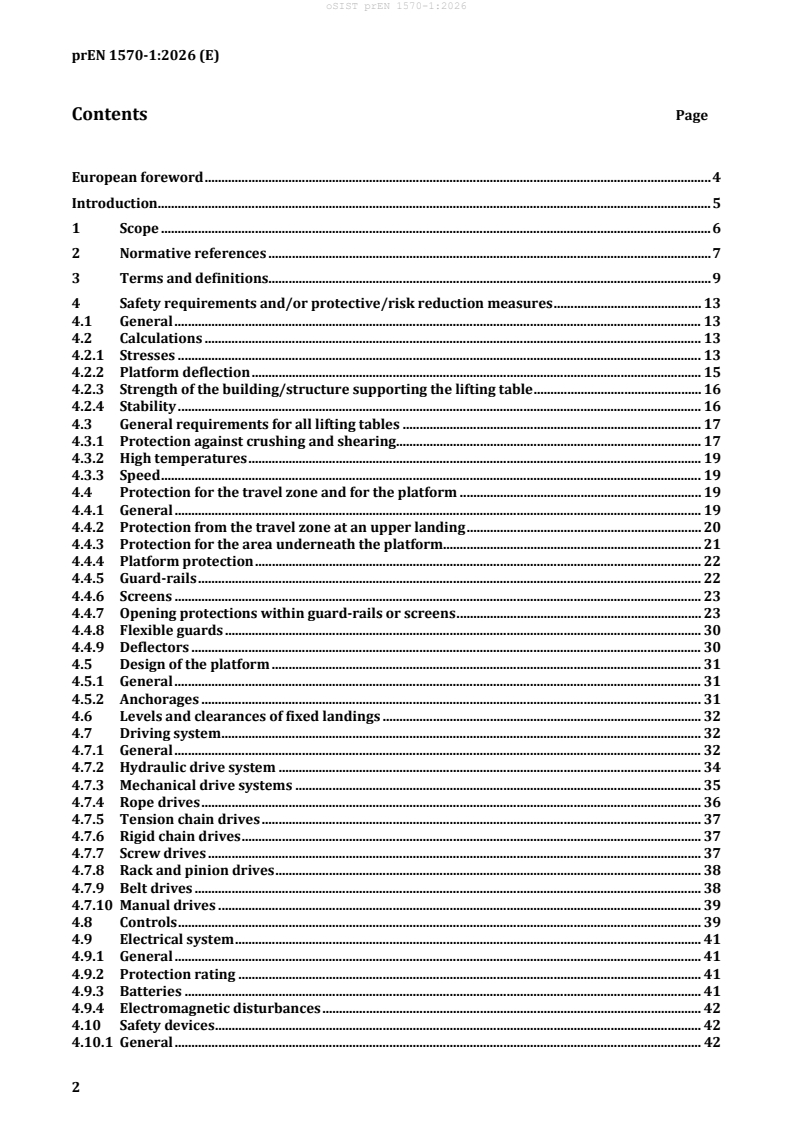
Contents Page
European foreword . 4
Introduction. 5
1 Scope . 6
2 Normative references . 7
3 Terms and definitions. 9
4 Safety requirements and/or protective/risk reduction measures . 13
4.1 General . 13
4.2 Calculations . 13
4.2.1 Stresses . 13
4.2.2 Platform deflection . 15
4.2.3 Strength of the building/structure supporting the lifting table . 16
4.2.4 Stability . 16
4.3 General requirements for all lifting tables . 17
4.3.1 Protection against crushing and shearing. 17
4.3.2 High temperatures . 19
4.3.3 Speed . 19
4.4 Protection for the travel zone and for the platform . 19
4.4.1 General . 19
4.4.2 Protection from the travel zone at an upper landing . 20
4.4.3 Protection for the area underneath the platform. 21
4.4.4 Platform protection . 22
4.4.5 Guard-rails . 22
4.4.6 Screens . 23
4.4.7 Opening protections within guard-rails or screens . 23
4.4.8 Flexible guards . 30
4.4.9 Deflectors . 30
4.5 Design of the platform . 31
4.5.1 General . 31
4.5.2 Anchorages . 31
4.6 Levels and clearances of fixed landings . 32
4.7 Driving system . 32
4.7.1 General . 32
4.7.2 Hydraulic drive system . 34
4.7.3 Mechanical drive systems . 35
4.7.4 Rope drives . 36
4.7.5 Tension chain drives . 37
4.7.6 Rigid chain drives . 37
4.7.7 Screw drives . 37
4.7.8 Rack and pinion drives . 38
4.7.9 Belt drives . 38
4.7.10 Manual drives . 39
4.8 Controls . 39
4.9 Electrical system . 41
4.9.1 General . 41
4.9.2 Protection rating . 41
4.9.3 Batteries . 41
4.9.4 Electromagnetic disturbances . 42
4.10 Safety devices . 42
4.10.1 General . 42
4.10.2 Safety edges . 42
4.10.3 Maintenance support . 43
4.11 Additional requirements for mobile lifting tables . 43
4.12 Additional requirements for lifting tables in AGVs and in skillet-lines . 46
5 Verification of the safety requirements and/or measures. 47
5.1 General . 47
5.2 Design check . 49
5.3 Manufacturing check . 49
5.4 Visual verification . 49
5.5 Practical test . 49
5.6 Electrical tests . 50
6 Instructions for the user . 50
6.1 General . 50
6.2 Marking . 50
6.3 Instructions for use . 52
6.4 Instructions for installation . 53
6.5 Instructions for maintenance and inspection . 54
Annex A (normative) Test procedures. 56
Annex B (informative) List of significant hazards . 58
Annex C (normative) Manual force measurements methods . 62
C.1 Horizontal movement of mobile lifting tables . 62
C.2 Maximum allowable forces for raising and lowering manually operated lifting tables . 62
Annex D (normative) Dimensions of steps and ladders . 63
Annex E (informative) Sign pictograms . 65
Annex F (informative) Controls and corresponding pictograms . 67
F.1 General . 67
F.2 Requirements according to 4.8.3 . 67
Annex G (informative) Risk when passing an upper landing . 70
Annex H (informative) Guide to travel zone risks . 71
H.1 General . 71
H.2 Landing, risk question 1. 72
H.3 Landing, risk question 2 and 3 . 73
H.4 Platform, risk question 4 . 74
H.5 Platform, risk question 5 and 6 . 75
Annex ZA (informative) Relationship between this European Standard and the essential
requirements of Regulation (EU) 2023/1230 aimed to be covered . 76
Bibliography . 80
European foreword
This document (prEN 1570-1:2026) has been prepared by Technical Committee CEN/TC 98 “Lifting
platforms”, the secretariat of which is held by DIN.
This document is currently submitted to the CEN Enquiry.
This document will supersede EN 1570-1:2024.
This document has been prepared under a standardization request addressed to CEN by the European
Commission. The Standing Committee of the EFTA States subsequently approves these requests for its
Member States.
For the relationship with EU Legislation, see informative Annex ZA, which is an integral part of this
document.
The revisions to the standard are based mainly on the following points, which are embedded throughout
the document:
— detailed clarification of the border line between EN 1570-1 and EN 280-1;
— corporate the results of the GAP analysis;
— alignment to the Machinery Regulation.
Introduction
This document is a type-C standard as stated in EN ISO 12100.
This document is of relevance, in particular, for the following stakeholder groups representing the market
players with regard to machinery safety:
— machine manufacturers (small, medium and large enterprises);
— health and safety bodies (regulators, accident prevention organizations, market surveillance, etc.).
Others can be affected by the level of machinery safety achieved with the means of the document by the
above-mentioned stakeholder groups:
— machine users/employers (small, medium and large enterprises);
— machine users/employees (e.g. trade unions, organizations for people with special needs);
— service providers, e.g. for maintenance (small, medium and large enterprises);
— consumers (in the case of machinery intended for use by consumers)
The above-mentioned stakeholder groups have been given the possibility to participate at the drafting
process of this document. The machinery concerned and the extent to which hazards, hazardous
situations or hazardous events are covered are indicated in the Scope of this document.
When requirements of this type-C standard are different from those which are stated in type-A or -B
standards, the requirements of this type-C standard take precedence over the requirements of the other
standards for machines that have been designed and built according to the requirements of this type-C
standard.
1 Scope
1.1 This document specifies the safety requirements for lifting tables which fulfil the following
characteristics:
— serving no more than 2 fixed landings but able to pass a fixed landing and,
— having a vertical travel speed of no more than 0,15 m/s, unless the lifting table is safe by position
and,
— raising or lowering goods (with or without operator(s) and/or authorized person(s)) with a
fixed, movable or mobile lifting table or,
— raising or lowering operator(s) and/or authorized person(s) with or without goods, to positions
where they can carry out work from a fixed lifting table that is guided throughout its vertical
travel only.
1.2 This document specifies the appropriate technical measures for eliminating and reducing the risks
arising from the significant hazards listed in Annex B.
1.3 This document does not apply to the following equipment:
— lifting tables with a vertical travel speed exceeding 0,15 m/s, unless the lifting table is safe by
position;
— lifting tables, serving more than 2 fixed landings of a construction, for lifting goods, with a vertical
travel speed not exceeding 0,15 m/s (EN 1570-2:2016);
— lifting tables, serving more than 2 fixed landings of a construction, for lifting operators, with a vertical
travel speed not exceeding 0,15 m/s;
— lifting tables carrying operators and installed in full enclosures with a vertical travel speed not
exceeding 0,15 m/s;
— lifting tables used on ships;
— lifting tables designed for artists and stage set features during artistic performances
(EN 17206:2020);
— power operated lifting platforms for persons with impaired mobility (EN 81-41:2010);
— mobile lifting tables for airport ground support equipment (EN 1915-2:2001+A1:2009 and
EN 12312-1:2013);
— mobile elevating work platforms (EN 280-1:2022);
— vehicle servicing lifts (EN 1493:2022);
— mobile lifting tables used for firefighting (EN 1777:2010);
— mobile lifting tables with a horizontal travelling speed of more than 1,6 m/s;
— rail dependent storage and retrieval equipment (EN 528:2021);
— scissor lift pallet trucks (EN ISO 3691-5:2015);
— lifting tables suspended from a ceiling.
1.4 This document does not consider the requirements for:
— operation in severe conditions (e.g. extreme climates, freezer applications, strong magnetic fields);
— operation subject to special rules (e.g. potentially explosive atmospheres, mines);
— handling of loads, the nature of which could lead to dangerous situations (e.g. molten metal, acids,
radiating materials, particularly brittle loads, loose loads (gravel, tubes));
— hazards occurring during construction, transportation, and disposal;
— equipment installed on the load platform or the replacing or maintaining of it;
— integration into broader systems or other machines, etc.;
— cable-less controls, i.e. wireless;
— lifting tables where the hydraulic pressure is derived directly from gas pressure;
— lifting tables powered by internal combustion engines.
This document is not applicable to lifting tables manufactured before the date of its publication.
2 Normative references
The following documents are referred to in the text in such a way that some or all of their content
constitutes requirements of this document. For dated references, only the edition cited applies. For
undated references, the latest edition of the referenced document (including any amendments) applies.
EN 280-1:2022, Mobile elevating work platforms - Part 1: Design calculations - Stability criteria -
Construction - Safety - Examinations and tests
EN 1493:2022, Vehicle lifts
EN 12453:2017+A1:2021, Industrial, commercial and garage doors and gates — Safety in use of power
operated doors — Requirements and test methods
EN 60204-1:2018, Safety of machinery - Electrical equipment of machines - Part 1: General requirements
(IEC 60204-1:2016, modified)
EN 60204-32:2008, Safety of machinery - Electrical equipment of machines - Part 32: Requirements for
hoisting machines (IEC 60204-32:2008)
EN 60529:1991, Degrees of protection provided by enclosures (IP Code) (IEC 60529:1989)
EN 60947-5-1:2017, Low-voltage switchgear and controlgear - Part 5-1: Control circuit devices and
switching elements - Electromechanical control circuit devices (IEC 60947-5-1:2016)
As impacted by EN 60529:1991/AC:2006-12, EN 60529:1991/A1:2000, EN 60529:1991/A2:2013 and EN
60529:1991/A2:2013/AC:2019-02.
As impacted by EN 60947-5-1:2017/AC:2020-05.
EN 60947-5-3:2013, Low-voltage switchgear and controlgear - Part 5-3: Control circuit devices and
switching elements - Requirements for proximity devices with defined behaviour under fault conditions
(PDDB) (IEC 60947-5-3:2013)
EN 61310-2:2008, Safety of machinery - Indication, marking and actuation - Part 2: Requirements for
marking (IEC 61310-2:2007)
EN IEC 61496-1:2020, Safety of machinery - Electro-sensitive protective equipment - Part 1: General
requirements and tests (IEC 61496-1:2020)
EN IEC 61496-2:2020, Safety of machinery - Electro-sensitive protective equipment - Part 2: Particular
requirements for equipment using active opto-electronic protective devices (AOPDs) (IEC 61496-2:2020)
EN 61800-5-2:2017, Adjustable speed electrical power drive systems - Part 5-2: Safety requirements –
Functional (IEC 61800-5-2:2016)
EN IEC 60947-5-2:2020, Low-voltage switchgear and controlgear — Part 5-2: Control circuit devices and
switching elements — Proximity switches
EN ISO 4413:2010, Hydraulic fluid power - General rules and safety requirements for systems and their
components (ISO 4413:2010)
EN ISO 11161:2007, Safety of machinery - Integrated manufacturing systems - Basic requirements (ISO
11161:2007)
EN ISO 12100:2010, Safety of machinery - General principles for design - Risk assessment and risk reduction
(ISO 12100:2010)
EN ISO 13849-1:2023, Safety of machinery - Safety-related parts of control systems - Part 1: General
principles for design (ISO 13849-1:2023)
EN ISO 13850:2015, Safety of machinery - Emergency stop function - Principles for design (ISO 13850:2015)
EN ISO 13855:2024, Safety of machinery - Positioning of safeguards with respect to the approach of the
human body (ISO 13855:2024)
EN ISO 13856-2:2013, Safety of machinery - Pressure-sensitive protective devices - Part 2: General
principles for design and testing of pressure-sensitive edges and pressure-sensitive bars (ISO 13856-2:2013)
EN ISO 13857:2019, Safety of machinery - Safety distances to prevent hazard zones being reached by upper
and lower limbs (ISO 13857:2019)
EN ISO 14119:2025, Safety of machinery - Interlocking devices associated with guards - Principles for
design and selection (ISO 14119:2024)
EN ISO 14120:2015, Safety of machinery - Guards - General requirements for the design and construction
of fixed and movable guards (ISO 14120:2015)
EN ISO 14122-3:2016, Safety of machinery - Permanent means of access to machinery - Part 3: Stairs,
stepladders and guard-rails (ISO 14122-3:2016)
ISO 606:2015, Short-pitch transmission precision roller and bush chains, attachments, and associated chain
sprockets
As impacted by EN IEC 60947-5-2:2020/A11:2022.
ISO 2408:2017, Steel wire ropes - Requirements
ISO 4301-1:2016, Cranes - Classification - Part 1: General
ISO 4347:2015, Leaf chains, clevises and sheaves - Dimensions, measuring forces, tensile strengths and
dynamic strengths
ISO 11228-1:2021, Ergonomics - Manual handling - Part 1: Lifting, lowering and carrying
ISO 11228-2:2007, Ergonomics - Manual handling - Part 2: Pushing and pulling
ISO 16625:2025, Cranes and hoists - Selection of wire ropes, drums and sheaves
3 Terms and definitions
For the purposes of this document, the terms and definitions given in EN ISO 12100:2010 and the
following apply.
ISO and IEC maintain terminological databases for use in standardization at the following addresses:
— IEC Electropedia: available at https://www.electropedia.org/
— ISO Online browsing platform: available at https://www.iso.org/obp
3.1
lifting table
lifting device with a load supporting platform rigidly guided throughout its travel
Note 1 to entry: A scissor lift or mast lift for example.
3.2
fixed lifting table
lifting table where the place of installation is not intended to be changed, according to the manufacturer’s
instructions
3.3
movable lifting table
lifting table where the place of installation can be readily changed without integrated devices
Note 1 to entry: By use of a crane, forklift or similar for example.
3.4
mobile lifting table
lifting table which is mobile by one or more integrated devices
Note 1 to entry: By use of wheels or air cushions for example.
3.5
Horizontally guided mobile lifting table
lifting table which runs on a pre-set route
Note 1 to entry: Running on tracks or in rails for example.
3.6
maintenance support
device that can be set up in such a way that maintenance and repair work below the platform can be
carried out safely
3.7
self-propelled lifting table
lifting table, other than vehicle mounted, which is capable of horizontal movement under its own power
3.8
operator
person who is trained and authorised/permitted by the duty holder, to operate the lifting table, according
to the manufacturer’s instructions
Note 1 to entry: The machine owner is considered as the duty holder.
3.9
authorised person
person whose presence in the area is authorised/permitted by the operator and whose safety is the
responsibility of the operator
3.10
fixed landing
permanent level of the construction for loading and unloading the lifting table
3.11
variable landing
non-permanent level for loading and unloading of the lifting table
Note 1 to entry: Vehicle serving for example.
3.12
platform
part of the lifting table (including extensions) designed to accommodate the working load and/or
person(s) accompanying the goods or carrying out work; fork arms are considered as a load platform for
goods only
3.13
rated load
load that consists of goods, persons, tools, and material acting vertically on the platform and that the
manufacturer has stated the machine is capable of lifting/lowering when used in accordance with the
instruction manual
3.14
structural load
load, excluding rated load, comprising of any equipment that is fixed on the platform
Note 1 to entry: Structural load can include guard-rails, gates, roller conveyors etc.
Note 2 to entry: Structural load shall be considered as part of the lifting table self-weight.
3.15
guard
part of the machine or the surrounding structure specifically used to provide protection by means of a
physical barrier
3.16
maximum working pressure
highest pressure in the hydraulic system at which it is intended to operate under normal working
conditions with rated load and, if any, structural load
3.17
travel zone
space through which the lifting mechanism and load, platform, and any attachment to it moves
3.18
non-public area
area to which access is restricted only to persons who are authorised to be in that area, and not accessible
to the public
3.19
public area
space open to persons without specific training, instruction or awareness including children
3.20
vertical travel speed
average lifting and lowering speed of the platform when measured throughout its normal travel range
3.21
screen
permanent protection from access to the hazard for the whole body, also called distance guards in
EN ISO 14120:2015
3.22
guard-rail
device for protection against accidental fall or accidental access to a hazardous area, with which stairs,
step ladders, landings or platforms and walkways (level surface used for moving from one point to
another) can be equipped
3.23
removable guard-rail
guard-rail designed to be removable without the use of a tool
Note 1 to entry: Bolted guard-rails are not considered removable.
3.24
enclosure
permanent protection where the whole of the travel zone is protected with rigid guards to make the lifting
table inaccessible whilst in operation, i.e., safe by position
3.25
automatically controlled lifting table
lifting table whose operating sequence is determined by a control program, which can be semi-automatic
when operations are initiated by an operator, or fully automatic when no operator intervention is
required
3.26
gate
opening part within a guard-rail, enclosure, or screen, to give access from a landing or a platform
3.27
inward opening gate
platform mounted inward opening gate is always opened towards the centre of the platform; and a
landing mounted inward opening gate is opened away from the centre of the platform
3.28
outward opening gate
platform mounted outward opening gate is always opened away from the centre of the platform; and a
landing mounted outward opening gate is opened towards the centre of the platform
3.29
safe by position
condition in which a lifting table, any part of a lifting table, or the load is located so that it cannot be
reached or accessed during operation because access is prevented either by fixed or movable guarding
measures complying with Clause 4 or by permanent, non-removable structural elements such as parts of
the building, thereby avoiding hazards to persons or goods in accordance with EN ISO 13857:2019
3.30
remote control
cable connected control device, fixed or pendant, that is not situated on the platform
3.31
hinged connecting plate
plate mounted to the edge of the platform by a hinge to connect the platform to a landing (fixed or
variable)
3.32
unassisted hinged connecting plate
hinged connecting plate that is entirely manually operated
3.33
assisted hinged connecting plate
hinged connecting plate that is counterbalanced to reduce the manual effort of operating the plate
Note 1 to entry: Counterbalanced can be by spring or weights for example.
3.34
power actuated hinged connecting plate
hinged connecting plate that requires no manual effort to operate
3.35
interlocking device
mechanical, electrical, or other type of device, the purpose of which is to prevent the operation of
hazardous machine functions under specified conditions (generally as long as a guard is not closed)
[SOURCE: EN ISO 12100:2010, 3.28.1]
3.36
skillet-line
system utilising platforms (skillets) to transport materials or products through various assembly
operations providing access around the perimeter of the product, enabling the worker to travel with the
product as it is conveyed through the various stages of assembly
3.37
AGV
driverless industrial truck that follows marked lines or wires on the floor, or uses radio or satellite signals,
vision cameras, magnets, or lasers for navigation to transport loads
3.38
externally operated non-return valve
non-return check valve that can be overridden by external means e.g., actuated electrically or manually
3.39
rigid guarding
physical, non-flexible, barrier
Note 1 to entry: A physical barrier can be a guard-rail or wall for example.
3.40
fall protection device
device intended to prevent persons from falling from a lifting table or from a fixed landing, by providing
a physical barrier, e.g. guard rails, gates, screens
4 Safety requirements and/or protective/risk reduction measures
4.1 General
Machinery shall comply with the safety requirements and/or protective/risk reduction measures of this
clause. In addition, the machine shall be designed according to the principles of EN ISO 12100:2010 for
relevant, but not significant hazards, not dealt with by this document.
4.2 Calculations
4.2.1 Stresses
4.2.1.1 The lifting table shall be designed in accordance with usual calculation codes and good
engineering practice and all failure modes of the material shall be considered, including fatigue failure.
4.2.1.2 The stresses in any part of the lifting table assessed using the permissible stress method shall
not, under normal working conditions, exceed the lowest of the following values:
1) 0,66 times the yield stress of the material used; or
2) 0,50 times the ultimate tensile stress of the material used.
4.2.1.3 The stresses shall be calculated for a lifting table carrying its rated load and, if any, structural
load whilst being used in compliance with the instructions for use, see 6.3.
The loads shall include all real static and dynamic forces, both vertical and horizontal, any wind forces,
and all forces applied to the platform during loading and unloading. In case of extending part(s) of the
platform, the calculations shall consider the extension in the worst condition.
If wind forces are to be considered in the calculations, EN 280-1:2022, 4.2.3.3 shall be applied.
4.2.1.4 The minimum dynamic forces to be used for the calculations set out under 4.2.1.3 shall result
from:
1) the total vertical load (this includes the rated load and, if any, structural load, and the self-weight of
the moving parts of the structure) increased by the dynamic factor for the category of lifting table
shown in Table 1;
2) the horizontal load coefficient for the category of lifting table shown in Table 1, taken as acting
horizontally at the platform level in the direction causing the maximum stress in the part being
considered.
Table 1 — Load factors for lifting tables
b
Lift category Dynamic factor Horizontal load Lifetime Application
coefficient [in % of minimum load
the rated load] cycles under full
load [ × 10 ]
a
1 1,4 10 128 Lifting tables for
general purpose.
Lifting tables with a
clearly defined
lifting load and
where other forces
2 1,1 2,5 8
can be excluded;
height adjustment
without systematic
lateral forces.
Lifting tables suited
for the use of
manual work; e.g.
3 1,2 5,0 32
adjustable height
workstation.
Lifting tables suited
for crossing with,
e.g. manually
operated industrial
trucks, electric
pallet-stacking
4 1,3 10 128
trucks with a
maximum braking
of 10 %.
Lifting tables with
mounted gravity
conveyors.
Lifting tables suited
for a high number of
5 1,4 10 512 cycles e.g. for fully
automatic
production lines.
Lifting tables used
c d a
6 1,6 20 128
in skillet lines.
Lifting tables used
c d a
7 1,8 20 128
as part of AGVs.
When a lifting table is crossed by vehicles, or is integrated in a handling device, the lateral forces have to be
verified in individual cases. Higher horizontal load coefficients have to be established if required.
a
This minimum number of cycles shall be increased by the manufacturer according to the use of the lifting table.
b
When load cycle is used, in relation to lifting categories, the lifetime of lifting tables is generally 10 years when maintained
in accordance with the instructions for use.
c
Where skillet-lines or AGVs are used on uneven floors/driveways, the dynamic factor shall be increased to ensure that
the load bearing structure of the lifting table withstands the increased forces.
d
Horizontally moving lifting tables with high apex speeds, whilst turning, may require a higher value for the horizontal
load coefficient.
When determining the minimum dynamic forces used in the calculations, the following shall be taken into
consideration:
3) where rigid guarding prevents loading or unloading across a side, or other means prevent force
transmission to the platform in a particular direction, the horizontal load coefficient in this direction
need not be considered;
4) that lifting tables are classified in 7 categories (called lift category) depending on the use for which
they are designed. The dynamic factor, horizontal load coefficient and number of cycles used in the
design calculations shall be as defined in Table 1;
5) any likely wind forces, shall be in addition to the horizontal load coefficient calculations.
4.2.1.5 If operators and/or authorized persons are to be carried on the platform, their load shall be
taken as 80 kg, concentrated in an area of 0,2 m by 0,2 m for each person, spaced apart at 0,5 m centres
and placed in the most unfavourable position on the platform for stress and tilt calculations.
4.2.1.6 The use of the maintenance support(s) when applied according to the instructions fo use, see
6.3, shall not cause permanent deformation of the normal load bearing parts.
4.2.2 Platform deflection
When the lifting table is not designed for a specific loading, it shall be designed to meet all the following
load requirements (see Figure 1):
— firstly, the rated load evenly distributed over the usable platform area;
— secondly, half the rated load distributed over half the usable platform length or longest side of the
platform;
— finally, one third of the rated load distributed over half the usable platform width or shortest side of
the platform.
The load requirements shall be fulfilled when the platform is in the worst stressed position.
If the lifting table is driven by a scissor mechanism, the longest side is considered as the side parallel to
the scissor arms and the shortest side is considered as the side perpendicular to the scissor arms.
If the lifting table is driven by a non-scissor mechanism, the permissible loading configuration that the
machine is designed for shall be mentioned in the instructions for use (see 6.3.1).
Key
l length
w width
Figure 1 — Load distribution requirements
In neither case shall hazardous, tilting or deflection take place when used as intended by design. The
maximum tilting or deflection shall not exceed that shown in Figure 2 where:
a) is the maximum tilting or deflection (y) of any side up to 2,0 m (l) long and is y = (1+ (2 − l)) %;
b) is the maximum tilting or deflection (y) of any side above 2,0 m (l) long and is y = 1,0 %.
Key
y percentage tilting or deflection of a side l
l length of the side of a lifting table platform (in metres)
a maximum tilting or deflection of any side up to 2,0 m
b maximum tilting or deflection of any side above 2,0 m
Figure 2 — Deflection of platform
4.2.3 Strength of the building/structure supporting the lifting table
The support (and, if appropriate, the load-bearing structure of the construction) to which the lifting table
is attached shall be built to withstand all the reasonably foreseeable static and dynamic vertical and
horizontal forces generated by both the load and the lifting table itself during normal operation and
exceptional operating conditions, e.g. anti-fall device operation.
The design shall address all dynamic forces and all externally imposed forces, including those caused by
load transfer on and off the platform and those caused by loading equipment.
These forces and loads are to be conveyed to the construction structural engineers on request to ensure
the construction is designed and built in a manner to support the lifting table and they shall be included
in the instructions for installation, as required in 6.4.6.
4.2.4 Stability
4.2.4.1 The calculated factor of safety shall not be less than 1,3. This shall be calculated by dividing
the sum of all the stabilizing moments by the sum of all the overturning moments, including the relevant
horizontal load coefficient as defined in 4.2.1.4. The overturning moments are to include all dynamic
forces and all externally imposed forces, including those caused by transfer on and off the platform and
those caused by operators and authorized persons as defined in 4.2.4.2. For this calculation the rated load
shall be evenly distributed over an area half the length times half the width of the platform, in any
overturning position.
If the lifting table is capable of tilting, the worst overturning position taking the tilt function into account
shall be considered.
In the case of mobile or movable lifting tables, it shall be considered that they are raising and lowering
on a slope of 2,5 % (1 in 40) in the worst direction for stability.
For these calculations it shall be considered that stabilizers are correctly set.
4.2.4.2 Where operators and/or authorized person(s) enter or are carried on the platform, the worst-
case overturning moment caused by
...