

EN 934-1:2008
(Main)Admixtures for concrete, mortar and grout - Part 1: Common requirements
- Abstract
This European Standard specifies the common requirements for all admixtures covered by EN 934-2, EN 934-3, EN 934-4 and EN 934-5, which contain the specific requirements for each type of admixture.
The requirements for corrosion behaviour are not applicable to chloride based admixtures.
- Status
- Published
- Publication Date
- 22-Jan-2008
- Technical Committee
- CEN/TC 104 - Concrete ( performance, production, placing and compliance criteria )
- Drafting Committee
- CEN/TC 104/SC 3 - Admixtures for concrete
- Current Stage
- 9093 - Decision to confirm - Review Enquiry
- Start Date
- 26-Jun-2026
- Completion Date
- 07-Oct-2026

Overview
EN 934-1:2008 is a European Standard developed by CEN that specifies the common requirements for admixtures used in concrete, mortar, and grout. It serves as the foundation for the specific performance and quality criteria detailed in related parts EN 934-2 through EN 934-5. This standard ensures that all admixtures conform to uniform quality measures vital for construction durability, safety, and performance.
Key highlights include general physical and chemical requirements, corrosion behavior criteria, and the inclusion of approved and declared substance lists for admixture ingredients. EN 934-1:2008 supports consistent evaluation and conformity testing across European markets, enhancing the reliability and safety of cementitious products in construction.
Key Topics
- Scope and Application: Establishes baseline requirements applicable to all standard admixtures covered in subsequent EN 934 series parts.
- General Requirements:
- Homogeneity and uniformity in appearance
- Component integrity verified by infrared spectrum analysis
- Accurate density, dry material content, and pH level
- Limits on chlorine, water-soluble chloride, and alkali content
- Silicon dioxide content when silica exceeds 5% by mass
- Corrosion Behavior:
- Specifies testing according to EN 480-14 for admixtures containing substances outside approved or declared lists
- Approved substances do not require corrosion testing and are confirmed safe for embedded steel reinforcement
- Declared substances must be labeled and may have national usage restrictions
- Approved and Declared Substance Lists:
- Approved list includes acetates, aluminates, organic polymers (polycarboxylates, lignosulfonates), silica forms, surfactants, and others generally non-corrosive
- Declared list includes formates, sulfides, nitrates, nitrites, and thiocyanates which require declaration on product labels and may be regulated
- Special Requirements: Addresses evolving environmental and health considerations, including future directives related to admixtures in contact with drinking water
Applications
EN 934-1:2008 is essential for manufacturers, suppliers, and users of chemical admixtures in the construction industry, particularly those producing or using:
- Concrete admixtures improving workability, setting time, or strength
- Masonry mortar additives to enhance consistency and durability
- Grout mixtures for prestressing tendons ensuring structural integrity
- Sprayed concrete admixtures for tunnel linings or complex shapes
This standard ensures admixtures used in structural concrete are safe for embedded reinforcement steel by controlling corrosion potential. It also underpins environmental safety and compliance with European regulations, supporting sustainable construction practices.
Related Standards
EN 934-1:2008 works in conjunction with several complementary standards:
- EN 934-2: Concrete admixtures - Definitions, requirements, conformity, marking, and labelling
- EN 934-3: Admixtures for masonry mortar - Definitions, requirements, conformity, marking, and labelling
- EN 934-4: Admixtures for grout for prestressing tendons - Specifications and requirements
- EN 934-5: Admixtures for sprayed concrete - Requirements and conformity
- EN 480 series: Test methods for admixture properties including infrared analysis, chloride content, and corrosion susceptibility
- EN 196-2 / EN 197-1: Cement testing and composition standards relevant to admixture interactions
- ISO 758 / ISO 4316: Reference test methods for density and pH measurements of chemical admixtures
By adhering to EN 934-1:2008 and its related standards, industry professionals ensure the quality, safety, and regulatory compliance of admixtures used in modern concrete and mortar technologies.
Keywords: EN 934-1:2008, admixtures for concrete, mortar additives, grout admixtures, corrosion behavior, construction chemicals standard, concrete admixture requirements, European concrete standard, cementitious admixtures, EN 934 series, concrete admixture testing, concrete durability
Relations
- Effective Date
- 10-Jun-2026
- Effective Date
- 10-Jun-2026
- Effective Date
- 18-Mar-2026
- Effective Date
- 28-Jan-2026
- Effective Date
- 28-Jan-2026
- Effective Date
- 28-Jan-2026
- Effective Date
- 28-Jan-2026
- Effective Date
- 28-Jan-2026
- Effective Date
- 28-Jan-2026
- Effective Date
- 28-Jan-2026
- Refers
EN 480-6:2024 - Admixtures for concrete, mortar and grout - Test methods - Part 6: Infrared analysis - Effective Date
- 28-Jan-2026
- Effective Date
- 28-Jan-2026
- Effective Date
- 28-Jan-2026
- Refers
EN ISO 8030:1997 - Rubber and plastics hoses - Method of test for flammability (ISO 8030:1995) - Effective Date
- 28-Jan-2026
- Effective Date
- 28-Jan-2026
Get Certified
Connect with accredited certification bodies for this standard

DIBt (Deutsches Institut für Bautechnik)
German Institute for Building Technology.
DIN CERTCO
DIN Group product certification.

Aboma Certification B.V.
Specialized in construction, metal, and transport sectors.
Sponsored listings
Frequently Asked Questions
EN 934-1:2008 is a standard published by the European Committee for Standardization (CEN). Its full title is "Admixtures for concrete, mortar and grout - Part 1: Common requirements". This standard covers: This European Standard specifies the common requirements for all admixtures covered by EN 934-2, EN 934-3, EN 934-4 and EN 934-5, which contain the specific requirements for each type of admixture. The requirements for corrosion behaviour are not applicable to chloride based admixtures.
This European Standard specifies the common requirements for all admixtures covered by EN 934-2, EN 934-3, EN 934-4 and EN 934-5, which contain the specific requirements for each type of admixture. The requirements for corrosion behaviour are not applicable to chloride based admixtures.
EN 934-1:2008 is classified under the following ICS (International Classification for Standards) categories: 91.100.30 - Concrete and concrete products. The ICS classification helps identify the subject area and facilitates finding related standards.
EN 934-1:2008 has the following relationships with other standards: It is inter standard links to ISO 758:1976, ISO 4316:1977, EN ISO 1158:2026, EN 480-14:2006, EN ISO 2811-3:2001, EN 206-1:2000, EN 196-2:2025, EN 934-5:2007, EN 480-10:2009, EN ISO 1158:1998, EN 480-6:2024, EN 934-3:2009+A1:2012, EN 480-8:2012, EN ISO 8030:1997, EN 197-1:2011. Understanding these relationships helps ensure you are using the most current and applicable version of the standard.
EN 934-1:2008 is associated with the following European legislation: EU Directives/Regulations: 305/2011, 89/106/EEC; Standardization Mandates: M/128. When a standard is cited in the Official Journal of the European Union, products manufactured in conformity with it benefit from a presumption of conformity with the essential requirements of the corresponding EU directive or regulation.
EN 934-1:2008 is available in PDF format for immediate download after purchase. The document can be added to your cart and obtained through the secure checkout process. Digital delivery ensures instant access to the complete standard document.
Standards Content (Sample)
SLOVENSKI STANDARD
01-april-2008
Kemijski dodatki za beton, malto in injekcijsko maso - Kemijski dodatki za beton -
1. del: Splošne zahteve
Admixtures for concrete, mortar and grout - Part 1: Common requirements
Zusatzmittel für Beton, Mörtel und Einpressmörtel - Teil 1: Gemeinsame Anforderungen
Adjuvants pour béton , mortier et coulis - Partie 1 : Exigences communes
Ta slovenski standard je istoveten z: EN 934-1:2008
ICS:
91.100.30
2003-01.Slovenski inštitut za standardizacijo. Razmnoževanje celote ali delov tega standarda ni dovoljeno.
EUROPEAN STANDARD
EN 934-1
NORME EUROPÉENNE
EUROPÄISCHE NORM
January 2008
ICS 91.100.30
English Version
Admixtures for concrete, mortar and grout - Part 1: Common
requirements
Adjuvants pour béton, mortier et coulis - Partie 1 : Zusatzmittel für Beton, Mörtel und Einpressmörtel - Teil 1:
Exigences communes Gemeinsame Anforderungen
This European Standard was approved by CEN on 24 October 2007.
CEN members are bound to comply with the CEN/CENELEC Internal Regulations which stipulate the conditions for giving this European
Standard the status of a national standard without any alteration. Up-to-date lists and bibliographical references concerning such national
standards may be obtained on application to the CEN Management Centre or to any CEN member.
This European Standard exists in three official versions (English, French, German). A version in any other language made by translation
under the responsibility of a CEN member into its own language and notified to the CEN Management Centre has the same status as the
official versions.
CEN members are the national standards bodies of Austria, Belgium, Bulgaria, Cyprus, Czech Republic, Denmark, Estonia, Finland,
France, Germany, Greece, Hungary, Iceland, Ireland, Italy, Latvia, Lithuania, Luxembourg, Malta, Netherlands, Norway, Poland, Portugal,
Romania, Slovakia, Slovenia, Spain, Sweden, Switzerland and United Kingdom.
EUROPEAN COMMITTEE FOR STANDARDIZATION
COMITÉ EUROPÉEN DE NORMALISATION
EUROPÄISCHES KOMITEE FÜR NORMUNG
Management Centre: rue de Stassart, 36 B-1050 Brussels
© 2008 CEN All rights of exploitation in any form and by any means reserved Ref. No. EN 934-1:2008: E
worldwide for CEN national Members.
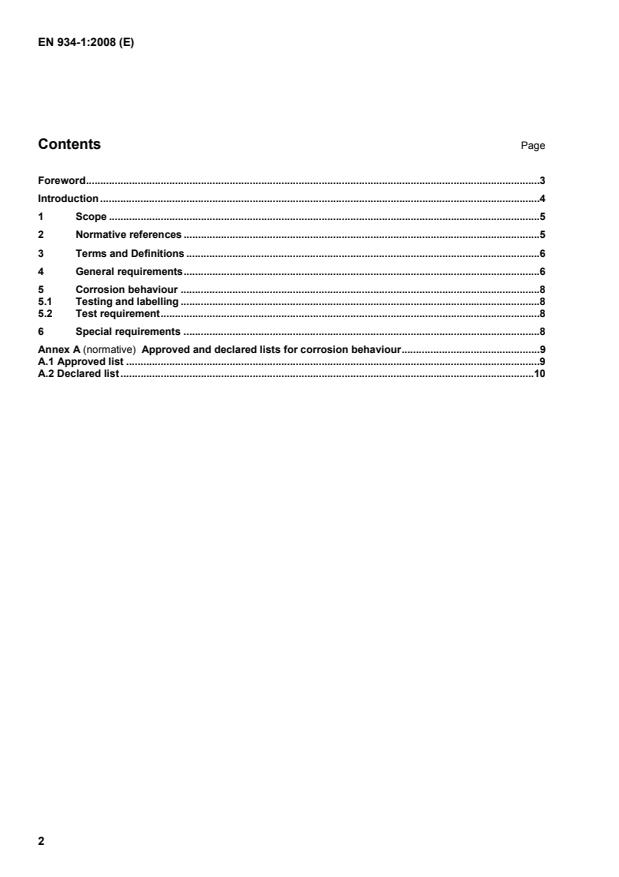
Contents Page
Foreword.3
Introduction .4
1 Scope.5
2 Normative references.5
3 Terms and Definitions .6
4 General requirements.6
5 Corrosion behaviour.8
5.1 Testing and labelling .8
5.2 Test requirement.8
6 Special requirements.8
Annex A (normative) Approved and declared lists for corrosion behaviour.9
A.1 Approved list .9
A.2 Declared list.10
Foreword
This document (EN 934-1:2008) has been prepared by Technical Committee CEN/TC 104 “Concrete and
related products”, the secretariat of which is held by DIN.
This European Standard shall be given the status of a national standard, either by publication of an identical
text or by endorsement, at the latest by July 2008, and conflicting national standards shall be withdrawn at the
latest by July 2008.
Attention is drawn to the possibility that some of the elements of this document may be the subject of patent
rights. CEN [and/or CENELEC] shall not be held responsible for identifying any or all such patent rights.
This standard is part of the series EN 934 “Admixtures for concrete, mortar and grout”, which is comprised of
the following additional parts:
- Part 2 Concrete admixtures – Definitions, requirements, conformity, marking and labelling
- Part 3 Admixtures for masonry mortar – Definitions, requirements, conformity, marking and labelling
- Part 4 Admixtures for grout for prestressing tendons - Definitions, requirements, conformity, marking
and labelling
- Part 5 Admixtures for sprayed concrete - Definitions, requirements, conformity, marking and labelling
- Part 6 Sampling, conformity control and evaluation of conformity
This draft European Standard is used with the standards of the EN 480 series which comprises the test
methods for admixtures.
This standard has been prepared under a mandate issued to CEN by the European Commission and the
European Free Trade Association and supports essential requirements of the Construction Products Directive.
According to the CEN/CENELEC Internal Regulations, the national standards organizations of the following
countries are bound to implement this European Standard: Austria, Belgium, Bulgaria, Cyprus, Czech
Republic, Denmark, Estonia, Finland, France, Germany, Greece, Hungary, Iceland, Ireland, Italy, Latvia,
Lithuania, Luxembourg, Malta, Netherlands, Norway, Poland, Portugal, Romania, Slovakia, Slovenia, Spain,
Sweden, Switzerland and the United Kingdom.
Introduction
This European Standard covers the requirements that are common to all admixtures. The general
requirements replace those which were previously included in EN 934 parts 2 to 5. They include the
requirements for the effect on corrosion behaviour when admixtures are used in concrete, mortar or grout
containing embedded metal.
The requirements for corrosion behaviour in this standard include an approved list and a declared list of active
substances used in some admixtures. These lists are based on experience, which shows that the use of
admixtures only containing substances on the approved list do not promote the corrosion of embedded steel.
Materials on the declared list are subject, in some countries, to national restrictions on their use for certain
applications and should be declared on the CE mark.
The specific requirements that characterise the performance of an admixture in a cementitous mix are detailed
in EN 934 parts 2 to 5.
The special requirements are new and relate to specific uses of admixtures and/or their effect on the
environment. It is anticipated that, in the future, special requirements will result from European legislation and,
for example, will be applicable to admixtures used in concrete or mortar in contact with drinking water and to
the release of dangerous regulated substances.
1 Scope
This European Standard specifies the common requirements for all admixtures covered by EN 934-2,
EN 934-3, EN 934-4 and EN 934-5, which contain the specific requirements for each type of admixture.
The requirements for corrosion behaviour are not applicable to chloride based admixtures.
2 Normative references
The following referenced documents are indispensable for the application of this document. For dated
references, only the edition cited applies. For undated references, the latest edition of the referenced
document (including any amendments) applies.
EN 196-2, Methods of testing cement - Part 2: Chemical analysis of cement
EN 197-1, Cement - Part 1: Composition, specifications and conformity criteria for common cements
EN 206-1:2000, Concrete - Part 1: Specification, performance, production and conformity
EN 480-6, Admixtures for concrete, mortar and grout – Test methods – Part 6: Infrared analysis
EN 480-8, Admixtures for concrete, mortar and grout – Test methods – Part 8: Determination
...