

EN 1332-4:2007
(Main)Identification card systems - Man-machine interface - Part 4: Coding of user requirements for people with special needs
General Information
- Abstract
This European Standard defines the data objects to be stored within an integrated circuit(s) card and exchanged in order to enable integrated circuit(s) card accepting terminals to identify specific user interface preferences. The preference information may be used by terminals to configure appropriate methods of communicating with the user during a transaction process.
The European Standard also specifies a mechanism for the retrieval of the user preference information from an integrated circuit(s) card and for the combination of data objects to form particular user profiles, through the assignment of unique tags.
Formats and detailed definitions of single data objects are specified, however, the exact method of storage of data within the integrated circuit(s) card is outside the scope of this European Standard.
This European Standard is applicable to the scenario where the cardholder operates the card accepting equipment (e.g. a cash dispenser, ticket machine, vending machine) and to integrated circuit(s) cards conforming to ISO/IEC 7816-4 and ISO/IEC 7816-6 and personalised to the individual cardholder.
- Status
- Published
- Publication Date
- 12-Jun-2007
- Withdrawal Date
- 30-Dec-2007
- Drafting Committee
- CEN/TC 224/WG 6 - User Interface
- Current Stage
- 9093 - Decision to confirm - Review Enquiry
- Start Date
- 28-Nov-2023
- Completion Date
- 23-Sep-2026

Overview
EN 1332-4:2007 - “Identification card systems - Man‑machine interface - Part 4: Coding of user requirements for people with special needs” is a European Standard from CEN that defines how user interface preferences for people with special needs are encoded on integrated circuit(s) cards. The standard specifies the data objects, tag-based identification and retrieval mechanisms that allow card‑accepting terminals (e.g., ATMs, ticket machines, vending machines) to detect and configure accessible interactions during a transaction.
Key topics and technical requirements
- Data objects and tags: Defines the set of user preference data objects and assigns unique tags so terminals can interpret combinations of preferences as user profiles.
- TLV structure: Uses Tag‑Length‑Value encoding principles (ASN.1/BER style) to structure preference data for interchange.
- Formats and definitions: Specifies formats and detailed definitions of individual data objects (for example: screen colour, speech output, screen reader, Braille display, captions/subtitles, input requirements, keyboard characteristics, time-outs).
- Retrieval mechanism: Describes how terminals retrieve preference information from cards conforming to ISO/IEC 7816‑4 and ISO/IEC 7816‑6.
- Scope limits: The standard defines data content and exchange mechanisms but does not mandate the physical storage method on the IC card.
- Privacy and consent: Information shall be stored on a card only with the cardholder’s consent. Card‑accepting devices must not retain data elements; any separate databases used for updates must comply with data protection legislation.
- Conformance: Guidance for claiming conformance and maintaining/updating the set of user requirement data objects (maintenance and application procedures included).
Practical applications and users
Who uses EN 1332‑4:
- Payment and transport card issuers who wish to store accessibility preferences on EMV/ISO 7816 cards.
- Terminal manufacturers (ATMs, ticketing, vending) implementing adaptive user interfaces that auto‑configure based on a cardholder’s needs.
- Accessibility and UX teams designing inclusive services for elderly and disabled users.
- System integrators and service providers wanting cross‑border, interoperable accessibility support.
Real‑world benefits:
- Automatic configuration of speech output, enlarged fonts, contrast settings, alternative input methods (Braille, on‑screen keyboard) and other assistive features at the point of service.
- Improved usability and independence for people with special needs across sectors and national borders.
Related standards
- ISO/IEC 7816‑4 (IC card commands and file organization)
- ISO/IEC 7816‑6 (Interindustry data elements)
- ISO/IEC 8825‑1 (ASN.1 encoding rules / BER)
- ISO 639 (language codes)
- Other parts of EN 1332: Part 1 (design principles), Part 2 (tactile identifier), Part 3 (keypads), Part 5 (raised tactile symbols) and related CEN guidance on accessible card‑activated devices.
Keywords: EN 1332-4:2007, identification card systems, man‑machine interface, user requirements, accessibility, integrated circuit card, ISO/IEC 7816, TLV, card accepting terminals.
Relations
- Effective Date
- 22-Dec-2008
- Effective Date
- 25-Aug-2026
- Effective Date
- 25-Aug-2026
- Effective Date
- 25-Aug-2026
- Effective Date
- 25-Aug-2026
- Effective Date
- 25-Aug-2026
- Effective Date
- 28-Jan-2026
- Effective Date
- 28-Jan-2026
- Effective Date
- 28-Jan-2026
- Effective Date
- 28-Jan-2026
- Effective Date
- 28-Jan-2026
- Effective Date
- 28-Jan-2026
- Effective Date
- 28-Jan-2026
- Effective Date
- 28-Jan-2026
Get Certified
Connect with accredited certification bodies for this standard

BSI Group
BSI (British Standards Institution) is the business standards company that helps organizations make excellence a habit.

NYCE
Mexican standards and certification body.
Sponsored listings
Frequently Asked Questions
EN 1332-4:2007 is a standard published by the European Committee for Standardization (CEN). Its full title is "Identification card systems - Man-machine interface - Part 4: Coding of user requirements for people with special needs". This standard covers: This European Standard defines the data objects to be stored within an integrated circuit(s) card and exchanged in order to enable integrated circuit(s) card accepting terminals to identify specific user interface preferences. The preference information may be used by terminals to configure appropriate methods of communicating with the user during a transaction process. The European Standard also specifies a mechanism for the retrieval of the user preference information from an integrated circuit(s) card and for the combination of data objects to form particular user profiles, through the assignment of unique tags. Formats and detailed definitions of single data objects are specified, however, the exact method of storage of data within the integrated circuit(s) card is outside the scope of this European Standard. This European Standard is applicable to the scenario where the cardholder operates the card accepting equipment (e.g. a cash dispenser, ticket machine, vending machine) and to integrated circuit(s) cards conforming to ISO/IEC 7816-4 and ISO/IEC 7816-6 and personalised to the individual cardholder.
This European Standard defines the data objects to be stored within an integrated circuit(s) card and exchanged in order to enable integrated circuit(s) card accepting terminals to identify specific user interface preferences. The preference information may be used by terminals to configure appropriate methods of communicating with the user during a transaction process. The European Standard also specifies a mechanism for the retrieval of the user preference information from an integrated circuit(s) card and for the combination of data objects to form particular user profiles, through the assignment of unique tags. Formats and detailed definitions of single data objects are specified, however, the exact method of storage of data within the integrated circuit(s) card is outside the scope of this European Standard. This European Standard is applicable to the scenario where the cardholder operates the card accepting equipment (e.g. a cash dispenser, ticket machine, vending machine) and to integrated circuit(s) cards conforming to ISO/IEC 7816-4 and ISO/IEC 7816-6 and personalised to the individual cardholder.
EN 1332-4:2007 is classified under the following ICS (International Classification for Standards) categories: 35.040 - Information coding; 35.240.15 - Identification cards. Chip cards. Biometrics. The ICS classification helps identify the subject area and facilitates finding related standards.
EN 1332-4:2007 has the following relationships with other standards: It is inter standard links to EN 1332-4:1999, ISO/IEC 7816-6:2004, ISO/IEC 7816-4:2005, ISO 639-1:2002, ISO 639-3:2007, ISO 639-2:1998, CEN/TR 10345:2013, EN 4160:2011, EN 15649-6:2009/FprA1, EN ISO 21530:2004, EN 571-1:1997, EN 1332-1:2009, EN 1545-1:2005, EN 1545-1:2015. Understanding these relationships helps ensure you are using the most current and applicable version of the standard.
EN 1332-4:2007 is available in PDF format for immediate download after purchase. The document can be added to your cart and obtained through the secure checkout process. Digital delivery ensures instant access to the complete standard document.
Standards Content (Sample)
2003-01.Slovenski inštitut za standardizacijo. Razmnoževanje celote ali delov tega standarda ni dovoljeno.Identifikationskartensysteme - Schnittstelle Mensch-Maschine - Teil 4: Codierung von Benutzeranforderungen für Personen mit besonderem BedarfSystemes de cartes d'identification - Interface homme-machine - Partie 4: Codage des prescriptions utilisateur pour les personnes ayant des besoins spécifiquesIdentification card systems - Man-machine interface - Part 4: Coding of user requirements for people with special needs35.240.15Identifikacijske kartice in sorodne napraveIdentification cards and related devices35.040Nabori znakov in kodiranje informacijCharacter sets and information codingICS:Ta slovenski standard je istoveten z:EN 1332-4:2007SIST EN 1332-4:2015en,fr,de01-maj-2015SIST EN 1332-4:2015SLOVENSKI
STANDARDSIST EN 1332-4:20041DGRPHãþD
EUROPEAN STANDARDNORME EUROPÉENNEEUROPÄISCHE NORMEN 1332-4June 2007ICS 35.040; 35.240.15Supersedes EN 1332-4:1999
English VersionIdentification card systems - Man-machine interface - Part 4:Coding of user requirements for people with special needsSystèmes de cartes d'identification - Interface homme-machine - Partie 4: Codage des prescriptions utilisateurpour les personnes ayant des besoins spécifiquesIdentifikationskartensysteme - Mensch-Maschine-Schnittstelle - Teil 4: Codierung vonBenutzeranforderungen für Personen mit besonderemBedarfThis European Standard was approved by CEN on 16 May 2007.CEN members are bound to comply with the CEN/CENELEC Internal Regulations which stipulate the conditions for giving this EuropeanStandard the status of a national standard without any alteration. Up-to-date lists and bibliographical references concerning such nationalstandards may be obtained on application to the CEN Management Centre or to any CEN member.This European Standard exists in three official versions (English, French, German). A version in any other language made by translationunder the responsibility of a CEN member into its own language and notified to the CEN Management Centre has the same status as theofficial versions.CEN members are the national standards bodies of Austria, Belgium, Bulgaria, Cyprus, Czech Republic, Denmark, Estonia, Finland,France, Germany, Greece, Hungary, Iceland, Ireland, Italy, Latvia, Lithuania, Luxembourg, Malta, Netherlands, Norway, Poland, Portugal,Romania, Slovakia, Slovenia, Spain, Sweden, Switzerland and United Kingdom.EUROPEAN COMMITTEE FOR STANDARDIZATIONCOMITÉ EUROPÉEN DE NORMALISATIONEUROPÄISCHES KOMITEE FÜR NORMUNGManagement Centre: rue de Stassart, 36
B-1050 Brussels© 2007 CENAll rights of exploitation in any form and by any means reservedworldwide for CEN national Members.Ref. No. EN 1332-4:2007: ESIST EN 1332-4:2015
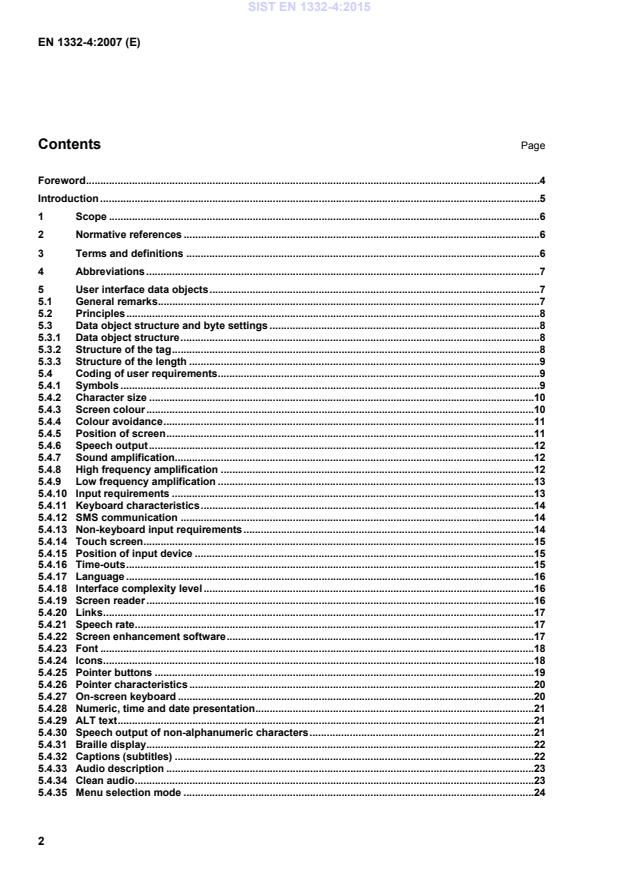
Summary of tags and meanings.28 Annex B (normative)
Maintenance of user requirements data objects.29 Annex C (normative)
Application for a new data object identifier.30 Bibliography.31
This European Standard is one of a series of standards, under the general title "Identification card systems - Man-machine interface" and the different parts are the following: Part 1 : Design principles for the user interface Part 2 : Dimensions and location of a tactile identifier for ID-1 cards Part 3 : Key-pads Part 4 : Coding of user requirements for people with special needs Part 5 : Raised tactile symbols for differentiation of application on ID-1 cards In addition there is a Technical Specification on Guidance on Design for Accessible Card Activated Devices. According to the CEN/CENELEC Internal Regulations, the national standards organizations of the following countries are bound to implement this European Standard: Austria, Belgium, Bulgaria, Cyprus, Czech Republic, Denmark, Estonia, Finland, France, Germany, Greece, Hungary, Iceland, Ireland, Italy, Latvia, Lithuania, Luxembourg, Malta, Netherlands, Norway, Poland, Portugal, Romania, Slovakia, Slovenia, Spain, Sweden, Switzerland and United Kingdom. SIST EN 1332-4:2015
[ISO/IEC 7816-4:2005] 3.2 data object
[ISO/IEC 7816-4:2005] 3.3 primitive/constructed data objects
[ISO/IEC 8825-1:2002] SIST EN 1332-4:2015
[ISO/IEC 7816-6:2004] 4 Abbreviations ASN.1 Abstract Syntax Notation One b8.b1 Bits one to eight of a byte (Isb) BCD Binary Coded Decimal ls Least significant byte ms Most significant byte PIN Personal Identification Number TLV Tag, length, value. 5 User interface data objects 5.1 General remarks Information shall only be stored on a card with the consent of the user. The interface device shall not retain the data elements or objects stored on the card. If a separate updating process exists it may retain a copy of the preference information in a database. This database shall conform to relevant data protection legislation. For each data object, the following descriptors may be present: purpose (a short description of the use of the given data object); format (giving the size of the data object and possibly a symbolic format used to describe the content); content (the exact definition for the coding of the data object); remarks (other information). Absence of a data object in the card indicates that no special requirements apply in the area concerned. Subclause 5.4 uses private tags in accordance with the registered Cardholder Included Requirements tag specified in ISO/IEC 7816-3 and ISO/IEC 7816-6. The defined data objects that may be present within an integrated circuit(s) card indicate user interface preferences. Presentation of the precise combination of user’s preferences specified in the data objects encoded on the card is dependent on the terminal’s capability to support the options. For example presentation may require the presence of a colour display or a loudspeaker. The ISO registered tag for Cardholder Requirements Included Features is 7F22. SIST EN 1332-4:2015
5.2 Principles The following principles apply to the identification of user preference data objects within this standard: data element is generally presented in the value field of a data object; data object is the concatenation of the following string of bytes: mandatory tag field, referred to as a tag; mandatory length field indicating the number of bytes of the value field; conditional value field of L bytes (when ‘L’ is not equal to ‘00’). 5.3 Data object structure and byte settings 5.3.1 Data object structure The following data object structures conforming to ISO/IEC 7816-4 are supported: primitive data object T L V where T = Tag, L = Length, V = Value constructed data object T L T1 L1 V1 T2 L2 V2 . Tn Ln Vn T = Tag of constructed data object L = Length of the string (template) T1 to Vn T1 = Tag of a data object L1 = Length of V1 V1 = Value 5.3.2 Structure of the tag The tag consists of one or two bytes. The coding of these bytes shall be consistent with the basic encoding rules of ASN.1 as defined in ISO/IEC 8825-1. Table 1 defines the first byte. SIST EN 1332-4:2015
- - 0 - - - - - Primitive data object - - 1 - - - - - Constructed data object - - - 1 1 1 1 1 Tag number contained in the next byte - range 31.127 - - - x x x x x Tag number - range 0 - 30 Not all equal to 1 The coding of the second byte of the tag, when present, is: b8 = 0; b7 to b1 = binary value of the tag number in the range 31.127. NOTE The first byte of tags of the primitive data objects defined in this document has the value ‘DF’. 5.3.3 Structure of the length All lengths are expressed in bytes. The length consists of one or more bytes. The coding of these bytes shall be consistent with the basic encoding rules of ASN.1 as defined in ISO/IEC 8825-1 and shall be as defined in Table 2. Table 2 — Coding of the length value Range Number of bytes 1st byte 2nd byte 3rd byte 0.127 1 binary value none none 0.255 2 ‘81’ binary value none 0.65,535 3 ‘82’ binary ms byte value ls byte 5.4 Coding of user requirements 5.4.1 Symbols Purpose: To indicate the preferred method of presentation of visual information, either via text, symbols, Braille or a combination of both. Format: 1 byte binary. Content: The content of this field is in accordance with Table 3. SIST EN 1332-4:2015
Remark: This data object is addressed through the use of tag number ‘DF52’. 5.4.4 Colour avoidance Purpose: To indicate specific colours or combination of colours to be avoided when displaying visual information to the user. Format: 1 byte binary. Content: The coding of the colour avoidance byte shall be in accordance with Table 5. Table 5 — Content of the colour avoidance data object b8 b7 b6 b5 b4 b3 b2 b1 Meaning - - - - - - - 1 Avoid display of information in red - - - - - - 1 - Avoid red/green colour combination - - - - - 1 - - Avoid blue/yellow colour combination - - - - 1 - - - Maximum contrast monochrome x x x x - - - - Reserved for future use. All bits set to zero Remark:
This data object is addressed through the use of tag number ‘DF53’. 5.4.5 Position of screen Purpose: To enable automatic height positioning of a screen to assist users in the reading of information. Format: 1 byte coded as two BCD digits. Content: The value of this object denotes the desired height of the centre of a visual display in decimetres (multiples of 100mm) relative to the ground or floor level. Remark: This data object is addressed through the use of tag number ‘DF54’. SIST EN 1332-4:2015
This data object is addressed through the use of tag number ‘DF55’. 5.4.7 Sound amplification Purpose: To enable sound amplification to be performed by the terminal for voice or other output information. Format: 1 byte binary. Content: The coding of the sound amplification byte shall be in accordance with Table 7. Table 7 — Content of the sound amplification data object b8 b7 b6 b5 b4 b3 b2 b1 Meaning - x x x x x x x Offset amount in dBA from the terminal’s normal sound le
...