

EN 15254-5:2009
(Main)Extended application of results from fire resistance tests - Non-loadbearing walls - Part 5: Metal sandwich panel construction
- Abstract
This part of EN 15254 defines rules for extended applications, provides guidance, and, where appropriate, defines procedures, for variations of certain parameters and factors associated with the design of internal and external non-loadbearing walls constructed of metal sandwich panels and that have been tested in accordance with EN 1364-1.
EN 15254-5 applies for self-supporting, double skin metal faced sandwich panels having an insulating core bonded to both facings as defined in EN 14509.
- Status
- Withdrawn
- Publication Date
- 03-Nov-2009
- Withdrawal Date
- 13-Oct-2026
- Technical Committee
- CEN/TC 127 - Fire safety in buildings
- Drafting Committee
- CEN/TC 127/WG 1 - Structural and separating elements
- Current Stage
- 9960 - Withdrawal effective - Withdrawal
- Start Date
- 25-Apr-2018
- Completion Date
- 14-Oct-2026



Relations
- Effective Date
- 08-Jun-2022
- Effective Date
- 28-Jan-2026
- Effective Date
- 28-Jan-2026
- Effective Date
- 28-Jan-2026
- Effective Date
- 28-Jan-2026
- Effective Date
- 28-Jan-2026
Get Certified
Connect with accredited certification bodies for this standard

DIBt (Deutsches Institut für Bautechnik)
German Institute for Building Technology.
DIN CERTCO
DIN Group product certification.

Kiwa BDA Testing
Building and construction product certification.
Sponsored listings
Frequently Asked Questions
EN 15254-5:2009 is a standard published by the European Committee for Standardization (CEN). Its full title is "Extended application of results from fire resistance tests - Non-loadbearing walls - Part 5: Metal sandwich panel construction". This standard covers: This part of EN 15254 defines rules for extended applications, provides guidance, and, where appropriate, defines procedures, for variations of certain parameters and factors associated with the design of internal and external non-loadbearing walls constructed of metal sandwich panels and that have been tested in accordance with EN 1364-1. EN 15254-5 applies for self-supporting, double skin metal faced sandwich panels having an insulating core bonded to both facings as defined in EN 14509.
This part of EN 15254 defines rules for extended applications, provides guidance, and, where appropriate, defines procedures, for variations of certain parameters and factors associated with the design of internal and external non-loadbearing walls constructed of metal sandwich panels and that have been tested in accordance with EN 1364-1. EN 15254-5 applies for self-supporting, double skin metal faced sandwich panels having an insulating core bonded to both facings as defined in EN 14509.
EN 15254-5:2009 is classified under the following ICS (International Classification for Standards) categories: 13.220.50 - Fire-resistance of building materials and elements; 91.060.10 - Walls. Partitions. Facades. The ICS classification helps identify the subject area and facilitates finding related standards.
EN 15254-5:2009 has the following relationships with other standards: It is inter standard links to EN 15254-5:2018, EN 14509:2013, EN 1364-1:1999, EN 1993-1-2:2024, EN 13501-2:2023, EN 1363-1:1999. Understanding these relationships helps ensure you are using the most current and applicable version of the standard.
EN 15254-5:2009 is associated with the following European legislation: EU Directives/Regulations: 305/2011, 89/106/EEC; Standardization Mandates: M/117. When a standard is cited in the Official Journal of the European Union, products manufactured in conformity with it benefit from a presumption of conformity with the essential requirements of the corresponding EU directive or regulation.
EN 15254-5:2009 is available in PDF format for immediate download after purchase. The document can be added to your cart and obtained through the secure checkout process. Digital delivery ensures instant access to the complete standard document.
Standards Content (Sample)
2003-01.Slovenski inštitut za standardizacijo. Razmnoževanje celote ali delov tega standarda ni dovoljeno.Erweiterter Anwendungsbereich der Ergebnisse von Feuerwiderstandsprüfungen - Nichttragende Wände - Teil 5: Sandwichelemente in MetallbauweiseApplication étendue des résultats d'essais de résistance au feu - Murs non porteurs - Partie 5 : Panneaux sandwich métalliques pour la constructionExtended application of results from fire resistance tests - Non-loadbearing walls - Part 5: Metal sandwich panel construction91.060.10Stene. Predelne stene. FasadeWalls. Partitions. Facades13.220.50Požarna odpornost gradbenih materialov in elementovFire-resistance of building materials and elementsICS:Ta slovenski standard je istoveten z:EN 15254-5:2009SIST EN 15254-5:2010en,de01-februar-2010SIST EN 15254-5:2010SLOVENSKI
STANDARD
EUROPEAN STANDARD NORME EUROPÉENNE EUROPÄISCHE NORM
EN 15254-5
November 2009 ICS 13.220.50; 91.060.10 English Version
Extended application of results from fire resistance tests - Non-loadbearing walls - Part 5: Metal sandwich panel construction
Application étendue des résultats d'essais de résistance au feu - Murs non porteurs - Partie 5 : Panneaux sandwiches métalliques pour la construction
Erweiterter Anwendungsbereich der Ergebnisse von Feuerwiderstandsprüfungen - Nichttragende Wände - Teil 5: Sandwichelemente in Metallbauweise This European Standard was approved by CEN on 5 October 2009.
CEN members are bound to comply with the CEN/CENELEC Internal Regulations which stipulate the conditions for giving this European Standard the status of a national standard without any alteration. Up-to-date lists and bibliographical references concerning such national standards may be obtained on application to the CEN Management Centre or to any CEN member.
This European Standard exists in three official versions (English, French, German). A version in any other language made by translation under the responsibility of a CEN member into its own language and notified to the CEN Management Centre has the same status as the official versions.
CEN members are the national standards bodies of Austria, Belgium, Bulgaria, Cyprus, Czech Republic, Denmark, Estonia, Finland, France, Germany, Greece, Hungary, Iceland, Ireland, Italy, Latvia, Lithuania, Luxembourg, Malta, Netherlands, Norway, Poland, Portugal, Romania, Slovakia, Slovenia, Spain, Sweden, Switzerland and United Kingdom.
EUROPEAN COMMITTEE FOR STANDARDIZATION
COMITÉ EUROPÉEN DE NORMALISATION EUROPÄISCHES KOMITEE FÜR NORMUNG
Management Centre:
Avenue Marnix 17,
B-1000 Brussels © 2009 CEN All rights of exploitation in any form and by any means reserved worldwide for CEN national Members. Ref. No. EN 15254-5:2009: ESIST EN 15254-5:2010
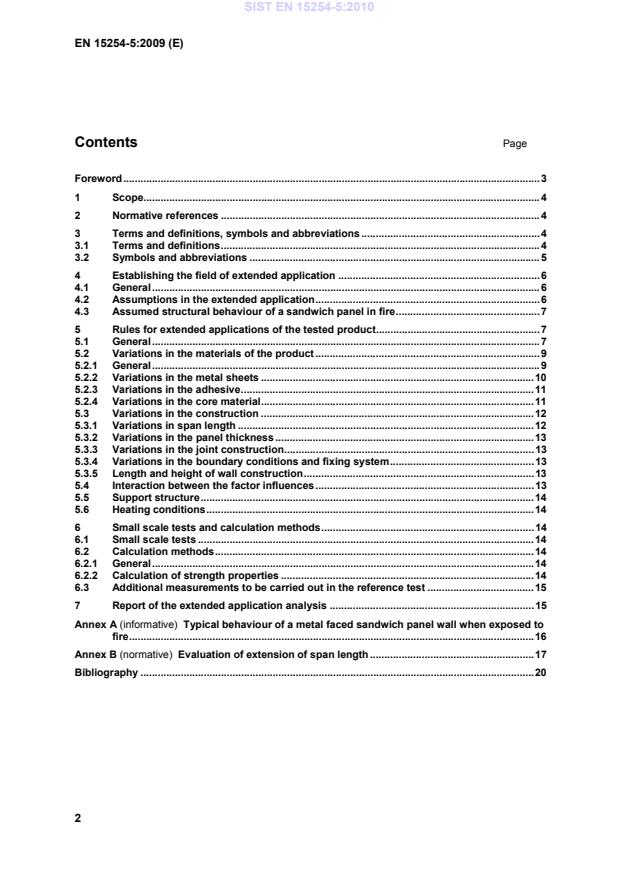
Typical behaviour of a metal faced sandwich panel wall when exposed to fire . 16Annex B (normative)
Evaluation of extension of span length . 17Bibliography . 20 SIST EN 15254-5:2010
3.1.1 direct field of application of test results outcome of a process (involving the application of defined rules) whereby a test result is deemed to be equally valid for variations in one or more of the product properties and/or intended end-use applications 3.1.2 extended field of application of test results outcome of a process (involving the application of defined rules that may incorporate calculation procedures) that predicts, for a variation of a product property and/or its intended end-use application(s), a test result on the basis of one or more test results to the same test standard 3.1.3 factor one of the possible variations that may be applied to a parameter 3.1.4 factor influence one of the potential causes of a change in the fire resistance due to a factor SIST EN 15254-5:2010
fixing device that fastens the panels to a support structure or to the test frame 3.1.6 fixing system system consisting of fastenings and possible other means to fasten the panels to a support structure or to the test frame 3.1.7 height of assembly for horizontally or vertically installed wall panels the height of the wall in the reference test or in the end-use application 3.1.8 length of assembly for horizontally or vertically installed wall panels the length of the wall in the reference test or in the end-use application 3.1.9 reference test fire resistance test in accordance with EN 1363-1 and EN 1364-1, and where applicable EN 1363-2, on which the extended application is based and the results of which are used as the main source of data for the extended application 3.1.10 stiching device for fixing panels to panels in the longitudinal joint 3.1.11 span length centre to centre distance between the supports of a panel and/or intermediate supports to which the sandwich panel is fixed 3.1.12 support structure construction onto which the panel wall is fastened in the end-use application 3.1.13 test frame frame containing the test construction for the purpose of mounting onto the furnace 3.2 Symbols and abbreviations For the purposes of this document, the following symbols and abbreviations apply. Ft,Ed
the tensile load on the fasteners
Fv,Ed
the shear load on the fasteners Ft,Rd
the design tensile load on the fastener at normal temperature Fv,Rd
the design shear load on the fastener at normal temperature L
span length
L1
distance between midspan of two adjacent panels SIST EN 15254-5:2010
overlap of the metal facing at the panel to panel joint b
width of panel c1
opening in adjacent metal sheet joints at normal room temperature on non exposed side c2
opening in adjacent metal sheet joints during the reference test on non exposed side fj
deflection of panel to panel joint in the reference test f1 f2
deflection of two adjacent panels at midspan in the reference test g
panel weight per square meter q
pressure action on the panel in a fire situation ∆c
increase in opening of the metal sheet joint in the reference test ∆f
relative deflection of the joint compared to the adjacent panels in the reference test 4 Establishing the field of extended application 4.1 General An extended application analysis is required when the application differs in one or more parameters from the tested one described in the test report and/or in the classification document, and which is not covered by the field of direct application of the classification document. The extended application of the wall shall be based on the reference fire test results performed according to EN 1364-1 and may be complemented by one or more additional small or full scale tests or by historical data. If historical data are used they shall comply with the rules given in this document. 4.2 Assumptions in the extended application The following assumptions are considered when evaluating extended applications for sandwich panels: The wall is required to possess fire resistance in the end-use condition; relevant classes are given in EN 13501-2; The wall is assumed to be exposed on the entire face of one side to the standardised heating conditions given in the EN 1363-1 fire resistance test specification; The structure above and below the wall does not deflect vertically during the fire exposure period; this simulates the non-deflecting nature of the test frame which forms part of the furnace test apparatus; NOTE In reality constructions deflect and this should be taken into account when designing the building and planning the constructional details so that no vertical loads are applied to the wall. After delamination of the fire-exposed facing the dead load of the panels is carried by a support structure to which the ends of the panels are attached; The support structure has at least the same loadbearing capacity R of the resistance to fire performance as the wall regarding integrity; SIST EN 15254-5:2010
NOTE Annex A illustrates a typical behaviour of panels. 5 Rules for extended applications of the tested product 5.1 General When performing extended applications for a tested wall changes can occur either in the materials and/or in the construction. Both are dealt with in this standard. Table 1 and Table 2 list the changes which may or may not be made in an extended application assessment. The rules for the changes are given in 5.2 and 5.3. SIST EN 15254-5:2010
no influence a
5.2.2.1
Change from coated to non coated metal no influence influence 5.2.2.1 Sheet thickness influence no influence a Valid up to ± 50 % of tested thickness Change from one metal to another no information no information 5.2.2.2 Change in sheet geometry no information no information 5.2.2.3 Changes in adhesive Amount
influence influence 5.2.3 Type influence
no influence a 5.2.3 Changes in core material Type major influence major influence 5.2.4 Change in composition.
major influence
major influence
5.2.4.2 - 5.2.4.6 a It is understood that when a change in a factor can influence the integrity of a joint, there is a possibility that a change in leakage of hot gases or in joint geometry can also influence the temperature rise near the joint and therefore influence the insulation rating.
Always valid Increase influence
no influence a 5.3.1 Orientation
influence no influence a Valid for both horizontal and vertical joints between panels but see also Annex B of this standard Panel width Decrease no influence no influence a Test results valid Increase influence
no influence a Test results valid up to + 20 % Panel thickness e.g. core thickness
no information
major influence 5.3.2 Joint construction Type major influence
major influence
5.3.3 Stiching decreased influence
influence Not allowed Stiching increased influence
influence 5.3.3 Sealants influence influence 5.3.3 Fixing system Type major influence
no influence a 5.3.4 Amount decreased major influence
no influence a 5.3.4 Amount increased influence
no influence a Valid Protection decreased major influence
influence
5.3.4 Protection increased influence
influence
Valid Length of assembly Vertical installation no influence no influence a 5.3.5 Horizontal installation
See span length 5.3.1 Height of assembly Vertical installation
See span length 5.3.1 Horizontal installation no influence no influence a 5.3.5 Support structure Changes no information no influence a 5.5 a It is understood that when a change in a factor can influence the integrity of a joint, there is a possibility that a change in leakage of hot gases or in joint geometry can also influence the temperature rise near the joint and therefore influence the insulation rating.
5.2 Variations in the materials of the product 5.2.1 General Sandwich panels consist of three main materials (facing metal sheets, adhesive and core material). In the case of autoadhesively bonded panels the foamed core material also form the adhesive layer during the foaming process.
...