

EN 16883:2017
(Main)Conservation of cultural heritage - Guidelines for improving the energy performance of historic buildings
- Abstract
This European Standard provides guidelines for sustainably improving the energy performance of historic buildings, e.g. historically, architecturally or culturally valuable buildings, while respecting their heritage significance. The use of this standard is not limited to buildings with statutory heritage designation, it applies to historic buildings of all types and ages.
This European Standard presents a normative working procedure for selecting measures to improve energy performance, based on an investigation, analysis and documentation of the building including its heritage significance. The procedure assesses the impact of those measures in relation to preserving the character-defining elements of the building.
- Status
- Published
- Publication Date
- 16-May-2017
- Withdrawal Date
- 29-Nov-2017
- Technical Committee
- CEN/TC 346 - Conservation of cultural property
- Drafting Committee
- WG 17 - Management and monitoring of built heritage
- Current Stage
- 9092 - Decision on results of review/2YR ENQ - revise - Review Enquiry
- Start Date
- 18-Mar-2025
- Completion Date
- 14-Oct-2026

Overview
EN 16883:2017 - published by CEN - provides practical, conservation-led guidelines for improving the energy performance of historic buildings while protecting their heritage significance. The standard applies to historically, architecturally or culturally valuable buildings of all ages, whether statutorily designated or not. It defines a normative working procedure based on investigation, analysis and documentation to select energy-efficiency measures that respect character‑defining elements and long‑term conservation objectives.
Key topics and requirements
- Conservation-first approach: Balance energy improvements with preservation of heritage values (aesthetic, historic, cultural, social, etc.).
- Structured procedure: A stepwise workflow covering initiation, building survey, assessment, specification of objectives, decision-making on whether improvements are needed, selection of measures, implementation, documentation and post‑occupancy evaluation.
- Building survey & documentation: Detailed recording of building fabric, structural types, condition, environmental influences and heritage significance before any intervention.
- Energy and indoor environment assessment: Assessment of current energy performance and indoor environmental conditions to inform appropriate measures.
- Assessment criteria & impact appraisal: Compile a long list of potential measures, exclude inappropriate options (based on heritage impact), assess remaining measures and select packages that meet both conservation and energy targets.
- Qualification & sustainability considerations: Emphasis on appropriate professional qualifications and on sustainable management of historic buildings.
- Documentation & evaluation: Mandatory documentation of chosen measures and post‑occupancy evaluation to verify performance and conservation outcomes.
Practical applications
- Retrofit planning for historic homes, public buildings, churches, museums and listed properties.
- Decision support for energy retrofit packages that minimize harm to historic fabric.
- Framework for multi‑disciplinary teams (conservation architects, energy auditors, engineers, conservators) to align energy goals with conservation priorities.
- Tool for building owners, heritage authorities and consultants to justify, design and document sensitive energy upgrades.
Who uses it:
- Building owners and estate managers
- Conservation architects and heritage professionals
- Energy auditors and building services engineers
- Local authorities and heritage agencies
Related standards
- EN 15603 - Energy performance of buildings: overall energy use and energy ratings
- EN 16096 - Conservation of cultural property: condition survey and report of built cultural heritage
- EN 16247-2 - Energy audits - Part 2: Buildings
EN 16883:2017 helps stakeholders deliver energy improvements in historic buildings in a transparent, evidence-based way that safeguards cultural significance while meeting sustainability objectives.
Relations
- Effective Date
- 28-Jan-2026
- Effective Date
- 28-Jan-2026
- Effective Date
- 28-Jan-2026
Get Certified
Connect with accredited certification bodies for this standard

DIBt (Deutsches Institut für Bautechnik)
German Institute for Building Technology.
DIN CERTCO
DIN Group product certification.

Aboma Certification B.V.
Specialized in construction, metal, and transport sectors.
Sponsored listings
Frequently Asked Questions
EN 16883:2017 is a standard published by the European Committee for Standardization (CEN). Its full title is "Conservation of cultural heritage - Guidelines for improving the energy performance of historic buildings". This standard covers: This European Standard provides guidelines for sustainably improving the energy performance of historic buildings, e.g. historically, architecturally or culturally valuable buildings, while respecting their heritage significance. The use of this standard is not limited to buildings with statutory heritage designation, it applies to historic buildings of all types and ages. This European Standard presents a normative working procedure for selecting measures to improve energy performance, based on an investigation, analysis and documentation of the building including its heritage significance. The procedure assesses the impact of those measures in relation to preserving the character-defining elements of the building.
This European Standard provides guidelines for sustainably improving the energy performance of historic buildings, e.g. historically, architecturally or culturally valuable buildings, while respecting their heritage significance. The use of this standard is not limited to buildings with statutory heritage designation, it applies to historic buildings of all types and ages. This European Standard presents a normative working procedure for selecting measures to improve energy performance, based on an investigation, analysis and documentation of the building including its heritage significance. The procedure assesses the impact of those measures in relation to preserving the character-defining elements of the building.
EN 16883:2017 is classified under the following ICS (International Classification for Standards) categories: 91.120.10 - Thermal insulation of buildings; 97.195 - Items of art and handicrafts. Cultural property and heritage. The ICS classification helps identify the subject area and facilitates finding related standards.
EN 16883:2017 has the following relationships with other standards: It is inter standard links to EN 16247-2:2022, EN ISO 52000-1:2017, EN 16096:2012. Understanding these relationships helps ensure you are using the most current and applicable version of the standard.
EN 16883:2017 is available in PDF format for immediate download after purchase. The document can be added to your cart and obtained through the secure checkout process. Digital delivery ensures instant access to the complete standard document.
Standards Content (Sample)
2003-01.Slovenski inštitut za standardizacijo. Razmnoževanje celote ali delov tega standarda ni dovoljeno.Erhaltung des kulturellen Erbes - Leitlinien für die Verbesserung der energiebezogenen Leistung von historisch, architektonisch oder kulturell wertvollen GebäudenConservation du patrimoine culturel - Principes directeurs pour l'amélioration de la performance énergétique des bâtiments d'intérêt patrimonialConservation of
cultural heritage - Guidelines for improving the energy performance of historic buildings97.195GHGLãþLQDItems of art and handicrafts. Cultural property and heritage91.120.10Toplotna izolacija stavbThermal insulation of buildings27.015VSORãQREnergy efficiency. Energy conservation in generalICS:Ta slovenski standard je istoveten z:EN 16883:2017SIST EN 16883:2017en,fr,de01-julij-2017SIST EN 16883:2017SLOVENSKI
STANDARD
EUROPEAN STANDARD NORME EUROPÉENNE EUROPÄISCHE NORM
EN 16883
May
t r s y ICS
{ sä s t rä s râ
{ yä s { w English Version
Conservation of
cultural heritage æ Guidelines for improving the energy performance of historic buildings Conservation du patrimoine culturel æ Principes directeurs pour l 5amélioration de la performance énergétique des bâtiments d 5intérêt patrimonial
Erhaltung des kulturellen Erbes æ Leitlinien für die Verbesserung der energiebezogenen Leistung historischer Gebäude This European Standard was approved by CEN on
t r February
t r s yä
egulations which stipulate the conditions for giving this European Standard the status of a national standard without any alterationä Upætoædate lists and bibliographical references concerning such national standards may be obtained on application to the CENæCENELEC Management Centre or to any CEN memberä
translation under the responsibility of a CEN member into its own language and notified to the CENæCENELEC Management Centre has the same status as the official versionsä
CEN members are the national standards bodies of Austriaá Belgiumá Bulgariaá Croatiaá Cyprusá Czech Republicá Denmarká Estoniaá Finlandá Former Yugoslav Republic of Macedoniaá Franceá Germanyá Greeceá Hungaryá Icelandá Irelandá Italyá Latviaá Lithuaniaá Luxembourgá Maltaá Netherlandsá Norwayá Polandá Portugalá Romaniaá Serbiaá Slovakiaá Sloveniaá Spainá Swedená Switzerlandá Turkey and United Kingdomä
EUROPEAN COMMITTEE FOR STANDARDIZATION COMITÉ EUROPÉEN DE NORMALISATION EUROPÄISCHES KOMITEE FÜR NORMUNG
CEN-CENELEC Management Centre:
Avenue Marnix 17,
B-1000 Brussels
t r s y CEN All rights of exploitation in any form and by any means reserved worldwide for CEN national Membersä Refä Noä EN
s x z z uã t r s y ESIST EN 16883:2017
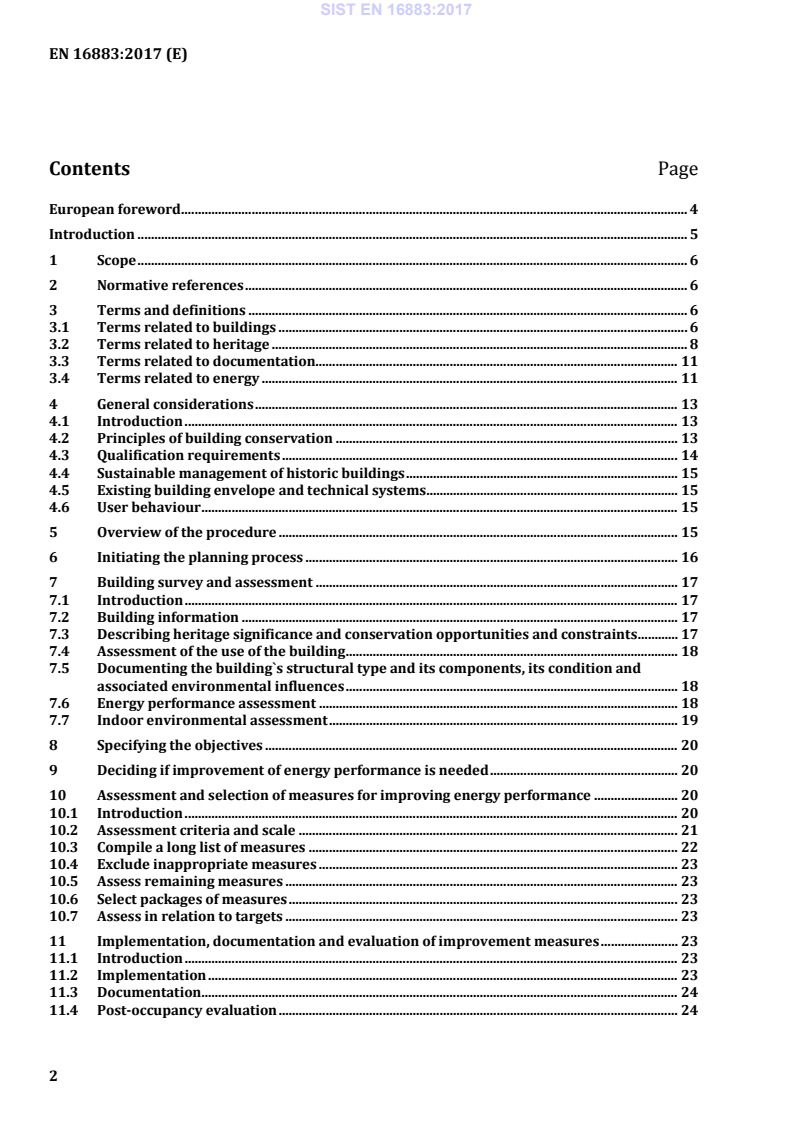
Example of template for building information . 25 A.1 Building information . 25 A.2 Legal information . 25 A.3 Building description . 25 A.4 Defining heritage significance and conservation opportunities and constraints . 26 A.5 Assessment of past and present use and intended future use . 26 A.6 Mapping building’s technical structure, condition and environmental influences . 26 A.7 Energy performance assessment . 27 A.8 Indoor environmental assessment . 27 A.9 Sources and management information. 27 Annex B (informative)
Example of assessment table . 28 Annex C (informative)
Alphabetical index of terms . 30 Bibliography . 31
Figure 1 — Flow chart showing the proposed procedure 6 Initiating the planning process The process should be seen in the wider context of refurbishments that are also driven by other forces. For example, if a building is refurbished due to its state of disrepair, or change of use, energy performance improvements should be made at the same time. The process should start with a clear indication of the general intentions of the client or owner of the building to the project leader. The project leader shall assemble the suitable project team (see 4.2). A joint site visit shall be carried out. Clear lines of cooperation shall be established at an early stage to identify who is responsible for each part of the assessment process and how information should be collected, analysed and presented. The decision-making progress shall be documented. Early dialogue with building control and planning authorities, and for heritage-designated buildings with heritage authorities (see 4.3), may be needed. Economic resources shall be identified at an early stage in the project. SIST EN 16883:2017
...